

|
시장보고서
상품코드
2117274
로봇 소프트웨어 플랫폼 시장 : 시장 점유율 분석, 업계 동향 및 통계, 성장 예측(2026-2031년)Robotic Software Platforms - Market Share Analysis, Industry Trends & Statistics, Growth Forecasts (2026 - 2031) |
||||||
 Mordor Intelligence
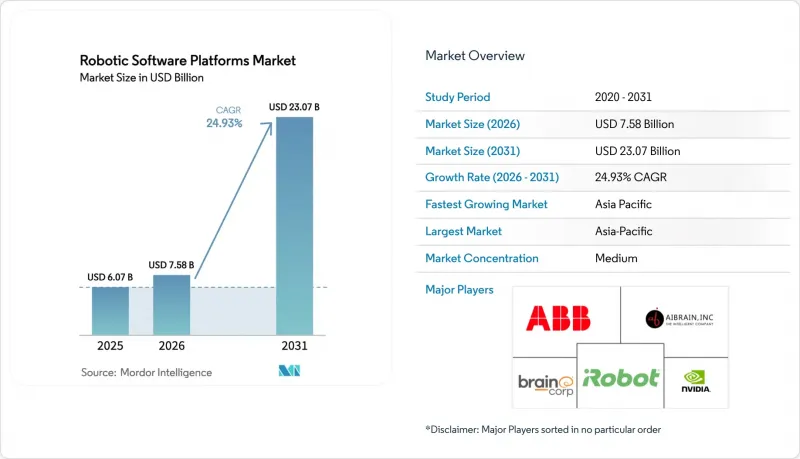
Mordor Intelligence에 의하면, 로봇 소프트웨어 플랫폼 시장 규모는 2025년에 60억 7,000만 달러로 평가되었고, 2026년 75억 8,000만 달러에서 2031년까지 230억 7,000만 달러에 이를 것으로 예측되며, 예측 기간(2026-2031년) CAGR은 24.93%를 나타낼 전망입니다.
본 보고서는 로봇 유형별(산업용 로봇, 서비스 로봇), 소프트웨어 유형별(커뮤니케이션 관리, 데이터 관리·분석, 기타), 배포 모델별(온프레미스, 클라우드 기반, 기타), 최종 사용자 산업별(자동차, 운송 및 물류, 기타), 지역별로 분류되어 있습니다. 시장 예측은 금액(달러) 기준으로 제시되어 있습니다.
세계의 로봇 소프트웨어 플랫폼 시장 동향 및 인사이트
급속히 보급되고 있는 로우코드형 로봇 프로그래밍 도구
ABB AppStudio의 2025년 출시에서 볼 수 있듯이, 드래그 앤 드롭 및 자연어 인터페이스를 통해 로봇 프로그래밍 시간을 최대 80% 단축할 수 있습니다. 이러한 보급으로 인해 2030년에 예상되는 210만 명의 제조업 인력 부족 문제에 대응할 수 있게 됩니다. 중견 제조업체의 경우, 필요한 전문 엔지니어 수가 감소함에 따라 비용 부담이 경감됩니다. 설정 속도가 빨라짐에 따라 투자 회수 기간이 단축되어, 과거에는 경제적 타당성이 부족했던 다품종 소량 생산 작업을 로봇이 처리할 수 있게 됩니다. 재사용 가능한 코드 블록을 통합한 벤더 덕분에 시운전에 소요되는 노력도 더욱 줄어듭니다. 그 결과, 구매자가 로봇 소프트웨어 플랫폼 후보를 선정할 때 로우코드 기능은 필수 요건이 되었습니다.
디바이스 상의 자율성을 가능하게 하는 산업용 엣지 AI
추론 처리를 클라우드에서 로봇 측으로 이전함으로써, 10밀리초 미만의 반응 시간이 필요한 용접 셀 등 안전성이 극히 중요한 환경에서 지연, 개인정보 보호, 신뢰성이 향상됩니다. 지멘스(Siemens)와 BYD 일렉트로닉스(BYD Electronics)가 NVIDIA의 아이작(Isaac) 플랫폼을 채택한 것은 지각 및 경로 계획용 엣지 GPU가 주류로 도입되고 있음을 반영합니다. 대역폭 비용 절감은 네트워크 연결이 불안정한 지역의 공장에 유익합니다. 또한 엣지 AI는 네트워크 장애 시 중복적인 페일세이프 작동을 지원하여, 생산의 연속성을 요구하는 보험 요건에도 부합합니다. 5G 네트워크가 성숙해짐에 따라 엣지 노드는 결정론적인 무선 링크를 확보하게 되어, 로봇 소프트웨어 플랫폼 시장에서 적응형 이동 로봇의 이용 사례를 더욱 확대할 것입니다.
데이터 상호 운용성을 저해하는 레거시 산업용 프로토콜
Modbus, Profibus, 독자 사양의 필드버스는 수십년전의 설비에 여전히 자리 잡고 있어, OPC UA 및 기타 최신 프레임워크와의 플러그 앤 플레이 연결을 방해하고 있습니다. 통합에는 대개 프로토콜 게이트웨이가 필요하며, 이로 인해 지연, 비용, 유지보수 오버헤드가 증가합니다. 여러 벤더의 생태계를 병행하여 운영하는 공장에서는 컨트롤러 간의 버전 일관성을 유지하는 데 어려움을 겪고 있습니다. 타임 센시티브 네트워킹(TSN)이 해결책으로 기대되고 있지만, 그 성숙도와 높은 가격 때문에 많은 기업이 여전히 시범 운영 단계에 머물러 있습니다. 그 결과, 브라운필드 현장에서는 프로젝트 일정이 장기화되고 통합 위험이 높아져, 로봇 소프트웨어 플랫폼 시장 전체의 보급이 둔화되고 있습니다.
부문 분석
2025년, 산업용 로봇은 로봇 소프트웨어 플랫폼 시장에서 53.20%의 점유율을 유지했습니다. 이는 자동차 및 전자 공장에서 결정론적 코드를 기반으로 수천 대의 다관절 암을 가동하고 있기 때문입니다. 한편, 서비스 로봇은 2031년까지 연평균 성장률(CAGR) 30.10%를 기록하며 기존 로봇을 크게 앞지르고 있습니다. 병원에서는 수술 지원 로봇 도입 대수를 확대하는 한편, 소매업체들은 재고 스캔 장치를 도입하여 품절로 인한 손실을 줄이고 있습니다. 존스 홉킨스 대학교 연구진은 수술용 로봇이 동영상을 보고 작업을 학습하도록 하는 데 성공하여, AI가 소프트웨어의 차별화를 어떻게 심화시키고 있는지를 보여주었습니다. 한편, BMW 등 자동차 제조업체들은 공장 내 물류 용도로 휴머노이드 로봇의 시범 운영을 진행하고 있어, 서비스 로봇과 산업용 로봇이라는 패러다임 간의 융합이 진행되고 있음을 보여줍니다.
서비스 로봇의 성장세는 고정된 동작 경로에 비해 적응형 지각과 인간과의 상호작용 알고리즘의 가치를 부각시키고 있습니다. 의료 분야의 구매자들은 적재 능력보다 시스템의 지능성을 중시하며, 클라우드 파이프라인을 통해 지속적으로 업데이트되는 플랫폼에 예산을 집중하고 있습니다. 산업 부문의 구매자들도 이에 부응하여, 자체 최적화되는 용접 경로와 같은 유사한 기능을 요구하고 있습니다. 따라서 로봇 소프트웨어 플랫폼 시장은 대량 생산 환경과 소량 생산 서비스 환경 모두를 지원할 수 있는 통합 플랫폼으로 전환되고 있습니다.
시뮬레이션 및 디지털 트윈 패키지는 하드웨어 구매 전에 셀 레이아웃의 위험을 줄일 수 있기 때문에 2025년 로봇 소프트웨어 플랫폼 시장 규모의 26.50%를 차지했습니다. 한편, 예측 유지보수 제품군은 가동 중단 시간 방지가 정량화 가능한 이점임이 입증됨에 따라 2031년까지 연평균 성장률(CAGR) 31.60%를 달성하고 있습니다. 진동, 온도, 전류 센서를 AI 모델에 통합함으로써 사업자는 고장 발생 전에 로봇을 정비할 수 있게 되어, 평균 고장 간격(MTBF)을 평균 15% 연장할 수 있습니다.
각 벤더사는 현재 고장 감지 정확도를 향상시키기 위해 합성 데이터를 생성하는 AI 탑재 디지털 트윈을 번들로 제공합니다. 유지보수 관련 인사이트력과 예비 부품 물류를 연계함으로써 창고 재고 수준을 최적화하고, 부서 간 비용 절감을 실현하고 있습니다. 독자적으로 개발한 비전 IP의 라이선스 비용 급등이 이익률을 압박하고 있기 때문에 소프트웨어 기업들은 오픈소스 또는 자체 개발 모델을 개발하고 있습니다. 엣지 네이티브 추론을 통해 가치는 중앙 집중식 분석에서 디바이스 상의 진단으로 더욱 이동하고 있습니다. 이러한 동향에 따라 예측 유지보수는 로봇 소프트웨어 플랫폼 시장에서 가장 빠르게 성장하는 부문으로서의 입지를 공고히 하고 있습니다.
지역별 분석
아시아태평양은 2025년에 전 세계 매출의 40.70%를 차지한 것으로 평가되었으며, 2031년까지 연평균 성장률(CAGR) 30.60%로 확대될 전망이어서, 이 지역의 제조업 집중도가 두드러지게 나타나고 있습니다. 중국의 1,380억 달러 규모 로봇 투자 공약은 현지 공급업체 생태계를 활성화시키고 있는 반면, 일본과 한국은 고령자 돌봄용 서비스 로봇에 투자하고 있습니다. 지방 자치 단체는 중소 수출 기업의 자동화를 지원하고 있으며, 이로 인해 로봇 소프트웨어 플랫폼 시장의 영향력이 2선 도시로 확대되고 있습니다.
북미에서는 AI 네이티브 스타트업에 대한 넉넉한 세액 공제와 견조한 벤처 자금 조달이 호재로 작용하고 있습니다. 엣지 아키텍처의 조기 도입으로 자동차, 항공우주, 물류 센터에서의 도입이 가속화되고 있습니다. 협동 로봇의 안전성에 관한 규제가 명확해짐에 따라, 통합업체들은 솔루션을 확대하기 위한 안정적인 틀을 확보하고 있습니다. 캐나다의 창고에서는 배터리 이용률과 통로 내비게이션을 최적화하는 차량 관리 소프트웨어가 도입되고 있으며, 이는 국경을 초월한 지식 이전의 증거가 되고 있습니다.
유럽에서는 ‘AI법’이 시행되어, 산업용 로봇은 데이터 출처와 설명 가능성을 문서화해야 하는 고위험 시스템으로 분류되고 있습니다. 규정 준수는 업무 부담을 증가시키지만 신뢰성을 높이는 결과로 이어지며, 현지 공급업체들은 규제가 더 엄격한 지역으로 수출할 때 이 점을 활용하고 있습니다. 중동부 유럽의 공장에서는 노동력 부족에 대처하기 위해 현대화가 진행되고 있는 반면, 스칸디나비아의 병원에서는 재활용 로봇이 도입되고 있습니다. 라틴아메리카, 중동 및 아프리카의 신흥 시장에서는 자본 제약을 회피하는 RaaS(Robot-as-a-Service) 모델이 채택되고 있으며, 로봇 소프트웨어 플랫폼 시장에서 지역별 수요원이 점차 다양화되고 있습니다.
기타 혜택
- 엑셀 형식 시장 예측(ME) 시트
- 3개월간의 애널리스트 지원
자주 묻는 질문
목차
제1장 서론
제2장 조사 방법
제3장 개요
제4장 시장 구도
제5장 시장 규모 및 성장 예측
제6장 경쟁 구도
제7장 시장 기회 및 향후 전망
AJY 26.09.01According to Mordor Intelligence, the robotic software platforms market size was valued at USD 6.07 billion in 2025 and estimated to grow from USD 7.58 billion in 2026 to reach USD 23.07 billion by 2031, at a CAGR of 24.93% during the forecast period (2026-2031).
This report is Segmented by Robot Type (Industrial Robots, Service Robots), Software Type (Communication Management, Data Management and Analytics and More), Deployment Model (On-Premises, Cloud-Based and More), End-User Industry (Automotive, Transportation and Logistics and More), and Geography. The Market Forecasts are Provided in Terms of Value (USD).
Global Robotic Software Platforms Market Trends and Insights
Accelerated Low-Code Robot Programming Tools
Drag-and-drop and natural-language interfaces cut robot programming time by up to 80%, as illustrated by ABB AppStudio's 2025 launch. The democratization addresses the 2.1 million manufacturing-talent gaps projected for 2030. Mid-market manufacturers gain affordability because fewer specialist engineers are needed. Faster configuration lowers payback periods, enabling robots to handle high-mix, low-volume tasks that once lacked economic justification. Vendors embedding reusable code blocks further shrink commissioning labour. Consequently, low-code capability becomes a must-have feature when buyers shortlist robotic software platforms market offerings.
Industrial-Edge AI Enabling On-Device Autonomy
Shifting inference from cloud to robot improves latency, privacy, and reliability in safety-critical settings such as welding cells that require sub-10 ms reaction windows. NVIDIA's Isaac platform adoption by Siemens and BYD Electronics reflects mainstream deployment of edge GPUs for perception and path planning. Reduced bandwidth costs help plants in regions with unstable connectivity. Edge AI also supports redundant fail-safe operation during network outages, aligning with insurance requirements for continuous production. As 5G networks mature, edge nodes gain deterministic wireless links, further broadening use cases for adaptive mobile robots inside the robotic software platforms market.
Legacy Industrial Protocols Slowing Data Interoperability
Modbus, Profibus, and proprietary fieldbuses remain entrenched in decades-old equipment, impeding plug-and-play connectivity with OPC UA and other modern frameworks. Integration often needs protocol gateways that add latency, cost, and maintenance overhead. Plants juggling multiple vendor ecosystems struggle to maintain version parity across controllers. Time-Sensitive Networking promises help, yet its maturity and price keep many firms in pilot mode. Consequently, brownfield sites experience elongated project schedules and higher integration risk, slowing overall robotic software platforms market adoption.
Other drivers and restraints analyzed in the detailed report include:
- Collaborative-Robot Safety Certifications Harmonizing Globally
- Robot-as-a-Service Uptake Among SMEs
- Scarcity of ROS2-Skilled Engineers
For complete list of drivers and restraints, kindly check the Table Of Contents.
Segment Analysis
Industrial robots retained 53.20% share of the robotic software platforms market in 2025 because automotive and electronics plants run thousands of articulated arms on deterministic code. However, service robots register a 30.10% CAGR through 2031, far ahead of traditional counterparts. Hospitals expand surgical-assistant fleets, while retailers deploy inventory-scanning units to trim stock-out losses. Johns Hopkins researchers trained surgical robots to learn tasks by watching videos, illustrating how AI deepens software differentiation. Meanwhile, automotive players such as BMW pilot humanoid robots for in-plant logistics, demonstrating convergence between service and industrial paradigms.
Service-robot momentum underscores the value of adaptive perception and human-interaction algorithms versus rigid motion paths. Healthcare buyers rank system intelligence over payload capacity, tilting budgets toward platforms that update continuously via cloud pipelines. Industrial buyers respond by requesting similar capabilities like self-optimizing weld paths. The robotic software platforms market thus shifts toward unified platforms that can support both high-volume manufacturing and low-volume service environments.
Simulation and digital-twin packages held a 26.50% slice of the robotic software platforms market size in 2025 because they de-risk cell layouts before hardware purchase. Yet predictive-maintenance suites are achieving a 31.60% CAGR through 2031 as downtime avoidance proves a quantifiable benefit. Integrating vibration, temperature, and current sensors into AI models lets operators service robot before failure, extending mean time between repair by 15% on average.
Vendors now bundle AI-powered twins that generate synthetic data to improve fault-detection accuracy. Coupling maintenance insights with spare-parts logistics optimizes warehouse stock levels, delivering cross-functional savings. Escalating licensing fees for proprietary vision IP squeeze margins, prompting software houses to develop open-source or home-grown models. Edge-native inference further shifts value from centralized analytics toward on-device diagnosis. These dynamics reinforce predictive maintenance as the fastest-growing slice of the robotic software platforms market.
Complete Report Scope:
- By Robot Type
- Industrial Robots
- Service Robots
- By Software Type
- Communication Management
- Data Management and Analytics
- Predictive Maintenance
- Recognition / Vision
- Simulation and Digital Twin
- By Deployment Model
- On-premises
- Cloud-based
- Edge-native
- By End-User Industry
- Automotive
- Transportation and Logistics
- Healthcare
- Retail and E-commerce
- Manufacturing (Discrete and Process)
- Government and Defense
- ICT and Data-Centers
- Other Verticals
- By Geography
- North America
- United States
- Canada
- Europe
- Germany
- France
- United Kingdom
- Italy
- Rest of Europe
- Asia-Pacific
- China
- Japan
- India
- South Korea
- Rest of Asia-Pacific
- South America
- Brazil
- Argentina
- Rest of South America
- Middle East and Africa
- Middle East
- Saudi Arabia
- UAE
- Turkey
- Africa
- South Africa
- Nigeria
- Rest of Africa
- Middle East
- North America
Geography Analysis
APAC generated 40.70% of global revenue in 2025 and is set to expand at a 30.60% CAGR through 2031, underscoring its manufacturing concentration. China's USD 138 billion robotic investment pledge catalyses local supplier ecosystems, while Japan and South Korea invest in service robotic for eldercare. Local governments subsidize automation for small exporters, broadening the robotic software platforms market footprint across tier-two cities.
North America benefits from generous tax credits and robust venture funding for AI-native startups. Early adoption of edge architectures supports deployments in automotive, aerospace, and fulfilment centers. Regulatory clarity on collaborative-robot safety gives integrators a stable framework to scale solutions. Canada's warehouses deploy fleet-management software that optimizes battery utilization and aisle navigation, evidence of cross-border knowledge transfer.
Europe enforces the AI Act, classifying industrial robots as high-risk systems that must document data provenance and explainability. Compliance adds workload yet raises trust, which local suppliers leverage when exporting to stricter jurisdictions. Central and Eastern European plants modernize to counter labour shortages, while Scandinavian hospitals adopt rehabilitation robots. Emerging markets in Latin America, the Middle East, and Africa adopt RaaS models that bypass capital constraints, slowly diversifying regional demand streams for the robotic software platforms market.
- ABB Ltd.
- AIBrain Inc.
- Brain Corp.
- CloudMinds Technology Inc.
- Cyberbotics Ltd.
- Energid Technologies Corp.
- Fanuc Corp.
- Furhat Robotics AB
- International Business Machines Corp.
- iRobot Corp.
- KUKA AG
- NVIDIA Corp.
- Neurala Inc.
- Realtime Robotics Inc.
- ADLINK Technology Inc.
- Robotic Systems Integration LLC
Additional Benefits:
- The market estimate (ME) sheet in Excel format
- 3 months of analyst support
TABLE OF CONTENTS
1 INTRODUCTION
- 1.1 Study Assumptions and Market Definition
- 1.2 Scope of the Study
2 RESEARCH METHODOLOGY
3 EXECUTIVE SUMMARY
4 MARKET LANDSCAPE
- 4.1 Market Overview
- 4.2 Market Drivers
- 4.2.1 Accelerated low-code robot programming tools
- 4.2.2 Industrial-edge AI enabling on-device autonomy
- 4.2.3 Collaborative-robot safety certifications harmonising globally
- 4.2.4 Robot-as-a-Service uptake among SMEs
- 4.2.5 Government tax credits for smart-factory software
- 4.2.6 Cyber-physical security mandates for critical infrastructure robots
- 4.3 Market Restraints
- 4.3.1 Legacy industrial protocols slowing data interoperability
- 4.3.2 Scarcity of ROS2-skilled engineers
- 4.3.3 Escalating licence costs for vision-AI IP cores
- 4.3.4 Pending EU AI Act liability exposure for autonomous systems
- 4.4 Value / Supply-Chain Analysis
- 4.5 Regulatory Landscape
- 4.6 Technological Outlook
- 4.7 Porter's Five Forces Analysis
- 4.7.1 Bargaining Power of Suppliers
- 4.7.2 Bargaining Power of Consumers
- 4.7.3 Threat of New Entrants
- 4.7.4 Threat of Substitute Products
- 4.7.5 Intensity of Competitive Rivalry
5 MARKET SIZE AND GROWTH FORECASTS (VALUE)
- 5.1 By Robot Type
- 5.1.1 Industrial Robots
- 5.1.2 Service Robots
- 5.2 By Software Type
- 5.2.1 Communication Management
- 5.2.2 Data Management and Analytics
- 5.2.3 Predictive Maintenance
- 5.2.4 Recognition / Vision
- 5.2.5 Simulation and Digital Twin
- 5.3 By Deployment Model
- 5.3.1 On-premises
- 5.3.2 Cloud-based
- 5.3.3 Edge-native
- 5.4 By End-User Industry
- 5.4.1 Automotive
- 5.4.2 Transportation and Logistics
- 5.4.3 Healthcare
- 5.4.4 Retail and E-commerce
- 5.4.5 Manufacturing (Discrete and Process)
- 5.4.6 Government and Defense
- 5.4.7 ICT and Data-Centers
- 5.4.8 Other Verticals
- 5.5 By Geography
- 5.5.1 North America
- 5.5.1.1 United States
- 5.5.1.2 Canada
- 5.5.2 Europe
- 5.5.2.1 Germany
- 5.5.2.2 France
- 5.5.2.3 United Kingdom
- 5.5.2.4 Italy
- 5.5.2.5 Rest of Europe
- 5.5.3 Asia-Pacific
- 5.5.3.1 China
- 5.5.3.2 Japan
- 5.5.3.3 India
- 5.5.3.4 South Korea
- 5.5.3.5 Rest of Asia-Pacific
- 5.5.4 South America
- 5.5.4.1 Brazil
- 5.5.4.2 Argentina
- 5.5.4.3 Rest of South America
- 5.5.5 Middle East and Africa
- 5.5.5.1 Middle East
- 5.5.5.1.1 Saudi Arabia
- 5.5.5.1.2 UAE
- 5.5.5.1.3 Turkey
- 5.5.5.2 Africa
- 5.5.5.2.1 South Africa
- 5.5.5.2.2 Nigeria
- 5.5.5.2.3 Rest of Africa
- 5.5.5.1 Middle East
- 5.5.1 North America
6 COMPETITIVE LANDSCAPE
- 6.1 Market Concentration
- 6.2 Strategic Moves
- 6.3 Market Share Analysis
- 6.4 Company Profiles (includes Global-level Overview, Market-level Overview, Core Segments, Financials as available, Strategic Information, Market Rank/Share, Products and Services, Recent Developments)
- 6.4.1 ABB Ltd.
- 6.4.2 AIBrain Inc.
- 6.4.3 Brain Corp.
- 6.4.4 CloudMinds Technology Inc.
- 6.4.5 Cyberbotics Ltd.
- 6.4.6 Energid Technologies Corp.
- 6.4.7 Fanuc Corp.
- 6.4.8 Furhat Robotics AB
- 6.4.9 International Business Machines Corp.
- 6.4.10 iRobot Corp.
- 6.4.11 KUKA AG
- 6.4.12 NVIDIA Corp.
- 6.4.13 Neurala Inc.
- 6.4.14 Realtime Robotics Inc.
- 6.4.15 ADLINK Technology Inc.
- 6.4.16 Robotic Systems Integration LLC
7 MARKET OPPORTUNITIES AND FUTURE OUTLOOK
- 7.1 White-space and Unmet-need Assessment


