

|
시장보고서
상품코드
2117286
추력 벡터 제어 시장 : 시장 점유율 분석, 업계 동향 및 통계, 성장 예측(2026-2031년)Thrust Vector Control - Market Share Analysis, Industry Trends & Statistics, Growth Forecasts (2026 - 2031) |
||||||
 Mordor Intelligence
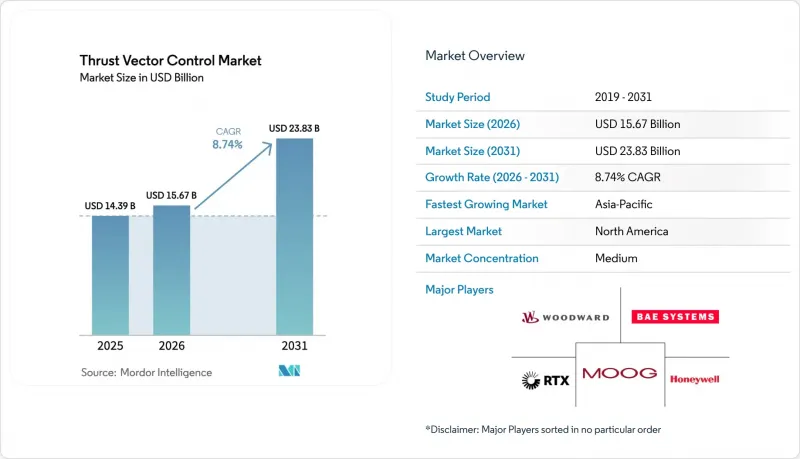
Mordor Intelligence에 의하면, 추력 벡터 제어 시장 규모는 2025년 143억 9,000만 달러로 평가되었고, 2026년에는 156억 7,000만 달러로 추정되고, 2026-2031년 CAGR 8.74%로 성장을 지속할 전망이며, 2031년까지 238억 3,000만 달러에 이를 것으로 예측됩니다.
본 보고서는 용도별(발사 로켓, 위성, 미사일, 전투기), 최종 사용자별(국방, 우주 기관), 기술별(짐벌 노즐, 플렉스 노즐, 스러스트, 회전 노즐), 지역별(북미, 유럽, 아시아태평양, 남미, 중동 및 아프리카)로 분류되어 있습니다. 시장 예측은 금액(달러) 기준으로 제시되어 있습니다.
세계의 추력 벡터 제어 시장 동향 및 인사이트
발사 로켓 발사 빈도 증가와 소형 위성 수요
2024년에 전 세계 발사 업무는 사상 최고 수준에 도달했으며, 이후 2025년에 걸쳐 더욱 가속화되었습니다. SpaceX는 165회의 궤도 투입 임무를 수행하여 미국 활동의 대부분을 차지했을 뿐만 아니라, 1단 및 2단 시스템 전체에 걸쳐 추력 벡터 제어 시스템과 예비 부품에 대한 꾸준한 수요를 견인했습니다. 중국의 민간 발사 기업들은 메탄을 연료로 하는 재사용형 로켓 개발을 추진하고 있으며, 2025년과 2026년에 설정된 프로그램의 주요 단계는 액추에이터의 가동 주기와 지상 정비 작업을 증가시키는 재사용형 플랫폼으로의 지역 전반에 걸친 전환을 시사하고 있습니다. 재사용성이 향상됨에 따라 비행 후 점검 및 부품 개조가 증가하고 있으며, 발사 빈도가 높아지고 로켓 군이 노후화됨에 따라 추력 벡터 제어 시스템 공급업체의 수명 주기 가치가 높아지고 있습니다. ‘프로젝트 카이퍼’와 같은 대규모 위성 군집 계획에서는 여러 공급업체에 발사 슬롯이 확보되어 있으며, 이로 인해 궤도면으로의 위성 배치를 신속하게 수행하기 위해 사용되는 대형 및 중형 로켓 모두에서 벡터링용 하드웨어에 대한 장기적인 수요가 뒷받침되고 있습니다. 이러한 규모 확대에 따라 액추에이터의 응답성 및 내열성에 대한 요구 사항이 더욱 엄격해지고 있으며, 특히 재사용 운용 시 신속한 재점화 및 정밀 착륙 조작에서 이러한 경향이 두드러집니다. 추력 벡터 제어 시장은 이러한 속도 주도형 확장의 혜택을 받고 있습니다. 비행 빈도 증가와 재비행 목표 설정으로 인해 도입 대수, 유지보수 주기, 장기적인 디지털 제어 업그레이드 수요가 증가하기 때문입니다.
주요 국방 예산 내 미사일 부대의 현대화
탄약 및 미사일 방어 재자본화 프로그램은 다년간에 걸친 조달과 생산 능력 확장을 통해 규모를 확대하고 있으며, 방공, 순항 미사일, 요격 미사일 각 부문에서 유도, 제어, 추력 벡터링 하위 시스템에 대한 안정적인 수요를 창출하고 있습니다. 2024년에는 전 세계 군사 지출이 대폭 증가할 전망이며, 2025년과 2026년 공공 예산에서는 원거리 공격, 통합 방공·미사일 방어, 장거리 화력 등이 우선순위로 지정됨에 따라 작동 장치와 제어 전자 장비에 대한 수요가 견인되고 있습니다. 일본은 2026년도 예산으로 사상 최대 규모의 국방 예산을 승인하고, 국산 ‘12형’ 대함 미사일을 포함한 장거리 미사일 능력에 막대한 자금을 배정했습니다. 이에 따라 각 생산 로트에 걸쳐 벡터링, 핀 작동, 제어 장치에 대한 수요가 유지되고 있습니다. 주요 계약업체들은 핵심 탄약 생산을 가속화하기 위해 기본 협정을 공식적으로 체결했으며, 여러 생산 라인에서 연간 수천 개에 달하는 생산 목표가 설정되었습니다. 이에 따라 공급업체의 금형 정비, 인력 확충, 추력 벡터 제어 부품에 대한 장기 조달 계약이 지원되고 있습니다. 이러한 조달 속도는 액추에이터 및 제어 카드의 모듈성과 공통 인터페이스의 가치를 부각시키고 있으며, 재설계를 최소화하면서 미사일 제품군 간 적용을 가능하게 함으로써 인증 주기를 단축하고 장기적으로 단가를 절감합니다. 이러한 현대화의 물결이 이어지는 가운데, 추력 벡터 제어 시장은 신규 프로젝트는 물론, 새로운 사거리, 기동성, 생존성 요건을 충족하기 위해 기존 재고를 업그레이드하는 개량 프로그램 모두를 통해 성장을 이루고 있습니다.
높은 인증 및 승인 비용
유인 우주 비행 및 국가 안보 프로그램에는 엄격한 기준이 적용되어, 추력 벡터 제어 시스템에 대해 광범위한 검증 및 타당성 확인 시험이 요구됩니다. 이로 인해 개발에 추가적인 시간과 비용이 소요됩니다. NASA 항공우주 안전 자문위원회는 개발 프로그램의 구조적·프로세스적 과제를 지적하며, 강력한 시스템 엔지니어링 감독과 안전 보증의 필요성을 강조했습니다. 이는 복잡한 작동 및 제어 요소의 비용 증가와 인증 지연으로 이어질 수 있습니다. 상업용 화물 및 승무원 프로그램에서는 하드웨어와 소프트웨어의 통합, 텔레메트리, 장애 관리에 대해 엄격한 요건이 부과되고 있으며, 그 결과 추력 벡터 제어 구성 요소에 관한 상세한 문서 및 인증 관련 자료의 작성이 필요합니다. 상업 유인 우주 비행에 대한 FAA(연방항공청)의 감독은 안전 프로세스의 추가 단계, 사고 조사 요건, 비행 재개 조건을 추가하며, 이는 추력 벡터링 시스템 및 관련 명령 소프트웨어에 영향을 미칩니다. 이러한 요구 사항들이 합쳐지면 대규모 규정 준수 팀을 보유하지 않은 중소 공급업체에게는 부담이 되며, 이미 성숙한 품질 시스템과 인증 프로세스를 유지하고 있는 주요 기업과의 제휴를 촉진하게 됩니다. 그 결과, 기존 기업들은 고신뢰성 프로그램 수주에서 우위를 차지하는 반면, 신규 진출기업들은 양산에 들어가기 전에 막대한 비반복적 엔지니어링 및 인증 작업에 자금을 투자해야 합니다. 이러한 막대한 비용은 추력 벡터 제어 시장에 대한 광범위한 진입에 구조적인 걸림돌이 되고 있습니다.
부문 분석
2025년, 추력 벡터 제어 시장 점유율의 48.73%를 발사 로켓이 차지했습니다. 이는 재사용형 부스터 기단과 빈번한 위성 군집 전개가 주도한 결과입니다. 재사용성 향상으로 인해 기체당 유지보수 주기 수가 증가함에 따라, 액추에이터 및 벡터링 하드웨어에 대한 전체 수명 주기 동안 수요가 증가하고 있습니다. 2025년 미국의 높은 발사 빈도는 반복되는 착륙과 신속한 재점화 과정에서 액추에이터의 신뢰성이 필수적임을 여실히 보여주었습니다. 중국에서 진행 중인 회수 가능한 메탄 로켓의 병행 개발은 견고해진 TVC 액추에이터와 제어 전자 기기에 대한 다지역에 걸친 비즈니스 기회를 시사하고 있습니다. 이러한 동향은 도입 대수를 증가시키고, 예측 유지보수 솔루션 및 추력 벡터 제어 하위 시스템 전체의 건전성 모니터링을 위한 텔레메트리 통합을 더욱 촉진하고 있습니다.
위성은 가장 빠르게 성장하는 용도 분야이며, 위성용 추력 벡터 제어 시장 규모는 2026-2031년 연평균 성장률(CAGR) 10.68%로 확대될 것으로 예측됩니다. 궤도 상승, 궤도 유지, 충돌 회피로 인해 제어 추진기 및 고정밀 액추에이터에 대한 수요가 주도되고 있습니다. 운행 중인 우주선 증가에 따라 반응 제어 시스템 및 소형 추진기 수요도 높아지고 있습니다. 유인 우주 비행의 물류 및 화물 수송선 역시 랑데부 및 도킹 조작과 관련된 벡터링 기능에 영향을 미치고 있습니다. 위성 대수가 증가함에 따라 벡터링 구성 요소의 표준화 및 모듈화를 통해 공통 예비 부품의 활용과 총소유비용(TCO) 절감이 촉진되고 있어, 위성 군의 갱신 및 확장을 검토 중인 운영 사업자에게 더 큰 가치를 제공합니다.
지역별 분석
북미는 2025년 추력 벡터 제어 시장에서 46.38%의 점유율을 유지했습니다. 이는 대규모 방위 산업 기반, 막대한 연구 및 조달 지출, 민간 공급업체가 주도하는 세계 최고의 궤도 투입 빈도에 의해 뒷받침되고 있습니다. 스페이스X는 2025년에 165회의 궤도 발사를 실시하며 재사용형 1단 로켓의 도입 기반을 확대했습니다. 이는 액추에이터에 대한 엄격한 유지보수와 빈번한 점검이 필요하기 때문에 전기 기계식 서브시스템 및 짐벌 유닛에 대한 지속적인 수요를 뒷받침하고 있습니다. 2026년 미국의 방위 조달에서는 미사일 방어, 장거리 공격, 초음속 기술 개발에 중점을 두고 있어, 핀 구동 장치 및 노즐 벡터링 장치에 대한 수주가 지속되고 있습니다. NASA 프로그램과 민간 화물 운송 사업은 계속해서 공급업체의 로드맵을 뒷받침하고 있습니다. 2025년 하반기에 ‘드림 체이서’가 달성한 비행 전 이정표는 첫 궤도 운용을 향한 진전을 보여주고 있으며, 이를 위해서는 궤도 상에서의 기동 및 재진입 시 안정성을 확보하기 위한 신뢰성 높은 추력 벡터링이 요구됩니다.
아시아태평양은 가장 빠른 성장률을 나타낼 것으로 예상되며, 이 지역의 추력 벡터 제어 시장은 2031년까지 연평균 성장률(CAGR) 9.77%로 성장할 전망입니다. 각국의 프로그램은 재사용형 발사체, 군용 재고, 국가 위성 군집에 중점을 두고 있습니다. 중국의 민간 기업들은 수직 회수 기술의 진전과 2026년까지의 궤도 시험 비행 계획을 보고하고 있으며, 이는 견고한 추력 벡터링 시스템에 대한 수요를 시사합니다. 일본의 2026년도 방위 예산은 사상 최고액을 기록했으며, 스탠드오프 미사일 능력과 국산화에 중점을 두고 있어 핀 작동 장치 및 노즐 벡터링 부품에 대한 수요가 증가하고 있습니다.
유럽에서는 우주 부문의 회복탄력성과 이중용도 능력에 대한 투자가 계속되고 있어, 발사, 위성, 방위용도에 걸친 추력 벡터 제어 공급업체들에게 기회가 창출되고 있습니다. 유럽우주국(ESA)은 항법 및 복원력에 관한 이니셔티브를 추진하고 있는 반면, 각 제조업체들은 시험 캠페인을 지원하기 위해 재사용형 로켓의 착륙 다리와 벡터링 시스템용 하드웨어를 공급했습니다. 중동 및 아프리카에서는 국방비 증가와 우주 부문에 대한 관심이 높아지면서 벡터링 및 제어 솔루션의 잠재적 시장 확대에 기여하고 있으며, 이는 지역 조달 프로그램과 새로운 위성 이니셔티브에 의해 뒷받침되고 있습니다.
기타 혜택
- 엑셀 형식 시장 예측(ME) 시트
- 3개월간의 애널리스트 지원
자주 묻는 질문
목차
제1장 서론
제2장 조사 방법
제3장 개요
제4장 시장 구도
제5장 시장 규모 및 성장 예측
제6장 경쟁 구도
제7장 시장 기회 및 향후 전망
AJY 26.09.01According to Mordor Intelligence, the thrust vector control market size is expected to grow from USD 14.39 billion in 2025 to USD 15.67 billion in 2026 and is forecasted to reach USD 23.83 billion by 2031 at an 8.74% CAGR over 2026-2031.
This report is Segmented by Application (Launch Vehicles, Satellites, Missiles, and Combat Aircraft), End User (Defense and Space Agencies), Technology (Gimbal Nozzle, Flex Nozzle, Thrusters, and Rotating Nozzle), and Geography (North America, Europe, Asia-Pacific, South America, and Middle East and Africa). The Market Forecasts are Provided in Terms of Value (USD).
Global Thrust Vector Control Market Trends and Insights
Rising Launch-Vehicle Cadence and Small-Sat Demand
Global launch operations scaled to record levels in 2024 and then accelerated through 2025, with SpaceX conducting 165 orbital missions that accounted for the bulk of US activity and driving steady demand for thrust vector control systems and spares across first- and second-stage systems. Chinese commercial launch firms advanced reusable methane-fueled vehicles, and program milestones set in 2025 and 2026 signaled a region-wide shift toward reusable platforms that intensify actuator duty cycles and ground turnaround work. Reusability has increased post-flight inspections and component refurbishment, which increases the lifetime value for thrust vector control providers as launch frequency rises and fleets age. Large constellation programs such as Project Kuiper have booked launch capacity across multiple providers, which underpins long-range demand for vectoring hardware on both heavy-lift and medium-lift vehicles used to seed orbit planes at pace. This scale introduces more exacting requirements for actuator responsiveness and thermal resilience, especially for rapid relight and precision landing maneuvers in reusable operations. The thrust vector control market benefits from this cadence-driven expansion because higher flight rates and reflight targets increase the installed base, the maintenance loop, and the need for digital control upgrades over time.
Missile Fleet Modernization in Major Defense Budgets
Munitions and missile defense recapitalization programs are scaling through multi-year procurements and capacity expansions, creating stable demand for guidance, control, and thrust vectoring subsystems across air defense, cruise missiles, and interceptors. Global military expenditure rose meaningfully in 2024, and public budgets in 2025 and 2026 have prioritized standoff strike, integrated air and missile defense, and long-range fires, which pull through actuation hardware and control electronics. Japan approved its largest defense budget to date for fiscal 2026, allocating significant funds to standoff missile capability, including domestic Type-12 surface-to-ship missiles, which sustains demand for vectoring, fin actuation, and control units across production lots. Prime contractors have formalized framework agreements to accelerate output of critical munitions, with production targets reaching into the thousands per year across multiple lines, supporting supplier tooling, workforce expansion, and long-lead material contracts for thrust vector control components. This procurement tempo underscores the value of modularity and common interfaces for actuators and control cards, enabling adaptation across families of missiles with minimal redesign, thereby shortening qualification cycles and reducing unit cost over time. As these modernization waves continue, the thrust vector control market captures growth from both new starts and retrofit programs that upgrade legacy inventories to meet new range, maneuverability, and survivability requirements.
High Qualification and Certification Cost
Human spaceflight and national security programs impose rigorous standards, driving extensive verification and validation test campaigns for propulsion vectoring systems that add time and expense to development. NASA's Aerospace Safety Advisory Panel highlighted structural and process challenges in developmental programs, reinforcing the need for strong systems engineering oversight and safety assurance, which can increase cost and delay certification for complex actuation and control elements. Commercial cargo and crew programs impose strict requirements on hardware and software integration, telemetry, and fault management, resulting in detailed documentation and qualification artifacts for thrust vector control components. FAA oversight in commercial human spaceflight adds another layer of safety processes, mishap review requirements, and return-to-flight conditions that affect propulsion vectoring systems and associated command software. These combined demands can stress smaller suppliers that lack large compliance teams, prompting them to partner with primes that already maintain mature quality systems and certification pathways. As a result, incumbents have an advantage in capturing high-assurance programs, while challengers must fund significant non-recurring engineering and qualification work before entering serial production. This cost intensity acts as a structural headwind for broad-based entry in the thrust vector control market.
Other drivers and restraints analyzed in the detailed report include:
- Reusable Rockets Amplifying TVC Maintenance Cycles
- Commercial Space-Tourism and Private Crewed-Mission Boom
- Stringent Reliability/Safety Thresholds in Human-Rated Flight
For complete list of drivers and restraints, kindly check the Table Of Contents.
Segment Analysis
Launch vehicles accounted for 48.73% of the thrust vector control market share in 2025, driven by reusable booster fleets and high-cadence constellation deployments. Reusability has increased lifecycle demand for actuators and vectoring hardware by enabling more maintenance cycles per vehicle. High launch rates in the US in 2025 highlighted the need for actuator reliability across repeated landings and rapid relights. Parallel developments in China with recoverable methane vehicles indicate a multi-regional opportunity for ruggedized TVC actuation and control electronics. These trends enhance the installed base, supporting predictive maintenance solutions and deeper integration of telemetry for health monitoring across thrust vector control subsystems.
Satellites are the fastest-growing application, with the thrust vector control market size for satellites projected to grow at a 10.68% CAGR from 2026 to 2031. Orbit-raising, station-keeping, and collision avoidance drive unit demand for control thrusters and precise actuation. The increasing number of active spacecraft boosts the need for reaction control systems and small thrusters. Human spaceflight logistics and cargo vehicles also influence vectoring content tied to rendezvous and docking maneuvers. As satellite volumes grow, standardization and modularity in vectoring components support common spares and lower total cost of ownership, strengthening the value proposition for operators renewing or expanding fleets.
Complete Report Scope:
- By Application
- Launch Vehicles
- Satellites
- Missiles
- Combat Aircraft
- By End User
- Defense
- Space Agencies
- By Technology
- Gimbal Nozzle
- Flex Nozzle
- Thrusters
- Rotating Nozzle
- By Geography
- North America
- United States
- Canada
- Mexico
- Europe
- United Kingdom
- France
- Germany
- Russia
- Rest of Europe
- Asia-Pacific
- China
- Japan
- India
- Australia
- Rest of Asia-Pacific
- South America
- Brazil
- Rest of South America
- Middle East and Africa
- Middle East
- United Arab Emirates
- Saudi Arabia
- Rest of Middle East
- Africa
- South Africa
- Rest of Africa
- Middle East
- North America
Geography Analysis
North America retained 46.38% of the thrust vector control market share in 2025, supported by a large defense industrial base, high research and procurement outlays, and the world's highest orbital cadence led by commercial providers. SpaceX executed 165 orbital launches in 2025 and widened the installed base of reusable first stages, which require rigorous actuator maintenance and frequent inspections, thereby supporting recurring demand for electromechanical subsystems and gimbal units. The US defense procurement in 2026 focuses on missile defense, standoff strike, and hypersonic development, sustaining orders for fin actuation and nozzle vectoring. NASA programs and commercial cargo initiatives continue to anchor supplier roadmaps, as Dream Chaser's pre-flight milestones in late 2025 signaled progress toward first orbital operations, which require reliable vectoring for orbital maneuvering and reentry stability.
Asia-Pacific is projected to register the fastest growth, with the thrust vector control market in the region expanding at a 9.77% CAGR through 2031. National programs focus on reusable launch vehicles, military inventories, and sovereign satellite constellations. Chinese commercial firms reported progress on vertical recovery and planned orbital test flights through 2026, signaling demand for ruggedized vectoring systems. Japan's record defense budget for fiscal 2026 emphasizes standoff missile capability and domestic production, elevating the need for fin actuation and nozzle vectoring content.
Europe continues to invest in space resilience and dual-use capabilities, creating opportunities for thrust vector control suppliers across launch, satellites, and defense applications. The European Space Agency advanced navigation and resilience efforts, while manufacturers delivered hardware for reusable-launcher landing legs and vectoring systems to support test campaigns. In the Middle East and Africa, defense spending growth and ambitions in space contribute to a rising addressable base for vectoring and control solutions, supported by regional procurement programs and new satellite initiatives.
- Honeywell International Inc.
- Moog Inc.
- RTX Corporation
- Woodward, Inc.
- BAE Systems plc
- SABCA SA
- JASC Corporation
- Wickman Spacecraft & Propulsion Company
- Northrop Grumman Corporation
- Lockheed Martin Corporation
- Space Exploration Technologies Corp.
- Nammo AS
- IHI Corporation
- Safran S.A.
- Israel Aerospace Industries Ltd.
- Almatech SA
- Sierra Space Corporation
Additional Benefits:
- The market estimate (ME) sheet in Excel format
- 3 months of analyst support
TABLE OF CONTENTS
1 INTRODUCTION
- 1.1 Study Assumptions and Market Definition
- 1.2 Scope of the Study
2 RESEARCH METHODOLOGY
3 EXECUTIVE SUMMARY
4 MARKET LANDSCAPE
- 4.1 Market Overview
- 4.2 Market Drivers
- 4.2.1 Rising launch-vehicle cadence and small-sat demand
- 4.2.2 Missile fleet modernization in major defense budgets
- 4.2.3 Reusable rockets amplifying TVC maintenance cycles
- 4.2.4 Hypersonic weapons race among the US, China, and Russia
- 4.2.5 Commercial space-tourism and private crewed-mission boom
- 4.2.6 Transition from hydraulic to all-electric actuators
- 4.3 Market Restraints
- 4.3.1 High qualification and certification cost
- 4.3.2 Stringent reliability/safety thresholds in human-rated flight
- 4.3.3 Supply bottlenecks in high-temperature composite nozzles
- 4.3.4 Tightening export-control regimes on dual-use propulsion tech
- 4.4 Value Chain Analysis
- 4.5 Regulatory Outlook
- 4.6 Technological Outlook
- 4.7 Porter's Five Forces Analysis
- 4.7.1 Bargaining Power of Suppliers
- 4.7.2 Bargaining Power of Buyers/Consumers
- 4.7.3 Threat of New Entrants
- 4.7.4 Threat of Substitute Products
- 4.7.5 Intensity of Competitive Rivalry
5 MARKET SIZE AND GROWTH FORECASTS (VALUE)
- 5.1 By Application
- 5.1.1 Launch Vehicles
- 5.1.2 Satellites
- 5.1.3 Missiles
- 5.1.4 Combat Aircraft
- 5.2 By End User
- 5.2.1 Defense
- 5.2.2 Space Agencies
- 5.3 By Technology
- 5.3.1 Gimbal Nozzle
- 5.3.2 Flex Nozzle
- 5.3.3 Thrusters
- 5.3.4 Rotating Nozzle
- 5.4 By Geography
- 5.4.1 North America
- 5.4.1.1 United States
- 5.4.1.2 Canada
- 5.4.1.3 Mexico
- 5.4.2 Europe
- 5.4.2.1 United Kingdom
- 5.4.2.2 France
- 5.4.2.3 Germany
- 5.4.2.4 Russia
- 5.4.2.5 Rest of Europe
- 5.4.3 Asia-Pacific
- 5.4.3.1 China
- 5.4.3.2 Japan
- 5.4.3.3 India
- 5.4.3.4 Australia
- 5.4.3.5 Rest of Asia-Pacific
- 5.4.4 South America
- 5.4.4.1 Brazil
- 5.4.4.2 Rest of South America
- 5.4.5 Middle East and Africa
- 5.4.5.1 Middle East
- 5.4.5.1.1 United Arab Emirates
- 5.4.5.1.2 Saudi Arabia
- 5.4.5.1.3 Rest of Middle East
- 5.4.5.2 Africa
- 5.4.5.2.1 South Africa
- 5.4.5.2.2 Rest of Africa
- 5.4.5.1 Middle East
- 5.4.1 North America
6 COMPETITIVE LANDSCAPE
- 6.1 Market Concentration
- 6.2 Strategic Moves
- 6.3 Market Share Analysis
- 6.4 Company Profiles (includes Global level Overview, Market level overview, Core Segments, Financials as available, Strategic Information, Market Rank/Share for key companies, Products and Services, and Recent Developments)
- 6.4.1 Honeywell International Inc.
- 6.4.2 Moog Inc.
- 6.4.3 RTX Corporation
- 6.4.4 Woodward, Inc.
- 6.4.5 BAE Systems plc
- 6.4.6 SABCA SA
- 6.4.7 JASC Corporation
- 6.4.8 Wickman Spacecraft & Propulsion Company
- 6.4.9 Northrop Grumman Corporation
- 6.4.10 Lockheed Martin Corporation
- 6.4.11 Space Exploration Technologies Corp.
- 6.4.12 Nammo AS
- 6.4.13 IHI Corporation
- 6.4.14 Safran S.A.
- 6.4.15 Israel Aerospace Industries Ltd.
- 6.4.16 Almatech SA
- 6.4.17 Sierra Space Corporation
7 MARKET OPPORTUNITIES AND FUTURE OUTLOOK
- 7.1 White-space and Unmet-need Assessment


