|
시장보고서
상품코드
2117300
비타민 D 검사 : 시장 점유율 분석, 업계 동향과 통계, 성장 예측(2026-2031년)Vitamin D Testing - Market Share Analysis, Industry Trends & Statistics, Growth Forecasts (2026 - 2031) |
||||||
 Mordor Intelligence
Mordor Intelligence에 따르면 비타민 D 검사 시장 규모는 2025년 10억 4,000만 달러에서 2026년에는 11억 3,000만 달러로 확대되고, 2026년부터 2031년까지 CAGR 8.21%를 기록하며 2031년에는 16억 7,000만 달러에 달할 것으로 예측됩니다.
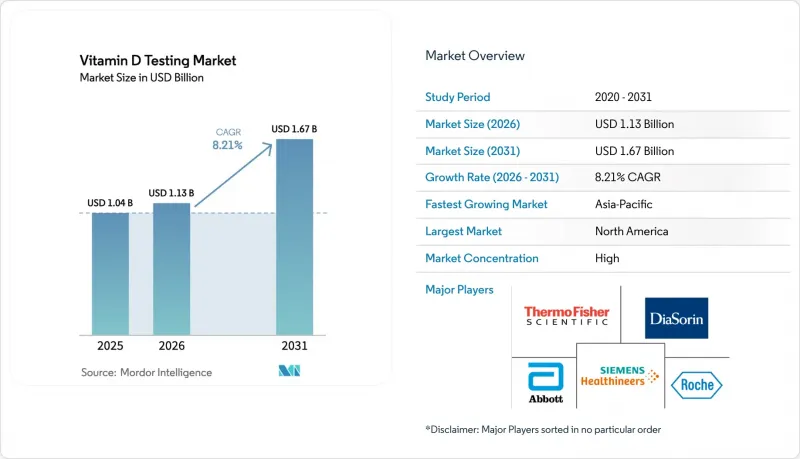
본 보고서는 제품 유형(시약·키트, 기기, 서비스), 기술(LC-MS/MS, 화학발광 면역분석법, ELISA, 방사면역분석법, 기타), 최종사용자(진단 검사실, 병원·진료소 등), 검체 유형(혈청·혈장, 전혈 등), 및 지역(북미, 유럽 등)별로 분류되어 있습니다. 시장 전망은 금액(달러) 기준으로 제시되어 있습니다.
세계 비타민 D 검사 시장의 동향 및 인사이트
비타민 D 결핍증 진단 건수의 증가
약 10억 명이 비타민 D 결핍 상태에 있으며, 그 유병률은 아프리카계 미국인의 경우 82.1%, 라틴계 커뮤니티에서는 69.2%까지 급증하고 있습니다. 2024년 내분비학회가 발표한 임상 지침에서는 고위험 집단에 대한 정확한 검사 기준이 마련되었으나, 이는 보편적인 선별 검사를 자제하도록 권장하는 한편, 역설적으로 대상 집단을 좁힌 수요를 확대하는 결과를 낳았습니다. 의료 서비스 제공자들은 당뇨병, 심혈관질환, 골다공증 등의 만성 질환 관리 프로그램에 비타민 D 평가를 점점 더 많이 포함시키고 있으며, 이것이 비타민 D 검사 시장의 성장을 뒷받침하고 있습니다. 고령화, 도시 생활에서의 일광 노출 부족, 흡수 장애 등의 요인이 복합적으로 작용하여 많은 지역에서 체계적인 선별 검사가 더욱 강화되고 있습니다. 식품 강화 프로그램과 관련된 정부의 감독도 안정적인 검사 수요의 원천이 되고 있으며, 공중보건의 우선순위가 검사 수요로 이어지고 있습니다.
예방 의료 및 정기 검진으로의 전환
가치 기반 보상 모델은 조기 발견을 촉진하고 있으며, 비타민 D 측정은 메디케어 어드밴티지 플랜(Medicare Advantage Plan)과 증가 추세에 있는 민간 보험사의 예방 건강 검진에서 일상적인 지표로 자리 잡고 있습니다. 소비자 직접 검사(DTC)에 대한 지출은 2033년까지 90억 달러를 넘어설 것으로 예상되며, 소비자는 의사의 중재 없이 검사를 의뢰할 수 있는 전례 없는 권한을 갖게 될 것입니다. 고용주는 기업 웰니스 대시보드에 비타민 D 추적 기능을 통합하고 직원의 정기적인 모니터링을 장려함으로써 예측 가능한 검사 건수를 창출하고 있습니다. 노인 돌봄 프로그램에서는 낙상 예방 대책에 비타민 D 결핍 검사가 포함되어, 보충제 섭취 계획의 준수가 촉진되고 있습니다. 이러한 행동적 및 정책적 변화가 결합되어 비타민 D 검사 시장의 지속적인 확장을 뒷받침하고 있습니다.
웰니스 검사 패키지로 인한 가격 압박
검사 건수에 기반한 계약으로 인해, 보험사는 비타민 D를 포함한 종합적인 대사 스크리닝 검사를 단일 통합 가격으로 환급하게 되어, 개별 검사 항목의 이익률이 압박받고 있습니다. 전국 규모의 통합 검사 기관은 규모의 경제를 활용할 수 있지만, 지역 독립 검사 기관은 대개 낮은 환급액을 감수해야 하며, 공급업체와의 계약 재협상을 피할 수 없습니다. 소비자 대상 플랫폼 역시 이러한 압박을 반영하여 시장 점유율 확대를 위해 다항목 검사 패널을 할인된 가격으로 판매하고 있어, 비타민 D 검사 시장의 가격 경쟁을 심화시키고 있습니다. 대기업들은 워크플로우 자동화 및 알레르기 검사·호르몬 검사 패널의 교차 판매를 통해 이에 대응하며 수익성을 유지하고 있습니다.
부문 분석
비타민 D 검사 시장의 서비스 부문은 병원의 아웃소싱 및 기준 검사 기관의 통합에 힘입어 2031년까지 연평균 성장률(CAGR) 8.87%로 확대되었습니다. 시약 및 키트는 2025년에도 여전히 비타민 D 검사 시장의 45.05% 점유율을 차지했지만, 자동화 시스템에서는 검사 1회당 소모품 사용량이 감소함에 따라 그 이익률은 축소되었습니다. 장비 부문은 매출 비중이 가장 작지만, 분석기 1대가 도입될 때마다 공급업체의 수익성을 뒷받침하는 장기적인 시약의 지속적인 수익원이 확립됩니다. 자동화에 대한 투자가 어려운 검사 기관은 전문적인 비타민 D 검사 패널을 서비스 제공업체에 위탁하는 사례가 증가하고 있으며, 이로 인해 서비스 부문의 성장세가 더욱 강화되고 있습니다. 퀘스트 다이아그노스틱스(Quest Diagnostics)의 10억 달러 규모 라이프랩(LifeLab) 인수가 대표적 사례로, 구매력과 지리적 범위를 확대하기 위한 네트워크 규모 확장 경쟁을 여실히 보여주고 있습니다.
이에 반해, 시약 제조업체들은 CLIA 및 신흥 LC-MS/MS 플랫폼 모두에 대응하는 고감도 분석법의 혁신에 주력하고 있으며, 검사당 소비량이 감소하더라도 수요를 확보하고 있습니다. 분석 장비와 검사 정보 시스템(LIS)을 연동하는 디지털 통합 서비스는 공급업체의 차별화를 도모하는 동시에 추가 수익을 창출하고 있습니다. 한편, 1차 진료 클리닉에서는 신속한 결과 표시를 통해 한 번의 진료 중에 영양제 투여 여부를 결정할 수 있는 현장 진단(PoC) 서비스 모델이 활성화되면서, 비타민 D 검사 시장은 중앙 검사실의 범위를 넘어 확장되고 있습니다.
지역별 분석
북미는 광범위한 보험 적용 범위와 고도의 자동화 인프라 덕분에 2025년 매출의 41.80%를 차지했습니다. 그러나 아시아태평양은 도시화, 중산층의 건강 의식 고취, 그리고 민간 부문의 진단 분야 투자에 힘입어 연평균 성장률(CAGR) 10.74%를 기록하며 성장의 원동력이 되고 있습니다. 인도에서는 조직화된 검사실 네트워크가 3급 도시까지 확산되고 있으며, 중국에서는 영양 보충제 소비 동향에 따라 수요가 급증하고 있습니다. 유럽에서는 영양 강화 식품을 기반으로 한 감시 프로그램과 고령화를 배경으로 꾸준한 확장이 이어지고 있지만, 의료비 상환에 대한 긴축 정책으로 인해 상승 여력은 제한적입니다. 중동 및 아프리카 시장에서는 각국 정부가 의료 현대화를 추진하는 한편, 일조 시간이 긴 기후에도 불구하고 예상치 못하게 높은 비타민 D 결핍증에 직면하고 있어 초기 단계이긴 하지만 유망한 조짐이 보입니다.
기타 혜택:
- 엑셀 형식의 시장 예측(ME) 시트
- 3개월간의 애널리스트 지원
자주 묻는 질문
목차
제1장 소개
제2장 조사 방법
제3장 주요 요약
제4장 시장 구도
제5장 시장 규모와 성장 예측
제6장 경쟁 구도
제7장 시장 기회와 향후 전망
KSM 26.08.26According to Mordor Intelligence, the vitamin d testing market size is expected to grow from USD 1.04 billion in 2025 to USD 1.13 billion in 2026 and is forecast to reach USD 1.67 billion by 2031 at 8.21% CAGR over 2026-2031.
This report is Segmented by Product Type (Reagent & Kits, Instruments, Services), Technology (LC-MS/MS, Chemiluminescence Immunoassay, ELISA, Radio-Immunoassay, Others), End User (Diagnostic Laboratories, Hospitals & Clinics, and More), Sample Type (Serum/Plasma, Whole Blood, and More), and Geography (North America, Europe, and More). The Market Forecasts are Provided in Terms of Value (USD).
Global Vitamin D Testing Market Trends and Insights
Rising Burden of Vitamin-D Deficiency Diagnoses
Roughly 1 billion people live with inadequate vitamin D levels, with prevalence soaring to 82.1% among Black Americans and 69.2% in Latino communities. Clinical guidelines published by the Endocrine Society in 2024 created precise testing criteria for high-risk populations, which paradoxically expanded targeted demand even while discouraging universal screening. Providers increasingly embed vitamin D assessment in chronic-disease management programs for diabetes, cardiovascular disease, and osteoporosis, sustaining growth of the Vitamin D testing market. The confluence of aging populations, limited sun exposure in urban lifestyles, and malabsorption disorders further reinforces systematic screening in many regions. Government surveillance linked to food-fortification programs adds another steady testing stream, translating population-health priorities into laboratory demand.
Shift to Preventive Healthcare & Routine Screening
Value-based reimbursement models encourage early detection, making vitamin D measurement a routine metric in preventive health check-ups covered by Medicare Advantage plans and a growing list of private insurers. Direct-to-consumer laboratory spending is poised to surpass USD 9 billion by 2033, giving consumers unprecedented power to order tests without physician mediation. Employers embed vitamin D tracking in corporate wellness dashboards, encouraging regular employee monitoring that generates predictable sample volumes. Senior-care programs integrate deficiency checks into fall-prevention initiatives, enhancing adherence to supplementation regimens. Collectively these behavioral and policy shifts underpin sustained expansion of the Vitamin D testing market.
Pricing Pressure from Bundled Wellness Panels
Volume-based contracting has encouraged insurers to reimburse comprehensive metabolic screens that include vitamin D for a single all-in price, compressing margins on individual assays. Consolidated national labs can leverage scale, but regional independents often absorb lower reimbursement, forcing them to renegotiate supplier contracts. Consumer-direct platforms mirror this pressure by marketing multi-analyte panels at discount prices to gain share, intensifying price competition in the Vitamin D testing market. Larger players counteract by automating workflows and cross-selling allergy or hormone panels to maintain profitability.
Other drivers and restraints analyzed in the detailed report include:
- CLIA Automation Lowering Per-Test Cost
- Emerging Reimbursement Codes in Europe & U.S.
- Regulatory Scrutiny over Direct-to-Consumer Claims
For complete list of drivers and restraints, kindly check the Table Of Contents.
Segment Analysis
The services arm of the Vitamin D testing market expanded at an 8.87% CAGR toward 2031, propelled by hospital outsourcing and reference-lab consolidation. Reagents and kits still delivered 45.05% Vitamin D testing market share in 2025, yet their revenue margins tightened because automated systems consume fewer consumables per assay. Instruments represent the smallest revenue slice, but every analyzer placement establishes a long-tail reagent annuity that underpins supplier profitability. Laboratories unable to fund automation increasingly subcontract specialized vitamin D panels to service providers, reinforcing service-segment momentum. Acquisitions like Quest Diagnostics' USD 1 billion LifeLabs deal highlight the race for network scale that amplifies purchasing leverage and geographic reach.
Reagent manufacturers respond by innovating high-sensitivity chemistries compatible with both CLIA and emerging LC-MS/MS platforms, safeguarding demand even as per-test consumption falls. Digital integration services that link analyzers to laboratory information systems deliver incremental revenue while differentiating suppliers. Meanwhile, point-of-care service models flourish in primary-care clinics where rapid readouts inform supplementation decisions during a single visit, extending the Vitamin D testing market beyond central laboratories.
Complete Report Scope:
- By Product Type (Value)
- Reagent & Kits
- Instruments
- Services
- By Technology (Value)
- LC-MS/MS
- Chemiluminescence Immunoassay (CLIA)
- ELISA
- Radio-Immunoassay (RIA)
- Others
- By End User (Value)
- Diagnostic Laboratories
- Hospitals & Clinics
- Home-care & Remote Testing
- Others
- By Sample Type (Value)
- Serum / Plasma
- Whole Blood
- Dried Blood Spot
- Others
- By Geography (Value)
- North America
- United States
- Canada
- Mexico
- Europe
- Germany
- United Kingdom
- France
- Italy
- Spain
- Rest of Europe
- Asia-Pacific
- China
- India
- Japan
- South Korea
- Australia
- Rest of Asia-Pacific
- South America
- Brazil
- Argentina
- Rest of South America
- Middle East and Africa
- GCC
- South Africa
- Rest of Middle East and Africa
- North America
Geography Analysis
North America generated 41.80% of 2025 revenue thanks to broad insurance coverage and advanced automation infrastructure. Asia-Pacific, however, is the growth engine with a 10.74% CAGR anchored by urbanization, rising middle-class health awareness, and private-sector diagnostic investment. Organized lab networks in India penetrate tier-3 towns, while Chinese demand swells alongside nutraceutical consumption trends. Europe continues steady expansion through fortification-driven surveillance programs and aging demographics, but reimbursement austerity limits upside. Middle East and Africa markets show early promise as governments modernize healthcare and grapple with surprisingly high deficiency in sun-rich climates.
- Abbott Laboratories
- Roche
- Siemens Healthineers
- Danaher
- Thermo Fisher Scientific
- DiaSorin
- Quest Diagnostics
- bioMerieux
- Bio-Rad Laboratories
- Ortho Clinical Diagnostics Holdings plc
- Grifols
- Randox Laboratories
- Mindray
- Tosoh
- Sysmex
- Eurofins
- ARUP Laboratories
- Cerba HealthCare SAS
- Unilabs AB
- Biomerica Inc.
Additional Benefits:
- The market estimate (ME) sheet in Excel format
- 3 months of analyst support
TABLE OF CONTENTS
1 Introduction
- 1.1 Study Assumptions & Market Definition
- 1.2 Scope of the Study
2 Research Methodology
3 Executive Summary
4 Market Landscape
- 4.1 Market Overview
- 4.2 Market Drivers
- 4.2.1 Rising burden of vitamin-D deficiency diagnoses (mainstream)
- 4.2.2 Shift to preventive healthcare & routine screening (mainstream)
- 4.2.3 CLIA automation lowering per-test cost (mainstream)
- 4.2.4 Emerging reimbursement codes in Europe & U.S. (mainstream)
- 4.2.5 AI-enabled at-home micro-sample kits (under-the-radar)
- 4.2.6 National fortification policies prompting surveillance testing (under-the-radar)
- 4.3 Market Restraints
- 4.3.1 Pricing pressure from bundled wellness panels (mainstream)
- 4.3.2 Variability between assay methods (mainstream)
- 4.3.3 Dried-blood-spot sample stability concerns (under-the-radar)
- 4.3.4 Regulatory scrutiny over direct-to-consumer claims (under-the-radar)
- 4.4 Value / Supply-Chain Analysis
- 4.5 Regulatory Landscape
- 4.6 Technological Outlook
- 4.7 Porter's Five Forces
- 4.7.1 Threat of New Entrants
- 4.7.2 Bargaining Power of Suppliers
- 4.7.3 Bargaining Power of Buyers
- 4.7.4 Threat of Substitutes
- 4.7.5 Competitive Rivalry
5 Market Size & Growth Forecasts
- 5.1 By Product Type (Value)
- 5.1.1 Reagent & Kits
- 5.1.2 Instruments
- 5.1.3 Services
- 5.2 By Technology (Value)
- 5.2.1 LC-MS/MS
- 5.2.2 Chemiluminescence Immunoassay (CLIA)
- 5.2.3 ELISA
- 5.2.4 Radio-Immunoassay (RIA)
- 5.2.5 Others
- 5.3 By End User (Value)
- 5.3.1 Diagnostic Laboratories
- 5.3.2 Hospitals & Clinics
- 5.3.3 Home-care & Remote Testing
- 5.3.4 Others
- 5.4 By Sample Type (Value)
- 5.4.1 Serum / Plasma
- 5.4.2 Whole Blood
- 5.4.3 Dried Blood Spot
- 5.4.4 Others
- 5.5 By Geography (Value)
- 5.5.1 North America
- 5.5.1.1 United States
- 5.5.1.2 Canada
- 5.5.1.3 Mexico
- 5.5.2 Europe
- 5.5.2.1 Germany
- 5.5.2.2 United Kingdom
- 5.5.2.3 France
- 5.5.2.4 Italy
- 5.5.2.5 Spain
- 5.5.2.6 Rest of Europe
- 5.5.3 Asia-Pacific
- 5.5.3.1 China
- 5.5.3.2 India
- 5.5.3.3 Japan
- 5.5.3.4 South Korea
- 5.5.3.5 Australia
- 5.5.3.6 Rest of Asia-Pacific
- 5.5.4 South America
- 5.5.4.1 Brazil
- 5.5.4.2 Argentina
- 5.5.4.3 Rest of South America
- 5.5.5 Middle East and Africa
- 5.5.5.1 GCC
- 5.5.5.2 South Africa
- 5.5.5.3 Rest of Middle East and Africa
- 5.5.1 North America
6 Competitive Landscape
- 6.1 Market Concentration
- 6.2 Market Share Analysis
- 6.3 Company Profiles (includes Global level Overview, Market level overview, Core Segments, Financials as available, Strategic Information, Market Rank/Share for key companies, Products & Services, and Recent Developments)
- 6.3.1 Abbott Laboratories
- 6.3.2 F. Hoffmann-La Roche AG
- 6.3.3 Siemens Healthineers AG
- 6.3.4 Danaher Corporation (Beckman Coulter)
- 6.3.5 Thermo Fisher Scientific Inc.
- 6.3.6 DiaSorin S.p.A.
- 6.3.7 Quest Diagnostics Incorporated
- 6.3.8 bioMerieux SA
- 6.3.9 Bio-Rad Laboratories Inc.
- 6.3.10 Ortho Clinical Diagnostics Holdings plc
- 6.3.11 Grifols S.A.
- 6.3.12 Randox Laboratories Ltd.
- 6.3.13 Shenzhen Mindray Bio-Medical Electronics Co., Ltd.
- 6.3.14 Tosoh Corporation
- 6.3.15 Sysmex Corporation
- 6.3.16 Eurofins Scientific SE
- 6.3.17 ARUP Laboratories
- 6.3.18 Cerba HealthCare SAS
- 6.3.19 Unilabs AB
- 6.3.20 Biomerica Inc.
7 Market Opportunities & Future Outlook
- 7.1 White-space & Unmet-Need Assessment