

|
시장보고서
상품코드
2117304
디지털 창상 측정 기기 시장 : 시장 점유율 분석, 업계 동향 및 통계, 성장 예측(2026-2031년)Digital Wound Measurement Devices - Market Share Analysis, Industry Trends & Statistics, Growth Forecasts (2026 - 2031) |
||||||
 Mordor Intelligence
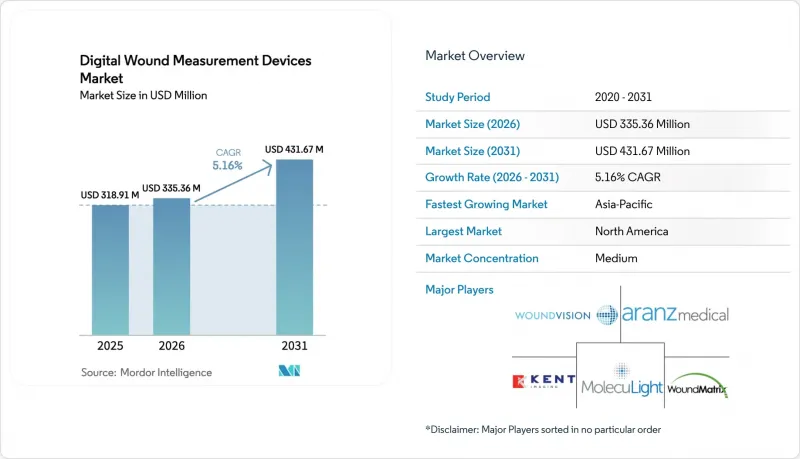
Mordor Intelligence에 의하면, 디지털 창상 측정 기기 시장 규모는 2025년 3억 1,891만 달러로 평가되었고, 2026년에는 3억 3,536만 달러로 추정되고, 2026-2031년 CAGR 5.16%로 성장을 지속할 전망이며, 2031년에는 4억 3,167만 달러에 이를 것으로 예측됩니다.
본 보고서는 제품별(접촉식 디지털 측정 기기, 비접촉식 2D 카메라 방식 기기, 기타), 기술별(2D 디지털 평면 측정법, 기타), 창상 유형별(만성 창상 및 급성 창상), 최종 사용자별(병원, 기타), 의료 현장별(입원 환자, 기타), 지역별(북미, 기타)로 분류되어 있습니다. 시장 전망은 금액(달러) 기준으로 제시되어 있습니다.
세계의 디지털 창상 측정 기기 시장 동향 및 인사이트
전 세계 만성 및 급성 상처 유병률 증가
현재 전 세계 5억 3,700만 명의 당뇨병 환자 중 4분의 1이 당뇨병성 족부 궤양을 앓고 있으며, 욕창 및 수술 부위 감염까지 더해져 치료 부담은 계속 증가하고 있습니다. 만성 상처는 각국 의료 예산의 2-4%를 차지하며, 당뇨병성 족부 궤양 1회 치료에 드는 비용은 최대 27,721달러에 달할 전망입니다. 디지털 측정 기술을 조기에 도입하면 치유 기간을 최대 50% 단축할 수 있어, 임상 자원을 확보하고 자원 낭비를 줄일 수 있습니다. 심혈관 질환, 운동 기능 장애, 인구 고령화로 인해 상처를 가진 환자층이 확대되고 있으며, 정밀한 측정 도구에 대한 장기적인 수요가 증가하고 있습니다. 그 결과, 임상의와 보험사는 디지털 창상 측정 기기 시장을 장기적인 만성 질환 관리에 있어 필수적인 요소로 인식하고 있습니다.
이미징 및 인공지능 분야의 기술 발전
MolecuLight의 형광 이미징은 100%의 민감도로 세균 부하를 감지함으로써, 회복 기간을 단축하고 비용을 절감하는 표적형 항생제 투여를 유도합니다. Kent Imaging의 SnapshotNIR과 같은 하이퍼스펙트럼 장치는 조직의 산소화 상태를 정량화하고, 상처 봉합 후 13.5일 만에 치유되었음을 보여주므로, 퇴원 여부를 더 일찍 확신하고 결정할 수 있게 해줍니다. 스테레오 포토그램메트리의 정확도는 현재 1mm 미만에 달하며, eKare inSight와 같은 FDA 승인 스마트폰 앱은 일상적으로 사용되는 카메라를 임상 기기로 탈바꿈시키고 있습니다. AI의 지속적인 개선을 통해 데이터의 선순환이 만들어지고 있습니다. 즉, 활용 범위의 확대가 더 풍부한 데이터 세트를 생성하고, 이는 알고리즘을 더욱 정교하게 만들어, 정확도의 시너지적 향상을 통해 디지털 창상 측정 기기 시장을 확대되고 있습니다.
첨단 기기의 높은 자본 비용과 운영 비용
시스템 1대당 1만 5,000-5만 달러의 초기 비용에 더해, 소프트웨어 라이선스, 교정, 20-40시간의 직원 교육이 필요하기 때문에 총 소유 비용은 많은 클리닉의 예산을 초과하게 됩니다. 지방 병원의 경우, 적은 환자 수로 고정비를 충당해야 하기 때문에 손익분기점 달성이 어려워집니다. 스마트폰 앱은 도입 장벽을 낮추지만, 복잡한 상처에서 중요시되는 체적 측정 정확도를 희생할 가능성이 있어, 의료 제공업체는 경제적 부담 경감과 임상적 정확도의 깊이를 저울질할 수밖에 없습니다. 리스 제도나 성과 연동형 가격 책정이 등장하고는 있지만, 자금 면의 장벽이 여전히 존재하여 자원이 제한된 환경에서 디지털 창상 측정 기기 시장의 보급을 지연시키고 있습니다.
부문 분석
비접촉식 2D 카메라 장치는 병원이 기존 기록 업무 프로세스 내에서 이미 이를 활용하고 있기 때문에 2025년에는 디지털 상처 측정 장치 시장 규모의 56.78%를 차지했습니다. 반면, AI의 발전으로 스마트폰의 광학 성능이 임상 수준에 근접함에 따라 소프트웨어 전용 플랫폼은 7.12%라는 가장 높은 연평균 성장률(CAGR)을 기록하고 있습니다. 조기 도입자들은 임상의가 일반적인 모바일 OS 내에서 이미지 촬영, 주석 달기, 업로드를 수행할 수 있고 케이블을 통한 전송이 필요 없어져 워크플로우가 효율화되었다고 보고하고 있습니다. 정기적인 라이선스 수수료를 통해 일회성 자본 판매가 예측 가능한 수익으로 전환되며, 시간이 지남에 따라 정확도를 향상시키는 데이터 사이언스에 대한 투자가 결실을 맺게 됩니다. Swift Medical과 같은 벤더들은 이러한 변화를 뒷받침할 알고리즘 라이브러리를 확충하기 위해 2024년에 800만 달러를 조달했습니다. 이에 반해, 하드웨어 제조업체들은 자사 카메라가 이러한 활기를 띠는 생태계에 기여할 수 있도록 애플리케이션 프로그래밍 인터페이스(API)를 개방하고 있으며, 향후 디지털 창상 측정 기기 시장의 성장은 광학 기술보다 분석 기술에 크게 의존하고 있음이 입증되고 있습니다.
접촉형 스캐너는 촉각 피드백이 상처 표면 절제 여부를 판단하는 근거가 되는 경우나, 심부 궤양에 필수적인 체적 변화를 포착하는 고급 3D 장치의 경우, 틈새 시장 수요를 유지하고 있습니다. 그러나 모바일 AI가 구조화된 광 처리를 통해 저비용으로 깊이 정보를 획득할 수 있게 됨에 따라, 그 시장 점유율은 축소될 가능성이 있습니다. 의료 기관은 저가형 스마트폰과 라이선싱 서비스를 결합하여 위험을 분산하고, 현재는 엔트리 레벨의 정확도를 확보하면서 향후 광학 시스템을 업그레이드함으로써 자본의 유연성을 유지하고 있습니다. 그 결과, 소프트웨어의 주도권이 강화되는 한편, 하드웨어는 상품화가 진행되어 디지털 창상 측정 기기 시장의 진화가 플랫폼 경제로 향하고 있다는 점이 확고해지고 있습니다.
2D 평면 측정은 습득이 용이하고 촬영 시간이 짧다는 점 때문에 2025년에는 디지털 창상 측정 기기 시장의 48.05%를 차지했습니다. 그러나 부피 감소는 표면적 감소보다 치유와 더 밀접한 관련이 있기 때문에 3D 스테레오 포토그램메트리는 연평균 성장률(CAGR) 7.38%로 확대되고 있습니다. 공동성 상처를 치료하는 외과의사는 숨겨진 주머니 전체의 육아종 형성을 확인할 수 있는 깊이 맵을 선호합니다. 초분광 영상은 색상 변화가 나타나기 전에 관류 부족을 감지함으로써 의사결정을 더욱 충실하게 하고, 감염을 미연에 방지하는 선제적 개입을 가능하게 합니다. 형광 및 열화상 같은 영상 기법은 여전히 틈새 시장 수준에 머물러 있지만, 교차 모달리티형 기기의 통합이 향후 진전되어 임상의에게 형태학적·생리학적 정보를 포괄하는 단일 도구 세트를 제공하게 될 것으로 예측됩니다.
비용은 여전히 3D 기술 도입의 주요 장벽이지만, 리스 모델이나 클라우드 기반 처리를 통해 자본 지출을 서비스 요금으로 대체함으로써 예산 부담을 줄일 수 있습니다. 스테레오 카메라를 시범 도입한 병원에서는 상처 봉합 예측 정확도가 두 자릿수 개선을 보였으며, 이 지표는 종합적 지불 제도의 스코어카드에 반영됩니다. 따라서 공급업체들은 기능 업그레이드를 판매할 때 화소 수가 아닌 치료 성과 지표를 강조하고 있으며, 검증된 정확도가 입원 기간 단축으로 이어지기 때문에 보험사들도 이에 귀를 기울이고 있습니다. 반도체 효율이 지속적으로 향상됨에 따라 계획 기간 내에 구매 가격이 하락할 것이며, 3D 스테레오 포토그램메트리는 디지털 창상 측정 기기 산업의 파이프라인에서 핵심 기술로서의 위상을 확립하게 될 것으로 보입니다.
지역별 분석
북미는 2025년 디지털 창상 측정 기기 시장의 39.78%를 차지했습니다. 이는 취득 비용 및 운영비를 상쇄하는 메디케어 청구 코드 97597-97602에 힘입은 결과입니다. 미국 병원들은 960억 달러에 달하는 상처 치료 비용 부담에 직면해 있으며, AI 영상 기술을 도입하여 입원 일수를 단축하고 재입원 지표와 관련된 벌금을 피하고자 하고 있습니다. 캐나다 의료 시스템에서는 영상 진단 기술이 주 전체의 전자 건강 기록에 통합되어 있는 반면, 멕시코에서는 의료기기 수입 확대가 지역 공급업체의 파이프라인을 뒷받침하고 있습니다. FDA의 510(k)에 따른 규제 명확화와 임상시험 인프라는 지속적인 벤처 자금을 유치하고 있으며, 그 대표적인 예로 2025년에 MolecuLight가 2,750만 달러의 시리즈 D 자금 조달을 진행한 것을 들 수 있습니다. 이러한 자본 축적은 혁신 주기를 지속시키고, 디지털 창상 측정 기기 시장에서 북미의 우위를 더욱 공고히 하고 있습니다.
아시아태평양은 정부 주도의 원격 의료 전략과 주요 경제권에서 80% 이상의 스마트폰 보급률에 힘입어 6.31%라는 가장 높은 연평균 성장률(CAGR)을 보이고 있습니다. 중국과 인도에서는 1차 진료 앱에 혁신적인 영상 기능을 통합한 지역 의료 이니셔티브를 확대하고 있으며, 방대한 당뇨병 환자층을 AI 정확도 향상에 기여하는 데이터 소스로 전환하고 있습니다. 고령화 사회에 직면한 일본과 한국에서는 장기 요양 체류를 억제하기 위해 첨단 3D 분광법이 도입되고 있습니다. 이 지역의 조달에서는 낮은 설비 투자(CAPEX)를 요구하는 기기가 선호되므로, 각 벤더사는 데이터 주권 규제를 충족하기 위해 가격 책정 및 클라우드 호스팅을 현지 사정에 맞추고 있습니다. 이러한 종합적인 성장 동력을 바탕으로, 2031년까지 아시아태평양이 유럽 및 미국 국가들 시장 점유율을 꾸준히 잠식하며 전 세계 디지털 창상 측정 기기 시장을 혁신해 나갈 것으로 전망됩니다.
유럽에서는 조달 전에 확고한 치료 성과 증거를 요구하는 협력적인 의료 기술 평가 하에 완만한 성장을 유지하고 있습니다. 독일과 영국은 영상 검사 결과를 당뇨병성 족부 병변 치료 채널에 대한 종합적 결제에 연계함으로써 도입을 주도하고 있습니다. 프랑스와 이탈리아는 EU의 디지털 헬스 자금 지원 창구가 열리면서 이에 뒤를 따르고 있습니다. GDPR(EU 개인정보보호규정)(일반 데이터 보호 규정) 준수에 따라 제조업체는 설계 단계부터 암호화 및 익명화를 적용해야 할 의무가 있으며, 이로 인해 진입 장벽이 높아지면서 성숙한 데이터 거버넌스 체계를 갖춘 공급업체에게 유리한 상황이 조성되고 있습니다. 국경을 초월한 상처 등록 제도를 연구하는 컨소시엄은 데이터의 상세도를 더욱 높이고, 범유럽적인 모범 사례 지침을 지원하는 동시에 디지털 창상 측정 기기 산업에 대한 구매자의 신뢰를 유지하고 있습니다.
기타 혜택
- 엑셀 형식 시장 예측(ME) 시트
- 3개월간의 애널리스트 지원
자주 묻는 질문
목차
제1장 서론
제2장 조사 방법
제3장 개요
제4장 시장 구도
제5장 시장 규모 및 성장 예측
제6장 경쟁 구도
제7장 시장 기회 및 향후 전망
AJY 26.09.01According to Mordor Intelligence, the digital wound measurement devices market size is expected to grow from USD 318.91 million in 2025 to USD 335.36 million in 2026 and is forecast to reach USD 431.67 million by 2031 at 5.16% CAGR over 2026-2031.
This report is Segmented by Product (Contact Digital Measuring Devices, Non-Contact 2-D Camera-Based Devices, and More), Technology (2-D Digital Planimetry, and More), Wound Type (Chronic Wounds and Acute Wounds), End User (Hospitals, and More), Healthcare Setting (In-Patient, and More), and Geography (North America, and More). The Market Forecasts are Provided in Terms of Value (USD).
Global Digital Wound Measurement Devices Market Trends and Insights
Rising Prevalence of Chronic and Acute Wounds Worldwide
Diabetic foot ulcers now affect one quarter of the 537 million global diabetes population, while pressure ulcers and surgical site infections add to the escalating care burden. Chronic wounds consume 2-4% of national healthcare budgets, and a single diabetic foot ulcer episode can cost up to USD 27,721. Early use of digital measurement curbs healing time by as much as 50%, freeing clinical capacity and cutting resource waste. Cardiovascular disease, mobility disorders, and demographic aging broaden the wound population, reinforcing secular demand for precise tools. Consequently, clinicians and payers view the digital wound measurement devices market as an indispensable element in long-range chronic-disease management.
Technological Advancements in Imaging and Artificial Intelligence
MolecuLight fluorescence imaging detects bacterial load with 100% sensitivity, guiding targeted antibiotics that shorten recovery and lower expenses. Hyperspectral devices such as Kent Imaging SnapshotNIR quantify tissue oxygenation, showing wounds resolve 13.5 days after visible closure, thus offering earlier confidence for discharge decisions. Stereophotogrammetry now reaches sub-millimeter accuracy, and FDA-cleared smartphone apps like eKare inSight transform everyday cameras into clinical instruments. Continuous AI refinement creates a data flywheel: wider use generates richer datasets that further sharpen algorithms, enlarging the digital wound measurement devices market through compounded accuracy gains.
High Capital and Operational Costs of Advanced Devices
Up-front price tags of USD 15,000-50,000 per system and the need for software licenses, calibration, and 20-40 hours of staff training lift total cost of ownership above many clinic budgets. Rural hospitals must spread fixed charges across thin case volumes, impeding break-even targets. While smartphone apps lower entry thresholds, they may forfeit volumetric precision prized for complex wounds, forcing providers to weigh financial relief against clinical depth. Leasing schemes and outcome-based pricing emerge, yet capital hurdles still slow digital wound measurement devices market diffusion in resource-constrained settings.
Other drivers and restraints analyzed in the detailed report include:
- Growing Emphasis on Value-Based Wound Care and Clinical Outcomes
- Increasing Adoption of Digital Health and Telemedicine Platforms
- Limited Reimbursement Coverage in Emerging Markets
For complete list of drivers and restraints, kindly check the Table Of Contents.
Segment Analysis
Non-Contact 2-D camera devices secured 56.78% of the digital wound measurement devices market size in 2025 because hospitals already use them inside established documentation routines. Yet software-only platforms claim the fastest 7.12% CAGR as AI upgrades push smartphone optics toward clinical parity. Early adopters report workflow gains because clinicians capture, annotate, and upload images within common mobile operating systems, eliminating cable transfers. Recurring license fees convert episodic capital sales into predictable revenue, rewarding data-science investments that uplift accuracy over time. Vendors such as Swift Medical raised USD 8 million in 2024 to deepen algorithm libraries that fuel this shift. Hardware makers respond by opening application-programming interfaces so their cameras feed these thriving ecosystems, confirming that future digital wound measurement devices market growth hinges on analytics more than optics.
Contact scanners keep niche relevance when tactile feedback informs debridement, and premium 3-D units capture volumetric change essential for deep ulcers. Yet their share may erode as mobile AI captures depth through structured-light processing at lower cost. Clinics hedge by pairing budget phones with cloud licenses, achieving entry-level precision now and upgrading optics later, thus preserving capital flexibility. As a result, software command grows while hardware commoditizes, cementing the digital wound measurement devices market evolution toward platform economics.
2-D planimetry dominated 48.05% of the digital wound measurement devices market share in 2025 thanks to its simple learning curve and quick capture times. However, 3-D stereophotogrammetry is scaling at a 7.38% CAGR because volume reduction correlates more tightly with healing than surface area alone. Surgeons treating cavity wounds prefer depth maps that confirm granulation across hidden pockets. Hyperspectral imaging further enriches decision-making by flagging perfusion deficits earlier than color change appears, enabling pre-emptive interventions that avert infection. Although fluorescence and thermal modalities remain niche, cross-modal devices will likely converge, giving clinicians a single toolset covering morphology and physiology.
Cost remains the main drag on 3-D adoption, yet leasing models and cloud-based processing ease budget shocks by swapping capital expense for service fees. Hospitals piloting stereo cameras show double-digit improvements in wound-closure prediction accuracy, a metric that feeds bundled-payment scorecards. Vendors thus spotlight outcome metrics rather than pixel counts when selling capability upgrades, and payers listen because validated precision drives down length of stay. Continuous gains in silicon efficiency will cut acquisition prices within the planning horizon, positioning 3-D stereophotogrammetry as the backbone of the digital wound measurement devices industry pipeline.
Complete Report Scope:
- By Product
- Contact Digital Measuring Devices
- Non-Contact 2-D Camera-Based Devices
- 3-D Imaging / Scanner Devices
- AI-Enabled Software-Only Solutions
- By Technology
- 2-D Digital Planimetry
- 3-D Stereophotogrammetry
- Fluorescence / Hyperspectral Imaging
- Thermal & Multimodal Imaging
- By Wound Type
- Chronic Wounds
- Pressure Ulcers
- Diabetic Foot Ulcers
- Venous Leg Ulcers
- Other Chronic Wounds
- Acute Wounds
- Surgical Wounds
- Burns & Trauma
- Chronic Wounds
- By End User
- Hospitals
- Specialty Wound-Care Centers
- Out-Patient Clinics
- Home Healthcare Settings
- By Healthcare Setting
- In-Patient
- Out-Patient / Ambulatory
- Home-Based
- Geography
- North America
- United States
- Canada
- Mexico
- Europe
- Germany
- United Kingdom
- France
- Italy
- Spain
- Rest of Europe
- Asia-Pacific
- China
- Japan
- India
- Australia
- South Korea
- Rest of Asia-Pacific
- Middle East & Africa
- GCC
- South Africa
- Rest of Middle East & Africa
- South America
- Brazil
- Argentina
- Rest of South America
- North America
Geography Analysis
North America captured 39.78% of the digital wound measurement devices market in 2025, supported by Medicare billing codes 97597-97602 that offset acquisition and operating expense. U.S. hospitals face a USD 96 billion wound-care burden and deploy AI imaging to compress lengths of stay and avoid penalties tied to readmission metrics. Canadian health systems integrate imaging into province-wide electronic charts, while Mexico's expanding device imports fuel regional supplier pipelines. Regulatory clarity through FDA 510(k) and clinical trial infrastructure attract sustained venture funding, exemplified by MolecuLight's USD 27.5 million Series D in 2025. Such capital density perpetuates innovation cycles that reinforce North American dominance within the digital wound measurement devices market.
Asia-Pacific presents the fastest 6.31% CAGR, driven by state-sponsored telehealth strategies and smartphone saturation beyond 80% in large economies. China and India scale community-health initiatives that embed wound imaging inside primary-care apps, converting vast diabetic populations into data sources that refine AI. Japan and South Korea, coping with aging demographics, adopt advanced 3-D spectroscopy to limit long-term nursing stays. Regional procurement favors low-capex tools, so vendors localize pricing and cloud hosting to meet data-sovereignty rules. Collective momentum signals that APAC will steadily erode Western share through 2031, transforming the global digital wound measurement devices market.
Europe sustains measured growth under coordinated health technology assessments that demand robust outcome evidence before procurement. Germany and the United Kingdom lead uptake by linking imaging outputs to bundled payments for diabetic-foot pathways. France and Italy follow as EU digital-health funding windows open. GDPR compliance forces manufacturers to embed encryption and anonymization by design, raising entry barriers that favor vendors with mature data-governance frameworks. Consortia studying cross-border wound registries further boost data granularity, supporting pan-European best-practice guidelines and sustaining purchasing confidence in the digital wound measurement devices industry.
- MolecuLight
- ARANZ Medical Ltd.
- Kent Imaging
- eKare Inc.
- WoundVision LLC
- Tissue Analytics (Net Health)
- Swift Medical Inc.
- Perceptive Solutions (WoundZoom)
- WoundMatrix Inc.
- Parable Health
- Healthy.io Ltd.
- Spectral AI Inc.
- KroniKare Pte Ltd.
- Intellicure Inc.
- Healogics Digital
- Smiths Group
- 3M Health Care
- Stryker (Novadaq)
- Medtronic
- Digital Diagnostics
Additional Benefits:
- The market estimate (ME) sheet in Excel format
- 3 months of analyst support
TABLE OF CONTENTS
1 Introduction
- 1.1 Study Assumptions & Market Definition
- 1.2 Scope Of The Study
2 Research Methodology
3 Executive Summary
4 Market Landscape
- 4.1 Market Overview
- 4.2 Market Drivers
- 4.2.1 Rising Prevalence of Chronic and Acute Wounds Worldwide
- 4.2.2 Increasing Adoption of Digital Health and Telemedicine Platforms
- 4.2.3 Growing Emphasis on Value-Based Wound Care and Clinical Outcomes
- 4.2.4 Technological Advancements in Imaging and Artificial Intelligence
- 4.2.5 Expanding Geriatric Population and Surgical Procedures
- 4.2.6 Favorable Regulatory and Reimbursement Support for Digital Solutions
- 4.3 Market Restraints
- 4.3.1 High Capital and Operational Costs of Advanced Devices
- 4.3.2 Limited Reimbursement Coverage in Emerging Markets
- 4.3.3 Data Privacy and Cybersecurity Concerns In Cloud-Based Platforms
- 4.3.4 Integration Challenges with Legacy Electronic Health Systems
- 4.4 Regulatory Landscape
- 4.5 Technological Outlook
- 4.6 Porter?s Five Forces Analysis
- 4.6.1 Threat Of New Entrants
- 4.6.2 Bargaining Power Of Buyers
- 4.6.3 Bargaining Power Of Suppliers
- 4.6.4 Threat Of Substitute Products
- 4.6.5 Intensity Of Competitive Rivalry
5 Market Size & Growth Forecasts (Value, USD)
- 5.1 By Product
- 5.1.1 Contact Digital Measuring Devices
- 5.1.2 Non-Contact 2-D Camera-Based Devices
- 5.1.3 3-D Imaging / Scanner Devices
- 5.1.4 AI-Enabled Software-Only Solutions
- 5.2 By Technology
- 5.2.1 2-D Digital Planimetry
- 5.2.2 3-D Stereophotogrammetry
- 5.2.3 Fluorescence / Hyperspectral Imaging
- 5.2.4 Thermal & Multimodal Imaging
- 5.3 By Wound Type
- 5.3.1 Chronic Wounds
- 5.3.1.1 Pressure Ulcers
- 5.3.1.2 Diabetic Foot Ulcers
- 5.3.1.3 Venous Leg Ulcers
- 5.3.1.4 Other Chronic Wounds
- 5.3.2 Acute Wounds
- 5.3.2.1 Surgical Wounds
- 5.3.2.2 Burns & Trauma
- 5.3.1 Chronic Wounds
- 5.4 By End User
- 5.4.1 Hospitals
- 5.4.2 Specialty Wound-Care Centers
- 5.4.3 Out-Patient Clinics
- 5.4.4 Home Healthcare Settings
- 5.5 By Healthcare Setting
- 5.5.1 In-Patient
- 5.5.2 Out-Patient / Ambulatory
- 5.5.3 Home-Based
- 5.6 Geography
- 5.6.1 North America
- 5.6.1.1 United States
- 5.6.1.2 Canada
- 5.6.1.3 Mexico
- 5.6.2 Europe
- 5.6.2.1 Germany
- 5.6.2.2 United Kingdom
- 5.6.2.3 France
- 5.6.2.4 Italy
- 5.6.2.5 Spain
- 5.6.2.6 Rest of Europe
- 5.6.3 Asia-Pacific
- 5.6.3.1 China
- 5.6.3.2 Japan
- 5.6.3.3 India
- 5.6.3.4 Australia
- 5.6.3.5 South Korea
- 5.6.3.6 Rest of Asia-Pacific
- 5.6.4 Middle East & Africa
- 5.6.4.1 GCC
- 5.6.4.2 South Africa
- 5.6.4.3 Rest of Middle East & Africa
- 5.6.5 South America
- 5.6.5.1 Brazil
- 5.6.5.2 Argentina
- 5.6.5.3 Rest of South America
- 5.6.1 North America
6 Competitive Landscape
- 6.1 Market Concentration
- 6.2 Market Share Analysis
- 6.3 Company Profiles (includes Global level Overview, Market level overview, Core Business Segments, Financials, Headcount, Key Information, Market Rank, Market Share, Products and Services, and analysis of Recent Developments)
- 6.3.1 MolecuLight Inc.
- 6.3.2 ARANZ Medical Ltd.
- 6.3.3 Kent Imaging Inc.
- 6.3.4 eKare Inc.
- 6.3.5 WoundVision LLC
- 6.3.6 Tissue Analytics (Net Health)
- 6.3.7 Swift Medical Inc.
- 6.3.8 Perceptive Solutions (WoundZoom)
- 6.3.9 WoundMatrix Inc.
- 6.3.10 Parable Health
- 6.3.11 Healthy.io Ltd.
- 6.3.12 Spectral AI Inc.
- 6.3.13 KroniKare Pte Ltd.
- 6.3.14 Intellicure Inc.
- 6.3.15 Healogics Digital
- 6.3.16 Smith & Nephew PLC
- 6.3.17 3M Health Care
- 6.3.18 Stryker (Novadaq)
- 6.3.19 Medtronic PLC
- 6.3.20 Digital Diagnostics Inc.
7 Market Opportunities & Future Outlook
- 7.1 White-Space & Unmet-Need Assessment


