

|
시장보고서
상품코드
2117344
스티렌 부타디엔 스티렌(SBS) 고무 시장 : 시장 점유율 분석, 업계 동향 및 통계, 성장 예측(2026-2031년)Styrene Butadiene Styrene Rubber - Market Share Analysis, Industry Trends & Statistics, Growth Forecasts (2026 - 2031) |
||||||
 Mordor Intelligence
Mordor Intelligence에 의하면, 스티렌 부타디엔 스티렌(SBS) 고무 시장 규모는 2025년 138억 9,000만 달러로 평가되었고, 2026년에는 143억 7,000만 달러로 추정되고 2026-2031년 CAGR 3.47%로 성장을 지속할 전망이며, 2031년에는 170억 4,000만 달러에 이를 것으로 예측됩니다.
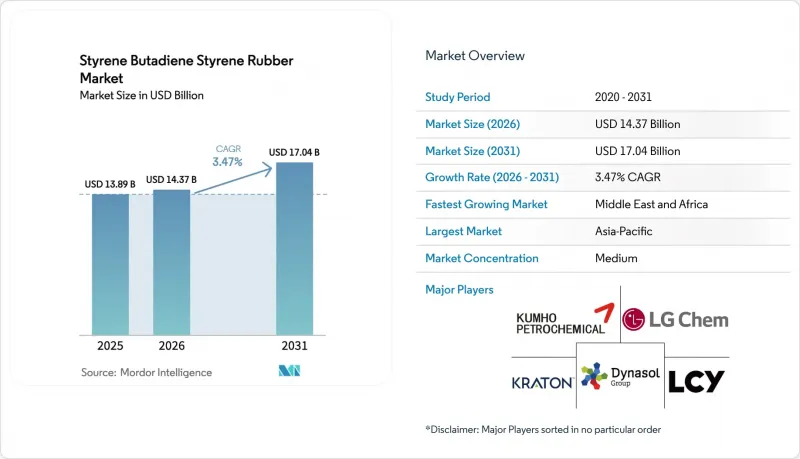
본 보고서는 유형별(오일 익스텐디드, 논오일 익스텐디드), 용도별(신발, 아스팔트 개질, 폴리머 개질·컴파운딩, 접착제 및 실란트, 기타 용도), 지역별(아시아태평양, 북미, 유럽, 남미, 중동 및 아프리카)로 분류되어 있습니다. 시장 예측은 금액(달러)으로 표시됩니다.
세계의 스티렌 부타디엔 스티렌(SBS) 고무 시장 동향 및 인사이트
신발 제조 거점의 급속한 확대
현재 베트남, 중국, 인도네시아는 미드솔, 아웃솔, 쿠션 인서트용으로 설계된 특수 SBS 등급을 필요로 하는 연속적인 제조 회랑을 형성하고 있습니다. 고탄성 등급은 퍼포먼스 신발 브랜드가 요구하는 에너지 반환 특성을 제공하는 동시에, 작업장 및 스포츠 활동에서 필수적인 미끄럼 방지 계수를 유지합니다. 전 세계 신발 브랜드들의 지속가능성 목표가 바이오 유래 SBS의 시범 발주를 촉진하고 있으며, SCG 케미칼즈가 베트남의 LSP 복합 시설에서 진행 중인 7억 달러 규모의 에탄 설비 확장은 지역 밑창 컴파운더들에게 모노머 자급자족이 최우선 과제임을 여실히 보여주고 있습니다. 생산 거점의 집적화를 통해 리드타임도 단축되어, 적시 재고 관리 모델이 가능해지며, 완제품 조립 제조업체의 운전 자본을 절감할 수 있습니다.
도로 및 지붕 공사 프로젝트에서 SBS 개질 아스팔트 사용 확대
정부 자금을 통한 고속도로 확장 및 도시 지역의 지붕 개보수 공사에서는 60°C에서 발생하는 차선 흔적과 -20°C에서 발생하는 균열에 대한 내성을 확보하기 위해 SBS 개질 바인더의 사용이 지정되어 있습니다. 유변학 시험을 통해 기존 아스팔트에 비해 수명이 최대 40% 연장되는 것으로 확인되었으며, 이를 통해 폴리머의 높은 초기 비용이 상쇄되고 있습니다. 사우디아라비아와 인도의 국가 인프라 계획에서는 폴리머 개질 처리된 고성능 아스팔트가 요구되고 있으며, 신규 차선 건설과 노면 재포장 프로그램 모두에서 SBS가 입찰 사양서의 최상위 항목으로 자리 잡고 있습니다.
원료 가격의 급격한 변동
INEOS Styrolution의 사니아에 위치한 430 kt 규모의 스티렌 생산 설비가 영구적으로 가동을 중단함에 따라 북미의 모노머 공급이 제한되고, 현물 가격이 상승하고 있습니다. 이로 인해 소규모 SBS 배합 제조업체들은 단기 수입 협상을 진행하거나, 국내 조달분에 대해 할증 가격을 지불할 수밖에 없는 상황에 처해 있습니다. Kraton은 스티렌 가격의 급등으로부터 이익률을 보호하기 위해 2025년 4월 전 세계 SBS 정가를 인상했는데, 이는 원료가 제품 원가의 31%를 차지하고 있음을 여실히 보여줍니다. S-SBR 타이어용 엘라스토머의 생산 확대가 병행되고 있어, SBS 제조업체로부터 부타디엔이 유출되면서 수급 균형이 더욱 타이트해지고 있습니다.
부문 분석
2025년에도 오일 연신 등급은 57.85%의 출하량 점유율을 유지했습니다. 이는 최대 25%의 공정 오일을 배합하여 용융 점도를 낮출 수 있다는 점을 높이 평가하는 아스팔트 및 신발용 컴파운드 제조업체들에 의해 뒷받침되고 있습니다. 이 점유율은 12 MPa를 초과하는 인장 강도 유지가 용도의 임계값을 충족하고, 고처리량 압출 성형에서의 가공 범위가 확대된다는 경제적 최적화를 반영한 것입니다. 비오일 확장형 SBS는 뛰어난 투명성과 내화학성을 갖추고 있어, 엄격한 VOC 기준 충족이 요구되는 의료용 플러그, 자동차용 벤트 개스킷, 전자기기 케이스 등의 용도에 적합합니다. 수요 증가에 따라 오일 프리 익스텐디드 유형의 소비량은 연평균 성장률(CAGR) 4.05%로 증가하고 있으며, 이는 SBS 시장 전체의 성장률을 상회하고 있습니다.
저점도 유성 등급은 포장 라인에서 분당 180m 속도의 핫멜트 접착제 코팅을 단순화하는 한편, 비유성 등급은 치수 안정성이 요구되는 사출 성형된 소프트 터치 그립에 적합합니다. 바이오프로세스 오일은 가공상의 이점을 유지하면서 지속가능성 점수를 향상시키는 하이브리드 접근 방식을 제공하며, 상업적 생산량이 증가함에 따라 일부 구매자들은 다시 유성 가소화 제품으로 회귀할 가능성이 있습니다.
지역별 분석
아시아태평양은 2025년 매출의 45.75%를 차지했으며, 중국과 아세안(ASEAN) 제조 회랑의 통합된 석유화학 산업 덕분에 스티렌-부타디엔-스티렌(SBS) 시장의 중심축으로 남아 있습니다. 베트남의 신발 수출은 2024년에 11% 증가하여 SBS를 사용한 밑창 컴파운드 소비를 직접적으로 끌어올렸습니다. 또한, 인도와 인도네시아 정부의 도로 정비 계획에서는 기후 변화에 대한 내성을 높이기 위해 SBS 개질 아스팔트가 지정되어 있어, 이 지역의 꾸준한 수요 흡수를 뒷받침하고 있습니다.
북미에서는 정유시설 합리화로 인해 국내 스티렌 생산량이 감소하고 있으며, 사니아 공장의 폐쇄로 인해 해당 지역은 범용 SBS 수입 의존으로 전환되고 있습니다. 한편, 자동차 및 건설 부문의 기준 강화로 인해 저VOC 특성을 갖춘 프리미엄 등급에 대한 수요는 유지되고 있습니다. 각 생산 업체들은 수입 원료에 대한 시장 점유율을 지키기 위해 애플리케이션 개발 서비스를 적극적으로 활용하고 있습니다.
유럽에서는 시장 규모가 성숙 단계에 이르렀음에도 재활용 가능한 소비재로의 채택이 꾸준히 진행되고 있으며, SBS의 열가소성으로 인한 회수 가능성이 순환형 경제의 지침과 부합하고 있습니다. 엄격한 REACH 규제로 인해 배합 제조업체들은 잔류 스티렌이 적고 바이오 유래 제품으로의 전환을 강요받고 있습니다.
중동 및 아프리카에서는 2031년 연평균 성장률(CAGR)이 3.75%로 예상되며, 그 원동력은 각국 정부의 인프라 메가 프로젝트와 SBS의 역방향 통합이 가능한 원료가 풍부한 석유화학 산업단지라는 이 지역의 강점입니다. 남미는 거시경제 회복에 의존하고 있으며, 브라질의 경우 현지 SBS 수지 생산 능력은 제한적이지만 자동차 생산 증가가 접착제 및 내장 트림 용도를 뒷받침하고 있습니다.
기타 혜택
- 엑셀 형식 시장 예측(ME) 시트
- 3개월간의 애널리스트 지원
자주 묻는 질문
목차
제1장 서론
제2장 조사 방법
제3장 개요
제4장 시장 구도
제5장 시장 규모 및 성장 예측
제6장 경쟁 구도
제7장 시장 기회 및 향후 전망
AJY 26.09.01According to Mordor Intelligence, the styrene butadiene styrene rubber market size is expected to grow from USD 13.89 billion in 2025 to USD 14.37 billion in 2026 and is forecast to reach USD 17.04 billion by 2031 at 3.47% CAGR over 2026-2031.
This report is Segmented by Type (Oil-Extended and Non-Oil-Extended), Application (Footwear, Asphalt Modification, Polymer Modification/Compounding, Adhesives and Sealants, and Other Applications), and Geography (Asia-Pacific, North America, Europe, South America, and Middle-East and Africa). The Market Forecasts are Provided in Terms of Value (USD).
Global Styrene Butadiene Styrene Rubber Market Trends and Insights
Rapid Expansion of Footwear Manufacturing Hubs
Vietnam, China, and Indonesia now form a contiguous manufacturing corridor that demands specialized SBS grades engineered for midsoles, outsoles, and cushioning inserts. High-elastic variants deliver energy return properties sought by performance footwear brands while maintaining anti-slip coefficients critical for workplace and athletic safety. Sustainability targets from global shoe brands are spurring pilot orders for bio-attributed SBS, and SCG Chemicals' USD 700 million ethane upgrade at its LSP Vietnam complex underlines the priority of monomer self-sufficiency for regional sole compounders. Clustered production also shortens lead times, enabling just-in-time inventory models that lower working capital for finished-goods assemblers.
Rising SBS-Modified Bitumen Use in Road and Roofing Projects
Government-funded highway expansions and urban roofing retrofits specify SBS-modified binders for resilience against rutting at 60°C and cracking at -20°C. Rheological testing confirms service-life extensions of up to 40% versus conventional asphalt, offsetting the higher initial polymer cost. National infrastructure plans in Saudi Arabia and India require performance-grade asphalt with polymer modification, positioning SBS at the top of bidder specifications for both new lane construction and resurfacing programs.
High Feedstock Price Volatility
The permanent shutdown of INEOS Styrolution's 430 kt styrene unit in Sarnia constrains North American monomer supply and lifts spot prices, prompting smaller SBS formulators to negotiate short-term imports or pay premiums for domestic volumes. Kraton raised global SBS list prices in April 2025 to defend margin against styrene spikes, highlighting the 31% cost-of-goods exposure to raw materials. Parallel expansions in S-SBR tire elastomers siphon butadiene from SBS producers, further tightening balances.
Other drivers and restraints analyzed in the detailed report include:
- Accelerating Demand from Hot-Melt Adhesives and Sealants
- Thermoplastic Elastomer Substitution for Recyclable Consumer Goods
- Competition from Hydrogenated SEBS and Other Advanced TPEs
For complete list of drivers and restraints, kindly check the Table Of Contents.
Segment Analysis
Oil-extended grades continued to command a 57.85% volume share in 2025, sustained by asphalt and footwear compounders who appreciate the melt-viscosity reduction that can be achieved at loadings of up to 25% process oil. This share reflects economic optimization where tensile retention above 12 MPa satisfies application thresholds, and processing windows widen for high-throughput extrusion. Non-oil-extended SBS delivers superior clarity and chemical resistance, positioning it for applications such as medical plugs, automotive vent gaskets, and electronics housings that require passing stringent VOC benchmarks. Rising demand lifts non-oil-extended consumption at a 4.05% CAGR, outpacing overall styrene butadiene styrene market growth.
Lower-viscosity oil-extended grades simplify hot-melt adhesive coating at 180 m/min for packaging lines, while non-oil-extended variants are suitable for injection-molded soft-touch grips that require dimensional stability. Bio-based process oils offer a hybrid approach that retains processing advantages while enhancing sustainability scores, potentially shifting some buyers back toward oil-plasticized offerings as commercial volumes increase.
Complete Report Scope:
- By Type
- Oil-Extended
- Non-Oil-Extended
- By Application
- Footwear
- Asphalt Modification
- Polymer Modification / Compounding
- Adhesives and Sealants
- Other Applications
- By Geography
- Asia-Pacific
- China
- India
- Japan
- South Korea
- Rest of Asia-Pacific
- North America
- United States
- Canada
- Mexico
- Europe
- Germany
- United Kingdom
- Italy
- France
- Russia
- Rest of Europe
- South America
- Brazil
- Argentina
- Rest of South America
- Middle-East and Africa
- Saudi Arabia
- United Arab Emirates
- South Africa
- Egypt
- Rest of Middle-East and Africa
- Asia-Pacific
Geography Analysis
The Asia-Pacific region held 45.75% of 2025 revenue and remains the anchor for the styrene butadiene styrene market due to integrated petrochemicals in China and ASEAN manufacturing corridors. Footwear exports from Vietnam increased by 11% in 2024, directly boosting SBS sole-compound consumption. Government road programs in India and Indonesia also specify SBS-modified bitumen for climate resilience, supporting steady regional drawdown.
North America's refinery rationalization reduces domestic styrene output, and the Sarnia closure shifts the region toward import dependence for commodity SBS, even as elevated automotive and construction standards sustain demand for premium grades with low VOC signatures. Producers leverage application development services to protect their share against imported material.
Europe shows mature volume yet steady uptake for recyclable consumer goods, where SBS's thermoplastic recoverability aligns with circular-economy directives. Stringent REACH protocols are pushing formulators toward low-styrene-residual and bioattributed variants.
The Middle East and Africa's 3.75% CAGR through 2031 is driven by sovereign infrastructure megaprojects and the region's advantage in feedstock-rich petrochemical parks that can backward integrate SBS. South America relies on macroeconomic recovery; Brazil's uptick in automobile production supports adhesives and interior trim applications, despite limited local SBS resin capacity.
- ARLANXEO
- Asahi Kasei Corporation
- Bridgestone
- China National Petroleum Corporation (CNPC)
- Dycon Chemicals
- Dynasol Group
- Exxon Mobil Corporation.
- The Goodyear Tire & Rubber Company
- JSR Corporation
- Kraton Corporation
- Kumho Petrochemical Co., Ltd.
- LCY GROUP
- LG Chem Ltd.
- SIBUR Holding PJSC
- Synthos
- Trinseo
- TSRC Corporation
- Versalis S.p.A.
- ZEON CORPORATION
Additional Benefits:
- The market estimate (ME) sheet in Excel format
- 3 months of analyst support
TABLE OF CONTENTS
1 Introduction
- 1.1 Study Assumptions and Market Definition
- 1.2 Scope of the Study
2 Research Methodology
3 Executive Summary
4 Market Landscape
- 4.1 Market Overview
- 4.2 Market Drivers
- 4.2.1 Rapid expansion of footwear manufacturing hubs
- 4.2.2 Rising SBS-modified bitumen use in road and roofing projects
- 4.2.3 Accelerating demand from hot-melt adhesives and sealants
- 4.2.4 Thermoplastic elastomer substitution for recyclable consumer goods
- 4.2.5 3-D printing adoption for flexible and transparent parts
- 4.3 Market Restraints
- 4.3.1 High feedstock (styrene, butadiene) price volatility
- 4.3.2 Competition from hydrogenated SEBS and other advanced TPEs
- 4.3.3 Tightening VOC / environmental regulations on styrenics
- 4.4 Value Chain Analysis
- 4.5 Porter's Five Forces
- 4.5.1 Bargaining Power of Suppliers
- 4.5.2 Bargaining Power of Buyers
- 4.5.3 Threat of New Entrants
- 4.5.4 Threat of Substitutes
- 4.5.5 Degree of Competition
5 Market Size & Growth Forecasts (Value)
- 5.1 By Type
- 5.1.1 Oil-Extended
- 5.1.2 Non-Oil-Extended
- 5.2 By Application
- 5.2.1 Footwear
- 5.2.2 Asphalt Modification
- 5.2.3 Polymer Modification / Compounding
- 5.2.4 Adhesives and Sealants
- 5.2.5 Other Applications
- 5.3 By Geography
- 5.3.1 Asia-Pacific
- 5.3.1.1 China
- 5.3.1.2 India
- 5.3.1.3 Japan
- 5.3.1.4 South Korea
- 5.3.1.5 Rest of Asia-Pacific
- 5.3.2 North America
- 5.3.2.1 United States
- 5.3.2.2 Canada
- 5.3.2.3 Mexico
- 5.3.3 Europe
- 5.3.3.1 Germany
- 5.3.3.2 United Kingdom
- 5.3.3.3 Italy
- 5.3.3.4 France
- 5.3.3.5 Russia
- 5.3.3.6 Rest of Europe
- 5.3.4 South America
- 5.3.4.1 Brazil
- 5.3.4.2 Argentina
- 5.3.4.3 Rest of South America
- 5.3.5 Middle-East and Africa
- 5.3.5.1 Saudi Arabia
- 5.3.5.2 United Arab Emirates
- 5.3.5.3 South Africa
- 5.3.5.4 Egypt
- 5.3.5.5 Rest of Middle-East and Africa
- 5.3.1 Asia-Pacific
6 Competitive Landscape
- 6.1 Market Concentration
- 6.2 Strategic Moves
- 6.3 Market Share**/Ranking Analysis
- 6.4 Company Profiles (includes Global level Overview, Market level overview, Core Segments, Financials as available, Strategic Information, Market Rank/Share, Products & Services, Recent Developments)
- 6.4.1 ARLANXEO
- 6.4.2 Asahi Kasei Corporation
- 6.4.3 Bridgestone
- 6.4.4 China National Petroleum Corporation (CNPC)
- 6.4.5 Dycon Chemicals
- 6.4.6 Dynasol Group
- 6.4.7 Exxon Mobil Corporation.
- 6.4.8 The Goodyear Tire & Rubber Company
- 6.4.9 JSR Corporation
- 6.4.10 Kraton Corporation
- 6.4.11 Kumho Petrochemical Co., Ltd.
- 6.4.12 LCY GROUP
- 6.4.13 LG Chem Ltd.
- 6.4.14 SIBUR Holding PJSC
- 6.4.15 Synthos
- 6.4.16 Trinseo
- 6.4.17 TSRC Corporation
- 6.4.18 Versalis S.p.A.
- 6.4.19 ZEON CORPORATION
7 Market Opportunities & Future Outlook
- 7.1 White-space and Unmet-Need Assessment


