

|
시장보고서
상품코드
2117380
고정익 VTOL 무인항공기 시장 : 시장 점유율 분석, 산업 동향 및 통계 데이터, 성장 예측(2025-2030년)Fixed-Wing VTOL UAV - Market Share Analysis, Industry Trends & Statistics, Growth Forecasts (2025 - 2030) |
||||||
 Mordor Intelligence
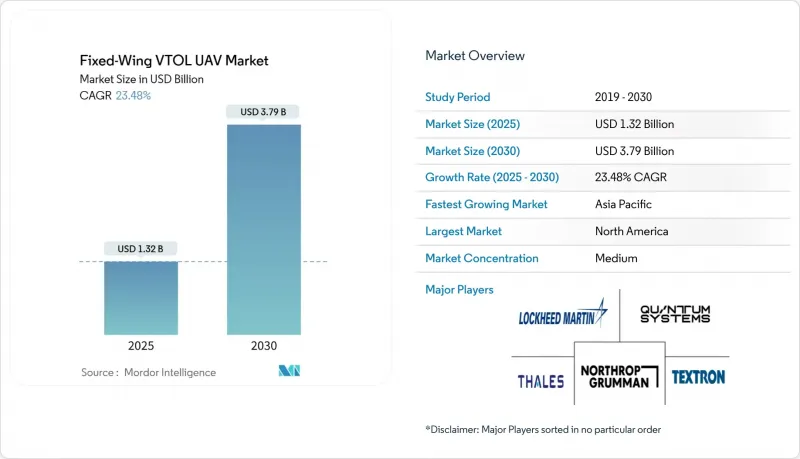
Mordor Intelligence에 의하면, 고정익 VTOL 무인항공기(UAV) 시장 규모는 2025년에 13억 2,000만 달러로 평가되었고, 2030년까지 37억 9,000만 달러에 이를 전망이며, CAGR 23.48%로 확대될 것으로 예측됩니다.
본 보고서는 용도별(ISR, 전투 작전, 국경 관리, 기타), 추진 방식별(전기식, 하이브리드 전기식, 연료전지식, 기존 방식), 운용 모드별(자율형 등), MTOW 등급별(25kg 미만, 25-150kg, 그 이상), 항속 거리별(단거리, 중거리, 장거리), 지역별(북미, 유럽 등)로 분류되어 있습니다. 시장 예측은 금액(달러) 기준으로 제시되어 있습니다.
세계의 고정익 VTOL 무인항공기 시장 동향 및 인사이트
활주로가 필요 없는 ISR 및 감시 플랫폼에 대한 전 세계적 수요 증가
군 당국은 고정익의 비행 시간을 유지하면서 취약한 활주로를 피할 수 있는 고정익 VTOL 무인 항공기 솔루션을 점점 더 중요하게 여기고 있습니다. 튀르키예가 개발 중인 2025년형 전술 VTOL 드론은 12피트 정사각형 갑판에서 10시간의 비행 시간과 1,300km의 비행 거리를 실현하고 있으며, 수직 이륙과 순항 효율을 통해 가능한 운영상의 도약을 보여주고 있습니다. 일본이 해상 감시를 위해 V-BAT 시스템을 도입한 것도, 이와 유사한 협소한 공간에서의 작전을 우선시하고 있음을 보여줍니다. 국경 경비 기관은 외딴 지역에서 인프라가 필요 없는 신속한 감시망을 구축하기 위해 이러한 기체를 배치하고 있으며, APUS 25 등에 탑재된 다연료 대응 기능은 분산된 임무 수행 시 후방 지원의 탄력성을 높이고 있습니다. 목표 식별을 위한 호버링과 새로운 임무 현장으로의 신속한 이동이라는 두 가지 능력을 겸비하고 있다는 점은 순수한 회전익기나 활주로에 의존하는 고정익기에는 없는 우위입니다.
상업용 매핑 및 항공 측량 용도의 확대
측량 회사들은 경비행기를 수직 이착륙의 용이성과 빠른 지역 커버리지를 겸비한 고정익 VTOL(수직 이착륙) 무인 항공기 플랫폼으로 대체하고 있습니다. XAG사의 M2000은 90분 비행으로 시간당 533헥타르를 센티미터 단위의 정밀도로 측량하여, 농업 분야 고객들에게 활주로에 대한 의존도를 해소해 주고 있습니다. Aeromao사의 VT-NAUT는 비행 고도를 4,900m까지 확장하여 지상 팀이 접근할 수 없는 산악 지대의 광산 현장에도 도달할 가능성이 있습니다. 최대 이륙 중량(MTOW) 100kg인 DAPHNE와 같은 수소 동력 프로토타입은 유럽의 엄격한 지속가능성 요건에 부합하는 제로 배출 환경 조사를 목표로 하고 있습니다. 채굴 후 지반 침하 모니터링 및 다중 스펙트럼 이미지 촬영은 멀티로터 기체에 비해 높은 도입 비용을 상쇄할 수 있는 지속적인 수익원을 창출하고 있습니다.
멀티로터 기체에 비해 높은 도입 비용
듀얼 모드 기체 구조, 복잡한 이행 비행 제어 시스템, 하이브리드 파워트레인으로 인해 경량급 항공기의 단가는 98,000-50만 달러로 상승하여, 더 저렴한 멀티로터 기체와는 대조를 이룹니다. 또한, 기술자가 전동 시스템과 내연기관 시스템 양쪽의 서브시스템을 유지보수해야 하기 때문에 유지보수 비용도 높아집니다. 그러나 장시간 비행이 요구되는 임무에서는 고정익기의 효율성으로 인해 시간당 운용 비용이 절반으로 줄어들기 때문에 이러한 가격 차이는 축소됩니다. RAND의 조사에 따르면, 생산량이 증가함에 따라 상업적 규모의 생산이 궁극적으로 군사 조달 가격을 끌어내려 고정익 VTOL 무인항공기 시장을 뒷받침하게 될 것이라고 합니다.
부문 분석
2024년에는 ISR 플랫폼이 고정익 VTOL 무인항공기 시장의 46.89%를 차지하며 주도적인 위치를 차지한 것으로 평가되었으며, 25.34%의 연평균 성장률(CAGR)은 활주로가 필요 없는 감시 활동을 위한 지속적인 조달 수요를 뒷받침하고 있습니다. V-BAT가 12피트 갑판에서 10시간의 항속 시간을 달성한 사실은 해군과 국경 수비대가 이러한 항공기를 우선적으로 선택하는 이유를 여실히 보여줍니다. 상용 센서(COTS)를 통해 탑재체 업그레이드가 가속화되면서, 그 활용 사례는 신호정보(SIGINT) 및 재난 평가로 확대되고 있습니다.
이 부문에서 전투 작전은 가장 빠르게 성장하는 분야이며, C-130의 램프 전개에서 이루어지는 ‘Hero 120’과 같은 공중 발사형 정밀유도탄의 시험 운용이 이를 뒷받침하고 있습니다. 영역 횡단 전술에서는 호버링 앤 스트라이크(Hovering and Strike)형 페이로드가 통합되어, ISR 기체가 다목적 자산으로 변모하고 있습니다. 민간 사업자들은 파이프라인 모니터링나 야생동물 보호에 ISR 기반 광학 장비를 활용하고 있으며, 이는 시장을 가로지르는 기술의 파급 효과를 보여줍니다.
2024년, 규제 당국이 소음과 배기가스가 없는 기체를 우선시한 결과, 고정익 VTOL 무인 항공기 시장 점유율의 53.75%를 전동 파워트레인이 차지했습니다. 그러나 연료전지 모델은 연평균 성장률(CAGR) 27.56%로 더욱 빠르게 시장을 확대되고 있습니다. 이는 PEM 스택이 2시간 이상의 출격에서 뛰어난 에너지 밀도를 발휘하기 때문입니다. 항속 거리와 지속가능성의 균형을 맞추려는 운영 사업자들은 장기적인 해결책으로서 수소를 점점 더 중요하게 여기고 있습니다.
하이브리드 전기 방식은 여전히 필수적인 가교 기술입니다. 복합익 실증기를 통한 25분간의 비행 시간 연장은 배터리와 엔진의 조합이 장거리 매핑 임무에서 고정익 VTOL 무인항공기 시장 규모를 확대할 수 있음을 보여줍니다. 신속한 급유가 배기가스 규제 목표보다 우선시되는 탑재 하중이 큰 군사 임무에서는 기존 연료 시스템이 계속해서 채택되고 있습니다.
지역별 분석
2024년, 북미는 고정익 VTOL 무인 항공기 시장에서 36.55%의 점유율을 차지하며 시장을 주도했습니다. 이는 국방 지출, 초기 BVLOS(시야 외 비행) 면제, 그리고 강력한 국내 제조거점에 힘입은 결과입니다. AeroVironment사는 2025 회계연도에 8억 2,100만 달러의 매출을 기록했으며, 자율 시스템을 확대하기 위해 41억 달러 규모의 BlueHalo사 인수를 통해 역량 통합을 추진하고 있습니다. FAA의 파워 리프트 규정 및 댈러스에서의 BVLOS 선례에 힘입어, 미국에서는 상업적 전개가 광범위하게 진행될 전망입니다. 한편, 캐나다와 멕시코는 USMCA에 기반한 3개국 간 공급망 연계의 혜택을 누리고 있습니다.
아시아태평양은 연평균 성장률(CAGR) 24.89%를 기록하며 가장 빠르게 성장하고 있는 지역입니다. 중국의 틸트로터 시제기, 일본의 2,500만 달러 규모 V-BAT 구매, 그리고 한국의 전자 기술 전문 지식이 국방 및 민간 프로그램의 견고한 파이프라인을 뒷받침하고 있습니다. 농업용 드론의 활용, 재난 대응 수요, 그리고 증가하는 해상 풍력 발전 자산이 민간 대상 시장을 확대되고 있습니다. 인도와 호주에서의 현지 생산 우대 조치는 비용 경쟁력을 높이고, 세계 수출 의지를 북돋우고 있습니다.
유럽의 성장은 꾸준하며, 회원국 간 인증을 표준화하는 EASA의 2025년 VCA 프레임워크가 그 기반이 되고 있습니다. 독일의 배터리 관리 노하우, 프랑스의 방위 산업 기반, 그리고 스칸디나비아 국가들의 해상 풍력 발전에 대한 집중이 다양한 수요를 창출하고 있습니다. DAPHNE 수소 UAV는 유럽이 환경 보전을 위한 제로 배출 감시를 중시하고 있음을 보여줍니다. 영국의 CAP2537 지침은 국내 인증을 추진하는 한편, EU 전역에 걸친 공역 조화를 통해 국경을 초월한 운용을 간소화하고 있습니다.
기타 혜택 :
- Excel 형식 시장 예측(ME) 시트
- 3개월간의 애널리스트 지원
자주 묻는 질문
목차
제1장 서론
제2장 분석 방법
제3장 개요
제4장 시장 구도
제5장 시장 규모 및 성장률 예측
제6장 경쟁 구도
제7장 시장 기회 및 향후 전망
AJY 26.09.01According to Mordor Intelligence, the fixed-wing VTOL UAV market size is USD 1.32 billion in 2025 and is forecasted to reach USD 3.79 billion by 2030, expanding at a 23.48% CAGR.
This report is Segmented by Application (ISR, Combat Operations, Border Management, and Others), Propulsion Type (Electric, Hybrid-Electric, Fuel-Cell, and Conventional), Mode of Operation (Autonomous, and More), MTOW Class (Less Than 25 Kg, 25 To 150 Kg, and More), Range (Short, Medium, and Long), and Geography (North America, Europe, and More). The Market Forecasts are Provided in Terms of Value (USD).
Global Fixed-Wing VTOL UAV Market Trends and Insights
Rising Global Demand for Runway-Independent ISR and Surveillance Platforms
Armed forces increasingly favor fixed-wing VTOL UAV market solutions that avoid vulnerable runways while preserving fixed-wing endurance. Turkey's 2025 tactical VTOL drone achieves 10-hour endurance and 1,300 km range from a 12-foot square deck, illustrating the operational leap offered by vertical launch and cruise efficiency. Japan's purchase of V-BAT systems for naval surveillance shows similar prioritization of confined-space operations. Border agencies deploy these aircraft to establish rapid, infrastructure-free coverage in remote sectors, and multi-fuel capabilities such as those on the APUS 25 enhance logistical resilience in dispersed missions. The dual ability to hover for target identification and sprint to new taskings is unmatched by pure rotorcraft or runway-bound fixed-wing types.
Expansion of Commercial Mapping and Aerial Surveying Applications
Surveying firms are replacing light aircraft with fixed-wing VTOL UAV market platforms that combine vertical launch ease with high-speed area coverage. XAG's M2000 maps 533 hectares per hour during 90-minute sorties at centimeter-level accuracy, removing runway dependencies for agricultural clients. Aeromao's VT-NAUT extends missions to altitudes of 4,900 m, reaching mountainous mining sites inaccessible by ground teams. Hydrogen-powered prototypes such as the 100 kg-MTOW DAPHNE aim for zero-emission environmental surveys, aligning with strict European sustainability mandates. Post-mining subsidence monitoring and multispectral imaging create recurring revenue streams that offset higher acquisition costs versus multirotors.
Higher Acquisition Costs Compared to Multirotor Alternatives
Dual-mode aerostructures, complex transition flight controls, and hybrid powertrains raise unit prices to USD 98,000-500,000 for light-class aircraft, versus lower-priced multirotors. Service costs also escalate because technicians must maintain both electric and combustion subsystems. That premium narrows in endurance-driven roles where fixed-wing efficiency halves per-hour operating costs over long sorties. RAND research notes that commercial scale should eventually compress military procurement prices as production volumes rise, supporting the Fixed-Wing VTOL UAV Market.
Other drivers and restraints analyzed in the detailed report include:
- Progress in Regulatory Approvals for Beyond Visual Line-of-Sight Operations
- Technological Advancements in Hybrid-Electric Propulsion Systems
- Endurance Limitations Due to Current Battery Energy Density Constraints
For complete list of drivers and restraints, kindly check the Table Of Contents.
Segment Analysis
ISR platforms dominated the fixed-wing VTOL UAV market in 2024 with a 46.89% share, and their 25.34% CAGR underlines sustained procurement for runway-independent surveillance. The V-BAT's 10-hour endurance from a 12-foot deck illustrates why navies and border forces prioritize these aircraft. Commercial off-the-shelf sensors accelerate payload upgrades, expanding use cases into signals intelligence and disaster assessment.
Combat operations constitute the fastest-rising niche within the segment, propelled by trials of air-launched precision munitions such as Hero 120 from C-130 ramp deployment. Cross-domain tactics integrate hover-and-strike payloads, turning ISR airframes into multi-mission assets. Civil operators leverage ISR-derived optics for pipeline monitoring and wildlife protection, illustrating technology spillover across markets.
Electric powertrains held 53.75% of the fixed-wing VTOL UAV market share in 2024 as regulators favored noise- and emission-free craft. Fuel-cell models, however, scale faster at 27.56% CAGR because PEM stacks offer superior energy density on 2-hour-plus sorties. Operators balancing endurance and sustainability increasingly view hydrogen as a long-term solution.
Hybrid-electric remains an essential bridge technology. A compound-wing demonstrator's 25-minute endurance gain shows how battery-engine pairing can expand the fixed-wing VTOL UAV market size for long-range mapping missions. Conventional fuel systems persist for payload-heavy military tasks where rapid refueling trumps emission targets.
Complete Report Scope:
- By Application
- Intelligence, Surveillance, and Reconnaissance (ISR)
- Combat Operations
- Border Management
- Others
- By Propulsion Type
- Electric
- Hybrid-Electric
- Fuel-Cell
- Conventional
- By Mode of Operation
- Autonomous
- Remotely Piloted
- Optionally Piloted
- By MTOW Class
- Less than 25 kg
- 25 to 150 kg
- Greater than 150 kg
- By Range
- Short Range
- Medium Range
- Long Range
- By Geography
- North America
- United States
- Canada
- Mexico
- Europe
- United Kingdom
- France
- Germany
- Italy
- Rest of Europe
- Asia-Pacific
- China
- India
- Japan
- South Korea
- Australia
- Rest of Asia-Pacific
- South America
- Brazil
- Rest of South America
- Middle East and Africa
- Middle East
- Saudi Arabia
- United Arab Emirates
- Rest of Middle East
- Africa
- South Africa
- Rest of Africa
- Middle East
- North America
Geography Analysis
North America led the fixed-wing VTOL UAV market with a 36.55% share in 2024, sustained by defense outlays, early BVLOS waivers, and strong domestic manufacturing. AeroVironment posted USD 821 million revenue in fiscal 2025 and is consolidating capabilities through the USD 4.1 billion BlueHalo acquisition to scale autonomous systems. The FAA's powered-lift rule and Dallas BVLOS precedent position the US for widespread commercial rollouts, while Canada and Mexico benefit from trilateral supply-chain alignment under USMCA.
Asia-Pacific is the fastest-growing region, with a 24.89% CAGR. China's tilt-rotor prototype, Japan's USD 25 million V-BAT buy, and South Korea's electronics expertise reinforce a robust pipeline of defense and civil programs. Agricultural drone use, disaster response needs, and growing offshore-wind assets widen the civil addressable market. Local production incentives in India and Australia enhance cost competitiveness and encourage global export ambitions.
Europe's growth is steady, anchored by EASA's 2025 VCA framework that standardizes certification across member states. Germany's battery-management know-how, France's defense industrial base, and Scandinavia's offshore-wind focus foster diverse demand. The DAPHNE hydrogen UAV illustrates Europe's emphasis on zero-emission surveillance for environmental stewardship. UK CAP2537 guidance advances home-grown certification while Pan-EU airspace harmonization simplifies cross-border operations.
- AeroVironment, Inc.
- Lockheed Martin Corporation
- Quantum-Systems GmbH
- Alti Unmanned
- Thales Group
- Israel Aerospace Industries Ltd.
- Northrop Grumman Corporation
- Textron, Inc.
- BAE Systems plc
- Autel Robotics Co., Ltd.
- Swift Engineering Inc.
- Elbit Systems Ltd.
Additional Benefits:
- The market estimate (ME) sheet in Excel format
- 3 months of analyst support
TABLE OF CONTENTS
1 INTRODUCTION
- 1.1 Study Assumptions and Market Definition
- 1.2 Scope of the Study
2 RESEARCH METHODOLOGY
3 EXECUTIVE SUMMARY
4 MARKET LANDSCAPE
- 4.1 Market Overview
- 4.2 Market Drivers
- 4.2.1 Rising global demand for runway-independent ISR and surveillance platforms
- 4.2.2 Expansion of commercial mapping and aerial surveying applications
- 4.2.3 Progress in regulatory approvals for beyond visual line-of-sight (BVLOS) operations
- 4.2.4 Technological advancements in hybrid-electric propulsion systems
- 4.2.5 Adoption of UAVs for environmental monitoring in hazardous sites
- 4.2.6 Growing use of high-wind-capable UAVs for offshore wind farm inspections
- 4.3 Market Restraints
- 4.3.1 Higher acquisition costs compared to multi-rotor UAV alternatives
- 4.3.2 Endurance limitations due to current battery energy density constraints
- 4.3.3 Shortage of skilled talent for hybrid flight control software development
- 4.3.4 Airspace congestion challenges around vertiport infrastructure
- 4.4 Value Chain Analysis
- 4.5 Regulatory Landscape
- 4.6 Technological Outlook
- 4.7 Porter's Five Forces Analysis
- 4.7.1 Threat of New Entrants
- 4.7.2 Bargaining Power of Suppliers
- 4.7.3 Bargaining Power of Buyers
- 4.7.4 Threat of Substitutes
- 4.7.5 Competitive Rivalry
5 MARKET SIZE AND GROWTH FORECASTS
- 5.1 By Application
- 5.1.1 Intelligence, Surveillance, and Reconnaissance (ISR)
- 5.1.2 Combat Operations
- 5.1.3 Border Management
- 5.1.4 Others
- 5.2 By Propulsion Type
- 5.2.1 Electric
- 5.2.2 Hybrid-Electric
- 5.2.3 Fuel-Cell
- 5.2.4 Conventional
- 5.3 By Mode of Operation
- 5.3.1 Autonomous
- 5.3.2 Remotely Piloted
- 5.3.3 Optionally Piloted
- 5.4 By MTOW Class
- 5.4.1 Less than 25 kg
- 5.4.2 25 to 150 kg
- 5.4.3 Greater than 150 kg
- 5.5 By Range
- 5.5.1 Short Range
- 5.5.2 Medium Range
- 5.5.3 Long Range
- 5.6 By Geography
- 5.6.1 North America
- 5.6.1.1 United States
- 5.6.1.2 Canada
- 5.6.1.3 Mexico
- 5.6.2 Europe
- 5.6.2.1 United Kingdom
- 5.6.2.2 France
- 5.6.2.3 Germany
- 5.6.2.4 Italy
- 5.6.2.5 Rest of Europe
- 5.6.3 Asia-Pacific
- 5.6.3.1 China
- 5.6.3.2 India
- 5.6.3.3 Japan
- 5.6.3.4 South Korea
- 5.6.3.5 Australia
- 5.6.3.6 Rest of Asia-Pacific
- 5.6.4 South America
- 5.6.4.1 Brazil
- 5.6.4.2 Rest of South America
- 5.6.5 Middle East and Africa
- 5.6.5.1 Middle East
- 5.6.5.1.1 Saudi Arabia
- 5.6.5.1.2 United Arab Emirates
- 5.6.5.1.3 Rest of Middle East
- 5.6.5.2 Africa
- 5.6.5.2.1 South Africa
- 5.6.5.2.2 Rest of Africa
- 5.6.5.1 Middle East
- 5.6.1 North America
6 COMPETITIVE LANDSCAPE
- 6.1 Market Concentration
- 6.2 Strategic Moves
- 6.3 Market Share Analysis
- 6.4 Company Profiles (includes Global level Overview, Market level overview, Core Segments, Financials as available, Strategic Information, Market Rank/Share for key companies, Products and Services, and Recent Developments)
- 6.4.1 AeroVironment, Inc.
- 6.4.2 Lockheed Martin Corporation
- 6.4.3 Quantum-Systems GmbH
- 6.4.4 Alti Unmanned
- 6.4.5 Thales Group
- 6.4.6 Israel Aerospace Industries Ltd.
- 6.4.7 Northrop Grumman Corporation
- 6.4.8 Textron, Inc.
- 6.4.9 BAE Systems plc
- 6.4.10 Autel Robotics Co., Ltd.
- 6.4.11 Swift Engineering Inc.
- 6.4.12 Elbit Systems Ltd.
7 MARKET OPPORTUNITIES AND FUTURE OUTLOOK
- 7.1 White-space and Unmet-Need Assessment


