

|
시장보고서
상품코드
2117394
인도의 전기차 충전 서비스 : 시장 점유율 분석, 산업 동향 및 통계 데이터, 성장 예측(2026-2031년)India EV Charging-As-A-Service - Market Share Analysis, Industry Trends & Statistics, Growth Forecasts (2026 - 2031) |
||||||
 Mordor Intelligence
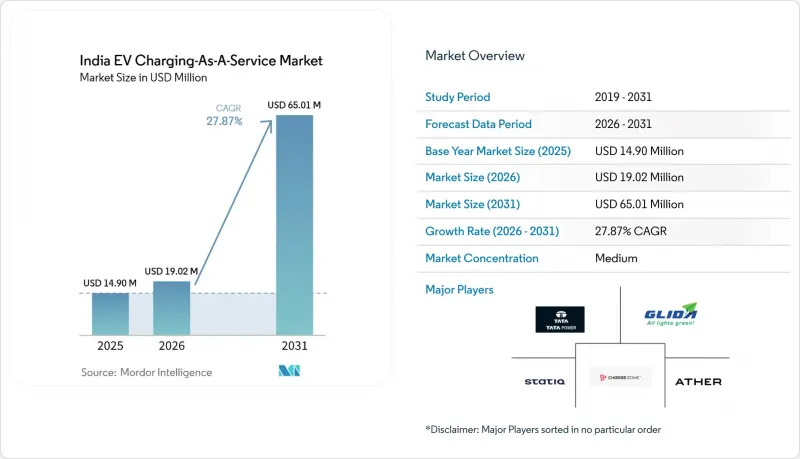
Mordor Intelligence에 의하면, 인도의 전기차 충전 서비스 시장 규모는 2025년에 1,490만 달러로 평가되었습니다. 2026년 1,902만 달러에서 2031년까지 6,501만 달러에 이를 것으로 추정되고 2026년부터 2031년에 걸쳐 CAGR 27.87%로 성장할 전망입니다.
본 보고서는 충전기 유형(AC 충전기, DC 충전기), 출력(레벨 1/AC(22kW 미만),레벨 2(22-50kW) 등), 차량 서비스 유형(사용차·차량 풀, 배송·물류 등), 용도(준공공 충전 설비, 공공 충전 설비), 지역별로 분류되어 있습니다. 시장 전망은 금액(달러) 기준으로 제시되어 있습니다.
인도의 전기차 충전 서비스 시장 동향 및 인사이트
이커머스·물류 대기업에 의한 법인 차량 전기화 의무화
CAQM의 지침에 따라 기업의 공약이 규정 준수 요건으로 전환됨에 따라, 인도의 전기차 충전 서비스 시장에서 계약량이 가속화되고 있습니다. 플립카트(Flipkart)의 2만 대가 넘는 전기 배송 차량과 아마존 인디아(Amazon India)의 1만 대 목표는 자사 전용 충전 수요의 규모를 여실히 보여주고 있습니다. 물류 센터 운영 사업자들은 차량 임대, 충전, 소프트웨어를 구독 패키지로 통합하여 주행 거리에 대한 불안을 줄이고 총 소유 비용(TCO)을 최적화하고 있습니다.
FAME-II 단계적 폐지 기간 연장 및 주 차원의 설비 투자 보조금
중공업부는 FAME-II 인센티브를 2027년까지 연장하는 한편, ‘PM E-DRIVE’ 프로그램을 도입하여 중소 도시의 공공 충전기에 200억 루피(약 2억 4,000만 달러)를 배정했습니다. 마하라슈트라주와 카르나타카주에서는 병행하여 시행되고 있는 정책을 통해 하드웨어에 대한 상당한 설비 투자 보조금이 제공되고 있습니다. 이 인센티브 덕분에 차량 기지 설치에 대한 투자 회수 기간이 수년으로 단축됩니다. 이러한 2단계 지원은 조기 도입이 진행되고 있는 대도시권과 2차 시장 간의 수익성 격차를 해소하는 데 도움이 되지만, 사업자에게는 자금 사정을 압박하는 보조금 지급 지연이라는 과제가 있습니다.
50kW를 초과하는 DC 충전기의 높은 초기 비용
중간 용량의 충전 장치는 일반적으로 비용 면에서 접근하기 쉬운 반면, 대용량 충전기는 여전히 상당히 비싸기 때문에 소규모 서비스 제공업체가 이를 도입하는 데 어려움이 있습니다. 하드웨어 비용의 일부를 경감하기 위한 보조금을 이용할 수 있지만, 필요한 승인 획득의 지연이나 변압기 업그레이드에 따른 추가 비용으로 인해 그 절차는 종종 복잡해집니다. 이러한 과제로 인해 많은 사업자들은 당초 저용량 모듈에 투자하고, 상황이 호전됨에 따라 인프라를 단계적으로 확장해 나갈 계획을 세우고 있습니다.
부문별 분석
2025년, 인도의 전기차 충전 서비스 시장 규모 중 60.13%를 AC 충전기가 차지했습니다. 이는 하드웨어 가격이 비교적 저렴하고, 야간 차량 가동 중단 시간과 일치하기 때문입니다. 플립카트의 물류 센터에서는 태양광 발전과 연계된 요금 체계를 활용하여 주간 충전 비용을 대폭 절감하기 위해 AC 충전소를 도입하고 있습니다. 최근 도입된 이러한 설비는 기업 캠퍼스나 중소규모 물류 회사들 사이에서 인기를 끌고 있습니다.
DC 급속 충전기는 비용은 높지만, 차량 회전 시간이 30-45분을 초과해서는 안 되는 라스트 마일 배송이나 라이드셰어 거점 등에서 급속히 보급되고 있습니다. Jio-bp 네트워크의 95%는 DC 방식이며,타타 파워의 새로운 60-320 kW EVERTA 모델이 고속도로변 주요 노선에 설치됨에 따라, 인도 전기차 충전 서비스 시장의 DC 하드웨어 연평균 성장률(CAGR)은 2031년까지 29.65%를 기록할 전망입니다.
레벨 2(22-50 kW)는 4-6시간의 주차 시간이 표준적인 거점 운영에 적합하기 때문에 2025년 인도 전기차 충전 서비스 시장 점유율의 44.36%를 차지했습니다. 방갈로르와 하이데라바드에서는 ChargeZone과 Statiq이 BluSmart의 확대되는 택시 차량 군에 대응하기 위해 중출력 충전기를 전략적으로 집약하고 있습니다.
장거리 트럭 및 도시 간 버스에 필요한 150kW를 초과하는 고출력 충전기는 연평균 성장률(CAGR) 30.48%로 증가할 것으로 예측됩니다. 타타 모터스는 업무 효율화를 도모하기 위해 ‘골든 쿼드릴래터럴’을 따라 일정한 간격으로 메가 충전기를 설치하여 전기 트럭의 충전 시간을 1시간 미만으로 단축할 계획입니다.
기타 혜택 :
- 엑셀 형식 시장 예측(ME) 시트
- 3개월간의 애널리스트 지원
자주 묻는 질문
목차
제1장 서론
제2장 분석 방법
제3장 개요
제4장 시장 구도
제5장 시장 규모 및 성장률 예측
제6장 경쟁 구도
제7장 시장 기회 및 향후 전망
KTH 26.09.02According to Mordor Intelligence, the India EV charging-As-A-Service market size was valued at USD 14.90 million in 2025 and is estimated to grow from USD 19.02 million in 2026 to reach USD 65.01 million by 2031, growing at a CAGR of 27.87% over 2026-2031.
This report is Segmented by Charger Type (AC Chargers, DC Chargers), Power Output (Level 1/AC (Below 22 KW), Level 2 (22-50 KW), and More), Fleet-Service Type (Company Vehicles and Motor Pools, Delivery and Logistics, and More), End-Use (Semi-Public Charging Setup, Public Charging Setup), and Geography. Market Forecasts are Provided in Terms of Value (USD).
India EV Charging-As-A-Service Market Trends and Insights
Corporate Fleet Electrification Mandates by E-Commerce and Logistics Majors
The CAQM directive converts corporate pledges into compliance requirements, accelerating contract volumes for the India EV Charging-As-A-Service market . Flipkart's 20,000-plus electric delivery vehicles and Amazon India's 10,000-vehicle target illustrate the scale of captive charging demand. Depot operators are bundling vehicle leasing, charging, and software in subscription packages that mitigate range anxiety and optimize total cost of ownership.
FAME-II Phase-Out Extension and State-Level CAPEX Subsidies
The Ministry of Heavy Industries extended FAME-II incentives through 2027 and introduced the PM E-DRIVE program, earmarking INR 2,000 crore (~USD 240 million) for public chargers in smaller cities . In Maharashtra and Karnataka, parallel policies offer significant capital subsidies on hardware. This incentive reduces payback periods for depot installations to a few years. While this dual-layer support helps bridge the viability gap between early-adopter metros and Tier-2 markets, operators face a challenge: disbursement lags that strain their working capital.
High Upfront Cost of Above 50 kW DC Chargers
Charging units with moderate capacity are generally more accessible in terms of cost, whereas higher-capacity chargers remain significantly more expensive, posing challenges for smaller service providers to adopt them. Although subsidies are available to reduce a portion of the hardware costs, the process is often complicated by delays in obtaining necessary approvals and the additional expenses associated with upgrading transformers. These challenges lead many operators to initially invest in lower-capacity modules, with plans to expand their infrastructure gradually as conditions become more favorable.
Other drivers and restraints analyzed in the detailed report include:
- Battery-Swapping-as-a-Service Integration with CaaS Hubs
- Mandatory EV-Ready Parking Provisions in National Building Code (2025 Draft)
- Distribution-Transformer Capacity Gaps in Tier-2/3 Cities
For complete list of drivers and restraints, kindly check the Table Of Contents.
Segment Analysis
AC installations dominated the India EV Charging-As-A-Service market size at 60.13% in 2025, thanks to lower hardware prices and alignment with overnight fleet downtime. Flipkart's fulfillment centers have adopted AC points, leveraging solar-linked tariffs to significantly reduce charging costs during the day. Introduced in recent years, these units have gained popularity among corporate campuses and smaller logistics firms.
DC fast chargers, although more expensive, are scaling quickly in last-mile delivery and ride-hailing depots where vehicle turnaround cannot exceed 30-45 minutes. Jio-bp's network is 95% DC, and Tata Power's new 60-320 kW EVERTA models will anchor highway corridors, helping the India EV Charging-As-A-Service market record a 29.65% CAGR for DC hardware through 2031.
Level 2 (22-50 kW) captured 44.36% of India's EV Charging-As-A-Service market share in 2025 because four- to six-hour dwell times fit standard depot operations. In Bengaluru and Hyderabad, ChargeZone and Statiq have strategically clustered mid-range units to cater to BluSmart's growing taxi fleet.
High-power chargers above 150 kW, necessary for long-haul trucks and inter-city buses, are forecast to rise at a 30.48% CAGR. In a bid to streamline operations, Tata Motors plans to install mega-chargers at regular intervals along the Golden Quadrilateral, reducing electric truck recharge stops to under an hour.
Complete Report Scope:
- By Charger Type
- AC Chargers
- DC Chargers
- By Power Output
- Level 1 / AC (Below 22 kW)
- Level 2 (22 - 50 kW)
- Fast (50 -150 kW)
- High-Power (Above 150 kW)
- By Fleet-Service Type
- Company Vehicles and Motor Pools
- Delivery and Logistics
- Passenger Fleets (Ride-hailing, Corporate Cabs)
- By End-Use
- Semi-Public Charging Setup (Depots, Campuses)
- Public Charging Setup (Highways, Urban Hubs)
- By Geography (States & UTs)
- North India (Delhi, Uttar Pradesh, Punjab, Haryana, Himachal Pradesh, Uttarakhand, and Rajasthan)
- North-East India (Assam, Arunachal Pradesh, Manipur, Meghalaya, Mizoram, Nagaland, Tripura, and Sikkim)
- South India (Tamil Nadu, Karnataka, Andhra Pradesh, Telangana, and Kerala)
- West India (Maharashtra, Gujarat, Rajasthan, and Goa)
- East India (West Bengal, Odisha, Bihar, and Jharkhand)
- Central India (Madhya Pradesh and Chhattisgarh)
- Union Territories (Jammu & Kashmir, Ladakh, Chandigarh, Andaman & Nicobar Islands, Lakshadweep, Dadra & Nagar Haveli, Daman & Diu, and Puducherry)
List of Companies Covered in this Report:
- Tata Power
- GLIDA (Fortum Charge & Drive India)
- Statiq
- ChargeZone
- Charzer
- Magenta ChargeGrid
- Ather Energy Limited
- Volttic
- Jio-bp pulse
- Convergence Energy Services Ltd (CESL)
Additional Benefits:
- The market estimate (ME) sheet in Excel format
- 3 months of analyst support
TABLE OF CONTENTS
1 Introduction
- 1.1 Study Assumptions & Market Definition
- 1.2 Scope of the Study
2 Research Methodology
3 Executive Summary
4 Market Landscape
- 4.1 Market Overview
- 4.2 Market Drivers
- 4.2.1 Corporate Fleet Electrification Mandates by E-Commerce and Logistics Majors
- 4.2.2 FAME-II Phase-Out Extension and State-Level CAPEX Subsidies
- 4.2.3 Battery-Swapping-as-a-Service Integration with CaaS Hubs
- 4.2.4 Mandatory EV-Ready Parking Provisions in National Building Code (2025 Draft)
- 4.2.5 Implementation of Bharat EV Charger Interoperability Protocols
- 4.2.6 Time-of-Day Renewable-Linked Tariffs Lowering Depot Charging Costs
- 4.3 Market Restraints
- 4.3.1 High Upfront Cost of Above 50 kW DC Chargers
- 4.3.2 Distribution-Transformer Capacity Gaps in Tier-2/3 Cities
- 4.3.3 Uncertain GST Input-Tax-Credit Eligibility on Charging Services
- 4.3.4 Fragmented Municipal Land-Lease Norms for Public Chargers
- 4.4 Value / Supply-Chain Analysis
- 4.5 Regulatory Landscape
- 4.6 Technological Outlook
- 4.7 Porter's Five Forces
- 4.7.1 Threat of New Entrants
- 4.7.2 Bargaining Power of Suppliers
- 4.7.3 Bargaining Power of Buyers
- 4.7.4 Threat of Substitutes (Battery Swapping, Home Charging)
- 4.7.5 Competitive Rivalry
5 Market Size & Growth Forecasts (Value, USD)
- 5.1 By Charger Type
- 5.1.1 AC Chargers
- 5.1.2 DC Chargers
- 5.2 By Power Output
- 5.2.1 Level 1 / AC (Below 22 kW)
- 5.2.2 Level 2 (22 - 50 kW)
- 5.2.3 Fast (50 -150 kW)
- 5.2.4 High-Power (Above 150 kW)
- 5.3 By Fleet-Service Type
- 5.3.1 Company Vehicles and Motor Pools
- 5.3.2 Delivery and Logistics
- 5.3.3 Passenger Fleets (Ride-hailing, Corporate Cabs)
- 5.4 By End-Use
- 5.4.1 Semi-Public Charging Setup (Depots, Campuses)
- 5.4.2 Public Charging Setup (Highways, Urban Hubs)
- 5.5 By Geography (States & UTs)
- 5.5.1 North India (Delhi, Uttar Pradesh, Punjab, Haryana, Himachal Pradesh, Uttarakhand, and Rajasthan)
- 5.5.2 North-East India (Assam, Arunachal Pradesh, Manipur, Meghalaya, Mizoram, Nagaland, Tripura, and Sikkim)
- 5.5.3 South India (Tamil Nadu, Karnataka, Andhra Pradesh, Telangana, and Kerala)
- 5.5.4 West India (Maharashtra, Gujarat, Rajasthan, and Goa)
- 5.5.5 East India (West Bengal, Odisha, Bihar, and Jharkhand)
- 5.5.6 Central India (Madhya Pradesh and Chhattisgarh)
- 5.5.7 Union Territories (Jammu & Kashmir, Ladakh, Chandigarh, Andaman & Nicobar Islands, Lakshadweep, Dadra & Nagar Haveli, Daman & Diu, and Puducherry)
6 Competitive Landscape
- 6.1 Market Concentration
- 6.2 Strategic Moves
- 6.3 Market Share Analysis
- 6.4 Company Profiles (Includes Global Level Overview, Market Level Overview, Core Segments, Financials as Available, Strategic Information, Market Rank/Share for Key Companies, Products and Services, SWOT Analysis, and Recent Developments)
- 6.4.1 Tata Power
- 6.4.2 GLIDA (Fortum Charge & Drive India)
- 6.4.3 Statiq
- 6.4.4 ChargeZone
- 6.4.5 Charzer
- 6.4.6 Magenta ChargeGrid
- 6.4.7 Ather Energy Limited
- 6.4.8 Volttic
- 6.4.9 Jio-bp pulse
- 6.4.10 Convergence Energy Services Ltd (CESL)


