

|
시장보고서
상품코드
2117413
태양광발전식 EV 충전소 시장 : 점유율 분석, 산업 동향 및 통계 데이터, 성장 예측(2026-2031년)Solar Powered EV Charging Station - Market Share Analysis, Industry Trends & Statistics, Growth Forecasts (2026 - 2031) |
||||||
 Mordor Intelligence
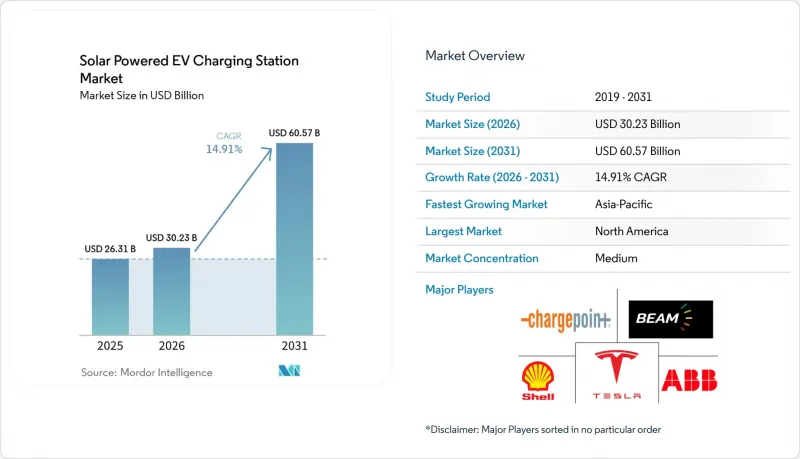
Mordor Intelligence에 의하면, 태양광발전식 EV 충전소 시장 규모는 2025년에 263억 1,000만 달러로 평가되었고 2026년 302억 3,000만 달러에서 2031년까지 605억 7,000만 달러에 이를 것으로 예측되며, 예측 기간(2026-2031년) CAGR은 14.91%를 나타낼 전망입니다.
본 보고서는 유형별(소형·중형 태양광 충전소, 대형 태양광 충전소), 용도별(가정용, 상업용·공공용),충전소유형별(계통 연계형 태양광 충전소, Off-grid형 태양광 충전소), 구성 요소별(EV 충전용 하드웨어, 태양광 어레이 등), 지역별로 분류되어 있습니다. 시장 예측은 금액(달러) 기준으로 제시되어 있습니다.
전 세계 태양광발전식 EV 충전소 시장 동향 및 인사이트
태양광 발전의 균등화 발전 원가(LCOE) 하락
태양광 모듈 비용은 계속해서 하락할 것으로 예상되며, 이에 따라 자가 발전 비용은 소매 전기 요금을 대폭 하회하는 수준이 될 전망입니다. 전기 밴 차량군을 관리하는 디포 운영 사업자의 경우, 더 많은 미국 주에서 양의 순현재가치가 확대되고 있습니다. 미국 남서부에서는 양면 수광형 어레이와 단축 추적기를 결합함으로써 용량 계수가 향상되어, 세액 공제가 없더라도 투자 회수 기간이 단축됩니다. 그러나 고위도 지역에 설치된 설비는 여전히 고정가격임베디드제도(FIT)에 의존하고 있어 이중적인 비용 구조가 발생하고 있습니다. 또한, 하루 부하의 상당 부분을 차지하는 대용량 축전지는 수요 요금에 대한 완충 역할을 합니다. 수요 요금은 뉴욕이나 독일 등의 지역에서 상업용 전기 요금의 상당 부분을 차지하는 경우가 있습니다.
송전망 혼잡에 따른 추가 요금이 BTM(behind-the-meter) 발전을 촉진
PJM의 혼잡 요금이 대폭 상승함에 따라, 시설 소유주들은 과부하 상태인 변전소를 우회하기 위해 태양광발전식 EV 충전소를 도입하고 자가 발전으로 전환하고 있습니다. 한편, 캘리포니아주의 전력 회사는 kW시당 우회 불가능한 요금을 도입하여, 계통으로부터의 전력 수입과 부지 내 태양광 발전 간의 격차를 더욱 확대시키고 있습니다. 유럽에서도 유사한 부담이 발생하고 있습니다. 스페인에서는 재생에너지 접속 대기 시간이 길어지고 있으며, 독일에서는 피크 시간대에 태양광 발전 출력의 일부를 제한했습니다. 이로 인해 특히 물류 거점 지역에서 마이크로그리드 도입이 가속화되고 있습니다. 뉴욕시에서는 계통 연계 지연으로 인해 전력회사의 승인 없이도 전력을 공급할 수 있는 컨테이너형 솔라팟에 대한 수요가 증가하고 있습니다. 사이트별 송전망 강화 비용이 막대한 지역에서는 이러한 재정적 인센티브가 특히 매력적입니다.
일별 태양광 발전의 불안정성과 과잉 용량의 저장 설비 필요성
일조량이 중간 정도인 지역의 운영 사업자는 저녁 충전 피크 시간대와 정오의 태양광 발전 출력이 일치하지 않기 때문에 배터리를 과도하게 대형화할 수밖에 없습니다. 이러한 과잉 설계로 인해 kWh당 추가적인 설비 투자가 발생합니다. 독일에서는 겨울철 태양광 발전 가동률이 낮아, 수요의 상당 부분이 송전망 공급에 의존하게 됩니다. 미국 병설 프로젝트의 대부분을 차지하는 인산철 리튬 배터리는 열화를 억제하기 위한 조치에도 불구하고 여전히 왕복 손실이 발생하고 있습니다. 사하라 이남 아프리카에서는 장기간 흐린 날씨가 이어지기 때문에 디젤 발전 기반의 백업에 대한 의존이 불가피하며, 이 지역의 ‘제로 배출’ 주장에 의문이 제기되고 있습니다.
부문 분석
150kW를 초과하는 대규모 충전소는 연평균 15.22%의 성장률을 보일 것으로 예상되며, 2025년에는 150kW 미만 충전소가 차지하는 매출의 58.12%를 넘어설 전망입니다. 대규모 물류 거점의 태양광발전식 EV 충전소 시장은 상당한 성장이 예상됩니다. 이러한 성장은 주로 더 빠른 충전 속도를 요구하는 물류 차량 수요 증가에 의해 주도되고 있습니다. ChargePoint사는 자본 지출(CAPEX)을 대폭 절감하는 ‘Express Solo’를 도입했습니다. 이 혁신적인 제품은 메가와트급 허브 구현의 길을 열어주어, 아마존이나 UPS와 같은 대기업에게도 도입이 현실적인 선택이 될 것입니다. 부품의 규모의 경제 덕분에 고출력 설비의 경우, 소규모 설비에 비해 자본 지출이 대폭 낮아집니다.
대규모 충전소가 늘어나는 한편, 소규모 유닛은 계속해서 주택 및 소규모 상업시설 수요를 충족시키고 있으며, 야간 충전에는 AC 유닛으로 충분합니다. SolarEdge사의 ‘ONE’ 충전기는 잉여 지붕 발전 전력을 배터리를 거치지 않고 직접 전기차에 공급합니다. 이 혁신적인 기술은 시장의 대부분을 차지하는 일반 가정에게 특히 매력적입니다. 그러나 대규모 시설의 경우 규제 당국의 심사가 엄격해지고 있으며, 특히 캘리포니아주에서는 특정 설치 시설에 대해 CEQA(캘리포니아주 환경 품질법)에 따른 심사가 시작됨에 따라, 기대되었던 규모의 경제 효과 중 일부는 상쇄되고 있습니다. 긍정적인 측면으로는 지멘스의 ‘SICHARGE Flex’와 같은 모듈식 시스템을 통해 사업자가 소규모 설비부터 시작해 단계적으로 확장할 수 있게 되었으며, 인허가 절차가 간소화되었습니다.
2025년 매출액 중 일반 가정이 64.33%를 차지하고 있지만, 상업시설 및 공공시설에서의 도입은 연평균 16.92%의 성장이 예상됩니다. 태양광발전식 EV 충전소 시장은 대폭적인 성장이 예상됩니다. 주요 촉진요인으로는 고용주의 의무화 조치와 ‘타이틀 24’ 건축 기준이 꼽히며, 한편 ‘충전 서비스(Charging-as-a-Service)’ 계약은 설비 투자에 따른 부담을 피하는 데 도움이 됩니다. 전기 요금이 높은 주에서는 다수의 충전 공간을 갖춘 직장 내 카포트가 높은 내부 수익률을 달성하고 있습니다.
주거 부문에서의 보급은 IRA(인플레이션 감축법)의 세액 공제 및 독일 KfW의 리베이트에 힘입어 가속화되고 있습니다. 그러나 개인 진입로가 없는 도시 지역 주민들은 대개 공공 충전소나 직장의 충전기에 의존할 수밖에 없습니다. Enphase사의 ‘IQ’와 같은 양방향 가정용 충전 장치는 정전이 자주 발생하는 전력망에서 복원력을 제공하기 때문에 영국과 미국의 도시 거주자들에게 매력적입니다. 반면, 상업시설은 피크 부하 절감 및 부가 서비스를 통해 혜택을 받는 반면, 주택 소유자는 주로 전기 요금 절감을 중시하고 있어, 이것이 향후 성장률을 억제할 가능성이 있습니다.
지역별 분석
북미는 자본 요건을 대폭 줄이고 견실한 프로젝트 파이프라인을 가져온 IRA 인센티브에 힘입어 2025년 매출의 38.92%를 차지했습니다. 이 지역은 대규모 에너지 저장 용량 통합에 성공했으며, 추가 확장을 목표로 하고 있습니다. 캘리포니아주의 혼잡 요금과 NEM 3.0으로 인해 사업자들은 태양광 발전과 에너지 저장을 결합한 통합형 사이트로의 전환을 촉진받고 있습니다. 다만, 현재 V2G를 통한 전력 공급에 대해 보상을 제공하는 주는 극히 적다는 점은 주목할 만합니다. 캐나다에서는 수요 및 공급 간의 큰 격차가 두드러지고 있으며, 직장용 충전기의 부족 문제에 직면해 있습니다. 한편, 테슬라와 PG&E가 진행한 시범 프로젝트는 업계가 양방향 전력 흐름에 대비가 되어 있음을 보여줍니다.
아시아태평양은 연평균 성장률(CAGR) 15.86%를 기록하며 가장 빠르게 성장하고 있는 지역입니다. 중국은 충전기 설치 대수에 대해 큰 목표를 세웠으며, 이미 그 수를 늘리고 있습니다. 또한, 중국에서는 공공 충전기의 평균 출력도 눈부신 성장을 보이고 있습니다. 인도에서는 PM E-DRIVE가 다수의 충전소에 자금을 배정하고 있으나, 실제 전개는 지연되고 있습니다. 이미 다수의 장치가 도입된 BYD의 급속 충전기는 주요 도시(Tier-1)에서 새로운 충전 속도 기준을 정립하고 있습니다. 일본과 한국은 직장용 충전기 도입을 추진하고 있는 반면, 동남아시아에서는 불안정한 전력망 상황에 대처하기 위해 Off-grid형 충전 포드가 주류를 이루고 있습니다.
유럽의 전기차 충전 환경의 미래는 전력망과의 통합을 위한 노력과 밀접하게 연결되어 있습니다. 독일은 충전기와 관련해 야심 찬 목표를 제시하고 있으며, 프랑스는 막대한 보조금을 약속하고 있습니다. 그러나 스페인과 이탈리아에서는 태양광발전식 EV 충전소 도입이 지연되고 있어 여전히 과제가 남아 있습니다. 긍정적인 측면으로는 ISO 15118-20 및 EU 건축 규정 등의 지침이 직장 내 충전 인프라의 성장을 가속할 것으로 전망됩니다. 영국에서는 자택에 주차 공간이 없는 가구가 수백만 가구에 달하기 때문에 공공 태양광 발전 허브에 대한 수요가 급증하고 있습니다. 또한, BMW와 E.ON의 공동 시범 사업에서는 V2G 주파수 조정 서비스에 매년 투자하고 있습니다.
남미에서는 브라질에서 급속 충전기의 설치가 놀라운 속도로 증가하여, 현재 수많은 지자체에 보급되어 있습니다. BYD는 급속 충전기 확대를 추진하고 있을 뿐만 아니라 아르헨티나에 공장을 건설하고 있습니다. 이 시설을 통해 해당 국가의 현재 충전 네트워크가 대폭 확충될 전망입니다. 또한 지방 주에서는 컨테이너형 태양광 포드가 도입되어, 전력망의 불안정성으로 인한 문제를 효과적으로 해소하고 있습니다.
중동 및 아프리카에서는 태양광 발전 설비가 일사량이 많은 지역에 전략적으로 집중되고 있습니다. 아랍에미리트(UAE)와 사우디아라비아는 주요 관광 거점에 시설을 구축함으로써 이러한 노력을 알리고 있습니다. 남아프리카공화국에서는 지속적인 계획 정전으로 인해 Off-grid 솔루션 도입이 가속화되고 있습니다. 정책적 틀은 아직 초기 단계에 있지만, 케냐의 Enzi나 ABB의 Terra 360과 같은 네트워크가 주목을 받으며 이 지역의 성장세가 높아지고 있음을 보여주고 있습니다.
기타 혜택:
- Excel 형식 시장 예측(ME) 시트
- 3개월간의 애널리스트 지원
자주 묻는 질문
목차
제1장 서론
제2장 분석 방법
제3장 주요 요약
제4장 시장 구도
제5장 시장 규모·성장률 예측
제6장 경쟁 구도
제7장 시장 기회와 향후 전망
JHS 26.09.03According to Mordor Intelligence, the solar powered EV charging station market size was valued at USD 26.31 billion in 2025 and estimated to grow from USD 30.23 billion in 2026 to reach USD 60.57 billion by 2031, at a CAGR of 14.91% during the forecast period (2026-2031).
This report is Segmented by Type (Small and Medium Solar Charging Station, Large Solar Charging Station), Application (Household and Commercial/Public), Station Type (On-Grid Solar Charging Station, Off-Grid Solar Charging Station), Component (EV Charger Hardware, Solar PV Array, and More), and Geography. The Market Forecasts are Provided in Terms of Value (USD).
Global Solar Powered EV Charging Station Market Trends and Insights
Declining Levelized Cost of Solar PV
Solar modules are expected to continue declining in cost, positioning on-site generation significantly below retail tariffs. Depot operators managing fleets of electric vans have seen their positive net present value expand across more U.S. states. In the U.S. Southwest, combining bifacial arrays with single-axis trackers boosts capacity factors, reducing payback periods even without tax credits. However, installations situated in northern latitudes still depend on feed-in premiums, creating a two-tier cost structure. Additionally, oversized battery storage, accounting for a significant percentage of daily load, provides a buffer against demand charges, which can constitute a substantial portion of commercial bills in regions like New York and Germany.
Grid-Congestion Surcharges Driving Behind-the-Meter Generation
PJM congestion fees have increased significantly, prompting site hosts to pivot to self-generation by deploying solar-powered EV charging stations to bypass overloaded substations. Meanwhile, California utilities introduced non-bypassable charges per kilowatt-hour, amplifying the disparity between grid imports and on-site solar. Europe is also experiencing strain: Spain is facing extended wait times for renewables, and Germany curtailed a portion of its solar output during peak hours. This has accelerated the adoption of micro-grids, particularly in logistics hubs. In New York City, delays in interconnection have driven demand for containerized solar pods that can be energized without utility approval. The financial incentives are especially compelling in areas where grid reinforcement costs are substantial per site.
Inter-Day Solar Intermittency and Need for Oversized Storage
Operators in regions with moderate sunlight are compelled to oversize batteries due to the misalignment of evening charging peaks and midday PV output. This oversizing results in an additional capital expenditure per kWh. In Germany, the solar capacity factor during winter means a significant portion of demand depends on the grid supply. While lithium-iron-phosphate chemistries, which constitute a substantial share of U.S. co-located projects, mitigate degradation, they still experience round-trip losses. In sub-Saharan Africa, extended cloudy periods necessitate reliance on diesel backup, casting doubt on the region's zero-emission assertions.
Other drivers and restraints analyzed in the detailed report include:
- Government Net-Metering and IRA-Like Incentives
- Rapid Uptake of Workplace Charging Programs
- Land-Use Permitting Bottlenecks in Urban Areas
For complete list of drivers and restraints, kindly check the Table Of Contents.
Segment Analysis
Large stations above 150 kW are set to grow at 15.22% annually, eclipsing the 58.12% revenue held by sub-150 kW sites in 2025. The market for solar-powered EV charging stations at large depots is set to grow significantly. This growth is largely fueled by logistics fleets increasingly demanding higher charge rates. ChargePoint has introduced the Express Solo, which significantly reduces capital expenditure (capex). This innovation paves the way for megawatt-class hubs, making them feasible for major players like Amazon and UPS. Due to economies of scale in components, capex is considerably lower for higher-rated installations compared to smaller ones.
While larger stations are on the rise, smaller units continue to cater to residential and light-commercial demands, with AC units being adequate for overnight charging. SolarEdge's ONE charger directly channels surplus rooftop energy to the EV, bypassing the need for batteries. This innovation is particularly enticing for households that dominate the market. However, as larger builds face tightening regulatory scrutiny-especially with California's CEQA reviews kicking in for certain installations-some of the anticipated scale advantages are offset. On a brighter note, modular systems like Siemens' SICHARGE Flex allow operators to kick off with a smaller setup and gradually expand, simplifying the permitting process.
Households accounted for 64.33% of 2025 revenue, yet commercial and public deployments are forecast to grow 16.92% per year. The solar-powered EV charging station market is projected to grow significantly. Key drivers include employer mandates and Title 24 codes, while "charging-as-a-service" contracts help sidestep capital expenditure hurdles. In tariff-heavy states, workplace canopies accommodating large numbers of stalls achieve high internal rates.
Residential adoption is bolstered by IRA tax credits and KfW rebates in Germany. However, urban residents without driveways often rely on public or employer chargers. Bidirectional home units, like Enphase's IQ, offer resilience in grids prone to outages, making them appealing to urbanites in the U.K. and U.S. While commercial sites benefit from peak shaving and ancillary services, homeowners primarily value retail bill savings, which may temper future growth rates.
Complete Report Scope:
- By Type
- Small and Medium Solar Charging Station (Less than 150 kW)
- Large Solar Charging Station (More than 150 kW)
- By Application
- Household
- Commercial/Public
- By Station Type
- On-Grid Solar Charging Station
- Off-Grid Solar Charging Station
- By Component
- EV Charger Hardware
- Solar PV Array
- Battery Energy-Storage System (BESS)
- Power Conversion and Controls
- By Geography
- North America
- United States
- Canada
- Rest of North America
- South America
- Brazil
- Argentina
- Rest of South America
- Europe
- Germany
- France
- United Kingdom
- Italy
- Spain
- Rest of Europe
- Asia-Pacific
- China
- Japan
- South Korea
- India
- Rest of Asia-Pacific
- Middle East and Africa
- South Africa
- United Arab Emirates
- Saudi Arabia
- Rest of Middle East and Africa
- North America
Geography Analysis
North America contributed 38.92% of 2025 revenue, buoyed by IRA incentives that slashed capital requirements and led to a robust pipeline. The region successfully integrated substantial storage capacity and has ambitions to further increase it. California's congestion fees, alongside NEM 3.0, have nudged operators towards integrated solar-plus-storage sites. However, it's noteworthy that only a few states currently offer remuneration for V2G exports. Highlighting a significant demand gap, Canada faces a shortfall in workplace chargers. Meanwhile, Tesla and PG&E's pilot projects underscore the industry's readiness for bidirectional flow.
Asia-Pacific is the fastest-growing region, with a 15.86% CAGR. China, eyeing a significant target for chargers, has already increased its count. Additionally, the nation has seen a commendable uptick in the average power of public chargers. In India, while PM E-DRIVE has earmarked funds for numerous stations, the actual rollout is lagging. BYD's flash charger, with an impressive number of units already deployed, is setting new speed standards in Tier-1 cities. Japan and South Korea are advancing workplace charger rollouts, while Southeast Asia is leaning towards off-grid pods to address unreliable grid conditions.
Europe's future in the EV charging landscape is closely tied to grid integration efforts. Germany has set an ambitious goal for chargers, while France has committed substantial subsidies. However, challenges persist as Spain and Italy grapple with delays in deploying their solar-powered EV charging stations. On a brighter note, directives like ISO 15118-20 and EU building regulations are poised to catalyze workplace growth. In the U.K., with millions of households lacking home parking, there's a burgeoning demand for public solar hubs. Additionally, BMW and E.ON's collaborative pilots are investing annually in V2G frequency services.
In South America, Brazil witnessed a staggering surge in fast-charger installations, now reaching numerous municipalities. BYD is not only expanding its footprint with flash chargers but is also setting up a plant in Argentina. This facility is projected to significantly amplify the nation's current network. Furthermore, containerized solar pods are being deployed in rural provinces, effectively sidestepping the challenges posed by unstable grids.
In the Middle East and Africa, installations are strategically concentrated in regions with high solar irradiance. The UAE and Saudi Arabia are showcasing their commitment by deploying sites in prominent tourist hubs. In South Africa, persistent load shedding has accelerated the adoption of off-grid solutions. Despite nascent policy frameworks, networks such as Enzi in Kenya and ABB's Terra 360 are gaining traction, signaling growing momentum in the region.
- ABB Ltd.
- Beam Global
- Tesla Inc.
- ChargePoint, Inc.
- Siemens AG
- Shell plc
- Tritium
- Delta Electronics
- Schneider Electric
- SolarEdge
- Enphase Energy
- Wallbox
- Alfen N.V.
- EVgo
- Volta Charging
Additional Benefits:
- The market estimate (ME) sheet in Excel format
- 3 months of analyst support
TABLE OF CONTENTS
1 Introduction
- 1.1 Study Assumptions and Market Definition
- 1.2 Scope of the Study
2 Research Methodology
3 Executive Summary
4 Market Landscape
- 4.1 Market Overview
- 4.2 Market Drivers
- 4.2.1 Declining Levelized Cost of Solar PV
- 4.2.2 Grid-Congestion Surcharges Driving Behind-the-Meter Generation
- 4.2.3 Government Net-Metering and IRA-Like Incentives
- 4.2.4 Rapid Uptake of Workplace Charging Programs
- 4.2.5 Vehicle-to-Everything (V2X) Monetization Potential
- 4.2.6 Emergence of Containerized, Pre-Fab Solar Charging Pods
- 4.3 Market Restraints
- 4.3.1 Inter-Day Solar Intermittency and Need for Oversized Storage
- 4.3.2 Land-Use Permitting Bottlenecks in Urban Areas
- 4.3.3 Tariff Uncertainty for Bidirectional Export to Grid
- 4.3.4 Raw-Material Price Volatility for Li-ion ESS
- 4.4 Value/Supply-Chain Analysis
- 4.5 Regulatory Landscape
- 4.6 Technological Outlook
- 4.7 Porter's Five Forces
- 4.7.1 Threat of New Entrants
- 4.7.2 Bargaining Power of Suppliers
- 4.7.3 Bargaining Power of Buyers
- 4.7.4 Threat of Substitutes
- 4.7.5 Competitive Rivalry
5 Market Size and Growth Forecasts (Value, USD)
- 5.1 By Type
- 5.1.1 Small and Medium Solar Charging Station (Less than 150 kW)
- 5.1.2 Large Solar Charging Station (More than 150 kW)
- 5.2 By Application
- 5.2.1 Household
- 5.2.2 Commercial/Public
- 5.3 By Station Type
- 5.3.1 On-Grid Solar Charging Station
- 5.3.2 Off-Grid Solar Charging Station
- 5.4 By Component
- 5.4.1 EV Charger Hardware
- 5.4.2 Solar PV Array
- 5.4.3 Battery Energy-Storage System (BESS)
- 5.4.4 Power Conversion and Controls
- 5.5 By Geography
- 5.5.1 North America
- 5.5.1.1 United States
- 5.5.1.2 Canada
- 5.5.1.3 Rest of North America
- 5.5.2 South America
- 5.5.2.1 Brazil
- 5.5.2.2 Argentina
- 5.5.2.3 Rest of South America
- 5.5.3 Europe
- 5.5.3.1 Germany
- 5.5.3.2 France
- 5.5.3.3 United Kingdom
- 5.5.3.4 Italy
- 5.5.3.5 Spain
- 5.5.3.6 Rest of Europe
- 5.5.4 Asia-Pacific
- 5.5.4.1 China
- 5.5.4.2 Japan
- 5.5.4.3 South Korea
- 5.5.4.4 India
- 5.5.4.5 Rest of Asia-Pacific
- 5.5.5 Middle East and Africa
- 5.5.5.1 South Africa
- 5.5.5.2 United Arab Emirates
- 5.5.5.3 Saudi Arabia
- 5.5.5.4 Rest of Middle East and Africa
- 5.5.1 North America
6 Competitive Landscape
- 6.1 Market Concentration
- 6.2 Strategic Moves
- 6.3 Market Share Analysis
- 6.4 Company Profiles (Includes Global Level Overview, Market Level Overview, Core Segments, Financials as Available, Strategic Information, Market Rank/Share for Key Companies, Products and Services, SWOT Analysis, and Recent Developments)
- 6.4.1 ABB Ltd.
- 6.4.2 Beam Global
- 6.4.3 Tesla Inc.
- 6.4.4 ChargePoint, Inc.
- 6.4.5 Siemens AG
- 6.4.6 Shell plc
- 6.4.7 Tritium
- 6.4.8 Delta Electronics
- 6.4.9 Schneider Electric
- 6.4.10 SolarEdge
- 6.4.11 Enphase Energy
- 6.4.12 Wallbox
- 6.4.13 Alfen N.V.
- 6.4.14 EVgo
- 6.4.15 Volta Charging
7 Market Opportunities and Future Outlook
- 7.1 White-Space and Unmet-Need Assessment


