

|
시장보고서
상품코드
2117415
영국의 광산 기계 시장 : 점유율 분석, 산업 동향 및 통계 데이터, 성장 예측(2026-2031년)United Kingdom Mining Equipment - Market Share Analysis, Industry Trends & Statistics, Growth Forecasts (2026 - 2031) |
||||||
 Mordor Intelligence
Mordor Intelligence에 의하면, 영국 광산 기계 시장 규모는 2025년에 8억 9,000만 달러로 평가되었고 2026년 9억 2,000만 달러에서 2031년까지 11억 1,000만 달러에 이를 것으로 추정되고 있어 2026년부터 2031년까지 CAGR 3.78%로 성장할 전망입니다.
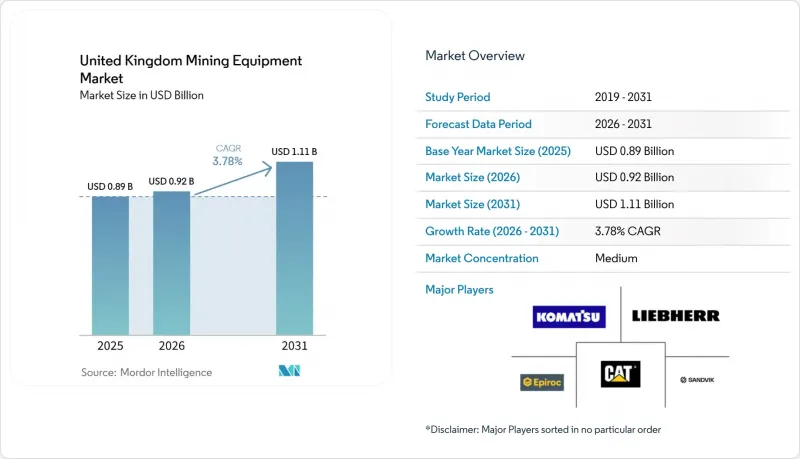
본 보고서는 장비 유형(노천 채굴용 기계, 지하 채굴용 기계 등), 자동화 수준(수동식 기계, 반자동식 기계 등), 파워트레인 유형(내연기관 등), 출력(500 HP 미만 등), 용도(금속 채굴 등) 및 지역별로 분류되어 있습니다. 시장 전망은 금액(달러) 기준으로 제시되어 있습니다.
영국 광산 기계 시장 동향 및 인사이트
배터리용 핵심 금속 수요 증가
리튬 생산을 대폭 늘리겠다는 국가 목표에 따라, 한때 수익성이 없습니다고 여겨졌던 심층 광산 및 지열 프로젝트가 부활하고 있습니다. Cornish Lithium의 최근 자금 조달과 South Crofty의 할당으로 인해 고성능 시추 장비, 수중 펌프, 광물 처리 장비에 대한 투자가 촉진되고 있습니다. 또한, 호조를 보이는 APT 가격에 힘입어 텅스텐 웨스트(Tungsten West)가 추진 중인 헤머던(Hemerdon) 광산 재가동 계획에서는 방대한 자원량을 처리하기 위해 중부하용 로더와 대용량 트럭이 필요해지면서 내마모성 크러셔에 대한 수요가 증가하고 있습니다. 설비 설계도 진화하고 있습니다. 리튬 염수 회로에는 내식성 펌프가 필요한 반면, 텅스텐의 높은 경도로 인해 더욱 에너지 집약적인 파쇄 시스템이 요구되고 있습니다. 또한, 국내 제련 능력 부족으로 인해 구리 스크랩이 대량으로 수출되고 있지만, 지원 정책이 도입된다면 제련 및 전해 제련 라인의 성장 기회가 생길 것입니다.
영국의 ‘중요 광물 전략’에 기반한 정부의 인센티브
막대한 보조금과 국가부유기금(SWF)의 동액 자본 출자로 인해 탐사부터 개발에 이르는 기간이 단축되고 있습니다. 타마 미네랄즈(Tamar Minerals)와 노던 리튬(Northern Lithium)은 시추 작업을 확대하고, 다이아몬드 코어 시추기 및 지구물리 센서의 도입을 가속화하고 있습니다. 앵글로 아메리칸(Anglo American)과 미쓰비시 상사는 우드스미스 폴리하라이트 광산에 막대한 투자를 하고 있으며, 첫 광석이 채굴되기 전부터 건설용 굴삭기 및 갱도 굴삭기에 대한 안정적인 수요가 확보되어 있습니다. OEM(주문자 상표 제조업체) 각사는 현지에 부품 창고를 설치하고 있습니다. 예를 들어, 산드빅사는 레텍사와의 제휴를 확대하여 주요 부품의 리드타임을 대폭 단축했습니다. 그러나 이러한 진전에도 불구하고, 계획 승인은 여전히 병목 현상으로 남아 있습니다. 포레스트 우드 채석장은 치밀한 조사를 거쳐 마침내 승인을 얻었지만, 이는 여전히 기계 납품을 지연시킬 수 있는 과제를 여실히 드러내고 있습니다.
엄격한 환경 허가 및 ESG 심사
환경청에 신청할 때는 현재 종합적인 생태계, 소음, 교통에 관한 조사가 의무화되어 있습니다. 이러한 요건으로 인해 신청 절차가 상당히 길어지고, 현장마다 막대한 컨설팅 비용이 발생할 가능성이 있습니다. 게다가 광업 복원국의 수수료로 인해 비용은 더욱 증가합니다. 금융 기관은 자금을 대출하기 전에 배기가스 및 생물 다양성에 대한 대응책을 포함한 상세한 계획서 제출을 요구하고 있습니다. 또한, 규제 당국의 인력 부족으로 인해 모든 규정 준수 기준을 충족하는 제안서라 하더라도 승인이 지연될 수 있습니다. 이러한 지연으로 인해, 특히 기상 조건으로 인해 현장 작업이 제한되기 전에 공급업체가 장비를 운송할 수 있는 기간이 촉박해집니다.
부문별 분석
2025년, 영국 광산 기계 시장에서 노천 채굴용이 45.27%의 점유율을 차지했습니다. 국내 총 생산량은 높은 생산 수준을 반영하고 있습니다. 이동식 파쇄기 및 스크린은 고정 설비를 대체하는 추세가 강해지고 있습니다. 이러한 추세는 이동식 플랜트가 운송 횟수 감축에 기여하는 주요 인프라 공사 현장에서 특히 두드러집니다. 지하 채굴용 기계는 여전히 틈새 시장이지만, 특히 콘월의 리튬 및 주석 광산과 관련하여 중요한 부문으로 자리 잡고 있습니다. 소유주들이 환경 기준 준수에 필요한 연비 효율 향상을 우선시함에 따라 드릴 및 브레이커의 교체 주기가 짧아지고 있습니다.
로더 시장은 연평균 성장률(CAGR) 6.46%를 나타낼 것으로 예측되며, 이는 영국 광산 기계 시장 전체의 성장을 가속화할 전망입니다. 로몬드 플랜트(Lomond Plant)사가 최근 여러 대의 JCB 장비를 도입하며 진행한 장비 갱신은 이 업계의 규모를 여실히 보여줍니다. 채석장에서는 고출력 로더가 일반적이지만, 헤머던(Hemerdon)과 같은 금속 광산에서는 더욱 고출력인 로더가 도입되기 시작하고 있습니다. 적재량 모니터링, 타이어 공기압 감시 시스템, 공장 출고 시 장착된 자율 주행 키트 등의 기능이 표준화되고 있어 평균 판매 가격 상승에 기여하고 있습니다.
2025년에도 수동식 기계가 68.28%의 시장 점유율을 유지하고 있지만, 완전 자동식 기계는 7.43%라는 가장 높은 연평균 성장률(CAGR)을 기록하며 영국 광산 기계 시장 전체의 성장 궤도를 더욱 향상시킬 전망입니다. 시벨코(Sibelco)에서는 벨(Bell)사의 B40E를 활용한 실증 실험을 통해 운송 비용이 대폭 절감되어, 데본(Devon)과 요크셔(Yorkshire)의 다른 채석장들에게 벤치마크가 되었습니다. 완전 자율화를 위한 예산이 없는 중규모 채석장의 경우, 캐터필러사의 ‘Grade with Assist’와 같은 반자동 방식으로의 업그레이드가 현실적인 대안이 될 것입니다.
커넥티비티나 LiDAR의 초기 비용은 과제로 남아 있지만, 처리 능력이 높은 현장에서는 투자 회수 기간이 짧은 경향이 있어 도입할 가치가 충분합니다. 그러나 영국에는 자율 주행에 관한 독자적인 규정이 존재하지 않아, 사업자는 ISO 17757에 의존할 수밖에 없으며, 책임 문제가 해결되기 전까지는 더 광범위한 도입이 저해되고 있습니다.
기타 혜택:
- Excel 형식 시장 예측(ME) 시트
- 3개월간의 애널리스트 지원
자주 묻는 질문
목차
제1장 서론
제2장 분석 방법
제3장 주요 요약
제4장 시장 구도
제5장 시장 규모·성장률 예측
제6장 경쟁 구도
제7장 시장 기회와 향후 전망
JHS 26.09.03According to Mordor Intelligence, the United Kingdom mining equipment market size was valued at USD 0.89 billion in 2025 and is estimated to grow from USD 0.92 billion in 2026 to reach USD 1.11 billion by 2031, growing at a CAGR of 3.78% over 2026-2031.
This report is Segmented by Equipment Type (Surface Mining Equipment, Underground Mining Equipment, and More), Automation Level (Manual Equipment, Semi-Autonomous Equipment, and More), Powertrain Type (Internal Combustion Engine Vehicles and More), Power Output (Below 500 HP and More), Application (Metal Mining and More), and Geography. The Market Forecasts are Provided in Terms of Value (USD).
United Kingdom Mining Equipment Market Trends and Insights
Growing Demand for Battery-Critical Metals
The national goal of significantly increasing lithium production has revived deep-shaft and geothermal projects once considered uneconomic. Cornish Lithium's recent financing and South Crofty's allocation are driving investment in high-specification drilling rigs, submersible pumps, and mineral processors. Tungsten West's planned Hemerdon restart, supported by favorable APT prices, will require heavy-duty loaders and large-capacity trucks to handle substantial resource volumes, boosting demand for wear-protected crushers. Equipment designs are evolving: lithium-brine circuits now require corrosion-resistant pumps, while tungsten's high hardness necessitates more energy-intensive crushing systems. Additionally, the lack of domestic refining capacity, which has led to significant copper scrap exports, presents opportunities for growth in smelting and electrowinning lines if supportive policies are introduced .
Government Incentives under the UK Critical Minerals Strategy
With a significant grant pool and matched equity from the National Wealth Fund, exploration-to-development timelines are shrinking. Tamar Minerals and Northern Lithium have ramped up their drilling campaigns, hastening the acquisition of diamond-core rigs and geophysical sensors. Anglo American and Mitsubishi are committing substantial investments to the Woodsmith polyhalite mine, ensuring steady demand for construction shovels and shaft-sinking machines even before the first ore is extracted. Original Equipment Manufacturers (OEMs) are setting up localized parts depots; for instance, Sandvik expanded its Retec partnership, significantly reducing lead times for critical components. Yet, despite this progress, planning approval remains a bottleneck. Forest Wood Quarry secured consent only after extensive studies, highlighting the challenges that can still delay equipment deliveries.
Strict Environmental Permitting and ESG Scrutiny
Environmental Agency applications now mandate comprehensive ecological, noise, and traffic studies. These requirements can significantly extend the application process and lead to substantial consultant fees per site. Additionally, charges from the Mining Remediation Authority further increase costs. Institutional lenders require detailed plans before disbursing funds that address emissions and biodiversity. Moreover, staffing backlogs at regulatory bodies delay approvals, even for proposals that meet all compliance standards. This delay compresses the timeframe for suppliers to transport machinery, especially before weather conditions restrict site operations.
Other drivers and restraints analyzed in the detailed report include:
- Fleet Replacement to Meet Stringent Stage V Emission Norms
- Rising Adoption of Autonomous Haulage Systems
- Commodity-Price Volatility Curbing CAPEX Cycles
For complete list of drivers and restraints, kindly check the Table Of Contents.
Segment Analysis
Surface units accounted for 45.27% of the United Kingdom mining equipment market share in 2025. The national aggregate output reflects significant production levels. Mobile crushers and screens are increasingly replacing static installations. This trend is particularly noticeable on major infrastructure worksites, where relocatable plants help reduce haulage runs. Underground machinery remains a niche but valuable segment, especially in connection with lithium and tin shafts in Cornwall. Drills and breakers are experiencing shorter replacement cycles as owners prioritize fuel-efficiency improvements required for compliance with environmental standards.
Loaders are forecast to grow at a 6.46% CAGR, accelerating overall United Kingdom mining equipment market growth. Lomond Plant's recent fleet renewal, featuring multiple JCB units, underscores the industry's scale. In quarries, high-powered loaders are the norm, whereas metal pits, like Hemerdon, are now seeing the entry of even more powerful loaders. Features like payload monitoring, tire-pressure systems, and factory-fitted autonomy kits are becoming standard, contributing to higher average selling prices.
Manual units retained 68.28% market share in 2025, yet fully autonomous machines will post the fastest 7.43% CAGR, improving the overall trajectory of the United Kingdom mining equipment market. At Sibelco, Bell's B40E demonstration significantly reduced haul costs, setting a benchmark for other pits in Devon and Yorkshire. For mid-tier quarries without the budget for full autonomy, semi-autonomous upgrades like Caterpillar's Grade with Assist serve as a practical alternative.
While the initial costs for connectivity and LiDAR pose challenges, sites with high throughput often see rapid returns on investment, making the adoption worthwhile. However, the absence of UK-specific autonomous regulations means operators lean on ISO 17757, hindering broader adoption until liability concerns are addressed.
Complete Report Scope:
- By Equipment Type
- Surface Mining Equipment
- Underground Mining Equipment
- Mineral Processing Equipment
- Drills and Breakers
- Crushing, Pulverizing and Screening Equipment
- Loaders
- Mining Trucks
- By Automation Level
- Manual Equipment
- Semi-Autonomous Equipment
- Fully Autonomous Equipment
- By Powertrain Type
- Internal-Combustion Engine Vehicles
- Battery-Electric Vehicles
- Hybrid Vehicles
- By Power Output
- Below 500 HP
- 500 - 1,000 HP
- Above 1,000 HP
- By Application
- Metal Mining
- Mineral Mining
- Coal Mining
- By Geography
- England
- Scotland
- Wales
- Northern Ireland
List of Companies Covered in this Report:
- Caterpillar Inc.
- Komatsu Ltd.
- Sandvik AB
- Epiroc AB
- Liebherr Group
- Hitachi Construction Machinery Co. Ltd.
- AB Volvo (Volvo Construction Equipment)
- J.C. Bamford Excavators Limited
- Bell Equipment UK Ltd.
- Atlas Copco AB
- Terex Corp.
- HD Hyundai Infracore
- Sany Heavy Industry Co. Ltd.
- XCMG Group
- Metso Corporation
- thyssenkrupp Mining Technologies
- Normet UK Ltd.
- Weir Group PLC (UK)
- Wirtgen Group (John Deere)
Additional Benefits:
- The market estimate (ME) sheet in Excel format
- 3 months of analyst support
TABLE OF CONTENTS
1 Introduction
- 1.1 Study Assumptions & Market Definition
- 1.2 Scope of the Study
2 Research Methodology
3 Executive Summary
4 Market Landscape
- 4.1 Market Overview
- 4.2 Market Drivers
- 4.2.1 Growing Demand for Battery-Critical Metals
- 4.2.2 Government Incentives Under the UK Critical Minerals Strategy
- 4.2.3 Fleet Replacement to Meet Stringent Stage V Emission Norms
- 4.2.4 Rising Adoption of Autonomous Haulage Systems
- 4.2.5 Repurposing Legacy Mine Sites for Geothermal and Critical-Metal Extraction
- 4.2.6 Surge In Aggregates Demand From HS2 and Offshore-Wind Foundations
- 4.3 Market Restraints
- 4.3.1 Strict Environmental Permitting and ESG Scrutiny
- 4.3.2 Commodity-Price Volatility Curbing CAPEX Cycles
- 4.3.3 Shortage of UK Technicians for Advanced Automation
- 4.3.4 Post-Brexit Investment-Confidence Gap
- 4.4 Value / Supply-Chain Analysis
- 4.5 Regulatory Landscape
- 4.6 Technological Outlook
- 4.7 Porter's Five Forces
- 4.7.1 Threat of New Entrants
- 4.7.2 Bargaining Power of Buyers
- 4.7.3 Bargaining Power of Suppliers
- 4.7.4 Threat of Substitutes
- 4.7.5 Competitive Rivalry
5 Market Size & Growth Forecasts (Value, USD)
- 5.1 By Equipment Type
- 5.1.1 Surface Mining Equipment
- 5.1.2 Underground Mining Equipment
- 5.1.3 Mineral Processing Equipment
- 5.1.4 Drills and Breakers
- 5.1.5 Crushing, Pulverizing and Screening Equipment
- 5.1.6 Loaders
- 5.1.7 Mining Trucks
- 5.2 By Automation Level
- 5.2.1 Manual Equipment
- 5.2.2 Semi-Autonomous Equipment
- 5.2.3 Fully Autonomous Equipment
- 5.3 By Powertrain Type
- 5.3.1 Internal-Combustion Engine Vehicles
- 5.3.2 Battery-Electric Vehicles
- 5.3.3 Hybrid Vehicles
- 5.4 By Power Output
- 5.4.1 Below 500 HP
- 5.4.2 500 - 1,000 HP
- 5.4.3 Above 1,000 HP
- 5.5 By Application
- 5.5.1 Metal Mining
- 5.5.2 Mineral Mining
- 5.5.3 Coal Mining
- 5.6 By Geography
- 5.6.1 England
- 5.6.2 Scotland
- 5.6.3 Wales
- 5.6.4 Northern Ireland
6 Competitive Landscape
- 6.1 Market Concentration
- 6.2 Strategic Moves
- 6.3 Market Share Analysis
- 6.4 Company Profiles (Includes Global level Overview, Market level overview, Core Segments, Financials as available, Strategic Information, Market Rank/Share for key companies, Products & Services, and Recent Developments)
- 6.4.1 Caterpillar Inc.
- 6.4.2 Komatsu Ltd.
- 6.4.3 Sandvik AB
- 6.4.4 Epiroc AB
- 6.4.5 Liebherr Group
- 6.4.6 Hitachi Construction Machinery Co. Ltd.
- 6.4.7 AB Volvo (Volvo Construction Equipment)
- 6.4.8 J.C. Bamford Excavators Limited
- 6.4.9 Bell Equipment UK Ltd.
- 6.4.10 Atlas Copco AB
- 6.4.11 Terex Corp.
- 6.4.12 HD Hyundai Infracore
- 6.4.13 Sany Heavy Industry Co. Ltd.
- 6.4.14 XCMG Group
- 6.4.15 Metso Corporation
- 6.4.16 thyssenkrupp Mining Technologies
- 6.4.17 Normet UK Ltd.
- 6.4.18 Weir Group PLC (UK)
- 6.4.19 Wirtgen Group (John Deere)


