

|
시장보고서
상품코드
2117435
가솔린 직접 분사 시장 : 점유율 분석, 산업 동향 및 통계 데이터, 성장 예측(2026-2031년)Gasoline Direct Injection - Market Share Analysis, Industry Trends & Statistics, Growth Forecasts (2026 - 2031) |
||||||
 Mordor Intelligence
Mordor Intelligence에 의하면, 가솔린 직접 분사(GDI) 시장 규모는 2025년에 94억 7,000만 달러로 평가되었고 2026년 101억 9,000만 달러에서 2031년까지 147억 1,000만 달러에 이를 것으로 추정되고 있어 예측 기간(2026-2031년) CAGR은 7.61%를 나타낼 전망입니다.
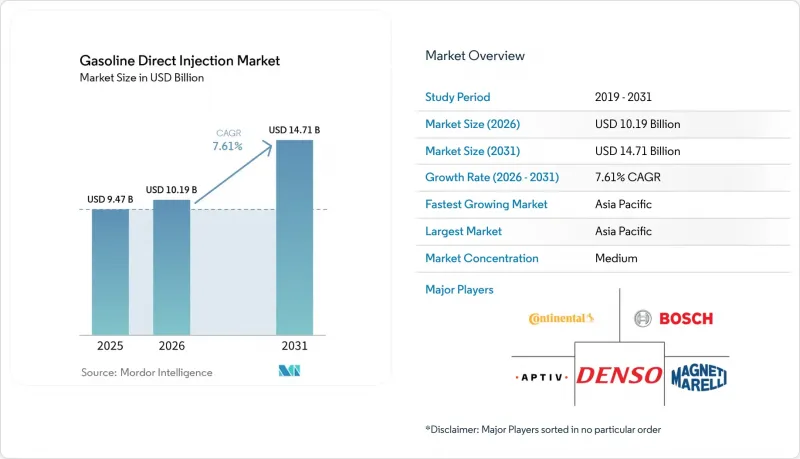
본 보고서는 구성 요소(연료 분사 장치 등), 엔진 유형(직렬 3기통 등), 차종(해치백 등), 판매 채널(OEM, 애프터마켓) 및 지역별로 분류되어 있습니다. 시장 예측은 금액(미 달러) 기준으로 제시되어 있습니다.
세계 가솔린 직접 분사 시장 동향 및 인사이트
배출 가스 및 연비 기준의 강화
Euro 7 PN10, 중국의 GB 19578-2024, 미국 EPA의 Tier 3 규제와 같은 새로운 기준으로 인해 각 OEM 업체들은 멀티 펄스 전략 및 가솔린 미립자 필터의 채택을 피할 수 없게 되었습니다. 차량 연비 모니터링으로 인해 모든 차량이 ‘주행 중 감사 대상’이 됨에 따라, 폐쇄 루프식 고압 시스템에 대한 규정 준수 프리미엄이 발생하고 있습니다. 이에 대응하여 공급업체들은 중복 람다 프로브와 입자 센서를 추가하고 있으며, 차량당 센서 장착 수가 증가하고 있습니다. 2027년에는 인도에서도 ‘Bharat Stage VI Phase 3’가 도입되어 입자상 물질 배출 제한이 강화되는 동시에, 실제 주행 사이클에 기반한 배기가스 시험이 의무화됩니다. 이러한 지역을 아우르는 동시적인 움직임으로 인해 개발 일정이 단축되면서, Tier 1 공급업체들은 350바급 인젝터 생산 능력 확대를 서둘러야 하는 상황에 놓여 있습니다.
OEM의 엔진 다운사이징 및 터보차저 채택
자동차 제조업체들이 풀 하이브리드의 비용을 부담하지 않으면서 차종 전체의 CO2 배출량 목표를 달성하기 위해 노력하는 가운데, 3기통 및 소형 4기통 터보 엔진이 배기량이 더 큰 엔진을 대체하며 급속히 보급되고 있습니다. 스텔란티스의 2.0리터 ‘허리케인 4’와 토요타의 2.0리터 터보 엔진은 350바의 직접 분사, 프리챔버 점화, 합성 연료 대응을 통해 V6에 필적하는 출력을 실현하면서도 두 자릿수의 연비 향상을 가져온다는 것을 보여주고 있습니다. 직렬 3기통 엔진은 NVH(소음·진동·거칠기) 문제가 있기는 하지만, 현재 중국과 유럽의 주류인 A/B 부문 모델에 탑재되고 있습니다. 가변 용량식 연료 펌프와 압전식 인젝터는 이러한 다운사이징된 엔진에 필요한 고압 및 다회 분사를 지원하며, 그렇지 않았다면 배터리식 전기차로 직접 전환되었을 가능성이 있는 부문에서도 가솔린 직접 분사 시장의 존재 의의를 유지하고 있습니다.
승용차의 급속한 전동화
향후 몇 년 동안 전기차(EV)는 일일 석유 소비량을 대폭 줄일 것으로 예상되며, 이에 따라 내연기관(ICE) 시장은 축소될 전망입니다. 중국의 NEV 크레딧은 가까운 시일 내에 대폭 증가할 것으로 예측됩니다. 한편, 유럽은 향후 10년 이내에 전기차 시장 점유율에서 압도적인 위치를 확립하는 것을 목표로 하고 있으며, 미국도 같은 기간 동안 전기차로의 전환을 대폭 추진할 계획입니다. 이러한 움직임으로 인해 연구개발 투자는 배터리 시스템으로 이동하고 있으며, 차세대 인젝터는 뒷전으로 밀려나고 있습니다. 이러한 추세로 인해 하이브리드 차량에는 이 기술이 계속해서 채택되고 있음에도 불구하고, 가솔린 직접 분사 시장의 성장은 제한되고 있습니다. 공급업체들은 현재 내연기관 관련 수익원을 확보하는 동시에 전동 구동 제품의 라인업을 확대하는 전략적 전환을 요구받고 있습니다.
부문 분석
유로 7 및 미국의 OBD III 규제는 연료-공기 비율과 미세먼지 배출량을 실시간으로 모니터링할 것을 의무화하고 있어, 센서 제품군에 대한 수요가 확대되었습니다. 연료 인젝터는 단가가 높기 때문에 2025년 매출의 38.81%를 차지했지만, 센서 매출은 연평균 성장률(CAGR) 7.63%로 다른 모든 부품을 능가하는 속도로 성장할 전망입니다. 이러한 추세에 따라 각 OEM 업체들이 와이드밴드 람다 프로브, PM 센서, 레일 내압 트랜스듀서를 도입함에 따라 가솔린 직접 분사 시장의 센서 시장 규모는 확대될 것입니다.
고급차의 경우, 피에조식 인젝터가 솔레노이드식 인젝터를 꾸준히 대체하고 있습니다. 콘티넨탈사의 레일 압력 센서는 넓은 온도 범위에서 높은 정밀도를 발휘합니다. 이러한 센서들은 첨단 전자 제어 장치(ECU)에 내장된 적응형 맵을 지원합니다. 또한, 산소 센서의 노후화나 질량 공기 유량계 시스템의 오염으로 인해 림프 홈(Limp Home) 기능의 작동이 방해받을 수 있습니다. 이로 인해 애프터마켓 수요가 증가하고 있으며, 차량의 전체 수명 주기 동안 가솔린 직접 분사 시장을 뒷받침하는 서비스 수익을 창출하고 있습니다.
2025년 부문 가치에서 직렬 4기통 엔진은 67.73%를 차지했으나, 중국과 유럽의 엄격한 차량 평균 CO₂ 배출량 규제로 인해 3기통 터보 엔진이 성장의 주역이 되어 2031년까지 GDI 시장 점유율을 확대되고 있습니다. 스텔란티스와 토요타의 사례는 350바의 GDI와 프리챔버 점화를 통해 소형 블록에서도 V6에 필적하는 성능을 이끌어낼 수 있음을 보여줍니다.
한때 직렬 3기통 엔진의 매력을 제한했던 NVH(소음·진동·거칠기) 문제는 밸런스 샤프트와 액티브 마운트를 통해 완화되었으며, 이 시장은 2031년까지 연평균 성장률(CAGR) 7.66%로 확대되고 있습니다. 포드의 1.0리터 EcoBoost와 폭스바겐의 1.0리터 TSI가 초기 벤치마크를 확립했으며, 공급업체들은 높은 BMEP(비기계적 유효압) 운전에 대응하기 위해 크랭크샤프트, 펌프, 인젝터의 규모 확대를 추진하고 있습니다. V6 및 V8 엔진은 견인 능력과 브랜드의 전통이 여전히 프리미엄 가격을 정당화하는 픽업 트럭 및 고성능 SUV 분야로 이동하고 있습니다.
지역별 분석
아시아태평양은 2025년 지역별 매출의 36.48%를 차지하며, 2031년까지 연평균 성장률(CAGR) 7.71%를 기록하여 가솔린 직접 분사 시장의 성장을 주도하는 지역이 되고 있습니다. 인도의 승용차 판매 대수가 사상 최고치를 기록하고, E20이 도입되며, SUV 수요가 지속됨에 따라 현지 공급업체들은 내식성 인젝터와 적응형 에탄올 매핑을 채택할 수밖에 없는 상황입니다. 2025년 초, 중국의 하이브리드 차량 수출이 급증하면서, 특히 충전 인프라가 미비한 지역에서 레인지 익스텐더 설계에 있어 가솔린 직접 분사 엔진(GDI)의 매우 중요한 역할이 부각되었습니다.
2025년, 유럽은 시장에서 두드러진 점유율을 차지했습니다. 그러나 유로 7 규제에 대한 대응 및 엄격한 전기차 도입 의무에 따른 비용이 판매 대수 증가를 억제하고 있습니다. 이에 대응하기 위해 OEM은 GDI와 48V 마일드 하이브리드를 통합하고 있습니다. 이 조합을 통해 엔진 정지 시의 관성 주행과 즉각적인 재시동이 가능해지며, 플러그인 방식의 구성 요소 없이도 효율을 향상시킬 수 있습니다. 북미에서도, 특히 프리미엄 SUV나 픽업트럭에서 유사한 접근 방식이 채택되고 있습니다. 이곳에서는 견인 작업 주기 내 수요가 가솔린 엔진 사용을 정당화하여, 가솔린 직접 분사 엔진, 고압 인젝터 및 미립자 필터 시장 점유율을 끌어올리고 있습니다.
남미에서는 브라질의 플렉스 연료 차량이 주도적인 역할을 하고 있으며, 중동 및 아프리카와 함께 나머지 수익원을 구성하고 있습니다. 브라질에서는 에탄올이 혼합된 가솔린을 사용하기 때문에 에탄올의 낮은 에너지 밀도를 보완하기 위해 더 높은 유량을 공급할 수 있는 인젝터가 필요합니다. 이러한 요구 사항으로 인해 플렉스 연료 전용 GDI 생산 라인이 강화되고 있습니다. 한편, 전동화가 여전히 탄력을 받고 있는 걸프협력회의(GCC) 국가들에서는 수입된 가솔린 SUV가 잘 구축된 애프터마켓 네트워크의 혜택을 누리고 있습니다. 이러한 네트워크는 시스템의 수명을 연장할 뿐만 아니라, 가솔린 직접 분사 시장에 추가적인 수익을 가져다주고 있습니다.
기타 혜택:
- Excel 형식 시장 예측(ME) 시트
- 3개월간의 애널리스트 지원
자주 묻는 질문
목차
제1장 서론
제2장 분석 방법
제3장 주요 요약
제4장 시장 구도
제5장 시장 규모·성장률 예측
제6장 경쟁 구도
제7장 시장 기회와 향후 전망
JHS 26.09.03According to Mordor Intelligence, the gasoline direct injection market size was valued at USD 9.47 billion in 2025 and is estimated to grow from USD 10.19 billion in 2026 to reach USD 14.71 billion by 2031, at a CAGR of 7.61% during the forecast period (2026-2031).
This report is Segmented by Component (Fuel Injectors and More), Engine Type (Inline-3 and More), Vehicle Type (Hatchback and More), Sales Channel (OEM and Aftermarket), and Geography. The Market Forecasts are Provided in Terms of Value (USD).
Global Gasoline Direct Injection Market Trends and Insights
Stricter Emission & Fuel-Economy Standards
New standards such as Euro 7 PN10, China's GB 19578-2024, and the U.S. EPA Tier 3 rule are forcing OEMs to adopt multi-pulse strategies and gasoline particulate filters . On-board fuel-consumption monitoring makes every vehicle a rolling audit, creating a compliance premium for closed-loop, high-pressure systems. Suppliers are responding by adding redundant lambda probes and particulate sensors, raising sensor content per vehicle. Bharat Stage VI Phase 3 will extend this standard to India in 2027, tightening particulate limits and mandating real-driving-cycle emissions testing. The synchronous effect across regions compresses development timelines and pushes Tier-1s to expand 350-bar injector capacity .
OEM Engine Downsizing & Turbocharging
Three-cylinder and small four-cylinder turbos are rapidly replacing larger-displacement units as automakers chase fleet CO2 targets without incurring full-hybrid costs. Stellantis's 2.0-liter Hurricane 4 and Toyota's 2.0-liter turbo show how 350-bar direct injection, pre-chamber ignition, and synthetic-fuel readiness can deliver V6-level output with double-digit fuel savings. Inline-3 engines, despite NVH challenges, now power mainstream A/B-segment models in China and Europe. Variable-displacement fuel pumps and piezoelectric injectors support the high pressure and multiple injections these downsized engines require, keeping the gasoline direct injection market relevant in segments that might otherwise migrate straight to battery-electric alternatives.
Rapid Electrification of Passenger Vehicles
EVs are expected to significantly reduce daily oil consumption in the coming years, thereby shrinking the market for internal combustion engines (ICE). China's NEV credit is projected to increase substantially in the near future. Meanwhile, Europe aims to achieve a dominant EV market share within the next decade, and the U.S. targets a significant shift toward EV adoption during the same period. These initiatives are steering R&D investments towards battery systems, sidelining next-gen injectors. This trend limits growth for the gasoline direct injection market, even as hybrids continue to utilize the technology. Suppliers are now tasked with a strategic shift: safeguarding their combustion revenue streams while expanding their electric-drive product offerings.
Other drivers and restraints analyzed in the detailed report include:
- Growing Gasoline-Vehicle Production in Asia-Pacific
- High-Pressure (>=350 bar) Injection Systems
- Intake-Valve Carbon Build-Up Warranty Risk
For complete list of drivers and restraints, kindly check the Table Of Contents.
Segment Analysis
Sensor suites gained momentum because Euro 7 and U.S. OBD III rules require real-time monitoring of fuel-air ratios and particulate output. Fuel injectors still accounted for 38.81% of 2025 revenue due to their high unit pricing, but sensor sales will outpace all other components at a 7.63% CAGR. That trajectory lifts the gasoline direct injection market size for sensors as OEMs deploy wideband lambda probes, PM sensors, and on-rail pressure transducers.
In premium cars, piezoelectric injectors are steadily replacing their solenoid counterparts. Continental's rail-pressure sensors offer high accuracy across a wide temperature range. These sensors back adaptive maps housed in advanced electronic control units. Additionally, as oxygen sensors age and mass airflow systems become fouled, they hinder limp-home strategies. This has spurred a growing aftermarket demand, generating service revenue that bolsters the gasoline direct injection market throughout a vehicle's lifecycle.
Inline-4 engines held 67.73% of the 2025 segment value, but tough fleet-average CO2 caps in China and Europe make three-cylinder turbos the growth story, lifting their share of the gasoline direct-injection market through 2031. Stellantis and Toyota examples show how 350-bar GDI and pre-chamber ignition can deliver V6 performance from small blocks.
NVH hurdles that once limited the inline-3's appeal are mitigated by balance shafts and active mounts, which are growing at a 7.66% CAGR through 2031. Ford's 1.0-liter EcoBoost and Volkswagen's 1.0-liter TSI set early benchmarks, encouraging suppliers to scale crankshafts, pumps, and injectors for high BMEP operation. V6 and V8 designs retreat to pickups and performance SUVs, where towing and brand heritage still command premium pricing.
Complete Report Scope:
- By Component
- Fuel Injectors
- Engine Control Units (ECUs)
- Sensors
- Fuel Pumps
- Fuel Rails
- By Engine Type
- Inline-3 (I3)
- Inline-4 (I4)
- V6
- V8
- By Vehicle Type
- Hatchback
- Sedan
- SUVs/MUVs
- Van
- Pick-up Truck
- By Sales Channel
- OEM
- Aftermarket
- By Geography
- North America
- United States
- Canada
- Rest of North America
- South America
- Brazil
- Argentina
- Rest of South America
- Europe
- United Kingdom
- Germany
- Spain
- Italy
- France
- Russia
- Rest of Europe
- Asia-Pacific
- India
- China
- Japan
- South Korea
- Rest of Asia-Pacific
- Middle East and Africa
- United Arab Emirates
- Saudi Arabia
- Turkey
- Egypt
- South Africa
- Rest of Middle East and Africa
- North America
Geography Analysis
Asia-Pacific generated 36.48% of 2025 regional revenue, and a 7.71% CAGR to 2031 makes it the geographic engine for the gasoline direct injection market. India's record passenger-vehicle sales, the E20 rollout, and sustained SUV demand are forcing local suppliers to adopt corrosion-resistant injectors and adaptive ethanol mapping. China's hybrid exports surged in the early part of 2025, underscoring the pivotal role of Gasoline Direct Injection (GDI) in range-extender designs, especially in regions with underdeveloped charging infrastructure.
In 2025, Europe commanded a notable share of the market. However, the costs associated with Euro 7 compliance and stringent EV mandates have tempered volume growth. In response, Original Equipment Manufacturers (OEMs) are integrating GDI with 48-V mild hybrids. This combination facilitates engine-off coasting and immediate restarts, enhancing efficiency without the need for plug-in components. North America is adopting a similar approach, especially in premium SUVs and pickups. Here, the demands of towing duty cycles validate the use of gasoline engines, bolstering the market share of gasoline direct injection, high-pressure injectors, and particulate filters.
South America, spearheaded by Brazil's flex-fuel vehicles, alongside the Middle East and Africa, rounds out the remaining revenue contributions. In Brazil, the use of gasoline blended with ethanol requires injectors to deliver higher flow rates to compensate for ethanol's lower energy density. This requirement bolsters the dedicated flex-fuel GDI production lines. Meanwhile, in the Gulf Cooperation Council nations, where electrification is still gaining momentum, imported gasoline SUVs benefit from robust aftermarket networks. These networks not only extend the system's lifespan but also generate additional revenue for the gasoline direct-injection market.
- Robert Bosch GmbH
- Denso Corporation
- Continental AG
- Aptiv PLC
- Magneti Marelli S.p.A.
- Hitachi Astemo Ltd.
- Keihin Corporation
- Stanadyne LLC
- Eaton Corporation
- Infineon Technologies AG
- TI Fluid Systems
- BorgWarner Inc.
- Orbital Corporation Ltd.
- Airtex Products
- Holley Performance Products
- Helio Precision Products
- MSR Technologies
- Motonic Corporation
- Raydiance Inc.
Additional Benefits:
- The market estimate (ME) sheet in Excel format
- 3 months of analyst support
TABLE OF CONTENTS
1 Introduction
- 1.1 Study Assumptions & Market Definition
- 1.2 Scope of the Study
2 Research Methodology
3 Executive Summary
4 Market Landscape
- 4.1 Market Overview
- 4.2 Market Drivers
- 4.2.1 Stricter Emission & Fuel-Economy Standards
- 4.2.2 OEM Engine Downsizing & Turbocharging
- 4.2.3 Growing Gasoline-Vehicle Production In Apac
- 4.2.4 Integration Of Gdi In Hybrid Powertrains
- 4.2.5 High-Pressure (more than or equal to 350 Bar) Injection Systems
- 4.2.6 Edge-Computing Ecus & Ota Fuel Mapping
- 4.3 Market Restraints
- 4.3.1 Rapid Electrification Of Passenger Vehicles
- 4.3.2 High Cost & Maintenance Complexity
- 4.3.3 Intake-Valve Carbon Build-Up Warranty Risk
- 4.3.4 Future PN Regulations Raising Compliance Costs
- 4.4 Value / Supply-Chain Analysis
- 4.5 Regulatory Landscape
- 4.6 Technological Outlook
- 4.7 Porter's Five Forces
- 4.7.1 Threat of New Entrants
- 4.7.2 Bargaining Power of Suppliers
- 4.7.3 Bargaining Power of Buyers
- 4.7.4 Threat of Substitutes
- 4.7.5 Competitive Rivalry
5 Market Size & Growth Forecasts (Value (USD))
- 5.1 By Component
- 5.1.1 Fuel Injectors
- 5.1.2 Engine Control Units (ECUs)
- 5.1.3 Sensors
- 5.1.4 Fuel Pumps
- 5.1.5 Fuel Rails
- 5.2 By Engine Type
- 5.2.1 Inline-3 (I3)
- 5.2.2 Inline-4 (I4)
- 5.2.3 V6
- 5.2.4 V8
- 5.3 By Vehicle Type
- 5.3.1 Hatchback
- 5.3.2 Sedan
- 5.3.3 SUVs/MUVs
- 5.3.4 Van
- 5.3.5 Pick-up Truck
- 5.4 By Sales Channel
- 5.4.1 OEM
- 5.4.2 Aftermarket
- 5.5 By Geography
- 5.5.1 North America
- 5.5.1.1 United States
- 5.5.1.2 Canada
- 5.5.1.3 Rest of North America
- 5.5.2 South America
- 5.5.2.1 Brazil
- 5.5.2.2 Argentina
- 5.5.2.3 Rest of South America
- 5.5.3 Europe
- 5.5.3.1 United Kingdom
- 5.5.3.2 Germany
- 5.5.3.3 Spain
- 5.5.3.4 Italy
- 5.5.3.5 France
- 5.5.3.6 Russia
- 5.5.3.7 Rest of Europe
- 5.5.4 Asia-Pacific
- 5.5.4.1 India
- 5.5.4.2 China
- 5.5.4.3 Japan
- 5.5.4.4 South Korea
- 5.5.4.5 Rest of Asia-Pacific
- 5.5.5 Middle East and Africa
- 5.5.5.1 United Arab Emirates
- 5.5.5.2 Saudi Arabia
- 5.5.5.3 Turkey
- 5.5.5.4 Egypt
- 5.5.5.5 South Africa
- 5.5.5.6 Rest of Middle East and Africa
- 5.5.1 North America
6 Competitive Landscape
- 6.1 Market Concentration
- 6.2 Strategic Moves
- 6.3 Market Share Analysis
- 6.4 Company Profiles (includes Global Level Overview, Market Level Overview, Core Segments, Financials as Available, Strategic Information, Market Rank/Share for Key Companies, Products and Services, SWOT Analysis, and Recent Developments)
- 6.4.1 Robert Bosch GmbH
- 6.4.2 Denso Corporation
- 6.4.3 Continental AG
- 6.4.4 Aptiv PLC
- 6.4.5 Magneti Marelli S.p.A.
- 6.4.6 Hitachi Astemo Ltd.
- 6.4.7 Keihin Corporation
- 6.4.8 Stanadyne LLC
- 6.4.9 Eaton Corporation
- 6.4.10 Infineon Technologies AG
- 6.4.11 TI Fluid Systems
- 6.4.12 BorgWarner Inc.
- 6.4.13 Orbital Corporation Ltd.
- 6.4.14 Airtex Products
- 6.4.15 Holley Performance Products
- 6.4.16 Helio Precision Products
- 6.4.17 MSR Technologies
- 6.4.18 Motonic Corporation
- 6.4.19 Raydiance Inc.
7 Market Opportunities & Future Outlook
- 7.1 White-space & Unmet-Need Assessment


