

|
시장보고서
상품코드
2117438
수소 트럭 시장 : 점유율 분석, 업계 동향과 통계, 성장 예측(2026-2031년)Hydrogen Truck - Market Share Analysis, Industry Trends & Statistics, Growth Forecasts (2026 - 2031) |
||||||
 Mordor Intelligence
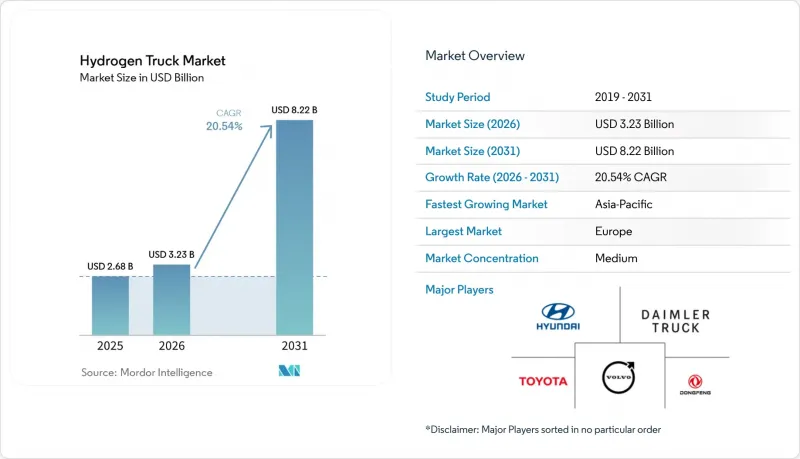
Mordor Intelligence에 의하면, 수소 트럭 시장 규모는 2025년에 26억 8,000만 달러로 평가되었고 2026년에는 32억 3,000만 달러, 2031년까지 82억 2,000만 달러에 이를 것으로 예상되고 있어 2026년부터 2031년까지 CAGR 20.54%로 성장할 전망입니다.
본 보고서는 적재량별(3.5-7.5톤, 7.5-16톤 및 그 이상), 주행 거리(300마일 미만, 300-500마일 및 그 이상), 용도(물류, 건설 및 기타), 소유 형태(플릿 운영사, 개인 소유주), 차체 유형(플랫베드, 박스 트럭, 기타), 지역별로 분류되어 있습니다. 시장 전망은 금액(미 달러) 및 수량(대)으로 제시되어 있습니다.
전 세계 수소 트럭 시장 동향 및 인사이트
그린 수소의 LCOH(수소 균등화 비용)의 급격한 하락
청정 수소의 비용 목표가 더 이상 먼 미래의 목표로만 여겨지지 않게 됨에 따라, 수소 트럭 시장의 실현 가능성이 높아지고 있습니다. 미국 에너지부는 현재 규모 확대, 효율화 및 재생 가능 전력 투입 비용 절감을 통해 2026년까지 2달러/kg, 2031년까지 1달러/kg을 달성하는 것을 목표로 하고 있습니다. 이러한 변화는 중요한 의미를 지닙니다. 왜냐하면 연료비는 트럭 운영 경제성의 핵심을 차지하고 있으며, 수소 공급 가격에서 부분적인 진전만 있어도 수소 트럭 시장의 광범위한 보급을 제한해 온 비용 격차를 대폭 줄일 수 있기 때문입니다. 또한, 수소 트럭 시장에서는 뚜렷한 지역 격차도 나타납니다. 재생에너지가 풍부한 지역은 전기 요금이 높은 수준을 유지하거나 가격 변동이 심한 지역에 비해 실용적인 경제성을 더 빨리 달성할 수 있으므로, 상업적 도입은 국가별로 고르게 확산되기보다는 우선 저비용 전력 공급 지역을 중심으로 집중될 가능성이 높기 때문입니다. 이러한 경향은 전용 노선이나 회랑 계획의 유효성을 뒷받침합니다. 왜냐하면 유리한 현지 수소 생산에 접근할 수 있는 사업자는 비용이 높은 지역에서의 트럭 운송에 의존하는 사업자보다 더 빠르고 안정적인 차량 운용 경제성을 실현할 수 있기 때문입니다. 그 결과, 수소 트럭 시장에서는 수소 조달을 별개의 하류 문제로 다루기보다는 차량과 지역 내 생산·공급을 결합한 프로젝트 개발자가 성공할 가능성이 높을 것입니다. 또한 이는 보조금이 없는 초기 성공 사례가 전국적인 고속도로망 전체로의 확대보다는 소수의 유리한 물류 거점에서 나올 가능성이 높다는 것을 의미합니다.
제로 배출 화물 회랑의 확대
수소 트럭 시장은 회랑 기반의 도입 모델로부터 지지를 얻고 있습니다. 이는 정부가 대형 차량의 이용에 대응할 수 없는 산재된 공공 충전소에 의존하기보다는 화물 운송 밀도나 노선의 합리성을 고려하여 인프라를 계획하는 경향이 강해지고 있기 때문입니다. 미국에서는 ‘국가 제로 배출 화물 회랑 전략(National Zero-Emission Freight Corridor Strategy)’이 제1단계로 국가 고속도로 화물 네트워크(National Highway Freight Network)의 12,000마일을 대상으로 하고 있으며, 이를 통해 수소 트럭 시장은 운송량이 많은 노선에서의 클래스 7 및 클래스 8 트럭 운행을 위한 보다 명확한 인프라 구축 로드맵을 확보하게 될 것입니다. 유럽에서는 AFIR(수소 인프라 규정)에 따라 2030년까지 TEN-T 핵심 네트워크를 따라 일정 간격으로 수소 충전소 설치가 의무화되어 있으며, 컨소시엄 주도의 확장을 통해 해당 정책 프레임워크와 차량 및 충전소 도입 계획 간의 조화가 이루어지기 시작했습니다. 수소 트럭 시장은 이러한 접근 방식의 혜택을 받고 있습니다. 노선의 확실성이 높아짐에 따라 자산 유휴 위험이 감소하고, 충전소의 이용률이 향상되며, 사업자는 전 지역을 아우르는 인프라가 정비되기를 기다릴 필요 없이, 이미 알려진 충전 접근성에 맞추어 차량을 조달할 수 있게 되기 때문입니다. 또한 사업자의 상업적 의사결정 방식도 변화합니다. 왜냐하면 최선의 첫걸음은 단순히 차량 모델을 선택하는 것이 아니라, 대부분의 경우 운영 가능한 통로에서의 서비스를 확보하는 것이기 때문입니다. 따라서 수소 트럭 시장에서 통로에 대한 소유권, 충전소와의 파트너십, 그리고 화물 집약은 트럭의 하드웨어만큼이나 중요해지고 있습니다.
공공 수소 충전 네트워크의 낮은 밀도
수소 트럭 시장이 여전히 직면하고 있는 가장 시급한 장벽은 충전소 밀도입니다. 이는 대형 차량용 수소 충전 지점의 수가 광범위한 노선 유연성을 확보하는 데 필요한 수준보다 훨씬 낮기 때문입니다. 유럽에서는 상용차용 공공 네트워크가 여전히 희박하며, 승용차용으로 설계된 구형 충전소를 트럭에 적합한 형태로 개조한 결과, 다음 투자 물결이 본격화되기 전에 일부 지역에서는 이용 가능한 충전소 수가 감소해 버렸습니다. 미국에서는 연방 정부의 계획 문서가 여전히 장기적이고 대규모의 인프라 구축을 시사하고 있어, 정책적 목표와 실제 가용성 사이에 얼마나 큰 격차가 남아 있는지를 보여주고 있습니다. 수소 트럭 시장은 충전 방식을 둘러싼 불확실성으로 인해 더욱 제자리걸음을 하고 있습니다. 기체 수소와 액체 수소가 호환되지 않기 때문에 투자자들이 어떤 자산에 자금을 투입할지 판단하는 데 주저함이 생기고 있기 때문입니다. 즉, 문제는 충전소의 수뿐만 아니라, 차량 운영 사업자가 해당 충전소가 미래의 차량 플랫폼에 대응할 수 있다고 신뢰할 수 있는지 여부도 중요한 쟁점이 되고 있습니다. 그러한 신뢰가 높아질 때까지는 수소 트럭 시장이 개방형 전국 네트워크보다는 전용 차량군이나 폐쇄적인 운송 노선에 유리한 상황이 지속될 것입니다.
부문 분석
2025년 시점에서 30톤 초과 부문은 수소 트럭 시장 규모의 42.15%를 차지하고 있으며, 2031년까지 연평균 성장률(CAGR) 26.75%라는 가장 높은 성장률을 나타낼 것으로 예측됩니다. 이러한 위상은 수소 트럭 시장에서 가장 명확한 운영상 적합성을 반영한 것입니다. 장거리 운송이나 총중량이 큰 화물 운송에서는 신속한 급유, 노선의 연속성, 적재량 유지가 가장 중요시되기 때문입니다. 파워트레인의 중량 트레이드오프에 관한 조사에 따르면, 가장 중량이 큰 차량 등급에서 수소 시스템은 배터리 팩에 비해 중량 증가가 적은 것으로 나타났습니다. 이는 컨테이너 운송, 벌크 화물 및 장거리 운송용 트랙터 사용에 있어 직접적으로 중요한 의미를 지닙니다. 다임러 트럭(Daimler Trucks)이 수소 대형 트럭의 소량 생산을 약속하고 있다는 점은 30톤 초과 등급이 제조업체에게 양산 경제성과 운영상의 의의를 가장 강력하게 기대할 수 있는 분야임을 뒷받침합니다. 실용적인 관점에서 볼 때, 각 차량이 하루에 장거리를 주행하고, 고가이거나 중량에 민감한 화물을 운송하며, 장시간 충전으로 인한 가동 중단 시간을 피할 수 있다면, 수소 트럭 시장의 도입은 더욱 정당화되기 쉽습니다.
16-30톤 부문은 건설 물류, 지역 배송, 덤프 작업 등 경로가 변동하기 쉽고 신속한 연료 보급이 매력적인 혼합 사이클 운영에 대응하고 있기 때문에 상업적으로 여전히 중요합니다. 많은 차량 운영사가 장거리용 트랙터를 본격적으로 도입하기 전에 이 부문에서 수소 트럭의 시범 운행을 진행할 수 있기 때문에 수소 트럭 업계에게도 이 중량급 부문은 유익합니다. 대조적으로, 7.5-16톤 및 3.5-7.5톤 범위의 경우, 도시나 지역 내의 단거리 주행은 기지에서 충전함으로써 전동화가 용이하기 때문에 당분간은 도입의 타당성이 아직 약한 상황입니다. 이는 해당 등급이 수소 트럭 시장에서 제외된다는 것을 의미하지는 않지만, 현재의 투자 우선순위에서는 더 중량급 등급에 뒤처져 있는 상황입니다. 또한, UNECE 수소 자동차 규정에 기반한 안전 및 인증 요건은 모든 적재량 등급에서 저장 시스템의 설계, 통합 옵션 및 상용화 속도에 계속 영향을 미치고 있습니다.
2025년에는 300-500마일 범주가 수소 트럭 시장 규모의 54.33%를 차지했으나, 500마일 이상 범주는 2031년까지 연평균 성장률(CAGR) 33.45%로 성장할 전망입니다. 현재 300-500마일 구간이 주도하고 있는 상황은 인프라가 제한적이긴 하지만 계획된 급유 간격으로 지역 화물 네트워크를 뒷받침하기에 충분한 예측 가능성을 갖춘 현재의 운송 회랑 구축 구조를 반영하고 있습니다. 500마일 초과 부문의 성장이 더 빠른 것은 특히 초장거리 노선을 위한 액체 및 고밀도 저장 솔루션이 성숙해짐에 따라 수소 트럭 시장이 다음 가치의 물결을 창출할 것으로 예상되는 분야를 보여줍니다. 다임러의 ‘NextGenH2’ 플랫폼은 액체 수소를 사용할 경우 주행 거리를 1,000km 이상으로 설계되어 있어, 수소 트럭을 지역 간 운송 노선으로만 제한하지 말고 장거리 운송 서비스 전반으로 확대해야 한다는 주장을 직접 뒷받침하고 있습니다. 또한, 엘리멘탈 트랙스(Elemental Trucks)가 캐나다에서 63.5톤급 수소 구동 클래스 8 차량을 상용화한 것은 장거리 화물 운송이 프로토타입뿐만 아니라 시판 제품을 통해서도 실현 가능하다는 확신이 높아지고 있음을 보여줍니다.
300마일 미만의 부문은 항만 드로저, 폐기물 처리, 도시 물류 분야에서 여전히 중요한 위치를 차지하고 있습니다. 이러한 분야에서는 운행의 정기성과 지역 대기질 규제로 인해 수소의 경제성이 아직 이상적이지 않더라도 제로 배출 차량의 도입이 촉진되고 있습니다. 하지만 이 단거리 부문에서는 예측 가능한 귀고 일정 덕분에 충전 작업을 차고에서 일원화할 수 있는 경우가 많아, 배터리식 전기 플랫폼과의 경쟁이 격화되고 있습니다. 따라서 수소 트럭 시장에서는 단거리 이용 사례가 초기 실증 및 규제 준수 요구를 뒷받침하는 한편, 장거리 이용 사례가 향후 성장의 주요 원천이 되는 양극화가 나타나고 있습니다. 운송 노선의 밀도가 높아짐에 따라, 운행 일정의 유연성과 연료 보급 빈도의 저감을 중시하는 운송 사업자들에 의해 중거리 부문에서 장거리 차량으로 수요의 일부가 이동할 가능성이 있습니다. 이러한 발전에 따라 수소 트럭 시장은 수소의 주행 거리라는 우위성이 가장 대체하기 어려운 운송 용도를 중심으로 계속해서 자리 잡을 것입니다.
지역별 분석
2025년, 유럽은 수소 트럭 시장 규모의 45.11%를 차지하며, 현재 매출 기준 최대의 지역 블록이 되었습니다. 유럽이 주도적인 입지를 차지하고 있는 것은 정책 지원이 단편적인 것이 아니라 다층적으로 구축되어 있기 때문입니다. 구체적으로, AFIR가 주요 회랑에 대한 충전소 설치 요건을 규정하고 있는 반면, RED III는 경제 전반에 걸친 재생 가능 수소 이용 촉진을 강화하고 있습니다. 이러한 정책의 심도는 수소 트럭 시장에 중요하며, 이를 통해 차량 운영사, OEM, 연료 공급업체 모두가 보다 명확한 규제 로드맵에 기반하여 투자 결정을 내릴 수 있게 됩니다. 독일은 충전소에 대한 자금 지원 및 차량 함대 지원을 통해 여전히 중심적인 역할을 수행하고 있으며, 일부 상업용 사용자에 대한 수소 순가격 인하로 인해 트럭 사업자에게 경제성이 실용적인 이용 수준에 가까워지고 있습니다. 프랑스는 Hyliko를 통해 실제 차량 운영 실적을 쌓아가고 있는 반면, 스페인의 저비용 재생 수소 잠재력은 남유럽을 해당 지역의 미래 비용 곡선에서 점점 더 중요한 공급 거점으로 자리매김하고 있습니다.
아시아태평양은 수소 트럭 시장에서 가장 빠르게 성장하는 지역이며, 2031년까지 연평균 성장률(CAGR)은 24.65%로 예측됩니다. 중국은 도입을 자유 시장 경쟁에 맡기지 않고, 실증 클러스터, 공공 인센티브, 차량 함대 확충, 주행 거리 축적을 결합한 생태계 모델을 통해 전진하고 있으며, 이러한 클러스터를 통해 2025년 말까지 이미 2만 대 이상의 연료전지차를 보급했습니다. XCMG의 내구성 측면에서의 진전과 신에너지 대형 트럭 분야에서의 지속적인 강점 또한 이 지역의 규모 확대를 뒷받침하고 있습니다. 왜냐하면 수소 트럭 시장의 상업적 신뢰성은 정책적 의지와 마찬가지로 실제 운용 실적에 크게 좌우되기 때문입니다. 한국은 현대자동차(현대)의 통합형 ‘HTWO’ 접근 방식을 통해 여전히 중요한 위치를 차지하고 있습니다. 이 접근 방식은 여러 국가에 걸친 생산, 연료 공급, 차량 도입을 아우르며, 아시아태평양의 영향력을 우루과이 등의 수출 시장으로 확대되고 있습니다. 인도는 아직 초기 단계이지만, 광업 분야에서의 도입 및 기술·경제적 논의가 진행되면서 수소 트럭 시장은 개념적 논의에서 체계적인 프로젝트 평가로 전환되고 있습니다.
북미에서는 2026년을 기점으로 회랑 계획, 항만 운영, 통합형 차량 도입 모델이 더욱 명확하게 조화를 이루기 시작하며, 보다 확실한 상용화 단계에 접어들었습니다. 캘리포니아주는 여전히 이 지역의 수소 트럭 시장의 중심지이며, 하이로드 에너지(High Road Energy)사의 롱비치 항구에서의 대규모 도입과 도요타 자동차와의 연계된 공급 체제가 미국에서 가장 구체적인 운영 사례 중 하나를 형성하고 있습니다. 연방 정부의 회랑 전략은 특히 이용 밀도가 높고 단계적인 인프라 확장을 뒷받침할 수 있는 5번 주간고속도로 및 기타 주요 화물 수송 노선을 따라 보다 장기적인 틀을 제공합니다. 캐나다에서는 대형 트럭 도입 및 임대 기반 접근을 통해 시장이 부상하고 있지만, 남미, 중동 및 아프리카는 여전히 초기 단계에 있는 지역으로, 프로젝트 활동은 일부 관찰되나 대규모 보급을 위해서는 향후 충전소 건설과 신뢰할 수 있는 수소 공급이 여전히 필수적입니다.
기타 혜택:
- 엑셀 형식 시장 예측(ME) 시트
- 3개월간의 애널리스트 지원
자주 묻는 질문
목차
제1장 서론
제2장 조사 방법
제3장 개요
제4장 시장 구도
제5장 시장 규모와 성장 예측
제6장 경쟁 구도
제7장 시장 기회와 향후 전망
JHS 26.09.01According to Mordor Intelligence, the hydrogen truck market size was valued at USD 2.68 billion in 2025 and is expected to reach USD 3.23 billion in 2026 and USD 8.22 billion by 2031, growing at a CAGR of 20.54% over 2026-2031.
This report is Segmented by Tonnage Capacity (3. 5 To 7. 5 Tons, 7. 5 To 16 Tons, and More), Range (Below 300 Miles, 300-500 Miles, and More), Application (Logistics, Construction, and More), Ownership (Fleet Operators, Individual Owners), Body Type (Flatbed, Box Truck, and More), and Geography. The Market Forecasts are Provided in Terms of Value (USD) and Volume (Units).
Global Hydrogen Truck Market Trends and Insights
Rapid Decline in Green-Hydrogen LCOH (Levelized Cost of Hydrogen)
The hydrogen truck market is becoming more viable because clean hydrogen cost targets are no longer framed only as distant ambitions, with the U.S. Department of Energy now pushing toward USD 2/kg by 2026 and USD 1/kg by 2031 through scale, efficiency, and lower renewable electricity input costs. That shift matters because fuel cost sits at the center of truck operating economics, and even partial progress on delivered hydrogen price can materially narrow the cost gap that has limited wider rollout in the hydrogen truck market. The hydrogen truck market is also seeing a clear geographic split, since renewable-rich regions can move faster toward workable economics than areas where electricity remains expensive or volatile, which means commercial adoption is likely to cluster first around low-cost power rather than spread evenly by country. This pattern strengthens the case for captive routes and corridor planning, because operators with access to favorable local hydrogen production can reach more stable fleet economics earlier than operators that depend on trucked-in supply from higher-cost regions. As a result, the hydrogen truck market is likely to reward project developers that pair vehicles with local production and dispensing rather than treat hydrogen sourcing as a separate downstream issue. It also means early unsubsidized wins are more likely to come from a handful of advantaged logistics zones than from national rollouts across full highway networks.
Expansion of Zero-Emission Freight Corridors
The hydrogen truck market is gaining support from corridor-based deployment models because governments are increasingly planning infrastructure around freight density and route logic rather than relying on scattered public stations that cannot support heavy-duty utilization. In the United States, the National Zero-Emission Freight Corridor Strategy targets 12,000 miles of the National Highway Freight Network in its first phase, which gives the hydrogen truck market a clearer infrastructure roadmap for Class 7 and Class 8 operations on high-volume routes. In Europe, AFIR requires hydrogen stations at regular intervals along the TEN-T core network by 2030, and consortium-led deployments are beginning to match that policy framework with vehicle and station commitments. The hydrogen truck market benefits from this approach because route certainty reduces the risk of idle assets, raises station utilization, and lets fleets match vehicle procurement to known refueling access instead of waiting for universal coverage. It also changes the commercial decision for operators, since the best first move is often to secure service on a viable corridor rather than simply choose a vehicle model. That is why corridor ownership, station partnerships, and freight aggregation are becoming as important as truck hardware in the hydrogen truck market.
Limited Public H2 Refueling Network Density
The hydrogen truck market still faces its most immediate barrier in station density, because the number of heavy-duty hydrogen refueling points remains far below the level needed for broad route flexibility. In Europe, the public network for commercial vehicles is still thin, and the reconfiguration of older passenger-focused stations into truck-suitable formats has reduced available locations in some areas before the next wave of investment fully arrives. In the United States, federal planning documents still imply a very large infrastructure buildout over time, which shows how wide the current gap remains between policy ambition and operational access. The hydrogen truck market is further slowed by uncertainty over refueling formats, because incompatible approaches for gaseous and liquid hydrogen create hesitation for investors deciding which assets to fund. This means the issue is not only the number of stations, but also whether fleets can trust those stations to match future vehicle platforms. Until that confidence improves, the hydrogen truck market will keep favoring captive fleets and closed corridors over open-access national networks.
Other drivers and restraints analyzed in the detailed report include:
- BEV-Range Limitations for Long-Haul Duty Cycles
- Clean-Fuel Procurement Mandates from Global Shippers
- Higher TCO Versus Diesel in Low-Subsidy Regions
For complete list of drivers and restraints, kindly check the Table Of Contents.
Segment Analysis
Above 30 Tons accounted for 42.15% of the hydrogen truck market size in 2025 and is projected to record the fastest CAGR of 26.75% through 2031. This position reflects the clearest operating fit in the hydrogen truck market, because long-haul and high-gross-weight freight places the greatest value on rapid refueling, route continuity, and preserved payload. Research on powertrain weight tradeoffs shows that hydrogen systems impose a smaller weight penalty than battery packs in the heaviest vehicle classes, which matters directly for container haulage, bulk freight, and line-haul tractor use. Daimler Truck's small-series commitment for its hydrogen heavy truck reinforces that the above-30-ton class is where manufacturers see the strongest path to series economics and operational relevance. In practical terms, the hydrogen truck market becomes easier to justify when each vehicle covers long daily distances, carries high-value or weight-sensitive loads, and avoids extended charging downtime.
The 16-30 Tons segment remains commercially important because it serves mixed-cycle operations in construction logistics, regional distribution, and tipping work, where route variability makes fast refueling attractive. The hydrogen truck industry also benefits from this middle band because many fleet operators can pilot hydrogen there before moving into full long-haul tractor deployment. By contrast, the 7.5-16 Tons and 3.5-7.5 Tons ranges still face a weaker immediate case, since shorter urban and regional cycles are easier to electrify with depot charging. That does not remove them from the hydrogen truck market, but it does place them behind heavier classes in the current investment queue. Safety and certification requirements under UNECE hydrogen vehicle rules also continue to shape storage design, integration choices, and commercialization pace across all tonnage classes.
The 300-500 miles category held 54.33% of the hydrogen truck market size in 2025, while above 500 miles is set to expand at a 33.45% CAGR through 2031. The current lead of the 300-500 miles bracket reflects the structure of today's corridor buildout, where infrastructure is limited but predictable enough to support regional freight networks with planned refueling intervals. The faster growth of the Above 500 miles segment shows where the hydrogen truck market is expected to generate its next wave of value, especially as liquid and high-density storage solutions mature for very long routes. Daimler's NextGenH2 platform is designed for more than 1,000 km of range with liquid hydrogen, which directly supports the case for expanding hydrogen into full long-haul service rather than keeping it inside regional corridors. Elemental Trucks' commercial introduction of a 63.5-tonne hydrogen Class 8 vehicle in Canada also points to growing confidence that longer-range freight operations can be addressed with commercially offered products rather than only prototypes.
The Below 300 miles segment remains relevant in port drayage, waste, and urban logistics, where route regularity and local air-quality rules support zero-emission adoption even when hydrogen economics are not yet ideal. Still, that lower-range bracket faces stronger competition from battery-electric platforms because charging can often be centralized at depots with predictable return schedules. The hydrogen truck market is therefore seeing a split in which lower-range use cases support early demonstration and compliance needs, while higher-range use cases carry the larger future growth pool. As corridor density improves, some demand is likely to move upward from the mid-range category into longer-range vehicles because fleets value schedule resilience and lower refueling frequency. That progression would keep the hydrogen truck market centered on the transport applications where hydrogen's range advantage is hardest to replace.
Complete Report Scope:
- By Tonnage Capacity
- 3.5 to 7.5 Tons
- 7.5 to 16 Tons
- 16 to 30 Tons
- Above 30 Tons
- By Range
- Below 300 miles
- 300 to 500 miles
- Above 500 miles
- By Application
- Logistics
- Construction
- Agriculture
- Mining
- Utility
- Others
- By Ownership
- Fleet Operators
- Individual Owners
- By Body Type
- Flatbed
- Box Truck
- Refrigerated
- Tanker
- Tipper
- By Geography
- North America
- United States
- Canada
- Rest of North America
- South America
- Brazil
- Argentina
- Rest of South America
- Europe
- United Kingdom
- Germany
- Spain
- Italy
- France
- Russia
- Rest of Europe
- Asia-Pacific
- India
- China
- Japan
- South Korea
- Rest of Asia-Pacific
- Middle East and Africa
- United Arab Emirates
- Saudi Arabia
- Turkey
- Egypt
- South Africa
- Rest of Middle East and Africa
- North America
Geography Analysis
Europe represented 45.11% of the hydrogen truck market size in 2025, which made it the leading regional bloc in current revenue terms. Europe leads because policy support is layered rather than isolated, with AFIR setting station requirements on core corridors while RED III strengthens the push toward renewable hydrogen use in the broader economy. That policy depth matters for the hydrogen truck market because fleets, OEMs, and fuel suppliers can all make investment decisions against a clearer regulatory path. Germany remains central through station funding and fleet support, while lower net hydrogen pricing for selected commercial users has brought the economics closer to workable utilization levels for truck operators. France is adding real fleet operating evidence through Hyliko, while Spain's lower-cost renewable hydrogen potential positions southern Europe as an increasingly important supply anchor for the region's future cost curve.
Asia-Pacific is the fastest-growing region in the hydrogen truck market, with a projected CAGR of 24.65% through 2031. China is advancing through an ecosystem model that ties demonstration clusters, public incentives, fleet buildout, and mileage accumulation together rather than leaving adoption to open-market competition, and those clusters had already promoted more than 20,000 fuel cell vehicles by the end of 2025. XCMG's durability progress and continued strength in new-energy heavy trucks also support the region's scale story, because commercial credibility in the hydrogen truck market depends on real operating proof as much as on policy commitments. South Korea remains important through Hyundai's integrated HTWO approach, which spans production, fueling, and vehicle deployment across multiple countries and extends Asia-Pacific influence into export markets such as Uruguay. India is still early, but mining deployment and techno-economic debate are moving the hydrogen truck market from concept discussion into structured project evaluation.
North America entered a clearer commercial phase in 2026 as corridor planning, port operations, and integrated fleet models began to align more visibly. California remains the center of gravity for the hydrogen truck market in the region, with Hyroad Energy's large Port of Long Beach deployment and Toyota's linked supply arrangement creating one of the most concrete operating examples in the United States. Federal corridor strategy adds longer-term structure, especially along Interstate 5 and other major freight routes where utilization density can support staged infrastructure rollout. Canada is emerging through heavy-truck launches and lease-based access, while South America and the Middle East and Africa remain earlier-stage regions where project activity is visible but large-scale adoption still depends on future station buildout and dependable hydrogen supply.
- Hyundai Motor Company
- Daimler Truck AG
- Toyota Motor Corporation
- Volvo Group
- Scania AB
- MAN Truck and Bus SE
- Iveco Group
- Kenworth (Paccar Inc.)
- Renault Trucks
- Quantron AG
- Tata Motors Limited
- FAW Jiefang
- SAIC Motor Corp., Ltd.
- Dongfeng Motor Corporation
- Foton Motor Co.
Additional Benefits:
- The market estimate (ME) sheet in Excel format
- 3 months of analyst support
TABLE OF CONTENTS
1 Introduction
- 1.1 Study Assumptions and Market Definition
- 1.2 Scope of the Study
2 Research Methodology
3 Executive Summary
4 Market Landscape
- 4.1 Market Overview
- 4.2 Market Drivers
- 4.2.1 Rapid Decline in Green-Hydrogen LCOH (Levelized Cost of Hydrogen)
- 4.2.2 Expansion of Zero-Emission Freight Corridors
- 4.2.3 BEV-Range Limitations for Long-Haul Duty Cycles
- 4.2.4 Clean-Fuel Procurement Mandates from Global Shippers
- 4.2.5 Surplus Renewable-Energy Curtailment Monetization
- 4.2.6 OEM Leasing Models that Eliminate Residual-Value Risk
- 4.3 Market Restraints
- 4.3.1 Limited Public H2 Refueling Network Density
- 4.3.2 Higher TCO Versus Diesel in Low-Subsidy Regions
- 4.3.3 Powertrain Durability Unknowns beyond 500,000 Km
- 4.3.4 H2 Price Volatility Linked to Natural-Gas Benchmarks
- 4.4 Value / Supply-Chain Analysis
- 4.5 Regulatory Landscape
- 4.6 Technological Outlook
- 4.7 Porter's Five Forces Analysis
- 4.7.1 Threat of New Entrants
- 4.7.2 Bargaining Power of Suppliers
- 4.7.3 Bargaining Power of Buyers
- 4.7.4 Threat of Substitutes
- 4.7.5 Intensity of Competitive Rivalry
5 Market Size and Growth Forecast (Value (USD) and Volume (Units))
- 5.1 By Tonnage Capacity
- 5.1.1 3.5 to 7.5 Tons
- 5.1.2 7.5 to 16 Tons
- 5.1.3 16 to 30 Tons
- 5.1.4 Above 30 Tons
- 5.2 By Range
- 5.2.1 Below 300 miles
- 5.2.2 300 to 500 miles
- 5.2.3 Above 500 miles
- 5.3 By Application
- 5.3.1 Logistics
- 5.3.2 Construction
- 5.3.3 Agriculture
- 5.3.4 Mining
- 5.3.5 Utility
- 5.3.6 Others
- 5.4 By Ownership
- 5.4.1 Fleet Operators
- 5.4.2 Individual Owners
- 5.5 By Body Type
- 5.5.1 Flatbed
- 5.5.2 Box Truck
- 5.5.3 Refrigerated
- 5.5.4 Tanker
- 5.5.5 Tipper
- 5.6 By Geography
- 5.6.1 North America
- 5.6.1.1 United States
- 5.6.1.2 Canada
- 5.6.1.3 Rest of North America
- 5.6.2 South America
- 5.6.2.1 Brazil
- 5.6.2.2 Argentina
- 5.6.2.3 Rest of South America
- 5.6.3 Europe
- 5.6.3.1 United Kingdom
- 5.6.3.2 Germany
- 5.6.3.3 Spain
- 5.6.3.4 Italy
- 5.6.3.5 France
- 5.6.3.6 Russia
- 5.6.3.7 Rest of Europe
- 5.6.4 Asia-Pacific
- 5.6.4.1 India
- 5.6.4.2 China
- 5.6.4.3 Japan
- 5.6.4.4 South Korea
- 5.6.4.5 Rest of Asia-Pacific
- 5.6.5 Middle East and Africa
- 5.6.5.1 United Arab Emirates
- 5.6.5.2 Saudi Arabia
- 5.6.5.3 Turkey
- 5.6.5.4 Egypt
- 5.6.5.5 South Africa
- 5.6.5.6 Rest of Middle East and Africa
- 5.6.1 North America
6 Competitive Landscape
- 6.1 Market Concentration
- 6.2 Strategic Moves
- 6.3 Market Share Analysis
- 6.4 Company Profiles (includes Global Level Overview, Market Level Overview, Core Segments, Financials as Available, Strategic Information, Market Rank/Share for Key Companies, Products and Services, SWOT Analysis, and Recent Developments)
- 6.4.1 Hyundai Motor Company
- 6.4.2 Daimler Truck AG
- 6.4.3 Toyota Motor Corporation
- 6.4.4 Volvo Group
- 6.4.5 Scania AB
- 6.4.6 MAN Truck and Bus SE
- 6.4.7 Iveco Group
- 6.4.8 Kenworth (Paccar Inc.)
- 6.4.9 Renault Trucks
- 6.4.10 Quantron AG
- 6.4.11 Tata Motors Limited
- 6.4.12 FAW Jiefang
- 6.4.13 SAIC Motor Corp., Ltd.
- 6.4.14 Dongfeng Motor Corporation
- 6.4.15 Foton Motor Co.
7 Market Opportunities and Future Outlook
- 7.1 White-space and Unmet-Need Assessment


