

|
시장보고서
상품코드
2117440
하이퍼카 시장 : 점유율 분석, 업계 동향과 통계, 성장 예측(2026-2031년)Hyper Car - Market Share Analysis, Industry Trends & Statistics, Growth Forecasts (2026 - 2031) |
||||||
 Mordor Intelligence
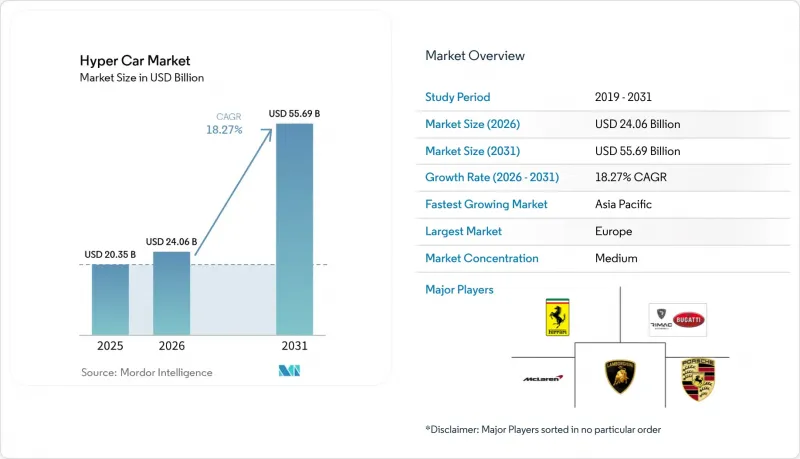
Mordor Intelligence에 의하면, 하이퍼카 시장 규모는 2025년 203억 5,000만 달러에서 2026년에는 240억 6,000만 달러로 확대되어 2031년까지 556억 9,000만 달러에 이를 것으로 예측되며, 예측 기간(2026-2031년) CAGR 18.27%로 성장할 전망입니다.
본 보고서는 추진 방식(내연기관 및 기타), 용도(개인용 및 레이싱용), 차종(쿠페, 컨버터블, 로드스터), 엔진 배기량(컴팩트, 미드사이즈, 풀사이즈) 및 지역별로 분류되어 있습니다. 시장 전망은 금액(미 달러) 및 수량(대) 단위로 제시되어 있습니다.
세계 하이퍼카 시장 동향 및 인사이트
아시아태평양 및 중동의 초고액 자산가 급증
걸프 국가들과 아시아의 주요 금융 허브에서는 유동 자산을 한정 생산되는 플래그십 모델에 배분하는 전략이 새롭게 자리 잡고 있습니다. 최근 아랍에미리트(UAE)에서는 새로운 백만장자가 크게 증가하고 있으며, 향후 수십 년에 걸쳐 예상되는 대규모 세대 간 자산 이전의 중심에 위치하고 있습니다. 이에 대응하여 각 브랜드는 두바이나 리야드에 맞춤형 쇼룸을 개설하고, 금 상감 장식이 적용된 패키지 및 지역 취향에 맞춘 인테리어를 도입하고 있습니다. UAE의 1인당 고급차 보급률은 현재 북미를 상회하고 있으며, 이는 해당 지역의 인도 대수가 미국을 앞지르고 있다는 사실에서도 분명하게 드러납니다. 또한, 지역 내 자유무역지대에는 최종 조립 거점이 잇달아 설립되고 있어, 수입 관세 인하 혜택을 활용하는 동시에 고객과의 더욱 긴밀한 관계를 구축하고 있습니다.
하이퍼카의 급속한 전동화 및 하이브리드화
하이브리드 시스템은 단순한 규제 대응책에서 성능을 비약적으로 향상시키는 중요한 요소로 진화했습니다. 페라리의 F80은 강력한 트윈 터보 V6 엔진과 고성능 전기 모터를 결합하고 있습니다. 한편, 부가티의 투르비옹은 압도적인 V16 엔진에 첨단 전기 구동 시스템을 통합하고 있습니다. 이러한 시너지 효과로 인해 순간적인 전기 토크가 터보 랙을 완화하고, 정교한 소프트웨어 제어를 통한 토크 벡터링이 가능해졌습니다. 2026년 말부터는 유로 7 규제에 따라 실제 주행 조건 하에서의 입자 수 측정이 의무화되며, 자동차 제조업체들은 엔진을 시동하지 않고도 도심 주행 사이클을 완주할 수 있는 플러그인 플랫폼으로의 전환을 강요받게 될 것입니다. 충전 인프라 구축은 아직 따라잡지 못하고 있지만, 첨단 배터리 기술의 등장으로 급속 충전이라는 매력적인 전망이 열리고 있습니다. 다만, 이는 특정 대용량 충전소에서만 가능해집니다.
매우 높은 연구개발비 및 제조 비용
하이퍼카 제조는 자본 집약적인 사업으로, 제한된 생산 대수로는 투자를 회수하지 못하는 경우가 많습니다. 수작업 조립을 많이 사용하고 수많은 3D 프린팅 부품을 채택한 Czinger의 ‘21C’는 매우 높은 판매 가격을 형성하고 있습니다. 부가티의 ‘투르비옹’은 2020년대 말까지 연간 생산 대수를 보수적으로 계획하고 있어, 손익계산서상 환율이나 금리 변동의 영향을 받기 쉬운 상황에 놓여 있습니다. 한편, 포르쉐는 2020년대 중반, 전용 BEV 플랫폼 개발 지연으로 인해 막대한 감손 손실을 계상할 수밖에 없었습니다. 이는 확고한 입지를 가진 브랜드조차 직면하는 고유한 위험을 여실히 드러내고 있습니다.
부문 분석
배터리 전기차(BEV) 모델은 2031년까지 연평균 성장률(CAGR) 18.29%를 나타낼 것으로 예측되며, 이는 파워트레인 중 가장 빠른 성장세입니다. 2025년 시점에서도 내연기관 아키텍처는 하이퍼카 시장에서 58.71%의 점유율을 유지했지만, 그 기세는 특징적인 V8 및 V12 엔진 소리를 해치지 않으면서 전기 토크를 더해 랩 타임을 단축하는 하이브리드 차량으로 기울고 있습니다. 페라리와 부가티는 현재 엔진 출력뿐만 아니라 시스템 총 마력을 공개하고 있으며, 이는 전략적 전환을 시사합니다.
리맥의 ‘네베라’와 같은 순수 BEV 플래그십 모델은 각 150대씩으로 여전히 틈새 시장 수준이지만, 랩 기록과 800볼트 급속 충전 기능은 정숙성이 더 이상 저속을 의미하지 않음을 입증하고 있습니다. 인프라 구축 현황이나 실리콘 카바이드 인버터의 비용이 단기적인 보급을 억제하고 있지만, 유로 7 규제에 대응해야 하는 압박으로 인해 2031년까지의 모든 신제품 계획에 듀얼 모터 또는 트리플 모터 구성이 포함될 것으로 확실시되고 있습니다.
2025년 인도 대수의 83.37%를 개인 수집가들이 차지했습니다. 이들은 차량의 유래와 희소성을 중시하고 있으며, 이에 따라 자동차 제조업체들은 생산 대수를 500대 미만으로 제한하고 수년치의 예약금을 요구하고 있습니다. 맥라렌의 ‘W1’ 할당 물량은 48시간 만에 매진되며, 이러한 접근 방식의 유효성이 입증되었습니다.
한편, 레이스 용도에 대해서는 연평균 성장률(CAGR) 18.31%로 증가할 것으로 예측됩니다. 개정된 FIA 르망 하이퍼카 규정에서는 일반 도로 주행이 가능한 모델이 의무화되어, 파워 유닛에 관한 지식이 24시간 레이스 서킷에서 교외의 차고로 직접 활용되고 있습니다. 월드 엔듀런스 시리즈의 그리드에는 현재 14개 제조업체가 참가하고 있으며, 이는 2023년의 8개사보다 증가한 수치입니다. 또한, 예비 부품 및 기술 업데이트를 통한 수익원을 바탕으로 모터스포츠는 자체 자금으로 운영되는 실험의 장이 되고 있습니다.
지역별 분석
2025년 수익 중 36.56%를 유럽이 차지하고 있으며, 그 기반이 되는 것은 이탈리아의 ‘모터 밸리’와 영국의 첨단 복합 소재 허브입니다. 2026년 11월에 시행될 유로 7 규제는 기존의 배기 파이프 규제에 더해 새로운 내구성 및 미세먼지 관련 요건을 부과하는 것으로, 이로 인해 차량 1대당 적합 비용이 최대 20% 상승하게 됩니다. 마라넬로와 산타가타에 위치한 전통 있는 자동차 제조업체들은 알프스 고개길에서 트레이드마크인 배기음을 유지하면서도, 도심에서는 제로 배출 주행을 가능하게 하는 플러그인 아키텍처로의 전환을 통해 이에 대응하고 있습니다. 영국의 엔지니어링 업계는 브렉시트로 인한 마찰에도 불구하고 견조한 모습을 유지하고 있으며, 대학 클러스터를 활용하여 맥라렌과 애스턴 마틴에 숙련된 인력을 공급하고 있습니다. 독일의 각 OEM 기업들은 모그룹의 규모를 활용하여 양산 모델 간에 800볼트 플랫폼을 공유함으로써 연구개발비를 상각하고 있습니다.
아시아태평양은 2031년까지 연평균 성장률(CAGR) 18.37%를 기록할 전망이며, 이는 다른 어떤 지역보다 빠른 속도입니다. 중국, 싱가포르, 걸프 국가의 신흥 부유층은 향후 몇 년간 하이퍼카 할당량을 확보하기 위해 예금을 투입하고 있습니다. 상하이와 두바이의 전문 부티크에서는 금박을 입힌 인테리어나 현지 언어를 지원하는 인포테인먼트 화면 등 지역 특유의 사양이 제공되기 시작했습니다. 중국에서는 배기량 3리터를 초과하는 엔진의 수입 관세가 25% 전후로 유지되고 있어, 일부 제조업체는 관세 부담을 줄이기 위해 보세 구역에서의 조립을 검토하기 시작했습니다. 싱가포르의 자동차 등록 대수 제로 성장 정책으로 인해 등록 증명서 비용은 천문학적 수준에 달하고 있지만, 전기 하이퍼카는 추가 과세 대상에서 제외되기 때문에 리맥과 피닌파리나에게는 독자적인 호재가 되고 있습니다.
북미는 여전히 단일 국가로서는 최대 시장이며, 캘리포니아주, 플로리다주, 텍사스주가 등록 대수를 주도하고 있습니다. 실리콘 밸리의 유동성 변동은 할당 일정에 급격한 영향을 미칠 수 있지만, 확립된 수집가 문화가 중고 시장의 가격 안정을 뒷받침하고 있습니다. 남미는 높은 관세와 환율 변동에 제약을 받아 여전히 규모가 작은 상태입니다. 한편, 남아프리카공화국을 제외한 아프리카의 판매 대수는 극히 미미합니다. 중동은 1인당 기준으로 계속해서 평균 이상의 성장세를 보이고 있으며, 리야드와 도하에서의 쇼룸 확장은 주요 모터스포츠 행사와 연계하여 여행 중인 구매자들을 유치하기 위해 계획되었습니다.
기타 혜택:
- 엑셀 형식 시장 예측(ME) 시트
- 3개월간의 애널리스트 지원
자주 묻는 질문
목차
제1장 서론
제2장 조사 방법
제3장 개요
제4장 시장 구도
제5장 시장 규모와 성장 예측
제6장 경쟁 구도
제7장 시장 기회와 향후 전망
JHS 26.09.01According to Mordor Intelligence, the hyper car market size is expected to increase from USD 20.35 billion in 2025 to USD 24.06 billion in 2026 and reach USD 55.69 billion by 2031, growing at a CAGR of 18.27% during the forecast (2026-2031).
This report is Segmented by Propulsion Type (ICE and More), End Use (Private and Racing), Vehicle Type (Coupe, Convertible, and Roadster), Engine Capacity (Compact, Mid-Size, and Full-Size), and Geography. The Market Forecasts are Provided in Terms of Value (USD) and Volume (Units).
Global Hyper Car Market Trends and Insights
Surge in Ultra-High-Net-Worth Individuals in Asia-Pacific & Middle East
In the Gulf and prominent Asian financial hubs, liquid wealth is reshaping strategies for limited-run flagship allocations. Recently, the United Arab Emirates has seen a significant influx of new millionaires and is positioned at the center of a substantial intergenerational wealth transfer projected over the coming decades. In response, brands have unveiled bespoke showrooms in Dubai and Riyadh, featuring gold inlay packages and upholstery tailored to regional tastes. Per-capita luxury car penetration in the UAE now surpasses that of North America, as evidenced by the region's higher deliveries compared to the United States. Additionally, final-assembly satellites have emerged in regional free-trade zones, capitalizing on import-duty savings and fostering closer ties with customers .
Rapid Electrification & Hybridization of Hypercars
Hybrid systems have evolved from mere compliance measures to pivotal performance enhancers. Ferrari's F80 pairs a powerful twin-turbo V6 engine with a high-performance electric motor. Meanwhile, Bugatti's Tourbillon integrates an advanced electric drivetrain with its formidable V16 engine. This synergy allows instant electric torque to mitigate turbo lag and enables sophisticated software-controlled torque vectoring. As of late 2026, Euro 7 regulations will mandate real-world particle-number testing, pushing automakers towards plug-in platforms capable of completing city cycles without activating the engine. While charging infrastructure is still catching up, the advent of advanced battery technology offers the tantalizing prospect of rapid top-ups, but only at select high-capacity charging stations .
Extremely High R&D and Manufacturing Cost Base
Crafting a hypercar is a capital-intensive endeavor, often not recouped over limited production runs. Czinger's 21C, which requires extensive hand assembly and incorporates numerous 3D-printed parts, commands a significant entry price. Bugatti's Tourbillon, with plans for modest annual production through the end of the decade, finds itself vulnerable to currency and interest-rate fluctuations on its income statement. Meanwhile, Porsche faced a substantial impairment in the mid-2020s due to setbacks with its dedicated BEV platform, highlighting the inherent risks even established brands encounter.
Other drivers and restraints analyzed in the detailed report include:
- Breakthroughs in Lightweight Composite & Carbotanium Structures
- AI-Driven Aerodynamic and Digital-Twin Optimization Shortening Development Cycles
- Supply-Chain Scarcity of Aerospace-Grade Composites & Titanium
For complete list of drivers and restraints, kindly check the Table Of Contents.
Segment Analysis
Battery-electric variants are projected to log an 18.29% CAGR to 2031, the fastest climb among powertrains. Internal-combustion architectures still held 58.71% Hypercar market share in 2025, yet momentum favors hybrids that add electric torque for lap-time gains without retiring signature V8 or V12 soundtracks. Ferrari and Bugatti now publish combined system horsepower rather than engine figures alone, signaling the strategic pivot.
Pure BEV flagships like Rimac's Nevera remain niche at 150 units each, but record laps and 800-volt fast-charge capability demonstrate that silence no longer means slower. Infrastructure coverage and silicon-carbide inverter costs moderate near-term uptake, yet Euro 7 compliance pressures ensure dual-motor or tri-motor setups appear in every new product plan through 2031.
Private collectors accounted 83.37% of 2025 deliveries. They value provenance and scarcity, prompting OEMs to cap production runs at below 500 units and to request multi-year deposits. McLaren's W1 allocation closed inside 48 hours, validating the approach.
Racing applications, however, are forecast to increase at an 18.31% CAGR. Updated FIA Le Mans Hypercar rules require road-legal counterparts, moving power-unit learning straight from the 24-hour circuit to suburban garages. Fourteen makers now contest the World Endurance grid, up from eight in 2023, and revenue streams from spare parts and technical updates turn motorsport into a self-funding laboratory.
Complete Report Scope:
- By Propulsion Type
- ICE
- Hybrid
- Battery Electric
- By End Use
- Private
- Racing
- By Vehicle Type
- Coupe
- Convertible
- Roadster
- By Engine Capacity
- Compact (Less than 1500 cc)
- Mid-size (1500-2500 cc)
- Full-size (More than 2500 cc)
- By Geography
- North America
- United States
- Canada
- Rest of North America
- South America
- Brazil
- Argentina
- Rest of South America
- Europe
- United Kingdom
- Germany
- Spain
- Italy
- France
- Russia
- Rest of Europe
- Asia-Pacific
- India
- China
- Japan
- Indonesia
- Malaysia
- Singapore
- Vietnam
- Philippines
- South Korea
- Rest of Asia-Pacific
- Middle East and Africa
- United Arab Emirates
- Saudi Arabia
- Turkey
- Egypt
- South Africa
- Rest of Middle East and Africa
- North America
Geography Analysis
Europe accounted for 36.56% of 2025 revenue, anchored by Italy's Motor Valley and the United Kingdom's advanced composite hubs. Euro 7 implementation in November 2026 adds new durability and particulate requirements on top of existing tailpipe limits, raising per-unit compliance costs by up to 20%. Heritage factories in Maranello and Sant'Agata respond by shifting to plug-in architectures that allow zero-emission city cruising while retaining trademark exhaust notes on alpine passes. British engineering remains resilient despite Brexit friction, leveraging university clusters to feed skilled labor to McLaren and Aston Martin. German OEMs exploit parent-group scale by sharing 800-volt platforms across volume models to amortize research costs.
Asia-Pacific is on track for an 18.37% CAGR to 2031, the fastest of any region. New millionaires in China, Singapore, and the Gulf funnel deposits toward hypercar allocations for years in advance. Dedicated boutiques in Shanghai and Dubai now feature region-specific configurations, including gold-leaf interiors and local language infotainment skins. Import duties in China hover at 25% for engines above 3.0 liters, nudging some makers to explore bonded-zone assembly to shave tariff exposure. Singapore's zero-growth vehicle policy forces astronomical certificate costs, yet electric hypercars escape surtax, giving Rimac and Pininfarina a unique tailwind.
North America remains the single largest country market, with California, Florida, and Texas leading registrations. Silicon Valley liquidity swings can whiplash allocation schedules, but established collector culture supports steady secondary pricing. South America remains small, constrained by high duties and currency volatility, while Africa, excluding South Africa, contributes negligible volume. The Middle East continues to over-index on a per-capita basis, and showroom expansions in Riyadh and Doha are timed to major motorsport events to attract traveling buyers.
- Ferrari N.V.
- Automobili Lamborghini S.p.A.
- Bugatti Rimac
- McLaren Group Ltd.
- Porsche AG
- Koenigsegg Automotive AB
- Pagani Automobili S.p.A.
- Aston Martin Lagonda Global Holdings plc
- Rimac Automobili
- Mercedes-AMG GmbH
- Lotus Cars
- Automobili Pininfarina
- Zenvo Automotive A/S
- Czinger Vehicles
- SSC North America
- W Motors
- Aspark Co. Ltd.
- Hennessey Special Vehicles
- Apollo Automobil GmbH
- Hispano-Suiza Cars
Additional Benefits:
- The market estimate (ME) sheet in Excel format
- 3 months of analyst support
TABLE OF CONTENTS
1 Introduction
- 1.1 Study Assumptions & Market Definition
- 1.2 Scope of the Study
2 Research Methodology
3 Executive Summary
4 Market Landscape
- 4.1 Market Overview
- 4.2 Market Drivers
- 4.2.1 Surge In Ultra-High-Net-Worth Individuals In Apac & Middle East
- 4.2.2 Rising Demand For Ultra-Luxury High-Performance Vehicles
- 4.2.3 Rapid Electrification & Hybridization Of Hypercars
- 4.2.4 Breakthroughs In Lightweight Composite & Carbotanium Structures
- 4.2.5 AI-Driven Aerodynamic / Digital-Twin Optimisation Shortening Development Cycles
- 4.2.6 Crypto-Wealth & NFT-Linked Limited Editions Unlocking New Buyer Pools
- 4.3 Market Restraints
- 4.3.1 Extremely High R&D And Manufacturing Cost Base
- 4.3.2 Supply-Chain Scarcity Of Aerospace-Grade Composites & Titanium
- 4.3.3 Stringent Global Emissions / Noise Regulations
- 4.3.4 Immature Ultra-Fast-Charging Infrastructure For BEV Hypercars
- 4.4 Value / Supply-Chain Analysis
- 4.5 Regulatory Landscape
- 4.6 Technological Outlook
- 4.7 Porter's Five Forces
- 4.7.1 Threat of New Entrants
- 4.7.2 Bargaining Power of Suppliers
- 4.7.3 Bargaining Power of Buyers
- 4.7.4 Threat of Substitutes
- 4.7.5 Competitive Rivalry
5 Market Size & Growth Forecasts (Value (USD) and Volume (Units))
- 5.1 By Propulsion Type
- 5.1.1 ICE
- 5.1.2 Hybrid
- 5.1.3 Battery Electric
- 5.2 By End Use
- 5.2.1 Private
- 5.2.2 Racing
- 5.3 By Vehicle Type
- 5.3.1 Coupe
- 5.3.2 Convertible
- 5.3.3 Roadster
- 5.4 By Engine Capacity
- 5.4.1 Compact (Less than 1500 cc)
- 5.4.2 Mid-size (1500-2500 cc)
- 5.4.3 Full-size (More than 2500 cc)
- 5.5 By Geography
- 5.5.1 North America
- 5.5.1.1 United States
- 5.5.1.2 Canada
- 5.5.1.3 Rest of North America
- 5.5.2 South America
- 5.5.2.1 Brazil
- 5.5.2.2 Argentina
- 5.5.2.3 Rest of South America
- 5.5.3 Europe
- 5.5.3.1 United Kingdom
- 5.5.3.2 Germany
- 5.5.3.3 Spain
- 5.5.3.4 Italy
- 5.5.3.5 France
- 5.5.3.6 Russia
- 5.5.3.7 Rest of Europe
- 5.5.4 Asia-Pacific
- 5.5.4.1 India
- 5.5.4.2 China
- 5.5.4.3 Japan
- 5.5.4.4 Indonesia
- 5.5.4.5 Malaysia
- 5.5.4.6 Singapore
- 5.5.4.7 Vietnam
- 5.5.4.8 Philippines
- 5.5.4.9 South Korea
- 5.5.4.10 Rest of Asia-Pacific
- 5.5.5 Middle East and Africa
- 5.5.5.1 United Arab Emirates
- 5.5.5.2 Saudi Arabia
- 5.5.5.3 Turkey
- 5.5.5.4 Egypt
- 5.5.5.5 South Africa
- 5.5.5.6 Rest of Middle East and Africa
- 5.5.1 North America
6 Competitive Landscape
- 6.1 Market Concentration
- 6.2 Strategic Moves
- 6.3 Market Share Analysis
- 6.4 Company Profiles (includes Global Level Overview, Market Level Overview, Core Segments, Financials as Available, Strategic Information, Market Rank/Share for Key Companies, Products and Services, SWOT Analysis, and Recent Developments)
- 6.4.1 Ferrari N.V.
- 6.4.2 Automobili Lamborghini S.p.A.
- 6.4.3 Bugatti Rimac
- 6.4.4 McLaren Group Ltd.
- 6.4.5 Porsche AG
- 6.4.6 Koenigsegg Automotive AB
- 6.4.7 Pagani Automobili S.p.A.
- 6.4.8 Aston Martin Lagonda Global Holdings plc
- 6.4.9 Rimac Automobili
- 6.4.10 Mercedes-AMG GmbH
- 6.4.11 Lotus Cars
- 6.4.12 Automobili Pininfarina
- 6.4.13 Zenvo Automotive A/S
- 6.4.14 Czinger Vehicles
- 6.4.15 SSC North America
- 6.4.16 W Motors
- 6.4.17 Aspark Co. Ltd.
- 6.4.18 Hennessey Special Vehicles
- 6.4.19 Apollo Automobil GmbH
- 6.4.20 Hispano-Suiza Cars
7 Market Opportunities & Future Outlook
- 7.1 White-space & Unmet-Need Assessment


