

|
시장보고서
상품코드
2117457
전동 지게차 시장 : 점유율 분석, 업계 동향과 통계, 성장 예측(2026-2031년)Electric Forklift - Market Share Analysis, Industry Trends & Statistics, Growth Forecasts (2026 - 2031) |
||||||
 Mordor Intelligence
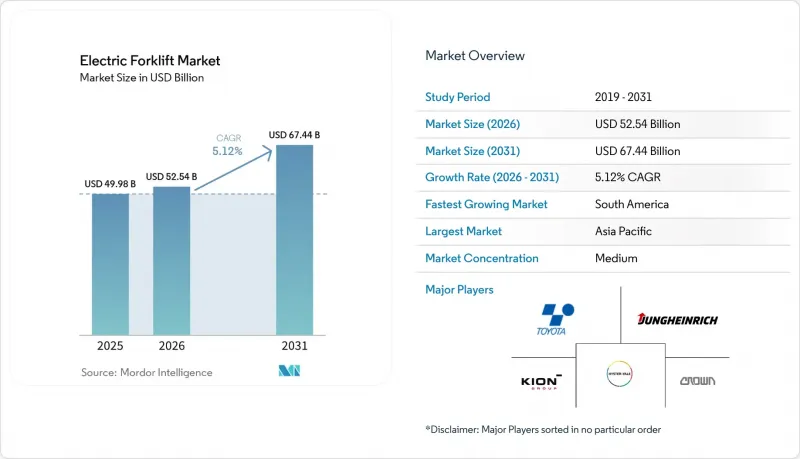
Mordor Intelligence에 의하면, 전동 지게차 시장 규모는 2025년에 499억 8,000만 달러로 평가되었고 2026년 525억 4,000만 달러에서 2031년까지 674억 4,000만 달러로 확대되어 2026년부터 2031년까지 CAGR 5.12%를 나타낼 것으로 예측됩니다.
본 보고서는 파워트레인 유형(전기식 및 수소 연료전지차), 차량 등급(클래스 I(승용형 전동 지게차) 등), 적재 용량(5톤 미만, 5-15톤, 15톤 이상), 최종 사용자 산업(제조, 물류 및 창고 등) 및 지역별로 분류되어 있습니다. 시장 전망은 금액(미화) 및 수량(대) 단위로 제시되어 있습니다.
세계 전동 지게차 시장 동향 및 인사이트
전자상거래에 따른 창고의 급속한 확대
당일 배송 약속을 지키기 위해서는 밀폐된 시설 내에서 연속 가동 가능한, 높은 처리 능력과 제로 배출을 자랑하는 장비가 필요합니다. 월마트가 2026년에 루이지애나주의 물류 센터에 실시할 투자는 조달을 소형 리튬 이온 지게차로 전환하게 하는 자동화 투자의 규모를 여실히 보여주고 있습니다. 일본, 싱가포르, 서유럽의 다층 도시형 창고에서는 용적을 극대화하기 위해 좁은 통로용 트럭이 채택되고 있어, 기동성이 뛰어난 전동 모델에 대한 수요가 증가하고 있습니다. 차량 운영 사업자들은 디젤 배기가스가 발생하지 않는 점, 소음이 적은 점, 그리고 건물 밖으로 나가지 않고도 짧은 휴식 시간에 충전할 수 있는 점을 높이 평가했습니다. 이러한 운영상의 이점 외에도, 땅값 급등으로 인해 수직 방향의 건설이 불가피해진 점이 더해져, 전자상거래라는 성장 요인이 시장 성장에 미치는 긍정적인 영향을 확고히 하고 있습니다.
제로 에미션 자재 운반 장비에 관한 규제
캘리포니아주의 ‘무배출 지게차 규정’에 따르면, 2026년부터 새로운 디젤 및 LPG 차량의 사용이 단계적으로 금지됩니다. 유럽연합(EU)의 병행 조치에 따라 2027년 2월부터 디지털 배터리 패스포트 제시가 의무화되었으며, 여기에는 수명 주기 동안의 탄소 배출 데이터가 포함되어 있어 현재 재판매 가격 및 리스 조건에 영향을 미치고 있습니다. 중국 각 성의 대기질 규제 역시 산업단지에서 디젤 사용을 제한하고 있어, 국내 차량을 배터리 구동 방식으로 전환하도록 유도하고 있습니다. 규제 준수 기한이 다가옴에 따라, 내연기관 차량을 다수 보유한 사업자들은 감가상각 가속화에 직면하고 있으며, 벌칙을 피하기 위해 예정보다 일찍 장비 교체를 시작하고 있습니다. 이러한 규제의 확실성으로 인해, 전기차 라인업을 확대하는 OEM(원천 장비 제조업체)의 자본 배분 위험이 감소하고, 규제를 준수하는 모델에 대한 프리미엄 가격 책정의 정당성이 뒷받침되고 있습니다.
높은 초기 비용 대 내연기관(ICE)의 대안
우대 대출이나 리스 프로그램을 이용할 수 없는 소규모 사업자에게는 구매 시의 높은 가격 부담이 여전히 장벽으로 작용하고 있습니다. 수명 주기 비용의 관점에서 전기차(EV)가 유리함에도 불구하고, 가격에 민감한 지역에서는 투자 회수 기간이 일반적인 계획 주기를 넘어 길어질 가능성이 있습니다. ‘배터리 아스 어 서비스(BaaS)’는 이러한 장벽을 완화하지만, 완전히 해소하지는 못합니다. 석유 제품에 보조금이 지급되는 시장에서는월이용료가 여전히 디젤 연료비를 상회하기 때문입니다. 배터리 팩 가격이 하락하고 금융 기관이 실시간 배터리 건전성 데이터를 기반으로 잔존 가치 모델을 개발해 나감에 따라, 이러한 제약의 영향은 점차 완화될 것입니다.
부문 분석
2025년 시장에서 전기차 모델은 71.27%를 차지하며, 2031년까지 연평균 성장률(CAGR) 11.79%라는 가장 높은 성장률을 보일 것으로 예측됩니다. 리튬 이온 배터리 채택이 확대되면서 납축전지의 매력은 떨어지고 있습니다. 이는 사업자들이 급속 충전 및 유지보수 비용 절감을 중시하기 때문입니다. 특히 캘리포니아주의 2025년 신형 디젤 트럭 판매 금지 같은 법적 규제의 뒷받침으로 대형 차량 플릿의 전기화 확산이 가속화되고 있습니다. 각 OEM 업체들은 품질 관리를 강화하고, 동적 전압 관리 등의 소프트웨어 기능을 구현하는 수직 통합형 배터리 어셈블리를 도입하고 있습니다. 최종 사용자들은 인프라가 정비될 때까지는 수소 시범 운영을 주로 리스크 헤지를 위한 파일럿 사업으로 간주하고 있습니다.
인산철리튬 화학 기술의 발전으로 열 안전성과 비용 안정성이 향상되어, 배터리식 파워트레인의 우위가 더욱 공고해지고 있습니다. 현재 지게차 모델에는 최적의 충전 시간대를 추천하는 배터리 상태 분석 기능이 탑재되어 있어, 배터리 팩의 수명을 연장하고 전기 요금을 절감하고 있습니다. 차량 관리자는 이러한 분석 데이터를 창고 관리 대시보드에 통합하여, 지게차의 가동 상황을 로봇 피킹 일정과 조율하고 있습니다. 한편, 연료전지 프로그램은 충전 거점 운영을 뒷받침하기 위해 산업 전반에 걸친 수소 수요에 의존하고 있지만, 그 전망은 여전히 불투명합니다. 그 결과, 전기자동차는 시장 점유율을 공고히 하고 있는 반면, 수소는 대체 수단이라기보다는 어디까지나 미래의 보완 수단으로서의 위치에 머물고 있습니다.
2025년에는 클래스 III 팔레트 트럭이 41.37%의 시장 점유율로 1위를 차지했지만, 클래스 II 협통로 트럭은 2031년까지 연평균 성장률(CAGR) 9.28%의 속도로 성장할 전망입니다. 고밀도 도시 지역의 창고에서는 2미터 미만의 통로를 주행할 수 있는 협통로형 트럭이 도입되어, 1제곱피트당 보관 용량을 최적화하고 있습니다. 소매업체와 제3자 물류(3PL) 사업자는 작업자와 파손되기 쉬운 상품을 모두 보호하기 위해 이러한 모델에 충돌 방지 센서를 장착하고 있습니다. 음성 피킹 기능과의 통합을 통해 작업자는 트럭에서 내리지 않고도 리프트를 조작할 수 있어 처리 능력이 더욱 향상됩니다.
클래스 II 지게차의 성장 추세는 자동 창고 시스템의 보급을 반영합니다. 자동 창고 시스템에서는 다단 랙 전체에 걸쳐 정밀한 수직 위치 결정이 요구됩니다. 배터리 구동 시스템은 이러한 정밀도에 필요한 미세한 토크 제어를 실현하는 동시에, 소음에 민감한 도심 지역 창고에서 저소음성을 유지합니다. 클래스 I 카운터밸런스 지게차는 더 무거운 화물 취급에 있어 여전히 중요한 역할을 하고 있지만, 자본 집약적이기 때문에 교체 주기가 느립니다. 컴팩트한 배터리 설계의 지속적인 개선으로 인해 등급 간의 경계가 모호해지면서, 팔레트 트럭의 기동성과 중하중 리프트 능력을 겸비한 새로운 하이브리드 카테고리가 등장할 가능성이 있습니다.
지역별 분석
아시아태평양은 중국의 공장 자동화 추진과 인도의 A급 창고 붐에 힘입어 2025년에도 43.29%의 시장 점유율을 유지했습니다. 지방 자치 단체의 배출 규제로 인해 디젤 지게차에 대한 규제가 강화되고 있으며, 중국의 OEM 업체들은 인산철 리튬 배터리 생산 규모를 확대하여 수입품을 능가하는 저가 장비를 공급하고 있습니다. 인도의 물류 부동산 투자자들은 신축 건물에 급속 충전 인프라를 구축하고 있으며, 전동화된 차량 군을 전자상거래 고객을 대상으로 한 경쟁적 차별화 요인으로 간주하고 있습니다. 일본과 한국 정부는 인력 부족을 보완하기 위해 자동화에 대한 보조금을 지급하고 있으며, 이로 인해 협폭 통로용 전동 지게차의 도입이 가속화되고 있습니다. 급속한 성장에도 불구하고, 송전망 확충은 여전히 창고 확장 속도를 따라가지 못하고 있어, 부지 내 태양광 발전과 에너지 저장 시스템의 결합이 선호되는 대책으로 자리 잡고 있습니다.
남미에서는 브라질의 전자상거래 주문 처리 경쟁과 아르헨티나의 수출 지향형 콜드체인 개편에 힘입어 2031년까지 연평균 성장률(CAGR) 8.72%를 나타낼 것으로 예측됩니다. 상파울루에 위치한 브라질의 물류 센터에서는 자동 컨베이어와 연계하여 충전 베이를 개조함으로써, 야간에도 원활한 재고 보충을 실현하고 있습니다. 아르헨티나의 농산물·식품 수출업체들은 국제 바이어들의 지속가능성 감사 요건을 충족하기 위해 전동 지게차를 도입하여 프리미엄 시장 진출을 가능하게 하고 있습니다. 자금 조달 문제는 여전히 남아 있지만, 유지보수가 포함된 배터리 리스 덕분에 초기 비용 부담이 경감되고 있습니다. 현지 조립 업체들은 환율 변동을 피하고 리드 타임을 단축하기 위해 노크다운 키트 수입을 검토하고 있습니다.
북미와 유럽에서는 규제 시행과 기업의 탈탄소화 목표에 힘입어 전동화가 성숙 단계에 접어들었습니다. 캘리포니아주의 신형 디젤 지게차 판매 금지 조치로 인해 차량 함대의 교체가 가속화되고 있으며, 전력 회사는 비수기 시간대에 충전을 계획하는 창고에 수요 반응 크레딧을 제공합니다. EU의 ‘배터리 여권’ 체계는 투명성이 높은 공급망을 촉진하며, 광물의 출처와 재활용 가능성을 추적하는 OEM에 우대 조치를 제공합니다. 창고 운영 사업자들은 지게차 배차와 인력 교대 근무를 연동하는 AI 대시보드를 도입하여 각 배터리 팩에서 더 많은 가동 주기를 이끌어내고 있습니다. 중동 및 아프리카에서는 전기화 시범 사업이 걸프 지역의 자유무역지대와 남아프리카의 항구에 집중되어 있으며, 렌탈 프로그램을 통해 자본 위험을 완화하는 동시에 사용자가 리튬이온 기술에 익숙해질 수 있도록 하는 노력이 진행되고 있습니다.
기타 혜택:
- 엑셀 형식 시장 예측(ME) 시트
- 3개월간의 애널리스트 지원
자주 묻는 질문
목차
제1장 서론
제2장 조사 방법
제3장 개요
제4장 시장 구도
제5장 시장 규모와 성장 예측
제6장 경쟁 구도
제7장 시장 기회와 향후 전망
JHS 26.09.01According to Mordor Intelligence, the electric forklift market size was valued at USD 49.98 billion in 2025 and is projected to expand from USD 52.54 billion in 2026 to USD 67.44 billion by 2031, registering a 5.12% CAGR between 2026 and 2031.
This report is Segmented by Power-Train Type (Electric and Hydrogen Fuel-Cell Vehicle), Vehicle Class (Class I (Electric Rider Trucks), and More), Load Capacity (Below 5 Tons, 5-15 Tons, and Above 15 Tons), End-User Industry (Manufacturing, Logistics and Warehousing, and More), and Geography. The Market Forecasts are Provided in Terms of Value (USD) and Volume (Units).
Global Electric Forklift Market Trends and Insights
Rapid E-commerce-Driven Warehouse Expansion
Same-day fulfillment commitments require high-throughput, zero-emission equipment that can operate continuously inside enclosed facilities. Walmart's 2026 Louisiana distribution center investment exemplifies the scale of automation spending that tilts procurement toward compact, lithium-ion forklifts. Multi-story urban warehouses across Japan, Singapore, and Western Europe employ narrow-aisle trucks to maximize cubic capacity, amplifying demand for maneuverable electric models. Fleet operators value the absence of diesel exhaust, lower noise, and the ability to recharge during micro-breaks without leaving the building. These operational gains, combined with rising land costs that force vertical construction, anchor the e-commerce driver's positive impact on market growth.
Mandates on Zero-Emission Material-Handling Equipment
California's Zero-Emission Forklift Regulation bans new diesel and LPG units in phases beginning in 2026. Parallel measures in the European Union require digital battery passports from February 2027, embedding lifecycle carbon data that now influences resale pricing and lease terms. Provincial air-quality rules in China likewise restrict diesel use in industrial parks, nudging domestic fleets toward battery power. As compliance deadlines tighten, operators with large internal-combustion fleets face accelerated depreciation and have begun swapping equipment ahead of schedule to avoid penalties. This regulatory certainty de-risks capital allocation for OEMs expanding electric lines and justifies premium pricing on compliant models.
High Upfront Cost vs. ICE Alternatives
The purchase premium remains a hurdle for smaller operators that lack access to concessional finance or leasing programs. Even though lifetime economics favor electrics, the payback horizon can stretch beyond planning cycles typical in price-sensitive regions. Battery-as-a-service alleviates, but does not eliminate, this barrier, as monthly fees still exceed diesel fuel costs in markets with subsidized petroleum. The restraint's influence will moderate as pack prices fall and financiers develop residual-value models based on real-time battery health data.
Other drivers and restraints analyzed in the detailed report include:
- Declining Li-Ion Battery Cost Curve
- OEM Battery-As-A-Service (Baas) Models
- Grid-Capacity Constraints at Brownfield Sites
For complete list of drivers and restraints, kindly check the Table Of Contents.
Segment Analysis
Electric variants occupied 71.27% of the 2025 market and are projected to chart the fastest 11.79% CAGR through 2031. Growing lithium-ion adoption has diminished the appeal of lead-acid units, as operators value rapid charging and lower maintenance. Legislative tailwinds, notably California's 2025 sales prohibition on new diesel trucks, propel electric penetration in heavy-duty fleets. OEMs deploy vertically integrated battery assemblies that tighten quality control and unlock software features such as dynamic voltage management. End users view hydrogen tests mainly as risk-hedging pilots until infrastructure scales.
Advances in lithium-iron-phosphate chemistry reinforce the dominance of battery power-trains by enhancing thermal safety and cost stability. Forklift models now integrate battery health analytics that recommend optimal charge windows, lengthening pack life and curbing electricity bills. Fleet managers integrate these analytics into warehouse-management dashboards, aligning forklift availability with robotic picking schedules. Conversely, fuel-cell programs depend on cross-industry hydrogen demand to underwrite refueling hubs, a scenario that remains uncertain. As a result, electrics consolidate share while hydrogen remains an aspirational complement rather than a substitute.
Class III pallet trucks led with 41.37% market share in 2025, whereas Class II narrow-aisle trucks are on pace for a 9.28% CAGR through 2031. High-density urban warehouses rely on narrow-aisle units that maneuver in sub-two-meter corridors, optimizing storage per square foot. Retailers and third-party logistics providers outfit these models with collision-avoidance sensors that protect both personnel and fragile goods. Voice-picking integration further enhances throughput by allowing operators to control lifts without dismounting.
The growth trajectory of Class II trucks reflects the proliferation of automated storage and retrieval systems, which demand precise vertical positioning across multi-level racking. Battery-electric drivetrains supply the micro-torque control necessary for such precision while maintaining low acoustic signatures in noise-sensitive urban depots. Class I counterbalance trucks remain relevant for heavier loads but experience slower replacement cycles due to their capital intensity. Continuous improvement in compact battery designs could blur class boundaries, enabling emerging hybrid categories that combine pallet-truck agility with mid-lift capability.
Complete Report Scope:
- By Power-train Type
- Electric
- Lead-acid
- Li-ion
- Hydrogen Fuel-cell Vehicle (HFCV)
- Electric
- By Vehicle Class
- Class I (Electric Rider Trucks)
- Class II (Electric Narrow-Aisle)
- Class III (Electric Pallet)
- By Load Capacity
- Below 5 Tons
- 5 - 15 Tons
- Above 15 Tons
- By End-user Industry
- Manufacturing
- Logistics and Warehousing
- Construction and Infrastructure
- Retail and Wholesale
- Food and Beverage Cold-Chain
- By Geography
- North America
- United States
- Canada
- Rest of North America
- South America
- Brazil
- Argentina
- Rest of South America
- Europe
- Germany
- United Kingdom
- France
- Italy
- Spain
- Rest of Europe
- Asia-Pacific
- China
- India
- Japan
- South Korea
- Rest of Asia-Pacific
- Middle East and Africa
- United Arab Emirates
- Saudi Arabia
- Turkey
- South Africa
- Rest of Middle East and Africa
- North America
Geography Analysis
Asia-Pacific retained 43.29% market share in 2025, buoyed by China's factory automation drive and India's Grade-A warehouse boom. Provincial pollution limits tighten the noose on diesel forklifts, prompting Chinese OEMs to scale lithium-iron-phosphate output and deliver lower-priced equipment that outflanks imports. India's logistics real estate investors embed fast-charging infrastructure in new builds, viewing electrified fleets as a competitive differentiator for e-commerce clients. Governments in Japan and South Korea subsidize automation to offset labor shortages, hastening adoption of narrow-aisle electrics. Despite rapid growth, grid upgrades still lag warehouse expansion, making on-site solar plus storage a favored mitigation strategy.
South America is forecast to post an 8.72% CAGR through 2031, underpinned by Brazil's e-commerce fulfillment race and Argentina's export-oriented cold-chain overhaul. Brazilian distribution centers in Sao Paulo retrofit charging bays alongside automated conveyors, allowing seamless overnight replenishment. Argentine agrifood exporters integrate electric forklifts to meet international buyers' sustainability audits, unlocking premium market access. Financing obstacles persist, but battery leasing packaged with maintenance softens upfront cost hurdles. Local assemblers explore knock-down kit imports to sidestep currency volatility and shorten lead times.
North America and Europe exhibit mature electrification driven by regulatory enforcement and corporate decarbonization goals. California's sales ban on new diesel forklifts compels accelerated fleet renewal, and utilities offer demand-response credits for warehouses that schedule off-peak charging. The EU's battery passport framework catalyzes transparent supply chains, rewarding OEMs that track mineral provenance and recyclability. Warehouse operators deploy AI dashboards that align forklift dispatch with labor rosters, squeezing extra cycles from each battery pack. In the Middle East and Africa, nascent electrification pilots concentrate in Gulf free-trade zones and South African ports, where rental programs reduce capital exposure and familiarize users with lithium-ion technology.
- Toyota Industries Corporation
- KION Group AG
- Jungheinrich AG
- Hyster-Yale Inc.
- Crown Equipment Corporation
- Mitsubishi Logisnext Co.Ltd.
- Hangcha Group Co.Ltd.
- Anhui Heli Co.Ltd.
- Komatsu Ltd.
- Clark Material-Handling Company
- Doosan Corporation
- UniCarriers Corporation
- Hyundai Construction Equipment North America Inc.
- Lonking Holdings Limited
- EP Equipment
- Godrej & Boyce Mfg.Co.Ltd.
- BYD Motors Inc.
- Noblelift Intelligent Equipment Co., Ltd.
- Carer Electric Forklift
Additional Benefits:
- The market estimate (ME) sheet in Excel format
- 3 months of analyst support
TABLE OF CONTENTS
1 Introduction
- 1.1 Study Assumptions & Market Definition
- 1.2 Scope of the Study
2 Research Methodology
3 Executive Summary
4 Market Landscape
- 4.1 Market Overview
- 4.2 Market Drivers
- 4.2.1 Rapid E-Commerce-Driven Warehouse Expansion
- 4.2.2 Mandates On Zero-Emission Material-Handling Equipment
- 4.2.3 Declining Li-Ion Battery Cost Curve
- 4.2.4 OEM Battery-As-A-Service (Baas) Models
- 4.2.5 Solid-State Battery Commercialization Road-Map (2027+)
- 4.2.6 AI-Enabled Predictive Maintenance Driving TCO Optimization
- 4.3 Market Restraints
- 4.3.1 High Upfront Cost Vs. ICE Alternatives
- 4.3.2 Grid-Capacity Constraints At Brown-Field Sites
- 4.3.3 Lead-Acid Battery Recycling Bottlenecks
- 4.3.4 Sub-MW Hydrogen Refueling Infra Gaps
- 4.4 Value / Supply-Chain Analysis
- 4.5 Regulatory Landscape
- 4.6 Technological Outlook
- 4.7 Porter's Five Forces
- 4.7.1 Threat of New Entrants
- 4.7.2 Bargaining Power of Suppliers
- 4.7.3 Bargaining Power of Buyers
- 4.7.4 Threat of Substitutes
- 4.7.5 Competitive Rivalry
5 Market Size & Growth Forecasts (Value (USD))
- 5.1 By Power-train Type
- 5.1.1 Electric
- 5.1.1.1 Lead-acid
- 5.1.1.2 Li-ion
- 5.1.2 Hydrogen Fuel-cell Vehicle (HFCV)
- 5.1.1 Electric
- 5.2 By Vehicle Class
- 5.2.1 Class I (Electric Rider Trucks)
- 5.2.2 Class II (Electric Narrow-Aisle)
- 5.2.3 Class III (Electric Pallet)
- 5.3 By Load Capacity
- 5.3.1 Below 5 Tons
- 5.3.2 5 - 15 Tons
- 5.3.3 Above 15 Tons
- 5.4 By End-user Industry
- 5.4.1 Manufacturing
- 5.4.2 Logistics and Warehousing
- 5.4.3 Construction and Infrastructure
- 5.4.4 Retail and Wholesale
- 5.4.5 Food and Beverage Cold-Chain
- 5.5 By Geography
- 5.5.1 North America
- 5.5.1.1 United States
- 5.5.1.2 Canada
- 5.5.1.3 Rest of North America
- 5.5.2 South America
- 5.5.2.1 Brazil
- 5.5.2.2 Argentina
- 5.5.2.3 Rest of South America
- 5.5.3 Europe
- 5.5.3.1 Germany
- 5.5.3.2 United Kingdom
- 5.5.3.3 France
- 5.5.3.4 Italy
- 5.5.3.5 Spain
- 5.5.3.6 Rest of Europe
- 5.5.4 Asia-Pacific
- 5.5.4.1 China
- 5.5.4.2 India
- 5.5.4.3 Japan
- 5.5.4.4 South Korea
- 5.5.4.5 Rest of Asia-Pacific
- 5.5.5 Middle East and Africa
- 5.5.5.1 United Arab Emirates
- 5.5.5.2 Saudi Arabia
- 5.5.5.3 Turkey
- 5.5.5.4 South Africa
- 5.5.5.5 Rest of Middle East and Africa
- 5.5.1 North America
6 Competitive Landscape
- 6.1 Market Concentration
- 6.2 Strategic Moves
- 6.3 Market Share Analysis
- 6.4 Company Profiles (Includes Global level Overview, Market level overview, Core Segments, Financials as available, Strategic Information, Market Rank/Share for key companies, Products & Services, and Recent Developments)
- 6.4.1 Toyota Industries Corporation
- 6.4.2 KION Group AG
- 6.4.3 Jungheinrich AG
- 6.4.4 Hyster-Yale Inc.
- 6.4.5 Crown Equipment Corporation
- 6.4.6 Mitsubishi Logisnext Co.Ltd.
- 6.4.7 Hangcha Group Co.Ltd.
- 6.4.8 Anhui Heli Co.Ltd.
- 6.4.9 Komatsu Ltd.
- 6.4.10 Clark Material-Handling Company
- 6.4.11 Doosan Corporation
- 6.4.12 UniCarriers Corporation
- 6.4.13 Hyundai Construction Equipment North America Inc.
- 6.4.14 Lonking Holdings Limited
- 6.4.15 EP Equipment
- 6.4.16 Godrej & Boyce Mfg.Co.Ltd.
- 6.4.17 BYD Motors Inc.
- 6.4.18 Noblelift Intelligent Equipment Co., Ltd.
- 6.4.19 Carer Electric Forklift


