

|
시장보고서
상품코드
2117461
미국의 전기차 모터 라미네이션 시장 : 점유율 분석, 산업 동향 및 통계 데이터, 성장 예측(2026-2031년)United States Electric Vehicle Motor Lamination - Market Share Analysis, Industry Trends & Statistics, Growth Forecasts (2026 - 2031) |
||||||
 Mordor Intelligence
Mordor Intelligence에 의하면, 미국 전기차 모터 라미네이션 시장 규모는 2025년에 72억 3,000만 달러로 평가되었고 2026년 77억 7,000만 달러에서 2031년까지 111억 2,000만 달러에 이를 것으로 예측되며, 2026년부터 2031년까지 예측 기간에서 CAGR은 7.44%를 나타낼 전망입니다.
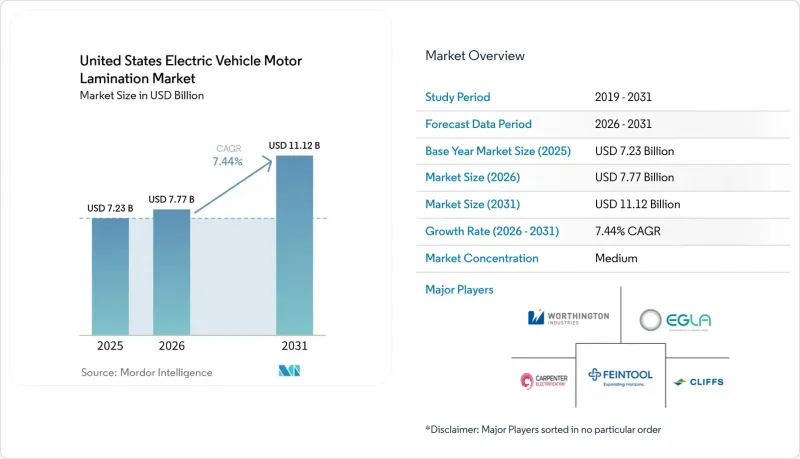
본 보고서는 라미네이트의 유형(전자강판, 규소강판 등), 모터의 유형(영구자석 동기 모터(PMSM), 유도 모터 등), 차종(승용차, 상용차 등), 용도(고정자용 라미네이트, 회전자용 라미네이트)별로 분류되어 있습니다. 시장 예측은 금액(달러) 기준으로 제시되어 있습니다.
미국 전기차 모터 라미네이션 시장 동향 및 인사이트
IRA에 힘입은 국내 전기차 생산의 급속한 확대
미국의 전기차 모터 라미네이션 시장은 IRA가 제조 세액 공제 및 공장 투자 결정을 통해 확장을 뒷받침한 국내 전기차 생산 기반과 밀접하게 관련되어 있습니다. 현재 시행 중인 IRA 규정에 따라 2030년까지 미국 내 전기차 판매 대수가 크게 증가할 것으로 예측됩니다. 이러한 급증은 설치 대수의 대폭적인 확대로 이어져, 향후 모터 수요를 뒷받침하는 기반이 될 것입니다. 이러한 규모는 라미네이션 산업에 중요한데, 이는 구동 시스템이 하나 늘어날 때마다 모터 코어 수준의 정밀 강판 스택, 코팅 및 접합 공정에 대한 수요가 증가하기 때문입니다. 2025년 9월 연방 정부의 전기차 소비자 세액 공제가 종료됨에 따라 순수 배터리 전기차의 성장세는 다소 둔화되었습니다. 그러나 하이브리드 시스템에는 여전히 상당한 양의 전기 구동 부품이 사용되고 있으므로, 모터 라미네이션에 대한 수요가 사라진 것은 아닙니다. 따라서 미국의 전기차 모터 라미네이션 시장은 차량 구성이 순수 배터리 전기차와 하이브리드 플랫폼 사이에서 변화하더라도 견고한 판매량 기반을 유지하고 있습니다.
초박형 라미네이션을 의무화하는 DOE의 효율 목표
미국 전기차 모터 라미네이션 시장은 공급망 전반에 걸친 재설계를 불가피하게 만드는 더욱 엄격한 모터 효율 기준에 의해서도 형성되고 있습니다. DOE가 2023년 10월에 제정한 규정에 따르면, 100-250 hp 모터에 대한‘슈퍼 프리미엄’ 효율 기준 준수 기한을 2027년 6월 1일로 정했으며, 2025년 1월 규정에서는 2029년 1월 1일부터 더 소형 모터로도 적용 범위가 확대되었습니다. IE4 효율 수준을 달성하기 위해서는 코어 손실 저감, 적층판의 얇아짐, 그리고 보다 정밀한 펀칭 품질이 요구되며, 이로 인해 EV 모터에 사용되는 강종에 대한 가공 요건이 직접적으로 높아집니다. DOE는 또한 이러한 효율화 전환을 위해서는 적층판의 박형화와 제조업체의 막대한 설비 투자가 필요하다고 지적하고 있으며, 이는 대응이 일시적인 것이 아니라 구조적인 것임을 의미합니다. 이 리뷰에서는 ESEM(전기차 모터용 강판) 출하량의 상당 부분이 재설계를 필요로할 것으로 나타났으며, 전기차의 직접적인 보급 여부와 관계없이 라미네이션 프레스 가공 업계는 광범위한 제품 갱신 주기에 직면하게 될 것입니다. 미국의 전기차 모터 라미네이션 시장은 이러한 재설계 주기에 힘입어 안정적인 수요 기반을 확보하게 될 것입니다. 이는 공급업체들이 새로운 규제 준수 기한이 도래하기 전에 저손실 스택이나 개선된 재료 등급에 대한 인증을 획득해야 하기 때문입니다.
전자강판 가격 변동
미국의 전기차 모터 라미네이션 시장은 무역 조치로 인해 수입 압력이 일부 억제되고 있기는 하지만, 여전히 전기강판 가격 변동의 영향을 받기 쉬운 상황에 놓여 있습니다. 미국철강협회(AISI)에 따르면, 중국의 철강 수출은 향후 몇 년간 대폭 증가할 것으로 예상되며, 이로 인해 세계 기준 가격이 더욱 왜곡될 것입니다. 2026년에 발표된 미국 국제무역위원회(USITC)의 결정에 따라, 여러 수출국에서 수입되는 NOES(비자성 강판)에 대한 상계관세 및 반덤핑 명령이 유지되었습니다. 이는 국내 가격 안정화에 기여하지만, 원자재 가격의 변동성을 해소하는 것은 아닙니다. 적층판 프레스 가공업체의 경우, OEM과공급 계약은 수년에 걸쳐 협상되므로 비용 전가는 투입 가격의 변동보다 늦어지는 경우가 많습니다. 이로 인해, 특히 고객이 계약 기간 중 조건 재검토를 원하지 않는 경우, 가격 급등 시 이익률에 압박이 가해집니다. 따라서 미국의 전기차 모터 라미네이션 시장은 최종 수요가 견조한 경우에도 수익성과 관련된 제약에 반복적으로 직면하고 있습니다.
부문 분석
2025년, 미국의 전기차 모터 라미네이션 시장에서 전자강판 라미네이트는 79.12%의 점유율을 차지하며, 주류 EV 모터 프로그램에서 그 핵심적인 역할을 입증했습니다. 이러한 선도적 지위는 대량 생산되는 트랙션 모터의 설계에서 비용,자기 성능, 그리고 제조에 대한 숙련도가 훌륭하게 균형을 이루고 있기 때문입니다. 미국의 전기차 모터 라미네이션 시장은 여전히 전기강판에 대한 의존도가 높은 상황입니다. 그 이유는 대부분의 OEM 플랫폼에서 최대 출력 밀도보다 신뢰성이 높은 대규모 프레스 가공과 예측 가능한 인증 주기가 요구되기 때문입니다. 클리블랜드 클리프스(Cleveland Cliffs)사의 ‘MOTOR-MAX’ 제품 라인은 고주파 자동차 트랙션 용도에 최적화되어 있어 이 시장에서의 입지를 공고히 하고 있습니다. 또한, 이 소재는 자동차용 생산 수준에서 가공, 코팅, 적층 노하우를 이미 보유한 공급업체들 사이에서 널리 수용되고 있다는 점도 강점으로 작용하고 있습니다.
그 밖의 적층재 유형, 주로 니켈-철 합금 및 코발트-철 합금은 2031년까지 연평균 성장률(CAGR) 13.55%를 나타낼 것으로 예측되며, 이 부문에서 가장 빠르게 성장하는 소재 카테고리가 될 전망입니다. 카펜터 일렉트리피케이션(Carpenter Electrification)에 따르면, Hiperco 50 합금은 기존 실리콘강에 비해 30% 더 높은 출력 밀도와 25% 더 높은 토크를 실현하며, 모터의 작동 온도를 10°C에서 20°C까지 낮출 수 있습니다. 이러한 특성으로 인해 원자재 비용보다 모터의 소형 패키징이 중시되는 프리미엄 전기차 및 기타 용도에서 첨단 합금의 중요성이 더욱 높아지고 있습니다. 실리콘강은 여전히 중간 위치를 차지하고 있는데, 이는 Waelzholz NO 30-15와 같은 새로운 등급이 비용이 대폭 높은 합금으로 전환하지 않고도 성능을 향상시키고 있기 때문입니다. 또한, Feintool사의 글루록(glulock) 공정은 적층 두께를 0.1 mm까지 얇게 만들어 모터 효율을 최대 15% 향상시키는 것으로 알려져 있으며, 이를 통해 전기강판 및 실리콘강이 더 오랫동안 경쟁력을 유지할 수 있게 되었습니다.
2025년 미국 전기차 모터 라미네이션 시장에서 영구자석 동기 모터(PMSM)는 68.22%를 차지하고 있으며, 이는 현재 EV 파워트레인에서 PMSM이 차지하는 확고한 위상을 반영합니다. 조사에 따르면, PMSM의 효율과 출력 밀도는 일관되게 높은 수준을 유지하고 있으며, 이것이 OEM 각사가 승용 전기차에서 계속해서 이 아키텍처를 선호하는 이유입니다. 미국의 전기차 모터 라미네이션 시장도 이러한 구성으로부터 혜택을 받고 있습니다. PMSM 설계에서는 작동 주파수가 상승함에 따라 더 얇고 손실이 적은 적층판이 중요시되기 때문입니다. BMW의 6세대 eDrive와 Lucid의 자체 제작 드라이브 유닛은 고효율 모터 개발이 소재 및 펀칭 공차 수준을 높이고 있음을 보여줍니다. 이러한 공차를 안정적으로 충족할 수 있는 공급업체는 장기적으로 OEM으로부터 주문을 확보하는 데 유리한 입장에 있습니다.
스위치 릴랙턴스 모터(SRM)는 2031년까지 연평균 성장률(CAGR) 12.27%를 나타낼 것으로 예측되며, 시장에서 가장 빠르게 성장하는 모터 유형이 될 전망입니다. 이러한 부상은 성능의 중점을 로터 형상이나 강재 가공으로 옮기는 희토류를 포함하지 않거나 희토류 사용량을 줄인 설계에 대한 관심 증가와 관련이 있습니다. 아스테모(Astemo)는 출력 180kW로, 기존 PMSM 설계에 비해 크기가 불과 30%만 증가한 자석 보조형 동기 릴랙턴스 모터를 발표했습니다. 이는 성능과 크기 간의 상충 관계가 점차 줄어들고 있음을 보여줍니다. BLDC 모터는 소형 고급차 및 보조 용도에서 계속해서 중요한 역할을 하고 있는 반면, 유도 모터는 최대 효율보다는 내구성과 확립된 조달 경로가 중시되는 분야에서 여전히 중요한 위치를 차지하고 있습니다. 따라서 미국의 전기차 모터 라미네이션 시장은 단일 아키텍처로의 전환으로 인해 발생할 수 있었던 것보다 더 광범위한 고정자 및 회전자 사양으로 전환되고 있습니다.
기타 혜택:
- Excel 형식 시장 예측(ME) 시트
- 3개월간의 애널리스트 지원
자주 묻는 질문
목차
제1장 서론
제2장 분석 방법
제3장 주요 요약
제4장 시장 구도
제5장 시장 규모·성장률 예측
제6장 경쟁 구도
제7장 시장 기회와 향후 전망
JHS 26.09.03According to Mordor Intelligence, the United States electric vehicle motor lamination market size was valued at USD 7.23 billion in 2025 and is estimated to grow from USD 7.77 billion in 2026 to reach USD 11.12 billion by 2031, at a CAGR of 7.44% during the forecast period 2026 to 2031.
This report is Segmented by Laminates Type (Electrical Steel Laminates, Silicon Steel Laminates, and More), Motor Type (Permanent Magnet Synchronous Motors (PMSM), Induction Motors, and More), Vehicle Type (Passenger Vehicles, Commercial Vehicles, and More), and Application (Stator Laminations and Rotor Laminations). The Market Forecasts are Provided in Terms of Value (USD).
United States Electric Vehicle Motor Lamination Market Trends and Insights
IRA-Fueled Domestic EV Production Boom
The United States electric vehicle motor lamination market is closely tied to the domestic EV production base that the IRA helped expand through manufacturing credits and plant investment decisions. Ongoing IRA provisions are expected to drive significant growth in EV sales in the United States by 2030. This surge sets the stage for a substantially larger installed base, fueling future motor demand. That scale matters for laminations because each additional drivetrain raises demand for precision steel stacks, coatings, and joining processes at the motor core level. The September 2025 end of the federal consumer EV credit has moderated some pure battery-electric momentum. However, it has not eliminated demand for motor laminations because hybrid systems still use substantial electric-drive content. The United States electric vehicle motor lamination market, therefore, keeps a durable volume base even when the vehicle mix shifts between full battery electric and hybrid platforms.
DOE Efficiency Targets Mandating Ultra-Thin Laminations
The United States electric vehicle motor lamination market is also being shaped by stricter motor efficiency standards that are forcing redesign across the supply chain. The DOE's October 2023 rule set June 1, 2027, compliance for super-premium efficiency standards in 100 to 250 hp motors, and the January 2025 rule extended coverage to smaller motors from January 1, 2029 . Reaching IE4 efficiency levels requires lower core loss, thinner laminations, and more precise punching quality, which directly increases processing demands on the steel grades used in EV motors. The DOE also noted that these efficiency shifts require thinner laminations and meaningful capital spending by manufacturers, which means the response is structural rather than temporary. The same review indicated that a notable share of ESEM shipments would need redesign, so the lamination stamping base faces a wide product refresh cycle even outside direct EV adoption. The United States electric vehicle motor lamination market gains a steady floor in demand from this redesign cycle because suppliers must qualify lower-loss stacks and upgraded material grades before the new compliance dates arrive.
Electrical-Steel Price Volatility
The United States electric vehicle motor lamination market remains exposed to swings in electrical steel prices, even though trade actions limit some import pressure. According to the American Iron and Steel Institute, China's steel exports are expected to increase significantly in the coming years, further distorting global reference pricing. The USITC decision published in 2026 kept countervailing and anti-dumping orders on NOES from several exporting countries, which supports domestic pricing discipline but does not remove raw material volatility. For lamination stampers, cost pass-through is often slower than input price changes because supply agreements with OEMs are negotiated over multiple years. That creates margin pressure during price spikes, especially when customers are unwilling to reopen terms mid-contract. The United States electric vehicle motor lamination market, therefore, faces a recurring profitability constraint even when end demand remains healthy.
Other drivers and restraints analyzed in the detailed report include:
- Automaker Vertical Integration of E-Motors
- Domestic NOES Capacity Expansions (InduX, Cleveland-Cliffs)
- Supply-Chain Concentration and Capacity Bottlenecks
For complete list of drivers and restraints, kindly check the Table Of Contents.
Segment Analysis
Electrical steel laminates held 79.12% of the United States electric vehicle motor lamination market share in 2025, which confirmed their central role in mainstream EV motor programs. This leadership comes from their balance of cost, magnetic performance, and manufacturing familiarity across high-volume traction motor designs. The United States electric vehicle motor lamination market still depends heavily on electrical steel because most OEM platforms need reliable, large-scale stamping and predictable qualification cycles more than they need maximum power density. Cleveland-Cliffs' MOTOR-MAX product line supports this position because it is tailored for high-frequency automotive traction applications. The material also benefits from broad acceptance across suppliers that already know how to process, coat, and stack it at automotive volumes.
Other laminate types, mainly nickel-iron and cobalt-iron alloys, are projected to grow at a 13.55% CAGR through 2031, making them the fastest-moving material class in this segment. Carpenter Electrification states that Hiperco 50 alloys can deliver 30% higher power density, 25% more torque, and motor operation that is 10°C to 20°C cooler than conventional silicon steels. That profile makes advanced alloys more relevant in premium EVs and other applications where compact motor packaging matters more than raw material cost. Silicon steel still occupies the middle ground because newer grades such as Waelzholz NO 30-15 are extending performance without moving to much higher-cost alloys. Feintool's glulock process, which enables stack thicknesses down to 0.1 mm and claims up to 15% greater motor efficiency, also helps electrical and silicon steel remain competitive for longer.
Permanent Magnet Synchronous Motors (PMSM) accounted for 68.22% of the United States electric vehicle motor lamination market in 2025, reflecting their strong position in current EV powertrains. Research indicates that PMSM efficiency and power density have consistently remained high, which explains why OEMs continue to favor the architecture in passenger EVs. The United States electric vehicle motor lamination market also benefits from this mix because PMSM designs place a premium on thinner and lower-loss laminations as operating frequencies rise. BMW's sixth-generation eDrive and Lucid's in-house drive units show how high-efficiency motor programs are pushing material and punching tolerances upward. Suppliers that can consistently meet those tolerances are better positioned to secure long-cycle OEM awards.
Switch Reluctance Motors (SRMs) are forecast to grow at a 12.27% CAGR through 2031, making them the fastest-growing motor type in the market. Its rise is tied to a stronger interest in rare-earth-free or reduced-rare-earth designs that shift performance emphasis toward rotor geometry and steel processing. Astemo announced a magnet-assisted synchronous reluctance motor with 180 kW output and only a 30% increase in size compared with conventional PMSM designs, indicating the trade-off is narrowing. BLDC motors continue to play a role in smaller premium and auxiliary applications, while induction motors remain relevant where durability and established sourcing are valued over maximum efficiency. The United States electric vehicle motor lamination market is therefore shifting toward a broader set of stator and rotor specifications than a single-architecture transition would have created.
Complete Report Scope:
- By Laminates Type
- Electrical Steel Laminates
- Silicon Steel Laminates
- Other Laminates Types (Nickel-iron, Cobalt-iron, etc.)
- By Motor Type
- Permanent Magnet Synchronous Motors (PMSM)
- Induction Motors
- Switch Reluctance Motors (SRM)
- Brushless DC Motors (BLDC)
- By Vehicle Type
- Passenger Vehicles
- Commercial Vehicles
- Two-wheelers
- By Application
- Stator Laminations
- Rotor Laminations
List of Companies Covered in this Report:
- Worthington Industries
- EuroGroup Laminations
- Carpenter Electrification
- Feintool International
- Cleveland-Cliffs Inc.
- United States Steel Corporation
- Thyssenkrupp Steel
- ArcelorMittal S.A.
- POSCO Mobility Solution
- Nippon Steel Corporation
- JFE Steel Corporation
- Waelzholz Group
- Lamination Specialties Corp.
- Pitti Engineering Limited
Additional Benefits:
- The market estimate (ME) sheet in Excel format
- 3 months of analyst support
TABLE OF CONTENTS
1 Introduction
- 1.1 Study Assumptions and Market Definition
- 1.2 Scope of the Study
2 Research Methodology
3 Executive Summary
4 Market Landscape
- 4.1 Market Overview
- 4.2 Market Drivers
- 4.2.1 IRA-Fueled Domestic EV Production Boom
- 4.2.2 DOE Efficiency Targets Mandating Ultra-Thin Laminations
- 4.2.3 Automaker Vertical Integration of E-Motors
- 4.2.4 Domestic NOES Capacity Expansions (InduX, Cleveland-Cliffs)
- 4.2.5 Rare-Earth-Free Motor Topologies Boosting Steel Demand
- 4.2.6 State-Level Zero-Emission Vehicle (ZEV) Mandates Accelerate EV Uptake
- 4.3 Market Restraints
- 4.3.1 Electrical-Steel Price Volatility
- 4.3.2 Supply-Chain Concentration and Capacity Bottlenecks
- 4.3.3 High Scrap Rates from Precision Stamping
- 4.3.4 Environmental-Permit Delays for New Steel Lines
- 4.4 Value/Supply-Chain Analysis
- 4.5 Technological Outlook
- 4.6 Regulatory Landscape
- 4.7 Porter's Five Forces
- 4.7.1 Threat of New Entrants
- 4.7.2 Bargaining Power of Suppliers
- 4.7.3 Bargaining Power of Buyers
- 4.7.4 Threat of Substitutes
- 4.7.5 Competitive Rivalry
5 Market Size and Growth Forecasts (Value (USD))
- 5.1 By Laminates Type
- 5.1.1 Electrical Steel Laminates
- 5.1.2 Silicon Steel Laminates
- 5.1.3 Other Laminates Types (Nickel-iron, Cobalt-iron, etc.)
- 5.2 By Motor Type
- 5.2.1 Permanent Magnet Synchronous Motors (PMSM)
- 5.2.2 Induction Motors
- 5.2.3 Switch Reluctance Motors (SRM)
- 5.2.4 Brushless DC Motors (BLDC)
- 5.3 By Vehicle Type
- 5.3.1 Passenger Vehicles
- 5.3.2 Commercial Vehicles
- 5.3.3 Two-wheelers
- 5.4 By Application
- 5.4.1 Stator Laminations
- 5.4.2 Rotor Laminations
6 Competitive Landscape
- 6.1 Market Concentration
- 6.2 Strategic Moves
- 6.3 Market Share Analysis
- 6.4 Company Profiles (includes Global Level Overview, Market Level Overview, Core Segments, Financials as Available, Strategic Information, Market Rank/Share for Key Companies, Products and Services, SWOT Analysis, and Recent Developments)
- 6.4.1 Worthington Industries
- 6.4.2 EuroGroup Laminations
- 6.4.3 Carpenter Electrification
- 6.4.4 Feintool International
- 6.4.5 Cleveland-Cliffs Inc.
- 6.4.6 United States Steel Corporation
- 6.4.7 Thyssenkrupp Steel
- 6.4.8 ArcelorMittal S.A.
- 6.4.9 POSCO Mobility Solution
- 6.4.10 Nippon Steel Corporation
- 6.4.11 JFE Steel Corporation
- 6.4.12 Waelzholz Group
- 6.4.13 Lamination Specialties Corp.
- 6.4.14 Pitti Engineering Limited


