

|
시장보고서
상품코드
2117466
자율형 건설장비 시장 : 점유율 분석, 산업 동향 및 통계 데이터, 성장 예측(2025-2030년)Autonomous Construction Equipment - Market Share Analysis, Industry Trends & Statistics, Growth Forecasts (2025 - 2030) |
||||||
 Mordor Intelligence
Mordor Intelligence에 의하면, 자율형 건설장비 시장 규모는 2025년에 53억 1,000만 달러, 2030년까지 94억 9,000만 달러에 이르고, CAGR 12.32%로 확대될 것으로 예측됩니다.
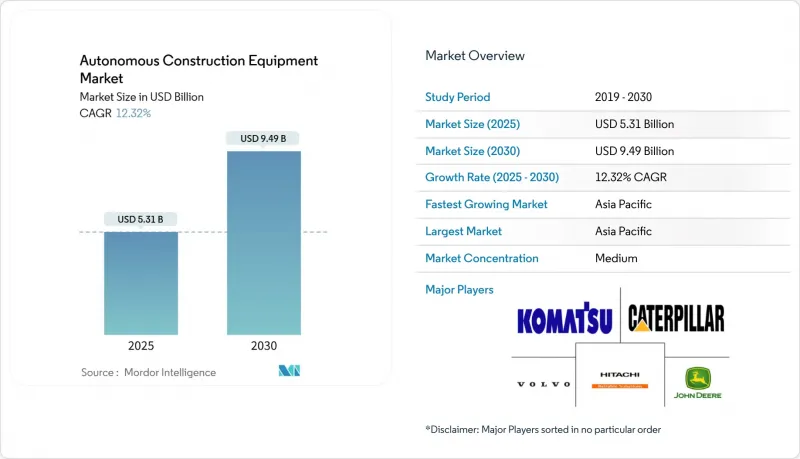
본 보고서는 자동화 수준(반자동, 완전 자동), 기계 유형(토공 기계 등), 구동 방식(내연 기관 등), 기계 크기(대형(11톤 이상) 등), 출력(250 HP 이하 등), 용도, 판매 채널 및 지역별로 분류되어 있습니다. 시장 전망은 금액(미 달러) 및 수량(대) 단위로 제시되어 있습니다.
세계 자율형 건설장비 시장 동향 및 인사이트
인력 부족을 배경으로 한, 자동화를 통한 ROI 중시 추세
북미 건설 업계에서는 2026년까지 220만 명의 노동력 부족이 예상되며, 이로 인해 무인 시스템은 단순한 옵션 업그레이드에서 사업 지속을 위한 필수 요소로 그 위상이 변화하고 있습니다. 자율형 굴삭기를 도입하는 건설사는 1교대당 2-3명의 운전사에 대한 의존도를 줄이고, 초과근무 수당 지급을 피할 수 있습니다. 연중무휴 24시간 연속 가동으로 자산 가동률이 향상되고 프로젝트 공사 기간이 단축되어 입찰 경쟁력이 강화됩니다. 작업 현장에서의 사고 위험이 낮아짐에 따라 보험료 절감 효과도 얻을 수 있습니다. 개정된 ANSI B11 및 UL 4600 규격 준수는 위험 회피 성향이 강한 프로젝트 소유주의 신뢰를 높여줍니다.
OEM용 개조 키트를 통한 설비 투자 대폭 절감
자율형 개조 패키지는 신규 장비 구매에 비해 도입 비용을 40-60% 절감합니다. Liebherr 사의 PR 776 불도저에 탑재된 Trimble 호환 하드웨어는 공장 출하 시 통합된 장착 지점을 갖추고 있어, 보증을 유지하면서 현장에서의 가동 개시를 신속하게 할 수 있습니다. 렌탈 사업자들은 벤더 종속성을 피하고 브랜드에 관계없이 사용할 수 있는 기계 비의존형 3D 제어 시스템을 높이 평가했습니다. 초기 비용 절감으로 인해 소규모 도급업체의 기술 시범 사용이 촉진됩니다. 또한, 개조를 통한 도입은 다양한 기종이 혼재된 차량군의 수명을 연장하고, 자율형 건설장비 시장에서 완전 자율형 도입으로의 전환을 원활하게 합니다.
현장 지형이 복잡하여 GNSS/LiDAR의 신뢰성이 제한되는
도시 재개발이나 다층 굴착 시에는 신호가 차단되어 자율 위치 측정의 정확도가 떨어집니다. 리프헬(Leuphel)사의 GPS 비의존형 휠 로더는 3D 환경 센싱을 활용하여 위성 통신을 이용할 수 없는 터널 내에서도 주행이 가능합니다. 지형의 동적 변화로 인해 실시간 지도 갱신이 요구되어 탑재된 프로세서에 부하가 가해집니다. 국방 등급의 센서 퓨전 기술이 해결책이 될 수 있지만, 시스템 비용을 상승시켜 고가 프로젝트 이외의 분야에서는 보급이 저해되고 있습니다.
부문 분석
2024년 매출의 69.75%를 반자동 기계가 차지했습니다. 이는 도급업체들이 위험을 줄이면서 즉시 생산성을 높이기 위해 운전자 지원 기능을 선호했기 때문입니다. 반면, 완전 자율형 시스템은 규제가 명확해지고 초기 시범 프로젝트를 통해 신뢰성이 입증됨에 따라 가장 높은 연평균 성장률(CAGR) 17.83%를 나타낼 것으로 예측됩니다. 통합형 지휘 플랫폼을 통해 현재는 한 명의 감독자가 여러 대의 무인 자산을 관리할 수 있게 되어 인건비 절감이 가능해졌습니다. 이러한 이점은 공사 기간 단축과 비용 예측 가능성을 추구하는 소유주의 요구와 부합합니다.
완전 자동화 시스템은 ANSI B11 안전 요건을 충족하는 감지 센서와 페일세이프 아키텍처의 발전으로 혜택을 보고 있습니다. 캐터필러(Caterpillar)사의 ‘MineStar Command’는 철광석 광산에서 골재 채석장으로 확대되는 확장 가능한 자율성을 보여주고 있습니다. 조기 도입 기업들로부터는 가동 주기 연장 및 공회전 시 연료 소비량 감소가 보고되고 있습니다. 도입의 장벽은 초기 통합의 복잡성과, 장비 운전자가 아닌 원격 감독자에게 필요한 교육에 주로 기인합니다.
2024년, 광산 및 고속도로 프로젝트에서 자율 운반 시스템과 모터 그레이더가 정착됨에 따라 토공 기계는 47.18%의 시장 점유율을 유지했습니다. 한편, 소형 장비는 도시 지역 및 유틸리티 현장에서 보급되고 있는 스키드 스티어 로더, 플레이트 컴팩터, 자재 핸들러에 자율화가 확산됨에 따라 연평균 성장률(CAGR) 13.42%를 기록할 전망입니다. 이러한 소형 장비는 대형 기계가 작업할 수 없는 좁은 공간에서의 작업에 탁월하며, 재작업 감소와 교통 혼잡 완화에 기여합니다. 주요 OEM 제조업체들의 모델 라인업 확충으로 초기 도입 가격이 억제되면서, 메가 프로젝트 예산을 확보하지 못한 중규모 도급업체들의 관심을 끌고 있습니다.
자율형 건설장비 시장 중에서도 소형 장비 시장 규모는 여전히 작지만, 제조업체에 관계없이 사후 장착 키트를 이용할 수 있게 되고 자금 조달이 용이해짐에 따라 그 성장은 가속화되고 있습니다. 이미 미니 굴삭기, 로봇식 트랙 로더, 자동 다짐기가 연계하여 작업을 수행하는 ‘멀티 머신 현장’의 개념이 실증되었습니다. 보다 광범위한 보급을 위해서는 안전 인증 절차의 간소화와, 다양한 기종이 혼재된 차량군의 유지보수를 지원할 수 있는 딜러의 지원이 필수적입니다. 렌탈 서비스의 확충으로 인해 유지보수, 소프트웨어 업데이트, 운전사 교육이 패키지화되어 진입 장벽이 더욱 낮아지고 있습니다.
2024년에는 내연기관이 74.36%의 점유율을 차지했으나, 배기가스 규제와 총 소유 비용 절감을 배경으로 배터리식 전기 기계는 연평균 성장률(CAGR) 19.26%로 급증할 것으로 예측됩니다. 민관 협력에 의한 충전 인프라가 보급되고 배터리 가격이 1kWh당 70달러 아래로 떨어짐에 따라, 배터리 전기식 자율형 건설장비 시장 점유율은 해마다 확대되고 있습니다. 전기 구동 시스템은 순간적인 토크와 정밀한 속도 제어를 실현하고, 알고리즘에 의한 제어 루프를 단순화하기 때문에 자율형과 매우 잘 어울립니다. 디젤 연료비 급등과 기업의 탈탄소화 노력이 전환 프로그램에 경제적 뒷받침을 제공합니다.
순간 토크 덕분에 더욱 부드러운 경로 추종이 가능해지며, 회생 제동은 디젤 유압 시스템에 비해 가동 시간을 연장하고 유지보수 주기를 단축합니다. 배터리 중량이 제약이 되는 대형 휠 로더의 경우, 수소 연료전지 시험이 진행 중이지만 실용화까지는 아직 수년이 소요될 것으로 예측됩니다. 하이브리드 유압 시스템은 과도기적 수단으로 기능하며, 인프라 전환 기간 동안 연료와 전기를 병행하여 사용할 수 있게 합니다. 이러한 추진 옵션은 종합적으로, 다양한 가동 주기와 현장 제약에 직면한 차량 운용 계획 담당자가 활용할 수 있는 기술 도구 키트를 확충합니다.
지역별 분석
2024년, 아시아태평양은 자율형 건설장비 시장에서 매출의 45.13%를 차지하며 시장을 주도했습니다. 이를 이끈 원동력은 중국의 배터리 교체형 굴삭기, 일본의 고정밀 센서, 그리고 한국의 전자 부품 공급망이었습니다. 각 지역 정부는 생산성 향상과 배기가스 감축을 의무화하는 스마트 시티 및 고속철도 프로젝트에 자금을 지원하고 있습니다. 그러나 성숙한 하위 부문에서는 도입이 빠르게 포화 상태에 이르기 때문에 이 지역의 연평균 성장률(CAGR) 12.51%는 지역 전체의 성장 속도를 따라가지 못하고 있는 상황입니다. 국가마다 다른 기준은 규정 준수 부담을 가중시키고, 지역 간 차량 공유를 지연시키고 있습니다.
북미 시장의 12.42% 연평균 성장률(CAGR)은 심각한 숙련 노동력 부족과 보다 명확한 안전 체계에 기인합니다. 네바다주 등 미국 각 주에서는 실증 시험이 허용되고 있어 상용화 주기가 가속화되고 있습니다. 연방 정부의 인프라 자금에는 탄소 감축 점수가 반영되어 있어, 유틸리티 도급업체들이 전기차와 자율 주행을 결합한 솔루션으로 전환하도록 장려하고 있습니다. 캐나다의 입찰 평가에서는 이미 운전자가 필요 없는 장비에 가산점이 부여되고 있어, 대규모 프로젝트에서 자율주행이 차별화 요인으로 작용하고 있습니다. 또한, 공급망 회복탄력성 향상 노력도 배터리 팩 및 센서 모듈의 현지 생산을 뒷받침하고 있습니다.
유럽에서는 전체 수명 주기의 탄소 배출량을 입찰 평가에 반영하는 ‘친환경 공공 조달’ 규정의 뒷받침을 받아 견조한 연평균 성장률(CAGR)이 예상됩니다. 네덜란드 등 일부 국가에서는 ‘CO2 성과 사다리(CO2 Performance Ladder)’라는 인센티브 제도를 통해 저배출 작업 현장을 장려하고 있으며, 이에 따라 도급업체들은 전동 및 자율주행 차량 도입을 추진하고 있습니다. EU 회원국 간 안전 인증이 통일되어 있지 않아 국경을 넘는 도입은 복잡해지고 있지만, ISO에 준거한 지침 마련이 진행되고 있습니다. 아인트호벤 등 도시에서 진행된 초기 전동화 시범 사업에서는 공공 공사 현장에서 배출 제로 자율형 굴삭기의 유효성이 입증되었으며, 보다 광범위한 도입을 위한 모델이 확립되었습니다.
기타 혜택:
- Excel 형식 시장 예측(ME) 시트
- 3개월간의 애널리스트 지원
자주 묻는 질문
목차
제1장 서론
제2장 분석 방법
제3장 주요 요약
제4장 시장 구도
제5장 시장 규모·성장률 예측
제6장 경쟁 구도
제7장 시장 기회와 향후 전망
JHS 26.09.03According to Mordor Intelligence, the autonomous construction equipment market size stood at USD 5.31 billion in 2025 and is forecast to climb to USD 9.49 billion by 2030, advancing at a 12.32% CAGR.
This report is Segmented by Level of Automation (Semi-Autonomous and Fully Autonomous), Equipment Type (Earthmoving and More), Propulsion Type (Internal Combustion and More), Equipment Size (Heavy (Above 11 T) and More), Power Output (Up To 250 HP and More), Application, Sales Channel, and Geography. The Market Forecasts are Provided in Terms of Value (USD) and Volume (Units).
Global Autonomous Construction Equipment Market Trends and Insights
Labor-shortage Driven ROI Focus on Automation
Construction faces a projected 2.2 million-worker gap by 2026 in North America, elevating unmanned systems from optional upgrades to business-continuity necessities. Contractors deploying autonomous excavators cut reliance on two to three operators per shift and avoid overtime premiums. Continuous 24/7 operation improves asset utilization and compresses project timelines, enhancing bid competitiveness. Insurance savings accrue as exposure to work-site accidents falls. Compliance with updated ANSI B11 and UL 4600 standards boosts confidence among risk-averse project owners.
OEM Retrofit Kits Slashing Capital Outlay
Retrofit autonomy packages cut implementation costs 40-60% compared with new equipment purchases. Trimble-ready hardware on Liebherr PR 776 dozers illustrates factory-integrated mounting points that preserve warranties and speed field activation. Rental fleets value machine-agnostic 3D control systems that travel across brands, avoiding vendor lock-in. Lower upfront spend hastens technology trials by small contractors. Retrofit pathways also extend the service life of mixed fleets, smoothing the transition toward fully autonomous deployments in the autonomous construction equipment market.
Fragmented Job-site Topography Limiting GNSS/LiDAR Reliability
Urban reconstruction and multi-level excavations produce obstructed signals that diminish autonomous positioning accuracy. Liebherr's GPS-independent wheel loader uses 3D environmental sensing to navigate in tunnels where satellite access fails. Dynamic terrain changes force real-time map updates that tax onboard processing. Defense-grade sensor fusion offers a workaround yet raises system cost, inhibiting widespread use beyond premium projects.
Other drivers and restraints analyzed in the detailed report include:
- Rapid Battery-cost Decline Enabling Electrification
- AI-enabled Multi-machine Orchestration
- Unharmonized Safety Regulations Across Jurisdictions Delaying Approvals
For complete list of drivers and restraints, kindly check the Table Of Contents.
Segment Analysis
Semi-autonomous machines delivered 69.75% of 2024 revenue as contractors favored operator-assisted functions for immediate productivity gains with limited risk. Fully autonomous systems, however, are forecast to capture the fastest 17.83% CAGR as regulatory clarity improves and early pilots prove reliability. Integrated command platforms now let a single supervisor oversee multiple unmanned assets, compressing labor budgets. These gains align with owner demands for shorter schedules and predictable costs.
The fully autonomous cohort benefits from advances in perception sensors and fail-safe architectures that meet ANSI B11 safety requirements. Caterpillar's MineStar Command demonstrates scalable autonomy migrating from iron-ore mines to aggregates quarries. Early adopters report extended duty cycles and reduced idle fuel burn. Adoption barriers center on upfront integration complexity and the training required for remote supervisors rather than equipment operators.
Earthmoving equipment retained 47.18% market share in 2024 owing to entrenched autonomous haulage systems and motor graders across mining and highway projects. Compact tools, conversely, will post a 13.42% CAGR as autonomy penetrates skid steers, plate compactors, and material handlers popular on urban and utilities work sites. These smaller assets excel in confined areas where large machinery cannot maneuver, reducing rework and traffic disruption. Expanding model availability from mainstream OEMs keeps upfront prices in check, drawing interest from midsized contractors that lack mega-project budgets.
The autonomous construction equipment market size for compact tools remains modest yet accelerates as retrofit kits become brand-agnostic and easier to finance. Multi-machine site concepts already showcase coordinated tasks among mini-excavators, robotic track loaders, and automated compactors. Broader accessibility rests on streamlined safety certification and dealer support capable of servicing mixed fleets. Increased rental availability further lowers entry barriers by bundling maintenance, software updates, and operator onboarding.
Internal-combustion engines held 74.36% share in 2024, but battery-electric units are projected to surge at a 19.26% CAGR on the back of emissions mandates and total-cost savings. The autonomous construction equipment market share attributable to battery-electric machines improves yearly as public-private charging infrastructure spreads and batteries hit sub-USD 70/kWh pricing. Electric drivetrains deliver instant torque and precise speed modulation that simplify algorithmic control loops, making them a natural partner for autonomy. Rising diesel costs and corporate decarbonization pledges add financial impetus to conversion programs.
Instant torque enables smoother path-following, while regenerative braking extends runtime and trims maintenance cycles compared with diesel hydraulics. Hydrogen fuel-cell trials progress in heavy wheel loaders where battery mass proves restrictive, though commercialization remains several years away. Hybrid hydraulic systems serve as an interim step, allowing mixed fuel and electric operation during the infrastructure transition. Collectively, these propulsion options widen the technology toolkit available to fleet planners facing varied duty cycles and site constraints.
Complete Report Scope:
- By Level of Automation
- Semi-Autonomous
- Fully Autonomous
- By Equipment Type
- Earthmoving
- Material Handling
- Concrete and Road Machinery
- Light / Compact Tools
- By Propulsion Type
- Internal Combustion
- Hybrid Hydraulic
- Battery-Electric
- Hydrogen Fuel-Cell
- By Equipment Size
- Heavy (Above 11 t)
- Medium (6 to 11 t)
- Compact (Below 6 t)
- By Power Output
- Up to 250 HP
- 250 to 500 HP
- Above 500 HP
- By Application
- Infrastructure
- Residential and Commercial Construction
- Mining and Quarrying
- Oil and Gas / Pipelines
- Industrial and Manufacturing
- By Sales Channel
- New Equipment
- Rental
- Used / Refurbished
- By Geography
- North America
- United States
- Canada
- Rest of North America
- South America
- Brazil
- Argentina
- Rest of South America
- Europe
- Germany
- United Kingdom
- France
- Italy
- Spain
- Sweden
- Rest of Europe
- Asia-Pacific
- China
- India
- Japan
- South Korea
- Indonesia
- Rest of Asia-Pacific
- Middle East and Africa
- Saudi Arabia
- United Arab Emirates
- Turkey
- South Africa
- Nigeria
- Egypt
- Rest of Middle East and Africa
- North America
Geography Analysis
Asia-Pacific dominated the autonomous construction equipment market with 45.13% revenue in 2024, anchored by China's battery-swap excavators, Japan's precision sensors, and South Korea's electronics supply chain. Regional governments finance smart-city and high-speed rail projects that mandate productivity gains and emissions cuts. However, the 12.51% regional CAGR trails the region's pace because adoption saturates quickly in mature sub-sectors. Divergent national standards add compliance overhead and slow pan-regional fleet sharing.
North America's 12.42% CAGR arises from critical skilled-labor shortages and clearer safety frameworks. U.S. states such as Nevada permit live site testing, accelerating commercialization cycles. Federal infrastructure funding includes carbon-reduction scoring, nudging public contractors toward electric-autonomous packages. Canada's tender evaluations already award points for zero-operator equipment, making autonomy a differentiator on mega-projects. Supply-chain resilience initiatives also drive local manufacturing of battery packs and sensor modules.
Europe is projected to post a robust CAGR, driven by Green Public Procurement rules that factor whole-life carbon into bid scoring. Nations like the Netherlands use CO2 Performance Ladder incentives to reward low-emission job sites, pushing contractors to integrate electric-autonomous fleets. Fragmented safety certification across EU states complicates cross-border deployments, but ISO-aligned guidance is tightening. Early electrification pilots in cities such as Eindhoven validate emission-free autonomous diggers on municipal works, setting templates for broader rollouts.
- Caterpillar Inc.
- Komatsu Ltd.
- Deere & Company
- Volvo Construction Equipment
- Hitachi Construction Machinery
- Liebherr Group
- CNH Industrial
- JCB Ltd.
- DEVELON (HD Hyundai Infracore)
- Hyundai Construction Equipment
- Wirtgen Group
- Bobcat Company
- Sandvik AB
- Epiroc AB
- Trimble Inc.
- Topcon Corp.
- Built Robotics
- SafeAI
- Autonomous Solutions Inc. (ASI)
- XCMG
- Sany Heavy Industry
Additional Benefits:
- The market estimate (ME) sheet in Excel format
- 3 months of analyst support
TABLE OF CONTENTS
1 Introduction
- 1.1 Study Assumptions and Market Definition
- 1.2 Scope of the Study
2 Research Methodology
3 Executive Summary
4 Market Landscape
- 4.1 Market Overview
- 4.2 Market Drivers
- 4.2.1 Labor-shortage Driven ROI Focus on Automation
- 4.2.2 OEM Retrofit Kits Slashing Cap-ex vs. New Buys (After-market Autonomy)
- 4.2.3 Rapid Battery-cost Decline Enabling Heavy Equipment Electrification
- 4.2.4 Carbon-linked Project Tender Scores in Europe and Canada Favouring Zero-operator Sites
- 4.2.5 AI-enabled Multi-machine Fleet Orchestration Boosts Productivity 25 to 30%
- 4.2.6 Defence-funded Sensor Fusion Spilling Over to Construction OEMs
- 4.3 Market Restraints
- 4.3.1 Fragmented Job-site Topography Limiting GNSS/LiDAR Reliability
- 4.3.2 Unharmonized Safety Regulations Across US-States/EU-27 Delaying Approvals
- 4.3.3 Data-ownership Disputes Between EPCs, OEMs and Tech Suppliers
- 4.3.4 Scarcity of High-capacity, Ruggedised Battery Packs (Over 600 kWh) Until 2026
- 4.4 Value / Supply-Chain Analysis
- 4.5 Regulatory Landscape
- 4.6 Technological Outlook
- 4.7 Porter's Five Forces Analysis
- 4.7.1 Threat of New Entrants
- 4.7.2 Bargaining Power of Suppliers
- 4.7.3 Bargaining Power of Buyers
- 4.7.4 Threat of Substitutes
- 4.7.5 Intensity of Competitive Rivalry
5 Market Size and Growth Forecasts (Value (USD) and Volume (Units))
- 5.1 By Level of Automation
- 5.1.1 Semi-Autonomous
- 5.1.2 Fully Autonomous
- 5.2 By Equipment Type
- 5.2.1 Earthmoving
- 5.2.2 Material Handling
- 5.2.3 Concrete and Road Machinery
- 5.2.4 Light / Compact Tools
- 5.3 By Propulsion Type
- 5.3.1 Internal Combustion
- 5.3.2 Hybrid Hydraulic
- 5.3.3 Battery-Electric
- 5.3.4 Hydrogen Fuel-Cell
- 5.4 By Equipment Size
- 5.4.1 Heavy (Above 11 t)
- 5.4.2 Medium (6 to 11 t)
- 5.4.3 Compact (Below 6 t)
- 5.5 By Power Output
- 5.5.1 Up to 250 HP
- 5.5.2 250 to 500 HP
- 5.5.3 Above 500 HP
- 5.6 By Application
- 5.6.1 Infrastructure
- 5.6.2 Residential and Commercial Construction
- 5.6.3 Mining and Quarrying
- 5.6.4 Oil and Gas / Pipelines
- 5.6.5 Industrial and Manufacturing
- 5.7 By Sales Channel
- 5.7.1 New Equipment
- 5.7.2 Rental
- 5.7.3 Used / Refurbished
- 5.8 By Geography
- 5.8.1 North America
- 5.8.1.1 United States
- 5.8.1.2 Canada
- 5.8.1.3 Rest of North America
- 5.8.2 South America
- 5.8.2.1 Brazil
- 5.8.2.2 Argentina
- 5.8.2.3 Rest of South America
- 5.8.3 Europe
- 5.8.3.1 Germany
- 5.8.3.2 United Kingdom
- 5.8.3.3 France
- 5.8.3.4 Italy
- 5.8.3.5 Spain
- 5.8.3.6 Sweden
- 5.8.3.7 Rest of Europe
- 5.8.4 Asia-Pacific
- 5.8.4.1 China
- 5.8.4.2 India
- 5.8.4.3 Japan
- 5.8.4.4 South Korea
- 5.8.4.5 Indonesia
- 5.8.4.6 Rest of Asia-Pacific
- 5.8.5 Middle East and Africa
- 5.8.5.1 Saudi Arabia
- 5.8.5.2 United Arab Emirates
- 5.8.5.3 Turkey
- 5.8.5.4 South Africa
- 5.8.5.5 Nigeria
- 5.8.5.6 Egypt
- 5.8.5.7 Rest of Middle East and Africa
- 5.8.1 North America
6 Competitive Landscape
- 6.1 Market Concentration
- 6.2 Strategic Moves
- 6.3 Market Share Analysis
- 6.4 Company Profiles (Includes Global Level Overview, Market Level Overview, Core Segments, Financials as Available, Strategic Information, Market Rank/Share, Products and Services, Recent Developments)
- 6.4.1 Caterpillar Inc.
- 6.4.2 Komatsu Ltd.
- 6.4.3 Deere & Company
- 6.4.4 Volvo Construction Equipment
- 6.4.5 Hitachi Construction Machinery
- 6.4.6 Liebherr Group
- 6.4.7 CNH Industrial
- 6.4.8 JCB Ltd.
- 6.4.9 DEVELON (HD Hyundai Infracore)
- 6.4.10 Hyundai Construction Equipment
- 6.4.11 Wirtgen Group
- 6.4.12 Bobcat Company
- 6.4.13 Sandvik AB
- 6.4.14 Epiroc AB
- 6.4.15 Trimble Inc.
- 6.4.16 Topcon Corp.
- 6.4.17 Built Robotics
- 6.4.18 SafeAI
- 6.4.19 Autonomous Solutions Inc. (ASI)
- 6.4.20 XCMG
- 6.4.21 Sany Heavy Industry
7 Market Opportunities and Future Outlook
- 7.1 White-space and Unmet-Need Assessment


