

|
시장보고서
상품코드
2117486
트립토렐린 시장 : 점유율 분석, 업계 동향과 통계, 성장 예측(2026-2031년)Triptorelin - Market Share Analysis, Industry Trends & Statistics, Growth Forecasts (2026 - 2031) |
||||||
 Mordor Intelligence
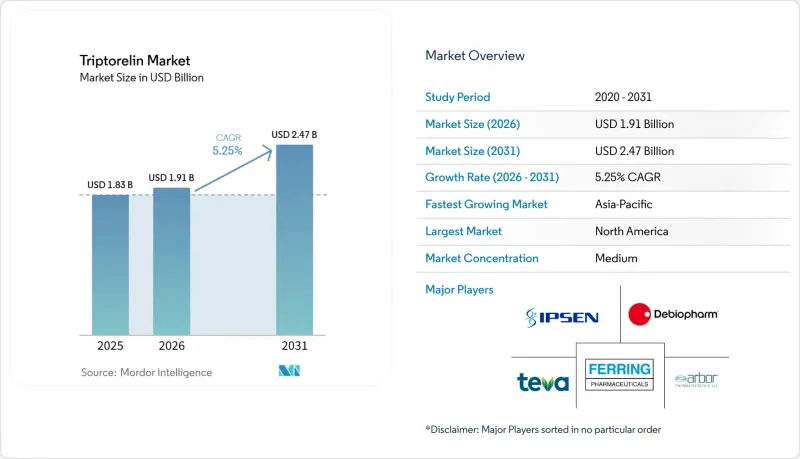
Mordor Intelligence에 의하면, 트립토렐린 시장 규모는 2025년에 18억 3,000만 달러, 2026년에 19억 1,000만 달러가 되고, 2031년까지 24억 7,000만 달러에 이를 것으로 예측되며, 2026년부터 2031년까지 CAGR 5.25%로 성장할 전망입니다.
본 보고서는 약제 유형(파모에이트, 아세테이트, 엠보네이트), 투여 경로(근육 내 주사, 피하 주사), 적응증(전립선암, 자궁내막증, CPP, 자궁근종, 근치적 전립선 전적출술, 기타),유통 채널(병원, 소매, 온라인 약국, 기타) 및 지역(북미, 유럽, 아시아태평양, 중동 및 아프리카, 남미)별로 분류되어 있습니다. 예측치는 금액(달러)으로 표시되어 있습니다.
세계 트립토렐린 시장 동향 및 인사이트
전립선암 및 자궁내막증의 부담 증가
2021년 전 세계 전립선암 신규 발병자 수는 132만 명에 달했으며, 해당 질환 부담에 관한 조사에 따르면 2040년까지 240만 명에 이를 것으로 예측됩니다. 이에 따라 트립토렐린 시장에는 대규모이며 지속적으로 확대되는 치료 대상층이 예상됩니다. 미국에서만 2026년에는 33만 3,830건의 전립선암 신규 진단과 3만 6,320명의 사망이 예상되며, 현재의 치료 지침에서는 전이성 호르몬 민감성 질환에 대한 1차 선택 거세 요법으로 LHRH 작용제가 계속해서 권장되고 있습니다. 자궁내막증은 세계보건기구(WHO)의 추정에 따르면 전 세계적으로 1억 9,000만 명의 가임기 여성이 앓고 있는 것으로 알려져 있으며, 2026년 리뷰에서는 장기 무작위 대조 시험의 증거를 바탕으로,GnRH 작용제가 통증 관리에 있어 가장 효과적인 호르몬 요법 중 하나임이 확인됨에 따라, 두 번째 주요 수요원으로 부상하고 있습니다. 따라서 트립토렐린 시장에는 지속적인 수요가 예상됩니다. 이는 두 질환 모두 대규모의 활동성 환자 집단이 존재하는 데다, 진단 지연이 여전히 지속되고 있어 자궁내막증 치료 대상자층에 대한 보급률이 아직 낮은 것으로 보이기 때문입니다.
중추성 조기 사춘기 관리에서의 사용 확대
2024년 10월에 발표된, 중국 내 12개 기관에서 실시된 제3상 임상시험에서는 중추성 조기 사춘기 소아에게 트립토렐린 파모에이트 디포 제제 22.5 mg을 1회 투여한 결과, 6개월 후 황체형성호르몬 억제율이 100%에 달한 것으로 나타났습니다. 이 임상시험에서 참가자의 98.5%에서 사춘기의 퇴행 또는 안정화가 확인되었으며, 3등급 이상의 이상반응은 보고되지 않았습니다. 이를 통해 트립토렐린 시장은 향후 큰 수요가 예상되는 시장에서 소아 환자에 대한 유효성과 안전성에 대한 강력한 근거를 확보하게 되었습니다. 두 번째 진전은 2026년 4월에 있었으며, GenSci006에 대한 집단 약동학 연구를 통해 트립토렐린 아세테이트 마이크로스피어의 소아에 대한 외삽 체계가 진전되었습니다. 이는 아시아태평양에서의 신제제 승인에 중요한 의미를 지닙니다. 이러한 연구 결과는 단기간 투여용 소아용 제제에서 더 장기 투여 옵션으로의 광범위한 전환을 뒷받침하며, 종종 수년에 걸쳐 이어지는 치료 기간 동안의 지속성을 향상시킬 수 있습니다.
펩타이드 합성 및 무균 주사제 제조의 높은 비용
트립토렐린은 데카펩타이드의 유사체이며, 그 제조에는 고가의 보호 아미노산, 고순도 정제, 무균 충전 및 마무리 능력, 그리고 콜드체인 관리가 필요하기 때문에 트립토렐린 시장 전체의 비용이 높은 수준을 유지하고 있습니다. 이러한 요건들은 소규모 사업자에게는 진입 장벽이 되는 한편, 기술적으로 고도로 발달한 주사제 부문에서 저가 제네릭 의약품이나 지역 한정 제품과 경쟁하려는 기업의 이익률 확대도 제한하고 있습니다. 공급망의 취약성도 두드러지는데, 2025년 3월 스코틀랜드 국민건강보험(NHS Scotland)이 ‘고나펩틸 데포 3.75 mg’에 대해 의약품 공급 경보를 발령했으며, 공급 차질은 2026년 1월까지 이어지고 있습니다. 단일 무균 데포 제제공급 문제는 동일한 분자가 전립선암, 자궁내막증, 중추성 조기 사춘증 치료에 사용되고 있기 때문에 여러 치료 분야에 동시에 영향을 미칠 가능성이 있습니다. 따라서 트립토렐린 시장은 제조 비용뿐만 아니라 여러 임상 용도에 걸쳐 동시에 안정적인 공급을 유지하는 문제와도 관련된 근본적인 비용 절감 과제에 직면해 있습니다.
부문 분석
2025년에는 트립토렐린 파모에이트가 45.35%의 점유율을 차지할 것으로 예상되는 반면, 트립토렐린 엠보네이트는 2031년까지 연평균 성장률(CAGR) 6.34%로 성장할 것으로 전망되어, 이것이 트립토렐린 시장에서 염형 간 현재경쟁 구도를 형성하고 있습니다. 파모에이트는 전립선암, 중추성 조기 사춘기 및 기타 호르몬 억제 요법 분야에서 사용되는 브랜드 제품 라인에서 이미 폭넓은 임상적 인지도와 지지를 얻고 있기 때문에 여전히 가장 큰 제형으로 남아 있습니다. 이러한 기존 기반은 매우 중요하며, 처방 의사나 조달 팀은 병원 프로토콜에 저장형 제형이 정착되면 종종 해당 제형을 계속 사용하는 경향이 있기 때문입니다. 엠보네이트는 2025년 스위스에서 피하 투여형 파모렐린 LA가 승인되고, 진행성 또는 전이성 전립선암을 대상으로 한 6개월 투여형 데카펩틸-엠보네이트 제제에 대한 유럽의 분산형 승인 절차가 완료됨에 따라 새로운 주목을 받고 있습니다.
2025년 매출액 중 근육 내 투여가 82.23%를 차지하고 있어, 트립토렐린 시장이 종양학 및 내분비 치료 분야에서 확립된 데포 주사 관행에 의해 얼마나 견고하게 뒷받침되고 있는지를 보여줍니다. 근육 내 투여 경로가 오랫동안 이러한 우위를 구축해 온 이유는 전문 의료기관에서 치료를 받는 경우가 많은 고령의 전립선암 환자들에게서, 더 깊은 부위로의 저장 주사가 제제의 투여량과 예측 가능한 방출을 뒷받침하기 때문입니다. 피하 투여는 가장 빠르게 성장하는 투여 경로이며, 이 경로를 통한 트립토렐린 시장 규모는 2031년까지 연평균 성장률(CAGR) 5.68%로 확대될 것으로 예측됩니다. 2025년 스위스에서 피하 투여형 파모렐린 LA가 승인된 것은 이 투여 경로에 있어 중요한 제도적 지침이 되었습니다. 이는 데비오팜(Debiofarm)사가 통증과 혈종 위험을 줄이면서도 동등한 테스토스테론 억제 효과를 얻을 수 있다고 보고했기 때문입니다.
지역별 분석
2025년, 북미는 전 세계 매출의 40.36%를 차지하며 트립토렐린 시장에서 가장 큰 기여를 한 지역이 되었습니다. 미국에서는 전립선암 발병률이 여전히 높으며, 현행 진료 지침에 따라 2026년에는 33만 3,830건의 신규 진단이 예상에 따라, 이 지역은 계속해서 1위 자리를 유지할 전망입니다. 북미의 트립토렐린 시장은 확립된 보험 급여 제도와 장기 작용형 데포 요법을 일상적으로 도입할 수 있는 전문 암 치료 네트워크의 혜택도 받고 있습니다. 미국은 ‘트렐스타(Trelstar)’나 ‘트립토듀어(Triptodur)’ 등의 제품을 통해 주요 브랜드 의약품 시장으로 자리매김하고 있는 한편, 성숙한 처방 환경과 맞물려 제네릭 의약품으로의 전환 압력이 가장 활발한 시장 중 하나가 되고 있습니다. 유럽은 브랜드 의약품의 데포 제제 사용이 정착되어 있으며, 승인 및 조달 환경이 엄격하게 규제되고 있어 임상적으로 중요한 지역으로 남아 있습니다.
아시아태평양은 가장 빠르게 성장하고 있는 지역으로, 이 지역의 트립토렐린 시장 규모는 2031년까지 연평균 성장률(CAGR) 6.39%로 확대될 것으로 예측됩니다. 중국은 특히 주목할 만한 존재입니다. 2024년에 실시된 조기 사춘기에 관한 3상 중앙 임상시험에서 중국 소아를 대상으로 6개월간 파모에이트 제제를 투여했을 때 황체형성호르몬(LH)이 100% 억제된 것이 확인되어, 소아에 대한 더 광범위한 사용 근거가 강화되었기 때문입니다. 일본, 인도, 호주,한국도 주요 의료 시스템 중 일부에서 내분비학 및 종양학 전문 치료 체계가 확대되고 있어 이 지역의 성장에 기여하고 있습니다. 따라서 트립토렐린 시장은 아시아태평양에서 가장 강력한 미래 성장 모멘텀을 보이고 있으며, 이곳에서는 소아 분야와 종양학 분야의 성장 요인이 서로 독립적으로 작용하는 것이 아니라 시너지 효과를 발휘하고 있습니다.
기타 혜택:
- 엑셀 형식 시장 예측(ME) 시트
- 3개월간의 애널리스트 지원
자주 묻는 질문
목차
제1장 서론
제2장 조사 방법
제3장 개요
제4장 시장 구도
제5장 시장 규모와 성장 예측
제6장 경쟁 구도
제7장 시장 기회와 향후 전망
JHS 26.09.01According to Mordor Intelligence, the triptorelin market size is projected to be USD 1.83 billion in 2025, USD 1.91 billion in 2026, and reach USD 2.47 billion by 2031, growing at a CAGR of 5.25% from 2026 to 2031.
This report is Segmented by Drug Type (Pamoate, Acetate, Embonate), Route of Administration (IM, SC), Application (Prostate Cancer, Endometriosis, CPP, Uterine Fibroids, Radical Prostatectomy, Others), Distribution Channel (Hospital, Retail, Online Pharmacies, Others), and Geography (North America, Europe, Asia-Pacific, Middle East and Africa, South America). Forecasts are Provided in Terms of Value (USD).
Global Triptorelin Market Trends and Insights
Rising Burden Of Prostate Cancer And Endometriosis
Global prostate cancer incidence reached 1.32 million cases in 2021, and the same body of disease burden work projects cases to reach 2.4 million by 2040, which keeps a large and growing treatment base in view for the triptorelin market. The United States alone is expected to record 333,830 new prostate cancer diagnoses and 36,320 deaths in 2026, and current treatment guidance continues to support LHRH agonists as first-line castration options in metastatic hormone-sensitive disease. Endometriosis adds a second major demand pool because the World Health Organization estimates that 190 million women of reproductive age are affected globally, and a 2026 review confirmed GnRH agonists as one of the strongest hormonal options for pain control across a long span of randomized evidence. The triptorelin market therefore, carries durable demand because both diseases have large active patient populations, and the endometriosis treatment pool still appears underpenetrated due to persistent diagnostic delay.
Growing Use In Central Precocious Puberty Management
A Phase 3 study published in October 2024 across 12 Chinese sites showed 100% luteinizing hormone suppression at month 6 after a single 22.5 mg triptorelin pamoate depot dose in children with central precocious puberty. The same study also reported pubertal regression or stabilization in 98.5% of participants and no grade 3 or higher adverse events, which gives the triptorelin market a strong pediatric efficacy and safety reference in a large future demand center. A second development came in April 2026 when population pharmacokinetics work for GenSci006 advanced the pediatric extrapolation framework for triptorelin acetate microspheres, which matters for new formulation approvals in the Asia-Pacific. These findings support a broader move from short-interval pediatric use toward longer-interval options, which can improve continuity during treatment courses that often last several years.
High Cost Of Peptide Synthesis And Sterile Injectable Manufacturing
Triptorelin is a decapeptide analog, and its production depends on expensive protected amino acids, high-grade purification, sterile fill finish capacity, and cold chain handling, which keeps costs elevated across the triptorelin market. These requirements create entry barriers for smaller players, but they also limit margin expansion for companies trying to compete with lower-priced generic or regional products in a technically demanding injectable category. Supply chain fragility is also visible because NHS Scotland issued a medicine supply alert in March 2025 for Gonapeptyl Depot 3.75 mg, with disruption continuing through January 2026. A supply issue in one sterile depot product can affect several therapeutic areas at once because the same molecule serves prostate cancer, endometriosis, and central precocious puberty. The triptorelin market, therefore faces a basic cost restraint that is not only about manufacturing expense, but also about maintaining a reliable supply across multiple clinical uses at the same time.
Other drivers and restraints analyzed in the detailed report include:
- Shift Toward Long-Acting Depot Formulations
- Expansion Of Fertility And Gender-Affirming Use Cases
- Regulatory And Label Expansion Complexity Across Major Markets
For complete list of drivers and restraints, kindly check the Table Of Contents.
Segment Analysis
Triptorelin pamoate held 45.35% share in 2025, while triptorelin embonate is projected to grow at a 6.34% CAGR through 2031, which sets the current shape of competition across salt forms in the triptorelin market. Pamoate remains the largest format because it already has broad clinical familiarity and support across branded product lines used in prostate cancer, central precocious puberty, and other hormone suppression settings. That installed base matters because prescribers and procurement teams often stay with a depot format once it is established in hospital protocols. Embonate has gained fresh attention after the 2025 Swiss approval for subcutaneous Pamorelin LA and the completed European decentralized procedure for the 6 month Decapeptyl embonate formulation in advanced or metastatic prostate cancer.
Intramuscular administration accounted for 82.23% of revenue in 2025, which shows how firmly the triptorelin market still rests on established depot injection practice in oncology and endocrine care. The intramuscular route built this lead over many years because deeper depot delivery supports formulation volume and predictable release in an elderly prostate cancer population that is commonly treated in specialist settings. Subcutaneous delivery is the fastest-growing route, and the triptorelin market size for this route is projected to advance at 5.68% CAGR through 2031. Swiss approval for subcutaneous Pamorelin LA in 2025 gave this route a major institutional reference point because Debiopharm reported equivalent testosterone suppression with lower pain and reduced hematoma risk.
Complete Report Scope:
- By Drug Type
- Triptorelin Pamoate
- Triptorelin Acetate
- Triptorelin Embonate
- By Route of Administration
- Intramuscular (IM)
- Subcutaneous (SC)
- By Application
- Prostate Cancer
- Radical Prostatectomy
- Endometriosis
- Central Precocious Puberty
- Uterine Fibroids
- Fertility Suppression and Assisted Reproduction Protocols
- Others (Salivary Gland Cancer, Hormone-Sensitive Breast Cancer)
- By Distribution Channel
- Hospital Pharmacies
- Retail Pharmacies
- Online Pharmacies
- Others (Specialty Pharmacies, Government Procurement Channels)
- By Geography
- North America
- United States
- Canada
- Mexico
- Europe
- Germany
- United Kingdom
- France
- Italy
- Spain
- Rest of Europe
- Asia-Pacific
- China
- India
- Japan
- Australia
- South Korea
- Rest of Asia-Pacific
- Middle East and Africa
- GCC
- South Africa
- Rest of Middle East and Africa
- South America
- Brazil
- Argentina
- Rest of South America
- North America
Geography Analysis
North America held 40.36% of global revenue in 2025, which made it the largest regional contributor in the triptorelin market. The region stays ahead because the United States continues to carry a high prostate cancer burden, with 333,830 new diagnoses expected in 2026 under current guideline references. The triptorelin market in North America also benefits from established reimbursement structures and specialist oncology networks that can absorb long-acting depot therapy on a routine basis. The United States remains the main branded base through products such as Trelstar and Triptodur, while the mature prescribing environment also makes it one of the most active settings for generic substitution pressure. Europe remains a clinically important region because it houses entrenched branded depot use and a highly regulated approval and procurement environment.
Asia-Pacific is the fastest-growing geography, and the triptorelin market size in the region is projected to rise at 6.39% CAGR through 2031. China stands out because the 2024 Phase 3 central precocious puberty study supported 100% luteinizing hormone suppression with the 6-month pamoate formulation in Chinese children, which strengthens the case for broader pediatric use. Japan, India, Australia, and South Korea also contribute to the regional growth profile because specialist endocrine and oncology treatment capacity is expanding across several of the largest healthcare systems. The triptorelin market therefore has its strongest forward regional momentum in Asia-Pacific, where pediatric and oncology drivers are working together rather than independently.
- Ache Laboratorios Farmaceuticos S.A.
- Adium Pharma
- Anhui Anke Bioengineering (Group) Co., Ltd.
- Arbor Pharmaceuticals
- Azurity Pharmaceuticals
- Bachem Holding
- Chengdu Tiantaishan Pharmaceutical Co., Ltd.
- Debiopharm Group
- Dr. Reddy's Laboratories
- Ferring Pharmaceuticals
- Ipsen
- Knight Therapeutics Inc.
- Orient Europharma Co., Ltd.
- Sun Pharmaceuticals Industries
- Tecnofarma S.A.
- Teva Pharmaceutical Industries
- Unilab Inc.
- Verity Pharmaceuticals
Additional Benefits:
- The market estimate (ME) sheet in Excel format
- 3 months of analyst support
TABLE OF CONTENTS
1 Introduction
- 1.1 Study Assumptions & Market Definition
- 1.2 Scope of the Study
2 Research Methodology
3 Executive Summary
4 Market Landscape
- 4.1 Market Overview
- 4.2 Market Drivers
- 4.2.1 Rising Burden of Prostate Cancer and Endometriosis
- 4.2.2 Growing Use in Central Precocious Puberty Management
- 4.2.3 Shift Toward Long-Acting Depot Formulations
- 4.2.4 Expansion of Fertility and Gender-Affirming Use Cases
- 4.2.5 Emerging Clinical Trial Activity in New Indications
- 4.2.6 Hospital Procurement Preference for High-Compliance Injectable Therapies
- 4.3 Market Restraints
- 4.3.1 High Cost of Peptide Synthesis and Sterile Injectable Manufacturing
- 4.3.2 Regulatory and Label Expansion Complexity Across Major Markets
- 4.3.3 Formulation Switching Risk From Generic and Regional Competition
- 4.3.4 Adherence Friction From Injection-Based Administration and Cold-Chain Handling
- 4.4 Supply-Chain Analysis
- 4.5 Regulatory Landscape
- 4.6 Porter's Five Forces
- 4.6.1 Threat of New Entrants
- 4.6.2 Bargaining Power of Suppliers
- 4.6.3 Bargaining Power of Buyers
- 4.6.4 Threat of Substitutes
- 4.6.5 Industry Rivalry
5 Market Size & Growth Forecasts (Value, USD)
- 5.1 By Drug Type
- 5.1.1 Triptorelin Pamoate
- 5.1.2 Triptorelin Acetate
- 5.1.3 Triptorelin Embonate
- 5.2 By Route of Administration
- 5.2.1 Intramuscular (IM)
- 5.2.2 Subcutaneous (SC)
- 5.3 By Application
- 5.3.1 Prostate Cancer
- 5.3.2 Radical Prostatectomy
- 5.3.3 Endometriosis
- 5.3.4 Central Precocious Puberty
- 5.3.5 Uterine Fibroids
- 5.3.6 Fertility Suppression and Assisted Reproduction Protocols
- 5.3.7 Others (Salivary Gland Cancer, Hormone-Sensitive Breast Cancer)
- 5.4 By Distribution Channel
- 5.4.1 Hospital Pharmacies
- 5.4.2 Retail Pharmacies
- 5.4.3 Online Pharmacies
- 5.4.4 Others (Specialty Pharmacies, Government Procurement Channels)
- 5.5 By Geography
- 5.5.1 North America
- 5.5.1.1 United States
- 5.5.1.2 Canada
- 5.5.1.3 Mexico
- 5.5.2 Europe
- 5.5.2.1 Germany
- 5.5.2.2 United Kingdom
- 5.5.2.3 France
- 5.5.2.4 Italy
- 5.5.2.5 Spain
- 5.5.2.6 Rest of Europe
- 5.5.3 Asia-Pacific
- 5.5.3.1 China
- 5.5.3.2 India
- 5.5.3.3 Japan
- 5.5.3.4 Australia
- 5.5.3.5 South Korea
- 5.5.3.6 Rest of Asia-Pacific
- 5.5.4 Middle East and Africa
- 5.5.4.1 GCC
- 5.5.4.2 South Africa
- 5.5.4.3 Rest of Middle East and Africa
- 5.5.5 South America
- 5.5.5.1 Brazil
- 5.5.5.2 Argentina
- 5.5.5.3 Rest of South America
- 5.5.1 North America
6 Competitive Landscape
- 6.1 Market Concentration
- 6.2 Market Share Analysis
- 6.3 Company Profiles {(includes Global level Overview, Market level overview, Core Segments, Financials as available, Strategic Information, Market Rank/Share for key companies, Products & Services, and Recent Developments)}
- 6.3.1 Ache Laboratorios Farmaceuticos S.A.
- 6.3.2 Adium Pharma
- 6.3.3 Anhui Anke Bioengineering (Group) Co., Ltd.
- 6.3.4 Arbor Pharmaceuticals, LLC
- 6.3.5 Azurity Pharmaceuticals
- 6.3.6 Bachem Holding AG
- 6.3.7 Chengdu Tiantaishan Pharmaceutical Co., Ltd.
- 6.3.8 Debiopharm Group
- 6.3.9 Dr. Reddy's Laboratories Ltd.
- 6.3.10 Ferring Pharmaceuticals
- 6.3.11 Ipsen S.A.
- 6.3.12 Knight Therapeutics Inc.
- 6.3.13 Orient Europharma Co., Ltd.
- 6.3.14 Sun Pharmaceutical Industries Ltd.
- 6.3.15 Tecnofarma S.A.
- 6.3.16 Teva Pharmaceutical Industries Ltd.
- 6.3.17 Unilab Inc.
- 6.3.18 Verity Pharmaceuticals Inc.
7 Market Opportunities & Future Outlook
- 7.1 White-space & unmet-need assessment


