

|
시장보고서
상품코드
2117488
저분자 API : 시장 점유율 분석, 업계 동향 및 통계, 성장 예측(2026-2031년)Small Molecule API - Market Share Analysis, Industry Trends & Statistics, Growth Forecasts (2026 - 2031) |
||||||
 Mordor Intelligence
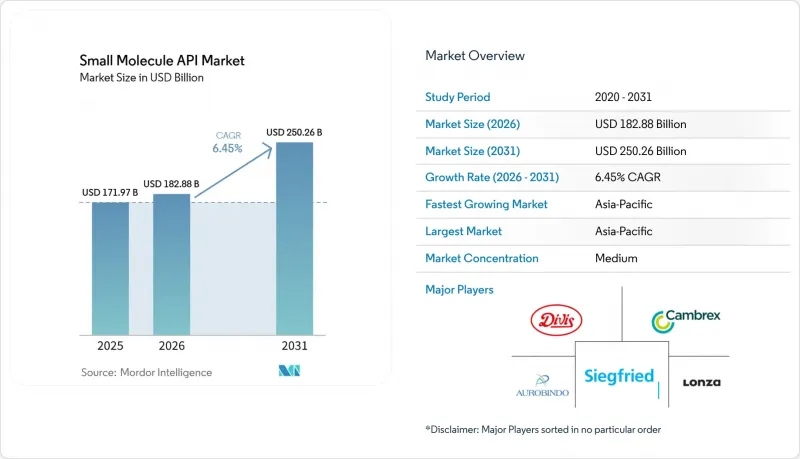
저분자 API 시장 규모는 2025년 1,719억 7,000만 달러로 평가되었습니다. 2026년에는 1,828억 8,000만 달러로 확대되어 2031년까지 2,502억 6,000만 달러에 이를 것으로 예측되며, 2026년부터 2031년에 걸쳐 CAGR 6.45%로 성장할 전망입니다.
본 보고서는 유형별(합성, 생물 유래), 제조업체별(자체 생산, 외부 위탁), 치료 분야별(종양학, 심혈관 질환 등), 지역별(북미, 유럽, 아시아태평양, 중동 및 아프리카, 남미)로 분류되어 있습니다. 시장 예측은 금액(달러) 기준으로 제시되어 있습니다.
세계의 저분자 API 시장 동향 및 인사이트
만성 질환 부담 증가 및 장기 치료 수요 증가
저분자 API 시장은 종양학, 심혈관 및 대사 질환 치료, 그리고 장기 유지 요법 분야의 만성 질환 치료 수요의 꾸준한 증가로 인해 혜택을 보고 있습니다. 치료 기간의 장기화는 진단 건수 증가와 마찬가지로 중요한 요소입니다. 왜냐하면 수개월에서 수년에 걸쳐 사용되는 제품은 짧은 재고 보충 주기가 아닌 지속적인 API 수요를 창출하기 때문입니다. 이는 표적 지향형 암 치료나 만성 심대사 질환 치료 분야에서 승인된 치료법이 보급됨에 따라 예측 가능한 재고 보충 패턴을 보이는 경향이 있으므로, 저분자 API 시장을 뒷받침하는 요인이 됩니다. 또한, 치료 기간이 긴 경우 구매자는 일반적으로 공급의 지속성이 입증된 것을 선호하기 때문에 확립된 규제 관련 자료와 신뢰할 수 있는 생산 규모를 갖춘 제조업체에게도 유리하게 작용합니다.
특허 만료 및 제네릭 의약품 전환 주기
많은 기존 저분자 의약품이 독점권 상실을 앞두고 있는 가운데, 저분자 API 시장은 제네릭 공급 준비에 유리한 시기에 접어들고 있습니다. 이 과정으로 인해 최초의 제네릭 의약품이 출시되기 훨씬 전부터 API 적격성 평가 활동, 신청 업무 및 상업적 공급 계획이 증가하는 경향을 보입니다. 인도는 이 주기에서 유리한 입지에 있으며, 2025 회계연도에는 API 수출액이 4만 1,500 카롤 루피(48억 8,000만 달러)에 달하고, 인도 의약품 수입액을 사상 처음으로 넘어설 것으로 전망됩니다. 저분자 API 시장에 미치는 영향은 단순한 수량 증가에 그치지 않습니다. 제네릭 의약품 시장 진입에 따라 새로운 조달 입찰, 제2 공급원 적격성 평가 작업, 그리고 제제 제조업체 측의 리드타임 단축에 대한 기대가 높아지기 때문입니다. 따라서 이미 규정 준수 프로세스, 원자재 조달 경로 및 신청 준비가 완료된 공급업체는 이러한 흐름을 포착하는 데 있어 더 유리한 입장에 있습니다.
니트로소아민, 불순물 및 추적성에 관한 규정 준수 부담
저분자 API 시장은 불순물 관리의 엄격화, 특히 니트로소아민의 위험 평가 및 추적성 요건의 확대에 따라 명백한 제약에 직면해 있습니다. FDA는 2025년 6월 니트로소아민 불순물에 관한 지침을 업데이트하고, 제조업체에 2025년 8월 1일까지 확인 시험 진행 상황을 보고할 것을 의무화했습니다. EMA 역시 니트로소아민 불순물을 관리하기 위한 상세한 체계를 유지하고 있으며, 이는 여러 규제 시장에 제품을 공급하는 기업이 광범위한 문서화, 분석 및 공정 재검토 노력을 지속해야 함을 의미합니다. 저분자 API 시장에서 이러한 요건은 제품 변경이 상업적 규모에 도달하기도 전에 비용을 증가시킵니다. 공급업체는 생성 경로, 분석법의 적합성 및 다운스트림 공정의 사양을 통합적으로 재검토해야 하기 때문입니다. 오염 경로를 관리하기 어려운 구형 배치 자산은 더 큰 위험에 노출되어 있으며, 이로 인해 경쟁력은 점차 더 새로운 시스템과 우수한 공정 가시성을 갖춘 공장으로 이동하고 있습니다.
부문별 분석
2025년, 저분자 API 시장에서 합성 API가 86.18%를 차지했으며, 이는 심혈관계, 항감염제, 중추신경계(CNS), 대사계 치료제 각 분야에서 화학 합성이 얼마나 깊이 정착되어 있는지를 보여줍니다. 이 범주는 성숙한 규제 절차, 광범위한 제조 거점 확보, 그리고 대규모 제네릭 의약품 및 브랜드 의약품 생산량에 적합한 비용 구조라는 이점을 누리고 있습니다. 반합성 발효 기반 경로 및 생물학적 변환 공정을 포함하는 생물학적 API는 2026년부터 2031년까지 연평균 성장률(CAGR) 7.83%로 확대될 것으로 예측됩니다. 이로 인해, 특히 종양학 관련 유도체나 보다 전문적인 공정 경로가 중요성을 더하고 있는 분야에서 저분자 API 시장 내에서 가장 빠르게 성장하는 분야가 되고 있습니다.
이 구분은 단순히 생산량의 문제만은 아닙니다. 많은 신규 프로젝트에서 단일 제조 경로가 아닌, 합성 공정과 생물학적 지원 공정을 조합하여 사용하고 있기 때문입니다. 따라서 공정 화학, 생체 촉매 및 분석 관리를 하나의 개발 체인으로 통합할 수 있는 기업이 유리합니다. 또한, FDA의 첨단 제조 기법에 대한 관심 증가와 공정 일관성에 관한 규제의 지속적인 강화 역시 저분자 API 시장 내 두 카테고리의 실행 기준을 높이고 있습니다. 장기적으로는 가치 점유율 측면에서 합성 API의 우위가 유지될 전망이지만, 생물 유래 API의 급속한 확대로 인해 부문 구성은 점차 더 전문성이 높은 제조 분야로 전환될 것입니다.
지역별 분석
아시아태평양은 2025년에 저분자 API 시장 점유율의 47.18%를 차지했으며, 2026년부터 2031년에 걸쳐 연평균 성장률(CAGR) 8.43%를 나타낼 것으로 예측됩니다. 중국은 여전히 이 지역의 제조거점의 핵심을 담당하고 있는 반면, 인도는 저분자 API 시장에서 수출 및 국내 대체 역할을 강화하고 있습니다. 인도의 원료의약품 PLI 제도에 따라 2025년 12월까지 28개의 지정 제품에 걸친 38개의 프로젝트가 발주되었으며, 누적 매출액은 2,720 카롤 루피(3억 1,900만 달러)에 달했습니다. 인도 정부의 최신 보고서에 따르면, 이 제도 하에서 191종의 API, 주요 원료 및 의약품 중간체가 국내에서 처음으로 생산되고 있다고 합니다. 또한 인도는 2025 회계연도에 4만 1,500 카롤 루피(약 48억 8,000만 미 달러) 규모의 API 수출을 기록했으며, 의약품 수출액이 수입액을 넘어선 것은 이번이 처음입니다.
북미는 개발 의사 결정, 규제 감독 및 상업적 적합성 평가 활동이 여전히 해당 지역에 집중되어 있기 때문에 저분자 API 시장에 있어 중요한 지원 지역이자 조달 지역으로 남아 있습니다. 미국에서 제안된 관세 조치와 더 광범위한 공급 안정성에 대한 우려로 인해, 국내 및 우방국에 대한 API 생산 능력에 대한 관심이 높아지고 있습니다. 이에 대응하여 캄브렉스(Cambrex)사는 아이오와주 찰스시티에 1억 2,000만 달러 규모의 새로운 대규모 API 공장을 건설할 계획을 발표했으며, 2026년 하반기에 착공할 예정입니다.
유럽은 독일, 영국, 프랑스, 이탈리아, 스페인에 걸쳐 있는 성숙한 생태계의 뒷받침을 받아, 저분자 API 시장에서 여전히 두 번째로 중요한 지역 거점으로 자리 잡고 있습니다. 유럽연합(EU)은 정책 지원을 통해 공급 탄력성 강화를 추진하고 있으며, EUROAPI는 ‘프랑스 2030’ 계획 하에 의약품 주권과 관련된 3개의 혁신 프로그램에 대해 최대 1억 4,000만 유로(1억 5,400만 달러)의 공공 지원을 확보했습니다. 한편, Medicines for Europe는 많은 회원국에서 제네릭 의약품 가격이 장기간 정체되거나 하락하고 있다고 보고하며, 이로 인해 회복탄력성 투자에 할당될 자금이 제한되고 있다고 밝혔습니다.
기타 혜택 :
- 엑셀 형식 시장 예측(ME) 시트
- 3개월간의 애널리스트 지원
자주 묻는 질문
목차
제1장 서론
제2장 조사 방법
제3장 개요
제4장 시장 구도
제5장 시장 규모 및 성장 예측
제6장 경쟁 구도
제7장 시장 기회 및 향후 전망
KTH 26.09.02According to Mordor Intelligence, the small molecule API market size is expected to increase from USD 171.97 billion in 2025 to USD 182.88 billion in 2026 and reach USD 250.26 billion by 2031, growing at a CAGR of 6.45% over 2026-2031.
This report is Segmented by Type (Synthetic, Biological), by Manufacturer (In-House, Outsourced), by Therapeutic Area (Oncology, Cardiovascular Diseases, and More), and by Geography (North America, Europe, Asia-Pacific, Middle East & Africa, South America). The Market Forecasts are Provided in Terms of Value (USD).
Global Small Molecule API Market Trends and Insights
Rising Chronic Disease Burden and Long-Term Therapy Volumes
The Small molecule API market is benefiting from a steady rise in chronic disease treatment needs across oncology, cardiometabolic care, and long-duration maintenance therapies. Longer treatment duration matters as much as rising diagnosis volume, because products used over many months or years create recurring API demand rather than short refill cycles. This supports the Small molecule API market because approved therapies in targeted oncology and chronic cardiometabolic care tend to hold predictable replenishment patterns once adoption broadens. It also favors manufacturers with established regulatory files and dependable scale, since buyers usually prefer proven supply continuity when treatment duration is long.
Patent Expiries and Generic Substitution Cycles
The Small molecule API market is entering a favorable period for generic supply preparation as a larger set of established small molecule drugs moves closer to loss of exclusivity. That process tends to increase API qualification activity, filing work, and commercial supply planning well before the first generic launch. India is well-positioned in this cycle, with API exports reaching INR 41,500 crore, or USD 4.88 billion, in FY2025 and exceeding the country's pharmaceutical imports for the first time. The effect on the Small molecule API market is broader than a simple volume increase, because generic entry also brings new sourcing bids, second-source qualification work, and tighter lead-time expectations from formulators. Suppliers that already have compliant processes, raw material access, and filing readiness are therefore in a stronger position to capture this wave.
Nitrosamine, Impurity, and Traceability Compliance Burden
The Small molecule API market faces a clear restraint from tighter impurity control, especially where nitrosamine risk assessment and traceability requirements are expanding. The FDA updated its nitrosamine impurity guidance in June 2025 and required manufacturers to provide confirmatory testing progress updates by August 1, 2025. The EMA also maintains a detailed framework for managing nitrosamine impurities, which means companies serving multiple regulated markets must sustain broad documentation, analytical, and process review efforts. In the Small molecule API market, these requirements increase cost even before a product change reaches commercial scale, because suppliers must review formation pathways, method suitability, and downstream specifications together. Older batch assets are more exposed where contamination pathways are harder to control, which gradually shifts competitiveness toward plants with newer systems and better process visibility.
Other drivers and restraints analyzed in the detailed report include:
- Outsourcing Shift Toward CDMOs for Cost and Capacity Flexibility
- Expansion of High Potency and Complex Small Molecule Pipelines
- Feedstock and Solvent Supply Volatility
For complete list of drivers and restraints, kindly check the Table Of Contents.
Segment Analysis
Synthetic APIs accounted for 86.18% of the Small molecule API market in 2025, which shows how deeply established chemical synthesis remains across cardiovascular, anti-infective, CNS, and metabolic therapies. This category benefits from mature regulatory pathways, broad plant availability, and cost structures that fit large generic and branded volumes. Biological APIs, which include semi-synthetic fermentation-based routes and bio-transformation processes, are forecast to expand at 7.83% CAGR from 2026 to 2031. That makes them the faster-moving complement inside the Small molecule API market, especially where oncology-linked derivatives and more specialized process routes are becoming more relevant.
The split is not purely a volume issue, because many newer programs use a mix of synthetic and biologically assisted steps rather than one route alone. That favors companies that can combine process chemistry, biocatalysis, and analytical control in one development chain. The FDA's increasing attention to advanced manufacturing methods and the continued regulatory push around process consistency are also raising the execution standard for both categories in the Small molecule API market. Over time, synthetic dominance is likely to stay intact on value share, but the faster expansion of biological APIs should keep the segment mix gradually moving toward more specialized manufacturing content.
Complete Report Scope:
- By Type
- Synthetic
- Biological
- By Manufacturer
- In-House
- Outsourced
- By Therapeutic Area
- Oncology
- Cardiovascular Diseases
- Central Nervous System and Neurology
- Infectious Diseases
- Metabolic Disorders
- Respiratory Disorders
- Gastroenterology
- Ophthalmology
- Dermatology
- Urology
- Others (Endocrinology, Nephrology, etc.)
- By Geography
- North America
- United States
- Canada
- Mexico
- Europe
- Germany
- United Kingdom
- France
- Italy
- Spain
- Rest of Europe
- Asia-Pacific
- China
- Japan
- India
- South Korea
- Australia
- Rest of Asia-Pacific
- Middle East and Africa
- GCC
- South Africa
- Rest of Middle East and Africa
- South America
- Brazil
- Argentina
- Rest of South America
- North America
Geography Analysis
Asia-Pacific held 47.18% of the Small molecule API market share in 2025 and is projected to grow at 8.43% CAGR from 2026 to 2031. China remains central to regional manufacturing depth, while India is strengthening its export and domestic substitution role within the Small molecule API market. India's bulk drug PLI scheme had commissioned 38 projects across 28 notified products by December 2025, with cumulative sales of INR 2,720 crore, or USD 319 million. The same government update stated that 191 APIs, key starting materials, and drug intermediates were being produced domestically for the first time under the scheme. India also recorded API exports of INR 415.0 billion (~USD 4.88 billion) in FY2025, which marked the first year exports surpassed pharmaceutical imports.
North America remains a critical sponsor and sourcing region for the small-molecule API market because development decisions, regulatory oversight, and commercial qualification activity remain deeply concentrated there. Proposed U.S. tariff measures and broader supply security concerns are accelerating interest in domestic and friend-shored API capacity. Cambrex responded with a USD 120 million plan for a new large-scale API plant in Charles City, Iowa, with groundbreaking scheduled for late 2026.
Europe remains the second major regional base in the Small molecule API market, supported by a mature ecosystem across Germany, the United Kingdom, France, Italy, and Spain. The European Union is pushing supply resilience through policy support, and EUROAPI secured up to EUR 140 million, or USD 154 million, in public aid under the France 2030 plan for three innovation programs tied to pharmaceutical sovereignty. At the same time, Medicines for Europe documented long-term price stagnation and decline in generic medicines across many member states, which limits the cash available for resilience investment.
- Abbvie
- Albemarle Corporation
- Asymchem Laboratories Co., Ltd.
- Aurobindo Pharma Ltd.
- BASF
- Boehringer Ingelheim
- Bristol-Myers Squibb
- Cambrex
- Cipla
- Divi's Laboratories Limited
- Dr. Reddy's Laboratories
- EUROAPI S.A.
- Evonik Industries
- Hikma Pharmaceuticals
- Lonza Group
- Merck
- Pfizer
- Siegfried Holding AG
- Sun Pharmaceuticals Industries
- Teva Pharmaceutical Industries
Additional Benefits:
- The market estimate (ME) sheet in Excel format
- 3 months of analyst support
TABLE OF CONTENTS
1 INTRODUCTION
- 1.1 Study Assumptions and Market Definition
- 1.2 Scope of the Study
2 RESEARCH METHODOLOGY
3 EXECUTIVE SUMMARY
4 MARKET LANDSCAPE
- 4.1 Market Overview
- 4.2 Market Drivers
- 4.2.1 Rising Chronic Disease Burden and Long-Term Therapy Volumes
- 4.2.2 Patent Expiries and Generic Substitution Cycles
- 4.2.3 Outsourcing Shift Toward CDMOs for Cost and Capacity Flexibility
- 4.2.4 Expansion of High Potency and Complex Small Molecule Pipelines
- 4.2.5 Friend-Shoring of Critical API Capacity and Dual-Sourcing Programs
- 4.2.6 Continuous Manufacturing and Inline Analytics Improving Batch Economics
- 4.3 Market Restraints
- 4.3.1 Nitrosamine, Impurity, and Traceability Compliance Burden
- 4.3.2 High Containment, Solvent Recovery, and Waste Treatment Capex
- 4.3.3 Feedstock and Solvent Supply Volatility
- 4.3.4 Tender-Led Generic Pricing Pressure in Large Volume APIs
- 4.4 Supply Chain Analysis
- 4.5 Regulatory Landscape
- 4.6 Technological Outlook
- 4.7 Porter's Five Forces Analysis
- 4.7.1 Threat of New Entrants
- 4.7.2 Bargaining Power of Suppliers
- 4.7.3 Bargaining Power of Buyers
- 4.7.4 Threat of Substitutes
- 4.7.5 Competitive Rivalry
5 MARKET SIZE AND GROWTH FORECASTS (VALUE, USD)
- 5.1 By Type
- 5.1.1 Synthetic
- 5.1.2 Biological
- 5.2 By Manufacturer
- 5.2.1 In-House
- 5.2.2 Outsourced
- 5.3 By Therapeutic Area
- 5.3.1 Oncology
- 5.3.2 Cardiovascular Diseases
- 5.3.3 Central Nervous System and Neurology
- 5.3.4 Infectious Diseases
- 5.3.5 Metabolic Disorders
- 5.3.6 Respiratory Disorders
- 5.3.7 Gastroenterology
- 5.3.8 Ophthalmology
- 5.3.9 Dermatology
- 5.3.10 Urology
- 5.3.11 Others (Endocrinology, Nephrology, etc.)
- 5.4 By Geography
- 5.4.1 North America
- 5.4.1.1 United States
- 5.4.1.2 Canada
- 5.4.1.3 Mexico
- 5.4.2 Europe
- 5.4.2.1 Germany
- 5.4.2.2 United Kingdom
- 5.4.2.3 France
- 5.4.2.4 Italy
- 5.4.2.5 Spain
- 5.4.2.6 Rest of Europe
- 5.4.3 Asia-Pacific
- 5.4.3.1 China
- 5.4.3.2 Japan
- 5.4.3.3 India
- 5.4.3.4 South Korea
- 5.4.3.5 Australia
- 5.4.3.6 Rest of Asia-Pacific
- 5.4.4 Middle East and Africa
- 5.4.4.1 GCC
- 5.4.4.2 South Africa
- 5.4.4.3 Rest of Middle East and Africa
- 5.4.5 South America
- 5.4.5.1 Brazil
- 5.4.5.2 Argentina
- 5.4.5.3 Rest of South America
- 5.4.1 North America
6 COMPETITIVE LANDSCAPE
- 6.1 Market Concentration
- 6.2 Market Share Analysis
- 6.3 Company Profiles (includes Global Level Overview, Market Level Overview, Core Segments, Financials as available, Strategic Information, Market Rank/Share, Products and Services, Recent Developments)
- 6.3.1 AbbVie Inc.
- 6.3.2 Albemarle Corporation
- 6.3.3 Asymchem Laboratories Co., Ltd.
- 6.3.4 Aurobindo Pharma Ltd.
- 6.3.5 BASF SE
- 6.3.6 Boehringer Ingelheim International GmbH
- 6.3.7 Bristol-Myers Squibb Company
- 6.3.8 Cambrex Corporation
- 6.3.9 Cipla Ltd.
- 6.3.10 Divi's Laboratories Limited
- 6.3.11 Dr. Reddy's Laboratories Ltd.
- 6.3.12 EUROAPI S.A.
- 6.3.13 Evonik Industries AG
- 6.3.14 Hikma Pharmaceuticals PLC
- 6.3.15 Lonza Group AG
- 6.3.16 Merck KGaA
- 6.3.17 Pfizer Inc.
- 6.3.18 Siegfried Holding AG
- 6.3.19 Sun Pharmaceutical Industries Ltd.
- 6.3.20 Teva Pharmaceutical Industries Ltd.
7 MARKET OPPORTUNITIES AND FUTURE OUTLOOK
- 7.1 White-Space and Unmet-Need Assessment


