

|
시장보고서
상품코드
2117492
코팅 유리 시장 : 점유율 분석, 업계 동향과 통계, 성장 예측(2026-2031년)Coated Glass - Market Share Analysis, Industry Trends & Statistics, Growth Forecasts (2026 - 2031) |
||||||
 Mordor Intelligence
Mordor Intelligence에 의하면, 코팅 유리 시장 규모는 2025년에 443억 7,000만 달러로 평가되었고 2026년 470억 6,000만 달러에서 2031년까지 681억 2,000만 달러에 이를 것으로 추정되고 있어 예측 기간(2026-2031년) CAGR은 7.68%를 나타낼 전망입니다.
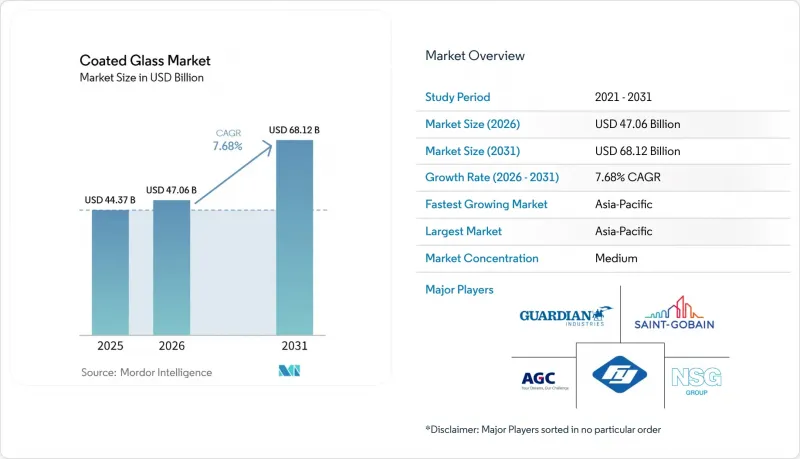
본 보고서는 유형(건축용 유리 등), 코팅 유형(반사 코팅, Low-E 코팅 등), 기판(플로트 유리, 강화 유리 등), 최종 이용 산업(건축 및 건설, 자동차 등), 지역(아시아태평양, 북미, 유럽, 남미, 중동 및 아프리카)별로 분류되어 있습니다. 시장 전망은 금액(달러) 기준으로 제시되어 있습니다.
세계 코팅 유리 시장 동향 및 인사이트
건축 외피의 에너지 소비량 감소로 인해 저방사율(Low-E) 사양의 채택률이 상승하고 있습니다.
현재 상업용 및 주거용 건물의 에너지 규제 준수에 있어 유리 지붕이 중심적인 역할을 하고 있기 때문에 건축 외피의 성능은 코팅 유리 시장에서 직접적인 구매 요인이 되고 있습니다. 개정된 ‘건축물의 에너지 성능에 관한 지침’은 2024년 5월에 발효되었으며, 회원국들에게 2026년 5월까지 이를 국내법에 반영할 것을 의무화하고 있습니다. 이에 따라 리모델링 목표 및 제로 배출 건축 기준이 프로젝트 개발업체와 제조업체에게 단기적인 수요 지표가 되고 있습니다. 또한, 2026년 4월에 공포되어 2026년 11월부터 시행되는 중국의 GB/T 47553-2026 규격도, 건축용 유리 선정을 측정 가능한 에너지 수지 계산과 더욱 밀접하게 연계함으로써 코팅 유리 시장을 뒷받침할 것으로 예측됩니다. 효율 관련 규제가 강화됨에 따라 대규모 상업 입찰에서 표준 투명 유리의 채택 범위는 축소되고 있으며, 새로운 공급이 본격화되기 전부터 코팅 유리 시장에서 인증된 Low-E 제품의 실용적 가치가 높아지고 있습니다. NSG 그룹이 폴란드의 새로운 스퍼터링 코팅 라인에 1억 6,000만 폴란드 즐로티(4,000만 달러)를 투자하기로 한 결정은 공급업체들이 규제에 따른 차기 개조 수요의 물결을 예상하여 그 근처에 생산 능력을 배치하고 있음을 보여줍니다.
일사 제어 수요 증가가 전기차(EV)의 주행 거리 경제성과 코팅 유리의 사양을 연결하고 있습니다.
또한, 자동차 디자인과 태양광 발전의 보급으로 인해 단일 제품 내에서의 광학 성능 및 열 제어 성능의 가치가 높아지고 있어, 코팅 유리 시장도 그 혜택을 누리고 있습니다. 전기차(EV)에서 일사 제어 유리나 가열 가능한 유리는 차량 내부의 온도 관리를 개선할 수 있으며, 제조업체들이 주행 거리 유지와 각 플랫폼의 기능 강화를 목표로 하는 가운데 그 중요성은 점점 더 커지고 있습니다. 푸야오 글라스(Fuyao Glass)의 보고서에 따르면, 2025년에는 이 회사의 고부가가치 제품 점유율이 5.4% 증가했고, 순이익은 24.2% 증가했습니다. 이는 코팅 처리가 되어 기능성이 뛰어난 유리 제품이 표준 자동차용 유리 제품보다 빠르게 성장하고 있음을 보여줍니다. 태양광 발전 분야에서는 프로젝트 개발자들이 모듈 성능 향상과 장기적인 프로젝트의 경제성 향상을 여전히 중시하고 있기 때문에 반사 방지 코팅 유리는 계속해서 중요한 위치를 차지하고 있으며, 이로 인해 코팅 유리 시장은 건설 분야를 넘어 폭넓은 용도 기반을 유지하고 있습니다. 가디언 글래스가 이집트에 새로운 고성능 코팅 설비에 투자한 것 또한, 공급업체들이 지역 건설 시장과 인근 수출 경로 모두에서 일사 제어 유리 및 Low-E 유리에 대한 수요를 예상하고 있음을 보여줍니다.
막대한 설비 투자가 필요하다는 점이 시장 진출기업들에게 구조적인 장벽이 되고 있습니다.
코팅 유리 시장에는 높은 진입 장벽이 존재합니다. 이는 첨단 스퍼터링 라인에 막대한 설비 투자, 긴 시운전 기간, 그리고 생산 개시 후 엄격한 수율 관리가 요구되기 때문입니다. NSG 그룹의 폴란드 프로젝트는 이러한 요인을 여실히 보여주고 있습니다. 단일 첨단 코팅 라인 한 개만으로도 1억 6,000만 즈워티(4,000만 달러)의 투자가 필요합니다. 시세캄의 코팅 유리 라인에 대한 지속적인 투자 또한, 이 시장에서 실질적인 생산 능력 확대가 여전히 재무 기반이 견고하고 하류 시장에 대한 안정적인 접근성을 갖춘 기업으로 거의 한정되어 있음을 보여줍니다. 코팅 유리 시장에서 신흥 경제국에서는 지역 수요가 현지 코팅 유리 공급을 초과할 가능성이 있습니다. 이는 많은 잠재적 진출기업들이 경쟁력 있는 생산 라인을 신속하게 구축하는 데 필요한 시간, 공정에 대한 전문 지식, 또는 자본 구성을 갖추지 못했기 때문입니다. 그 결과, 특히 설비 리드타임이 길어지는 수요가 활발한 시기에는 대형 기존 기업들이 새로운 지역으로 진출하는 속도가 중소기업들이 국내에서 실질적인 생산 능력을 구축하는 속도를 앞지르게 됩니다.
부문 분석
2025년에는 건축용 유리가 매출의 56.44%를 차지하며 코팅 유리 시장에서 가장 큰 카테고리가 되었습니다. 이러한 위치를 뒷받침한 것은 대규모 상업 및 주거 건축 활동이었으며, 또한 많은 대규모 프로젝트에서 코팅 건축용 유리가 일반적인 사양으로 채택됨에 따라 에너지 절약 규제도 기여했습니다. 사무실 건물, 상업 지구, 유틸리티 및 고성능 주택 개발에서는 Low-E 제품이나 일사 제어 제품 등 폭넓은 조합이 요구되고 있으므로, 코팅 유리 시장은 계속해서 이러한 유형을 판매량의 기반으로 삼고 있습니다. 건축 관련 수요는 단일 제품 주기에 의존하는 것이 아니라, 개보수, 신축, 건축 기준에 따른 개보수 등 다방면에 걸쳐 있기 때문에 개별 최종 시장의 상황이 제각각인 경우에도 이 기반의 중요성은 변함없습니다. 이러한 폭넓은 수요 기반은 주요 제조업체가 공장 가동률을 높이는 데에도 도움이 되며, 새로운 코팅 스택 및 다운스트림 공정에 대한 투자를 뒷받침하고 있습니다.
건축용 유리가 주도적인 위치를 차지하고 있는 것은 그 규모가 클 뿐만 아니라, 규제, 에너지 절약, 사양 주도형 조달과 같은 코팅 유리 업계의 주요 수요 요인과 부합하기 때문입니다. 한편, 자동차용 유리는 가장 빠르게 성장하는 분야로, 2031년까지 연평균 성장률(CAGR)이 7.80%를 나타낼 것으로 예측됩니다. 이는 고부가가치 기능성이 기존의 건설 주도형 카테고리보다 빠르게 확대되고 있음을 보여줍니다. 자동차 용도에서 유리는 현재 열 관리, 광학 성능, 디스플레이 통합, 센서 호환성을 지원하고 있으며, 이로 인해 새로운 차량 플랫폼마다 이전보다 더 많은 코팅이 채택되고 있습니다. 후야오 글라스(Fuyao Glass)의 2025년 실적(고부가가치 제품 점유율 확대 포함)은 이러한 변화를 뒷받침하며, 단순한 자동차 생산 대수 증가에 의한 성장이 아니라 코팅이 적용된 기능이 풍부한 제품에 대한 수요가 강해지고 있음을 보여줍니다. 이러한 추세에 따라 코팅 유리 시장은 건축 분야의 방대한 판매량 기반과 더 빠르게 성장하는 자동차 분야의 가치 흐름 사이에서 균형을 유지하며, 앞으로도 제품 구성의 재편이 계속될 것으로 예측됩니다.
2025년, 저방사(Low-E) 코팅은 코팅 유리 시장에서 42.70%의 점유율을 차지하며 시장을 주도했습니다. 이는 에너지 절약형 창문, 파사드, 단열 유리 유닛에서 Low-E 코팅이 중심적인 역할을 하고 있음을 반영합니다. 이러한 위상은 코팅 유리 시장의 주요 규제 요건, 즉 채광 성능을 저해하지 않으면서 건축 외피를 통한 열전달을 저감해야 한다는 요건을 충족할 수 있는 능력에서 비롯됩니다. 따라서 Low-E 제품은 유럽, 중국, 북미 및 건축 성능 규제가 강화되고 있는 기타 지역에서 사업을 전개하는 코팅 제조업체들에게 주요 수익원이 되고 있습니다. 반사형 및 일사 제어형 코팅도 Low-E 제품과 함께 중요한 위치를 차지하고 있습니다. 이들은 일사 획득이 주요 설계 고려 사항이 되는 시장에서 고온 기후 하의 건축 요건, 눈부심 억제 및 파사드의 미관을 충족시킵니다. 이러한 코팅들이 결합되어 코팅 유리 시장을 규제 준수 및 기후 특유의 성능 요건과 연결함으로써, 다양한 건축 유형에 걸친 폭넓은 수요를 유지하는 데 기여하고 있습니다.
반사 방지 코팅은 2031년까지 연평균 성장률(CAGR) 8.12%를 나타낼 것으로 예측되며, 이는 코팅 유리 시장이 기존의 창문 용도를 넘어 확대되고 있음을 보여줍니다. 자동차용 센서, 헤드업 디스플레이 시스템, 카메라 커버, 태양광 발전용 유리 등 광학적 투명도가 성능에 직접적인 영향을 미치는 용도가 이러한 성장을 가장 강력하게 견인하고 있습니다. 유리 표면이 전자적·시각적 기능을 점점 더 많이 담당함에 따라, 반사 방지 성능은 제품 요구 사항에 필수적인 요소가 되고 있습니다. 코닝(Corning)이 2025년 1월에 출시한 ‘Gorilla Armor 2’는 모바일 기기용으로서는 최초로 내스크래치 기능을 갖춘 반사 방지 유리 세라믹으로 평가받고 있으며, 이 제품 또한 가시성, 내구성, 그리고 프리미엄 포지셔닝을 단일 층 구조로 겸비한 코팅으로의 전환을 뒷받침하고 있습니다. 그 결과, 빠르게 성장하는 틈새 제품 분야에서 광학 성능의 중요성이 높아짐에 따라 코팅 유리 시장은 더 이상 열 효율만으로 정의되지 않게 되었습니다.
지역별 분석
아시아태평양은 2025년에 전 세계 코팅 유리 시장 점유율의 47.52%를 차지하며, 2031년까지 연평균 성장률(CAGR) 8.41%를 기록하여 지역별 가장 높은 성장률을 보일 것으로 전망됩니다. 이에 따라 아시아태평양은 대규모 건설 활동, 제조 네트워크, 그리고 건축물 및 자동차 분야의 성능 요구 사항 증가에 힘입어 코팅 유리 시장의 주요 수요 지역으로서의 입지를 확고히 하고 있습니다. 중국은 광대한 건축 환경과 판유리 및 하류 가공 생태계에 힘입어 계속해서 이 지역에서 가장 큰 생산량을 자랑하는 시장으로 자리매김하고 있습니다. 신축 주택의 성장세는 지난 몇 년에 비해 둔화될 가능성이 있지만, 리모델링 수요와 규제 대응을 위한 개보수가 코팅 제품에 대한 수요를 지속적으로 뒷받침하고 있습니다. 2025년 11월 시행 예정인 중국의 최신 친환경 제품 평가 기준 ‘GB/T 35604-2025’는 중국 최대의 건설 용도인 건축용 유리 선정에 있어 더욱 공식적인 기준을 추가하게 될 것입니다.
인도는 코팅 유리 시장에서 중요한 성장 시장으로 부상하고 있습니다. 이는 상업 지구의 발전과 고성능 건물에 대한 수요가 증가함에 따라 Low-E 유리 및 일사 제어 유리의 채택이 확대되고 있기 때문입니다. 또한 이 지역에서는 특히 운송, 파손 위험, 납기 등이 중요한 요소가 되는 경우, 코팅 제품의 현지 공급을 중시하는 제조 모델이 효과를 거두고 있습니다. 자동차 및 전자 관련 용도에서는 아시아태평양이 우위를 유지하고 있습니다. 이는 제조업체, 부품 공급업체 및 최종 사용자가 동일한 광범위한 산업 단지에 집중되어 있기 때문입니다. 이러한 규모와 근접성의 조합은 아시아태평양의 코팅 유리 시장을 지속적으로 뒷받침하고 있으며, 다른 지역이 단기간 내에 이를 따라잡기는 여전히 어렵습니다.
북미와 유럽은 코팅 유리 시장에서 규제 및 기술의 기준점 역할을 하고 있습니다. 유럽에서는 개정된 ‘건축물의 에너지 성능에 관한 지침(EPBD)’에 따라 2026년 5월까지 각국의 국내법에 이를 반영해야 하는 기한이 설정됨에 따라, 지역 전체에서 고성능 건축용 제품의 꾸준한 조달이 뒷받침되고 있습니다. NSG 그룹의 폴란드 내 신규 코팅 라인과 시세캄(Sisecam)의 유럽 내 코팅 유리 투자는 정책 지원과 리모델링 수요가 안정적인 시장에서 공급업체들이 생산 능력을 확대하고 있음을 보여줍니다. 북미에서는 고성능 건축자재에 대한 수요와 상업 프로젝트를 위한 환경 제품 선언(EPD)에 기반한 자재 포함 제품 문서화에 대한 관심이 높아지면서 코팅 유리 시장을 뒷받침하고 있습니다.
남미, 중동 및 아프리카 및 기타 유럽은 여전히 코팅 유리 시장에서 비교적 작은 비중을 차지하고 있지만, 전망은 계속해서 양호합니다. 남미에서는 건설 활동의 활성화가 호재로 작용하고 있으나, 환율 변동과 에너지 비용이 코팅 유리 수요 증가를 억제할 가능성이 있습니다. 중동 및 아프리카에서는 가디언 글래스가 이집트에 고성능 코팅 설비에 투자한 것이, 수입 의존도가 높은 상황에서 점차 현지 또는 지역적 공급 옵션으로 전환되고 있음을 보여줍니다. 이러한 전환을 통해 공급 지연이 완화되고, 인근 건축 시장 전반에 걸쳐 고성능 코팅 제품의 접근성이 향상될 가능성이 있습니다.
기타 혜택:
- 엑셀 형식 시장 예측(ME) 시트
- 3개월간의 애널리스트 지원
자주 묻는 질문
목차
제1장 서론
제2장 조사 방법
제3장 개요
제4장 시장 구도
제5장 시장 규모와 성장 예측
제6장 경쟁 구도
제7장 시장 기회와 향후 전망
JHS 26.09.01According to Mordor Intelligence, the coated glass market size was valued at USD 44.37 billion in 2025 and is estimated to grow from USD 47.06 billion in 2026 to reach USD 68.12 billion by 2031, at a CAGR of 7.68% during the forecast period (2026-2031).
This report is Segmented by Type (Architectural Glass, and More), Coating Type (Reflective Coatings, Low-E Coatings, and More), Substrate (Float Glass, Tempered Glass, and More), End-Use Industry (Building and Construction, Automotive, and More), and Geography (Asia-Pacific, North America, Europe, South America, and Middle-East and Africa). The Market Forecasts are Provided in Terms of Value (USD).
Global Coated Glass Market Trends and Insights
Lower Building Envelope Energy Consumption Lifts Low-Emissivity (Low-E) Specification Rates
Building envelope performance is becoming a direct purchasing factor in the coated glass market, as glazing now plays a central role in energy compliance for commercial and residential buildings. The revised Energy Performance of Buildings Directive entered into force in May 2024 and requires member states to incorporate it into national law by May 2026, turning renovation targets and zero-emission building standards into near-term demand indicators for project developers and fabricators. China's GB/T 47553-2026 standard, released in April 2026 and effective from November 2026, is also expected to support the coated glass market by linking building glass selection more closely to measurable energy balance calculations. As efficiency rules become stricter, standard clear glass is losing scope in large commercial tenders, increasing the practical value of certified Low-E products in the coated glass market even before the new supply fully comes online. NSG Group's decision to invest PLN 160 million (USD 40 million) in a new sputtering coating line in Poland shows how suppliers are placing capacity close to the next wave of regulated renovation demand.
Rising Solar-Control Demand Links EV Range Economics to Coated Glass Specification
The coated glass market is also benefiting as vehicle design and solar generation increase the value of optical and thermal control performance within a single product. In electric vehicles, solar-control and heatable glass can improve cabin temperature management, which is becoming more important as manufacturers aim to protect driving range and increase the feature content of each platform. Fuyao Glass reported that the share of its high-value-added products increased by 5.4 percentage points in 2025, while net profit rose by 24.2%, indicating that coated and function-rich glazing is growing faster than standard vehicle glass lines. On the solar side, anti-reflective coated glass remains important because project developers continue to value improvements that enhance module performance and long-term project economics, helping the coated glass market maintain a broader application base beyond construction. Guardian Glass's investment in a new high-performance coater in Egypt also shows that suppliers are positioning for solar-control and Low-E demand from both regional construction and nearby export corridors.
High Capex Requirements Create a Structural Barrier for Market Entrants
The coated glass market has a high entry barrier, as advanced sputtering lines require large capital outlays, long commissioning periods, and strict yield control once production begins. NSG Group's Poland project illustrates this factor: a single advanced coating line requires an investment of PLN 160 million (USD 40 million). Sisecam's continued investments in coated glass lines further indicate that meaningful capacity expansion in this market remains largely limited to companies with strong balance sheets and stable downstream access. In the coated glass market, regional demand can outpace local coated glass supply in emerging economies because many potential entrants lack the time, process expertise, or capital structure needed to build competitive lines quickly. As a result, large incumbents can expand into new regions faster than smaller firms can establish viable domestic capacity, particularly during periods of strong demand when equipment lead times increase.
Other drivers and restraints analyzed in the detailed report include:
- Growth in Electrochromic Glass Converts Glazing from Passive to Active Infrastructure
- Stricter Embodied-Carbon Regulations Redefine Procurement Criteria for Coated Glass
- Silver And Specialty Oxide Price Volatility Undermines Cost Predictability
For complete list of drivers and restraints, kindly check the Table Of Contents.
Segment Analysis
Architectural glass accounted for 56.44% of revenue in 2025, making it the largest type in the coated glass market. Large-scale commercial and residential building activity supported this position, while energy-efficiency regulations also contributed, as coated architectural glazing has become a common specification in many large projects. The coated glass market continues to rely on this type for its volume base, as office buildings, commercial corridors, public projects, and higher-performance residential developments require a broad mix of Low-E and solar-control products. This base remains important when individual end markets become uneven, as building-related demand spans renovations, new construction, and code-driven upgrades rather than depending on a single product cycle. The same broad demand base also helps leading producers improve plant utilization, supporting investment in newer coating stacks and downstream processing.
Architectural glass leads because of its scale and its alignment with the coated glass industry's key demand drivers: regulation, energy savings, and specification-led procurement. Automotive glass, however, is the fastest-growing type, with a 7.80% CAGR through 2031, indicating that higher-value functionality is expanding faster than traditional construction-led categories. In automotive applications, glass now supports heat management, optical performance, display integration, and sensor compatibility, allowing each new vehicle platform to carry more coating content than before. Fuyao Glass's 2025 results, including the increase in the share of high-value-added products, support this shift, as they indicate stronger demand for coated and function-rich products rather than growth driven only by higher vehicle output. This dynamic keeps the coated glass market balanced between a large architectural volume base and a faster-moving automotive value stream that is expected to continue reshaping the product mix.
Low-emissivity (Low-E) coatings led the coated glass market with a 42.70% share in 2025, reflecting their central role in energy-efficient windows, facades, and insulated glazing units. Their position comes from their ability to address the coated glass market's primary regulatory requirement: reducing heat transfer through building envelopes without compromising daylight performance. This makes Low-E products the main revenue anchor for coating producers serving Europe, China, North America, and other regions tightening building performance rules. Reflective and solar-control coatings remain important alongside Low-E products, as they address hot-climate building requirements, glare control, and facade aesthetics in markets where solar gain is a major design concern. Together, these coatings keep the coated glass market linked to compliance and climate-specific performance needs, helping maintain broad demand across different building types.
Anti-reflective coatings are projected to grow at an 8.12% CAGR through 2031, showing how the coated glass market is expanding beyond traditional window applications. Applications where optical clarity directly affects performance, such as automotive sensors, heads-up display systems, camera covers, and photovoltaic glass, provide the strongest support for this growth. As glass surfaces take on more electronic and visual functions, anti-reflective performance becomes more embedded in product requirements. Corning's January 2025 launch of Gorilla Armor 2, described as the first scratch-resistant anti-reflective glass ceramic for mobile devices, also supports the shift toward coatings that combine visibility, durability, and premium positioning in a single layer stack. As a result, the coated glass market is no longer defined only by thermal efficiency, as optical performance is becoming important in faster-growing product niches.
Complete Report Scope:
- By Type
- Architectural Glass
- Automotive Glass
- Industrial Glass
- Consumer Glass
- By Coating Type
- Reflective Coatings
- Low-E Coatings
- Solar Control Coatings
- Anti-Reflective Coatings
- By Substrate
- Float Glass
- Tempered Glass
- Laminated Glass
- By End-Use Industry
- Building and Construction
- Automotive
- Consumer Electronics
- Industrial
- By Geography
- Asia-Pacific
- China
- India
- Japan
- South Korea
- Rest of Asia-Pacific
- North America
- United States
- Canada
- Mexico
- Europe
- Germany
- United Kingdom
- France
- Italy
- Russia
- Rest of Europe
- South America
- Brazil
- Argentina
- Rest of South America
- Middle-East and Africa
- Saudi Arabia
- South Africa
- Rest of Middle-East and Africa
- Asia-Pacific
Geography Analysis
Asia-Pacific is expected to hold 47.52% of the global coated glass market share in 2025 and is forecast to record the fastest regional CAGR, at 8.41%, through 2031. This positions Asia-Pacific as a key demand region for the coated glass market, supported by large-scale construction activity, manufacturing networks, and rising performance requirements across buildings and vehicles. China remains the region's largest-volume base, driven by its vast built environment and flat-glass and downstream-processing ecosystem. Although new housing growth may moderate compared with previous years, renovation demand and compliance-led upgrades continue to support demand for coated products. China's updated green product assessment standard, GB/T 35604-2025, which is set to take effect in November 2025, will add another formal layer to building glass selection in the country's largest construction applications.
India is emerging as a key growth market within the coated glass market, as commercial corridors and demand for higher-performance buildings drive greater adoption of Low-E and solar-control glass. The region also benefits from a manufacturing model that favors local supply for coated products, especially where transportation, breakage risk, and delivery timelines are critical. In vehicle and electronics-linked applications, Asia-Pacific retains an advantage because producers, component suppliers, and end-use customers are concentrated across the same broader industrial zones. This combination of scale and adjacency continues to support the coated glass market in Asia-Pacific and remains difficult for other regions to match in the near term.
North America and Europe serve as regulatory and technology reference points for the coated glass market. In Europe, the May 2026 national transposition deadline under the revised Energy Performance of Buildings Directive (EPBD) supports steady procurement of high-performance architectural products across the region. NSG Group's new coating line in Poland and Sisecam's coated glass investments in Europe indicate that suppliers are adding capacity in markets where policy support and renovation demand remain stable. In North America, demand for higher-performing architectural products and increased focus on product documentation, including Environmental Product Declaration (EPD)-backed materials for commercial projects, are supporting the coated glass market.
South America, the Middle East and Africa, and the rest of Europe remain smaller parts of the coated glass market, but their outlook remains positive. South America benefits from improving construction activity, although currency volatility and energy costs can limit the pace of coated glass demand growth. In the Middle East and Africa, Guardian Glass's investment in a high-performance coater in Egypt indicates a gradual shift from higher import dependence toward more local or regional supply options. This shift can reduce supply delays and improve the availability of higher-performance coated products across nearby building markets.
- AGC Inc.
- Asahi India Glass Limited
- Cardinal Glass Industries, Inc.
- Central Glass Co., Ltd.
- China Glass Holding, Ltd.
- Euroglas GmbH
- Fuyao Glass Industry Group Co., Ltd.
- Guardian Industries
- Nippon Sheet Glass Co., Ltd.
- Saint-Gobain
- SCHOTT AG
- Sisecam Group
- Taiwan Glass Ind. Corp.
- Vitro, S.A.B. de C.V.
- Xinyi Glass Holdings Limited
Additional Benefits:
- The market estimate (ME) sheet in Excel format
- 3 months of analyst support
TABLE OF CONTENTS
1 Introduction
- 1.1 Study Assumptions and Market Definition
- 1.2 Scope of the Study
2 Research Methodology
3 Executive Summary
4 Market Landscape
- 4.1 Market Overview
- 4.2 Market Drivers
- 4.2.1 Lower Building Envelope Energy Loss in Commercial Retrofits
- 4.2.2 Rising Solar-Control Demand in Vehicle Glazing
- 4.2.3 Growth in Electrochromic and Smart Glazing Compatibility
- 4.2.4 Stricter Embodied-Carbon Procurement in Green Building Programs
- 4.2.5 Need for Scratch-Resistant and Chemical-Resistant Industrial Surfaces
- 4.2.6 Expansion of Multifunctional Glass in Data Centers and Specialty Buildings
- 4.3 Market Restraints
- 4.3.1 High Capex and Yield Loss in Vacuum Coating Lines
- 4.3.2 Silver and Specialty Oxide Input Cost Volatility
- 4.3.3 Requalification Burden for OEM and Facade Specifications
- 4.4 Value Chain Analysis
- 4.5 Porter's Five Forces Analysis
- 4.5.1 Threat of New Entrants
- 4.5.2 Bargaining Power of Suppliers
- 4.5.3 Bargaining Power of Buyers
- 4.5.4 Threat of Substitutes
- 4.5.5 Competitive Rivalry
5 Market Size and Growth Forecasts (Value)
- 5.1 By Type
- 5.1.1 Architectural Glass
- 5.1.2 Automotive Glass
- 5.1.3 Industrial Glass
- 5.1.4 Consumer Glass
- 5.2 By Coating Type
- 5.2.1 Reflective Coatings
- 5.2.2 Low-E Coatings
- 5.2.3 Solar Control Coatings
- 5.2.4 Anti-Reflective Coatings
- 5.3 By Substrate
- 5.3.1 Float Glass
- 5.3.2 Tempered Glass
- 5.3.3 Laminated Glass
- 5.4 By End-Use Industry
- 5.4.1 Building and Construction
- 5.4.2 Automotive
- 5.4.3 Consumer Electronics
- 5.4.4 Industrial
- 5.5 By Geography
- 5.5.1 Asia-Pacific
- 5.5.1.1 China
- 5.5.1.2 India
- 5.5.1.3 Japan
- 5.5.1.4 South Korea
- 5.5.1.5 Rest of Asia-Pacific
- 5.5.2 North America
- 5.5.2.1 United States
- 5.5.2.2 Canada
- 5.5.2.3 Mexico
- 5.5.3 Europe
- 5.5.3.1 Germany
- 5.5.3.2 United Kingdom
- 5.5.3.3 France
- 5.5.3.4 Italy
- 5.5.3.5 Russia
- 5.5.3.6 Rest of Europe
- 5.5.4 South America
- 5.5.4.1 Brazil
- 5.5.4.2 Argentina
- 5.5.4.3 Rest of South America
- 5.5.5 Middle-East and Africa
- 5.5.5.1 Saudi Arabia
- 5.5.5.2 South Africa
- 5.5.5.3 Rest of Middle-East and Africa
- 5.5.1 Asia-Pacific
6 Competitive Landscape
- 6.1 Market Concentration
- 6.2 Strategic Moves
- 6.3 Market Share (%)/Ranking Analysis
- 6.4 Company Profiles (includes Global Overview, Market Overview, Core Segments, Financials as available, Strategic Information, Products and Services, and Recent Developments)
- 6.4.1 AGC Inc.
- 6.4.2 Asahi India Glass Limited
- 6.4.3 Cardinal Glass Industries, Inc.
- 6.4.4 Central Glass Co., Ltd.
- 6.4.5 China Glass Holding, Ltd.
- 6.4.6 Euroglas GmbH
- 6.4.7 Fuyao Glass Industry Group Co., Ltd.
- 6.4.8 Guardian Industries
- 6.4.9 Nippon Sheet Glass Co., Ltd.
- 6.4.10 Saint-Gobain
- 6.4.11 SCHOTT AG
- 6.4.12 Sisecam Group
- 6.4.13 Taiwan Glass Ind. Corp.
- 6.4.14 Vitro, S.A.B. de C.V.
- 6.4.15 Xinyi Glass Holdings Limited
7 Market Opportunities and Future Outlook
- 7.1 White-Space and Unmet-Need Assessment


