

|
시장보고서
상품코드
2117494
합성 석고 시장 : 점유율 분석, 업계 동향과 통계, 성장 예측(2026-2031년)Synthetic Gypsum - Market Share Analysis, Industry Trends & Statistics, Growth Forecasts (2026 - 2031) |
||||||
 Mordor Intelligence
Mordor Intelligence에 의하면, 합성 석고 시장 규모는 2025년 19억 8,000만 달러에서 2026년에는 20억 5,000만 달러로 확대되어 2026년부터 2031년까지 CAGR 3.73%로 성장을 지속하여, 2031년까지 24억 6,000만 달러에 이를 것으로 예측됩니다.
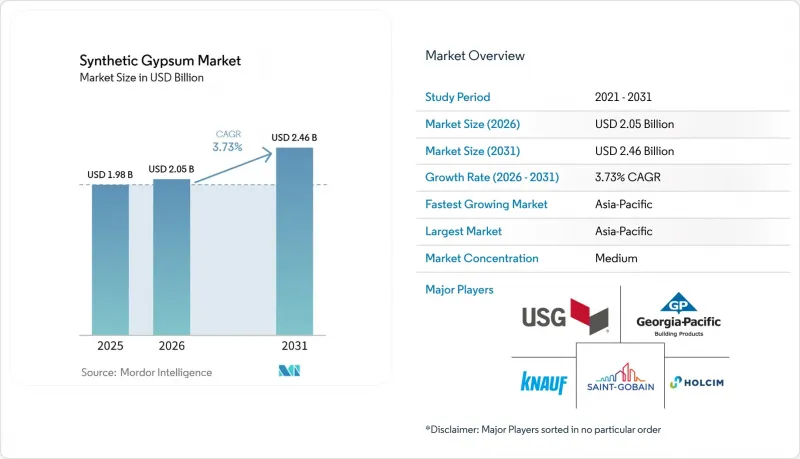
본 보고서는 유형(인산석고, 불소석고 등), 용도(건식 벽체, 시멘트 등) 및 지역(아시아태평양, 북미, 유럽, 남미, 중동 및 아프리카)별로 분류되어 있습니다. 시장 예측은 금액(달러) 기준으로 제시되어 있습니다.
세계 합성 석고 시장 동향 및 인사이트
지속 가능한 건축자재에 대한 선호도 증가
합성 석고 시장에서는 건축자재에 있어 재활용 함량, 추적 가능성, 그리고 매립 처리량 감소를 더욱 중시하는 조달 동향이 나타나고 있습니다. ‘에너지 및 환경 설계 리더십(LEED)’이나 ‘BREEAM’과 같은 인증 제도는 재활용 함유율이 검증된 자재를 평가하고 있어, 환경 성능 증명이 요구되는 개발업자나 공공기관 구매자에게 합성 석고의 매력이 높아지고 있습니다. 2025년, 미국 지질조사국(USGS)은 합성 석고가 미국 국내 석고 공급 총량의 39%를 차지할 것으로 추정하고 있으며, 이는 이 소재가 단순한 지속가능성의 부수적인 역할이 아니라 실질적인 운영상의 역할을 담당하고 있음을 보여줍니다. 이러한 도입 실적은 대형 벽판 제조업체와 건설 업계의 구매자가 최종 제품의 재설계나 핵심 사양의 변경 없이도 재활용 석고의 사용을 확대할 수 있다는 점에서 중요합니다. 구매 결정은 단기적인 원자재 가격 차이만으로 판단되는 것이 아니라, 규정 준수, 보고 의무 및 포트폴리오 기준과 연계되는 경향이 강해지고 있으며, 이는 합성 석고 시장 수요 하한선을 더욱 안정적으로 만드는 요인이 되고 있습니다.
석탄 화력 발전소의 배연 탈황(FGD) 시스템이 안정적인 공급을 창출하고 있습니다.
합성 석고 시장은 여전히 배연 탈황(FGD) 시스템에 크게 의존하고 있으며, 이러한 연관성은 석탄 화력 발전 용량이 계속 가동되고 있는 지역이나 스크러버 규제 준수가 확대되고 있는 지역에서 공급 측면에서 계속해서 긍정적인 요인으로 작용하고 있습니다. 미국의 합성 석고 생산량은 2024년과 2025년 모두 추정 1,700만 미터톤으로 횡보하며, 이 기간 동안 북미는 성숙 단계에 접어들었음에도 안정적인 공급 기반을 유지한 것으로 나타났습니다. 아시아에서는 신규 또는 개조된 스크러버 시스템 덕분에 건설 수요가 확대되고 있는 시장에 여전히 이용 가능한 석고 공급량을 늘릴 수 있습니다. 이러한 지역 간 격차로 인해 합성 석고 시장은 여전히 불균형한 상태를 보이고 있습니다. 이는 동일한 발전 기술이 남아시아 및 동남아시아의 확장을 뒷받침하는 반면, 선진국의 전력 시스템에서는 기존 설비의 갱신 분량 정도공급만 지탱하고 있기 때문입니다. 지역별 공급 패턴이 계속해서 갈라지는 가운데, 하류 공장을 최저 비용으로 규제 기준을 충족하는 FGD 공급원에 연결할 수 있는 생산자는 물류 및 이익률 측면에서 우위를 유지하게 될 것입니다.
석탄 화력 발전의 단계적 감축이 FGD 석고 공급을 압박
선진국에서의 석탄 화력 발전 감소는 합성 석고 시장에 있어 중대한 구조적 과제가 되고 있습니다. FGD 석고공급은 탈황 처리를 거친 석탄 화력 발전소의 존재와 가동률과 직접적으로 연결되어 있기 때문입니다. 이 문제는 하류 부문인 벽판 및 시멘트의 생산 능력이 여전히 큰 반면, 업스트림 부문인 전력 사업 기반이 대체 석고 공급원의 확대 속도보다 빠르게 축소되고 있는 지역에서 가장 심각합니다. 석탄 화력 발전소가 폐쇄됨에 따라 구매자들은 오랫동안 예측 가능한 순도, 계약의 확실성, 그리고 유리한 운송 비용을 제공해 온 인근 공급원을 잃게 될 것입니다. 합성 석고 시장에 미치는 영향으로는 현지에서의 입수 가능성 저하, 장거리 운송을 통한 조달, 수입 자재, 또는 사용 전 추가 검증이 필요한 고비용 재활용 원료에 대한 의존도 증가 등을 들 수 있습니다. 이러한 공급 구조의 변화로 인해 일부 지역에서는 합성 석고와 천연 석고의 비용 차이가 줄어들게 되어, FGD의 광범위한 채택을 뒷받침해 온 비용 측면의 우위 중 하나가 약화될 가능성이 있습니다.
부문 분석
2025년, FGD 석고는 시장 점유율의 59.17%를 차지하며 합성 석고 시장에서 가장 큰 유형 부문이 되었습니다. 이러한 위상은 일관된 입자 특성, 발전소에서 석고보드 공장 및 시멘트 공장에 이르는 확립된 공급망, 그리고 대규모 건설 용도에서의 오랜 실적을 반영한 것입니다. 미국에서는 2024년과 2025년 모두 합성 석고 생산량이 1,700만 미터톤으로 추정되며, 이는 FGD 유래 재료가 북미 공급 기반에서 차지하는 비중이 크다는 점을 여실히 보여줍니다. 불소석고 및 시트로석고는 여전히 훨씬 소규모 공급원에 그치고 있으며, 총량보다는 불순물 관리가 중시되는 특수한 용도로 사용되고 있습니다. 규모는 제한적이지만, 이러한 유형들은 합성 석고 시장이 벽판 중심의 FGD 부문에만 국한되지 않고 더 광범위한 재료를 아우르고 있음을 보여줍니다.
인석고는 2031년까지 연평균 성장률(CAGR) 4.55%를 나타낼 것으로 예측되며, 합성 석고 시장에서 가장 빠르게 성장하는 유형가 될 전망입니다. 이전에는 산더미처럼 쌓아두기만 했던 이 재료가 농업, 건설 및 특정 산업용도에서 유용한 원료로 점점 더 높이 평가받고 있습니다. 국제비료협회(IFA) 보고서에 따르면, 매년 3억 톤 이상의 인산석고가 발생하고 있지만, 재이용되는 비율은 고작 14%에 불과하여, 품질 및 규제 요건을 충족한다면 활용 가능한 막대한 자원 기반이 남아 있음을 의미합니다. 또한 세척, 부유, 생물학적 처리 등의 처리 기술 향상으로 인해, 특히 구매자가 오염 물질 관리에 대해 더 높은 신뢰성을 요구하는 분야에서 고부가가치 용도로의 상업적 실현 가능성이 높아지고 있습니다. 따라서 이 유형별 부문에서는 명확한 전환 추세가 나타나고 있으며, 최대 원료 공급원은 성숙한 유틸리티 기반과, 가장 빠르게 성장하는 원료 공급원은 처리 능력 향상 및 합성 석고 시장 전반에서의 수용 확대와 각각 연결되어 있습니다.
지역별 분석
아시아태평양은 2025년에 매출의 39.51%를 차지하며, 2031년까지 연평균 성장률(CAGR) 4.82%로 성장할 것으로 전망되어, 합성 석고 시장에서 가장 크고 가장 빠르게 성장하는 지역 시장이 되고 있습니다. 중국은 이 지역 최대 수요 거점으로 계속 자리 잡고 있습니다. 이는 중국의 벽판 및 시멘트 밸류체인이 건설 관련 광범위한 제조 네트워크 내에서 대량의 합성 석고를 흡수할 수 있기 때문입니다. 인도의 경우, 석탄 화력 발전소의 배연 탈황(FGD) 설비가 제품별 생산을 뒷받침하는 한편, 시멘트 및 벽판 제조업체들이 최종 시장의 확대를 위해 신뢰할 수 있는 석고 원료를 필요로 하고 있어 주목할 만한 수급 구도가 나타나고 있습니다. 일본과 한국은 이 지역 시장 중에서도 보다 성숙한 부문을 차지하고 있으며, 고부가가치 보드 제조에 필요한 품질 요건을 뒷받침하는 기술적으로 엄격한 가공 기준이 확립되어 있습니다. 베트남, 인도네시아, 방글라데시는 배출 규제 강화와 견조한 건설 수요가 지역 전체의 합성 석고 사용 확대를 뒷받침할 것으로 예상되어 중기적인 전망을 긍정적으로 만들고 있습니다.
북미는 합성 석고 시장에서 여전히 기술적으로 가장 통합이 진행된 지역 중 하나이며, FGD 제조업체와 보드 제조업체 사이에는 오랜 기간에 걸친 협력 관계가 구축되어 있습니다. 2025년, 미국 지질조사국(USGS)은 합성 석고가 미국 국내 석고 공급 총량의 39%를 차지할 것으로 추정하며, 미국의 광범위한 석고 시스템에서 합성 석고가 수행하는 핵심적인 역할을 뒷받침했습니다. 동 보고서에 따르면, 벽판 판매량이 260억제곱피트인 반면, 패널 생산 능력은 연간 340억제곱피트에 달한다고 보고되었으며, 이는 적격 자재를 흡수할 수 있는 하류 수요의 규모를 반영하고 있습니다. 2026년 6월, 크나우프 그룹 산하의 USG 코퍼레이션은 CGC사를 통해 앨버타주 휘틀랜드 카운티에 2억 1,000만 캐나다 달러(약 1억 4,885만 달러)를 투자한 벽판 공장을 개장했습니다. 이 공장은 이산화탄소 배출량 감축, 물 사용량 감축, 그리고 제조 폐기물의 매립 제로를 목표로 하고 있습니다. 캐나다와 멕시코는 지역 시장에 깊이를 더하고 있지만, 북미에서 합성 석고의 최대 사업 거점은 여전히 미국입니다.
유럽에서는 하류 부문 수요가 견조한 반면, 장기적인 FGD 공급 기반이 핍박받고 재활용에 대한 중요성이 높아짐에 따라 합성 석고 시장을 둘러싼 환경은 더욱 복잡해지고 있습니다. 오스트리아는 그 정책 방향을 제시하고 있습니다. 오스트리아의 2025년 재활용 석고 프레임워크와 2026년 매립 금지 조치에 이어, 슈토커아우에 GzG Gipsrecycling GmbH 공장이 문을 열었습니다. 이 공장의 연간 생산 능력은 6만 톤으로, 상고반(Sangoban)의 석고보드 생산에 최대 40%의 재활용 소재를 공급할 수 있습니다. 남미는 브라질의 인산석고 자원이 농업 및 건설 용도 모두를 뒷받침하고 있어 그 중요성이 커지고 있습니다. 한편, Etex는 2026년부터 2027년까지 페루, 칠레, 아르헨티나 전역에서 석고보드 사업 확장에 6,500만 유로를 투자하기로 결정했습니다. 중동 및 아프리카는 매출 규모 면에서는 여전히 소규모이지만, 건설 프로젝트, 시멘트 생산 능력 증강, 그리고 배기가스 제어 시스템의 보급 확대가 시장의 점진적인 성장을 지속적으로 뒷받침하고 있습니다.
기타 혜택:
- 엑셀 형식 시장 예측(ME) 시트
- 3개월간의 애널리스트 지원
자주 묻는 질문
목차
제1장 서론
제2장 조사 방법
제3장 개요
제4장 시장 구도
제5장 시장 규모와 성장 예측
제6장 경쟁 구도
제7장 시장 기회와 향후 전망
JHS 26.09.01According to Mordor Intelligence, the synthetic gypsum market size is expected to grow from USD 1.98 billion in 2025 to USD 2.05 billion in 2026 and is forecast to reach USD 2.46 billion by 2031 at 3.73% CAGR over 2026-2031.
This report is Segmented by Type (Phosphogypsum, Fluorogypsum and More), Application (Drywall, Cement, and More), and Geography (Asia-Pacific, North America, Europe, South America, and Middle-East and Africa). The Market Forecasts are Provided in Terms of Value (USD).
Global Synthetic Gypsum Market Trends and Insights
Rising Preference for Sustainable Building Materials
The synthetic gypsum market is seeing a procurement shift that places greater weight on recycled content, traceability, and reduced landfill exposure in building materials. Certification systems such as Leadership in Energy and Environmental Design (LEED) and BREEAM reward materials with validated recycled content, making synthetic gypsum more attractive to developers and public buyers who must document environmental performance. In 2025, the United States Geological Survey (USGS) estimated synthetic gypsum at 39% of total US domestic gypsum supply, indicating that the material holds a substantial operational role rather than a marginal sustainability position. This installed base is significant because large wallboard producers and construction buyers can expand secondary gypsum use without redesigning end products or changing core specifications. Buying decisions are increasingly tied to compliance, reporting, and portfolio standards rather than short-term raw material price spreads alone, which supports a more stable demand floor for the synthetic gypsum market.
Coal Plant Flue Gas Desulfurization (FGD) Systems Generating Consistent Supply
The synthetic gypsum market remains heavily dependent on flue gas desulfurization (FGD) systems, and this link continues to be a positive supply factor in regions where coal capacity remains active or where scrubber compliance is expanding. US synthetic gypsum production held steady at an estimated 17 million metric tons in both 2024 and 2025, indicating that North America retained a mature but stable supply base during that period. In Asia, new or retrofitted scrubber systems can still add usable gypsum volumes to markets with growing construction demand. That regional split keeps the synthetic gypsum market uneven, as the same utility technology supports expansion in South and Southeast Asia while offering only replacement-level support in developed power systems. Producers that can connect downstream plants to the lowest-cost compliant FGD supply will retain a logistical and margin advantage as regional supply patterns continue to diverge.
Coal Phase-Down Eroding FGD Gypsum Supply
The decline of coal-fired power generation in developed economies presents a significant structural challenge to the synthetic gypsum market, as FGD gypsum supply is directly tied to the presence and operating rates of scrubbed coal plants. This issue is most acute in regions where downstream wallboard and cement capacity remains large, but the upstream utility base is shrinking faster than alternative gypsum streams can scale. As coal plants close, buyers lose a nearby source that had long offered predictable purity, contract visibility, and favorable transport economics. The impact on the synthetic gypsum market includes reduced local availability and greater reliance on longer-haul sourcing, imported material, or higher-cost recycled streams that require additional verification before use. This supply shift can narrow the cost gap between synthetic and mined gypsum in some locations, weakening one of the cost advantages that supported broad FGD adoption.
Other drivers and restraints analyzed in the detailed report include:
- Soil Amendment Demand from Agricultural Producers
- Tightening Circular Economy Regulations
- Contaminant and Radioactivity Concerns in Phosphogypsum
For complete list of drivers and restraints, kindly check the Table Of Contents.
Segment Analysis
FGD gypsum held 59.17% of the market in 2025, making it the largest type segment in the synthetic gypsum market. This position reflects consistent particle characteristics, established supply chains from utility sites to board and cement plants, and a long track record in high-volume construction applications. In the United States, synthetic gypsum production was estimated at 17 million metric tons in both 2024 and 2025, underlining the scale that FGD-derived material contributes to the North American supply base. Fluorogypsum and citrogypsum remained much smaller streams, serving specialized applications where impurity control is more important than total volume. Although limited in scale, these types indicate that the synthetic gypsum market encompasses a broader range of materials than the wallboard-centered FGD segment alone.
Phosphogypsum is projected to grow at a 4.55% CAGR through 2031, making it the fastest-growing type in the synthetic gypsum market. Material that was previously stockpiled in stacks is increasingly being evaluated as a usable feedstock for agriculture, construction, and selected industrial applications. The International Fertilizer Association reported that more than 300 million tons of phosphogypsum are generated every year and that only 14% is reused, leaving a large resource base available if quality and regulatory requirements are met. Treatment methods such as washing, flotation, and biological approaches are also improving the commercial case for higher-value applications, particularly where buyers require greater confidence in contaminant control. The type segment therefore reflects a clear transition, with the largest feedstock tied to a maturing utility base and the fastest-growing feedstock tied to improving treatment capability and broader acceptance across the synthetic gypsum market.
Complete Report Scope:
- By Type
- Flue Gas Desulfurization Gypsum
- Phosphogypsum
- Fluorogypsum
- Citrogypsum
- Other Types
- By Application
- Drywall
- Cement
- Agriculture (Soil Amendments)
- Water Treatment
- Other Applications
- By Geography
- Asia-Pacific
- China
- India
- Japan
- South Korea
- Rest of Asia-Pacific
- North America
- United States
- Canada
- Mexico
- Europe
- Germany
- United Kingdom
- France
- Italy
- Russia
- Rest of Europe
- South America
- Brazil
- Argentina
- Rest of South America
- Middle-East and Africa
- Saudi Arabia
- South Africa
- Rest of Middle-East and Africa
- Asia-Pacific
Geography Analysis
Asia-Pacific accounted for 39.51% of revenue in 2025 and is projected to grow at a 4.82% CAGR through 2031, making it the largest and fastest-growing regional market for synthetic gypsum. China remains the region's largest demand center, as its wallboard and cement value chains can absorb substantial synthetic gypsum volumes within large construction-linked manufacturing networks. India presents a notable supply-and-demand combination, as flue gas desulfurization (FGD) installations at coal plants support byproduct generation, while cement and wallboard producers require reliable gypsum inputs to expand end markets. Japan and South Korea represent a more mature segment of the regional market, with technically disciplined processing standards that support quality requirements in higher-value board manufacturing. Vietnam, Indonesia, and Bangladesh strengthen the medium-term outlook, as tightening emissions controls and steady construction demand are expected to support wider use of synthetic gypsum across the region.
North America remains one of the most technically integrated regions in the synthetic gypsum market, with long-standing links between FGD producers and board manufacturers. In 2025, the United States Geological Survey (USGS) estimated synthetic gypsum at 39% of the total US domestic gypsum supply, confirming the central role of synthetic gypsum in the country's broader gypsum system. The same publication reported wallboard sales of 26 billion square feet against panel manufacturing capacity of 34 billion square feet per year, reflecting the scale of installed downstream demand capable of absorbing qualified material. In June 2026, Knauf Group's USG Corporation, through CGC Inc., opened a CAD 210 million (~USD 148.85 million) wallboard plant in Wheatland County, Alberta, targeting lower carbon emissions, lower water use, and zero manufacturing waste to landfill. Canada and Mexico add depth to the regional market, but the United States remains the largest operating benchmark for synthetic gypsum in North America.
Europe presents a more complex environment for the synthetic gypsum market, as strong downstream demand coincides with a tightening long-term FGD supply base and a growing emphasis on recycling. Austria illustrates the policy direction: its 2025 recycled gypsum framework and 2026 landfill ban were followed by the opening of the GzG Gipsrecycling GmbH plant in Stockerau, which has an annual capacity of 60,000 tons and can supply Saint-Gobain plasterboard production with up to 40% recycled material. South America is gaining relevance as Brazil's phosphogypsum base supports both agricultural and construction applications, while Etex has committed EUR 65 million to gypsum board expansion across Peru, Chile, and Argentina through 2026 and 2027. The Middle East and Africa remain smaller in revenue terms, though construction programs, cement capacity additions, and wider adoption of emissions control systems continue to support gradual market expansion.
- American Gypsum Company, LLC
- BauMineral
- BNBM Group
- Dolina Nidy Sp. z o.o.
- Drax Group PLC
- Etex Group
- Georgia-Pacific Gypsum LLC
- Gypsemna Co. LLC
- Gyptec Iberica
- HOLCIM
- Knauf Group
- LafargeHolcim
- National Company Gypsum Services
- PABCO Gypsum
- Saint-Gobain
- STEAG GmbH
- Synthetic Materials
- Travancore Titanium Products Limited
- USG Corporation
- Valmet
- Yoshino Gypsum Co., Ltd.
Additional Benefits:
- The market estimate (ME) sheet in Excel format
- 3 months of analyst support
TABLE OF CONTENTS
1 Introduction
- 1.1 Study Assumptions and Market Definition
- 1.2 Scope of the Study
2 Research Methodology
3 Executive Summary
4 Market Landscape
- 4.1 Market Overview
- 4.2 Market Drivers
- 4.2.1 Rising Preference for Industrial By-Product Based Building Materials
- 4.2.2 Coal Plant Flue Gas Desulfurization Gypsum Availability Remains Material in Several Manufacturing Hubs
- 4.2.3 Cement Producers Seeking Consistent Set Control and Lower Clinker Dependency
- 4.2.4 Soil Amendment Demand Expands in Salinity-Stressed Agricultural Zones
- 4.2.5 Tightening Circular Economy Procurement Standards in Construction and Agriculture
- 4.2.6 Emerging Waste Valorization Pathways for Phosphogypsum and Fluorogypsum
- 4.3 Market Restraints
- 4.3.1 Coal Phase-Down Erodes Long-Term Flue Gas Desulfurization Gypsum Supply
- 4.3.2 Contaminant and Radioactivity Compliance Limits Restrict Phosphogypsum Reuse
- 4.3.3 Handling, Drying, and Logistics Costs Reduce Margin in Low-Value Applications
- 4.3.4 Quality Variability Versus Natural Gypsum Slows End-User Conversion
- 4.4 Value Chain Analysis
- 4.5 Porter's Five Forces Analysis
- 4.5.1 Threat of New Entrants
- 4.5.2 Bargaining Power of Suppliers
- 4.5.3 Bargaining Power of Buyers
- 4.5.4 Threat of Substitutes
- 4.5.5 Competitive Rivalry
5 Market Size and Growth Forecasts (Value)
- 5.1 By Type
- 5.1.1 Flue Gas Desulfurization Gypsum
- 5.1.2 Phosphogypsum
- 5.1.3 Fluorogypsum
- 5.1.4 Citrogypsum
- 5.1.5 Other Types
- 5.2 By Application
- 5.2.1 Drywall
- 5.2.2 Cement
- 5.2.3 Agriculture (Soil Amendments)
- 5.2.4 Water Treatment
- 5.2.5 Other Applications
- 5.3 By Geography
- 5.3.1 Asia-Pacific
- 5.3.1.1 China
- 5.3.1.2 India
- 5.3.1.3 Japan
- 5.3.1.4 South Korea
- 5.3.1.5 Rest of Asia-Pacific
- 5.3.2 North America
- 5.3.2.1 United States
- 5.3.2.2 Canada
- 5.3.2.3 Mexico
- 5.3.3 Europe
- 5.3.3.1 Germany
- 5.3.3.2 United Kingdom
- 5.3.3.3 France
- 5.3.3.4 Italy
- 5.3.3.5 Russia
- 5.3.3.6 Rest of Europe
- 5.3.4 South America
- 5.3.4.1 Brazil
- 5.3.4.2 Argentina
- 5.3.4.3 Rest of South America
- 5.3.5 Middle-East and Africa
- 5.3.5.1 Saudi Arabia
- 5.3.5.2 South Africa
- 5.3.5.3 Rest of Middle-East and Africa
- 5.3.1 Asia-Pacific
6 Competitive Landscape
- 6.1 Market Concentration
- 6.2 Strategic Moves
- 6.3 Market Share (%)/Ranking Analysis
- 6.4 Company Profiles (includes Global Overview, Market Overview, Core Segments, Financials as available, Strategic Information, Products and Services, and Recent Developments)
- 6.4.1 American Gypsum Company, LLC
- 6.4.2 BauMineral
- 6.4.3 BNBM Group
- 6.4.4 Dolina Nidy Sp. z o.o.
- 6.4.5 Drax Group PLC
- 6.4.6 Etex Group
- 6.4.7 Georgia-Pacific Gypsum LLC
- 6.4.8 Gypsemna Co. LLC
- 6.4.9 Gyptec Iberica
- 6.4.10 HOLCIM
- 6.4.11 Knauf Group
- 6.4.12 LafargeHolcim
- 6.4.13 National Company Gypsum Services
- 6.4.14 PABCO Gypsum
- 6.4.15 Saint-Gobain
- 6.4.16 STEAG GmbH
- 6.4.17 Synthetic Materials
- 6.4.18 Travancore Titanium Products Limited
- 6.4.19 USG Corporation
- 6.4.20 Valmet
- 6.4.21 Yoshino Gypsum Co., Ltd.
7 Market Opportunities and Future Outlook
- 7.1 White-Space and Unmet-Need Assessment


