

|
시장보고서
상품코드
2117495
레이온 섬유 : 시장 점유율 분석, 업계 동향 및 통계, 성장 예측(2026-2031년)Rayon Fibers - Market Share Analysis, Industry Trends & Statistics, Growth Forecasts (2026 - 2031) |
||||||
 Mordor Intelligence
레이온 섬유 시장 규모는 2025년 221억 7,000만 달러로 평가되었습니다. 2026년에는 236억 5,000만 달러로 확대되어 2031년까지 325억 2,000만 달러에 이르고 2026년부터 2031년에 걸쳐 CAGR 6.58%를 나타낼 것으로 예측됩니다.
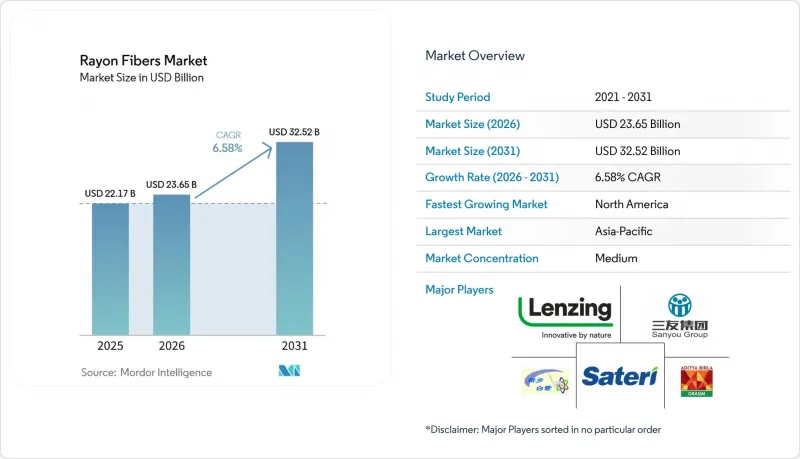
본 보고서는 제품 유형(비스코스 레이온, 리오셀 등), 섬유 형태(스테이플 섬유 및 필라멘트 섬유), 용도(의류, 가정용 직물 등), 지역(아시아태평양, 북미, 유럽, 남미, 중동 및 아프리카)별로 분류되어 있습니다. 시장 전망은 금액(달러) 기준으로 제시되어 있습니다.
세계의 레이온 섬유 시장 동향 및 인사이트
지속 가능하고 생분해성 섬유에 대한 수요 증가
레이온 섬유 시장은 섬유의 생분해성에 대한 구매자의 관심 증가와 화석 유래 소재에 대한 의존도를 낮추려는 추세로부터 혜택을 받고 있습니다. 합성 미세 플라스틱으로 인한 오염에 대한 우려로 인해, 지속가능성 담당 팀은 섬유 선정을 단순한 브랜드의 자발적 노력으로 취급하지 않고 공식적인 조달 기준에 포함시키고 있습니다. 또한 구매자들이 재생 셀룰로오스계 섬유를 모두 한데 묶어 취급하지 않고, 화학약품 사용량이나 용매 회수율을 개별 기준으로 평가하게 됨에 따라 기존의 비스코스와 클로즈드 루프 리요셀 간의 구분이 더욱 명확해지고 있습니다. 빌라 셀룰로오스(Bilra Cellulose)사의 ‘Livaeco 리오셀’은 용제 회수율이 최대 99.7%에 달하며, 목재 펄프의 100%가 산림관리협의회(FSC) 인증을 획득하고 있어, 폐쇄형 루프 가공과 조달 과정의 투명성이 고품질 셀룰로오스계 섬유 구매 기준으로 자리 잡고 있음을 보여줍니다. 조달 기준이 엄격해짐에 따라 이러한 수요 추세는 의류 분야에 그치지 않고, 추적 가능한 원자재의 중요성이 점점 더 커지고 있는 홈 텍스타일 및 위생용품 분야로도 확대되고 있습니다.
리요셀 및 모달 섬유의 생산 능력 확대
리오셀 생산이 특수 용도 수준의 규모에서 보다 대규모의 표준화된 생산량으로 전환됨에 따라, 레이온 섬유 시장은 변화하고 있습니다. 2025년까지 전 세계 리요셀 생산 능력은 130만 톤을 넘어섰으며, 사테리(Sateli)는 산둥성 유타이 공장의 가동 개시에 따라 2026년에는 4개 거점에서 총 60만 미터톤의 리요셀 생산 능력에 도달했습니다. 그라심 인더스트리즈 리미티드는 2026 회계연도에 셀룰로오스계 단섬유의 연간 생산 능력 89만 톤을 가동률 97%로 운영 중이며, 하리할에서 리오셀 2단계 확장 계획에 3,094 카롤 루피(3억 2,400만 달러)를 투자하는 리요셀 2단계 확장 계획을 승인했으며, 1단계 및 2단계가 완료되면 리요셀의 총 생산 능력을 연간 21만 톤으로 확대될 전망입니다. 이러한 변화로 인해 단위 비용 절감이 기대될 뿐만 아니라, 그동안 리요셀을 지나치게 비싸다고 여겼던 중저가 의류 부문에서의 채택이 확대될 것으로 전망됩니다. 또한, 바이어들이 비스코스, 모달, 리요셀을 비용과 지속가능성 성과에 따라 명확하게 순위를 매기는 단계적 조달 방침을 점점 더 많이 채택하고 있기 때문에 모달에도 긍정적인 영향이 있을 것으로 예측됩니다.
이황화탄소와 폐수 규제가 생산 비용을 상승시키고 있습니다.
레이온 섬유 시장에서는 기존의 비스코스 생산 과정에서 비용 측면의 과제에 직면해 있습니다. 이는 이황화탄소(CS2) 회수 및 황 관련 처리 시스템에 지속적인 투자가 필요하기 때문입니다. 미국 환경보호청(EPA)은 ‘유기 화학 물질, 플라스틱 및 합성 섬유 폐수 지침’에 따라 비스코스 레이온 공장의 폐수 배출을 규제하고 있으며, 이로 인해 공해 대책이 공장의 경제성과 밀접하게 연결되어 있습니다. 아시아태평양 레이온의 ‘2025년 EU 최선 이용 기술(BAT) 평가 보고서’에 따르면, 첨단 배출 저감 시스템을 도입하면 섬유 1톤당 황 대기 배출량을 20kg 미만으로 줄여 EU의 BAT 기준을 충족할 수 있지만, 이 수준의 배출 제어를 위해서는 모든 중규모 생산자가 감당할 수 없는 막대한 자본이 필요합니다. 또한, 레이온 섬유 시장에서도 켈하임 파이버스(Kellheim Fibers)사가 파산 절차를 통해 실행 가능한 장기적인 해결책을 찾지 못해 2026년 3월 31일부로 가동을 중단한 것은 유럽에서 주목할 만한 동향이 되었습니다. ‘유해 화학물질 제로 배출(ZDHC)’ MMCF 지침에 따라 재생 셀룰로오스 밸류체인 전반에 걸쳐 규정 준수 기대감이 확산되고 있으며, 비용 압박은 더 이상 일부 비스코스 생산자에게만 국한된 문제가 아닙니다.
부문별 분석
2025년, 비스코스 레이온은 레이온 섬유 시장 점유율의 67.38%를 차지했습니다. 이는 비스코스 레이온의 저비용 특성, 습식 방적 공정의 규모, 그리고 아시아 섬유 산업 거점의 표준 방적·마감 설비와의 폭넓은 호환성을 반영한 결과입니다. 레이온 섬유 시장은 고가의 재생 셀룰로오스계 섬유보다 대량 생산되는 의류 및 홈 텍스타일의 경제성에 부합하기 때문에 계속해서 비스코스를 양산 기반으로 의존하고 있습니다. 모달은 범용 비스코스와 프리미엄 리오셀 사이의 중간층을 차지하고 있으며, 부드러운 촉감과 높은 흡습성 덕분에 속옷, 스포츠웨어, 고급 침구류에서 널리 사용되고 있습니다. 리오셀은 브랜드의 지속가능성 요건, 폐쇄형 공정(closed-loop process)의 매력, 그리고 신규 생산 능력 가동에 따른 비스코스와의 비용 격차 축소에 힘입어, 2031년까지 연평균 성장률(CAGR) 8.52%를 기록하며 가장 빠르게 성장한 제품 유형이었습니다.
쿠프라미온 레이온은 주로 일본의 고급 의류 분야에서 틈새 시장을 유지하고 있으며, 그 초미세 필라멘트 특성으로 인해 실크와 같은 드레이프성과 표면 마감을 실현하고 있습니다. 고강도 레이온 및 초고강도 레이온은 타이어 코드 보강재, 산업용 벨트, 여과용 원단 등 부드러움보다 인장 성능이나 열안정성이 중시되는 산업용도로 계속해서 사용되고 있습니다. 레이온 섬유 시장에서는 시장 규모를 지탱하는 대규모 비스코스 기반과, 프리미엄 성장 분야를 선점하고 있는 소규모 리오셀 부문 사이에서 더욱 뚜렷한 양극화가 진행되고 있습니다. 빌라 셀룰로오스(Bilra Cellulose)사의 ‘Livaeco Lyocell’은 최대 99.7%의 용매 회수율을 자랑하며, 100% FSC(산림관리협의회) 인증을 받은 목재 펄프를 사용하여 제조되어, 레이온 섬유 시장의 제품 포트폴리오가 점점 더 충족해야 할 지속가능성 기준을 높이고 있습니다.
지역별 분석
2025년, 아시아태평양은 세계 레이온 섬유 시장의 62.44%를 차지하며 생산과 소비 양면에서 가장 규모가 큰 지역이 되었습니다. 중국은 여전히 가장 큰 단일 생산 거점이며, 당산 삼우, 사테리, 이빈 그레이스 그룹이 연간 수십만 톤 규모로 가동하고 있습니다. 인도도 중요한 역할을 하고 있으며, 글라심 인더스트리즈는 2026 회계연도에 연간 89만 톤(TPA)의 셀룰로오스계 스테이플 섬유를 가동률 97%로 생산했습니다. 이는 수요가 견조하고 잉여 생산 능력이 제한적임을 보여줍니다. 일본은 생산량이 여전히 소규모이지만, 고급 의류 및 우수한 드레이프성과 관련된 특수 필라멘트와 구리-암모늄 계열 용도 분야에서 중요한 위치를 차지하고 있습니다. 한국은 하류 방적 능력으로 기여하고 있는 반면, 베트남, 방글라데시, 인도네시아는 의류 조립 네트워크를 통해 중국 및 인도산 섬유를 점점 더 대량으로 흡수하고 있습니다.
북미는 2031년까지 연평균 성장률(CAGR) 7.13%를 나타낼 것으로 예측되며, 레이온 섬유 시장에서 가장 빠르게 성장하는 지역이 될 전망입니다. 이러한 성장은 국내 섬유 생산량이 많기 때문이라기보다는 인증받은 지속 가능한 셀룰로오스 기반 소재로의 조달 전환에 의해 주도되고 있습니다. 렌징(Lenzing)이 2025년에 에지웰 퍼스널케어(Edgewell Personal Care)와 제휴하여 북미에서 VEOCEL 리요셀 기반의 위생용품을 출시한 것은 프리미엄 부직포가 오랫동안 화석 유래 소재가 지배해 온 카테고리에 진입할 수 있음을 입증했습니다. 또한, 미국-멕시코-캐나다 협정(USMCA)의 틀 아래 진행되는 니어쇼어링이 공급망 단축을 추구하는 미국 브랜드를 위한 레이온 의류 조립을 지원하고 있어 멕시코의 중요성이 높아지고 있습니다.
2025년, 유럽은 전 세계 레이온 섬유 수요에서 중요한 점유율을 차지했으며, 그 시장은 패션, 위생용 부직포 및 지속가능성에 관한 규정 준수 요건에 의해 형성되었습니다. EU의 섬유 정책 의제는 브랜드 기업의 조달을, 더욱 강력한 추적 가능성과 제조 공정 문서화를 갖춘 인증된 셀룰로오스계 섬유로 이끌고 있습니다. 독일과 영국은 활발한 섬유 수요와 집중된 패션 소매 활동을 겸비하여, 유럽 내 최대 국내 시장으로서의 위상을 유지했습니다. 브라질과 아르헨티나를 필두로 한 남미는 여전히 소규모 시장이지만, 도시화와 섬유 제조에 대한 투자를 통해 수요가 확대되고 있습니다. 중동 및 아프리카 역시, 기존 아시아 지역 내 무역 경로에서 벗어나 다각화를 모색하는 아시아 수출업체들에게 여전히 초기 단계의 목표 시장으로 남아 있습니다.
기타 혜택 :
- 엑셀 형식 시장 예측(ME) 시트
- 3개월간의 애널리스트 지원
자주 묻는 질문
목차
제1장 서론
제2장 조사 방법
제3장 개요
제4장 시장 구도
제5장 시장 규모 및 성장 예측
제6장 경쟁 구도
제7장 시장 기회 및 향후 전망
KTH 26.09.02According to Mordor Intelligence, the rayon fibers market size is expected to increase from USD 22.17 billion in 2025 to USD 23.65 billion in 2026 and reach USD 32.52 billion by 2031, and is expected to grow at a CAGR of 6.58% over 2026-2031.
This report is Segmented by Product Type (Viscose Rayon, Lyocell, and More), Fiber Form (Staple Fiber and Filament Fiber), Application (Apparel, Home Textiles, and More), and Geography (Asia-Pacific, North America, Europe, South America, and Middle-East and Africa). The Market Forecasts are Provided in Terms of Value (USD).
Global Rayon Fibers Market Trends and Insights
Rising Demand for Sustainable and Biodegradable Fibers
The rayon fibers market is benefiting from greater buyer focus on fiber biodegradability and reduced dependence on fossil-derived materials. Concerns over synthetic microplastic contamination are prompting sustainability teams to incorporate fiber selection into formal sourcing standards, rather than treating it as a voluntary brand commitment. The market is also seeing a clearer distinction between conventional viscose and closed-loop lyocell, as buyers now evaluate chemical intensity and solvent recovery as separate criteria rather than grouping all regenerated cellulosics together. Birla Cellulose's Livaeco Lyocell, with up to 99.7% solvent recovery and 100% Forest Stewardship Council (FSC)-certified wood pulp, illustrates how closed-loop processing and documented sourcing are becoming purchasing criteria for premium cellulosics. As procurement standards tighten, this demand pattern is extending beyond apparel into home textiles and hygiene applications, where traceable raw materials are increasingly important.
Expansion of Lyocell and Modal Fiber Production Capacity
The rayon fibers market is shifting as lyocell production moves from specialty-scale output to larger, more standardized volumes. Global lyocell capacity exceeded 1.3 million tons by 2025, and Sateri's lyocell capacity reached 600,000 metric tons across four sites in 2026 following the start of production at its Yutai facility in Shandong province. Grasim Industries Limited operates 890,000 tons per annum (TPA) of cellulosic staple fiber at 97% utilization in fiscal year 2026 and has approved a Phase II lyocell expansion at Harihar for INR 3,094 crore (USD 324 million), building toward 210,000 TPA of total lyocell capacity upon completion of Phase I and Phase II. This shift is expected to result in lower unit costs and broader adoption in mid-market apparel categories that had previously considered lyocell too expensive. Modal is also expected to benefit, as buyers increasingly apply tiered sourcing policies that place viscose, modal, and lyocell on a defined scale of cost and sustainability performance.
Carbon Disulfide and Effluent Compliance Raising Production Costs
The rayon fibers market faces a cost challenge in conventional viscose production, as CS2 recovery and sulfur-related treatment systems require sustained investment. The U.S. Environmental Protection Agency regulates effluent discharge from viscose rayon plants under the Organic Chemicals, Plastics, and Synthetic Fibers Effluent Guidelines, keeping pollution control closely tied to plant economics. Asia Pacific Rayon's 2025 EU Best Available Techniques (BAT) Assessment Report showed that advanced abatement systems can reduce sulfur-to-air emissions below 20 kg per ton of fiber to meet EU BAT benchmarks, but this level of control requires capital that not every mid-scale producer can sustain. The rayon fibers market also recorded a notable development in Europe when Kelheim Fibres closed operations as of March 31, 2026, after insolvency proceedings failed to secure a viable long-term solution. The Zero Discharge of Hazardous Chemicals (ZDHC) MMCF Guidelines broaden compliance expectations across regenerated cellulose value chains, meaning cost pressure is no longer limited to a narrow group of viscose producers.
Other drivers and restraints analyzed in the detailed report include:
- Growth of Eco-Friendly Fashion Initiatives
- Increasing Use of Regenerated Cellulose Fibers Across Sectors
- Environmental Regulations Governing Viscose Production Methods
For complete list of drivers and restraints, kindly check the Table Of Contents.
Segment Analysis
Viscose rayon held 67.38% of the rayon fibers market share in 2025, reflecting its low-cost position, the scale of wet-spinning processes, and wide compatibility with standard spinning and finishing equipment across Asian textile hubs. The rayon fibers market continues to rely on viscose as the volume base because it aligns better with the economics of mass apparel and home textiles than higher-priced regenerated cellulosics. Modal occupied a middle tier between commodity viscose and premium lyocell, with its softer hand-feel and higher moisture absorption supporting use in intimate apparel, sportswear, and premium bedding. Lyocell was the fastest-growing product type, with an 8.52% CAGR through 2031, supported by brand sustainability requirements, the appeal of its closed-loop process, and a narrowing cost gap with viscose as new capacity comes online.
Cuprammonium rayon retained a niche role, mainly in the Japanese luxury apparel segment, where ultra-fine filament characteristics support silk-like drape and surface finish. High tenacity rayon and super high tenacity rayon remained tied to industrial uses such as tire cord reinforcement, industrial belting, and filtration fabrics, where tensile performance and thermal stability matter more than softness. The rayon fibers market is separating more clearly between a large viscose base that supports scale and a smaller lyocell segment that is capturing premium growth. Birla Cellulose's Livaeco Lyocell, made with up to 99.7% solvent recovery and 100% Forest Stewardship Council (FSC)-certified wood pulp, raises the sustainability benchmark that product portfolios in the rayon fibers market increasingly need to meet.
Complete Report Scope:
- By Product Type
- Viscose Rayon
- Modal Rayon
- Lyocell
- Cuprammonium Rayon
- High Tenacity Rayon
- Super High Tenacity Rayon
- Other Product Types
- By Fiber Form
- Staple Fiber
- Filament Fiber
- By Application
- Apparel
- Home Textiles
- Industrial Textiles
- Medical Textiles
- Other Applications
- By Geography
- Asia-Pacific
- China
- India
- Japan
- South Korea
- Rest of Asia-Pacific
- North America
- United States
- Canada
- Mexico
- Europe
- Germany
- United Kingdom
- France
- Italy
- Russia
- Rest of Europe
- South America
- Brazil
- Argentina
- Rest of South America
- Middle-East and Africa
- Saudi Arabia
- South Africa
- Rest of Middle-East and Africa
- Asia-Pacific
Geography Analysis
Asia-Pacific accounted for 62.44% of the global rayon fibers market in 2025, making it the largest region for both production and consumption. China remained the largest single production base, with Tangshan Sanyou, Sateri, and Yibin Grace Group operating at multi-hundred-thousand-ton annual scales. India also played a notable role, as Grasim Industries operated 890,000 tons per annum (TPA) of cellulosic staple fiber at 97% utilization in fiscal year 2026, indicating strong demand and limited spare capacity. Japan remained smaller in volume but relevant in specialty filament and cuprammonium applications tied to luxury apparel and fine drape. South Korea contributed downstream spinning capacity, while Vietnam, Bangladesh, and Indonesia continued to absorb greater volumes of Chinese and Indian fiber through garment assembly networks.
North America is projected to grow at a 7.13% CAGR through 2031, making it the fastest-growing region in the rayon fibers market. Growth is driven less by large domestic fiber output and more by sourcing shifts toward certified sustainable cellulosics. Lenzing's 2025 launch of VEOCEL lyocell-based hygiene products in North America with Edgewell Personal Care demonstrated that premium nonwovens can enter categories long dominated by fossil-derived materials. Mexico is also becoming more relevant, as nearshoring under the United States-Mexico-Canada Agreement (USMCA) framework supports rayon-based garment assembly for U.S. brands seeking shorter supply chains.
Europe represented a meaningful share of global rayon fiber demand in 2025, with the market shaped by fashion, hygiene nonwovens, and sustainability compliance requirements. The EU textiles policy agenda is directing brand procurement toward certified cellulosic fibers with stronger traceability and process documentation. Germany and the United Kingdom remained the largest national markets in Europe, combining strong textile demand with concentrated fashion retail activity. South America, led by Brazil and Argentina, remains a smaller market but is building demand through urbanization and investment in textile manufacturing. The Middle East and Africa also remain early-stage targets for Asian exporters seeking to diversify beyond established intra-Asia trade routes.
- Asia Pacific Rayon Limited
- Bohi Industry
- CHTC Helon
- Grasim Industries Limited
- Kelheim Fibres GmbH
- Lenzing AG
- Sateri
- Tangshan Sanyou Group Xingda Chemical Fibre Co., Ltd.
- Xinxiang Bailu Chemical Fibre Group Co., Ltd.
- Yibin Grace Group
- Yibin Grace Group
- Zhejiang Fulida Holding Co., Ltd.
Additional Benefits:
- The market estimate (ME) sheet in Excel format
- 3 months of analyst support
TABLE OF CONTENTS
1 Introduction
- 1.1 Study Assumptions and Market Definition
- 1.2 Scope of the Study
2 Research Methodology
3 Executive Summary
4 Market Landscape
- 4.1 Market Overview
- 4.2 Market Drivers
- 4.2.1 Rising demand for sustainable and biodegradable fibers
- 4.2.2 Increasing consumption in apparel and home textiles
- 4.2.3 Expansion of lyocell and modal fiber production
- 4.2.4 Growth of eco-friendly fashion initiatives
- 4.2.5 Increasing use of regenerated cellulose fibers as alternatives to synthetic fibers
- 4.3 Market Restraints
- 4.3.1 Carbon Disulfide And Effluent Compliance Raise Operating Costs
- 4.3.2 Environmental regulations governing viscose production
- 4.3.3 High capital investment for advanced lyocell manufacturing
- 4.4 Value Chain Analysis
- 4.5 Porter's Five Forces Analysis
- 4.5.1 Threat of New Entrants
- 4.5.2 Bargaining Power of Suppliers
- 4.5.3 Bargaining Power of Buyers
- 4.5.4 Threat of Substitutes
- 4.5.5 Competitive Rivalry
5 Market Size and Growth Forecasts (Value)
- 5.1 By Product Type
- 5.1.1 Viscose Rayon
- 5.1.2 Modal Rayon
- 5.1.3 Lyocell
- 5.1.4 Cuprammonium Rayon
- 5.1.5 High Tenacity Rayon
- 5.1.6 Super High Tenacity Rayon
- 5.1.7 Other Product Types
- 5.2 By Fiber Form
- 5.2.1 Staple Fiber
- 5.2.2 Filament Fiber
- 5.3 By Application
- 5.3.1 Apparel
- 5.3.2 Home Textiles
- 5.3.3 Industrial Textiles
- 5.3.4 Medical Textiles
- 5.3.5 Other Applications
- 5.4 By Geography
- 5.4.1 Asia-Pacific
- 5.4.1.1 China
- 5.4.1.2 India
- 5.4.1.3 Japan
- 5.4.1.4 South Korea
- 5.4.1.5 Rest of Asia-Pacific
- 5.4.2 North America
- 5.4.2.1 United States
- 5.4.2.2 Canada
- 5.4.2.3 Mexico
- 5.4.3 Europe
- 5.4.3.1 Germany
- 5.4.3.2 United Kingdom
- 5.4.3.3 France
- 5.4.3.4 Italy
- 5.4.3.5 Russia
- 5.4.3.6 Rest of Europe
- 5.4.4 South America
- 5.4.4.1 Brazil
- 5.4.4.2 Argentina
- 5.4.4.3 Rest of South America
- 5.4.5 Middle-East and Africa
- 5.4.5.1 Saudi Arabia
- 5.4.5.2 South Africa
- 5.4.5.3 Rest of Middle-East and Africa
- 5.4.1 Asia-Pacific
6 Competitive Landscape
- 6.1 Market Concentration
- 6.2 Strategic Moves
- 6.3 Market Share (%)/Ranking Analysis
- 6.4 Company Profiles (includes Global Overview, Market Overview, Core Segments, Financials as available, Strategic Information, Products and Services, and Recent Developments)
- 6.4.1 Asia Pacific Rayon Limited
- 6.4.2 Bohi Industry
- 6.4.3 CHTC Helon
- 6.4.4 Grasim Industries Limited
- 6.4.5 Kelheim Fibres GmbH
- 6.4.6 Lenzing AG
- 6.4.7 Sateri
- 6.4.8 Tangshan Sanyou Group Xingda Chemical Fibre Co., Ltd.
- 6.4.9 Xinxiang Bailu Chemical Fibre Group Co., Ltd.
- 6.4.10 Yibin Grace Group
- 6.4.11 Yibin Grace Group
- 6.4.12 Zhejiang Fulida Holding Co., Ltd.
7 Market Opportunities and Future Outlook
- 7.1 White-Space and Unmet-Need Assessment


