

|
시장보고서
상품코드
2117507
의료 및 제약용 정전기 방지 밀봉 솔루션 : 시장 점유율 분석, 업계 동향 및 통계, 성장 예측(2026-2031년)Medical and Pharmaceutical Static Sealing Solutions - Market Share Analysis, Industry Trends & Statistics, Growth Forecasts (2026 - 2031) |
||||||
 Mordor Intelligence
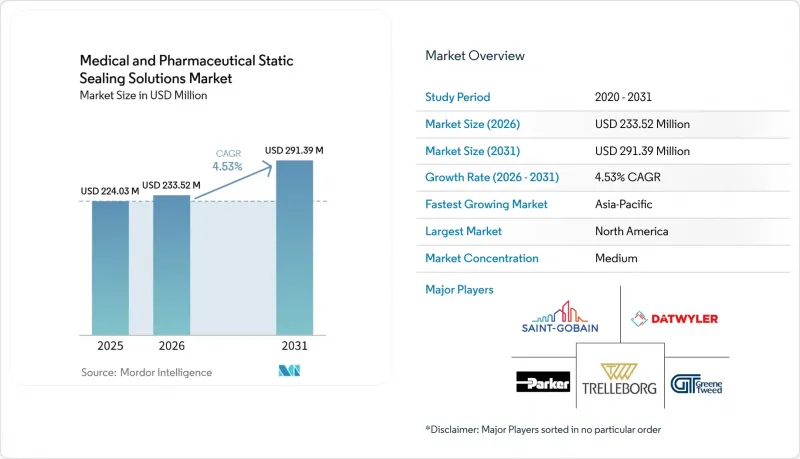
의료 및 제약용 정전기 방지 밀봉 솔루션 시장은 2025년 2억 2,403만 달러로 평가되었습니다. 2026년에는 2억 3,352만 달러로 확대되어 2031년까지 2억 9,139만 달러에 이를 것으로 예측됩니다.
2026년부터 2031년까지의 연평균 성장률(CAGR)은 4.53%를 나타낼 전망입니다.
본 보고서는 소재별(엘라스토머, 실리콘, 기타), 제품 유형별(O-링, 개스킷, 기타), 용도별(가공 설비, 기타), 최종 사용자별(제약 공장, 기타), 지역별(북미, 유럽, 아시아태평양, 중동 및 아프리카, 남미)로 분류되어 있습니다. 시장 전망은 금액(달러) 기준으로 제시되어 있습니다.
세계의 의료 및 제약용 정전기 방지 밀봉 솔루션 시장 동향 및 인사이트
바이오의약품, 바이오시밀러 및 무균 의약품 생산량 증가
바이오의약품 치료로의 전환에 따라 의료 및 제약용 정전기 방지 밀봉 솔루션 시장 전체에서 씰링 요구 사항이 변화하고 있습니다. 이는 이러한 제품에서 순도, 적합성 및 공정 안정성에 대한 보다 엄격한 관리가 요구되기 때문입니다. 새로운 바이오의약품 및 바이오시밀러 생산 라인이 추가될 때마다, 업스트림 공정의 바이오리액터, 다운스트림 공정의 정제 라인, 그리고 무균 충전 시스템 전반에 걸쳐 검증된 밀봉 지점이 다수 증가합니다. 이로 인해 설치된 장비 수를 넘어 구성 요소에 대한 총 수요가 증가하게 됩니다. 단일 클론 항체, 재조합 단백질, 세포 치료제 등의 원료 의약품은 미량의 용출 물질에 더 민감하기 때문에 이러한 환경에서는 표준 산업용 재료가 적합하지 않습니다. 또한, 바이오시밀러 제조 시설에서는 참조 제품의 제조 조건을 더 엄격하게 재현해야 하므로, 공정 수준에서 문서화가 요구되는 인증된 씰의 수가 증가합니다. 미국에서는 2025년 중반까지 60건 이상의 바이오시밀러가 승인되었으며, 이는 검증된 용기 밀봉 및 공정 밀봉 체계와 연계된 보다 광범위한 제조 활동을 촉진하고 있습니다. 이러한 추세는 주로 수량 기준의 가격 경쟁에 의존하는 공급업체가 아닌, 이미 용도에 따른 라이브러리와 이를 뒷받침하는 문서를 보유하고 있는 의료 및 제약용 정적 밀봉 솔루션 시장공급업체에게 유리하게 작용합니다.
추출물 및 용출물에 대한 적합성 요건의 강화
추출물 및 용출물에 대한 규제는 의료 및 제약 분야의 정전기 방지 밀봉 솔루션 시장에서 더욱 강력한 성장 요인으로 작용하고 있습니다. 이는 적합성 평가가 단순한 자재 수령 심사 단계에서 시스템 전체의 성능 심사 단계로 전환되고 있기 때문입니다. USP 일반 장 <382>는 2025년 12월 1일부터 공식적인 요건이 되었으며, 개별 재료 등급뿐만 아니라 조립된 엘라스토머 씰링 시스템 자체에 더 중점을 두게 되었습니다. 이러한 변화로 인해 많은 규제 대상 용도에서 기존의 USP 클래스 VI 데이터만으로는 불충분해졌으며, 제조업체는 현재 이미 사용 중인 제품에 대해서도 추가 시험을 수행해야 할 필요가 생겼습니다. 2025년 8월에 승인되어 2025년 12월에 FDA에 의해 공표된 ICH Q3E ‘추출물 및 용출물에 관한 지침’은 규제 당국 간에 조화로운 위험 기반 요건을 추가하여 이러한 방향을 더욱 강화하고 있습니다. 그 결과, 의료 및 제약 분야의 정적 씰 솔루션 시장에서는 사전 검증된 구성 요소, 보다 상세한 자료, 그리고 적합성 평가 패키지에 대한 신속한 지원을 제공할 수 있는 공급업체에 대한 수요가 증가하고 있습니다. 또한, 소규모 사업자는 여러 제품군에 걸친 반복적인 시험 및 문서 갱신을 지속하기 어려운 경우가 많기 때문에 이로 인해 적격 공급업체의 선택 폭도 좁아지고 있습니다.
긴 검증 및 재인증 주기가 신제품 출시를 지연시킴
긴 검증 소요 기간은 의료 및 제약 분야의 정전기 방지 밀봉 솔루션 시장의 급속한 확장을 저해하는 가장 뚜렷한 제약 요인 중 하나로 남아 있습니다. 이는 새로운 구성 요소가 기술적 및 규제적 심사를 여러 단계를 거쳐야 하기 때문입니다. 인증 과정에서는 규제 대상 제품이나 공정에서 씰이 승인되기까지, 재료 선정부터 추출물 시험, 생체적합성 심사, 기능 평가, 안정성 시험에 이르기까지 일련의 절차를 거쳐야 합니다. 시험 프레임워크가 갱신될 경우, 대부분의 경우 추가 작업 없이 기존 데이터를 그대로 활용할 수 없습니다. 즉, 변경 사항이 없는 소재라 하더라도 계속 사용하려면 새로운 시험이 필요할 가능성이 있습니다. 중소 바이오의약품 기업이나 많은 CDMO는 여러 인증 프로그램을 동시에 수행할 수 있는 사내 품질 관리 체제가 갖춰져 있지 않은 경우가 많아, 이러한 영향에 더 크게 시달리고 있습니다.
부문별 분석
2025년 시점에서 엘라스토머는 의료 및 제약 분야의 정전기 방지 밀봉 솔루션 시장 점유율의 51.11%를 차지했으며, 이러한 우위는 세척 및 멸균이 빈번하게 이루어지는 생산 환경에서 오랜 기간 동안 축적된 사용 실적을 반영한 것입니다. 이러한 지위는 CIP(정지 세척) 및 SIP(정지 멸균) 환경에서 수년에 걸쳐 입증된 성능을 바탕으로 구축되었습니다. 이러한 환경에서는 입증되지 않은 화합물을 이용한 실험보다 재현성이 더 중요하게 여겨지기 때문입니다. 실리콘은 2031년까지 연평균 성장률(CAGR)이 6.18%에 달하고, 가장 빠르게 성장하는 소재가 될 것으로 예측됩니다. 이러한 성장은 생체 적합성 프로파일과 무균 처리 및 일회용 용도에 대한 적합성에 기인합니다. 백금 경화형 액상 실리콘 고무는 바이오리액터의 인터페이스 및 기타 민감한 접촉 지점에서 채택이 확대되고 있습니다. 이는 미립자 발생이 적고 멸균 처리와의 호환성이 높아, 보다 청정한 적합성 평가 프로세스를 가능하게 하기 때문입니다.
금속은 주로 고압 공정 연결용 보강 개스킷 설계에 사용되며, 의료 및 제약 분야의 정적 씰 솔루션 시장에서 기존 라인 요구 사항이라는 제한된 용도에 계속해서 기여하고 있습니다. 더 중요한 소재 전환 측면에서는 플루오로카본 대체재에 대한 심사가 엄격해짐에 따라 배합 선택이 더욱 전략적으로 이루어지고 있으며, 그 결과 장기적으로 적합성 평가 위험이 낮은 것으로 간주되는 실리콘에 대한 관심이 높아지고 있습니다. 실제로 의료 및 제약 분야의 정전기 방지 밀봉 솔루션 시장 고객은 물리적 부품과 함께 적합성 평가 패키지를 구매하고 있으므로, 소재의 성능과 상세한 문서화를 모두 제공할 수 있는 공급업체가 가장 큰 강점을 발휘합니다.
2025년에는 O-링이 제품 수요의 48.27%를 차지하며, 용기, 밸브, 플랜지 연결부 및 기기 관통부에 관계없이 의료 및 제약용 정전기 방지 밀봉 솔루션 시장에서 중심적인 위치를 계속 차지했습니다. O-링의 형상은 널리 표준화되어 있어 설계의 복잡성을 줄이고 호환성 평가를 용이하게 하며, 제조업체가 제품 라인 인증이나 설비 개조를 진행할 때 여러 공급업체를 대상으로 벤치마킹을 쉽게 할 수 있게 해줍니다. 또한, 이러한 표준화 덕분에 조달 팀은 대안을 검토할 때 인증 프로세스의 각 단계를 처음부터 다시 거치지 않고도 공급의 연속성을 유지할 수 있습니다.
립 씰은 가장 빠른 성장이 예상되는 제품 유형이며, 이 부문에서 의료 및 제약용 정전기 방지 밀봉 솔루션 시장 규모는 2031년까지 연평균 성장률(CAGR) 5.25%로 확대될 것으로 예측됩니다. 이러한 성장의 배경에는 소형 약물 투여 환경에서 기능적 신뢰성이 요구되는 고정밀 충전 라인, 프리필드 주사기 어셈블리 및 밀폐형 이송 장치 증가가 있습니다. 다이어프램은 바이오프로세싱 스위트 내 무균 밸브 및 펌프의 격리 수요와 밀접한 관련이 있으며, 특히 통합 프로세스 아일랜드의 도입에 따라 멤브레인 밸브 수요가 증가하고 있는 분야에서 수요가 높아지고 있습니다. 나머지 제품군에는 PTFE 씰, 고급 개스킷, 세프텀 관련 제품 등이 포함되어 있으며, 의료 및 제약 분야의 정전기 방지 밀봉 솔루션 시장에서 낮은 추출물 및 멸균 안정성이 요구되는 보다 전문적인 프로그램을 위해 제공되어, 이에 따라 높은 가격 책정이 정당화되고 있습니다.
지역별 분석
2025년, 북미는 의료 및 제약용 정전기 방지 밀봉 솔루션 시장 점유율의 40.60%를 차지하며, 규제 대상인 제약 및 바이오프로세싱 용도에서 검증된 정적 씰링에 있어 최대의 지역 거점이 되었습니다. 이 지역은 업스트림 공정에서 다운스트림 공정에 이르기까지 적합한 씰링이 필요한 바이오의약품 혁신 기업, 수탁 제조업체 및 대규모 무균 생산 시설이 밀집해 있다는 이점이 있습니다. 새로운 충전 및 마무리 라인, 바이오의약품 생산 능력, 그리고 업스트림 공정의 바이오리액터에 대한 투자로 인해, 초기 설비 사양 수립 단계부터 검증된 씰에 대한 수요가 지속적으로 증가하고 있습니다. 또한 북미는 규격이 변경되었을 때 가장 신속하게 조달 대응이 이루어지는 지역으로도 기능하고 있습니다. 이는 이 지역공급업체와 제조업체들이 재인증, 변경 관리 및 문서화 갱신에 있어 종종 선도적으로 대응하기 때문입니다.
2025년, 유럽은 지역별 2위를 차지했으며, 그 수요 패턴은 다층적인 규제 요건과 의약품 제조 분야에서 확고한 도입 실적을 바탕으로 계속해서 형성되고 있습니다. 독일, 프랑스, 영국이 확립된 수요량의 대부분을 차지하고 있으며, 특히 독일의 수탁 제조 네트워크는 바이오리액터나 무균 이송 환경에서 사용되는 엘라스토머 씰에 대한 집중적인 수요를 창출하고 있습니다. 또한, 유럽의 구매자들은 용기 밀폐의 완전성이나 무균 제조 성능에 엄격한 주의를 기울이는 경향이 있어, 이로 인해 더 높은 사양의 씰링 재료와 평판이 좋은 공급업체에 대한 선호도가 유지되고 있습니다. 이탈리아, 스페인 및 중동부 유럽 전역의 생산 거점은 수탁 제조 능력의 확대와 국경을 초월한 의약품 공급망에 대응하는 시설 증가에 따라 지역 시장 규모를 더욱 확대되고 있습니다.
아시아태평양은 가장 빠르게 성장하는 지역 부문이 될 것으로 예측되며, 이 지역의 의료 및 제약용 정적 밀봉 솔루션 시장은 2031년까지 연평균 성장률(CAGR) 6.47%로 확대될 것으로 전망됩니다. 중국과 인도는 새로운 바이오시밀러, 백신 및 CDMO 생산 능력을 통해 이러한 성장의 상당 부분을 주도하고 있으며, 이로 인해 일회용 및 기존 제조 라인 전반에 걸쳐 인증된 정적 씰에 대한 수요가 증가하고 있습니다. 일본과 한국은 여전히 확고한 제조 거점이며, 일본이 2025년을 향해 바이오의약품 용도의 Liveo 의료용 실리콘 소재에 중점을 두고 있다는 점은 규제 준수 제제 개발을 위한 지역 내 노력이 지속될 것임을 시사합니다. 중동 및 아프리카는 현재 매출 기준으로는 여전히 규모가 작지만, GCC(걸프협력회의) 국가들의 의료 및 제약 분야 생산 능력에 대한 투자를 통해 규제 준수 생산을 지원하기 위한 보다 견고한 현지 기반이 구축되고 있습니다. 브라질과 아르헨티나를 필두로 한 남미 지역도 현지 제조업체들이 국내 공급을 확대하고, 고품질 의약품 생산을 위한 검증 완료된 부품 조달을 늘려감에 따라 활기를 띠고 있습니다.
기타 혜택 :
- 엑셀 형식 시장 예측(ME) 시트
- 3개월간의 애널리스트 지원
자주 묻는 질문
목차
제1장 서론
제2장 조사 방법
제3장 개요
제4장 시장 구도
제5장 시장 규모 및 성장 예측
제6장 경쟁 구도
제7장 시장 기회 및 향후 전망
KTH 26.09.02According to Mordor Intelligence, the medical and pharmaceutical static sealing solutions market is expected to grow from USD 224.03 million in 2025 to reach USD 233.52 million in 2026 and is forecasted to reach USD 291.39 million by 2031, growing at a CAGR of 4.53% from 2026 to 2031.
This report is Segmented by Material (Elastomers, Silicone, and Others), Product Type (O-Rings, Gaskets, and Others), Application (Processing Equipment, and Others), End-User (Pharmaceutical Manufacturing Plants, and Others), and Geography (North America, Europe, Asia-Pacific, Middle East and Africa, South America). The Market Forecasts are Provided in Terms of Value (USD).
Global Medical and Pharmaceutical Static Sealing Solutions Market Trends and Insights
Rising Biologics, Biosimilars, and Sterile Drug Output
The shift toward biologic therapies is changing sealing requirements across the medical and pharmaceutical static sealing solutions market, because these products need tighter control over purity, compatibility, and process stability. Each new biologic or biosimilar line adds many validated sealing points across upstream bioreactors, downstream purification trains, and aseptic filling systems, which raises total component demand beyond the installed equipment count. Drug substances such as monoclonal antibodies, recombinant proteins, and cell-based therapies are more sensitive to trace leachables, so standard industrial materials are less suitable in these settings. Biosimilar facilities also need to mirror reference product manufacturing conditions more closely, which expands the number of qualified seals that must be documented at the process level. The United States had more than 60 biosimilar approvals through mid 2025, which supports broader manufacturing activity tied to validated container closure and process sealing frameworks.This pattern benefits suppliers in the medical and pharmaceutical static sealing solutions market that already hold application matched libraries and supporting documentation, rather than suppliers that compete mainly on volume pricing.
Tightened Extractables and Leachables Qualification Expectations
Extractables and leachables rules have become a stronger growth force in the medical and pharmaceutical static sealing solutions market, because qualification is moving from simple material acceptance toward full system performance review. USP General Chapter <382> became an official requirement on December 1, 2025, and it places more attention on the assembled elastomeric sealing system rather than only the individual material grade. That change means historical USP Class VI data is no longer enough by itself for many regulated applications, and manufacturers now need additional testing for products already in use. The ICH Q3E Guideline for Extractables and Leachables, endorsed in August 2025 and published by the FDA in December 2025, adds harmonized risk based expectations across regulators and reinforces the same direction of travel.As a result, the medical and pharmaceutical static sealing solutions market is seeing stronger pull toward suppliers that can provide pre validated components, deeper dossiers, and faster support for qualification packages. This also narrows the qualified supplier pool, because smaller participants often struggle to sustain repeated testing and documentation updates across multiple product families.
Long Validation and Requalification Cycles Delay New Product Adoption
Long validation timelines remain one of the clearest limits on faster expansion in the medical and pharmaceutical static sealing solutions market, because new components must move through several layers of technical and regulatory review. Qualification can run from material selection through extractables work, biocompatibility review, functional assessment, and stability testing before a seal is accepted for a regulated product or process. When testing frameworks are updated, legacy data often cannot be carried forward without more work, which means even unchanged materials may need fresh studies before continued use. Smaller biopharma firms and many CDMOs are affected more sharply, because they often have less internal quality capacity to run several qualification programs at the same time.
Other drivers and restraints analyzed in the detailed report include:
- Expansion of Single-Use and Disposable Bioprocess Assemblies
- Growth in CIP, SIP, and High-Validation Maintenance Cycles
- High Cost of Pharma-Grade Polymers, Metals, and Documentation
For complete list of drivers and restraints, kindly check the Table Of Contents.
Segment Analysis
Elastomers held 51.11% of the medical and pharmaceutical static sealing solutions market share in 2025, and that lead reflected long standing use in cleaning and sterilization heavy production settings. Their position has been built over many years of validated performance in CIP and SIP environments, where repeatability matters more than experimentation with less proven compounds. Silicone is expected to be the fastest growing material, with a 6.18% CAGR through 2031, and that rise is tied to its biocompatibility profile and its fit with sterile processing and single use applications. Platinum cured liquid silicone rubber is gaining traction in bioreactor interfaces and other sensitive contact points, because low particulate behavior and sterilization compatibility support cleaner qualification paths.
Metals, largely in reinforced gasket designs for high pressure process connections, continue to serve a narrower set of conventional line requirements within the medical and pharmaceutical static sealing solutions market. The more important material shift is that scrutiny around fluorocarbon alternatives is making formulation choice more strategic, which raises interest in silicone where qualification risk looks lower over time. In practice, suppliers are strongest when they can offer both material performance and documentation depth, because customers in the medical and pharmaceutical static sealing solutions market are buying the qualification package along with the physical component.
O-rings accounted for 48.27% of product demand in 2025, which kept them at the center of the medical and pharmaceutical static sealing solutions market across vessels, valves, flanged connections, and equipment penetrations. Their geometry is widely standardized, and that reduces design complexity, eases compatibility review, and supports multi supplier benchmarking when manufacturers qualify a line or retrofit an asset. This standardization also helps procurement teams maintain supply continuity without restarting every part of the qualification process when they review alternatives.
Lip seals are expected to be the fastest-growing product type, and the medical and pharmaceutical static sealing solutions market size for this segment is projected to rise at a 5.25% CAGR through 2031. Their growth comes from more precision filling lines, prefilled syringe assemblies, and closed system transfer devices that need functional reliability in compact drug delivery settings. Diaphragms move closely with sterile valve and pump isolation demand in bioprocessing suites, especially where membrane valve volumes rise with integrated process islands. The remaining product group, which includes PTFE seals, high end gaskets, and septum related formats, serves more specialized programs where low extractables and sterilization stability justify higher prices within the medical and pharmaceutical static sealing solutions market.
Complete Report Scope:
- By Material
- Elastomers
- Silicone
- Metals
- Others
- By Product Type
- O-Rings
- Gaskets
- Lip Seals
- Diaphragms
- Others
- By Application
- Processing Equipment
- Bioreactors
- Filling Systems
- Sterile Processing Equipment
- Medical Devices
- Other Applications
- By End-User
- Pharmaceutical Manufacturing Plants
- Biotechnology Companies
- Contract Manufacturing Organizations
- Medical Device Manufacturers
- Other End-Users
- By Geography
- North America
- United States
- Canada
- Mexico
- Europe
- Germany
- United Kingdom
- France
- Italy
- Spain
- Rest of Europe
- Asia-Pacific
- China
- Japan
- India
- Australia
- South Korea
- Rest of Asia-Pacific
- Middle East and Africa
- GCC
- South Africa
- Rest of Middle East and Africa
- South America
- Brazil
- Argentina
- Rest of South America
- North America
Geography Analysis
North America accounted for 40.60% of the medical and pharmaceutical static sealing solutions market share in 2025, which made it the largest regional base for validated static seals in regulated pharmaceutical and bioprocessing applications. The region benefits from a dense mix of biopharmaceutical innovators, contract manufacturers, and large-scale sterile production assets that need qualified sealing across upstream and downstream operations. New fill finish lines, biologics capacity, and upstream bioreactor investments continue to require validated sealing from the first equipment specification stage onward. North America also acts as the earliest procurement response zone when standards change, since suppliers and manufacturers in the region often move first on requalification, change control, and documentation updates.
Europe held the second-largest regional position in 2025, and its demand pattern remains shaped by layered regulatory expectations and a strong installed base in pharmaceutical production. Germany, France, and the United Kingdom anchor most of the established volume, with Germany's contract manufacturing network creating concentrated demand for elastomeric seals used in bioreactor and sterile transfer environments. European buyers also tend to maintain strict attention to container closure integrity and sterile manufacturing performance, which sustains preference for higher specification sealing materials and established suppliers. Italy, Spain, and production sites across Central and Eastern Europe are adding to regional depth as contract manufacturing capacity broadens and more facilities serve cross border pharmaceutical supply chains.
Asia-Pacific is projected to be the fastest-growing regional segment, and the medical and pharmaceutical static sealing solutions market is projected to expand there at a 6.47% CAGR through 2031. China and India are driving most of that momentum through new biosimilar, vaccine, and CDMO capacity that increases demand for qualified static seals across single use and conventional lines. Japan and South Korea remain established manufacturing centers, and Japan's 2025 emphasis on Liveo medical silicone materials for biopharma applications points to continued regional work in compliant formulation development. Middle East and Africa remain smaller in current revenue terms, but healthcare and pharmaceutical capacity investment in the GCC is creating a firmer local base for regulated production support. South America, led by Brazil and Argentina, is also becoming more active as local manufacturers expand domestic supply and increase procurement of validated components for higher quality pharmaceutical output.
- APM Hexseal Corporation
- Apple Rubber Products, Inc.
- Bal Seal Engineering, Inc.
- Datwyler Holding Inc.
- Dichtomatik GmbH
- EagleBurgmann GmbH and Co. KG
- Freudenberg Sealing Technologies GmbH and Co. KG
- Garlock Sealing Technologies LLC
- Greene, Tweed and Co.
- IDEX
- James Walker and Co. Ltd.
- Marco Rubber and Plastics, LLC
- Minnesota Rubber and Plastics, Inc.
- Morgan Advanced Materials plc
- Parker Hannifin
- Precision Associates, Inc.
- Saint-Gobain
- Sealmatic India Pvt. Ltd.
- SKF AB
- Technetics Group
- Trelleborg AB
Additional Benefits:
- The market estimate (ME) sheet in Excel format
- 3 months of analyst support
TABLE OF CONTENTS
1 Introduction
- 1.1 Study Assumptions and Market Definition
- 1.2 Scope of the Study
2 Research Methodology
3 Executive Summary
4 Market Landscape
- 4.1 Market Overview
- 4.2 Market Drivers
- 4.2.1 Rising Biologics, Biosimilars, and Sterile Drug Output
- 4.2.2 Tightened Extractables and Leachables Qualification Expectations
- 4.2.3 Expansion of Single-Use and Disposable Bioprocess Assemblies
- 4.2.4 Cleanroom Traceability Demand Across Multi-Site Pharma Networks
- 4.2.5 Growth in CIP, SIP, and High-Validation Maintenance Cycles
- 4.2.6 Supplier Qualification Burden Favors Deeply Certified Sealing Partners
- 4.3 Market Restraints
- 4.3.1 Long Validation and Requalification Cycles Delay New Product Adoption
- 4.3.2 High Cost of Pharma-Grade Polymers, Metals, and Documentation
- 4.3.3 Compatibility Gaps with Aggressive Sterilization and Cleaning Regimes
- 4.3.4 Production Fragmentation Across Device Formats Raises Customization Cost
- 4.4 Supply/Value Chain Analysis
- 4.5 Regulatory Landscape
- 4.6 Technological Outlook
- 4.7 Porter's Five Forces Analysis
- 4.7.1 Threat of New Entrants
- 4.7.2 Bargaining Power of Suppliers
- 4.7.3 Bargaining Power of Buyers
- 4.7.4 Threat of Substitutes
- 4.7.5 Competitive Rivalry
5 Market Size & Growth Forecasts (Value, USD)
- 5.1 By Material
- 5.1.1 Elastomers
- 5.1.2 Silicone
- 5.1.3 Metals
- 5.1.4 Others
- 5.2 By Product Type
- 5.2.1 O-Rings
- 5.2.2 Gaskets
- 5.2.3 Lip Seals
- 5.2.4 Diaphragms
- 5.2.5 Others
- 5.3 By Application
- 5.3.1 Processing Equipment
- 5.3.2 Bioreactors
- 5.3.3 Filling Systems
- 5.3.4 Sterile Processing Equipment
- 5.3.5 Medical Devices
- 5.3.6 Other Applications
- 5.4 By End-User
- 5.4.1 Pharmaceutical Manufacturing Plants
- 5.4.2 Biotechnology Companies
- 5.4.3 Contract Manufacturing Organizations
- 5.4.4 Medical Device Manufacturers
- 5.4.5 Other End-Users
- 5.5 By Geography
- 5.5.1 North America
- 5.5.1.1 United States
- 5.5.1.2 Canada
- 5.5.1.3 Mexico
- 5.5.2 Europe
- 5.5.2.1 Germany
- 5.5.2.2 United Kingdom
- 5.5.2.3 France
- 5.5.2.4 Italy
- 5.5.2.5 Spain
- 5.5.2.6 Rest of Europe
- 5.5.3 Asia-Pacific
- 5.5.3.1 China
- 5.5.3.2 Japan
- 5.5.3.3 India
- 5.5.3.4 Australia
- 5.5.3.5 South Korea
- 5.5.3.6 Rest of Asia-Pacific
- 5.5.4 Middle East and Africa
- 5.5.4.1 GCC
- 5.5.4.2 South Africa
- 5.5.4.3 Rest of Middle East and Africa
- 5.5.5 South America
- 5.5.5.1 Brazil
- 5.5.5.2 Argentina
- 5.5.5.3 Rest of South America
- 5.5.1 North America
6 Competitive Landscape
- 6.1 Market Concentration
- 6.2 Market Share Analysis
- 6.3 Company Profiles (includes Global level Overview, Market level overview, Core Segments, Financials as available, Strategic Information, Market Rank/Share for key companies, Products & Services, Recent Developments)
- 6.3.1 APM Hexseal Corporation
- 6.3.2 Apple Rubber Products, Inc.
- 6.3.3 Bal Seal Engineering, Inc.
- 6.3.4 Datwyler Holding Inc.
- 6.3.5 Dichtomatik GmbH
- 6.3.6 EagleBurgmann GmbH and Co. KG
- 6.3.7 Freudenberg Sealing Technologies GmbH and Co. KG
- 6.3.8 Garlock Sealing Technologies LLC
- 6.3.9 Greene, Tweed and Co.
- 6.3.10 IDEX Corporation
- 6.3.11 James Walker and Co. Ltd.
- 6.3.12 Marco Rubber and Plastics, LLC
- 6.3.13 Minnesota Rubber and Plastics, Inc.
- 6.3.14 Morgan Advanced Materials plc
- 6.3.15 Parker Hannifin Corporation
- 6.3.16 Precision Associates, Inc.
- 6.3.17 Saint-Gobain S.A.
- 6.3.18 Sealmatic India Pvt. Ltd.
- 6.3.19 SKF AB
- 6.3.20 Technetics Group
- 6.3.21 Trelleborg AB
7 Market Opportunities & Future Outlook
- 7.1 White-space & Unmet-need Assessment


