

|
시장보고서
상품코드
2117508
하이드록시아파타이트 크로마토그래피 : 시장 점유율 분석, 업계 동향 및 통계, 성장 예측(2026-2031년)Hydroxyapatite Chromatography - Market Share Analysis, Industry Trends & Statistics, Growth Forecasts (2026 - 2031) |
||||||
 Mordor Intelligence
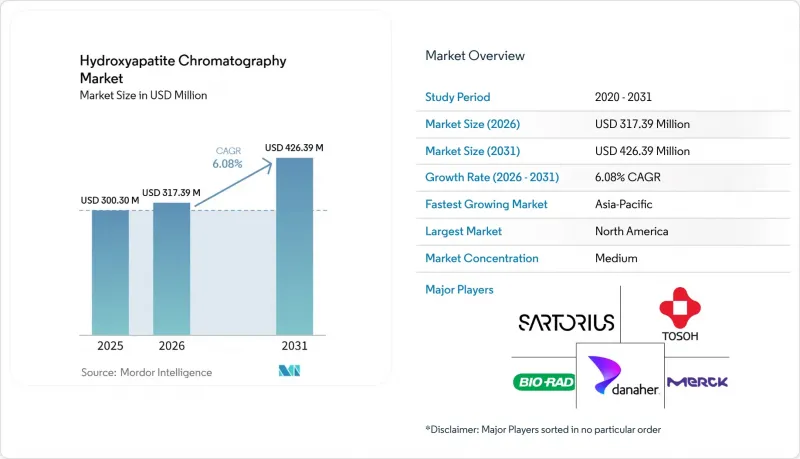
하이드록시아파타이트 크로마토그래피 시장은 2025년 3억 30만 달러로 평가되었습니다. 2026년에는 3억 1,739만 달러로 확대되어 2031년까지 4억 2,639만 달러에 이를 것으로 예상되고 2026년부터 2031년에 걸쳐 CAGR 6.08%로 성장할 전망입니다.
본 보고서는 제품 유형(고순도 하이드록시아파타이트 수지, 표준 하이드록시아파타이트 수지), 용도(단백질 정제, 핵산 분리, 기타), 최종 사용자(제약·생명공학 기업, 기타),및 지역(북미, 유럽, 아시아태평양, 중동 및 아프리카, 남미)별로 분류되어 있습니다. 시장 전망은 금액(달러) 기준으로 제시되어 있습니다.
세계의 하이드록시아파타이트 크로마토그래피 시장 동향 및 인사이트
바이오의약품 분야에서 고분해능 정제에 대한 수요 증가
하이드록시아파타이트 크로마토그래피 시장은 바이오의약품 파이프라인이 이중 특이성 항체, 융합 단백질, ADC 등 정제가 더 어려운 형태로 전환되고 있는 데서 혜택을 받고 있습니다. 이러한 제품의 경우, 다운스트림 공정에서 단순한 불순물 제거뿐만 아니라 유사한 물질을 분리해야 합니다. 세라믹 하이드록시아파타이트는 칼슘 친화성과 양이온 교환 거동을 모두 갖추고 있어, 이러한 상황에서 표준적인 단일 모드 정제 매체보다 더 넓은 선택성 범위를 실현할 수 있다는 점이 두드러집니다. 2025년에 발표된 동료 심사를 거친 연구에 따르면, 세라믹 하이드록시아파타이트를 이용한 정제를 통해 이중 특이성 항체의 순도는 최소 97%로 향상되었고, 고분자량 불순물은 0.5%까지 감소하여, 직접 비교 시 양이온 교환 크로마토그래피를 크게 능가하는 성능을 보였습니다. 제품의 구조가 점점 더 복잡해짐에 따라, 크로마토그래피로 인한 응집을 억제하면서 불순물의 선별성을 높이는 정제 매체의 가치는 공정 팀에게 있어 무시할 수 없는 요소가 되고 있습니다.
mAb, ADC 및 바이러스 벡터에서의 활용 확대
하이드록시아파타이트 크로마토그래피 시장은 항체 제품, 접합체, 재조합 단백질 및 핵산 관련 워크플로우에서의 활용 확대에 힘입어 성장하고 있으며, 이에 따라 수요는 단일 치료 형태에 국한되지 않고 확대되고 있습니다. 사용자가 제공한 초안에 따르면, 항체 부문은 2025년에 3,000억 달러를 넘어섰으며, 승인 건수가 1건 증가할 때마다 하이드록시아파타이트가 확립된 정제 단계로 기능하는 정제 플랫폼이 더욱 강화되는 추세입니다. ADC 제조에서는 소수성이 높고 과잉 결합으로 인해 응집체가 발생하기 쉬운 특성이 분리상의 과제가 되지만, 기존의 대체 수단으로는 종종 공동 용출되는 제품 관련 변이체를 구별할 수 있기 때문에 하이드록시아파타이트 매체는 이에 적합합니다. 이 같은 하이드록시아파타이트 크로마토그래피 시장은 재조합 단백질 및 유전자 치료제 제조 분야로도 확대되고 있습니다. 이는 하이드록시아파타이트가 단백질, DNA, 내독소를 동시에 결합시켜 일부 공정에서 필요한 다운스트림 공정의 수를 줄일 수 있기 때문입니다. 니켈 이온 치환 하이드록시아파타이트 매트릭스에 대한 연구 또한 재료 설계가 여전히 진화하고 있음을 보여주며, 향후 제품 주기에서는 현재의 항체 및 백신 정제 프로그램을 뛰어넘는 추가적인 이용 사례가 지원될 가능성이 있음을 시사합니다.
높은 비용과 범용 이온 교환 수지와의 비교
하이드록시아파타이트 크로마토그래피 시장은 여전히 비용 측면의 장벽에 직면해 있습니다. 이는 GMP 등급의 세라믹 하이드록시아파타이트가 상업적 구매 결정에 있어 표준 이온 교환 매체에 비해 여전히 뚜렷하게 비싸게 느껴지기 때문입니다. 이러한 가격 부담으로 인해 많은 제조업체는 초기 소모품 비용뿐만 아니라 기술적 필요성, 규제 준수, 또는 장기적인 공정 안정성 등의 관점에서 하이드록시아파타이트의 도입을 정당화해야 하는 상황에 처해 있습니다. 이러한 과제는 바이오시밀러나 대량 생산 현장에서 가장 두드러지게 나타납니다. 이러한 현장에서는 제조 원가가 항상 압박을 받고 있으며, 이미 승인된 공정에 하이드록시아파타이트가 포함되어 있지 않은 한, 저가 대체품이 종종 우선적으로 선택되는 경향이 있습니다. 한편, 중국 공급업체들은 더 저렴한 세라믹 하이드록시아파타이트 제품을 제공함으로써 가격 격차를 좁히고 있으며, 이는 기존 공급업체의 이익률을 압박하는 한편, 초기 단계의 프로젝트나 비용을 중시하는 CDMO 프로그램에서의 채택을 촉진하고 있습니다. 즉, 하이드록시아파타이트 크로마토그래피 시장이 정체되어 있는 것은 기술적 타당성의 부족 때문이 아니라, 불순물 요건이 그리 엄격하지 않은 경우에는 여전히 저렴한 매체가 우선시되는 구매 균형 때문인 것입니다.
부문별 분석
2025년, 고순도 하이드록시아파타이트 수지는 하이드록시아파타이트 크로마토그래피 시장 점유율의 57.23%를 차지했습니다. 이는 상업적 바이오의약품 제조가 여전히 문서화된 순도, 추적성 및 배치 대응 품질 시스템에 크게 의존하고 있음을 나타냅니다. 이 부문은 제품이 라이선싱 단계에 도달하면, 승인된 제조 공정에서 수지의 출처나 로트 수준의 품질 문서에 대한 불확실성이 거의 허용되지 않는다는 사실로부터 혜택을 받고 있습니다. 하이드록시아파타이트 크로마토그래피 시장에서 이러한 상황으로 인해 고순도 등급의 수지는 대체 위험이 높으며, 승인 신청을 통해 이미 공정 프레임워크가 확정된 후기 단계 및 상업적 생산 플랫폼과 밀접하게 연결되어 있습니다.
표준 하이드록시아파타이트 수지는 2031년까지 연평균 성장률(CAGR) 6.24%를 나타낼 것으로 예측되며, 이는 완전한 GMP 추적성이 반드시 동일한 수준으로 요구되지 않는 연구, 파일럿 및 초기 임상 프로그램에서의 채택이 확대될 것임을 시사합니다. 하이드록시아파타이트 크로마토그래피 시장의 이 분야는 진입 비용이 낮을 뿐만 아니라, 학술 연구소, 소규모 개발 기업, 지역 제조업체들 사이에서 프리미엄 등급으로 전환하기 전에 새로운 워크플로우에서 하이드록시아파타이트를 시험적으로 사용하려는 의지가 높아지고 있는 것이 뒷받침되고 있습니다. 기공 구조 및 처리 능력 프로파일에 걸쳐 제품 라인업이 확대됨에 따라, 하이드록시아파타이트 크로마토그래피 시장의 구매자들은 프로그램 단계, 규제 부담, 비용 제약에 맞추어 등급을 선택할 수 있는 자유도가 높아지고 있습니다.
지역별 분석
2025년, 북미는 하이드록시아파타이트 크로마토그래피 시장 규모의 49.13%를 차지하며, 도입 수요 면에서 다른 지역을 크게 앞질렀습니다. 이 지역의 우위는 미국이 바이오의약품의 주요 승인 및 상업 생산 중심지로서의 역할과 밀접한 관련이 있으며, 미국에서는 정제의 일관성과 불순물 관리가 규제상 직접적인 중요성을 띠고 있습니다. USP 일반 장 <1132.1>에서는 숙주 세포 단백질의 상세한 측정이 강조되면서 심사가 더욱 엄격해졌습니다. 이에 따라 불순물 제거 성능이 뛰어난 정제 공정에 대한 수요가 증가하고 있습니다. 캐나다와 멕시코의 기여도는 작지만, 연구 프로그램, 수탁 제조 활동, 그리고 더 광범위한 북미 바이오의약품 공급 기반과의 연계를 통해 지역 수요를 뒷받침하고 있습니다.
유럽은 독일, 영국, 프랑스 등 여러 국가에 확립된 바이오의약품 제조거점을 바탕으로, 하이드록시아파타이트 크로마토그래피 시장에서 여전히 2위를 차지하는 지역 블록입니다. 이 지역 수요는 승인된 바이오의약품 생산, 꾸준한 바이오시밀러 파이프라인, 그리고 상업 생산 및 임상 생산 환경 모두에서 진행 중인 지속적인 공정 개발 작업에 의해 뒷받침되고 있습니다. 유럽의 하이드록시아파타이트 크로마토그래피 시장은 오랜 기간 이어져 온 크로마토그래피 문화의 혜택도 받고 있습니다. 이 지역에서는 불순물 프로파일이 추가 비용을 정당화하는 경우, 구매자들이 특수 정제 공정에 익숙합니다. 유럽의 기타 지역, 중동, 아프리카 및 남미 수요는 절대적인 규모로는 여전히 제한적이지만, 각국의 바이오의약품 제조 능력 확대에 따라 수요는 계속 증가하고 있습니다.
아시아태평양은 2031년까지 연평균 성장률(CAGR) 8.06%를 나타낼 것으로 예측되며, 하이드록시아파타이트 크로마토그래피 시장에서 가장 빠르게 성장하는 지역이 될 것입니다. 중국이 주요 견인차 역할을 하고 있으며, 상하이 및 양쯔강 삼각주 지역에서는 바이오의약품 제조거점이 지속적으로 강화되고 있습니다. 또한, 2026년 5월 우시 바이오로직스(WuXi Biologics)의 제18호 의약품 제조 시설이 GMP 인증을 획득한 것은 이러한 성장세를 더욱 뒷받침할 것입니다. 공급 측면에서 일본은 여전히 중요한 위치를 차지하고 있습니다. 이는 HOYA사의 세라믹 하이드록시아파타이트 매체가 항체 및 백신 정제 분야에서 오랫동안 중요한 역할을 수행해 왔으며, 이로 인해 해당 지역에 수요와 기술 양면에서의 중요성을 부여하고 있기 때문입니다. 한국과 호주는 바이오시밀러, mRNA 및 첨단 바이오의약품 분야에서의 활동을 통해 규모는 작지만 수요가 확대되고 있으며, 이로 인해 하이드록시아파타이트 크로마토그래피 시장의 지역적 기반이 단일 국가나 지역 그룹에 국한되지 않는 형태로 확대되고 있습니다.
기타 혜택 :
- 엑셀 형식 시장 예측(ME) 시트
- 3개월간의 애널리스트 지원
자주 묻는 질문
목차
제1장 서론
제2장 조사 방법
제3장 개요
제4장 시장 구도
제5장 시장 규모 및 성장 예측
제6장 경쟁 구도
제7장 시장 기회 및 향후 전망
KTH 26.09.02According to Mordor Intelligence, the hydroxyapatite chromatography market is expected to increase from USD 300.30 million in 2025 to USD 317.39 million in 2026 and reach USD 426.39 million by 2031, growing at a CAGR of 6.08% over 2026-2031.
This report is Segmented by Product Type (High-Purity Hydroxyapatite Resin, Standard Hydroxyapatite Resin), Application (Protein Purification, Nucleic Acid Isolation, and Others), End-User (Pharmaceutical and Biotechnology Companies, and Others), and Geography (North America, Europe, Asia-Pacific, Middle East and Africa, South America). The Market Forecasts are Provided in Terms of Value (USD).
Global Hydroxyapatite Chromatography Market Trends and Insights
Rising Demand for High-Resolution Polishing in Biologics
The hydroxyapatite chromatography market is benefiting from a shift in biologics pipelines toward harder-to-purify formats, including bispecific antibodies, fusion proteins, and ADCs, where downstream steps must separate closely related species rather than only remove bulk contaminants. Ceramic hydroxyapatite stands apart because it combines calcium affinity and cation exchange behavior, which gives it a broader selectivity range than standard single-mode polishing media in these settings. A 2025 peer-reviewed study showed that ceramic hydroxyapatite polishing lifted bispecific antibody purity to at least 97% and cut high-molecular-weight impurities to 0.5%, which materially outperformed cation exchange chromatography in direct comparison.As product structures become more complex, the value of a polishing medium that suppresses chromatography-induced aggregation while improving impurity discrimination becomes harder for process teams to ignore.
Expanding Use in mAbs, ADCs, and Viral Vectors
The hydroxyapatite chromatography market is also being supported by wider use across antibody products, conjugates, recombinant proteins, and nucleic acid-related workflows, which broadens demand beyond one therapeutic format. The user-supplied draft notes that the antibody segment exceeded USD 300 billion in 2025, and each additional approval tends to reinforce purification platforms where hydroxyapatite can serve as an established polishing step. In ADC production, higher hydrophobicity and a greater tendency toward over-conjugated aggregates create a separation problem that fits hydroxyapatite media well because they can discriminate among product-related variants that often co-elute on conventional alternatives. The same hydroxyapatite chromatography market is extending into recombinant protein and gene therapy manufacturing because hydroxyapatite can bind protein, DNA, and endotoxin together and reduce the number of downstream steps required in some processes. Work on nickel-ion substituted hydroxyapatite matrices also shows that material design is still evolving, which suggests future product cycles may support additional use cases beyond current antibody and vaccine purification programs.
Higher Cost Versus Commodity Ion Exchange Resins
The hydroxyapatite chromatography market continues to face a cost hurdle because GMP-grade ceramic hydroxyapatite still carries a clear premium over standard ion exchange media in commercial buying decisions. That premium forces many manufacturers to justify hydroxyapatite on technical need, regulatory fit, or long-term process stability rather than on initial consumables cost alone. The challenge is most visible in biosimilar and large-volume production settings, where cost of goods remains under constant pressure and lower-priced alternatives are often preferred unless hydroxyapatite is already embedded in a filed process. At the same time, Chinese suppliers are narrowing the gap by offering lower-priced ceramic hydroxyapatite products, which supports adoption in early-phase and cost-sensitive CDMO programs even if it also compresses margins for incumbent suppliers. This means the hydroxyapatite chromatography market is not being held back by lack of technical relevance, but by a purchasing equation that still rewards cheaper media when impurity demands are less severe.
Other drivers and restraints analyzed in the detailed report include:
- Increased Need for Aggregates, HCP, and Endotoxin Removal
- Rising Outsourcing of Purification to CDMOs and Specialized Suppliers
- Cleaning and Validation Sensitivity in Regulated Manufacturing
For complete list of drivers and restraints, kindly check the Table Of Contents.
Segment Analysis
High-purity hydroxyapatite resin accounted for 57.23% of the hydroxyapatite chromatography market share in 2025, which shows how strongly commercial biologics manufacturing still depends on documented purity, traceability, and batch-ready quality systems. This segment benefits from the fact that approved manufacturing processes rarely tolerate uncertainty around resin provenance or lot-level quality documentation once a product reaches licensed production. In the hydroxyapatite chromatography market, this keeps high-purity grades closely tied to late-stage and commercial platforms where substitution risk is high and approval filings have already fixed the process framework.
Standard hydroxyapatite resin is expected to grow at a 6.24% CAGR through 2031, which points to stronger uptake in research, pilot, and early clinical programs where full GMP traceability is not always required at the same level. This part of the hydroxyapatite chromatography market is helped by lower entry cost and by a broader willingness among academic labs, smaller developers, and regional manufacturers to test hydroxyapatite in new workflows before moving to premium grades. As the product range expands across pore structures and throughput profiles, buyers in the hydroxyapatite chromatography market gain more freedom to match grade selection with program stage, regulatory burden, and cost limits.
Complete Report Scope:
- By Product Type
- High-Purity Hydroxyapatite Resin
- Standard Hydroxyapatite Resin
- By Application
- Protein Purification
- Nucleic Acid Isolation
- Vaccine Production
- Biotherapeutic Polishing
- Chromatography and Filtration
- Other Applications
- By End-User
- Pharmaceutical and Biotechnology Companies
- Contract Development and Manufacturing Organizations
- Research Institutes and Universities
- By Geography
- North America
- United States
- Canada
- Mexico
- Europe
- Germany
- United Kingdom
- France
- Italy
- Spain
- Rest of Europe
- Asia-Pacific
- China
- Japan
- India
- Australia
- South Korea
- Rest of Asia-Pacific
- Middle East and Africa
- GCC
- South Africa
- Rest of Middle East and Africa
- South America
- Brazil
- Argentina
- Rest of South America
- North America
Geography Analysis
North America accounted for 49.13% of the hydroxyapatite chromatography market size in 2025, which kept it well ahead of other regions in installed demand. The region's lead is tied to the United States' role as the main approval and commercial manufacturing center for biologics, where purification consistency and impurity control carry direct regulatory weight. USP General Chapter <1132.1> added another layer of scrutiny by emphasizing detailed host cell protein measurement, which supports demand for polishing steps that can show strong impurity clearance performance. Canada and Mexico contribute smaller volumes, but they still add to regional demand through research programs, contract manufacturing activity, and links to the broader North American biologics supply base.
Europe remained the second-largest regional block in the hydroxyapatite chromatography market, supported by an established biologics manufacturing base in countries such as Germany, the United Kingdom, and France. Demand in the region is supported by licensed biologics production, a steady biosimilar pipeline, and continued process development work across both commercial and clinical manufacturing environments. The hydroxyapatite chromatography market in Europe also benefits from a long-standing chromatography culture, where buyers are familiar with specialized polishing steps when impurity profiles justify the added cost. Smaller demand pools across the rest of Europe, the Middle East and Africa, and South America remain limited in absolute terms, yet they continue to expand as domestic biologics capabilities widen.
Asia-Pacific is projected to grow at an 8.06% CAGR through 2031, which makes it the fastest-growing geography in the hydroxyapatite chromatography market. China is the main driver, with the Shanghai and Yangtze River Delta corridors continuing to add biologics manufacturing depth, and WuXi Biologics' 18th drug product facility reaching GMP release in May 2026 reinforced that momentum. Japan remains important on the supply side because HOYA's ceramic hydroxyapatite media has a long role in antibody and vaccine purification, which gives the region both demand and technology relevance. South Korea and Australia add smaller but rising demand through biosimilar, mRNA, and advanced biologics activity, which helps broaden the regional base of the hydroxyapatite chromatography market beyond one country cluster.
- Bio-Link Co., Ltd.
- Bio-Rad Laboratories
- Cerdia International GmbH
- Clarkson Chromatography Products, Inc.
- Danaher
- Duoning Biotechnology
- LT Biotech
- Merck
- NanoMicro Technology Co., Ltd.
- Pall
- Pinshan Biotechnology (Shanghai) Co., Ltd.
- Repligen
- Sartorius
- Thermo Fisher Scientific
- Tosoh
- Truking Technology Limited
- Welch Materials, Inc.
Additional Benefits:
- The market estimate (ME) sheet in Excel format
- 3 months of analyst support
TABLE OF CONTENTS
1 Introduction
- 1.1 Study Assumptions and Market Definition
- 1.2 Scope of the Study
2 Research Methodology
3 Executive Summary
4 Market Landscape
- 4.1 Market Overview
- 4.2 Market Drivers
- 4.2.1 Rising Demand for High-Resolution Polishing in Biologics
- 4.2.2 Expanding Use in mAbs, ADCs, and Viral Vectors
- 4.2.3 Shift Toward Single-Use and GMP-Ready Downstream Workflows
- 4.2.4 Increased Need for Aggregates, HCP, and Endotoxin Removal
- 4.2.5 Rising Outsourcing of Purification to CDMOs and Specialized Suppliers
- 4.2.6 Adoption of Hydroxyapatite as a High-Selectivity Alternative to Conventional Resins
- 4.3 Market Restraints
- 4.3.1 Higher Cost Versus Commodity Ion Exchange Resins
- 4.3.2 Narrower Process Familiarity Among End Users
- 4.3.3 Limited Supply Base for High-Grade Ceramic Media
- 4.3.4 Cleaning and Validation Sensitivity in Regulated Manufacturing
- 4.4 Supply/Value Chain Analysis
- 4.5 Regulatory Landscape
- 4.6 Technological Outlook
- 4.7 Porter's Five Forces Analysis
- 4.7.1 Threat of New Entrants
- 4.7.2 Bargaining Power of Suppliers
- 4.7.3 Bargaining Power of Buyers
- 4.7.4 Threat of Substitutes
- 4.7.5 Competitive Rivalry
5 Market Size & Growth Forecasts (Value, USD)
- 5.1 By Product Type
- 5.1.1 High-Purity Hydroxyapatite Resin
- 5.1.2 Standard Hydroxyapatite Resin
- 5.2 By Application
- 5.2.1 Protein Purification
- 5.2.2 Nucleic Acid Isolation
- 5.2.3 Vaccine Production
- 5.2.4 Biotherapeutic Polishing
- 5.2.5 Chromatography and Filtration
- 5.2.6 Other Applications
- 5.3 By End-User
- 5.3.1 Pharmaceutical and Biotechnology Companies
- 5.3.2 Contract Development and Manufacturing Organizations
- 5.3.3 Research Institutes and Universities
- 5.4 By Geography
- 5.4.1 North America
- 5.4.1.1 United States
- 5.4.1.2 Canada
- 5.4.1.3 Mexico
- 5.4.2 Europe
- 5.4.2.1 Germany
- 5.4.2.2 United Kingdom
- 5.4.2.3 France
- 5.4.2.4 Italy
- 5.4.2.5 Spain
- 5.4.2.6 Rest of Europe
- 5.4.3 Asia-Pacific
- 5.4.3.1 China
- 5.4.3.2 Japan
- 5.4.3.3 India
- 5.4.3.4 Australia
- 5.4.3.5 South Korea
- 5.4.3.6 Rest of Asia-Pacific
- 5.4.4 Middle East and Africa
- 5.4.4.1 GCC
- 5.4.4.2 South Africa
- 5.4.4.3 Rest of Middle East and Africa
- 5.4.5 South America
- 5.4.5.1 Brazil
- 5.4.5.2 Argentina
- 5.4.5.3 Rest of South America
- 5.4.1 North America
6 Competitive Landscape
- 6.1 Market Concentration
- 6.2 Market Share Analysis
- 6.3 Company Profiles (includes Global level Overview, Market level overview, Core Segments, Financials as available, Strategic Information, Market Rank/Share for key companies, Products & Services, Recent Developments)
- 6.3.1 Bio-Link Co., Ltd.
- 6.3.2 Bio-Rad Laboratories, Inc.
- 6.3.3 Cerdia International GmbH
- 6.3.4 Clarkson Chromatography Products, Inc.
- 6.3.5 Danaher Corporation
- 6.3.6 Duoning Biotechnology
- 6.3.7 LT Biotech
- 6.3.8 Merck KGaA
- 6.3.9 NanoMicro Technology Co., Ltd.
- 6.3.10 Pall Corporation
- 6.3.11 Pinshan Biotechnology (Shanghai) Co., Ltd.
- 6.3.12 Repligen Corporation
- 6.3.13 Sartorius AG
- 6.3.14 Thermo Fisher Scientific Inc.
- 6.3.15 Tosoh Corporation
- 6.3.16 Truking Technology Limited
- 6.3.17 Welch Materials, Inc.
7 Market Opportunities & Future Outlook
- 7.1 White-space & Unmet-need Assessment


