

|
시장보고서
상품코드
2117551
단백질 마이크로어레이 : 시장 점유율 분석, 업계 동향 및 통계, 성장 예측(2026-2031년)Protein Microarray - Market Share Analysis, Industry Trends & Statistics, Growth Forecasts (2026 - 2031) |
||||||
 Mordor Intelligence
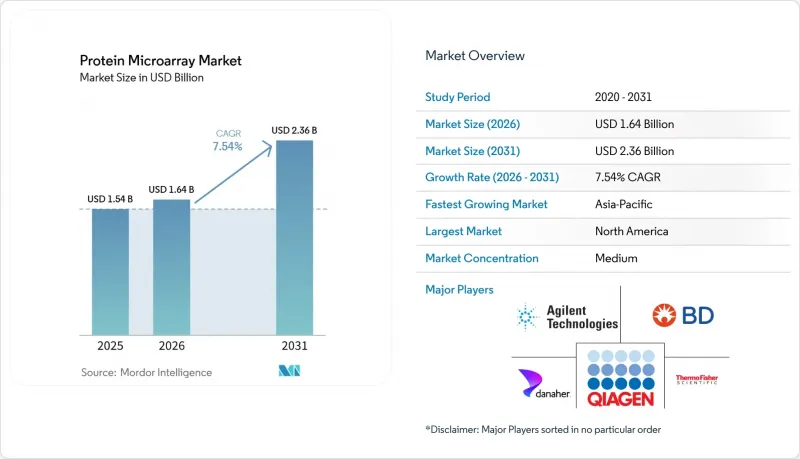
Mordor Intelligence에 의하면, 단백질 마이크로어레이 시장 규모는 2025년 15억 4,000만 달러로 평가되었습니다. 2026년 16억 4,000만 달러에서 2031년까지 23억 6,000만 달러로 확대되며 2026년부터 2031년까지 연평균 성장률(CAGR)은 7.54%를 나타낼 전망입니다.
본 보고서는 제공 분야(제품, 서비스), 유형(바이오칩, 마이크로어레이 장비), 기술(분석용, 기능성, 역상 마이크로어레이), 용도(임상 진단, 신약 개발, 단백질체학 연구), 최종 사용자(바이오의약품 기업 등), 지역(북미, 유럽,아시아태평양 등)별로 분류되어 있습니다. 시장 전망은 금액(달러) 기준으로 제시되어 있습니다.
세계의 단백질 마이크로어레이 시장 동향 및 인사이트
멀티플렉스 바이오마커 발견 워크플로우의 확대
단백질 마이크로어레이 시장은 단일 분석 대상 검사에서 하나의 워크플로우 내에서 다수의 표적을 평가할 수 있는 멀티플렉스 패널 형식으로의 전환에 힘입어 성장하고 있습니다. AliveDx는 2025년 4월, 자사의 ‘MosaiQ AiPlex CTDplus’ 멀티플렉스 마이크로어레이에 대해 FDA 510(k) 신청을 제출했습니다. 이 패널은 시간당 1,275개의 질환 마커를 처리하면서 15개의 자가항체 마커를 검출하도록 설계되어 있으며, 이는 증후군 검사가 규제 대상 영역으로 이동하고 있음을 보여줍니다. 이러한 변화가 중요한 이유는 자가면역 질환 및 기타 복잡한 질환에서 순차적 검사의 필요성을 줄이고, 기존에는 시간이 오래 걸리고 반복적이었던 진단 과정을 단축할 수 있기 때문입니다. 『Frontiers in Microbiology』지에 게재된 2025년 연구에 따르면, 49종의 항체를 사용한 멀티플렉스 단백질 마이크로어레이가 카르바페네마제 내성 검사에서 기존의 ELISA보다 우수한 교차반응성 식별 능력을 보였음이 밝혀졌으며, 임상적으로 민감한 상황에서 멀티플렉스 단백질 스크리닝의 가치를 입증하고 있습니다. 이러한 워크플로우가 보급됨에 따라, 높은 검체 처리 능력과 밀접하게 관련된 단백질 표적 간의 우수한 판별 능력이 요구되는 환경에서 단백질 마이크로어레이 시장의 중요성은 더욱 커지고 있습니다. 또한, 유럽의 IVDR이나 FDA의 510(k)와 같은 규제 경로도 상용 패널의 설계에 영향을 미치고 있습니다. 이는 공급업체들이 현재 분석법의 폭넓은 적용 범위와 재현성 있는 검증을 모두 지원할 수 있는 확장 가능한 형식을 필요로 하고 있기 때문입니다.
정밀 종양학 및 면역 프로파일링 분야에서의 활용 확대
단백질 마이크로어레이 시장은 유전체 분석 결과와 단백질 수준의 질환 양상 사이의 가교가 필요한 정밀 종양학 프로그램으로부터 지지를 얻고 있습니다. 일루미나(Illumina)는 2025년 9월에 ‘Protein Prep’을 출시했습니다. 이 분석법은 표준 NGS 플랫폼에서 SOMAmer 기술을 활용하여 9,500종의 고유한 인간 단백질을 검출하도록 설계되었으며, 단백질체학 측정 결과가 단독 실험으로 취급되는 것이 아니라 보다 광범위한 멀티오믹스 프로그램에 통합되고 있음을 보여줍니다. 2025년 11월까지 전 세계 16개 거점에 위치한 40개 이상의 고객사가 암, 심혈관 및 대사 질환, 면역 관련 응용 분야에서 ‘Protein Prep’을 사용하여 4만 건 이상의 샘플을 처리했으며, 이는 연구 기관과 대규모 바이오뱅크 양쪽 모두에서 수요가 확대되고 있음을 보여줍니다. 2025년 『Clinical and Experimental Medicine』지에 게재된 연구에서는 마이크로어레이를 이용한 자가항체 프로파일링과 면역관문억제제의 독성 예측 간의 연관성이 제시되었으며, 면역 관련 이상반응과 관련된 9가지 자가항체 시그니처가 확인되었습니다. 이를 통해 이러한 마이크로어레이의 유용성은 면역요법 의사결정 지원 분야로 확대되고 있습니다. 이에 따라 단백질 마이크로어레이 시장은 동반 진단 개발로 한 걸음 더 다가서고 있습니다. 단백질 프로파일링이 치료법 선택 및 독성 스크리닝을 지원함으로써 그 상업적 가치는 더욱 높아집니다. 또한 이는 임상 검증 프로세스가 확립된 공급업체가 탐색적 발견 작업에만 집중하는 벤더보다 더 많은 시장 점유율을 확보할 가능성이 있음을 의미합니다.
분석법의 복잡성과 전문 운영자의 필요성
단백질 마이크로어레이 시장은 여전히 실질적인 도입 장벽에 직면해 있습니다. 그 이유는 이러한 워크플로가 많은 유사한 면역측정법보다 더 높은 수준의 기술적 숙련도를 요구하기 때문입니다. 표면 차단, 단백질 도포, 혼성화 관리, 형광 정규화와 같은 전처리 공정은 표준 ELISA나 래터럴 플로우 법에 비해 실패 요인이 될 수 있는 부분이 많습니다. 이는 단순한 훈련의 문제로만 그치지 않습니다. 왜냐하면 실험이 결과 판독 단계에 도달하기도 전에 단백질의 입체 구조나 검체 취급 조건이 분석의 품질에 영향을 미칠 가능성이 있기 때문입니다. 그 결과, 병원 검사실에서의 활용은 보다 견고한 품질 관리 체제와 전담 인력을 갖춘 핵심 시설이나 전문적인 환경으로 제한되어 있습니다. 바로 이러한 압박이 단백질 마이크로어레이 시장의 서비스 제공업체들을 뒷받침하고 있습니다. 아웃소싱 모델을 통해 고객은 사내에 완전한 기술 팀을 구축하지 않고도 이 워크플로우를 활용할 수 있기 때문입니다. 또한, 임상 등급 제품 제조에는 ISO 13485 품질 관리 요건에 따른 추가적인 규정 준수 부담이 수반되므로, 소규모 제조업체나 복잡한 워크플로우를 사내에 도입하려는 검사실의 경우 시장 진입 장벽이 높아지고 있습니다.
부문별 분석
2025년, 제품은 단백질 마이크로어레이 시장의 64.78%를 차지했으며, 이 카테고리는 소모품, 어레이 칩, 시약 키트, 표면 화학 처리와 같은 분야 전반에 걸쳐 여전히 주요 수익원입니다. 각 실험은 여전히 물리적 투입물에 의존하고 있기 때문에 고객이 아웃소싱 모델을 선택하더라도 지속적인 제품 수요는 분석 수행량과 밀접하게 연결되어 있습니다. 칩과 시약의 안정적인 소비 없이는 서비스를 확대할 수 없기 때문에 제품 카테고리는 단백질 마이크로어레이 시장의 중심적인 위치를 계속 차지하고 있습니다. 또한, 이미 도입된 워크플로에서는 반복적으로 수행되는 시험 및 검증 작업에서 동일한 소모품이 계속 사용되므로 교체 수요도 뒷받침하고 있습니다. 따라서 관련 비즈니스 모델이 변화하더라도 제품은 여전히 상업적 기반이 될 것입니다. 지속적인 소모품 사용이 모든 연구 및 임상시험의 기반으로 남아 있기 때문에 제품 관련 단백질 마이크로어레이 시장 규모는 2025년에도 최대 규모를 유지했습니다.
서비스 부문은 2031년까지 연평균 성장률(CAGR) 8.53%를 나타낼 것으로 예측되며, 이는 시장 전체보다 빠른 속도입니다. 이러한 성장은 특히 임상 및 제약 분야의 사용자가 대규모 사내 체계를 구축하지 않고도 분석 지원, 생물정보학 및 문서화를 요구할 때, 관리된 결과를 선호하는 고객의 경향을 반영합니다. 또한, 서비스 계약은 공급업체와의 관계를 심화시키는 결과로 이어집니다. 이는 연구소가 일단 공급업체의 결과 해석 워크플로우에 통합되면, 공급업체를 변경하는 것이 더 어렵고 시간이 많이 걸리기 때문입니다. 이로 인해 전환 비용이 증가하며, 서비스에 중점을 두는 기업에게는 일회성 제품 판매만 하는 경우보다 지속 가능한 수익원이 제공됩니다. 따라서 단백질 마이크로어레이 업계에서는 제품이 여전히 규모 면에서 주도적인 역할을 하고 있지만, 워크플로우의 복잡성에 따른 부가가치의 더 큰 부분을 서비스가 차지하는 추세가 나타나고 있습니다. 그 결과, 단백질 마이크로어레이 시장 전체에 걸쳐 보다 통합된 구조가 형성되고 있으며, 주요 공급업체는 소모품과 분석, 검증 지원, 규제 준수 문서화를 결합할 수 있다면 더 유리한 입지를 확보할 수 있습니다.
2025년 시점에서 바이오칩은 단백질 마이크로어레이 시장의 57.32%를 차지했으며, 2031년까지 연평균 성장률(CAGR) 8.07%를 나타낼 것으로 예측됩니다. 이에 따라 바이오칩은 가장 규모가 크고 성장 속도가 가장 빠른 유형 카테고리가 되었습니다. 이러한 추세는 주목할 만합니다. 왜냐하면 성숙한 플랫폼 시장에서는 대개 도입 실적이 가장 많은 포맷에서 주도권이 이동하는 경향이 있지만, 이 시장에서는 바이오칩이 여전히 새로운 수요를 확보하고 있기 때문입니다. 그 이유는 바이오칩 아키텍처의 표준화가 포맷을 특정 틈새 분야에 국한시키지 않고, 임상 및 연구용 이용 사례를 모두 뒷받침하고 있기 때문입니다. 진단용 랩온칩의 다양한 형태는 시료에서 결과까지의 처리가 밀폐된 환경에서 이루어져 오염 위험이 낮다는 장점을 활용할 수 있는 워크플로우에서 점점 더 주목을 받고 있습니다. 분석용 랩온어칩 형식은 단백질체학 연구나 신약 개발 작업에서 더 폭넓은 유연성을 필요로 하는 사용자들 사이에서 여전히 중요한 위치를 차지하고 있습니다. 따라서 바이오칩은 규모, 사용 편의성, 그리고 광범위한 분석 설계와의 호환성을 모두 갖추고 있어 단백질 마이크로어레이 시장의 중심에 자리 잡고 있습니다.
마이크로어레이 장비는 칩 기반 분석의 스캔, 처리 및 대규모 실행을 위한 하드웨어 기반을 제공하므로 여전히 필수적인 존재입니다. 통합 시스템은 무인 운전과 대규모 샘플 배치 전반에 걸친 보다 엄격한 운영 관리를 요구하는 고처리량 시설에서 특히 중요합니다. 어레이어는 맞춤형 콘텐츠 인쇄에 있어 여전히 중요하며, 특히 독자적인 패널이나 질환 특이적 패널을 구축하는 학술 사용자 및 수탁 연구 그룹에게 중요합니다. 바이오칩이 차지하는 단백질 마이크로어레이 시장 점유율은 장비 수요가 칩의 채택을 주도하는 것이 아니라, 그에 뒤따르고 있음을 보여줍니다. 2026년 『Nature Communications』에 게재된 금 나노입자로 패턴화된 플라즈모닉 칩에 관한 연구에서는 단백질 검출 시 형광 증강이 현저하게 확인되었으며, 어레이 제작 시 액적 포집이 용이해졌음이 밝혀졌습니다. 이는 칩 표면 수준에서의 지속적인 혁신이 중요함을 뒷받침합니다. 즉, 플랫폼 아키텍처 전체가 표준화되어 가는 가운데서도, 단백질 마이크로어레이 시장의 기술적 다양성은 칩 설계의 개선을 통해 여전히 진화하고 있습니다.
지역별 분석
2025년, 북미는 단백질 마이크로어레이 시장의 44.61%를 차지하며 지역별 시장 1위를 유지했습니다. 이러한 1위 위상은 미국 전역에 바이오의약품 기업, 연방 정부의 지원을 받는 연구 기관, 그리고 규제 대상인 임상 검사 인프라가 밀집해 있음을 반영합니다. 이 지역은 어레이,스캐너, 바이오인포매틱스 플랫폼 개발 기업을 보유하고 있을 뿐만 아니라, 진단 및 신약 개발 분야 수요도 뒷받침하고 있어 업스트림 및 하류 양면에서 혜택을 받고 있습니다. 유럽은 독일, 영국, 프랑스의 강력한 단백질체학 연구 역량을 바탕으로 2위를 차지했습니다. 유럽의 IVDR(체외진단용 의료기기 규정) 체계는 검사실에 대해 검증되고 표준화된 멀티플렉스 단백질 플랫폼의 채택을 지속적으로 추진하고 있으며, 이는 보다 강력한 분석 문서와 명확한 임상적 포지셔닝을 갖춘 공급업체에게 유리하게 작용하고 있습니다. AliveDx사는 2025년 2월, 자사의 ‘MosaiQ AiPlex CTDplus’ 패널에 대해 IVDR-CE 마크를 획득했는데, 이는 유럽에서 규제 준수가 단순한 선택적 이점이 아니라 시장 진입의 기본 조건이 되었음을 보여줍니다.
아시아태평양은 2031년까지 연평균 성장률(CAGR) 9.26%를 나타낼 것으로 예측되며, 단백질 마이크로어레이 시장에서 가장 빠르게 성장하는 지역 블록이 되고 있습니다. 이러한 성장을 주도하고 있는 것은 중국, 일본, 한국, 인도, 호주이며, 이들 국가에서는 밸류체인의 여러 분야에서 연구 역량, 생명공학 활동, 제조의 깊이가 확대되고 있습니다. 중국은 자동화된 단백질 시스템, 생물정보학 역량 및 현지 생산 규모에 대한 투자를 확대하고 있으며, 그 역할이 수입 수요에서 더욱 강력한 국내 플랫폼 개발로 전환되고 있기 때문에 특히 중요한 위치를 차지하고 있습니다. 인도는 분석 및 신약 개발 업무의 아웃소싱을 지원하는 지속적으로 성장하는 수탁 연구 생태계를 통해 기여하고 있습니다. 한국은 첨단 바이오칩 및 전자기기 연동 부품에 대한 제조 역량을 제공하고 있으며, 일본은 정밀 기기 역량과 강력한 학술적 단백질체학 기반을 더하고 있습니다. 따라서 단백질 마이크로어레이 시장은 연구 및 공급 측면의 역량 확대를 통해 아시아태평양에서 성장세를 보이고 있습니다.
중동, 아프리카 및 남미는 절대적인 규모 면에서는 여전히 작지만, 단백질 마이크로어레이 시장의 지역적 확장에 있어 다음 단계에서 전략적으로 중요한 위치를 차지하고 있습니다. GCC 국가들, 특히 사우디아라비아와 아랍에미리트는 검증된 단백질 프로파일링 도구에 대한 미래 수요를 창출할 수 있는 유전체학 및 단백질체학 프로그램에 투자하고 있습니다. 남아프리카공화국은 감염병 및 연구 관련 응용 분야에서 지역의 핵심 역할을 담당하고 있습니다. 남미에서는 브라질과 아르헨티나가 가장 발전된 생명공학 연구 생태계를 보유하고 있지만, 보험 환급 제한 및 의료 인프라의 불균형으로 인해 임상 현장에서의 보급은 여전히 더딘 임베디드니다. 이러한 상황은 단기적으로는 대규모 직접적인 상업 인프라 구축보다는 파트너십 주도형이나 서비스 기반 시장 진입 모델을 뒷받침하고 있습니다. 이러한 경향은 단백질 마이크로어레이 시장 전체에도 적용됩니다. 해당 시장에서는 사내 운영 역량이 아직 충분히 확립되지 않은 지역에서 외부 위탁을 통한 지원이 종종 먼저 확대되는 경향이 있습니다.
기타 혜택 :
- 엑셀 형식 시장 예측(ME) 시트
- 3개월간의 애널리스트 지원
자주 묻는 질문
목차
제1장 서론
제2장 조사 방법
제3장 개요
제4장 시장 구도
제5장 시장 규모 및 성장 예측
제6장 경쟁 구도
제7장 시장 기회 및 향후 전망
제1장 서론
제2장 조사 방법
제3장 개요
제4장 시장 구도
제5장 시장 규모 및 성장 예측
제6장 경쟁 구도
제7장 시장 기회 및 향후 전망
KTH 26.09.02According to Mordor Intelligence, the protein microarray market size is projected to expand from USD 1.54 billion in 2025 and USD 1.64 billion in 2026 to USD 2.36 billion by 2031, registering a CAGR of 7.54% between 2026 to 2031.
This report is Segmented by Offering (Products, Services), Type (Biochips, Microarray Instruments), Technology (Analytical, Functional, Reverse Phase Microarrays), Application (Clinical Diagnostics, Drug Discovery, Proteomics Research), End User (Biopharmaceutical Companies, and More), and Geography (North America, Europe, Asia-Pacific, and More). The Market Forecasts are Provided in Terms of Value (USD).
Global Protein Microarray Market Trends and Insights
Expanding Multiplex Biomarker Discovery Workflows
The protein microarray market is benefiting from a shift away from single-analyte testing toward multiplex panel formats that allow many targets to be assessed within one workflow. AliveDx submitted an FDA 510(k) application in April 2025 for its MosaiQ AiPlex CTDplus multiplex microarray, and the panel was designed to detect 15 autoantibody markers while processing 1,275 disease markers per hour, which shows how syndromic testing is moving into regulated settings. This shift matters because it reduces the need for sequential testing in autoimmune and other complex diseases, and that can shorten diagnostic pathways that were previously slow and repetitive. A 2025 study in Frontiers in Microbiology showed that a 49-antibody multiplex protein microarray delivered stronger cross-reactivity discrimination than conventional ELISA in carbapenemase resistance testing, which supports the value of multiplex protein screening in clinically sensitive settings. As these workflows spread, the protein microarray market is becoming more relevant in settings that need high sample throughput and better differentiation across closely related protein targets. Regulatory pathways such as European IVDR and FDA 510(k) are also shaping commercial panel design, because vendors now need scalable formats that can support both assay breadth and repeatable validation.
Rising Use in Precision Oncology and Immune Profiling
The protein microarray market is gaining support from precision oncology programs that need a bridge between genomic findings and protein-level disease behavior. Illumina launched Protein Prep in September 2025, and the assay was designed to detect 9,500 unique human proteins using SOMAmer technology on standard NGS platforms, which shows that proteomic readouts are being folded into broader multiomics programs rather than treated as stand-alone experiments. By November 2025, more than 40 customers across 16 global sites had processed over 40,000 samples with Protein Prep in cancer, cardiometabolic, and immune-related applications, which points to scaling demand from both research organizations and large biobank settings. A 2025 study in Clinical and Experimental Medicine linked microarray-based autoantibody profiling to the prediction of immune checkpoint inhibitor toxicity and identified 9 autoantibody signatures associated with immune-related adverse events, which extends the relevance of these arrays into immunotherapy decision support. This is moving the protein microarray market closer to companion diagnostic development, where commercial value rises when protein profiling supports treatment selection or toxicity screening. It also means suppliers with stronger clinical validation pathways may gain more share than vendors focused only on exploratory discovery work.
High Assay Complexity and Specialized Operator Requirements
The protein microarray market still faces a real adoption barrier because these workflows demand more technical skill than many comparable immunoassay formats. Preparation steps such as surface blocking, protein spotting, hybridization control management, and fluorescence normalization create more points of failure than standard ELISA or lateral flow routines. This is not only a training issue, because protein conformation and sample handling conditions can affect assay quality before the experiment even reaches the reading stage. As a result, use in hospital laboratories remains concentrated in reference centers and specialized settings that can support stronger quality systems and dedicated staff. That same pressure is helping service providers in the protein microarray market, because outsourced models let customers access the workflow without building a full in-house technical team. Clinical-grade production also carries an extra compliance burden under ISO 13485 quality management expectations, which raises the threshold for smaller manufacturers and for laboratories trying to internalize complex workflows.
Other drivers and restraints analyzed in the detailed report include:
- Growing Integration with Automated Sample Processing and AI Analytics
- Customizable Array Design for Rare-Disease and Autoantibody Panels
- Limited Reimbursement and Slow Clinical Adoption Outside Reference Settings
For complete list of drivers and restraints, kindly check the Table Of Contents.
Segment Analysis
Products held 64.78% of the protein microarray market in 2025, which kept this category as the main revenue base across consumables, array chips, reagent kits, and surface chemistries. Each experiment still depends on physical inputs, so recurring product demand remains closely tied to assay volume even when customers choose outsourced models. This keeps the products category central to the protein microarray market because services cannot scale without steady chip and reagent consumption. The installed workflow also supports replacement demand, since repeat testing and validation work continue to draw on the same consumable base. Products, therefore, remain the commercial anchor even as the business model around them changes. The protein microarray market size linked to products remains the largest in 2025 because recurring consumables continue to underpin every research and clinical run.
Services category is projected to grow at an 8.53% CAGR through 2031, which is faster than the broader market. That growth reflects customer preference for managed outcomes, especially when clinical and pharmaceutical users want analysis support, bioinformatics, and documentation without major internal buildout. Service contracts can also deepen vendor relationships because once a laboratory is tied into a supplier's interpretation workflow, changing providers becomes harder and slower. This raises switching costs and gives service-focused players a more durable revenue stream than one-time product sales alone. The protein microarray industry is therefore seeing a shift where products still lead scale, but services capture more of the added value tied to workflow complexity. The result is a more integrated structure across the protein microarray market, where leading vendors are better positioned when they can pair consumables with interpretation, validation support, and regulated documentation.
Biochips accounted for 57.32% of the protein microarray market in 2025, and they are also forecast to grow at an 8.07% CAGR through 2031, which makes them both the largest and fastest-growing type category. That pattern is notable because leadership in mature platform markets often shifts away from the largest installed format, but here biochips are still gaining new demand. The reason is that standardization in biochip architecture is supporting both clinical and research use cases rather than limiting the format to one niche. Diagnostic lab-on-chip variants are increasingly attractive in workflows that benefit from enclosed sample-to-answer handling and lower contamination risk. Analytical lab-on-chip formats remain relevant where users need broader flexibility for proteomics research and drug discovery tasks. Biochips therefore, sit at the center of the protein microarray market because they combine scale, usability, and compatibility with a wide range of assay designs.
Microarray instruments remain essential because they provide the hardware backbone for scanning, processing, and large-scale execution of chip-based assays. Integrated systems are particularly relevant in high-throughput facilities that want unattended runs and tighter operational control across larger sample batches. Arrayers continue to matter in custom content printing, especially for academic users and contract research groups that build proprietary or disease-specific panels. The protein microarray market share held by biochips shows that instrument demand follows chip adoption rather than leading it. A 2026 Nature Communications study on gold nanoparticle-patterned plasmonic chips showed significant fluorescence enhancement for protein detection and easier droplet confinement in array preparation, which supports the case for continued innovation at the chip surface level. This means the type landscape in the protein microarray market is still advancing through chip design improvements, even as the broader platform architecture becomes more standardized.
Complete Report Scope:
- By Offering
- Products
- Services
- By Type
- Biochips
- Diagnostic Lab-On-Chip
- Analytical Lab-On-Chip
- Microfluidic Chips
- Microarray Instruments
- Integrated Systems
- Arrayers
- Biochips
- By Technology
- Analytical Protein Microarrays
- Functional Protein Microarrays
- Reverse Phase Protein Microarrays
- By Application
- Clinical Diagnostics
- Cancer
- Infectious Diseases
- Diabetes
- Neurological Disorders
- Autoimmune Diseases
- Cardiovascular Diseases
- Other Clinical Diagnostic Applications
- Drug Discovery and Development
- Target Discovery
- Lead Identification
- Lead Optimization
- Preclinical Studies
- Proteomics Research
- Antibody Characterization
- Protein Functional Analysis
- Biomarker Discovery
- Clinical Diagnostics
- By End User
- Biopharmaceutical Companies
- Academic and Research Institutes
- Hospitals
- Clinical Laboratories
- Diagnostic Centers
- By Geography
- North America
- United States
- Canada
- Mexico
- Europe
- Germany
- United Kingdom
- France
- Italy
- Spain
- Rest of Europe
- Asia-Pacific
- China
- Japan
- India
- Australia
- South Korea
- Rest of Asia-Pacific
- Middle East & Africa
- GCC
- South Africa
- Rest of Middle East & Africa
- South America
- Brazil
- Argentina
- Rest of South America
- North America
Geography Analysis
North America held 44.61% of the protein microarray market in 2025, which kept it as the leading regional market. This lead reflects a dense concentration of biopharma companies, federally supported research institutions, and regulated clinical laboratory infrastructure across the United States. The region benefits on both the upstream and downstream sides because it hosts developers of arrays, scanners, and bioinformatics platforms while also supporting demand in diagnostics and drug development. Europe ranked second, supported by strong proteomics research capacity in Germany, the United Kingdom, and France. The European IVDR framework continues to push laboratories toward validated and standardized multiplex protein platforms, which favors suppliers with stronger analytical documentation and clearer clinical positioning. AliveDx received an IVDR-CE mark for its MosaiQ AiPlex CTDplus panel in February 2025, which illustrates how regulatory compliance has become a basic market access condition in Europe rather than an optional advantage.
Asia-Pacific is projected to grow at a 9.26% CAGR through 2031, which makes it the fastest-growing regional block in the protein microarray market. Growth is being driven by China, Japan, South Korea, India, and Australia, where research capacity, biotech activity, and manufacturing depth are expanding across several parts of the value chain. China remains especially important because it is increasing investment in automated protein systems, bioinformatics capability, and local production scale, which is shifting its role from import demand toward stronger domestic platform development. India contributes through a growing contract research ecosystem that supports outsourced assay and discovery work. South Korea brings relevant manufacturing strength for advanced biochip and electronics-linked components, while Japan adds precision instrument capability and a strong academic proteomics base. The protein microarray market is therefore broadening in Asia-Pacific through both research adoption and supply-side capability expansion.
Middle East and Africa and South America remain smaller in absolute terms, but they are strategically relevant for the next phase of regional spread in the protein microarray market. GCC countries, especially Saudi Arabia and the United Arab Emirates, are investing in genomics and proteomics programs that can create future demand for validated protein profiling tools. South Africa provides part of the regional anchor for infectious disease and research-related applications. In South America, Brazil and Argentina have the most developed biotech research ecosystems, though reimbursement limits and uneven healthcare infrastructure still slow broader clinical uptake. These conditions favor partnership-led and services-based entry models rather than heavy direct commercial infrastructure in the near term. That pattern fits the wider protein microarray market, where outsourced support often expands first in regions that do not yet have deep in-house operating capability.
- Agilent Technologies
- Arrayit
- Bio-Rad Laboratories
- Danaher
- Full Moon BioSystems, Inc.
- Genscript
- Illumina
- LC Sciences, LLC
- Merck
- Meso Scale Diagnostics, LLC
- PepperPrint GmbH
- PerkinElmer
- QIAGEN
- Quansys Biosciences, Inc.
- Quanterix Corporation
- RayBiotech Life, Inc.
- Sciomics GmbH
- Sengenics Corporation LLC
- Standard BioTools Inc.
- Thermo Fisher Scientific
Additional Benefits:
- The market estimate (ME) sheet in Excel format
- 3 months of analyst support
TABLE OF CONTENTS
1 Introduction
- 1.1 Study Assumptions & Market Definition
- 1.2 Scope of the Study
2 Research Methodology
3 Executive Summary
4 Market Landscape
- 4.1 Market Overview
- 4.2 Market Drivers
- 4.2.1 Expanding Multiplex Biomarker Discovery Workflows
- 4.2.2 Rising Use In Precision Oncology And Immune Profiling
- 4.2.3 Higher Adoption In Translational Research And Clinical Validation
- 4.2.4 Growing Integration With Automated Sample Processing And AI Analytics
- 4.2.5 Reproducibility Pressure From Clinical Labs For Standardized Protein Assays
- 4.2.6 Customizable Array Design For Rare-Disease And Autoantibody Panels
- 4.3 Market Restraints
- 4.3.1 High Assay Complexity And Specialized Operator Requirements
- 4.3.2 Reproducibility And Cross-Platform Standardization Gaps
- 4.3.3 Sample Quality Dependence And Protein Stability Constraints
- 4.3.4 Limited Reimbursement And Slow Clinical Adoption Outside Reference Settings
- 4.4 Value / Supply-Chain Analysis
- 4.5 Regulatory Landscape
- 4.6 Technological Outlook
- 4.7 Porter's Five Forces Analysis
- 4.7.1 Threat of New Entrants
- 4.7.2 Bargaining Power of Suppliers
- 4.7.3 Bargaining Power of Buyers
- 4.7.4 Threat of Substitutes
- 4.7.5 Industry Rivalry
5 Market Size & Growth Forecasts
- 5.1 By Offering
- 5.1.1 Products
- 5.1.2 Services
- 5.2 By Type
- 5.2.1 Biochips
- 5.2.1.1 Diagnostic Lab-On-Chip
- 5.2.1.2 Analytical Lab-On-Chip
- 5.2.1.3 Microfluidic Chips
- 5.2.2 Microarray Instruments
- 5.2.2.1 Integrated Systems
- 5.2.2.2 Arrayers
- 5.2.1 Biochips
- 5.3 By Technology
- 5.3.1 Analytical Protein Microarrays
- 5.3.2 Functional Protein Microarrays
- 5.3.3 Reverse Phase Protein Microarrays
- 5.4 By Application
- 5.4.1 Clinical Diagnostics
- 5.4.1.1 Cancer
- 5.4.1.2 Infectious Diseases
- 5.4.1.3 Diabetes
- 5.4.1.4 Neurological Disorders
- 5.4.1.5 Autoimmune Diseases
- 5.4.1.6 Cardiovascular Diseases
- 5.4.1.7 Other Clinical Diagnostic Applications
- 5.4.2 Drug Discovery and Development
- 5.4.2.1 Target Discovery
- 5.4.2.2 Lead Identification
- 5.4.2.3 Lead Optimization
- 5.4.2.4 Preclinical Studies
- 5.4.3 Proteomics Research
- 5.4.4 Antibody Characterization
- 5.4.5 Protein Functional Analysis
- 5.4.6 Biomarker Discovery
- 5.4.1 Clinical Diagnostics
- 5.5 By End User
- 5.5.1 Biopharmaceutical Companies
- 5.5.2 Academic and Research Institutes
- 5.5.3 Hospitals
- 5.5.4 Clinical Laboratories
- 5.5.5 Diagnostic Centers
- 5.6 By Geography
- 5.6.1 North America
- 5.6.1.1 United States
- 5.6.1.2 Canada
- 5.6.1.3 Mexico
- 5.6.2 Europe
- 5.6.2.1 Germany
- 5.6.2.2 United Kingdom
- 5.6.2.3 France
- 5.6.2.4 Italy
- 5.6.2.5 Spain
- 5.6.2.6 Rest of Europe
- 5.6.3 Asia-Pacific
- 5.6.3.1 China
- 5.6.3.2 Japan
- 5.6.3.3 India
- 5.6.3.4 Australia
- 5.6.3.5 South Korea
- 5.6.3.6 Rest of Asia-Pacific
- 5.6.4 Middle East & Africa
- 5.6.4.1 GCC
- 5.6.4.2 South Africa
- 5.6.4.3 Rest of Middle East & Africa
- 5.6.5 South America
- 5.6.5.1 Brazil
- 5.6.5.2 Argentina
- 5.6.5.3 Rest of South America
- 5.6.1 North America
6 Competitive Landscape
- 6.1 Market Concentration
- 6.2 Market Share Analysis
- 6.3 Company Profiles (includes Global Level Overview, Market-level Overview, Core Segments, Financials, Strategic Information, Market Rank/Share, Products & Services, Recent Developments)
- 6.3.1 Agilent Technologies, Inc.
- 6.3.2 Arrayit Corporation
- 6.3.3 Bio-Rad Laboratories, Inc.
- 6.3.4 Danaher Corporation
- 6.3.5 Full Moon BioSystems, Inc.
- 6.3.6 GenScript Biotech Corporation
- 6.3.7 Illumina, Inc.
- 6.3.8 LC Sciences, LLC
- 6.3.9 Merck KGaA
- 6.3.10 Meso Scale Diagnostics, LLC
- 6.3.11 PepperPrint GmbH
- 6.3.12 PerkinElmer, Inc.
- 6.3.13 Qiagen N.V.
- 6.3.14 Quansys Biosciences, Inc.
- 6.3.15 Quanterix Corporation
- 6.3.16 RayBiotech Life, Inc.
- 6.3.17 Sciomics GmbH
- 6.3.18 Sengenics Corporation LLC
- 6.3.19 Standard BioTools Inc.
- 6.3.20 Thermo Fisher Scientific Inc.
7 Market Opportunities & Future Outlook
- 7.1 White-space & Unmet-need Assessment


