
|
시장보고서
상품코드
2117561
AI 기반 콘텐츠 맞춤화 : 시장 점유율 분석, 업계 동향 및 통계, 성장 예측(2026-2031년)AI Content Personalization - Market Share Analysis, Industry Trends & Statistics, Growth Forecasts (2026 - 2031) |
||||||
 Mordor Intelligence
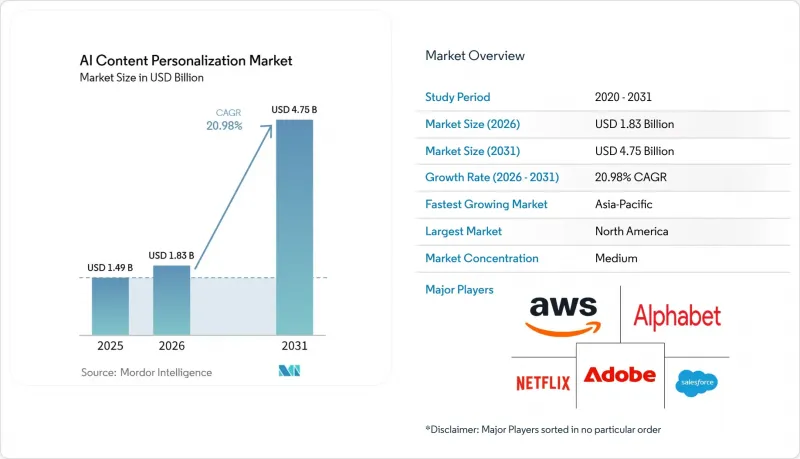
Mordor Intelligence에 의하면, AI 기반 콘텐츠 맞춤화 시장 규모는 2025년 14억 9,000만 달러로 평가되었습니다. 2026년 18억 3,000만 달러에서 2031년까지 47억 5,000만 달러로 확대되어 2026년부터 2031년에 걸쳐 CAGR 20.98%를 나타낼 것으로 예측됩니다.
본 보고서는 용도별(콘텐츠 추천, 마케팅 및 광고 개인화, 고객 경험 개인화, 오디언스 분석, 기타 용도), 최종 사용자별(스트리밍 플랫폼, 방송사 및 케이블 네트워크, 통신 사업자, 디지털 플랫폼, 기타 최종 사용자), 그리고 지역별로 분류되어 있습니다. 시장 전망은 금액(달러) 기준으로 제시됩니다.
세계의 AI 기반 콘텐츠 맞춤화 시장 동향 및 인사이트력
초개인화된 시청자 경험에 대한 수요 증가
콘텐츠 카탈로그가 확대됨에 따라, 특히 여러 서비스가 시청자의 관심을 끌기 위해 경쟁하는 상황에서 범용적인 콘텐츠 캐러셀의 유용성은 많은 시청자에게서 떨어지고 있습니다. 딜로이트의 2026년 조사에 따르면, 팬의 22%가 생성형 AI 기반의 추천이 제공된다면 스트리밍 동영상 서비스 이용 빈도를 높일 것이라고 응답했습니다. 또한 응답자의 30% 가까이가 스트리밍, 소셜 미디어, 지적 재산권 관련 뉴스를 결합한 맞춤형 요약 정보를 원한다고 답했습니다. 추천 기능이 시청자가 한 번 시작한 콘텐츠를 더 많이 끝까지 시청할 수 있도록 돕는다면, 그 비즈니스적 타당성은 가장 확고해집니다. 게다가 언어, 시청 습관, 콘텐츠 카탈로그 선호도가 서유럽의 훈련 데이터와 다른 경우, 지역 특화 모델은 지역 밀착형 서비스가 경쟁할 수 있는 더 견고한 기반을 제공합니다. 이로 인해 콘텐츠 라이브러리가 더욱 광범위하고 다양해지는 가운데, 사용자 참여를 유지하려는 서비스에게 AI 기반 콘텐츠 맞춤화 시장은 중요한 요소가 되고 있습니다.
생성형 AI를 활용한 크리에이티브 및 텍스트 생성
생성형 AI는 실험적인 기능에서 스트리밍 홈페이지를 구축하기 위한 실용적인 기법으로 전환되고 있습니다. 넷플릭스의 ‘GenPage’는 시청 이력 및 요청의 맥락을 활용하여 행, 엔티티, 페이지 레이아웃을 생성하고, 이를 단일한 구조화된 출력물로 통합합니다. 넷플릭스는 온라인 A/B 테스트에서 엔드투엔드 전송 지연이 20% 감소했으며, 핵심 참여 지표에서 통계적으로 유의미한 개선이 나타났다고 보고했습니다. 또한 오프라인 검증 결과, 프롬프트 강화를 통해 가중 이진 분류 손실이 6.9% 감소한 것으로 밝혀졌으며, 이는 단순히 모델의 처리 능력을 확장하는 기법을 능가하는 성과를 보여주었습니다. 이러한 접근 방식을 통해 서비스 사업자는 각 변형마다 별도의 수작업 편집 과정에 의존하지 않고도 행 이름, 아트워크, 페이지 구조를 최적화할 수 있게 됩니다. 따라서 사업자가 페이지 로딩 속도를 저하시키지 않으면서 더 세밀한 개인화를 추구함에 따라, 인공지능(AI)을 활용한 콘텐츠 맞춤화 시장이 그 혜택을 누리고 있습니다.
데이터 소재지 요건 및 동의의 복잡성
데이터 거주지 요건 및 동의 관련 요건으로 인해 개인화 시스템이 활용할 수 있는 행동 정보가 제한될 가능성이 있습니다. 유럽 데이터 보호 위원회가 2025년에 발표한 ‘디지털 서비스법’ 및 ‘일반 데이터 보호 규정(GDPR(EU 개인정보보호규정))’에 관한 지침에서는 추적에 기반한 프로파일링에는 명시적인 동의가 필요하며, 추천 시스템에는 프로파일링을 수행하지 않는 옵션을 제공해야 한다고 규정하고 있습니다. 동의를 얻은 퍼스트파티 신호에만 의존하는 사업자는 보다 광범위한 행동 그래프를 기반으로 구축된 시스템에 비해 훈련용 데이터가 부족할 가능성이 있습니다. GDPR(EU 개인정보보호규정)을 준수한 추천 시스템에 관한 조사에 따르면, 설득력 있는 예측을 생성하기 위해서는 평균 30회 이상의 사용자 상호작용이 필요한 것으로 밝혀졌습니다. AI 기반 콘텐츠 맞춤화 시장에서는 신규 사용자에 대한 콜드 스타트 기간이 길어질 가능성이 있어, 새로운 관할 구역에 진출하는 사업자에게 더 큰 부담이 될 수 있습니다. 따라서 AI 기반 콘텐츠 맞춤화 시장은 고객이 의미 있는 개인정보 보호 선택을 할 수 있도록 하면서도 유익한 경험을 제공해야 합니다.
부문별 분석
2025년 기준, 콘텐츠 추천은 AI 기반 콘텐츠 맞춤화 시장 규모의 34.04%를 차지했습니다. 이러한 위상은 축적된 상호작용 데이터의 가치를 반영합니다. 세션이 1회 증가할 때마다 협업 필터링 신호가 강화되기 때문입니다. 이러한 데이터상의 우위성으로 인해 후발 진출기업이 기존의 추천 품질을 따라잡기는 더욱 어려워질 수 있습니다. 고객 경험의 개인화는 2026년부터 2031년에 걸쳐 연평균 성장률(CAGR) 21.08%를 나타낼 것으로 예측됩니다. 이러한 변화는 단일 콘텐츠 항목에서 홈페이지, 내비게이션, 검색에 이르는 세션 전체의 조정으로 전환되고 있음을 반영합니다. 넷플릭스의 ‘GenPage’는 페이지 수준의 생성을 실제 사례로 보여주는 반면, 어도비의 ‘CX Enterprise’는 고객 경험 조율에 대한 보다 광범위한 접근 방식을 나타냅니다. AI 기반 콘텐츠 맞춤화 시장은 시청자가 선택한 타이틀뿐만 아니라 이를 둘러싼 경험까지 포괄하는 더 광범위한 개인화 정의로 나아가고 있습니다.
마케팅 및 광고 개인화 분야에서도 써드파티 쿠키의 중요성이 감소하는 가운데, 동의에 기반한 퍼스트파티 신호의 활용 확대가 순풍이 되고 있습니다. Taboola의 ‘Realize+’는 캠페인 전반에 걸친 예산 결정에 의사결정 엔진을, 크리에이티브 및 타겟팅 최적화에 요소 생성 도구를 활용하고 있습니다. 오디언스 분석은 신호를 수집하여 이를 최적화 프로세스에 피드백함으로써 이러한 용도를 지원합니다. 그 결과, 많은 구매자에게 이는 독립적인 경험이라기보다는 기반이 되는 레이어가 되고 있습니다. 그 밖의 활용 사례로는 음성 비서의 개인화나 인터랙티브 콘텐츠의 적응 등을 들 수 있지만, 이러한 분야는 상업적 규모에서는 아직 발전 단계에 있습니다. 커넥티드 TV 설정은 기존의 화면 세션을 넘어선 풍부한 행동 시그널을 제공할 가능성이 있습니다. AI 기반 콘텐츠 맞춤화 산업은 기업 학습, 헬스케어 콘텐츠 포털, 금융 서비스 분야에도 기여할 수 있으며, 스트리밍에서 파생된 기법이 더 높은 가치의 참여를 뒷받침할 가능성이 있습니다. 이러한 인접 용도는 핵심 개인화 기능의 상업적 역할을 확대합니다.
지역별 분석
2025년, 북미는 전체 시장의 42.76%를 차지했습니다. 이 지역은 집중된 기술 연구개발비와 대규모 구독형 동영상 수익원의 혜택을 받고 있습니다. 딜로이트 보고서에 따르면, 미국 가구의 90% 가까이가 평균 4개의 구독형 동영상 서비스에 가입해 있습니다. 이처럼 성숙한 AI 기반 콘텐츠 맞춤화 시장에서 참여의 질과 고객 유지율은 경쟁의 핵심 과제가 되고 있습니다. 또한 프로그래매틱 광고 시스템은 개인화된 콘텐츠 발견과 광고 수익 간의 보다 긴밀한 연계를 뒷받침하고 있습니다.
아시아태평양은 2026년부터 2031년까지 연평균 성장률(CAGR) 21.73%를 기록하며 가장 빠르게 성장하는 지역이 될 것으로 예측됩니다. 이러한 성장은 인도, 한국, 일본, 호주에서의 OTT 서비스 확대와 더불어, 지역 전체의 AI 엔지니어링 역량 강화에 힘입은 것입니다. Media Partners Asia의 예측에 따르면, 인도는 2030년까지 3억 5,800만 건의 개인 가입자 수를 기록하며, 중국을 제치고 세계 최대의 구독형 동영상 시장이 될 것으로 전망됩니다. 인도에서는 OTT 이용의 대부분을 지역 언어로 시청하는 비중이 차지하고 있어, 현지화 요구 사항이 까다로운 상황입니다. 인도의 각 언어별 자막, 전자 프로그램 가이드(EPG) 설명문, 캡션 번역에는 AI 시스템이 활용되고 있습니다. 또한 중국의 국내 동영상 플랫폼들도 남아시아 및 동남아시아 시장에서 경쟁력을 갖출 가능성이 있는 생성형 추천 및 라이브 스트리밍 개인화 시스템을 개발하고 있습니다.
유럽과 남미는 각각 3위와 4위의 지역 시장이었습니다. 유럽에서의 보급은 개인정보 보호 및 투명성에 관한 요건으로 인해 제약을 받고 있지만, 독일과 영국은 개인정보 보호를 고려한 개인화 서비스의 중요한 거점으로 계속 자리 잡고 있습니다. 2025년 BVDW 조사에 따르면, 독일 인터넷 사용자의 41%가 콘텐츠 추천을 개선하기 위해 이용 데이터를 공유할 의향이 있는 것으로 나타났습니다. 브라질을 필두로 한 남미에서는 OTT의 확대와 현지 언어로 된 프로그램 제작과 병행하여 개인화 기반이 정비되고 있습니다. 중동 및 아프리카는 여전히 초기 단계 시장이지만, 사우디아라비아의 미디어 디지털화와 남아프리카공화국에서의 OTT 광범위한 보급이 장기적인 수요를 뒷받침하고 있습니다. 이러한 지역별 차이로 인해, 인공지능(AI)을 활용한 콘텐츠 맞춤화 시장에서는 현지화, 데이터 거버넌스, 그리고 운영상의 편의성을 모두 갖추는 것이 요구되고 있습니다.
기타 혜택 :
- 엑셀 형식 시장 예측(ME) 시트
- 3개월간의 애널리스트 지원
자주 묻는 질문
목차
제1장 서론
제2장 조사 방법
제3장 개요
제4장 시장 구도
제5장 시장 규모 및 성장 예측
제6장 경쟁 구도
제7장 시장 기회 및 향후 전망
KTH 26.09.02According to Mordor Intelligence, the AI content personalization market size is projected to expand from USD 1.49 billion in 2025 and USD 1.83 billion in 2026 to USD 4.75 billion by 2031, registering a CAGR of 20.98% between 2026 and 2031.
This report is Segmented by Application (Content Recommendation, Marketing and Advertising Personalization, Customer Experience Personalization, Audience Analytics, and Other Applications), End User (Streaming Platforms, Broadcaster and Cable Networks, Telecom Operators, Digital Platforms, and Other End Users), and Geography. The Market Forecasts Provided in Terms of Value (USD).
Global AI Content Personalization Market Trends and Insights
Rising Demand for Hyper-Personalized Viewer Journeys
Catalog growth is making generic content carousels less useful for many viewers, especially when several services compete for the same attention. Deloitte's 2026 survey found that 22% of fans would use streaming video services more if they offered generative AI-based recommendations. Nearly 30% of respondents also wanted a personalized digest that combined streaming, social, and intellectual-property news. The underlying business case is strongest when recommendations help viewers complete more of the content they begin. Localized models can also give regional services a stronger basis for competing when language, viewing habits, and catalog preferences differ from those in Western training data. This makes the AI content personalization market important to services seeking to protect engagement as their libraries become broader and more varied.
GenAI-Assisted Creative and Row Generation
Generative AI is moving from an experimental feature toward a practical way to build streaming homepages. Netflix's GenPage uses viewing history and request context to generate rows, entities, and page layouts into a single, structured output. Netflix reported a 20% reduction in end-to-end serving latency and a statistically significant improvement in its core engagement metric during online A/B testing. Its offline work also found that prompt enrichment reduced the weighted binary classification loss by 6.9%, outperforming simply scaling model capacity. These approaches allow services to tailor row names, artwork, and page structure without depending on a separate human editorial process for every variation. The artificial intelligence (AI) content personalization market therefore benefits as operators seek more detailed personalization without slower page load times.
Data Residency and Consent Complexity
Data residency and consent requirements can limit the behavioral information available to personalization systems. The European Data Protection Board's 2025 guidance on the Digital Services Act and GDPR states that tracking-based profiling requires explicit consent and that recommender systems must provide non-profiling options. Operators that rely only on consented first-party signals can have less data for training than systems built on broader behavioral graphs. A study of GDPR-compliant recommender systems found that, on average, more than 30 user interactions were needed before compelling predictions could be generated. The AI content personalization market can face a longer cold-start period for new users and create a greater burden for operators entering additional jurisdictions. The AI content personalization market must therefore support useful experiences while allowing customers to make meaningful privacy choices.
Other drivers and restraints analyzed in the detailed report include:
- Expansion of Real-Time Behavioral Decisioning
- Rapid Adoption of Hybrid Recommendation Architectures
- High Integration Effort Across CMS, CRM, CDP, and Ad Tech Stacks
For complete list of drivers and restraints, kindly check the Table Of Contents.
Segment Analysis
Content recommendation accounted for 34.04% of the AI content personalization market size in 2025. Its position reflects the value of accumulated interaction data, because each additional session can strengthen collaborative filtering signals. That data advantage can make it more difficult for later entrants to match established recommendation quality. Customer experience personalization is projected to grow at a CAGR of 21.08% from 2026 to 2031. This shift reflects a move from standalone content rows to session-wide adjustments across homepages, navigation, and search. Netflix's GenPage illustrates page-level generation, while Adobe's CX Enterprise represents a broader approach to customer experience orchestration. The AI content personalization market is moving toward a broader definition of personalization that encompasses the surrounding experience rather than just the title selected for a viewer.
Marketing and advertising personalization also benefits from the growing use of consent-based first-party signals as third-party cookie pools become less central. Taboola's Realize+ uses a decision engine for cross-campaign budget decisions and an element generator for creative and targeting optimization. Audience analytics supports these applications by gathering signals and feeding them back into the optimization process. It is consequently an enabling layer rather than a separate experience for many buyers. Other applications include voice assistant personalization and interactive content adaptation, which remain less developed at a commercial scale. Connected television settings may provide rich behavioral signals beyond traditional screen sessions. The AI content personalization industry can also serve enterprise learning, healthcare content portals, and financial services, where streaming-derived methods may support higher-value engagements. These adjacent uses broaden the commercial role of core personalization capabilities.
Complete Report Scope:
- By Application
- Content Recommendation
- Marketing and Advertising Personalization
- Customer Experience Personalization
- Audience Analytics
- Other Applications
- By End User
- Streaming Platforms
- Broadcaster and Cable Networks
- Telecom Operators
- Digital Platforms
- Other End Users
- By Geography
- North America
- United States
- Canada
- Mexico
- South America
- Brazil
- Argentina
- Chile
- Rest of South America
- Europe
- Germany
- United Kingdom
- France
- Italy
- Spain
- Rest of Europe
- Asia-Pacific
- China
- Japan
- India
- South Korea
- Australia
- Rest of Asia-Pacific
- Middle East
- Saudi Arabia
- United Arab Emirates
- Qatar
- Rest of Middle East
- Africa
- South Africa
- Egypt
- Nigeria
- Rest of Africa
- North America
Geography Analysis
North America held 42.76% share of the regional total in 2025. The region benefits from concentrated technology research and development spending and large subscription video revenue pools. Deloitte reported that nearly 90% of US households subscribed to an average of 4 subscription video services. In this mature AI content personalization market, engagement quality and retention are central competitive issues. Programmatic advertising systems also support closer links between personalized discovery and advertising yield.
Asia-Pacific is projected to be the fastest-growing region, with a CAGR of 21.73% from 2026 to 2031. Growth is supported by expanding OTT services in India, South Korea, Japan, and Australia, as well as by stronger AI engineering capabilities across the region. Media Partners Asia projected that India will surpass China as the largest subscription video market by 2030, with 358 million individual subscriptions. India presents a demanding localization setting because regional-language viewing accounts for a major share of OTT consumption. AI systems are being used for subtitles, electronic program guide descriptions, and caption translation across Indian languages. China's domestic video platforms are also developing generative recommendation and live-streaming personalization systems that could compete in South and Southeast Asia.
Europe and South America were the third- and fourth-largest regional markets, respectively. European adoption is moderated by privacy and transparency requirements, although Germany and the United Kingdom remain important centers for privacy-compliant personalization. A 2025 BVDW study found that 41% of German internet users were willing to share their usage data to improve content recommendations. South America, led by Brazil, is building personalization capacity alongside OTT expansion and local-language programming. The Middle East and Africa remain early-stage markets, though media digitalization in Saudi Arabia and broader OTT adoption in South Africa support longer-term demand. These regional differences require the artificial intelligence (AI) content personalization market to combine localization, data governance, and operational simplicity.
- Netflix, Inc.
- Amazon.com, Inc.
- Alphabet Inc.
- Adobe Inc.
- International Business Machines Corporation
- Salesforce, Inc.
- Oracle Corporation
- Sitecore A/S
- Bloomreach, Inc.
- Taboola.com Ltd.
- Outbrain Inc.
- Revcontent, Inc.
- ThinkAnalytics Ltd.
- Kaltura, Inc.
- Brightcove Inc.
- Viaccess-Orca
- Dynamic Yield (Mastercard)
- Wurl, LLC
- ContentWise S.r.l.
- Personyze Ltd.
Additional Benefits:
- The market estimate (ME) sheet in Excel format
- 3 months of analyst support
TABLE OF CONTENTS
1 INTRODUCTION
- 1.1 Study Assumptions and Market Definition
- 1.2 Scope of the Study
2 RESEARCH METHODOLOGY
3 EXECUTIVE SUMMARY
4 MARKET LANDSCAPE
- 4.1 Market Overview
- 4.2 Market Drivers
- 4.2.1 Rising Demand for Hyper-Personalized Viewer Journeys
- 4.2.2 Expansion of Real-Time Behavioral Decisioning
- 4.2.3 Rapid Adoption of Hybrid Recommendation Architectures
- 4.2.4 Growing Need to Monetize Long-Tail Content Catalogs
- 4.2.5 Demand for Privacy-First Personalization Architectures
- 4.2.6 GenAI-Assisted Creative and Row Generation
- 4.3 Market Restraints
- 4.3.1 Cold-Start Accuracy Gaps for New Users and New Titles
- 4.3.2 Data Residency and Consent Complexity
- 4.3.3 High Integration Effort Across CMS, CRM, CDP and Ad Tech Stacks
- 4.3.4 Personalization Fatigue and Perceived Manipulation Risk
- 4.4 Industry Value Chain Analysis
- 4.5 Regulatory Landscape
- 4.6 Technological Outlook
- 4.7 Porter's Five Forces Analysis
- 4.7.1 Bargaining Power of Buyers
- 4.7.2 Bargaining Power of Suppliers
- 4.7.3 Threat of New Entrants
- 4.7.4 Threat of Substitutes
- 4.7.5 Intensity of Competitive Rivalry
5 MARKET SIZE AND GROWTH FORECASTS (VALUE)
- 5.1 By Application
- 5.1.1 Content Recommendation
- 5.1.2 Marketing and Advertising Personalization
- 5.1.3 Customer Experience Personalization
- 5.1.4 Audience Analytics
- 5.1.5 Other Applications
- 5.2 By End User
- 5.2.1 Streaming Platforms
- 5.2.2 Broadcaster and Cable Networks
- 5.2.3 Telecom Operators
- 5.2.4 Digital Platforms
- 5.2.5 Other End Users
- 5.3 By Geography
- 5.3.1 North America
- 5.3.1.1 United States
- 5.3.1.2 Canada
- 5.3.1.3 Mexico
- 5.3.2 South America
- 5.3.2.1 Brazil
- 5.3.2.2 Argentina
- 5.3.2.3 Chile
- 5.3.2.4 Rest of South America
- 5.3.3 Europe
- 5.3.3.1 Germany
- 5.3.3.2 United Kingdom
- 5.3.3.3 France
- 5.3.3.4 Italy
- 5.3.3.5 Spain
- 5.3.3.6 Rest of Europe
- 5.3.4 Asia-Pacific
- 5.3.4.1 China
- 5.3.4.2 Japan
- 5.3.4.3 India
- 5.3.4.4 South Korea
- 5.3.4.5 Australia
- 5.3.4.6 Rest of Asia-Pacific
- 5.3.5 Middle East
- 5.3.5.1 Saudi Arabia
- 5.3.5.2 United Arab Emirates
- 5.3.5.3 Qatar
- 5.3.5.4 Rest of Middle East
- 5.3.6 Africa
- 5.3.6.1 South Africa
- 5.3.6.2 Egypt
- 5.3.6.3 Nigeria
- 5.3.6.4 Rest of Africa
- 5.3.1 North America
6 COMPETITIVE LANDSCAPE
- 6.1 Market Concentration
- 6.2 Strategic Moves
- 6.3 Vendor Positioning Analysis
- 6.4 Company Profiles (includes Global Level Overview, Market Level Overview, Core Segments, Financials as available, Strategic Information, Products and Services, Recent Developments)
- 6.4.1 Netflix, Inc.
- 6.4.2 Amazon.com, Inc.
- 6.4.3 Alphabet Inc.
- 6.4.4 Adobe Inc.
- 6.4.5 International Business Machines Corporation
- 6.4.6 Salesforce, Inc.
- 6.4.7 Oracle Corporation
- 6.4.8 Sitecore A/S
- 6.4.9 Bloomreach, Inc.
- 6.4.10 Taboola.com Ltd.
- 6.4.11 Outbrain Inc.
- 6.4.12 Revcontent, Inc.
- 6.4.13 ThinkAnalytics Ltd.
- 6.4.14 Kaltura, Inc.
- 6.4.15 Brightcove Inc.
- 6.4.16 Viaccess-Orca
- 6.4.17 Dynamic Yield (Mastercard)
- 6.4.18 Wurl, LLC
- 6.4.19 ContentWise S.r.l.
- 6.4.20 Personyze Ltd.
7 MARKET OPPORTUNITIES AND FUTURE OUTLOOK
- 7.1 White-Space and Unmet-Need Assessment