

|
시장보고서
상품코드
2117568
라니티딘 시장 : 점유율 분석, 업계 동향과 통계, 성장 예측(2026-2031년)Ranitidine - Market Share Analysis, Industry Trends & Statistics, Growth Forecasts (2026 - 2031) |
||||||
 Mordor Intelligence
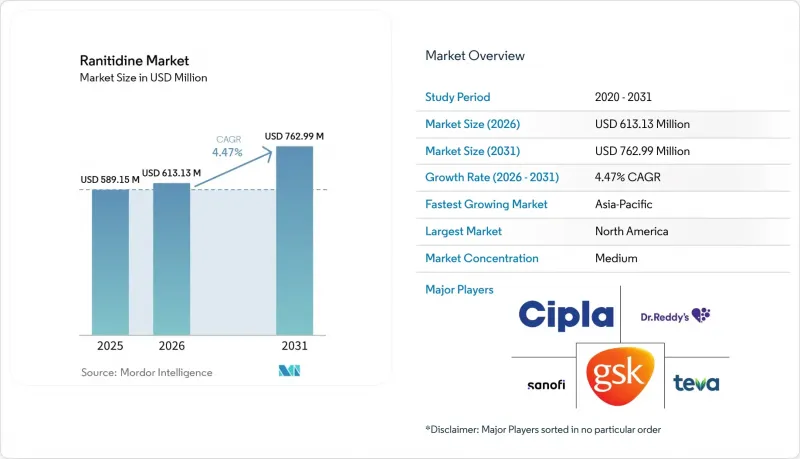
Mordor Intelligence에 의하면, 라니티딘 시장 규모는 2025년 5억 8,915만 달러에서 2026년에는 6억 1,313만 달러로 확대되어 2026년부터 2031년까지 CAGR 4.47%로 성장을 지속하여, 2031년에는 7억 6,299만 달러에 이를 것으로 예측됩니다.
본 보고서는 용량(75 Mg, 150 Mg, 300 Mg), 제형(정제, 시럽, 주사제), 투여 경로(경구, 정맥 내)별로 분류되어 있으며, 적응증(GERD, 소화성 궤양, ZES, 미란성 식도염, 스트레스성 궤양),유통 채널(병원, 소매, 온라인 약국), 최종 사용자(병원, 진료소, ASC, 재택 간호), 지역(북미, 유럽, 아시아태평양, 기타)별로 분류되어 있습니다. 시장 예측은 금액(달러) 기준으로 제시되어 있습니다.
세계 라니티딘 시장 동향 및 인사이트
GERD 및 소화성 궤양의 부담 증가로 인해 대상 환자층이 구조적으로 확대
세계 GERD 유병률은 1990년 이후 연평균 3.4%의 속도로 증가하여 2021년에는 8억 2,560만 건에 달했습니다. 2021년 신규 발병 건수는 인도에서 3,660만 건, 중국에서 2,090만 건을 기록했습니다. 산 분비 억제 요법에서 비용이 여전히 중요한 고려 사항이기 때문에 이들 국가는 라니티딘 시장에 있어 중요한 시장으로 부상하고 있습니다. 환자 수가 증가함에 따라 역류 증상이나 궤양 관련 질환의 치료가 필요한 환자층이 확대되고 있습니다. 식습관이나 보험 급여 제한으로 인해 동남아시아 및 사하라 이남 아프리카의 일부 지역에서는 저비용 치료법이 더욱 중요시되는 경향이 있습니다. 따라서 라니티딘 시장은 환자들이 고비용 치료로 쉽게 전환할 수 없는 지역에서 수요 잠재력을 유지하고 있습니다.
가격에 민감한 시장에서 저비용 산 분비 억제 요법에 대한 선호가 제네릭 의약품의 판매량을 뒷받침하고 있습니다.
본인 부담 치료 환경에서는 라니티딘이 모든 양성자 펌프 억제제(PPI) 처방에 대한 직접적인 대체제라기보다는 여전히 저비용 선택지로 남아 있습니다. 보험에 가입하지 않은 환자의 경우, 제네릭 양성자 펌프 억제제가 여전히 H2 차단제보다 비싼 지역에서는 라니티딘 시장이 혜택을 보고 있습니다. 하이데라바드와 아메다바드에 위치한 인도의 제조 클러스터는 국내 및 수출 시장에 원료의약품과 완제약을 공급하고 있습니다. 2025년에 도입된 필수 의약품 성분의 국내 생산을 지원하기 위한 정부의 인센티브는 이러한 공급 체계를 더욱 강화하고 있습니다. 저비용 생산을 통해 인도공급업체들은 해당 시장에서 철수하지 않고도 동남아시아, 아프리카, 남미로공급을 지속할 수 있게 되었습니다. 라니티딘 시장은 여전히 가격 경쟁에 직면해 있지만, 보험 적용 범위가 제한적이기 때문에 기존 제네릭 치료제에 대한 수요는 유지될 가능성이 있습니다.
NDMA 리콜의 여파와 뿌리 깊은 신뢰 부족이 재도입률을 억제
2020년 미국에서 라니티딘이 시장에서 철수한 것은 2025년 승인 이후에도 여전히 영향을 미치고 있는 신뢰의 장벽을 만들어 냈습니다. 라니티딘 시장은 다른 산 분비 억제 요법으로 전환한 처방 의사와 환자들로부터 신뢰를 되찾아야 합니다. 미국 위장병학회(AGSA)는 2025년 12월, 재제형된 라니티딘이 파모티딘보다 더 큰 임상적 이점을 제공할 가능성은 낮다는 견해를 밝혔습니다. 이러한 견해로 인해 이미 대체 약물로 증상이 안정된 환자들에게는 치료법을 변경할 이유가 줄어들게 됩니다. 검사, 로트 릴리스 및 보관 관리는 규제 대상 수출 시장에 제품을 공급하는 제조업체에게 비용과 복잡성을 가중시키는 요인이 됩니다. 라니티딘 시장은 신제품이 유통 기한 전반에 걸쳐 불순물 위험을 관리할 수 있다는 일관된 증거에 의존하게 될 것입니다.
부문 분석
2025년, 150mg 제제는 라니티딘 시장의 48.71%를 차지했으며, 많은 외래 환자의 위식도 역류 질환(GERD) 및 유지 요법 처방에서 여전히 표준 용량으로 사용되었습니다. 이 용법의 사용은 역류 증상 및 소화성 궤양에 대한 1일 2회 투여라는 확립된 치료 루틴에 반영되어 있습니다. 소매 약국과 병원에서는 일반적으로 이 용량이 주요 조제 옵션으로 꼽힙니다. 75mg 제제는 저용량 제품이 여전히 구할 수 있는 일부 유럽 및 아시아 국가에서 그 역할이 비교적 미미합니다. 유럽연합(EU)에서는 라니티딘 제제의 판매 중단 조치가 여전히 유효하기 때문에 그 시장 점유율은 제한적입니다. 라니티딘 업계는 각국 시장의 용량별 공급 상황에 계속 의존하고 있습니다.
300 mg 부문은 2026년부터 2031년까지 연평균 성장률(CAGR) 6.16%를 나타낼 것으로 예측됩니다. 이 용량은 일부 십이지장 궤양 환자에게 적용되는 취침 전 1회 투여 프로토콜을 뒷받침하고 있습니다. 투약 일정이 엄격하게 관리되는 의료 기관에서의 치료에서는 복용 횟수의 감소가 복약 순응도 향상으로 이어질 가능성이 있습니다. VKT Pharma사의 승인은 미국 내 150 mg 및 300 mg 재제형 정제 모두를 대상으로 합니다. 이번 승인으로 인해 미국 내 재출시 시 상업적으로 중요한 두 용량 모두 이용 가능해집니다. 따라서 승인된 제품이 병원 및 처방 채널에 공급되는 지역에서는 라니티딘 업계에서 고용량에 대한 수요가 더욱 증가할 가능성이 있습니다.
2025년 라니티딘 시장에서 정제가 61.82%를 차지했습니다. 이는 경구용 고형제가 외래 및 병원 조제에서 여전히 실용적이기 때문입니다. 이러한 확립된 사용 실적을 바탕으로 소매 약국 및 의료 기관 내 약국에서 폭넓게 구할 수 있습니다. 시럽 제제는 정제를 편안하게 복용하기 어려운 소아 및 고령 환자에게 별도의 역할을 수행하고 있습니다. 미국 의약품 정보에 따르면, 라니티딘 경구 용액은 15 mg/mL로 표기되어 있습니다. 체중에 따른 투여나 연하 곤란과 같은 요인이 이 액상 제제의 틈새 시장을 유지하는 한 요인이 되고 있습니다. 라니티딘 시장에서는 정제만을 공급하는 모델이 아닌, 여러 제형에 대한 수요가 여전히 존재하고 있습니다.
주사제는 2026년부터 2031년까지 연평균 성장률(CAGR) 4.82%로 확대될 것으로 예측됩니다. 정맥 내 투여는 스트레스성 궤양 예방, 마취 전 흡인 위험 관리, 그리고 특정 중환자 치료 요구에 대응하고 있습니다. 이러한 환자들은 소화관을 통해 약물을 섭취할 수 없는 경우가 있습니다. 2025년 연구에 따르면, 고위험 수술 환자군에 대한 비경구적 산 억제 프로토콜의 지속적인 사용이 보고되었습니다. 병원은 적절한 사용에 관한 현행 지침을 준수하고, 불필요한 예방 조치를 피해야 합니다. 라니티딘 업계는 이러한 병원 환경을 보다 전문적인 수요원으로 인식하고 있습니다.
지역별 분석
북미는 2025년 라니티딘 시장의 38.23%를 차지했으며, 2026년에도 지역별 최대 점유율을 유지했습니다. VKT Pharma사의 재조제 정제가 FDA 승인을 받음에 따라, 2020년 판매 중단 이후 미국 내 처방 접근성이 재개되었습니다. 해당 제품은 처방약이며, 개봉 후 90일 이내에 폐기해야 하므로 회복 속도는 완만할 것으로 예측됩니다. 또한, 많은 처방 의사들은 일반의약품 ‘Zantac 360’에 사용되는 파모티딘에도 익숙합니다. 캐나다와 멕시코에서는 제네릭 의약품공급이 유지되고 있으며, 가격에 민감한 병원의 조달 정책이 멕시코 내 사용을 뒷받침하고 있습니다.
유럽에서는 유럽연합(EU)의 라니티딘 제제 판매 중단 조치가 여전히 지속되고 있어, 규제 환경이 분열된 상태에서 운영되고 있습니다. 이러한 상황으로 인해 산 분비 억제 요법의 상당 부분이 양성자 펌프 억제제나 파모티딘으로 전환되고 있습니다. 독일에서는 2025년 12월에 ‘Ranitidin AbZ 150 mg 정’ 및 ‘Ranitidin-ratiopharm 300 mg 정’공급 부족이 해소되었습니다. 라니티딘 시장은 스페인 및 기타 소규모 유럽 시장에서만 제한적인 활동이 관찰됩니다. 영국, 프랑스, 이탈리아에서는 각국의 프로그램에 따라 특정 환자군을 대상으로 처방약 공급이 제한적으로 유지되고 있습니다. 유럽 수요는 준수 요건 및 각국의 승인 절차에 의해 여전히 제약을 받고 있습니다.
아시아태평양은 2031년까지 연평균 성장률(CAGR) 5.29%를 나타낼 것으로 예측되며, 라니티딘 시장에서 가장 빠르게 성장하는 지역이 될 전망입니다. 제시된 증거에 근거하여 보고된 GERD의 신규 유병 부담은 인도와 중국이 가장 큰 것으로 나타났습니다. 인도의 원료의약품 클러스터는 전 세계 제제 시장에 유효 성분을 공급하고 있습니다. 2025년에 도입된 국내 생산 장려책에 따라 이 제조거점은 더욱 강화될 것입니다. 한국과 일본에서는 병원 약국 채널에서 처방 수요가 유지되고 있으나, 의사의 양성자 펌프 억제제에 대한 숙련도 부족으로 인해 더 광범위한 보급이 제한되고 있습니다. 호주는 유럽연합과 마찬가지로 라니티딘 사용 일시 중단 조치를 시행하고 있습니다. 중동 및 아프리카에서는 주로 인도 제조업체로부터 비용 경쟁력이 있는 제네릭 의약품을 조달하고 있는 반면, 브라질과 아르헨티나에서는 니트로소아민에 대한 더 엄격한 감시 하에 공공 처방약 목록에 기반한 수요가 유지되고 있습니다.
기타 혜택:
- 엑셀 형식 시장 예측(ME) 시트
- 3개월간의 애널리스트 지원
자주 묻는 질문
목차
제1장 서론
제2장 조사 방법
제3장 주요 요약
제4장 시장 구도
제5장 시장 규모와 성장 예측
제6장 경쟁 구도
제7장 시장 기회와 향후 전망
JHS 26.09.03According to Mordor Intelligence, the ranitidine market size is expected to grow from USD 589.15 million in 2025 to USD 613.13 million in 2026 and is forecast to reach USD 762.99 million by 2031 at 4.47% CAGR over 2026-2031.
This report is Segmented by Strength (75 Mg, 150 Mg, 300 Mg), Form (Tablet, Syrup, Injection), Route (Oral, Intravenous), Application (GERD, Peptic Ulcer, ZES, Erosive Esophagitis, Stress Ulcer), Distribution Channel (Hospital, Retail, Online Pharmacies), End User (Hospitals, Clinics, Ascs, Home Care), and Geography (North America, Europe, Asia-Pacific, and More). The Market Forecasts are Provided in Terms of Value (USD).
Global Ranitidine Market Trends and Insights
Rising GERD and Peptic Ulcer Burden Structurally Widens the Addressable Patient Pool
Global GERD prevalence grew at an average annual rate of 3.4% from 1990 and reached 825.6 million prevalent cases in 2021. India recorded 36.6 million incident cases in 2021, while China recorded 20.9 million cases. These countries are important to the ranitidine market because cost remains a major consideration in acid suppression therapy. The increasing case load broadens the group of patients who may need treatment for reflux symptoms or ulcer-related conditions. Food patterns and limited reimbursement can make lower-cost therapies more relevant in parts of Southeast Asia and Sub-Saharan Africa. The ranitidine market therefore, retains demand potential where a patient cannot easily move to a higher-cost treatment.
Preference for Low-Cost Acid Suppression in Price-Sensitive Markets Sustains Generic Volume
In out-of-pocket treatment settings, ranitidine remains a lower-cost option rather than a direct substitute for every proton pump inhibitor prescription. The ranitidine market benefits where generic proton pump inhibitors still cost more than an H2 blocker for uninsured patients. Indian manufacturing clusters in Hyderabad and Ahmedabad support the supply of active pharmaceutical ingredients and finished doses to domestic and export markets. Government incentives introduced in 2025 to support domestic production of essential pharmaceutical ingredients reinforce this supply position. Lower-cost production can help Indian suppliers serve Southeast Asia, Africa, and South America without leaving these markets. The ranitidine market remains exposed to price competition, but limited insurance coverage can preserve demand for established generic therapies.
NDMA Recall Legacy and Persistent Trust Deficit Constrain Re-Adoption Rates
The 2020 withdrawal of ranitidine from the United States created a trust barrier that remains relevant after the 2025 approval. The ranitidine market must regain confidence among prescribers and patients who moved to other acid-suppression therapies. The American Gastroenterological Association stated in December 2025 that reformulated ranitidine is unlikely to provide a greater clinical benefit than famotidine. This position reduces the reason to change treatment for patients who are already stable on an alternative. Testing, batch release, and storage controls add cost and complexity for manufacturers serving regulated export markets. The ranitidine market will depend on consistent evidence that new products can manage the impurity risk throughout their shelf life.
Other drivers and restraints analyzed in the detailed report include:
- Reformulated Products and Impurity-Control Capabilities Reopening Selected Demand Pools
- Established Oral Dosage Familiarity in Hospital and Retail Formularies
- Substitution by PPIs and Famotidine-Based Alternatives Restructures the Long-Term Ceiling
For complete list of drivers and restraints, kindly check the Table Of Contents.
Segment Analysis
The 150 mg strength commanded 48.71% of the ranitidine market in 2025 and remained the standard dose for many outpatient GERD and maintenance prescriptions. Its use reflects established twice-daily treatment routines for reflux symptoms and peptic ulcer disease. Retail pharmacies and hospitals commonly list this strength as a core dispensing option. The 75 mg strength has a smaller role in selected European and Asian countries where lower-dose products remain available. Its contribution is limited in the European Union because the suspension of ranitidine medicines remains in effect. The Ranitidine industry continues to rely on strength-specific availability in each national market.
The 300 mg segment is forecast to grow at a 6.16% CAGR between 2026 and 2031. This dose supports single bedtime dosing protocols used for some duodenal ulcer patients. Fewer doses may improve adherence in institutional care where medication administration is closely scheduled. VKT Pharma's approval covered both 150 mg and 300 mg reformulated tablets in the United States. That approval gives the U.S. relaunch access to both commercially important strengths. The Ranitidine industry may therefore see more high-dose demand where approved supply reaches hospital and prescription channels.
Tablets accounted for 61.82% of the ranitidine market in 2025 because oral solids remain practical for outpatient and hospital dispensing. Their established use supports broad availability in retail and institutional pharmacies. Syrup serves a separate role for children and older patients who cannot comfortably use tablets. Ranitidine oral solution is labeled at 15 mg/mL in the U.S. drug information. Weight-based dosing and swallowing problems help maintain this liquid niche. The ranitidine market retains a need for several dosage forms rather than a tablet-only supply model.
Injections are forecast to expand at a 4.82% CAGR from 2026 to 2031. Intravenous use supports stress ulcer prophylaxis, aspiration-risk management before anesthesia, and selected intensive care needs. These patients may not be able to take medicines through the digestive tract. A 2025 study described continued use of parenteral acid suppression protocols for high-risk surgical populations. Hospitals must still apply current guidance on appropriate use and avoid unnecessary prophylaxis. The Ranitidine industry uses this hospital setting as a more specialized source of demand.
Complete Report Scope:
- By Strength
- 75 mg
- 150 mg
- 300 mg
- By Form
- Tablet
- Syrup
- Injection
- By Route of Administration
- Oral
- Intravenous
- By Application
- Gastroesophageal Reflux Disease
- Peptic Ulcer Disease
- Zollinger-Ellison Syndrome
- Erosive Esophagitis
- Stress Ulcer Prophylaxis
- By Distribution Channel
- Hospital Pharmacies
- Retail Pharmacies
- Online Pharmacies
- By End User
- Hospitals
- Clinics
- Ambulatory Surgical Centers
- Home Care Settings
- By Geography
- North America
- United States
- Canada
- Mexico
- Europe
- Germany
- United Kingdom
- France
- Italy
- Spain
- Rest of Europe
- Asia-Pacific
- China
- Japan
- India
- Australia
- South Korea
- Rest of Asia-Pacific
- Middle East & Africa
- GCC
- South Africa
- Rest of Middle East & Africa
- South America
- Brazil
- Argentina
- Rest of South America
- North America
Geography Analysis
North America held 38.23% of the ranitidine market in 2025 and retained the largest regional position in 2026. FDA approval of VKT Pharma's reformulated tablets reopened U.S. prescription access after the 2020 withdrawal. Recovery is likely to remain measured because the product is prescription-only and has a 90-day post-opening discard requirement. Many prescribers are also familiar with famotidine, which is used in over-the-counter Zantac 360. Canada and Mexico maintain a generic supply, while price-sensitive hospital purchasing supports use in Mexico.
Europe operates under a divided regulatory setting because the European Union suspension of ranitidine medicines remains in place. This framework has directed much acid suppression care toward proton pump inhibitors and famotidine. Germany resolved supply shortfalls for Ranitidin AbZ 150 mg tablets and Ranitidin-ratiopharm 300 mg tablets in December 2025. The ranitidine market has only limited activity in Spain and other smaller European markets. The United Kingdom, France, and Italy retain residual prescription supply for specific patient populations under national programs. European demand remains constrained by compliance requirements and national authorization pathways.
Asia-Pacific is forecast to grow at a 5.29% CAGR through 2031, making it the fastest-growing region in the ranitidine market. India and China had the largest incident GERD burdens reported in the supplied evidence base. Indian bulk-drug clusters supply active pharmaceutical ingredients to global formulation markets. Domestic production incentives introduced in 2025 reinforce this manufacturing base. South Korea and Japan retain prescription demand in hospital pharmacy channels, while physician familiarity with proton pump inhibitors limits broader uptake. Australia follows a suspended ranitidine framework similar to the European Union. The Middle East and Africa source cost-competitive generic supply largely from Indian manufacturers, while Brazil and Argentina sustain public-formulary demand under tighter nitrosamine monitoring.
- Apotex
- Aurobindo Pharma
- Boehringer Ingelheim
- Cipla
- Dr. Reddy's Laboratories Ltd.
- GlaxoSmithKline
- Glenmark Pharmaceuticals
- Granules India
- Hikma Pharmaceuticals
- J B Chemicals and Pharmaceuticals Limited
- Lupin
- Merck
- Sanofi
- Sandoz Group AG
- Strides Pharma Science
- Sun Pharmaceuticals Industries
- Teva Pharmaceutical Industries
- Tocris Bioscience
- Viatris
- Zydus Lifesciences Limited
Additional Benefits:
- The market estimate (ME) sheet in Excel format
- 3 months of analyst support
TABLE OF CONTENTS
1 Introduction
- 1.1 Study Assumptions & Market Definition
- 1.2 Scope of the Study
2 Research Methodology
3 Executive Summary
4 Market Landscape
- 4.1 Market Overview
- 4.2 Market Drivers
- 4.2.1 Rising GERD and Peptic Ulcer Burden
- 4.2.2 Preference for Low-Cost Acid Suppression in Price-Sensitive Markets
- 4.2.3 Established Oral Dosage Familiarity in Hospital and Retail Formularies
- 4.2.4 Reformulated Products and Impurity-Control Capabilities Reopening Selected Demand Pools
- 4.2.5 Pediatric and Geriatric Liquid-Dosing Needs in Selected Care Settings
- 4.2.6 Short-Course Procurement Preference in Acute Care and Stock-Buffering by Buyers
- 4.3 Market Restraints
- 4.3.1 NDMA Recall Legacy and Persistent Trust Deficit
- 4.3.2 Substitution by PPIs and Famotidine-Based Alternatives
- 4.3.3 Compliance, Testing, and Batch-Release Cost Burden
- 4.3.4 Stability, Packaging, and Cold-Chain Sensitivity in Reformulated Supply
- 4.4 Value / Supply-Chain Analysis
- 4.5 Regulatory Landscape
- 4.6 Technological Outlook
- 4.7 Porter's Five Forces Analysis
- 4.7.1 Threat of New Entrants
- 4.7.2 Bargaining Power of Suppliers
- 4.7.3 Bargaining Power of Buyers
- 4.7.4 Threat of Substitutes
- 4.7.5 Industry Rivalry
5 Market Size & Growth Forecasts
- 5.1 By Strength
- 5.1.1 75 mg
- 5.1.2 150 mg
- 5.1.3 300 mg
- 5.2 By Form
- 5.2.1 Tablet
- 5.2.2 Syrup
- 5.2.3 Injection
- 5.3 By Route of Administration
- 5.3.1 Oral
- 5.3.2 Intravenous
- 5.4 By Application
- 5.4.1 Gastroesophageal Reflux Disease
- 5.4.2 Peptic Ulcer Disease
- 5.4.3 Zollinger-Ellison Syndrome
- 5.4.4 Erosive Esophagitis
- 5.4.5 Stress Ulcer Prophylaxis
- 5.5 By Distribution Channel
- 5.5.1 Hospital Pharmacies
- 5.5.2 Retail Pharmacies
- 5.5.3 Online Pharmacies
- 5.6 By End User
- 5.6.1 Hospitals
- 5.6.2 Clinics
- 5.6.3 Ambulatory Surgical Centers
- 5.6.4 Home Care Settings
- 5.7 By Geography
- 5.7.1 North America
- 5.7.1.1 United States
- 5.7.1.2 Canada
- 5.7.1.3 Mexico
- 5.7.2 Europe
- 5.7.2.1 Germany
- 5.7.2.2 United Kingdom
- 5.7.2.3 France
- 5.7.2.4 Italy
- 5.7.2.5 Spain
- 5.7.2.6 Rest of Europe
- 5.7.3 Asia-Pacific
- 5.7.3.1 China
- 5.7.3.2 Japan
- 5.7.3.3 India
- 5.7.3.4 Australia
- 5.7.3.5 South Korea
- 5.7.3.6 Rest of Asia-Pacific
- 5.7.4 Middle East & Africa
- 5.7.4.1 GCC
- 5.7.4.2 South Africa
- 5.7.4.3 Rest of Middle East & Africa
- 5.7.5 South America
- 5.7.5.1 Brazil
- 5.7.5.2 Argentina
- 5.7.5.3 Rest of South America
- 5.7.1 North America
6 Competitive Landscape
- 6.1 Market Concentration
- 6.2 Market Share Analysis
- 6.3 Company Profiles (includes Global Level Overview, Market-level Overview, Core Segments, Financials, Strategic Information, Market Rank/Share, Products & Services, Recent Developments)
- 6.3.1 Apotex Inc.
- 6.3.2 Aurobindo Pharma Limited
- 6.3.3 Boehringer Ingelheim International GmbH
- 6.3.4 Cipla Limited
- 6.3.5 Dr. Reddy's Laboratories Ltd.
- 6.3.6 GlaxoSmithKline plc
- 6.3.7 Glenmark Pharmaceuticals Limited
- 6.3.8 Granules India Limited
- 6.3.9 Hikma Pharmaceuticals PLC
- 6.3.10 J B Chemicals and Pharmaceuticals Limited
- 6.3.11 Lupin Limited
- 6.3.12 Merck KGaA
- 6.3.13 Sanofi
- 6.3.14 Sandoz Group AG
- 6.3.15 Strides Pharma Science Limited
- 6.3.16 Sun Pharmaceutical Industries Limited
- 6.3.17 Teva Pharmaceutical Industries Ltd.
- 6.3.18 Tocris Bioscience
- 6.3.19 Viatris Inc.
- 6.3.20 Zydus Lifesciences Limited
7 Market Opportunities & Future Outlook
- 7.1 White-space & Unmet-need Assessment


