

|
시장보고서
상품코드
2117570
혈관운동 증상 시장 : 점유율 분석, 업계 동향과 통계, 성장 예측(2026-2031년)Vasomotor Symptoms - Market Share Analysis, Industry Trends & Statistics, Growth Forecasts (2026 - 2031) |
||||||
 Mordor Intelligence
Mordor Intelligence에 의하면, 혈관운동 증상 치료제 시장은 2025년에 42억 달러로 평가되었고 2026년 45억 달러에서 2031년까지 64억 달러에 이를 것으로 예측되며, 2026년부터 2031년까지의 예측 기간에서 CAGR은 7.4%를 나타낼 전망입니다.
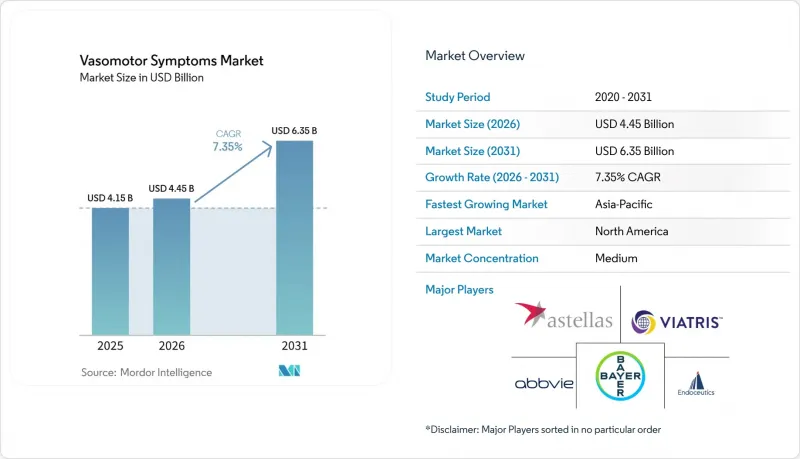
본 보고서는 치료법(호르몬 요법, 비호르몬 요법), 투여 경로(경구, 경피 패치, 경피 젤 및 스프레이, 비경구, 외용),유통 채널(병원, 소매, 온라인 약국), 폐경 단계(폐경 전후기, 폐경 초기, 폐경 후기), 지역(북미, 유럽, 아시아태평양, 중동 및 아프리카, 남미)을 다룹니다. 시장 예측은 금액(달러)으로 표시됩니다.
전 세계 혈관운동 증상 시장 동향 및 인사이트
폐경 후 여성 환자 수 증가
혈관운동 증상 시장은 매년 새로운 환자들이 치료 대상이 되는 대규모의 지속적인 인구 기반의 혜택을 지속적으로 누리고 있습니다. 2025년에는 10억 명 이상의 여성이 폐경 후기 단계에 있을 것이며, 세계보건기구(WHO)는 그 수가 2030년까지 12억 명에 달할 것으로 예측했습니다. 이러한 부담은 고르게 분산되어 있지 않습니다. 왜냐하면 폐경 후 여성의 대부분은 OECD 국가들에 비해 치료 인프라가 여전히 미비한 저·중소득 국가에 살고 있기 때문입니다. 여성의 최대 80%가 갱년기 과도기에 혈관운동 증상을 경험하기 때문에 인구 증가는 이미 치료가 충분히 이루어지고 있는 시장을 단순히 확대할 뿐만 아니라, 치료가 미흡한 환자층을 더욱 늘리는 결과로 이어집니다.
여성 건강 분야에 대한 제약 투자 확대
대기업들이 인수, 승인 및 후기 개발 활동을 통해 여성 건강 분야에 대한 집중도를 높임에 따라, 혈관운동 증상 시장은 제약 업계로부터 더욱 두드러진 주목을 받고 있습니다. 선 파마슈티컬 인더스트리즈(Sun Pharmaceutical Industries)는 2026년 4월, 117억 5,000만 달러 상당의 현금 거래를 통해 오르가논 앤 컴퍼니(Organon & Company)를 인수한다고 발표했으며, 이를 통해 140개국 이상에 걸친 세계 사업망을 보유한 광범위한 여성 건강 포트폴리오를 통합하게 되었습니다. 바이엘은 2025년, 영국, 미국, 유럽연합(EU)에서의 승인을 통해 엘리자네탄(elinzanetant)의 상업적 입지를 확대했습니다. 이는 새로운 비호르몬 계열 약물에 대한 지속적인 자본 투자를 보여줍니다. 아스테라스도 2026년, 페졸리네탄(fezolinetan)의 3상 임상시험에서 양호한 결과를 얻어 일본 내 개발을 진전시켰습니다. 이에 따라 파이프라인은 북미와 유럽뿐만 아니라 주요 지역 전반에 걸쳐 활발하게 유지되고 있습니다. 이러한 추세는 혈관운동 증상 시장에서 중요한 의미를 지닙니다. 포트폴리오가 클수록 일반적으로 제품 출시를 위한 강력한 지원, 더 광범위한 승인 획득을 위한 노력, 그리고 보험사와의 보다 일관된 협력을 얻을 수 있기 때문입니다.
NK-3 길항제에 대한 장기적인 간독성 우려
안전성 모니터링은 처방 의사의 안심감과 환자의 치료 지속에 직접적인 영향을 미치기 때문에 혈관운동 증상 시장에서 가장 명백한 단기적 제약 요소 중 하나로 남아 있습니다. FDA는 2024년 9월 페졸리네탄트에 관한 ‘의약품 안전성 정보(Drug Safety Communication)’를 처음으로 발령한 후, 시판 후 발생한 중증 간 손상 보고를 받아 2024년 12월에 박스 경고를 추가했습니다. 개정된 프로토콜에서는 기저선 시점의 간 기능 검사, 첫 3개월간의 월별 검사, 그리고 6개월 차와 9개월 차에 추가 검사를 의무화하고 있어 일상적인 사용에 실무상의 부담을 가중시키고 있습니다. 유럽의약품청(EMA)도 2025년에 의료 종사자를 대상으로 직접 공지를 발령하여, 모니터링 문제가 미국에만 국한된 것이 아님을 보여주었습니다. OASIS 임상시험에서 엘리냐제탄은 더 양호한 간 기능 프로파일을 보였으나, 이 약물군 전체에 대한 처방 의사의 신뢰는 여전히 장기적인 안전성 실적을 통해 결정될 것입니다.
부문 분석
2025년, 혈관운동 증상 치료 시장에서 호르몬 요법은 68.4%의 점유율을 차지하며, 치료 옵션 중 가장 큰 수익원이 되었습니다. 이러한 위상은 오랜 기간에 걸친 임상 사용 실적, 의사들 사이에서 널리 알려진 인지도, 그리고 폐경기 호르몬 요법이 위약에 비해 혈관운동 증상의 발생 빈도를 최대 75%까지 감소시킬 수 있다는 강력한 증거를 반영한 것입니다. 에스트로겐 단독 제제는 자궁을 적출한 여성을 대상으로 하지만, 에스트로겐·프로게스테론 복합 제제는 자궁을 보유한 여성에게 여전히 핵심적인 치료법이며, 따라서 처방 패턴은 표준적인 위험 선별 검사 및 환자의 병력에 따라 형성됩니다. 또한, 호르몬 요법은 선진국 시장에서 확립된 보험 환급 경로의 혜택을 받고 있으며, 이는 1차 진료 및 산부인과 진료 현장에서의 안정적인 사용을 뒷받침하고 있습니다.
비호르몬 요법에 의한 혈관운동 증상 시장 규모는 2031년까지 연평균 성장률(CAGR) 10.8%로 확대될 것으로 예측되며, 가장 빠르게 성장하는 치료군으로 전망됩니다. 이러한 성장은 주로 NK 세포를 표적으로 하는 치료제, 특히 아스텔라스 제약의 페졸리네탄과 바이엘의 엘리나제탄에 의해 주도되고 있으며, 이들은 호르몬 요법을 사용할 수 없거나 사용을 원하지 않는 환자에게 임상의에게 새로운 선택지를 제공합니다. SSRI 및 SNRI는 호르몬 요법이 금기인 여성에게 여전히 실용적인 역할을 하고 있지만, 그 사용은 보다 선택적이며, 효과 프로파일은 NK 세포를 표적으로 하는 치료법만큼 직접적이지 않습니다. 허브 제제 및 영양 보충제는 혈관운동 증상 업계에서 여전히 가장 세분화된 분야이며, 그 성장은 증상에 대한 효능 표시에 관한 규제의 강화와 제품 차별화의 약화로 인해 제약을 받고 있습니다.
2025년, 혈관운동 증상 시장에서 경구 투여는 56.5%를 차지하여 다른 모든 투여 경로를 앞질렀습니다. 이러한 선두 위상은 경구 호르몬 요법이 오랫동안 확립된 역할을 해왔습니다는 점과, 승인된 두 가지 NK 표적 요법이 모두 1일 1회 경구 투여라는 사실을 반영합니다. 의사들이 정제 형태의 투여법에 익숙해져 있다는 점도 경구 투여의 지속을 뒷받침하고 있습니다. 이는 용량 조정, 상담, 처방전 갱신과 같은 절차가 일상 진료에서 이미 충분히 이해되고 있기 때문입니다. 아시아태평양 갱년기 연맹의 2025년 합의 성명서에서는 경구 호르몬 요법이 여전히 해당 지역 전체에서 가장 일반적으로 처방되는 형태라는 점도 지적하고 있습니다.
경피 흡수형 젤 및 스프레이 제제는 2031년까지 연평균 성장률(CAGR) 8.8%를 나타낼 것으로 예측되어, 가장 역동적인 투여 경로가 되고 있습니다. 이 경로의 매력은 첫 통과 대사를 피할 수 있고, 일부 경구 제제에 비해 혈전색전증 위험을 줄일 수 있으며, 일상적인 사용에서 보다 안정적인 호르몬 노출을 제공할 수 있다는 점에 있습니다. 이 투여 경로는 특히 혈관운동 증상 시장에서 중요합니다. 이 시장에서는 일부 비호르몬 제제를 둘러싸고 간 기능 모니터링의 중요성이 높아지고 있기 때문에 임상의들은 전체 치료 계획에서 더 깨끗한 투여 메커니즘을 더 중시하는 경향이 있기 때문입니다. 패치, 비경구 제제, 그리고 질 내 투여나 국소 투여는 보다 제한적인 임상적 요구 사항에서는 여전히 중요하지만, 경구 투여의 규모나 경피 투여 분야의 현재 혁신 기세에는 아직 미치지 못하고 있습니다.
지역별 분석
2025년, 북미는 혈관운동 증상 시장의 41.9% 점유율을 차지하며 지역별로는 가장 큰 기여 지역이 되었습니다. 이 지역은 전문의에 대한 접근성이 양호하고, 새로운 치료법의 조기 도입, 그리고 다른 대부분 시장보다 확립된 보험 환급 제도의 혜택을 받고 있습니다. 2024년 FDA가 페졸리네탄에 대해 발령한 박스 경고는 모니터링의 복잡성을 높였지만, 비호르몬 요법에 대한 상업적 관심을 저해하기는커녕 오히려 약물군 간의 차별화에 대한 관심을 높이는 결과를 낳았습니다. 또한, 썬라이프 미국(Sun Life USA)이나 CVS 헬스(CVS Health)와 같은 기관이 주도하는 고용주 중심의 갱년기 프로그램도 기존의 보험사 채널을 넘어선 접근성 확대에 기여하고 있습니다.
유럽은 여전히 두 번째로 큰 규모를 자랑하는 지역이며, 공식적인 보험 급여 심사 및 규제상의 전환점을 통해 그 동향이 지속적으로 형성되고 있습니다. 바이엘(Bayer)의 보고에 따르면, OASIS 임상 프로그램 데이터를 바탕으로 유럽 여성의 약 40%가 중등도에서 중증의 혈관운동 증상을 경험하고 있는 것으로 나타났습니다. 유럽연합 집행위원회는 2025년 11월, 갱년기에 수반되는 혈관운동 증상 및 유방암 내분비 요법과 관련된 혈관운동 증상 모두에 대해 엘리나제탄탄을 승인했습니다. 이에 따라 해당 지역은 이 범주에서 가장 광범위한 비호르몬 요법의 적응증 승인을 받게 되었습니다. 또한, NICE(영국 국립의료기술평가기구)는 적격 환자에 대해 90일 이내에 국민보건서비스(NHS)를 통한 페졸리네탄탄의 비용 지원을 의무화했으나, 유럽 각국 간 환급 상황에 차이가 있어 접근성에 ‘양극화’ 현상이 나타나고 있습니다.
아시아태평양의 혈관운동 증상 시장 규모는 2031년까지 연평균 성장률(CAGR) 10.5%로 확대될 것으로 예상되며, 이는 지역별 부문 중 가장 높은 성장률입니다. 아스테라스가 2026년 2월 일본에서 페졸리네탄에 대한 3상 임상시험의 긍정적인 결과를 보고하여 향후 규제 당국에 대한 승인을 뒷받침하게 되었기 때문에 일본은 계속해서 주목해야 할 중요한 국가로 남아 있습니다. 호주 역시 엘리나제탄의 승인을 조기에 실시하고, 2026년에는 뉴사우스웨일스주에 네 번째 가상 갱년기 허브를 개설함으로써 접근성을 확대했습니다. 반면, 아시아 일부 지역의 의료 제공업체들의 지식 부족과 중동 및 아프리카의 뿌리 깊은 편견이 여전히 진단 및 치료의 보급을 저해하고 있습니다. 남미는 여전히 시장 규모가 작은 지역이며, 이 지역에서의 향후 성장은 보다 견고하고 체계적인 접근 경로의 구축과 여성 건강 문제에 대한 대응 확대에 달려 있는 것으로 보입니다.
기타 혜택:
- 엑셀 형식 시장 예측(ME) 시트
- 3개월간의 애널리스트 지원
자주 묻는 질문
목차
제1장 서론
제2장 조사 방법
제3장 개요
제4장 시장 구도
제5장 시장 규모와 성장 예측
제6장 경쟁 구도
제7장 시장 기회와 향후 전망
JHS 26.09.01According to Mordor Intelligence, the vasomotor symptoms market was valued at USD 4.2 billion in 2025 and estimated to grow from USD 4.5 billion in 2026 to reach USD 6.4 billion by 2031, at a CAGR of 7.4% during the forecast period 2026-2031.
This report is Segmented by Treatment Type (Hormonal, Non-Hormonal), Route of Administration (Oral, Transdermal Patch, Transdermal Gel and Spray, Parenteral, Topical), Distribution Channel (Hospital, Retail, Online Pharmacies), Menopausal Stage (Perimenopause, Early and Late Post-Menopause), and Geography (North America, Europe, APAC, MEA, South America). The Market Forecasts are in Value (USD).
Global Vasomotor Symptoms Market Trends and Insights
Rise in Post-Menopausal Female Population Base
The vasomotor symptoms market continues to benefit from a large and durable demographic base that keeps new patients entering treatment consideration every year. More than 1 billion women were in their postmenopausal years in 2025, and the World Health Organization expects that figure to reach 1.2 billion by 2030. The burden is not evenly distributed because a large share of postmenopausal women will live in lower and middle-income countries where treatment infrastructure remains thinner than in OECD markets. Since up to 80% of women experience vasomotor symptoms during the menopausal transition, population growth adds to an already under-treated pool rather than only widening a fully served market.
Growing Pharmaceutical Investment in Women's Health Portfolios
The vasomotor symptoms market is drawing more visible pharmaceutical attention as large companies deepen their women's health focus through acquisitions, approvals, and late-stage development activity. Sun Pharmaceutical Industries announced in April 2026 that it would acquire Organon & Co. in a cash deal valued at USD 11.75 billion, bringing together a broad women's health portfolio with global reach across more than 140 countries. Bayer expanded the commercial profile of elinzanetant through approvals in the UK, the United States, and the European Union during 2025, which shows sustained capital commitment to a new non-hormonal class. Astellas also moved fezolinetant forward in Japan in 2026 through a positive Phase 3 readout, which keeps the pipeline active across major regions rather than only in North America and Europe. This pattern matters for the vasomotor symptoms market because bigger portfolios usually bring stronger launch support, wider registration effort, and more consistent payer engagement.
Long-Term Hepatic Safety Concerns for NK-3 Antagonists
Safety monitoring remains one of the clearest near-term constraints on the vasomotor symptoms market because it directly affects prescribing comfort and patient follow-through. The FDA first issued a Drug Safety Communication on fezolinetant in September 2024 and then added a boxed warning in December 2024 after postmarketing reports of serious liver injury. The revised protocol requires baseline liver function testing, monthly testing for the first 3 months, and further testing at months 6 and 9, which adds a practical burden to routine use. The European Medicines Agency also issued a direct healthcare professional communication in 2025, showing that the monitoring issue is not limited to the United States. Even though elinzanetant showed a cleaner hepatic profile in the OASIS trials, prescriber confidence in the broader class will still depend on longer-term safety experience.
Other drivers and restraints analyzed in the detailed report include:
- Rapid Approvals of Neurokinin-3 Receptor Antagonists
- Employer Adoption of Menopause Benefits Platforms
- Expansion of Tele-Menopause Virtual Clinics in Underserved Regions
- AI-Enabled Precision Dosing and Companion Diagnostics
- Limited Reimbursement Outside OECD Markets
- Cultural Stigma Suppressing Care-Seeking in Asia and Middle East and Africa
- Regulatory Ambiguity for Botanical OTC Supplements
For complete list of drivers and restraints, kindly check the Table Of Contents.
Segment Analysis
Hormonal treatment held 68.4% of vasomotor symptoms market share in 2025, which made it the largest revenue pool across treatment options. This position reflects long clinical use, broad physician familiarity, and strong evidence that menopausal hormone therapy can reduce vasomotor symptom frequency by as much as 75% versus placebo. Estrogen-only products serve women without a uterus, while combination estrogen-progesterone products remain central for women with an intact uterus, so prescribing patterns are shaped by standard risk screening and patient history. Hormonal therapy also benefits from established payer pathways in developed markets, which supports stable use in primary care and OB/GYN settings.
The vasomotor symptoms market size for non-hormonal treatment is projected to expand at 10.8% CAGR through 2031, making it the fastest-growing treatment group. This expansion is being driven mainly by NK-targeted therapies, especially fezolinetant from Astellas and elinzanetant from Bayer, which have given clinicians a new option for patients who cannot or do not want to use hormones. SSRIs and SNRIs still hold a practical role for women with hormone contraindications, although their use is more selective and their effect profile is less direct than targeted NK therapies. Herbal and dietary supplements remain the most fragmented corner of the vasomotor symptoms industry, and their growth is constrained by tighter rules on symptom claims and weaker product differentiation.
Oral delivery accounted for 56.5% of the vasomotor symptoms market in 2025, which kept it ahead of all other administration routes. This lead reflects the long-established role of oral hormone therapy and the fact that both approved NK-targeted therapies are taken orally once daily. Physician comfort with tablet-based regimens also supports oral continuity because titration, counseling, and refill behavior are already well understood in routine practice. The Asia-Pacific Menopause Federation's 2025 consensus statement further noted that oral hormone therapy remains the most common format prescribed across the region.
Transdermal gel and spray formulations are projected to grow at 8.8% CAGR through 2031, which makes them the most dynamic route. Their appeal comes from bypassing first-pass hepatic metabolism, reducing thromboembolism risk relative to some oral options, and providing steadier hormone exposure in daily use. This route is especially relevant in a vasomotor symptoms market where liver monitoring has become more prominent around some non-hormonal agents, because clinicians may place higher value on cleaner delivery logic in the overall treatment plan. Patches, parenteral formats, and vaginal or topical routes remain important for narrower clinical needs, but they do not yet match the scale of oral use or the current momentum of transdermal innovation.
Complete Report Scope:
- By Treatment Type
- Hormonal Treatment
- Estrogen
- Progesterone
- Estrogen-Progesterone Combination
- Non-Hormonal Treatment
- NK-3 Receptor Antagonists
- SSRIs
- SNRIs
- Gabapentinoids
- Herbal and Dietary Supplements
- Hormonal Treatment
- By Route of Administration
- Oral
- Transdermal Patch
- Transdermal Gel and Spray
- Parenteral, Injectable
- Topical, Vaginal and Derma
- By Distribution Channel
- Hospital Pharmacies
- Retail Pharmacies
- Online Pharmacies
- By Menopausal Stage
- Perimenopause
- Early Post-Menopause, Less Than 5 Years
- Late Post-Menopause, More Than 5 Years
- Geography
- North America
- United States
- Canada
- Mexico
- Europe
- Germany
- United Kingdom
- France
- Italy
- Spain
- Rest of Europe
- APAC
- China
- India
- Japan
- Australia
- South Korea
- Rest of APAC
- Middle East and Africa
- GCC
- South Africa
- Rest of Middle East and Africa
- South America
- Brazil
- Argentina
- Rest of South America
- North America
Geography Analysis
North America held 41.9% of vasomotor symptoms market share in 2025, which made it the leading regional contributor. The region benefits from strong specialist access, early adoption of new therapies, and better-established reimbursement systems than most other markets. The FDA's 2024 boxed warning on fezolinetant added monitoring complexity, but it also increased attention on class differentiation rather than stopping commercial interest in non-hormonal care. Employer-sponsored menopause programs from organizations such as Sun Life U.S. and CVS Health are also widening access beyond standard payer channels.
Europe remained the second-largest regional block and continues to be shaped by formal reimbursement reviews and regulatory milestones. Bayer reported that around 40% of women in Europe experience moderate to severe vasomotor symptoms based on data from the OASIS clinical program. The European Commission approved elinzanetant in November 2025 for both menopause-associated vasomotor symptoms and vasomotor symptoms related to endocrine therapy for breast cancer, which gave the region the broadest approved non-hormonal label in the category. NICE also required National Health Service funding for fezolinetant within 90 days for eligible patients, although reimbursement remains uneven across European countries and creates a two-speed access pattern.
The Asia-Pacific vasomotor symptoms market size is projected to grow at 10.5% CAGR through 2031, which makes it the fastest-growing regional segment. Japan remains a key country to watch because Astellas reported positive Phase 3 results for fezolinetant there in February 2026, supporting a future regulatory filing. Australia has also moved early with elinzanetant approval and expanded access through a fourth virtual menopause hub in New South Wales during 2026. At the same time, provider knowledge gaps in parts of Asia and persistent stigma in the Middle East and Africa continue to suppress diagnosis and treatment uptake. South America remains a smaller opportunity set, and future expansion there is likely to depend on stronger structured access pathways and broader women's health engagement.
- Abbvie
- Astellas Pharma
- Bayer
- Besins Healthcare
- Cipla
- Eisai
- Endoceutics Inc.
- Ferring Pharmaceuticals
- Fervent Pharmaceuticals
- Hisamitsu Pharmaceutical Co.
- KaNDy Therapeutics
- Knight Therapeutics Inc.
- Lupin
- Mithra Pharmaceuticals
- Novo Nordisk
- Organon and Co.
- Pfizer
- Sun Pharma Industries Ltd.
- Teva Pharmaceutical Industries
- Theramex
- Viatris
Additional Benefits:
- The market estimate (ME) sheet in Excel format
- 3 months of analyst support
TABLE OF CONTENTS
1 INTRODUCTION
- 1.1 Study Assumptions and Market Definition
- 1.2 Scope of the Study
2 RESEARCH METHODOLOGY
3 EXECUTIVE SUMMARY
4 MARKET LANDSCAPE
- 4.1 Market Overview
- 4.2 Market Drivers
- 4.2.1 Rise in Post-Menopausal Female Population Base
- 4.2.2 Growing Pharmaceutical Investment in Women's Health Portfolios
- 4.2.3 Rapid Approvals of Neurokinin-3 Receptor Antagonists
- 4.2.4 Employer Adoption of Menopause Benefits Platforms
- 4.2.5 AI-Enabled Precision Dosing and Companion Diagnostics
- 4.2.6 Expansion of Tele-Menopause Virtual Clinics in Underserved Regions
- 4.3 Market Restraints
- 4.3.1 Long-Term Hepatic Safety Concerns for NK-3 Antagonists
- 4.3.2 Limited Reimbursement Outside OECD Markets
- 4.3.3 Cultural Stigma Suppressing Care-Seeking in Asia and Middle East and Africa
- 4.3.4 Regulatory Ambiguity for Botanical OTC Supplements
- 4.4 Supply-Chain Analysis
- 4.5 Regulatory Landscape
- 4.6 Technological Outlook
- 4.7 Porter's Five Forces Analysis
- 4.7.1 Bargaining Power of Suppliers
- 4.7.2 Bargaining Power of Buyers
- 4.7.3 Threat of New Entrants
- 4.7.4 Threat of Substitutes
- 4.7.5 Intensity of Competitive Rivalry
5 MARKET SIZE AND GROWTH FORECASTS
- 5.1 By Treatment Type
- 5.1.1 Hormonal Treatment
- 5.1.1.1 Estrogen
- 5.1.1.2 Progesterone
- 5.1.1.3 Estrogen-Progesterone Combination
- 5.1.2 Non-Hormonal Treatment
- 5.1.2.1 NK-3 Receptor Antagonists
- 5.1.2.2 SSRIs
- 5.1.2.3 SNRIs
- 5.1.2.4 Gabapentinoids
- 5.1.2.5 Herbal and Dietary Supplements
- 5.1.1 Hormonal Treatment
- 5.2 By Route of Administration
- 5.2.1 Oral
- 5.2.2 Transdermal Patch
- 5.2.3 Transdermal Gel and Spray
- 5.2.4 Parenteral, Injectable
- 5.2.5 Topical, Vaginal and Derma
- 5.3 By Distribution Channel
- 5.3.1 Hospital Pharmacies
- 5.3.2 Retail Pharmacies
- 5.3.3 Online Pharmacies
- 5.4 By Menopausal Stage
- 5.4.1 Perimenopause
- 5.4.2 Early Post-Menopause, Less Than 5 Years
- 5.4.3 Late Post-Menopause, More Than 5 Years
- 5.5 Geography
- 5.5.1 North America
- 5.5.1.1 United States
- 5.5.1.2 Canada
- 5.5.1.3 Mexico
- 5.5.2 Europe
- 5.5.2.1 Germany
- 5.5.2.2 United Kingdom
- 5.5.2.3 France
- 5.5.2.4 Italy
- 5.5.2.5 Spain
- 5.5.2.6 Rest of Europe
- 5.5.3 APAC
- 5.5.3.1 China
- 5.5.3.2 India
- 5.5.3.3 Japan
- 5.5.3.4 Australia
- 5.5.3.5 South Korea
- 5.5.3.6 Rest of APAC
- 5.5.4 Middle East and Africa
- 5.5.4.1 GCC
- 5.5.4.2 South Africa
- 5.5.4.3 Rest of Middle East and Africa
- 5.5.5 South America
- 5.5.5.1 Brazil
- 5.5.5.2 Argentina
- 5.5.5.3 Rest of South America
- 5.5.1 North America
6 COMPETITIVE LANDSCAPE
- 6.1 Market Concentration
- 6.2 Market Share Analysis
- 6.3 Strategic Moves
- 6.4 Company Profiles (includes Global Level Overview, Market Level Overview, Core Segments, Financials as available, Strategic Information, Market Rank/Share, Products and Services, Recent Developments)
- 6.4.1 AbbVie Inc.
- 6.4.2 Astellas Pharma Inc.
- 6.4.3 Bayer AG
- 6.4.4 Besins Healthcare
- 6.4.5 Cipla Ltd.
- 6.4.6 Eisai Co. Ltd.
- 6.4.7 Endoceutics Inc.
- 6.4.8 Ferring Pharmaceuticals
- 6.4.9 Fervent Pharmaceuticals
- 6.4.10 Hisamitsu Pharmaceutical Co.
- 6.4.11 KaNDy Therapeutics
- 6.4.12 Knight Therapeutics Inc.
- 6.4.13 Lupin Ltd.
- 6.4.14 Mithra Pharmaceuticals
- 6.4.15 Novo Nordisk A/S
- 6.4.16 Organon and Co.
- 6.4.17 Pfizer Inc.
- 6.4.18 Sun Pharma Industries Ltd.
- 6.4.19 Teva Pharmaceutical Industries Ltd.
- 6.4.20 Theramex
- 6.4.21 Viatris Inc.
7 MARKET OPPORTUNITIES AND FUTURE OUTLOOK
- 7.1 White-Space and Unmet-Need Assessment


