

|
시장보고서
상품코드
2117572
스트루바이트 비료 시장 : 점유율 분석, 업계 동향과 통계, 성장 예측(2026-2031년)Struvite Fertilizers - Market Share Analysis, Industry Trends & Statistics, Growth Forecasts (2026 - 2031) |
||||||
 Mordor Intelligence
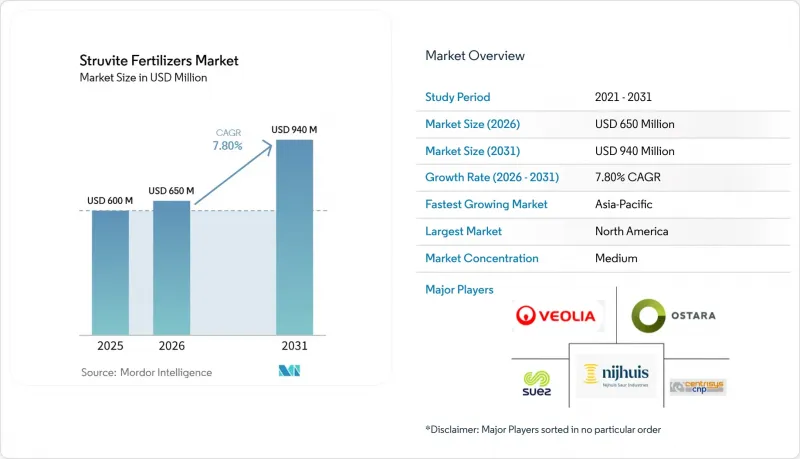
Mordor Intelligence에 의하면, 스트루바이트 비료 시장 규모는 2025년에 6억 달러로 평가되었고 2026년 6억 5,000만 달러에서 2031년까지 9억 4,000만 달러에 이를 것으로 예측되며, 예측 기간(2026-2031년) CAGR은 7.80%를 나타낼 전망입니다.
본 보고서는 제품 유형(과립형 스트루바이트, 분말형 스트루바이트, 액체형 스트루바이트), 용도(농업, 원예, 잔디 및 관상용, 기타), 작물 유형(곡물, 과일 및 채소, 기타) 및 지역(북미, 남미, 유럽, 아시아태평양, 기타)별로 분류되어 있습니다. 시장 전망은 달러(USD) 기준 금액으로 제시되어 있습니다.
세계 스트루바이트 비료 시장 동향 및 인사이트
인 공급 부족과 수입 의존
유럽에서는 비료 공급이 극히 일부 생산국에 계속 의존하고 있기 때문에 인은 전략적 원자재로 취급되고 있습니다. 2025년에는 경제적으로 채굴 가능한 매장량의 약 85%가 모로코와 서사하라에 집중되는 반면, 중국은 광산에서 시장에 이르는 공급의 대부분을 장악하고 있습니다. 이러한 집중으로 인해 수입에 의존하는 지역은 정책 전환이나 무역 혼란의 영향을 받기 쉬워지고 있습니다. 일본, 한국, 유럽, 인도에서는 채굴된 인산염의 유통에 차질이 생기면, 유틸리티체와 농업 분야 구매자 모두의 조달 계획에 즉각적인 영향이 미칠 가능성이 있습니다. 일본은 ‘비료관리법’ 개정을 통해 국내 회수 방식으로 전환하고 있으며, 동법에서는 회수된 인 제품의 ‘폐기물 종료 기준’이 정해져 있고, 폐수를 이용한 영양염 회수 시스템이 지원되고 있습니다. 도쿄도는 2024년 1월, 히가시 슬러지 처리장에서 인 회수 시설의 가동을 시작했으며, 고베시는 2027년도에 제3회수 유닛 설치를 계획하는 등 재활용 인 사업을 확대되고 있습니다. 이러한 동향은 이러한 전환이 정책 논의 단계에서 실제 처리 능력 확충 단계로 나아가고 있음을 보여줍니다. 스트루바이트 비료 시장은 이러한 동향의 혜택을 받고 있습니다. 회수된 인이 1톤 증가할 때마다 프로젝트 전체 기간 동안 수입 인광석에 대한 의존도가 낮아지기 때문입니다. 이러한 공급 안정성 측면에서의 고려는 특히 안정적인 국내 인광석 채굴이 없는 지역에서 장기적인 인수 계약을 결정하는 데 있어 점점 더 중요해지고 있습니다.
규제에 따른 영양염 회수 의무화
또한, 몇몇 주요 하수 처리 시스템에서 영양소 회수가 자발적인 노력에서 법적 준수 요건으로 전환되고 있는 점도 스트루바이트 비료 시장의 발전에 기여하고 있습니다. 독일의 개정된 ‘하수 슬러지 조례’는 인구 환산 5만 명 이상의 하수 처리장에 대해 2029년까지 하수 슬러지 내 인 함량을 최소 50% 감축하거나, 하수 슬러지 재에서 인의 80%를 회수할 것을 의무화하고 있습니다. 이 요건으로 인해 인 추출이 선택적 개선이 아닌 프로젝트의 필수 요건이 됨으로써, 스트루바이트 회수 기술로 가는 직접적인 길이 열리게 됩니다. 유럽 차원에서는 EU 비료 제품 규정 및 위임 규정(EU) 2021/2086에 따라 스트루바이트가 ‘성분 재료 카테고리 12’로 분류되어, CE 마크를 취득한 재료가 국가 간 장벽을 최소화하며 단일 시장 내에서 유통될 수 있게 되었습니다. 한국에서는 2025년 법 개정을 통해 회수된 인에 대한 ‘폐기물 종료’ 경로가 확립되었으며, 대규모 도시 하수 처리장에 대해 2030년까지 인 회수 시스템 도입이 의무화되었습니다. 이러한 규제로 인해 하수 처리 사업자는 슬러지 처리의 경제성을 관리하면서 비료 생산을 통해 2차 수익원을 창출할 수 있게 되었기 때문에 스트루바이트 비료 시장은 그 혜택을 누리고 있습니다. 규제 기한이 시설의 투자 주기와 일치할 경우, 도입은 소규모 시범 운영이 아닌 명확한 단계를 거쳐 진행되는 경향이 있으며, 이를 통해 보다 예측 가능한 생산 능력 확대가 촉진됩니다.
기존 인산 비료에 비해 높은 단가
스트루바이트 비료 시장은 대량 재배 시스템에서 기존의 인산 비료와 경쟁할 경우, 가격 면에서 분명한 과제에 직면해 있습니다. 2025년 오하이오 주립대학교의 포장 관찰에 따르면, 스트루바이트의 가격은 파운드당 0.60달러인 반면, 인산일암모늄은 파운드당 0.40-0.45달러인 것으로 보고되었습니다. 다만, 해당 연구에서는 시비량을 줄임으로써 장기적으로는 동등한 대두 수확량을 얻을 수 있을 가능성도 시사하고 있습니다. 이러한 가격 차이는 결정화 설비 비용, 마그네슘 투입 요건 및 운송 비용에서 기인합니다. 이는 많은 회수 공장이 농작물 수요 거점 근처가 아닌 폐수 처리장 부지 내에 위치해 있기 때문입니다. 이러한 장벽은 기존 인산 비료가 정부 보조금을 받고 있는 국가에서 더욱 두드러지며, 이로 인해 판매 시점의 비용 격차가 더욱 확대되기 때문입니다. 스트루바이트의 서방형 덕분에 첫 번째 재배 주기가 끝난 후에도 인의 일부가 이용 가능한 상태를 유지할 수 있어 여러 시즌에 걸쳐 비용 대비 효과를 높일 수 있지만, 이러한 가치를 연간 조달 과정에서 전달하기는 어렵습니다. 상품 구매 담당자는 일반적으로 시즌별 영양소 효율이 아닌 청구서상의 가격을 비교하기 때문에 도입이 더딘 실정입니다. 따라서 스트루바이트 비료 시장은 성능, 인증, 혹은 유출 저감과 같은 요소를 통해 높은 초기 비용을 정당화할 수 있는 용도에서 우선적으로 발전하고 있습니다. 광대한 농지에서 재배 시스템의 추가적인 보급은 대규모 농업 실증 연구의 강화나 납품 비용 격차의 축소 중 하나에 달려 있는 것으로 보입니다.
부문 분석
2025년 현재, 과립형 스트루바이트는 시장의 45.2%를 차지하며, 스트루바이트 비료 시장에서 가장 큰 제품 형태가 되었습니다. 이러한 지배적인 지위는 기존 살포기와의 직접적인 호환성, 발아 중인 작물 근처의 종자에 안전하게 시비할 수 있다는 점, 그리고 상업적 생산 시스템이 주로 펠릿 생산을 중심으로 구축되어 왔습니다는 사실에 기인합니다. 또한, 오하이오 주립대학교와 일리노이 대학교의 현장 조사 결과, 곡물 재배에서 더 적은 시비량으로도 인산일암모늄과 동등한 수확량을 얻을 수 있음이 입증되어, 이것이 입상 스트루바이트의 보급을 뒷받침하고 있습니다. 장비와의 호환성과 농업적 친화성이 결합되어, 입상 스트루바이트는 광대한 농지에서 확고한 입지를 다지고 있으며, 이것이 취급 방법의 변경을 필요로 하지 않는 농장 시스템을 통해 초기 시장 규모가 형성되어 온 이유를 설명해 줍니다.
액상 스트루바이트는 가장 빠르게 성장하는 형태이며, 이 부문은 2031년까지 연평균 성장률(CAGR) 8.8%로 확대될 것으로 예측됩니다. 이러한 성장을 주도하고 있는 것은 점적 관개 시스템을 통한 수용성 영양소 공급이 표준화된 비관개 재배를 기반으로 하는 원예 분야이며, 이는 고체 과립이 실용성이 부족하기 때문입니다. 분말형 스트루바이트는 이 두 형태 중간에 위치하며, 모종용 배지 배합이나 섬세하고 균일한 살포가 요구되는 잔디 조성용 혼합물 등 특수한 용도에 적합합니다. 또한, 유럽의 비료에 관한 통일된 체계에 따라 품질 정의 및 표시 요건에 대한 불확실성이 줄어들었기 때문에 모든 형태에 있어 제품 규제의 중요성이 높아지고 있습니다. 그 결과, 스트루바이트 비료 시장에서는 입상 형태의 대규모 시비, 액체 형태의 정밀 시비, 분말 형태의 특수 용도라는 세 가지 분야 간에 더욱 명확한 구분이 나타나고 있습니다.
지역별 분석
북미는 2025년에 35.8%의 점유율을 차지하며 스트루바이트 비료의 최대 지역 시장으로서의 지위를 유지했습니다. 이 지역은 확립된 상업적 생산과 회수 인 제품에 대한 규제 조치의 명확화에 힘입어 2031년까지 연평균 성장률(CAGR) 7.0%에서 8.0%를 나타낼 것으로 예측됩니다. 미국은 가장 발전된 상업적 기반을 갖추고 있으며, 오스탈라(Ostara)사의 세인트루이스 공장은 2025년 관세 위험을 낮춘 국내 생산 모델에 따라 중서부 및 태평양 연안 북서부 지역의 소매업체에 CG P2X를 공급하고 있습니다. 캐나다 역시 계속해서 활발한 모습을 보이고 있으며, 위니펙 등의 폐수 처리 시설 개보수 과정에서 상업적 생산을 목적으로 한 스트루바이트 추출이 포함되어 있습니다. 남미는 현재로서는 소규모 시장이지만, 대규모 농업 및 폐수 인프라 확충을 통해 향후 회수 영양소의 새로운 공급원이 탄생할 것으로 예측됩니다.
유럽에서는 규제가 시장 확대의 주요 원동력으로 계속 작용함에 따라 성장이 예상됩니다. 독일의 2029년 기한을 둔 인 회수 의무가 지자체 투자를 뒷받침하고 있으며, 브라운슈바이크와 기프호른의 P-Net 프로젝트에서는 향후 슬러지 규제치를 충족하기 위한 최적화된 침전 처리가 시험되고 있습니다. 벨기에는 유럽 상업용 스트루바이트 생산량의 약 16%에서 20%를 차지하고 있으며, NuReSys사와 AirPrex사가 생산 분야에서 확고한 입지를 구축하고 있습니다. 네덜란드에는 약 50곳의 본격적인 회수 시설이 가동 중이며, 일부 잉여 생산 능력도 존재합니다. 이는 농업용 마케팅 및 조달 채널이 개선되지 않는 한, 공급 체계의 정비가 수요 증가를 앞지르는 속도로 진행될 가능성이 있음을 시사합니다.
아시아태평양은 스트루바이트 비료 시장에서 가장 빠르게 성장하고 있는 지역으로, 2031년까지의 연평균 성장률(CAGR)은 9.5%로 예측됩니다. 일본은 2020년 ‘비료 관리법’ 개정을 통해 회수 인에 대한 명확한 오염 물질 기준이 제정되고, 국내 회수 프로젝트가 지원됨에 따라 규제 및 상업적 성숙도 측면에서 이 지역을 선도하고 있습니다. 고베시는 재활용 인 프로젝트를 확대하여 2027년도에 추가 회수 설비를 설치할 계획이며, 일본에서 지자체 규모의 회수 시스템이 이미 가동되고 있는 것으로 확인되었습니다. 인도 역시 국내 역량을 구축하고 있으며, 테르맥스(Thermax)사는 2024년 4월 푸네에 물·폐기물 솔루션 분야의 새로운 제조 시설을 개소하고, 해당 사업의 수주 잔고 목표를 1,000 카롤 루피(1억 2,000만 달러)로 설정했습니다. 중동 및 아프리카에서는 2026년 6월에 수주가 확정된 WABAG사의 일일 처리량 60 MLD 규모의 아주만 하수 바이오리파이너리 플랜트 3단계와 같은 대규모 하수 처리 프로젝트에 힘입어 시장이 확대되고 있습니다. 이는 향후 영양염 회수 시설의 병설을 뒷받침할 수 있는 인프라의 규모를 보여줍니다.
기타 혜택:
- 엑셀 형식 시장 예측(ME) 시트
- 3개월간의 애널리스트 지원
자주 묻는 질문
목차
제1장 서론
제2장 조사 방법
제3장 주요 요약
제4장 시장 구도
제5장 시장 규모와 성장 예측
제6장 경쟁 구도
제7장 시장 기회와 향후 전망
JHS 26.09.03According to Mordor Intelligence, the struvite fertilizers market size was valued at USD 600 million in 2025 and is estimated to grow from USD 650 million in 2026 to reach USD 940 million by 2031, at a CAGR of 7.80% during the forecast period (2026-2031).
This report is Segmented by Product Type (Granular Struvite, Powdered Struvite, and Liquid Struvite), by Application (Agriculture, Horticulture, Turf and Ornamental, and Others), by Crop Type (Cereals and Grains, Fruits and Vegetables, and More), and by Geography (North America, South America, Europe, Asia-Pacific, and More). The Market Forecasts are Provided in Terms of Value in USD.
Global Struvite Fertilizers Market Trends and Insights
Phosphorus Scarcity and Import Dependency
Phosphorus is treated as a strategic raw material in Europe because fertilizer supply remains tied to a narrow group of producing countries. In 2025, Around 85% of economically recoverable reserves are concentrated in Morocco and Western Sahara, while China controls a large share of mine-to-market supply. This concentration exposes import-dependent regions to policy shifts and trade disruptions. For Japan, South Korea, Europe, and India, disruptions in mined phosphate flows can quickly affect procurement planning for both utilities and agricultural buyers. Japan has moved toward domestic recovery through its revised Fertilizer Control Act, which established end-of-waste criteria for recovered phosphorus products and supported wastewater-based nutrient recovery systems. The Tokyo Metropolitan Government commissioned a phosphorus recovery facility at its Eastern Sludge Plant in January 2024, and Kobe City expanded its recycled phosphorus project with a third recovery unit planned for fiscal 2027. These developments indicate that the shift is moving beyond policy discussion into physical capacity buildout. The struvite fertilizers market is benefiting from this trend, as each additional ton of recovered phosphorus reduces reliance on imported rock phosphate throughout a project's life. This supply security consideration is becoming more important in long-term offtake decisions, particularly in regions without stable domestic phosphate mining.
Regulatory Nutrient Recovery Mandates
The struvite fertilizers market is also advancing as nutrient recovery shifts from a voluntary practice to a compliance requirement in several major wastewater systems. Germany's revised Sewage Sludge Ordinance requires wastewater treatment plants above 50,000 population equivalents to either reduce phosphorus content in sewage sludge by at least 50% or recover 80% of phosphorus from sewage sludge ash by 2029. This requirement creates a direct path for struvite recovery technologies by making phosphorus extraction a project necessity rather than a discretionary upgrade. At the European level, the EU Fertilising Products Regulation and Delegated Regulation (EU) 2021/2086 allow struvite under Component Material Category 12, enabling CE-marked material to move across the single market with fewer national barriers. South Korea's 2025 legislative revision created an end-of-waste route for recovered phosphorus and required large municipal wastewater plants to install phosphorus recovery systems by 2030. The struvite fertilizers market benefits from these regulations as wastewater operators can manage sludge handling economics while generating a secondary revenue stream from fertilizer output. When regulatory deadlines align with plant investment cycles, adoption tends to progress in defined steps rather than small trials, supporting more predictable capacity growth.
Higher Unit Cost Versus Conventional Phosphate Fertilizers
The struvite fertilizers market faces a clear pricing challenge when competing against conventional phosphate fertilizers in large-volume crop systems. A 2025 Ohio State University field observation cited struvite at USD 0.60 per pound compared with USD 0.40 to USD 0.45 per pound for monoammonium phosphate, even though the same study indicated that lower application rates could support comparable soybean yields over time. This price gap is rooted in crystallization equipment costs, magnesium input requirements, and freight burdens, as many recovery plants are located at wastewater sites rather than near crop demand centers. The barrier is more pronounced in countries where conventional phosphate fertilizers receive public subsidies, as these widen the cost gap at the point of sale. The slow-release profile of struvite can improve cost effectiveness over multiple seasons, as part of the phosphorus remains available after the first crop cycle, but this value is difficult to communicate within an annual procurement process. Commodity buyers typically compare invoice prices rather than season-by-season nutrient efficiency, which slows adoption. The struvite fertilizers market is therefore advancing first in applications where performance, certification, or runoff reduction can justify a higher upfront price. Wider adoption in broadacre crop systems will likely depend on either stronger agronomic proof at scale or a reduction in the delivered cost gap.
Other drivers and restraints analyzed in the detailed report include:
- Circular Economy Adoption in Wastewater Recovery
- Premium Demand for Low-Carbon and Organic-Approved Inputs
- Limited Farmer Familiarity and Distribution Depth
For complete list of drivers and restraints, kindly check the Table Of Contents.
Segment Analysis
Granular struvite held 45.2% of the market in 2025, making it the largest product format in the struvite fertilizers market. Its dominant position stems from direct compatibility with existing spreaders, seed-safe placement near germinating crops, and the fact that commercial production systems have been built primarily around pellet output. Granular adoption has also been supported by field research from Ohio State University and the University of Illinois, which demonstrated equivalent crop yields to monoammonium phosphate at lower application rates in cereal systems. This combination of equipment compatibility and agronomic familiarity gives granular struvite a strong position in broadacre settings and explains why early market volume has been built through farm systems that require no changes in handling practices.
Liquid struvite is the fastest-growing format, with this segment projected to expand at an 8.8% CAGR through 2031. Growth is being driven by fertigation-based horticulture, where soluble nutrient delivery via drip systems is standard, while solid granules are less practical. Powdered struvite occupies a position between these two formats, suited to specialty applications such as nursery substrate blending and turf establishment mixes where fine, even coverage is required. Product regulation is also becoming more important across all formats, as Europe's harmonized fertilizer framework reduces uncertainty around quality definitions and labeling requirements. As a result, the struvite fertilizers market is seeing a clearer separation between granular large-scale applications, liquid precision uses, and powdered specialty niches.
Complete Report Scope:
- By Product Type
- Granular Struvite
- Powdered Struvite
- Liquid Struvite
- By Application
- Agriculture
- Horticulture
- Turf and Ornamental
- Other Applications
- By Crop Type
- Cereals and Grains
- Fruits and Vegetables
- Oilseeds and Pulses
- Other Crop Types
- By Region
- North America
- United States
- Canada
- Mexico
- Rest of North America
- South America
- Brazil
- Argentina
- Rest of South America
- Europe
- Germany
- France
- United Kingdom
- Italy
- Spain
- Russia
- Turkey
- Rest of Europe
- Asia-Pacific
- China
- Japan
- India
- South Korea
- Rest of Asia-Pacific
- Middle East
- Saudi Arabia
- United Arab Emirates
- Rest of Middle East
- Africa
- South Africa
- Egypt
- Rest of Africa
- North America
Geography Analysis
North America held a 35.8% share in 2025, maintaining its position as the largest regional market for struvite fertilizers. The region is projected to expand at a CAGR of 7.0% to 8.0% through 2031, supported by established commercial production and clearer regulatory treatment for recovered phosphorus products. The United States has the most developed commercial base, with Ostara's St. Louis facility supplying CG P2X to retailers across the Midwest and Pacific Northwest under a domestic production model that reduced tariff exposure in 2025. Canada also remains active, with wastewater upgrades such as Winnipeg's incorporating struvite extraction for commercial output. South America represents a smaller market at present, but large-scale agriculture and expanding wastewater infrastructure are anticipated to create a new supply of recovered nutrients over time.
Europe is projected to grow, with regulation remaining the primary driver of market expansion. Germany's 2029 phosphorus recovery deadline is driving municipal investment, and the P-Net project at Braunschweig and Gifhorn is testing optimized precipitation to meet future sludge limits. Belgium produces an estimated 16% to 20% of Europe's commercial struvite, with NuReSys and AirPrex holding strong positions in the production landscape. The Netherlands, with around 50 full-scale recovery installations and some spare capacity, demonstrates that supply development can advance faster than offtake unless agronomic marketing and procurement channels also improve.
Asia-Pacific is the fastest-growing region in the struvite fertilizers market, with a projected CAGR of 9.5% through 2031. Japan leads the region in regulatory and commercial maturity, as its 2020 Fertilizer Control Act revision established clear contaminant limits for recovered phosphorus and supported domestic recovery projects. Kobe City expanded its recycled phosphorus project and planned an additional recovery unit for fiscal 2027, confirming that municipal-scale recovery is already operational in Japan. India is also building domestic capability, with Thermax opening a new water and waste solutions manufacturing facility in Pune in April 2024, tied to an order book target of INR 1,000 crore (USD 120 million) for the business. The Middle East and Africa are expanding supported by large wastewater projects such as WABAG's 60 MLD Ajman Sewage Biorefinery Plant Phase 3, awarded in June 2026, which illustrates the scale of infrastructure that can eventually support nutrient recovery co-location.
- Ostara Nutrient Recovery Technologies Inc.
- Veolia Water Technologies
- SUEZ Water Technologies and Solutions
- CNP - Technology Water and Biosolids Corporation
- Nijhuis Saur Industries
- AirPrex (P.C.S. Pollution Control Service GmbH)
- NuReSys
- Thermax Limited
- WABAG Group
- Xylem Inc.
Additional Benefits:
- The market estimate (ME) sheet in Excel format
- 3 months of analyst support
TABLE OF CONTENTS
1 Introduction
- 1.1 Study Assumptions and Market Definition
- 1.2 Scope of the Study
2 Research Methodology
3 Executive Summary
4 Market Landscape
- 4.1 Market Overview
- 4.2 Market Drivers
- 4.2.1 Phosphorus Scarcity and Import Dependency
- 4.2.2 Regulatory Nutrient Recovery Mandates
- 4.2.3 Circular Economy Adoption in Wastewater Recovery
- 4.2.4 Premium Demand for Low-Carbon and Organic-Approved Inputs
- 4.2.5 Process Integration Gains From Automated Nutrient Recovery
- 4.2.6 Recovered Nutrient Standardization Opening New Procurement Channels
- 4.3 Market Restraints
- 4.3.1 Higher Unit Cost Versus Conventional Phosphate Fertilizers
- 4.3.2 Limited Farmer Familiarity and Distribution Depth
- 4.3.3 Product Quality Variability and Contamination Concerns
- 4.3.4 Municipal Budget Constraints and Slow Procurement Cycles
- 4.4 Regulatory Landscape
- 4.5 Technological Outlook
- 4.6 Porter's Five Forces Analysis
- 4.6.1 Bargaining Power of Suppliers
- 4.6.2 Bargaining Power of Buyers
- 4.6.3 Threat of New Entrants
- 4.6.4 Threat of Substitutes
- 4.6.5 Intensity of Competitive Rivalry
5 Market Size And Growth Forecasts
- 5.1 By Product Type
- 5.1.1 Granular Struvite
- 5.1.2 Powdered Struvite
- 5.1.3 Liquid Struvite
- 5.2 By Application
- 5.2.1 Agriculture
- 5.2.2 Horticulture
- 5.2.3 Turf and Ornamental
- 5.2.4 Other Applications
- 5.3 By Crop Type
- 5.3.1 Cereals and Grains
- 5.3.2 Fruits and Vegetables
- 5.3.3 Oilseeds and Pulses
- 5.3.4 Other Crop Types
- 5.4 By Region
- 5.4.1 North America
- 5.4.1.1 United States
- 5.4.1.2 Canada
- 5.4.1.3 Mexico
- 5.4.1.4 Rest of North America
- 5.4.2 South America
- 5.4.2.1 Brazil
- 5.4.2.2 Argentina
- 5.4.2.3 Rest of South America
- 5.4.3 Europe
- 5.4.3.1 Germany
- 5.4.3.2 France
- 5.4.3.3 United Kingdom
- 5.4.3.4 Italy
- 5.4.3.5 Spain
- 5.4.3.6 Russia
- 5.4.3.7 Turkey
- 5.4.3.8 Rest of Europe
- 5.4.4 Asia-Pacific
- 5.4.4.1 China
- 5.4.4.2 Japan
- 5.4.4.3 India
- 5.4.4.4 South Korea
- 5.4.4.5 Rest of Asia-Pacific
- 5.4.5 Middle East
- 5.4.5.1 Saudi Arabia
- 5.4.5.2 United Arab Emirates
- 5.4.5.3 Rest of Middle East
- 5.4.6 Africa
- 5.4.6.1 South Africa
- 5.4.6.2 Egypt
- 5.4.6.3 Rest of Africa
- 5.4.1 North America
6 Competitive Landscape
- 6.1 Market Concentration
- 6.2 Strategic Moves
- 6.3 Market Share Analysis
- 6.4 Company Profiles (includes Global Level Overview, Market Level Overview, Core Segments, Financials as available, Strategic Information, Market Rank/Share, Products and Services, Recent Developments)
- 6.4.1 Ostara Nutrient Recovery Technologies Inc.
- 6.4.2 Veolia Water Technologies
- 6.4.3 SUEZ Water Technologies and Solutions
- 6.4.4 CNP - Technology Water and Biosolids Corporation
- 6.4.5 Nijhuis Saur Industries
- 6.4.6 AirPrex (P.C.S. Pollution Control Service GmbH)
- 6.4.7 NuReSys
- 6.4.8 Thermax Limited
- 6.4.9 WABAG Group
- 6.4.10 Xylem Inc.


