

|
시장보고서
상품코드
2117573
스트리밍 권리 시장 : 점유율 분석, 업계 동향과 통계, 성장 예측(2026-2031년)Streaming Rights - Market Share Analysis, Industry Trends & Statistics, Growth Forecasts (2026 - 2031) |
||||||
 Mordor Intelligence
Mordor Intelligence에 의하면, 스트리밍 권리 시장 규모는 2025년에 393억 6,000만 달러로 평가되었고 2026년 422억 4,000만 달러에서 2031년까지 600억 1,000만 달러에 이를 것으로 예측되며, 2026년부터 2031년까지의 예측 기간에서 CAGR은 7.28%를 나타낼 전망입니다.
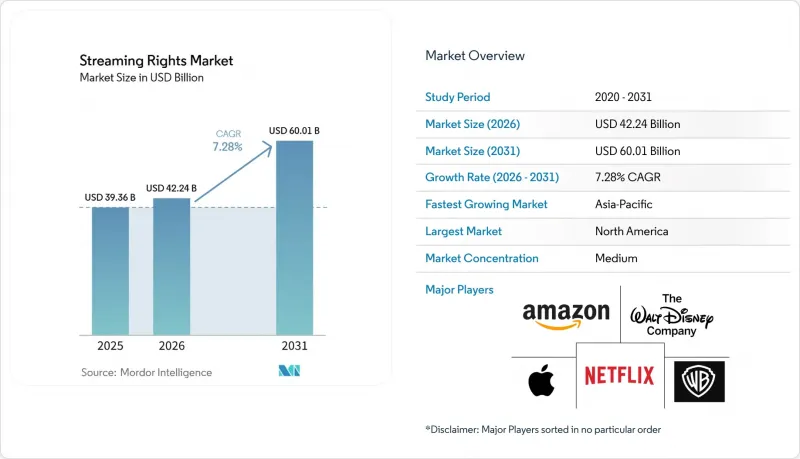
본 보고서는 권리별(독점 스트리밍 권리, 비독점 스트리밍 권리, 윈도우 방식의 스트리밍 권리), 컨텐츠 유형별(영화, TV 프로그램 및 에피소드 형식 컨텐츠, 기타), 최종 사용자별(OTT 플랫폼, 방송사, 통신 사업자 및 유료 TV 사업자, 미디어 및 엔터테인먼트 기업), 지역별(북미, 기타)로 분류되어 있습니다. 시장 예측은 금액(미 달러) 기준으로 제시되어 있습니다.
전 세계 스트리밍 권리 시장 동향 및 인사이트
스포츠 및 라이브 이벤트 독점 중계권의 프리미엄화
프리미엄 라이브 프로그램은 스트리밍 권리 시장에서 주요 경쟁 요인으로 작용하고 있습니다. 이는 독점적인 스포츠 컨텐츠가 가입자를 유치하고 해지율을 낮출 수 있기 때문입니다. Amazon Prime Video의 11년간 NBA 미디어 권리 계약은 전 세계 디지털 플랫폼이 주요 스포츠 컨텐츠에 대해 장기적인 전략을 수립하고 있음을 보여줍니다. 또한, 파라마운트+(Paramount+)도 2026년부터 미국 내 UFC의 독점 중계권을 확보함으로써, 또 하나의 주요 라이브 컨텐츠가 스트리밍 주도형 배포 모델 하에 임베디드되게 되었습니다. 권리 보유자는 주요 생중계 영상뿐만 아니라 대체 카메라 앵글, 해설 트랙, 다국어 방송, 실시간 통계, 데이터 오버레이 등도 라이선싱할 수 있습니다. 이러한 자산은 협상 가능한 권리의 범위를 넓히는 동시에, 서비스 사업자에게는 이벤트 시작 전에 제작, 방송, 권리 처리에 대한 조정을 요구하게 됩니다. 그 결과, 독점권, 패키징, 그리고 대규모의 안정적인 생중계가 더욱 중요시되고 있습니다.
FAST, AVOD 및 광고 포함 스트리밍 윈도우 확대
광고 포함 시청은 컨텐츠의 라이선싱 기간 순서를 변화시키고 있습니다. 특정 타이틀은 먼저 구독 서비스를 통해 공개된 후, 광고 포함 시청자에게 제공되고, 그 후에 더 광범위하게 라이선스가 부여되기도 합니다. 이러한 순서를 통해 권리 보유자는 조기 출시로 인한 가치를 보호하는 동시에, 광고 및 더 광범위한 배포를 통해 후속 수익을 창출할 수 있게 됩니다. Titan OS는 2026년 7월 NBC 유니버설 세계 TV 디스트리뷰션(NBC Universal Global TV Distribution)과의 계약을 통해 유럽 내 FAST 배포를 확대했습니다. 이 계약은 영국, 독일, 스페인, 이탈리아, 북유럽 국가 및 네덜란드를 대상으로 합니다. 이 협약을 통해 스튜디오, 기기 플랫폼, 광고 지원형 채널 사업자가 동일한 라이선싱 체인에 통합되는 동시에, 오래된 카탈로그 프로그램에 새로운 상업적 활용 기회가 제공됩니다.
권리 소유의 분산과 지역별 권리 처리의 복잡성
지역별 라이선싱은 여전히 전 세계 스트리밍 서비스를 복잡하게 만들고 있습니다. 공동 제작의 경우, 스트리밍 사업자가 특정 국가 이외의 권리를 취득하는 반면, 국내 방송사가 국내 권리를 보유하는 경우가 있습니다. 이러한 구조는 서비스 제공의 미흡을 초래하고, 조율된 광고나 프로모션 캠페인의 도달 범위를 좁힐 가능성이 있습니다. 개별 예외 사항마다 별도의 법적 검토, 컨텐츠 인계, 지불 조건, 규정 준수 모니터링, 그리고 서로 다른 배포 파트너와의 연락이 필요할 수 있습니다. 이러한 작업은 시장 간에 배포되는 프로그램 자체가 동일하더라도 비용 증가로 이어집니다. 따라서 스트리밍 권리 시장에서는 권리자가 보다 광범위한 배포를 목표로 할 때, 치밀한 권리 클리어런스 작업이 필수적입니다.
부문 분석
2025년, 독점 스트리밍 권리는 스트리밍 권리 시장 규모의 46.33%를 차지하며 주요 권리 범주가 되었습니다. 이러한 위상은 특히 시청자가 즉각적인 접근을 원할 때, 서비스 제공업체가 다른 곳에서는 구할 수 없는 컨텐츠를 제공할 수 있다는 가치를 반영합니다. 독점권은 가입자 확보를 촉진하며, 비독점 계약으로는 정당화할 수 없는 수준의 라이선스 비용을 정당화할 수도 있습니다. 스포츠 및 라이브 이벤트는 시간적 제약이 있는 시청자가 존재하기 때문에 프리미엄 독점 계약의 가치를 높이는 측면에서 중요합니다. 아마존과 NBA 간의 계약은 스트리밍 권리 시장에서 고가치 독점 라이브 권리에 대한 수요가 여전히 높음을 보여주었습니다.
윈도우 방식의 스트리밍 방송권은 2031년까지 연평균 성장률(CAGR) 7.76%로 확대될 것으로 예측되며, 이 권리 그룹 중 가장 높은 성장률을 보이고 있습니다. 이러한 계약을 통해 권리 소유자는 구독, 광고 포함 스트리밍, 그리고 더 광범위한 라이선싱 배포 채널을 통해 계획된 순서대로 프로그램을 배포할 수 있게 됩니다. 윈도우 기간을 단축함으로써 첫 배포 시의 가치를 유지하면서, 하나 이상의 배포 경로를 통해 수익을 창출할 수 있게 됩니다. 플랫폼 측은 장기 독점 계약을 체결하지 않고도 매력적인 컨텐츠를 확보할 수 있으므로, 권리 소유자는 이후의 배포 시기를 관리할 수 있는 여지가 넓어집니다. 비독점 계약, 재라이선스 계약, 클립 계약, 포맷 계약은 지적 재산권 라이선싱 방식을 확대하기 때문에 스트리밍 권리 시장에서 여전히 유용한 요소로 남아 있습니다.
지역별 분석
2025년, 북미는 스트리밍 권리 시장의 42.62%를 차지하며 여전히 지역별 라이선싱 기반 중 가장 큰 비중을 차지했습니다. 미국은 빈번하게 이루어지는 스포츠 중계권 갱신, 주요 플랫폼 및 스튜디오 그룹, 그리고 수많은 스트리밍 구독자 덕분에 이러한 위상을 유지하고 있습니다. 아마존의 NBA 계약과 파라마운트+의 미국 UFC 계약은 이 지역의 구매자들에게 프리미엄 스포츠가 여전히 가치 있는 자산임을 보여줍니다. 연방 통신 규제 및 저작권 사용료 체계는 디지털 배포에 적용되는 조건에 영향을 미치고 있습니다. 스포츠, 시나리오 기반 프로그램, 라이브 엔터테인먼트 분야의 활발한 경쟁이 스트리밍 권리 시장의 권리 입찰을 뒷받침하고 있습니다.
아시아태평양은 2031년까지 연평균 성장률(CAGR) 8.24%로 확대될 것으로 예측되며, 가장 빠르게 성장하는 지역이 될 전망입니다. 인도는 수요의 주요 원천으로 부상하고 있는데, 이는 현지 스포츠 중계권과 통신사의 번들 서비스를 통해 대규모 소비자층에 다양한 서비스를 제공할 수 있기 때문입니다. Jio의 2026년 OTT 번들 서비스는 통신 사업자가 모바일 접속과 엔터테인먼트 접속을 하나의 상품으로 통합할 수 있음을 보여주었습니다. 일본은 성숙한 가입자 기반을 바탕으로 프리미엄 가격 책정 및 스포츠 중심의 차별화에 중점을 두고 있는 반면, 중국, 한국, 호주, 동남아시아에서는 시청 환경과 규제 상황이 각각 다릅니다. 현지화 관련 규정, 언어 요건, 다양한 서비스 모델로 인해 스트리밍 권리 시장에서 여러 지역에 걸친 계약은 가치가 높을 뿐만 아니라 운영상의 부담도 커지고 있습니다.
유럽은 매출액 기준 2위 지역이며, 그 시청각 시장은 2024년에 1,420억 유로(1,550억 달러 상당)에 달했습니다. 유럽집행위원회의 ‘시청각 미디어 서비스 지침’ 개정은 멀티 테리토리 서비스의 현지 컨텐츠 및 투자 의무에 영향을 미칠 가능성이 있습니다. 남미에서는 스트리밍을 주축으로 한 스포츠 중계의 잠재력이 확대되고 있으며, CazeTV가 2026년 FIFA 월드컵의 전체 104경기는 물론 2026년 동계 올림픽 및 2028년 하계 올림픽의 중계권을 획득한 것이 그 한 예입니다. 중동에서는 스포츠 및 엔터테인먼트 분야에 대한 투자가 뒷받침되고 있는 반면, 아프리카는 낮은 수준에서 발전해 나가고 있어 FAST 서비스가 보다 접근하기 쉬운 진입로를 제공할 수 있는 상황입니다.
기타 혜택:
- 엑셀 형식 시장 예측(ME) 시트
- 3개월간의 애널리스트 지원
자주 묻는 질문
목차
제1장 서론
제2장 조사 방법
제3장 개요
제4장 시장 구도
제5장 시장 규모와 성장 예측
제6장 경쟁 구도
제7장 시장 기회와 향후 전망
JHS 26.09.01According to Mordor Intelligence, the streaming rights market size was valued at USD 39.36 billion in 2025 and is estimated to grow from USD 42.24 billion in 2026 to reach USD 60.01 billion by 2031, at a CAGR of 7.28% during the forecast period 2026-2031.
This report is Segmented by Rights (Exclusive Streaming Rights, Non-Exclusive Streaming Rights, and Windowed Streaming Rights), Content Type (Movies and Films, TV Shows and Episodic Content, and More), End User (OTT Platforms, Broadcasters, Telecom and Pay-TV Operators, and Media and Entertainment Companies), and Geography (North America, and More). The Market Forecasts are Provided in Terms of Value (USD).
Global Streaming Rights Market Trends and Insights
Exclusive Sports and Live Event Rights Premiumization
Premium live programming is a major source of competition in the Streaming rights market because exclusive sports can attract subscribers and reduce cancellations. Amazon Prime Video's 11-year NBA media rights agreement showed that global digital platforms are willing to take long-term positions in major sports properties. Paramount+ also secured exclusive U.S. UFC rights beginning in 2026, which brought another major live property under a streaming-led distribution model. Rights owners can license more than the primary live feed, including alternate camera angles, commentary tracks, language feeds, real-time statistics, and data overlays. These assets can widen the set of rights available for negotiation and require services to coordinate production, delivery, and clearance before an event begins. The result is greater emphasis on exclusivity, packaging, and reliable live delivery at scale.
FAST, AVOD, and Ad-Supported Window Expansion
Ad-supported viewing is changing the order in which content moves through licensing windows. A title can first appear through a subscription service, then reach ad-supported viewers, and later be licensed more broadly. This sequencing can let owners protect the value of an early release while building later revenue from advertising and wider distribution. Titan OS expanded its European FAST distribution through an agreement with NBCUniversal Global TV Distribution in July 2026. The agreement covered the United Kingdom, Germany, Spain, Italy, the Nordic markets, and the Netherlands. This arrangement brings studios, device platforms, and ad-supported channel operators into the same licensing chain while giving older catalog programs renewed commercial use.
Fragmented Rights Ownership and Territorial Clearing Complexity
Territory-by-territory licensing continues to complicate global streaming releases. A co-production may give a streamer rights outside one country while a domestic broadcaster retains the national rights. That structure can create gaps in availability and reduce the reach of a coordinated advertising or promotional campaign. Each carve-out can require separate legal review, title delivery, payment terms, compliance monitoring, and communication with a different distribution partner. These tasks add cost even when the underlying program is the same across markets. The Streaming rights market, therefore, depends on careful clearance work when owners seek wider releases.
Other drivers and restraints analyzed in the detailed report include:
- Cross-Border Localization and Multi-Territory Release Demand
- Cloud-Native Rights Operations and Automated Avails Management
- Escalating Content Licensing Costs and Margin Compression
For complete list of drivers and restraints, kindly check the Table Of Contents.
Segment Analysis
Exclusive streaming rights held 46.33% of the Streaming rights market size in 2025, making them the leading rights category. Their position reflects the value of content that a service can offer as unavailable elsewhere, particularly where viewers want immediate access. Exclusivity can support subscriber acquisition and can justify licensing fees that a non-exclusive agreement may not support. Sports and live events are important because their time-sensitive audience can make a premium, exclusive arrangement more valuable. Amazon's NBA agreement demonstrated the continued preference for high-value, exclusive live rights within the Streaming rights market.
Windowed streaming rights are projected to expand at a CAGR of 7.76% through 2031, the strongest rate in this rights group. These agreements let owners release a program through subscription, ad-supported, and broader licensing outlets in a planned sequence. A shorter window can help a title earn revenue from more than 1 route while preserving the value of its first release. Platforms can obtain appealing content without committing to a long exclusive term, which gives owners more room to manage later availability. Non-exclusive, sublicensing, clip, and format agreements remain useful parts of the Streaming rights market because they broaden the ways intellectual property can be licensed.
Complete Report Scope:
- By Rights
- Exclusive Streaming Rights
- Non-Exclusive Streaming Rights
- Windowed Streaming Rights
- Other Rights
- By Content Type
- Movies and Films
- TV Shows and Episodic Content
- Documentaries
- Other Content Types
- By End User
- OTT Streaming Platforms
- Broadcasters
- Telecom and Pay-TV Operators
- Media and Entertainment Companies
- Other End Users
- By Geography
- North America
- United States
- Canada
- Mexico
- South America
- Brazil
- Argentina
- Chile
- Rest of South America
- Europe
- Germany
- United Kingdom
- France
- Italy
- Spain
- Rest of Europe
- Asia-Pacific
- China
- Japan
- India
- South Korea
- Australia
- Rest of Asia-Pacific
- Middle East
- Saudi Arabia
- United Arab Emirates
- Qatar
- Rest of Middle East
- Africa
- South Africa
- Egypt
- Nigeria
- Rest of Africa
- North America
Geography Analysis
North America held 42.62% of the Streaming rights market in 2025 and remained the largest regional licensing base. The United States supports this position through frequent sports renewals, major platform-studio groups, and a large group of streaming subscribers. Amazon's NBA agreement and Paramount+'s U.S. UFC agreement show the continued value of premium sports to regional buyers. Federal communications and copyright royalty frameworks affect the terms used for digital distribution. Active competition across sports, scripted programming, and live entertainment sustains rights bidding in the Streaming rights market.
Asia-Pacific is projected to expand at a CAGR of 8.24% through 2031, making it the fastest-growing geography. India is a major source of demand because local sports rights and telecom bundles can bring several services to a large consumer base. Jio's 2026 OTT bundle showed how connectivity providers can combine mobile access and entertainment access in one offer. Japan relies more on premium pricing and sports-led differentiation within a mature subscriber base, while China, South Korea, Australia, and Southeast Asia have distinct viewing and regulatory conditions. Localization rules, language needs, and varied service models make multi-territory agreements valuable but operationally demanding for the Streaming rights market.
Europe is the second-largest region by revenue, and its audiovisual market reached EUR 142 billion, equivalent to USD 155 billion, in 2024. The European Commission's review of the Audiovisual Media Services Directive can affect local content and investment duties for multi-territory services. South America has growing potential for streaming-first sports distribution, illustrated by CazeTV's rights to all 104 matches of the 2026 FIFA World Cup and to the 2026 Winter Olympics and 2028 Summer Olympics. The Middle East is supported by sports and entertainment investment, while Africa is developing from a lower base where FAST services can offer a more accessible entry point.
- Netflix, Inc.
- The Walt Disney Company
- Warner Bros. Discovery, Inc.
- Amazon.com, Inc.
- Apple Inc.
- Alphabet Inc.
- Paramount Global
- Comcast Corporation
- Fox Corporation
- Spotify Technology S.A.
- Sony Group Corporation
- TelevisaUnivision, Inc.
- Viaplay Group AB
- DAZN Group Limited
- beIN MEDIA GROUP
- Vubiquity, Inc.
- Rightsline, Inc.
- Whip Media Group, Inc.
- FADEL, Inc.
- Vistex, Inc.
Additional Benefits:
- The market estimate (ME) sheet in Excel format
- 3 months of analyst support
TABLE OF CONTENTS
1 INTRODUCTION
- 1.1 Study Assumptions and Market Definition
- 1.2 Scope of the Study
2 RESEARCH METHODOLOGY
3 EXECUTIVE SUMMARY
4 MARKET LANDSCAPE
- 4.1 Market Overview
- 4.2 Market Drivers
- 4.2.1 Exclusive Sports and Live Event Rights Premiumization
- 4.2.2 FAST, AVOD, and Ad-Supported Window Expansion
- 4.2.3 Cross-Border Localization and Multi-Territory Release Demand
- 4.2.4 Cloud-Native Rights Operations and Automated Avails Management
- 4.2.5 AI-Powered Metadata, Fingerprinting, and Rights Matching
- 4.2.6 Bundled Distribution Deals Across Telco and Streaming Ecosystems
- 4.3 Market Restraints
- 4.3.1 Fragmented Rights Ownership and Territorial Clearing Complexity
- 4.3.2 Escalating Content Licensing Costs and Margin Compression
- 4.3.3 Persistent Piracy, Leakage, and Unauthorized Restreaming
- 4.3.4 Data Privacy, Localization, and Compliance Burden
- 4.4 Industry Value Chain Analysis
- 4.5 Regulatory Landscape
- 4.6 Technological Outlook
- 4.7 Impact of Macroeconomic Factors on the Market
- 4.8 Porter's Five Forces Analysis
- 4.8.1 Bargaining Power of Suppliers
- 4.8.2 Bargaining Power of Buyers
- 4.8.3 Threat of New Entrants
- 4.8.4 Threat of Substitutes
- 4.8.5 Competitive Rivalry
5 MARKET SIZE AND GROWTH FORECASTS (VALUE)
- 5.1 By Rights
- 5.1.1 Exclusive Streaming Rights
- 5.1.2 Non-Exclusive Streaming Rights
- 5.1.3 Windowed Streaming Rights
- 5.1.4 Other Rights
- 5.2 By Content Type
- 5.2.1 Movies and Films
- 5.2.2 TV Shows and Episodic Content
- 5.2.3 Documentaries
- 5.2.4 Other Content Types
- 5.3 By End User
- 5.3.1 OTT Streaming Platforms
- 5.3.2 Broadcasters
- 5.3.3 Telecom and Pay-TV Operators
- 5.3.4 Media and Entertainment Companies
- 5.3.5 Other End Users
- 5.4 By Geography
- 5.4.1 North America
- 5.4.1.1 United States
- 5.4.1.2 Canada
- 5.4.1.3 Mexico
- 5.4.2 South America
- 5.4.2.1 Brazil
- 5.4.2.2 Argentina
- 5.4.2.3 Chile
- 5.4.2.4 Rest of South America
- 5.4.3 Europe
- 5.4.3.1 Germany
- 5.4.3.2 United Kingdom
- 5.4.3.3 France
- 5.4.3.4 Italy
- 5.4.3.5 Spain
- 5.4.3.6 Rest of Europe
- 5.4.4 Asia-Pacific
- 5.4.4.1 China
- 5.4.4.2 Japan
- 5.4.4.3 India
- 5.4.4.4 South Korea
- 5.4.4.5 Australia
- 5.4.4.6 Rest of Asia-Pacific
- 5.4.5 Middle East
- 5.4.5.1 Saudi Arabia
- 5.4.5.2 United Arab Emirates
- 5.4.5.3 Qatar
- 5.4.5.4 Rest of Middle East
- 5.4.6 Africa
- 5.4.6.1 South Africa
- 5.4.6.2 Egypt
- 5.4.6.3 Nigeria
- 5.4.6.4 Rest of Africa
- 5.4.1 North America
6 COMPETITIVE LANDSCAPE
- 6.1 Market Concentration
- 6.2 Strategic Moves
- 6.3 Vendor Positioning Analysis
- 6.4 Company Profiles (includes Global Level Overview, Market Level Overview, Core Segments, Financials as available, Strategic Information, Products and Services, Recent Developments)
- 6.4.1 Netflix, Inc.
- 6.4.2 The Walt Disney Company
- 6.4.3 Warner Bros. Discovery, Inc.
- 6.4.4 Amazon.com, Inc.
- 6.4.5 Apple Inc.
- 6.4.6 Alphabet Inc.
- 6.4.7 Paramount Global
- 6.4.8 Comcast Corporation
- 6.4.9 Fox Corporation
- 6.4.10 Spotify Technology S.A.
- 6.4.11 Sony Group Corporation
- 6.4.12 TelevisaUnivision, Inc.
- 6.4.13 Viaplay Group AB
- 6.4.14 DAZN Group Limited
- 6.4.15 beIN MEDIA GROUP
- 6.4.16 Vubiquity, Inc.
- 6.4.17 Rightsline, Inc.
- 6.4.18 Whip Media Group, Inc.
- 6.4.19 FADEL, Inc.
- 6.4.20 Vistex, Inc.
7 MARKET OPPORTUNITIES AND FUTURE OUTLOOK
- 7.1 White-Space and Unmet-Need Assessment


