

|
시장보고서
상품코드
2117585
미디어 측정 소프트웨어 시장 : 점유율 분석, 업계 동향과 통계, 성장 예측(2026-2031년)Media Measurement Software - Market Share Analysis, Industry Trends & Statistics, Growth Forecasts (2026 - 2031) |
||||||
 Mordor Intelligence
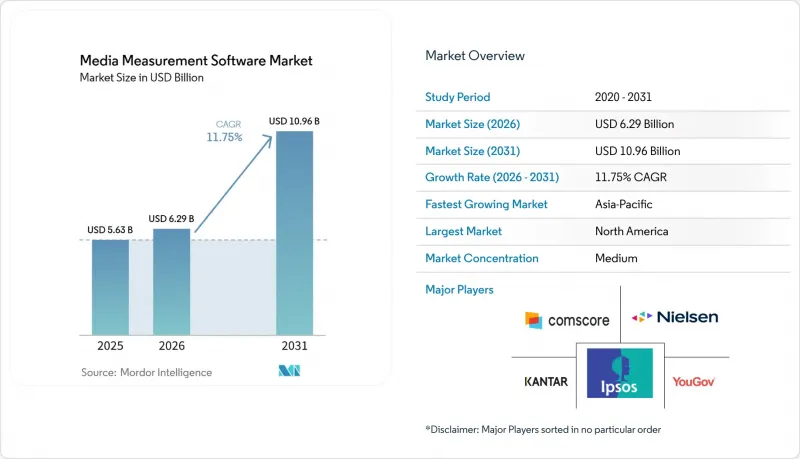
Mordor Intelligence에 의하면, 미디어 측정 소프트웨어 시장 규모는 2025년에 56억 3,000만 달러, 2026년에 62억 9,000만 달러가 되고, 2026년부터 2031년까지 CAGR 11.75%로 확대되어 2031년까지 109억 6,000만 달러에 이를 것으로 예측됩니다.
본 보고서는 도입 형태(클라우드 기반 및 On-Premise형), 조직 규모(대기업 및 중소기업), 용도(오디언스 측정·분석, 미디어 플래닝 등), 최종 사용자 산업(광고 대행사 등), 그리고 지역별로 분류되어 있습니다. 시장 예측은 금액(달러) 기준으로 제시되어 있습니다.
세계 미디어 측정 소프트웨어 시장 동향 및 인사이트
크로스 채널 어트리뷰션 및 통합 보고서에 대한 수요 증가
미디어 측정 소프트웨어 시장에서는 선형 TV, 커넥티드 TV, 디지털 비디오, 소셜 미디어, 리테일 미디어를 아우르는 단일 보고서 보기를 제공할 수 있는 플랫폼에 대한 수요가 증가하고 있습니다. 보고서의 파편화는 의사 결정을 지연시키고 채널 간의 비교 가능성을 저해하기 때문에 구매자들은 더 이상 시청자 보고서, 어트리뷰션, 캠페인 평가를 위해 별도의 시스템을 필요로 하지 않게 되었습니다. 미국 합동 산업 위원회(JIC)가 2025년 7월에 실시한 중간 감사에서는 콤스코어(Comscore), iSpot, VideoAmp에 대한 완전한 인증 및 통화 등급 준비 상태가 재확인되어, 인증된 크로스 플랫폼 측정 시스템에 대한 신뢰가 높아졌습니다. 또한 닐슨(Nielsen)도 2025년 7월, ‘아웃컴즈 마켓플레이스(Outcomes Marketplace)’를 통해 통합 보고서의 범위를 확대하고, 브랜드, 매출, 주목도, 전환에 관한 파트너 지표를 ‘닐슨 원(Nielsen ONE)’ 환경에 통합했습니다. 일본에서는 하쿠호도 DY 그룹이 구글의 메리디안(Meridian) 프레임워크와 애널리틱스 AaaS를 통합한 사례를 통해, 광고 대행사 역시 크로스 채널 ROI 분석을 예산 계획과 더욱 밀접하게 연계하는 통합 측정 프레임워크를 구축하고 있음을 보여주었습니다.
AI를 활용한 오디언스 인사이트 및 자동화된 인사이트 생성
미디어 측정 소프트웨어 시장은 정적인 대시보드에서 벗어나, 오디언스의 신호를 해석하여 의사결정에 직접 연결되는 결과를 생성하는 시스템으로 전환되고 있습니다. 어도비는 2026년 4월, Semrush의 기능을 통합한 ‘Brand Intelligence’를 도입하여 측정 범위를 AI를 활용한 검색 가시성까지 확대하는 동시에, 이러한 관점을 캠페인 관리 워크플로우에 연계했습니다. NIQ는 2026년 6월, 마케팅 효과 측정을 위한 복합 AI 운영 체제인 ‘NIQ Cadence’를 도입하며, 고립된 분석 도구에서 지속적인 의사 결정 환경으로의 광범위한 전환을 시사했습니다. Meltwater와 Sprout Social은 모두 2026년에 에이전트형 AI 기능을 확충하여, 자동화된 보고서 작성, 신호 추출 및 안내형 조치가 더 이상 선택적 부가 기능이 아니라 제품에 요구되는 핵심 기능이 되었음을 보여주었습니다. Cision이 2026년 7월에 발표한 ‘AI Visibility Dashboard’는 커뮤니케이션 팀이 AI 응답 화면 전반에서 브랜드가 어떻게 표시되고 있는지 모니터링할 수 있도록 지원함으로써 또 다른 차원을 더했습니다. 이는 오디언스 인사이트 생성이 기존 미디어 채널을 넘어 확대되고 있음을 보여줍니다.
엔터프라이즈급 제품군의 높은 총 소유 비용
미디어 측정 소프트웨어 시장은 여전히 엔터프라이즈급 구매자에게 큰 운영 부담을 주고 있습니다. 그 이유는 도입에 일반적으로 기획, 오디언스, 보고 및 사내 데이터 시스템 간의 통합이 필요하기 때문입니다. 플랫폼은 기존의 미디어 워크플로우와 의사결정 구조에 부합해야 하므로, 도입은 단순한 소프트웨어 구매 그 이상의 의미를 갖습니다. 2026년 6월 닐슨이 Mediaocean Prisma와 통합을 단행한 것은 엔터프라이즈급 구매자들이 측정 시스템을 기존 구매 플랫폼 외부에 두기보다는 이들과 직접 연동하기를 기대하고 있음을 보여줍니다. 2026년 4월 어도비가 Semrush의 기능을 통합하여 출시한 ‘Brand Intelligence’도 유사한 추세를 보여주고 있으며, 그 가치는 인접한 인텔리전스 계층을 보다 광범위한 운영 환경에 연결하는 데 달려 있습니다. 이로 인해 구현 범위가 넓은 대형 벤더들이 유리한 입지를 차지하게 되며, 미디어 측정 소프트웨어 시장에서 소규모 조직의 경우 조달 프로세스가 더 느려지고 부담이 커지게 됩니다.
부문 분석
클라우드 기반 부문은 2025년 미디어 측정 소프트웨어 시장 규모의 82.36%를 차지하고 있으며, 2031년까지 연평균 성장률(CAGR) 13.06%를 나타낼 것으로 예측됩니다. 구매자들이 릴리스 주기의 느린 속도에 의존하지 않고 스트리밍 플랫폼, 커넥티드 TV, 리테일 미디어, 소셜 채널, 웹 환경에서 발생하는 신호를 확장 가능하게 수집하기를 원하기 때문에 클라우드는 기본 아키텍처로 자리 잡았습니다. 2026년에 어도비, 스프라웃 소셜, 멜트워터, 시시온에서 출시된 모든 제품은 AI 기능, 보고서 보기, 브랜드 시각화 도구를 거의 실시간으로 추가할 수 있는 지속적으로 업데이트되는 소프트웨어 환경을 특징으로 했습니다. 이 도입 모델은 더 광범위한 API 기반의 상호 운용성도 지원합니다. 이는 미디어 측정 소프트웨어 시장이 현재 여러 시스템에 걸친 오디언스 데이터, 기획 도구, 성과 분석의 연동에 의존하고 있다는 점에서 중요한 의미를 지닙니다.
On-Premise 배포는 여전히 존재 의의가 있습니다. 특히 내부 보안 기준이나 데이터 상주 요건으로 인해 외부 처리가 제한되는 경우에는 더욱 그렇습니다. 따라서 미디어 측정 소프트웨어 시장에서 클라우드가 선호되는 모델이 되었다고 해도, 클라우드로 인해 로컬 관리 요건이 사라지는 것은 아닙니다. W3C와 FTC가 시사하는 개인정보 보호에 관한 방향성은 이러한 혼합적인 관점을 뒷받침합니다. 구매자들은 보고서의 연속성을 해치지 않으면서도 동의 제한이나 지역 규정을 준수할 수 있는 유연한 아키텍처를 원하기 때문입니다. 또한, 클라우드 기반 플랫폼은 빈번한 AI 기능 출시를 지원하는 데에도 유리한 입장에 있어, 미디어 측정 소프트웨어 시장의 다음 단계에서 주요 제공 모델로서의 역할을 강화하고 있습니다. 그 결과, 클라우드가 표준이 되고, 하이브리드 모델은 여전히 중요하게 여겨지며, 순수한 On-Premise 환경은 점점 더 제한된 이용 사례로 국한되는 시장이 형성되고 있습니다.
2025년, 대기업은 미디어 측정 소프트웨어 시장의 66.57%를 차지하고 있으며, 이는 지역, 채널, 브랜드 및 보고 팀 전반에 걸쳐 캠페인을 관리해야 할 필요성을 반영한 것입니다. 대규모 고객은 일반적으로 고도의 시스템 통합, 광범위한 대상층 커버리지, 그리고 다수의 내부 이해관계자에 걸친 일관된 보고서 정의를 필요로 합니다. 2026년 6월 닐슨이 Mediaocean Prisma와 통합한 사례는 이러한 구매자들이 공급업체에 기대하는 워크플로우 연계 수준을 여실히 보여줍니다. 또한, 이러한 고객들은 조달의 안정성, 조사 방법의 투명성, 거버넌스 관리를 더욱 중시하고 있어, 미디어 측정 소프트웨어 시장에서 오랜 운영 실적과 탄탄한 제품 라인업을 갖춘 공급업체가 유리한 위치에 서는 경향이 있습니다.
중소기업(SME) 시장은 2031년까지 연평균 성장률(CAGR) 13.64%로 확대될 것으로 예측되며, 이는 매출 측면에서는 여전히 대기업 수요가 지배적임에도 불구하고 진입 장벽이 완화되고 있음을 보여줍니다. 미디어 측정 소프트웨어 업계에서는 AI를 활용한 워크플로우와 SaaS 기반 제공으로 인해 도입 시 대규모 사내 애널리스트 팀이 필요하지 않게 되면서, 대상 고객 기반이 확대되고 있습니다. Sprout Social은 2026년 5월 주요 워크플로우 전반에 걸쳐 Trellis의 적용 범위를 확대했으며, 2026년 7월부터는 모든 고객에게 이 엔진을 제공하기 시작했습니다. 이는 보다 이용하기 쉬운 자동화로의 전환을 촉진하는 것입니다. Meltwater와 Cision도 2026년에 AI 주도형 모니터링 및 보고 기능을 확충하여, 이를 통해 소규모 조직에서도 수작업의 부담을 최소화하면서 보다 실질적인 성과를 얻을 수 있게 되었습니다. 이로 인해 가장 큰 예산은 여전히 대기업에 집중되어 있지만, 중소기업이 성장 주기의 초기 단계에서 미디어 측정 소프트웨어 시장에 진입할 여지가 생겼습니다.
지역별 분석
2025년, 북미는 미디어 측정 소프트웨어 시장 점유율의 34.97%를 차지하며 여전히 최대 지역으로서의 위상을 유지했습니다. 이 지역은 전국 규모의 TV 광고주가 밀집해 있고, 성숙한 프로그래매틱 바이잉 생태계, 그리고 다른 지역에 비해 더 발전된 다중 통화 지원 TV 측정 구조와 같은 이점을 누리고 있습니다. 미국 합동 산업 위원회(U.S. Joint Industry Committee)가 2025년 7월에 실시한 중간 감사에서는 컴스코어(Comscore), iSpot, VideoAmp에 대한 완전한 인증이 재확인되어, 미국 측정 환경의 제도적 완비도가 부각되었습니다. 또한 북미는 측정과 미디어 운영을 연결하는 제품 출시의 중심지로서의 위치를 계속 유지하고 있으며, 여기에는 닐슨(Nielsen)의 Mediaocean Prisma와의 통합 및 ‘Predictive Sales Lift’의 전개 등이 포함됩니다. 유럽은 개인정보 보호 규정 및 동의 처리가 해당 지역을 훨씬 넘어 플랫폼 아키텍처와 조달 기준을 계속해서 형성하고 있기 때문에 여전히 강력한 제2의 지역으로 자리 잡고 있습니다.
아시아태평양은 2031년까지 연평균 성장률(CAGR) 16.83%를 나타낼 것으로 예측되며, 미디어 측정 소프트웨어 시장에서 가장 두드러진 성장을 보이는 지역입니다. 이 지역에서는 모바일 우선 광고 행동, 확대되는 리테일 미디어 활동, 그리고 광고 규모에 걸맞은 더 우수한 크로스 플랫폼 측정에 대한 명확한 수요가 결합되어 있습니다. 2026년 6월 닐슨이 일본에서 ‘4스크린 광고 중복 제거’ 서비스를 시작한 것은 세계 벤더들이 이 지역을 단순한 판매 시장이 아닌 제품 개발의 우선 대상으로 삼고 있음을 보여줍니다. 또한, 2025년 1월 하쿠호도 DY 그룹이 ‘Meridian’ 기반의 Analytics AaaS를 발표한 것은 해당 지역의 에이전시들이 수입된 프레임워크에만 의존하지 않고 독자적인 측정 인프라를 구축해 나가고 있음을 보여줍니다. 중국은 주요 디지털 플랫폼이 ‘월드가든’ 방식으로 운영되고 있어 구조적으로 복잡한 상황이 지속되고 있지만, 인도, 한국, 호주, 동남아시아에서는 클라우드 기반의 어트리뷰션 및 오디언스 도구에 대한 수요가 증가하고 있습니다.
남미, 중동 및 아프리카에서는 수요 성숙도가 아직 초기 단계에 있지만, 미디어 측정 소프트웨어 시장의 장기적인 전망에서 이 지역들은 여전히 중요한 위치를 차지하고 있습니다. 브라질은 광고주가 감사 가능한 측정 체계를 평가하도록 장려하는 보다 공식적인 개인정보 보호 및 규정 준수 환경을 통해 남미를 주도하고 있습니다. 중동에서는 사우디아라비아와 UAE가 미디어 및 엔터테인먼트의 확장을 중심으로 새로운 수요를 창출하고 있으며, 이는 오디언스 측정 및 캠페인 분석에 대한 필요성을 뒷받침하고 있습니다. 아프리카는 전반적으로 아직 성숙도가 낮은 편이지만, 모바일 우선 이용 패턴과 남아프리카공화국의 보다 발전된 광고 생태계가 미디어 측정 소프트웨어 시장의 향후 성장을 위한 현실적인 출발점이 되고 있습니다.
기타 혜택:
- 엑셀 형식 시장 예측(ME) 시트
- 3개월간의 애널리스트 지원
자주 묻는 질문
목차
제1장 서론
제2장 조사 방법
제3장 개요
제4장 시장 구도
제5장 시장 규모와 성장 예측
제6장 경쟁 구도
제7장 시장 기회와 향후 전망
JHS 26.09.01According to Mordor Intelligence, the media measurement software market size was USD 5.63 billion in 2025, and USD 6.29 billion in 2026, and is forecast to reach USD 10.96 billion by 2031, at a CAGR of 11.75% during 2026-2031.
This report is Segmented by Deployment Mode (Cloud-Based, and On-Premises), Organization Size (Large Enterprises, and Small and Medium Enterprises), Application (Audience Measurement and Analytics, Media Planning, and More), End User Industry (Advertising Agencies, and More), and Geography. The Market Forecasts are Provided in Terms of Value (USD).
Global Media Measurement Software Market Trends and Insights
Rising Demand for Cross-Channel Attribution and Unified Reporting
The media measurement software market is seeing stronger demand for platforms that can present one reporting view across linear TV, connected TV, digital video, social media, and retail media. Buyers no longer want separate systems for audience reporting, attribution, and campaign evaluation because fragmented reporting slows decision-making and weakens comparability across channels. The U.S. Joint Industry Committee's July 2025 mid-term audit reaffirmed full certification and currency-grade readiness for Comscore, iSpot, and VideoAmp, which strengthened confidence in accredited cross-platform measurement systems. Nielsen also widened the scope of unified reporting in July 2025 through its Outcomes Marketplace, which brought partner metrics for brand, sales, attention, and conversion into the Nielsen ONE environment. In Japan, Hakuhodo DY Group's Analytics AaaS integration with Google's Meridian framework showed that agencies are also building unified measurement frameworks that tie cross-channel ROI work more closely to budget planning.
AI-Enabled Audience Insights and Automated Insight Generation
The media measurement software market is moving from static dashboards toward systems that interpret audience signals and return decision-ready outputs. Adobe introduced Brand Intelligence in April 2026 after integrating Semrush capabilities, extending measurement to AI-powered search visibility and connecting that view to campaign management workflows. NIQ introduced NIQ Cadence in June 2026 as a compound AI operating system for marketing effectiveness, signaling a broader shift from isolated analytics tools to continuous decision environments. Meltwater and Sprout Social both expanded agentic AI features in 2026, showing that automated reporting, signal extraction, and guided action are now core product expectations rather than optional add-ons. Cision's July 2026 AI Visibility Dashboard added another layer by helping communications teams monitor how brands appear across AI answer surfaces, which shows how audience insight generation is expanding beyond traditional media channels.
High Total Cost of Ownership for Enterprise-Grade Suites
The media measurement software market still carries a heavy operating burden for enterprise buyers because adoption usually requires integration across planning, audience, reporting, and internal data systems. This makes deployment more than a software purchase, because the platform must fit existing media workflows and decision-making structures. Nielsen's June 2026 integration with Mediaocean Prisma shows how enterprise buyers expect measurement systems to connect directly with established buying platforms rather than sit outside them. Adobe's April 2026 Brand Intelligence launch, built after integrating Semrush capabilities, points to the same pattern, where value depends on tying adjacent intelligence layers into a broader operating environment. This favors larger vendors with broader implementation depth and makes procurement slower and heavier for smaller organizations in the media measurement software market.
Other drivers and restraints analyzed in the detailed report include:
- Shift Toward Privacy-Safe First-Party Measurement
- Growing Need for Real-Time Campaign Optimization
- Data Privacy and Consent Compliance Constraints
For complete list of drivers and restraints, kindly check the Table Of Contents.
Segment Analysis
The cloud-based segment accounted for 82.36% of the media measurement software market size in 2025 and is projected to grow at 13.06% CAGR through 2031. Cloud has become the default architecture because buyers want scalable ingestion of signals from streaming platforms, connected TV, retail media, social channels, and web environments without relying on slow release cycles. Product launches in 2026 from Adobe, Sprout Social, Meltwater, and Cision all pointed to continuously updated software environments where AI features, reporting views, and brand visibility tools can be added in near real time. This deployment model also supports broader API-based interoperability, which matters because the media measurement software market now depends on linking audience data, planning tools, and outcome analysis across more than one system.
On-premises deployments still have a place, especially where internal security standards or data residency demands limit external processing. That is why cloud does not eliminate local control requirements, even though it has become the preferred model in the media measurement software market. The privacy direction signaled by the W3C and FTC supports this mixed view because buyers want flexible architectures that can handle consent limits and regional rules without losing reporting continuity. Cloud-based platforms are also better positioned to support frequent AI feature releases, which strengthens their role as the main delivery model for the next phase of the media measurement software market. The result is a market where cloud is standard, hybrid models remain relevant, and pure on-premises setups are increasingly limited to narrower use cases.
Large enterprises held 66.57% of the media measurement software market in 2025, which reflected their need to manage campaigns across geographies, channels, brands, and reporting teams. Large accounts usually require deep systems integration, broad audience coverage, and consistent reporting definitions across many internal stakeholders. Nielsen's June 2026 integration with Mediaocean Prisma illustrates the level of workflow connection these buyers expect from their vendors. These clients also place greater value on procurement stability, methodological transparency, and governance controls, which tends to favor providers with longer operating histories and deeper product stacks in the media measurement software market.
SMEs are projected to expand at 13.64% CAGR through 2031, which shows how access barriers are easing even though enterprise demand still dominates revenue. The media measurement software industry is widening its addressable base because AI-supported workflows and SaaS delivery reduce the need for large in-house analyst teams at the point of adoption. Sprout Social expanded Trellis across key workflows in May 2026 and made the engine available to all customers from July 2026, which supports the move toward more accessible automation. Meltwater and Cision also expanded AI-led monitoring and reporting features in 2026, which helps smaller organizations get more usable outputs from fewer manual steps. This creates room for SMEs to adopt the media measurement software market earlier in their growth cycle, even if the largest budgets still sit with enterprises.
Complete Report Scope:
- By Deployment Mode
- Cloud-Based
- On-Premises
- By Organization Size
- Large Enterprises
- Small and Medium Enterprises
- By Application
- Audience Measurement and Analytics
- Media Planning and Campaign Optimization
- Attribution and Marketing Performance Measurement
- Competitive Intelligence and Benchmarking
- Cross Platform Media Monitoring
- Other Applications
- By End User Industry
- Advertising Agencies
- Media and Entertainment
- Publishers and Broadcasters
- Retail and Consumer Brands
- Banking, Financial Services, and Insurance (BFSI)
- Healthcare and Life Sciences
- IT and Telecommunication
- Other End User Industries
- By Geography
- North America
- United States
- Canada
- Mexico
- South America
- Brazil
- Argentina
- Rest of South America
- Europe
- United Kingdom
- Germany
- France
- Italy
- Spain
- Russia
- Rest of Europe
- Asia-Pacific
- China
- India
- Japan
- South Korea
- Australia
- Rest of Asia-Pacific
- Middle East and Africa
- Middle East
- Turkey
- Saudi Arabia
- United Arab Emirates
- Rest of Middle East
- Africa
- South Africa
- Egypt
- Rest of Africa
- Middle East
- North America
Geography Analysis
North America held 34.97% of the media measurement software market share in 2025, which kept it as the largest regional position. The region benefits from a dense base of national TV advertisers, mature programmatic buying ecosystems, and a more developed multi-currency television measurement structure than other regions. The U.S. Joint Industry Committee's July 2025 mid-term audit reaffirmed full certification for Comscore, iSpot, and VideoAmp, which underscored the institutional depth of the U.S. measurement environment. North America also remains central to product launches that connect measurement to media execution, including Nielsen's integration with Mediaocean Prisma and its rollout of Predictive Sales Lift. Europe remained a strong secondary region because privacy regulation and consent handling there continue to shape platform architecture and procurement standards far beyond the region itself.
Asia-Pacific is projected to grow at 16.83% CAGR through 2031, which makes it the fastest-growing geography in the media measurement software market. The region combines mobile-first advertising behavior, expanding retail media activity, and a clear need for better cross-platform measurement relative to advertising scale. Nielsen's June 2026 Four-Screen Ad Deduplication launch in Japan showed that global vendors are treating the region as a product priority rather than only a sales market. Hakuhodo DY Group's January 2025 Meridian-based Analytics AaaS also showed that regional agencies are building proprietary measurement infrastructure instead of relying only on imported frameworks. China remains structurally complex because major digital platforms operate as walled gardens, while India, South Korea, Australia, and Southeast Asia are creating more demand for cloud-based attribution and audience tools.
South America, the Middle East, and Africa represent an earlier-stage demand profile, but they still matter to the long-term outlook for the media measurement software market. Brazil leads South America through a more formal privacy and compliance environment that encourages advertisers to evaluate auditable measurement setups. In the Middle East, Saudi Arabia and the UAE are building new demand around media and entertainment expansion, which supports audience measurement and campaign analytics needs. Africa remains less mature overall, but mobile-first usage patterns and South Africa's more developed advertising ecosystem create a practical starting point for future growth in the media measurement software market.
- Nielsen Holdings plc
- Kantar Group Ltd.
- Ipsos Group S.A.
- Comscore, Inc.
- YouGov plc
- Similarweb Ltd.
- Talkwalker S.A.
- Sprinklr, Inc.
- Meltwater N.V.
- Cision Ltd.
- NetBase Quid, Inc.
- Sprout Social, Inc.
- HubSpot, Inc.
- Adobe Inc.
- The Trade Desk, Inc.
- Oracle Corporation
- IBM Corporation
- Microsoft Corporation
- VideoAmp, Inc.
- iSpot.tv, Inc.
- Zappi Ltd.
- Innovid Corp.
Additional Benefits:
- The market estimate (ME) sheet in Excel format
- 3 months of analyst support
TABLE OF CONTENTS
1 INTRODUCTION
- 1.1 Study Assumptions and Market Definition
- 1.2 Scope of the Study
2 RESEARCH METHODOLOGY
3 EXECUTIVE SUMMARY
4 MARKET LANDSCAPE
- 4.1 Market Overview
- 4.2 Market Drivers
- 4.2.1 Rising Demand for Cross-Channel Attribution and Unified Reporting
- 4.2.2 AI-Enabled Audience Insights and Automated Insight Generation
- 4.2.3 Shift Toward Privacy-Safe First-Party Measurement
- 4.2.4 Growing Need for Real-Time Campaign Optimization
- 4.2.5 Enterprise Migration to Cloud-Native Measurement Platforms
- 4.2.6 Increasing Media Fragmentation Across Streaming, Social, and Retail Media
- 4.3 Market Restraints
- 4.3.1 High Total Cost of Ownership for Enterprise-Grade Suites
- 4.3.2 Data Privacy and Consent Compliance Constraints
- 4.3.3 API Dependency and Platform Access Volatility
- 4.3.4 Measurement Fragmentation Across Walled Gardens
- 4.4 Industry Value-Chain Analysis
- 4.5 Technology Outlook
- 4.6 Regulatory Landscape
- 4.7 Porter's Five Forces Analysis
- 4.7.1 Bargaining Power of Buyers
- 4.7.2 Bargaining Power of Suppliers
- 4.7.3 Threat of New Entrants
- 4.7.4 Threat of Substitutes
- 4.7.5 Intensity of Competitive Rivalry
- 4.8 Impact of Macroeconomic Factors on the Market
5 MARKET SIZE AND GROWTH FORECASTS (VALUE)
- 5.1 By Deployment Mode
- 5.1.1 Cloud-Based
- 5.1.2 On-Premises
- 5.2 By Organization Size
- 5.2.1 Large Enterprises
- 5.2.2 Small and Medium Enterprises
- 5.3 By Application
- 5.3.1 Audience Measurement and Analytics
- 5.3.2 Media Planning and Campaign Optimization
- 5.3.3 Attribution and Marketing Performance Measurement
- 5.3.4 Competitive Intelligence and Benchmarking
- 5.3.5 Cross Platform Media Monitoring
- 5.3.6 Other Applications
- 5.4 By End User Industry
- 5.4.1 Advertising Agencies
- 5.4.2 Media and Entertainment
- 5.4.3 Publishers and Broadcasters
- 5.4.4 Retail and Consumer Brands
- 5.4.5 Banking, Financial Services, and Insurance (BFSI)
- 5.4.6 Healthcare and Life Sciences
- 5.4.7 IT and Telecommunication
- 5.4.8 Other End User Industries
- 5.5 By Geography
- 5.5.1 North America
- 5.5.1.1 United States
- 5.5.1.2 Canada
- 5.5.1.3 Mexico
- 5.5.2 South America
- 5.5.2.1 Brazil
- 5.5.2.2 Argentina
- 5.5.2.3 Rest of South America
- 5.5.3 Europe
- 5.5.3.1 United Kingdom
- 5.5.3.2 Germany
- 5.5.3.3 France
- 5.5.3.4 Italy
- 5.5.3.5 Spain
- 5.5.3.6 Russia
- 5.5.3.7 Rest of Europe
- 5.5.4 Asia-Pacific
- 5.5.4.1 China
- 5.5.4.2 India
- 5.5.4.3 Japan
- 5.5.4.4 South Korea
- 5.5.4.5 Australia
- 5.5.4.6 Rest of Asia-Pacific
- 5.5.5 Middle East and Africa
- 5.5.5.1 Middle East
- 5.5.5.1.1 Turkey
- 5.5.5.1.2 Saudi Arabia
- 5.5.5.1.3 United Arab Emirates
- 5.5.5.1.4 Rest of Middle East
- 5.5.5.2 Africa
- 5.5.5.2.1 South Africa
- 5.5.5.2.2 Egypt
- 5.5.5.2.3 Rest of Africa
- 5.5.5.1 Middle East
- 5.5.1 North America
6 COMPETITIVE LANDSCAPE
- 6.1 Market Concentration
- 6.2 Strategic Moves
- 6.3 Market Share Analysis
- 6.4 Company Profiles (includes Global Level Overview, Market Level Overview, Core Segments, Financials as available, Strategic Information, Market Rank/Share, Products and Services, Recent Developments)
- 6.4.1 Nielsen Holdings plc
- 6.4.2 Kantar Group Ltd.
- 6.4.3 Ipsos Group S.A.
- 6.4.4 Comscore, Inc.
- 6.4.5 YouGov plc
- 6.4.6 Similarweb Ltd.
- 6.4.7 Talkwalker S.A.
- 6.4.8 Sprinklr, Inc.
- 6.4.9 Meltwater N.V.
- 6.4.10 Cision Ltd.
- 6.4.11 NetBase Quid, Inc.
- 6.4.12 Sprout Social, Inc.
- 6.4.13 HubSpot, Inc.
- 6.4.14 Adobe Inc.
- 6.4.15 The Trade Desk, Inc.
- 6.4.16 Oracle Corporation
- 6.4.17 IBM Corporation
- 6.4.18 Microsoft Corporation
- 6.4.19 VideoAmp, Inc.
- 6.4.20 iSpot.tv, Inc.
- 6.4.21 Zappi Ltd.
- 6.4.22 Innovid Corp.
7 MARKET OPPORTUNITIES AND FUTURE OUTLOOK
- 7.1 White-Space and Unmet-Need Assessment


