

|
시장보고서
상품코드
2117586
마케팅 데이터 거버넌스 플랫폼 시장 : 점유율 분석, 업계 동향과 통계, 성장 예측(2026-2031년)Marketing Data Governance Platform - Market Share Analysis, Industry Trends & Statistics, Growth Forecasts (2026 - 2031) |
||||||
 Mordor Intelligence
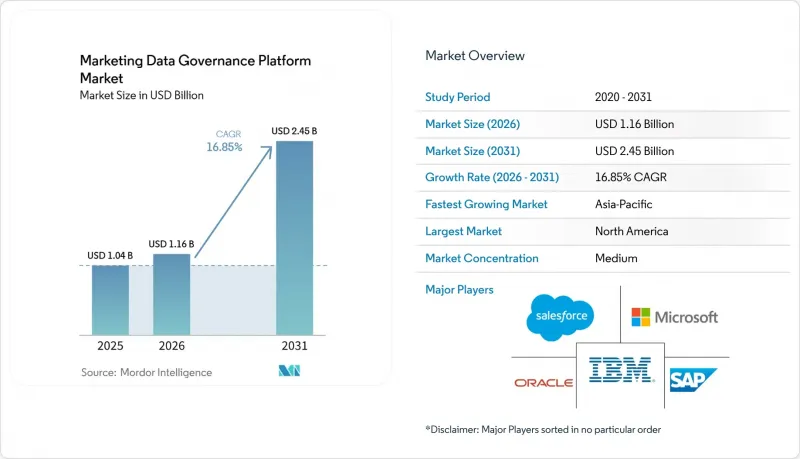
Mordor Intelligence에 의하면, 마케팅 데이터 거버넌스 플랫폼 시장 규모는 2025년 10억 4,000만 달러, 2026년 10억 4,000만 달러에서 2031년까지 24억 5,000만 달러로 확대된다고 예측되고 있어 2026년부터 2031년까지 연평균 성장률(CAGR)은 16.85%를 나타낼 전망입니다.
본 보고서는 도입 형태(클라우드 및 On-Premise), 기업 규모(대기업 및 중소기업), 용도(고객 데이터 거버넌스, 동의·선호도 관리, 캠페인·오디언스 거버넌스, 마케팅 컨텐츠·자산 거버넌스), 지역(북미 등)별로 분류되어 있습니다. 시장 전망은 금액(달러) 기준으로 제시되어 있습니다.
세계 마케팅 데이터 거버넌스 플랫폼 시장 동향 및 인사이트
퍼스트 파티 데이터 활용 수요의 급증
마케팅 데이터 거버넌스 플랫폼 시장은 제3자 신호에서 조직이 직접 수집한 고객 데이터로의 전환에 힘입어 성장하고 있습니다. 마케팅 팀은 개인화, 타겟 고객 개발 또는 측정 도구를 효과적으로 활용하기 전에 신뢰할 수 있는 고객 기록이 필요합니다. 따라서 마케팅 데이터 거버넌스 플랫폼 시장은 일상적인 캠페인 성과와 밀접하게 연결되어 있습니다. 인터랙티브 광고 협회(IAB) 보고서에 따르면, 퍼스트파티 데이터 세트의 도입률은 2년 동안 41%에서 71%로 상승했습니다. 이러한 변화로 인해 데이터 소유권, 품질 규칙, 허용된 이용 방법 및 채널 전반에 걸친 데이터 계보를 정의하는 관리 기능의 중요성이 커지고 있습니다. 고객 데이터 플랫폼은 데이터 활용을 지원할 수 있지만, 연동되는 시스템 전반에 걸쳐 필요한 정책 관리 기능을 항상 제공할 수 있는 것은 아닙니다. 따라서 거버넌스 도구는 캠페인 실행과 책임 있는 데이터 활용 사이에 존재하는 실무상의 격차를 해소하는 역할을 합니다.
동의에 크게 의존하는 캠페인에서의 ‘프라이버시 바이 디자인’ 거버넌스
개인정보 보호 규제가 강화됨에 따라, 동의 설계는 캠페인 시작 시점에 완료되는 법적 검토가 아니라 캠페인 팀에게 있어 핵심적인 요건이 되어가고 있습니다. 2025년 9월, 프랑스 데이터 보호 당국은 Gmail 내 광고 및 맞춤형 광고에 대한 동의 옵션과 관련하여 구글에 3억 2,500만 유로(3억 5,100만 달러)의 벌금을 부과했습니다. 이 결정은 동의 체계에서 사용자가 맞춤형 광고를 자유롭게 거부할 수 있어야 함을 보여주었습니다. 2025년 12월, 해당 당국은 유효한 법적 근거 없이 회원 데이터를 광고 목적으로 소셜 네트워크에 전송했다는 이유로 한 로열티 프로그램 운영자에게 350만 유로(378만 달러)의 벌금을 부과했습니다. 이러한 사례들로 인해 각 관할권에서 적절한 동의 규칙을 적용하는 레코드 수준의 관리에 대한 수요가 높아지면서, 마케팅 데이터 거버넌스 플랫폼 시장 전반 수요가 더욱 강해지고 있습니다. 또한, 여러 지역에서 캠페인을 관리하는 조직의 경우, 수동 검사는 더 이상 현실적인 방법이 아닙니다.
분산된 마케팅 기술(MarTech) 스택에서의 고도화된 통합의 복잡성
통합의 복잡성은 구매자가 마케팅 데이터 거버넌스 플랫폼 시장에서 기대하는 가치 실현을 지연시킬 수 있습니다. 마케팅 용도마다 스키마, 식별 키, 동의 형식, 데이터 전송 프로세스가 다를 수 있습니다. 거버넌스 팀은 정책 제어를 일관되게 적용하기 전에 이러한 차이점을 매핑해야 합니다. 조합 가능한 기술 환경은 유연성을 높일 수 있지만, 구성 요소가 변경될 때마다 제어 사항을 확인해야 합니다. 중규모 조직은 기술 팀이 진행 중인 캠페인의 요구 사항을 충족하면서 동시에 통합 작업도 관리해야 하기 때문에 종종 가장 큰 부담을 겪습니다. 네이티브 메타데이터 페더레이션을 통해 일부 노력은 줄일 수 있지만, 클라우드 환경이나 SaaS(Software-as-a-Service) 용도에 걸쳐 있는 거버넌스 격차를 해소할 수는 없습니다.
부문 분석
2025년, 마케팅 데이터 거버넌스 플랫폼 시장에서 클라우드 배포는 70.29%의 점유율을 차지했습니다. 이러한 체계에서는 운영 중인 모든 마케팅 채널에 걸쳐 동의 신호, 정책 변경 및 접근 결정을 처리해야 합니다. 클라우드 환경은 각 조직이 별도의 On-Premise 인프라를 구축할 필요 없이 지속적인 데이터 계보 업데이트 및 정책 점검을 지원합니다. 또한, 고객 데이터와 캠페인 데이터를 점점 더 많이 저장하게 된 클라우드 웨어하우스 및 레이크하우스 환경과도 원활하게 연동됩니다. 2025년 동료 심사를 거친 연구에 따르면, 클라우드 기반 거버넌스 프레임워크는 접근 제어, 암호화 및 데이터 저장 위치에 관한 조치를 통해 마케팅 분석의 보안 및 규정 준수를 지원할 수 있는 것으로 밝혀졌습니다.
데이터 주권, 내부 보안 규정 또는 업계 요구 사항으로 인해 클라우드 사용이 제한되는 경우, On-Premise 도입은 여전히 중요합니다. 금융 서비스, 규제 대상인 헬스케어 마케팅 및 공공 부문 관련 업무에서는 대개 On-Premise 처리 환경에 대한 더 강력한 관리 권한이 유지됩니다. 대신 많은 조직에서는 기밀성이 높은 처리를 On-Premise에서 유지하면서, 거버넌스 정책을 클라우드 서비스를 통해 관리하는 하이브리드 모델을 채택하고 있습니다. 이러한 구조를 통해 모든 데이터 세트를 즉시 마이그레이션할 필요 없이 팀에 통합된 정책 계층을 제공합니다. 향후 예측 기간 동안 하이브리드 모델의 채택이 확대됨에 따라, 정책 관리는 클라우드의 제어 계층으로 더욱 이전될 것으로 예측됩니다.
지역별 분석
2025년, 북미는 마케팅 데이터 거버넌스 플랫폼 시장 점유율의 35.61%를 차지했습니다. 미국에서는 막대한 마케팅 기술 예산, 탄탄한 공급업체 기반, 그리고 여러 주에 걸친 개인정보 보호 요건이 결합되어 있습니다. 캘리포니아주, 콜로라도주, 코네티컷주, 버지니아주, 텍사스주에서는 주 경계를 넘어 사업을 전개하는 조직을 위해 더욱 복잡한 규정 준수 환경이 조성되고 있습니다. 이로 인해 공유된 기술 환경 내에서 서로 다른 동의 및 데이터 권리 규칙을 적용하는 플랫폼에 대한 수요가 증가하고 있습니다. 캐나다와 멕시코 역시 데이터 보호 요건이 보다 공식적인 거버넌스 관행을 촉진하고 있어 이 지역 시장 활동을 뒷받침하고 있습니다.
2025년에는 유럽이 2위를 차지했습니다. GDPR(EU 개인정보보호규정)(일반 데이터 보호 규정)의 규정 준수 요건과 광고 관련 동의 규칙의 적극적인 집행이 유럽의 마케팅 데이터 거버넌스 플랫폼 시장을 뒷받침하고 있습니다. 2025년 9월, 프랑스 데이터 보호 당국은 구글에 3억 2,500만 유로(3억 5,100만 달러)의 벌금을 부과하며, 유효한 동의를 기반으로 한 광고 모델의 필요성을 재확인시켰습니다. 또한, EU의 AI 법에 따라 AI가 생성한 마케팅 컨텐츠를 활용하는 조직에게는 투명성 확보를 위한 계획 수립이 더욱 시급한 과제가 되고 있습니다. 따라서 유럽의 구매 기업에게는 동의, 소스 데이터, 승인, 컨텐츠 기록 및 내부 설명 책임 프로세스를 연계하는 거버넌스 시스템이 필요합니다.
아시아태평양은 2031년까지 연평균 성장률(CAGR) 17.56%를 나타낼 것으로 예측되며, 이는 각 지역 중 가장 높은 성장률입니다. 중국, 인도, 일본, 싱가포르, 태국, 한국은 각각 마케팅 데이터 활용에 영향을 미치는 고유한 데이터 보호 체계를 갖추고 있습니다. 태국은 2026년 7월, 마케팅 및 법적 근거에 관한 지침 초안을 발표하며, AI를 활용한 마케팅 활동 및 프로파일링에 대한 별도의 동의 요건을 포함시켰습니다. 중국과 인도는 데이터 현지화, 동의 및 집행 요건이 단순한 정책 문서 이상의 대응을 필요로 하기 때문에 중요한 기회를 제공합니다. 남미, 중동 및 아프리카 시장 점유율은 작지만, 브라질, 사우디아라비아, UAE, 남아프리카공화국, 나이지리아에서는 규제 기반이 점차 마련되고 있습니다. 이러한 지역에서는 디지털 마케팅 활동과 집행 역량의 발전에 따라 장기적인 수요가 발생할 가능성이 있습니다.
기타 혜택:
- 엑셀 형식 시장 예측(ME) 시트
- 3개월간의 애널리스트 지원
자주 묻는 질문
목차
제1장 서론
제2장 조사 방법
제3장 개요
제4장 시장 구도
제5장 시장 규모와 성장 예측
제6장 경쟁 구도
제7장 시장 기회와 향후 전망
JHS 26.09.01According to Mordor Intelligence, the marketing data governance platform market size is projected to expand from USD 1.04 billion in 2025 and USD 1.04 billion in 2026 to USD 2.45 billion by 2031, registering a CAGR of 16.85% between 2026 and 2031.
This report is Segmented by Deployment Mode (Cloud and On-Premises), Enterprise Size (Large Enterprises, and Small and Medium Enterprises), Application (Customer Data Governance, Consent and Preference Management, Campaign and Audience Governance, and Marketing Content and Asset Governance), and Geography (North America, and More). The Market Forecasts are Provided in Terms of Value (USD).
Global Marketing Data Governance Platform Market Trends and Insights
Surge in First-Party Data Activation Needs
The Marketing data governance platform market is supported by the move from third-party signals toward customer data collected directly by organizations. Marketing teams need trusted customer records before they can use personalization, audience development, or measurement tools effectively, which keeps the Marketing data governance platform market tied to everyday campaign performance. The Interactive Advertising Bureau reported that first-party dataset deployment rose from 41% to 71% over 2 years. This change raises the value of controls that define data ownership, quality rules, permitted uses, and lineage across channels. Customer data platforms can support activation, but they do not always provide the policy controls needed across connected systems. Governance tools, therefore, address a practical gap between campaign activation and accountable data use.
Privacy-by-Design Governance for Consent-Heavy Campaigns
Privacy enforcement is making consent design a core requirement for campaign teams rather than a legal review completed at launch. In September 2025, France's data protection authority fined Google EUR 325 million (USD 351 million) for advertisements in Gmail and for its consent choices for personalized advertising. The decision showed that a consent mechanism must allow users to freely opt out of personalized advertising. In December 2025, the same authority fined a loyalty-program operator EUR 3.5 million (USD 3.78 million) for transferring member data to a social network for advertising without a valid legal basis. These cases increase demand for record-level controls that apply the right consent rule in each jurisdiction, reinforcing demand across the Marketing data governance platform market. They also make manual checks less workable for organizations managing campaigns across several regions.
High Integration Complexity Across Fragmented Martech Stacks
Integration complexity can delay the value that buyers expect from the Marketing data governance platform market. Each marketing application can use a different schema, identity key, consent format, and data transfer process. Governance teams must map those differences before they can apply policy controls consistently. Composable technology environments can add flexibility, but they require controls to be checked whenever a component changes. Mid-sized organizations often face the largest burden because their technical teams must manage integration work alongside active campaign demands. Native metadata federation can reduce some effort, but it does not remove governance gaps across cloud environments and software-as-a-service applications.
Other drivers and restraints analyzed in the detailed report include:
- AI Content and Audience Data Auditability Requirements
- Martech Stack Convergence With Data Catalogs and Lineage Tools
- Limited Data Stewardship Skills in Marketing Teams
For complete list of drivers and restraints, kindly check the Table Of Contents.
Segment Analysis
Cloud deployment held 70.29% of the Marketing data governance platform market share in 2025. This position requires processing consent signals, policy changes, and access decisions across active marketing channels. Cloud environments support continuous lineage updates and policy checks without requiring each organization to build separate local infrastructure. They also work well with cloud warehouses and lakehouse environments that increasingly store customer and campaign data. A 2025 peer-reviewed study found that cloud-based governance frameworks can support security and compliance in marketing analytics through access controls, encryption, and residency measures.
On-premises deployment remains important where data sovereignty, internal security rules, or sector requirements limit cloud use. Financial services, regulated healthcare marketing, and public-sector-related operations often retain greater control over local processing environments. Many organizations instead use hybrid models that keep sensitive processing local while managing governance policies through cloud services. This structure gives teams a central policy layer without requiring every dataset to move immediately. Over the forecast period, hybrid adoption is expected to move more policy management toward cloud control planes.
Complete Report Scope:
- By Deployment Mode
- Cloud
- On-Premises
- By Enterprise Size
- Large Enterprises
- Small and Medium Enterprises
- By Application
- Customer Data Governance
- Consent and Preference Management
- Campaign and Audience Governance
- Marketing Content and Asset Governance
- By Geography
- North America
- United States
- Canada
- Mexico
- South America
- Brazil
- Argentina
- Rest of South America
- Europe
- Germany
- United Kingdom
- France
- Italy
- Spain
- Russia
- Rest of Europe
- Asia-Pacific
- China
- Japan
- India
- South Korea
- Australia and New Zealand
- Rest of Asia-Pacific
- Middle East
- Saudi Arabia
- United Arab Emirates
- Turkey
- Rest of Middle East
- Africa
- South Africa
- Nigeria
- Rest of Africa
- North America
Geography Analysis
North America accounted for 35.61% of the Marketing data governance platform market share in 2025. The United States combines substantial marketing technology budgets, a dense supplier base, and several state privacy requirements. California, Colorado, Connecticut, Virginia, and Texas have created a more complex compliance setting for organizations operating across state lines. This supports demand for platforms that apply different consent and data-rights rules within shared technology environments. Canada and Mexico add to regional activity as their data protection requirements encourage more formal governance practices.
Europe ranked second in 2025. GDPR compliance requirements and active enforcement of advertising consent rules support the Marketing data governance platform market in Europe. France's data protection authority imposed the EUR 325 million (USD 351 million) fine on Google in September 2025, reinforcing the need for a valid consent-based advertising model. The EU AI Act also makes transparency planning more urgent for organizations that use AI-generated marketing content. European buyers, therefore, need governance systems that connect consent, source data, approvals, content records, and internal accountability processes.
Asia-Pacific is projected to grow at a 17.56% CAGR through 2031, the fastest rate among the regions. China, India, Japan, Singapore, Thailand, and South Korea each have distinct data protection frameworks that affect the use of marketing data. Thailand released draft guidance on marketing and lawful bases in July 2026, including separate consent expectations for AI-driven marketing activity and profiling. China and India offer important opportunities because data localization, consent, and enforcement requirements require more than policy documents alone. South America, the Middle East, and Africa account for smaller shares, but Brazil, Saudi Arabia, the UAE, South Africa, and Nigeria are providing a growing regulatory base. These regions can create longer-term demand as digital marketing activity and enforcement capacity develop.
- Informatica LLC
- Collibra N.V.
- Alation, Inc.
- Microsoft Corporation
- IBM Corporation
- Oracle Corporation
- SAP SE
- Salesforce, Inc.
- OneTrust, LLC
- Ataccama Corporation
- Talend S.A.S.
- QlikTech International AB
- Precisely Holdings, LLC
- Varonis Systems, Inc.
- BigID, Inc.
- DataGalaxy SAS
- Atlan Pte. Ltd.
- Syniti, LLC
- Denodo Technologies, Inc.
- Reltio, Inc.
Additional Benefits:
- The market estimate (ME) sheet in Excel format
- 3 months of analyst support
TABLE OF CONTENTS
1 INTRODUCTION
- 1.1 Study Assumptions and Market Definition
- 1.2 Scope of the Study
2 RESEARCH METHODOLOGY
3 EXECUTIVE SUMMARY
4 MARKET LANDSCAPE
- 4.1 Market Overview
- 4.2 Market Drivers
- 4.2.1 Surge in First-Party Data Activation Needs
- 4.2.2 Privacy-By-Design Governance for Consent-Heavy Campaigns
- 4.2.3 AI Content and Audience Data Auditability Requirements
- 4.2.4 Martech Stack Convergence With Data Catalogs and Lineage Tools
- 4.2.5 Real-Time Governance for Omnichannel Decisioning
- 4.2.6 Clean Room and Secure Collaboration Adoption
- 4.3 Market Restraints
- 4.3.1 High Integration Complexity Across Fragmented Martech Stacks
- 4.3.2 Limited Data Stewardship Skills in Marketing Teams
- 4.3.3 Slow Governance Workflow Adoption in Revenue Organizations
- 4.3.4 Budget Pressure on Mid-Market Deployments
- 4.4 Industry Value Chain Analysis
- 4.5 Regulatory Landscape
- 4.6 Technological Outlook
- 4.7 Impact of Macroeconomic Factors on the Market
- 4.8 Porter's Five Forces Analysis
- 4.8.1 Threat of New Entrants
- 4.8.2 Bargaining Power of Suppliers
- 4.8.3 Bargaining Power of Buyers
- 4.8.4 Threat of Substitutes
- 4.8.5 Intensity of Competitive Rivalry
5 MARKET SIZE AND GROWTH FORECASTS (VALUE)
- 5.1 By Deployment Mode
- 5.1.1 Cloud
- 5.1.2 On-Premises
- 5.2 By Enterprise Size
- 5.2.1 Large Enterprises
- 5.2.2 Small and Medium Enterprises
- 5.3 By Application
- 5.3.1 Customer Data Governance
- 5.3.2 Consent and Preference Management
- 5.3.3 Campaign and Audience Governance
- 5.3.4 Marketing Content and Asset Governance
- 5.4 By Geography
- 5.4.1 North America
- 5.4.1.1 United States
- 5.4.1.2 Canada
- 5.4.1.3 Mexico
- 5.4.2 South America
- 5.4.2.1 Brazil
- 5.4.2.2 Argentina
- 5.4.2.3 Rest of South America
- 5.4.3 Europe
- 5.4.3.1 Germany
- 5.4.3.2 United Kingdom
- 5.4.3.3 France
- 5.4.3.4 Italy
- 5.4.3.5 Spain
- 5.4.3.6 Russia
- 5.4.3.7 Rest of Europe
- 5.4.4 Asia-Pacific
- 5.4.4.1 China
- 5.4.4.2 Japan
- 5.4.4.3 India
- 5.4.4.4 South Korea
- 5.4.4.5 Australia and New Zealand
- 5.4.4.6 Rest of Asia-Pacific
- 5.4.5 Middle East
- 5.4.5.1 Saudi Arabia
- 5.4.5.2 United Arab Emirates
- 5.4.5.3 Turkey
- 5.4.5.4 Rest of Middle East
- 5.4.6 Africa
- 5.4.6.1 South Africa
- 5.4.6.2 Nigeria
- 5.4.6.3 Rest of Africa
- 5.4.1 North America
6 COMPETITIVE LANDSCAPE
- 6.1 Market Concentration
- 6.2 Strategic Moves
- 6.3 Market Share Analysis
- 6.4 Company Profiles (includes Global Level Overview, Market Level Overview, Core Segments, Financials as available, Strategic Information, Market Rank/Share, Products and Services, Recent Developments)
- 6.4.1 Informatica LLC
- 6.4.2 Collibra N.V.
- 6.4.3 Alation, Inc.
- 6.4.4 Microsoft Corporation
- 6.4.5 IBM Corporation
- 6.4.6 Oracle Corporation
- 6.4.7 SAP SE
- 6.4.8 Salesforce, Inc.
- 6.4.9 OneTrust, LLC
- 6.4.10 Ataccama Corporation
- 6.4.11 Talend S.A.S.
- 6.4.12 QlikTech International AB
- 6.4.13 Precisely Holdings, LLC
- 6.4.14 Varonis Systems, Inc.
- 6.4.15 BigID, Inc.
- 6.4.16 DataGalaxy SAS
- 6.4.17 Atlan Pte. Ltd.
- 6.4.18 Syniti, LLC
- 6.4.19 Denodo Technologies, Inc.
- 6.4.20 Reltio, Inc.
7 MARKET OPPORTUNITIES AND FUTURE OUTLOOK
- 7.1 White-Space and Unmet-Need Assessment


