

|
시장보고서
상품코드
2117601
인앱 메시징 소프트웨어 시장 : 점유율 분석, 업계 동향과 통계, 성장 예측(2026-2031년)In-App Messaging Software - Market Share Analysis, Industry Trends & Statistics, Growth Forecasts (2026 - 2031) |
||||||
 Mordor Intelligence
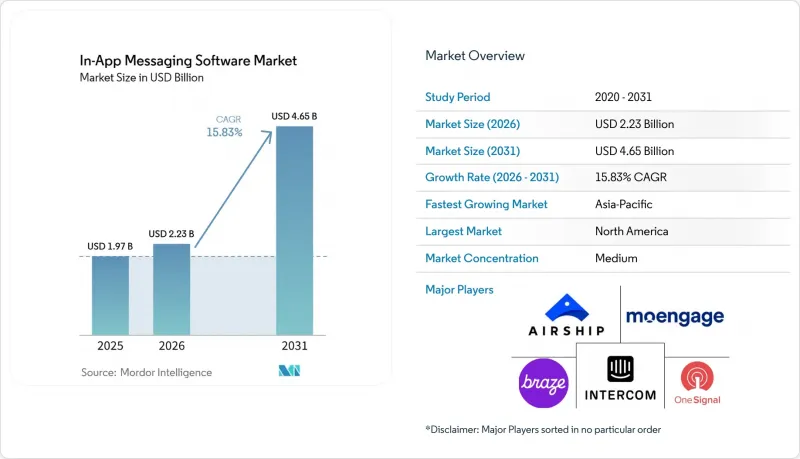
Mordor Intelligence에 의하면, 인앱 메시징 소프트웨어 시장 규모는 2025년에 19억 7,000만 달러로 평가되었고 2026년 22억 3,000만 달러에서 2031년까지 46억 5,000만 달러에 이를 것으로 예측되며, 예측 기간(2026-2031년) CAGR은 15.83%를 나타낼 전망입니다.
본 보고서는 구성 요소(소프트웨어 및 서비스), 도입 형태(클라우드, On-Premise, 하이브리드), 기업 규모(대기업 및 중소기업), 용도(마케팅 및 프로모션, 사용자 참여 및 유지 등), 최종 사용자 산업(IT 및 통신, BFSI 등), 그리고 지역별로 분류되어 있습니다. 시장 전망은 금액(달러) 기준으로 제시되어 있습니다.
세계 인앱 메시징 소프트웨어 시장 동향 및 인사이트
옴니채널 고객 경험의 중요성
기업들은 인앱 메시지를 단순한 독립적인 알림 채널이 아닌, 지속적인 고객 대화의 일환으로 활용하는 경향이 강해지고 있습니다. 2026년, Zendesk의 보고서에 따르면 소비자의 81%가 AI를 현대 서비스에 필수적인 요소로 인식하고 있는 것으로 나타났습니다. 또한, 해당 기업의 조사에 따르면 아시아태평양 소비자의 76%가 고객에게 정보를 반복해서 전달할 필요 없이 텍스트, 이미지, 음성을 통해 대화를 이어갈 수 있는 제공업체를 선호하는 것으로 나타났습니다. 이러한 요구 사항으로 인해 용도 및 기타 고객 채널 전반에 걸쳐 맥락을 유지할 수 있는 플랫폼이 유리해지고 있습니다. Infobip사는 2025년 모바일 채널에서 발생한 6,280억 건의 상호작용을 분석한 결과, 인앱 메시징을 최종 전환 채널로 삼고 4개 이상의 참여 채널을 활용하는 브랜드가 고객 유지율이 더 높은 것으로 나타났습니다고 밝혔습니다. 따라서 인앱 메시징 소프트웨어 시장에서는 광범위한 고객 여정 관리를 수행하는 벤더가 단일 알림 제공업체보다 우위를 점하고 있습니다.
AI를 활용한 개인화 및 최적화
인앱 메시징 소프트웨어 시장에서 메시지 발송 시기, 컨텐츠 선정, 타겟층 결정에 있어 AI 기능은 핵심적인 역할을 수행하고 있습니다. MoEngage사의 보고서에 따르면, 1,350개 이상의 소비자 대상 브랜드를 대상으로 한 2026년 벤치마크 조사에서 여정 기반 인앱 메시지는 평균 44.17%의 전환율을 달성했습니다. 같은 조사에서는 개인화되지 않은 일괄 전송 메시지의 수신 거부율이 행동에 기반해 트리거되는 메시지에 비해 최대 25배까지 높아질 수 있다는 사실도 보고되었습니다. 이러한 결과를 통해 메시지 전송량을 늘리는 것보다 행동에 기반한 관련성을 높이는 것이 중요하다는 것을 알 수 있습니다. MoEngage는 2026년 6월 Aampe를 인수하여 플랫폼에 사용자별 자율적 의사결정 기능을 추가했습니다. 개별적인 의사결정을 내리면서도 고객이 그 결정을 이해할 수 있도록 하는 제공업체는 기업 고객을 유지하는 데 유리한 입장에 있다고 볼 수 있습니다.
데이터 개인정보 보호, 동의 및 보안상의 위험
개인정보 보호 및 동의와 관련된 요건은 인앱 메시징 소프트웨어 시장에서 플랫폼의 평가 및 도입 과정을 장기화시킬 가능성이 있습니다. 프랑스 데이터 보호 당국은 2024년 9월 98페이지에 달하는 모바일 애플리케이션 개인정보 보호 프레임워크를 발표했으며, 2025년에는 모바일 앱을 대상으로 한 집중적인 법 집행 캠페인을 시작했습니다. 이러한 동향으로 인해 SDK 수준에서의 데이터 수집 및 명시적 동의에 대한 관심이 높아지고 있습니다. 2026년 1월 28일부터 시행되는 Google Play 정책에서는 ‘디지털 시장법(Digital Markets Act)’ 준수 의무에 따라 인앱 데이터 수집에 대해 사용자의 적극적인 동의를 요구합니다. 의료 분야의 구매자들도 감사 가능한 동의 관리 체계와 적절한 계약상 약정을 요구하고 있습니다. 확립된 개인정보 보호 관리 체계를 갖춘 공급업체는 구매자의 우려를 완화할 수 있지만, 소규모 공급업체의 경우 조달 주기가 길어질 가능성이 있습니다.
부문 분석
2025년, 소프트웨어는 인앱 메시징 소프트웨어 시장 점유율의 71.24%를 차지했습니다. 이러한 상황은 소프트웨어 개발 키트(SDK)를 통해 통합되는 플랫폼의 지속적 수익 모델을 반영한 것입니다. 행동 데이터, 워크플로우, 메시지 템플릿은 시간이 지남에 따라 플랫폼과 밀접하게 연계될 가능성이 있습니다. 공급업체를 변경하려면 데이터 마이그레이션, 애플리케이션 테스트, 캠페인 운영 변경이 필요할 수 있습니다. 이러한 요인들로 인해 기존 소프트웨어 벤더와의 계약 갱신에 대한 인센티브가 강화되고 있습니다. Braze는 2026년 4월, Figma 및 Canva와의 연동 기능을 갖춘 ‘Creative Studio’를 발표했습니다. 이번 출시는 각 벤더들이 본래라면 외부 서비스에 의존할 수밖에 없었던 작업을 자사 플랫폼에 통합하고 있는 실태를 보여줍니다.
서비스 시장은 2031년까지 연평균 성장률(CAGR) 18.82%로 확대될 것으로 예측됩니다. 이러한 성장은 도입 지원, 모델 거버넌스, 테스트 및 고객 시스템 간 통합에 대한 수요에서 기인합니다. AI 주도 캠페인에서는 조직이 의사결정 프로세스와 고객 데이터 활용 방식을 재검토해야 합니다. 이 서비스는 팀이 필요한 관리 체계를 설계하고 캠페인 성과를 측정할 수 있도록 지원합니다. 또한 전담 모바일 엔지니어링 팀을 통해 고객을 지원할 수도 있습니다. 소프트웨어 제공업체는 초기 도입 후 고객과의 관계를 강화하기 위해 이러한 서비스를 활용할 가능성이 있습니다. 따라서 인앱 메시징 소프트웨어 시장은 소프트웨어 중심의 수익 구조를 유지하면서, 서비스를 통해 고도화된 도입에 수반되는 운영상의 요구 사항을 충족할 수 있습니다. 서비스 파트너는 자동 메시지가 활성화되기 전에 캠페인 규칙, 사용자 권한, 에스컬레이션 경로를 정의하는 데도 도움을 줄 수 있습니다. 마케팅, 제품, 지원, 규정 준수 팀 간에 일관된 운영이 요구되는 경우, 서비스 파트너의 역할은 더욱 중요해집니다. 소프트웨어와 도입 지원을 모두 제공하는 공급업체는 고객이 시범 운영에서 정상 운영으로 전환하는 데 걸리는 시간을 단축할 수 있습니다.
2025년, 인앱 메시징 소프트웨어 시장 점유율의 68.41%를 클라우드 도입이 차지했습니다. 디지털 네이티브 기업들은 컴퓨팅 리소스를 확장할 수 있고, 행동 데이터를 메시징 워크플로우와 연동할 수 있다는 점에서 클라우드 도구를 선호하여 채택하고 있습니다. 또한, 클라우드를 통한 제공은 캠페인의 신속한 변경과 모델의 지속적인 업데이트도 지원합니다. 이러한 기능은 고객과의 세션 중에 즉각적으로 대응해야 하는 용도에 유용합니다. 클라우드 도입의 설치 기반은 벤더의 구독 수익을 뒷받침하며, 소규모 구매자에 대한 접근성 확대에도 기여하고 있습니다. 클라우드는 공급자의 아키텍처를 통해 데이터 저장 위치 및 보안 요구 사항을 충족할 수 있는 경우 여전히 적절한 선택지입니다. 클라우드의 높은 시장 점유율은 많은 고객에게 도입의 용이성이 여전히 중요하다는 점을 보여줍니다. 또한 클라우드 도구는 분산된 팀에 캠페인 성과 및 고객 반응 데이터에 대한 공통된 관점을 제공할 수도 있습니다. 이는 여러 용도를 관리하는 조직이나 여러 국가에서 사업을 전개하는 조직에 유용합니다. 벤더가 신뢰할 수 있는 보안, 가용성 및 데이터 처리 제어 능력을 입증할 수 있다면, 이 모델은 계속해서 매력적인 선택지가 될 것입니다.
하이브리드 배포는 2031년까지 연평균 성장률(CAGR) 17.69%를 나타낼 것으로 예측됩니다. 은행, 보험, 의료 분야의 사용자는 개인을 식별할 수 있는 정보나 지역별 데이터 거주지에 대해 더 엄격한 관리가 필요한 경우가 많습니다. 동시에, AI를 활용한 개인화를 실현하기 위해서는 클라우드 기반 컴퓨팅도 필요합니다. Braze는 2026년 4월, 자사의 Decisioning Studio를 위해 EU 지역 내 Google Cloud 호스팅을 추가했습니다. 이러한 조치는 의사 결정 서비스를 지속적으로 지원하면서 고객 데이터를 유럽 내에 보관해야 할 필요성을 반영한 것입니다. On-Premise 배포는 격리된 환경을 활용하는 정부 및 국방 분야에서 여전히 중요하게 여겨지고 있습니다. 그러나 하이브리드 아키텍처는 클라우드 기능을 희생하지 않으면서 데이터 관리를 원하는 규제 대상 사용자에게 해결책을 제시합니다. 이러한 접근 방식을 통해 기밀성이 높은 기록은 선택한 환경 내에 보관하면서, 특정 데이터를 활용해 통합적인 분석을 수행할 수 있게 됩니다. 또한 조직이 데이터 유형별로 서로 다른 관리 전략을 적용하는 데에도 도움이 될 수 있습니다. 높은 성장률을 통해 볼 때, 아키텍처 결정이 법적 요건, 운영상 요건 및 고객 신뢰와 관련된 요건과 점점 더 밀접하게 연관되어 있음을 알 수 있습니다. 구매자는 데이터가 어디에 저장되는지, 누가 접근할 수 있는지, 그리고 시스템 간에 정보가 어떻게 이동하는지를 고려해야 합니다. 이러한 결정은 도입 일정과 이용 가능한 메시징 기능의 범위 모두에 영향을 미칠 수 있습니다. 따라서 하이브리드 배포는 기술적 선택인 동시에 비즈니스 및 거버넌스상의 선택이기도 합니다.
지역별 분석
2025년, 북미는 인앱 메시징 소프트웨어 시장 점유율의 34.62%를 차지했습니다. 이 지역에는 기업 소프트웨어 구매자가 집중되어 있고, 모바일 상거래가 성숙해 있을 뿐만 아니라, 많은 주요 플랫폼 공급업체의 본사가 위치해 있습니다. 미국에서는 메시징과 고객 데이터 플랫폼을 연동하려는 소매, BFSI(은행 및 금융 및 보험), 의료 기관 수요가 시장을 주도하고 있습니다. 캐나다는 금융 서비스 분야 수요에 기여하고 있는 반면, 멕시코에서는 확대되는 핀테크 부문이 모바일 기반 고객 참여에 대한 수요를 뒷받침하고 있습니다. 이 지역에서는 풀 스위트 벤더, 제품 도입 전문가, AI 전문 벤더가 동일한 기업 고객에게 서비스를 제공하고 있어 경쟁이 치열해지고 있습니다. 또한, 각 주의 개인정보 보호 규정 및 캘리포니아주 소비자 개인정보 보호법(CCPA)의 시행으로 인해 퍼스트 파티 데이터를 활용한 접근 방식이 촉진되고 있습니다. 이 지역의 구매 담당자들은 벤더가 기존 고객 데이터, 마케팅 및 제품 시스템과 어느 정도 연동할 수 있는지를 평가하는 경우가 많습니다. 또한, 고객에 대한 접근 권한 관리 권한을 잃지 않으면서 대량의 메시지를 처리할 수 있는 벤더의 역량도 평가했습니다. 이러한 요구 사항은 깊은 통합성과 명확한 거버넌스를 겸비한 플랫폼에 대한 수요를 뒷받침하고 있습니다. 북미 기업들은 여러 고객용 용도를 보유하고 있으며, 이를 관리하는 팀이 각각 따로 있는 경우가 많습니다. 따라서 캠페인 승인, 접근 관리, 성과 보고를 위한 일관된 프레임워크의 가치가 높아집니다. 이러한 관리 기능을 지원하는 공급업체는 복잡한 도입 과정에서 더 신뢰할 수 있는 파트너가 될 수 있습니다.
아시아태평양은 2031년까지 연평균 성장률(CAGR) 19.18%를 나타낼 것으로 예측됩니다. 인도, 한국, 동남아시아, 일본, 중국은 중요한 시장이지만, 수요를 견인하는 요인은 각각 다릅니다. 인도의 핀테크 및 헬스테크 생태계에서는 확장성이 뛰어나고 동의 관리가 철저히 이루어지는 고객 대상 메시징이 요구되고 있습니다. 한국과 일본에서는 메시지 전송량이 방대한 엔터프라이즈 도입이 추진되고 있습니다. 인도네시아, 베트남, 필리핀에서는 앱 보급, 디지털화 프로그램, 슈퍼앱 개발을 통해 디지털 소비자 기반이 확대되고 있습니다. 이들 국가에서는 현지 언어를 지원하고 유연한 가격 책정이 가능한 벤더에게 인앱 메시징 소프트웨어 시장에서 비즈니스 기회가 있습니다. 수요를 주도하는 것은 데스크톱 채널이 아닌 스마트폰을 통해 고객을 확보한 기업들입니다. 이러한 기업들은 메시징 도구가 모바일 결제, 현지 서비스 모델 및 트래픽이 많은 용도과 연동되기를 기대할 가능성이 높습니다. 설정을 간소화하는 벤더는 신흥 디지털 비즈니스에 더 적합합니다. 이 지역에는 성숙한 기술 시장과 급속히 확장되는 소비자용 용도 환경이 모두 공존합니다. 이러한 다양성으로 인해 획일적인 영업 및 제품 접근 방식의 유용성은 제한됩니다. 공급업체는 고급 기능과 소규모 또는 신생 용도 팀도 쉽게 이해할 수 있는 도구 간의 균형을 맞추어야 합니다.
유럽, 남미, 중동 및 아프리카는 각각 서로 다른 수요 환경을 보이고 있습니다. 유럽 고객은 공급업체를 선정할 때 GDPR(EU 개인정보보호규정) 준수 및 데이터 레지던시를 매우 중요하게 여깁니다. 2026년 Braze가 EU 지역을 대상으로 실시한 호스팅 이니셔티브는 기업용 계약에서 이러한 요건이 얼마나 중요한지를 반영한 것입니다. 브라질의 디지털 소매 및 핀테크 분야에서는 즉시 결제의 성장에 힘입어 실시간 거래 및 참여 도구가 활용되고 있습니다. 걸프협력회의(GCC) 회원국들은 모바일 정부 서비스 및 소매 용도에 투자하고 있는 반면, 나이지리아와 남아프리카공화국은 모바일 결제 및 소비자용 용도의 주요 시장으로 부상하고 있습니다. 인프라, 개인정보 보호에 대한 기대치, 모바일 보급률의 차이로 인해 벤더는 각 지역에 맞추어 도입 방식을 조정해야 합니다. 유럽의 구매자는 기능의 급속한 확장보다 데이터 거버넌스를 우선시할 가능성이 있습니다. 남미나 아프리카의 사용자는 이용하기 쉬운 모바일 서비스나 결제 관련 커뮤니케이션을 우선시할 수도 있습니다. 따라서 지역적 적응은 플랫폼의 기본적인 가용성은 물론 도입 속도에도 영향을 미칠 수 있습니다. 공급자의 현지 데이터 옵션, 언어 지원 및 비즈니스 모델은 계약 체결 여부를 결정하는 데 영향을 미칠 수 있습니다. 또한, 고객이 도입 지원이나 현지 요건에 대한 지식이 필요한 경우, 지역 파트너가 도움이 될 수 있습니다. 이러한 요인들은 국제 벤더와 현지 벤더 간경쟁 구도를 형성할 수 있습니다.
기타 혜택:
- 엑셀 형식 시장 예측(ME) 시트
- 3개월간 애널리스트 지원
자주 묻는 질문
목차
제1장 서론
제2장 조사 방법
제3장 개요
제4장 시장 구도
제5장 시장 규모와 성장 예측
제6장 경쟁 구도
제7장 시장 기회와 향후 전망
JHS 26.09.01According to Mordor Intelligence, the in-app messaging software market size was valued at USD 1.97 billion in 2025 and is estimated to grow from USD 2.23 billion in 2026 to reach USD 4.65 billion by 2031, at a CAGR of 15.83% during the forecast period (2026-2031).
This report is Segmented by Component (Software, and Services), Deployment Mode (Cloud, On-Premise, and Hybrid), Enterprise Size (Large Enterprises, and Small and Medium Enterprises), Application (Marketing and Promotions, User Engagement and Retention, and More), End User Industry (IT and Telecommunication, BFSI, and More), and Geography. The Market Forecasts are Provided in Terms of Value (USD).
Global In-App Messaging Software Market Trends and Insights
Omnichannel Customer Experience Imperative
Enterprises increasingly use in-app messages as part of a continuous customer interaction rather than as a separate notification channel. In 2026, Zendesk reported that 81% of consumers viewed AI as integral to modern service. Its research also found that 76% of Asia-Pacific consumers preferred providers that continued a conversation across text, image, and voice without requiring customers to repeat information. This requirement favors platforms that retain context across applications and other customer channels. Infobip stated that its analysis covered 628 billion mobile-channel interactions in 2025 and found stronger retention outcomes among brands using 4 or more engagement channels with in-app messaging as the final conversion channel. The in-app messaging software market, therefore, gives broader journey-management vendors an advantage over standalone notification providers.
AI-Powered Personalization and Optimization
AI capabilities have become central to message timing, content selection, and audience decisions in the in-app messaging software market. MoEngage reported that journey-based in-app messages achieved an average conversion rate of 44.17% in its 2026 benchmark study of more than 1,350 consumer brands. The same study reported that non-personalized broadcast messages could have opt-out rates up to 25 times higher than behaviorally triggered alternatives. These results make behavioral relevance more important than higher message volume. MoEngage acquired Aampe in June 2026 to add per-user agentic decisioning to its platform. Providers that can make individual decisions while keeping those decisions understandable to customers may be better placed to retain enterprise accounts.
Data Privacy, Consent, and Security Exposure
Privacy and consent requirements can lengthen platform evaluation and deployment processes in the in-app messaging software market. France's data protection authority published a 98-page mobile application privacy framework in September 2024 and began a focused mobile-app enforcement campaign in 2025. These developments place closer attention on SDK-level data collection and explicit consent. Google Play policies, effective January 28, 2026, require affirmative user consent for in-app data collection under its Digital Markets Act compliance obligations. Healthcare buyers also require auditable consent controls and appropriate contractual arrangements. Vendors with established privacy controls can reduce buyer concerns, while smaller providers may face longer procurement cycles.
Other drivers and restraints analyzed in the detailed report include:
- Mobile-First and App-Centric Business Models
- Real-Time In-Session Decisioning for Revenue and Retention
- Integration Complexity Across Legacy and Fragmented App Stacks
For complete list of drivers and restraints, kindly check the Table Of Contents.
Segment Analysis
Software held 71.24% of the in-app messaging software market share in 2025. The position reflected the recurring-revenue model of platforms embedded through software development kits. Behavioral data, workflows, and message templates can become closely tied to the platform over time. Replacing a provider may require data migration, application testing, and changes to campaign operations. These factors strengthen renewal incentives for established software vendors. Braze introduced Creative Studio in April 2026, with integrations with Figma and Canva. The release showed how vendors are incorporating work that might otherwise require outside services into their platforms.
Services are projected to grow at a 18.82% CAGR through 2031. This growth comes from the need for implementation assistance, model governance, testing, and integration across customer systems. AI-led campaigns require organizations to review how decisions are made and how customer data is used. Services can help teams design the required controls and measure campaign outcomes. They can also assist customers w dedicated mobile engineering teams. Software providers may use services to deepen client relationships after the original implementation. The in-app messaging software market can therefore retain a software-led revenue structure while services address the operational demands of advanced deployments. Service partners can also help define campaign rules, user permissions, and escalation paths before automated messages are activated. Their role becomes more relevant when organizations need consistent practices across marketing, product, support, and compliance teams. Providers that offer both software and implementation support may be able to reduce the time needed for customers to move from a pilot to regular use.
Cloud deployment accounted for 68.41% of the in-app messaging software market share in 2025. Digital-native companies favor cloud tools because they can scale computing resources and connect behavioral data with messaging workflows. Cloud delivery also supports rapid campaign changes and continuous model updates. These capabilities are useful for applications that need to respond during an active customer session. The installed base of cloud deployments supports vendor subscription revenue and broadens access for smaller buyers. Cloud remains appropriate where data residency and security requirements can be met through the provider's architecture. Its large share indicates that ease of deployment still matters for many customers. Cloud tools can also give distributed teams a shared view of campaign performance and customer response data. This is useful for organizations that manage several applications or operate across multiple countries. The model remains attractive when vendors can demonstrate reliable security, availability, and data handling controls.
Hybrid deployment is projected to grow at a 17.69% CAGR through 2031. Banking, insurance, and healthcare users often need greater control over personally identifiable information and regional data residency. At the same time, they need cloud-based computing for AI-enabled personalization. Braze added EU-region Google Cloud hosting for its Decisioning Studio in April 2026. This move reflected the need to keep customer data within European boundaries while continuing to support decisioning services. On-premise deployments remain relevant for government and defense settings that use isolated environments. However, hybrid architectures offer a path for regulated users who want data control without giving up cloud capabilities. This approach can allow sensitive records to remain within a chosen environment while selected data supports centralized analysis. It may also help organizations apply different controls to different data types. The higher growth rate shows that architecture decisions are increasingly linked to legal, operational, and customer trust requirements. Buyers must consider where data is stored, who can access it, and how information is moved between systems. These decisions can affect both the timetable for implementation and the range of messaging functions available. Hybrid deployment is therefore a business and governance choice as well as a technical one.
Complete Report Scope:
- By Component
- Software
- Services
- By Deployment Mode
- Cloud
- On-Premise
- Hybrid
- By Enterprise Size
- Large Enterprises
- Small and Medium Enterprises
- By Application
- Marketing and Promotions
- User Engagement and Retention
- Customer Support
- Product Adoption and Onboarding
- Feedback and Voice of Customer Analytics
- By End User Industry
- IT and Telecommunication
- BFSI
- Healthcare and Life Sciences
- Retail and E-Commerce
- Industrial Manufacturing
- Education and Research Institutions
- Media and Entertainment
- Government and Administration
- Travel and Hospitality
- Other End User industries
- By Geography
- North America
- United States
- Canada
- Mexico
- South America
- Brazil
- Argentina
- Rest of South America
- Europe
- Germany
- United Kingdom
- France
- Russia
- Spain
- Rest of Europe
- Asia-Pacific
- China
- Japan
- India
- South Korea
- Southeast Asia
- Rest of Asia-Pacific
- Middle East and Africa
- Middle East
- Saudi Arabia
- United Arab Emirates
- Rest of Middle East
- Africa
- South Africa
- Nigeria
- Rest of Africa
- Middle East
- North America
Geography Analysis
North America held 34.62% of the in-app messaging software market share in 2025. The region has a high concentration of enterprise software buyers, mature mobile commerce, and the headquarters of many major platform vendors. The United States drives demand from retail, BFSI, and healthcare organizations that connect messaging with customer data platforms. Canada contributes to demand in financial services, while Mexico's expanding fintech sector supports mobile customer engagement needs. Competition in the region is strong because full-suite vendors, product-adoption specialists, and AI-focused providers serve the same enterprise accounts. State privacy rules and California Consumer Privacy Act enforcement are also encouraging first-party data approaches. Buyers in the region often evaluate how well a provider works with existing customer data, marketing, and product systems. They also assess the vendor's ability to support large message volumes without losing control over customer permissions. These needs support demand for platforms that combine integration depth with clear governance. North American enterprises frequently have several customer-facing applications and separate teams responsible for them. This can increase the value of a consistent framework for campaign approvals, access management, and performance reporting. Providers that support these controls can be more credible partners for complex deployments.
Asia-Pacific is projected to grow at a 19.18% CAGR through 2031. India, South Korea, Southeast Asia, Japan, and China are important markets, although their demand drivers differ. India's fintech and health technology ecosystems require scalable and consent-managed customer messaging. South Korea and Japan support enterprise deployments that have high message volumes. Indonesia, Vietnam, and the Philippines are expanding digital consumer bases through application adoption, digitalization programs, and super-app development. The in-app messaging software market has opportunities in these countries for vendors that support local languages and flexible pricing. Demand is shaped by businesses that acquired customers through smartphones rather than desktop channels. These companies may expect messaging tools to work with mobile payments, local service models, and high-volume applications. Vendors that simplify setup are more relevant to newer digital businesses. The region also contains both mature technology markets and rapidly expanding consumer application environments. This diversity limits the usefulness of a uniform sales and product approach. Providers need to balance advanced capabilities with tools understandable to smaller or newer application teams.
Europe, South America, the Middle East, and Africa represent distinct demand environments. European customers place substantial weight on GDPR compliance and data residency when choosing providers. Braze's EU-region hosting initiative in 2026 reflected the importance of these requirements for enterprise contracts. Brazil's digital retail and fintech sectors use real-time transaction and engagement tools, supported by the growth of instant payments. Gulf Cooperation Council countries invest in mobile government services and retail applications, while Nigeria and South Africa are important markets for mobile payments and consumer applications. Differences in infrastructure, privacy expectations, and mobile adoption mean vendors must adapt deployments to each region. European buyers may prioritize data governance over rapid feature expansion. South American and African users may prioritize accessible mobile services and payment-related communications. Regional adaptation can therefore affect the pace of adoption as much as the platform's basic availability. A provider's local data options, language support, and commercial model can influence whether it is considered for a contract. Regional partners may also be useful where customers need implementation support or familiarity with local requirements. These factors can shape the competitive position of international and local vendors.
- Braze, Inc.
- Intercom, Inc.
- OneSignal, Inc.
- Airship Group, Inc.
- MoEngage, Inc.
- CleverTap Private Limited
- Sendbird, Inc.
- Peaberry Software, Inc.
- Iterable, Inc.
- Swrve, Inc.
- Pushwoosh, Inc.
- WebEngage Inc.
- Xtremepush Limited
- MessageGears, Inc.
- Optimove, Inc.
- Cordial Experience, Inc.
- Pendo.io, Inc.
- Appcues, Inc.
- Userpilot, Inc.
- Chameleon Technologies, Inc.
Additional Benefits:
- The market estimate (ME) sheet in Excel format
- 3 months of analyst support
TABLE OF CONTENTS
1 INTRODUCTION
- 1.1 Study Assumptions and Market Definition
- 1.2 Scope of the Study
2 RESEARCH METHODOLOGY
3 EXECUTIVE SUMMARY
4 MARKET LANDSCAPE
- 4.1 Market Overview
- 4.2 Market Drivers
- 4.2.1 Omnichannel Customer Experience Imperative
- 4.2.2 Mobile-First and App-Centric Business Models
- 4.2.3 AI-Powered Personalization and Optimization
- 4.2.4 First-Party Data Strategy and Privacy Compliance
- 4.2.5 Real-Time In-Session Decisioning for Revenue and Retention
- 4.2.6 Embedded Messaging as a Lower-Cost Alternative to Paid Re-Engagement
- 4.3 Market Restraints
- 4.3.1 Data Privacy, Consent, and Security Exposure
- 4.3.2 Integration Complexity Across Legacy and Fragmented App Stacks
- 4.3.3 In-App Notification Fatigue and Attention Saturation
- 4.3.4 SDK Release Dependency and App-Store Governance Risk
- 4.4 Impact of Macroeconomic Factors on the Market
- 4.5 Industry Value-Chain Analysis
- 4.6 Technology Outlook
- 4.7 Regulatory Landscape
- 4.8 Porter's Five Forces Analysis
- 4.8.1 Threat of New Entrants
- 4.8.2 Bargaining Power of Suppliers
- 4.8.3 Bargaining Power of Buyers
- 4.8.4 Threat of Substitutes
- 4.8.5 Intensity of Competitive Rivalry
5 MARKET SIZE AND GROWTH FORECASTS (VALUE)
- 5.1 By Component
- 5.1.1 Software
- 5.1.2 Services
- 5.2 By Deployment Mode
- 5.2.1 Cloud
- 5.2.2 On-Premise
- 5.2.3 Hybrid
- 5.3 By Enterprise Size
- 5.3.1 Large Enterprises
- 5.3.2 Small and Medium Enterprises
- 5.4 By Application
- 5.4.1 Marketing and Promotions
- 5.4.2 User Engagement and Retention
- 5.4.3 Customer Support
- 5.4.4 Product Adoption and Onboarding
- 5.4.5 Feedback and Voice of Customer Analytics
- 5.5 By End User Industry
- 5.5.1 IT and Telecommunication
- 5.5.2 BFSI
- 5.5.3 Healthcare and Life Sciences
- 5.5.4 Retail and E-Commerce
- 5.5.5 Industrial Manufacturing
- 5.5.6 Education and Research Institutions
- 5.5.7 Media and Entertainment
- 5.5.8 Government and Administration
- 5.5.9 Travel and Hospitality
- 5.5.10 Other End User industries
- 5.6 By Geography
- 5.6.1 North America
- 5.6.1.1 United States
- 5.6.1.2 Canada
- 5.6.1.3 Mexico
- 5.6.2 South America
- 5.6.2.1 Brazil
- 5.6.2.2 Argentina
- 5.6.2.3 Rest of South America
- 5.6.3 Europe
- 5.6.3.1 Germany
- 5.6.3.2 United Kingdom
- 5.6.3.3 France
- 5.6.3.4 Russia
- 5.6.3.5 Spain
- 5.6.3.6 Rest of Europe
- 5.6.4 Asia-Pacific
- 5.6.4.1 China
- 5.6.4.2 Japan
- 5.6.4.3 India
- 5.6.4.4 South Korea
- 5.6.4.5 Southeast Asia
- 5.6.4.6 Rest of Asia-Pacific
- 5.6.5 Middle East and Africa
- 5.6.5.1 Middle East
- 5.6.5.1.1 Saudi Arabia
- 5.6.5.1.2 United Arab Emirates
- 5.6.5.1.3 Rest of Middle East
- 5.6.5.2 Africa
- 5.6.5.2.1 South Africa
- 5.6.5.2.2 Nigeria
- 5.6.5.2.3 Rest of Africa
- 5.6.5.1 Middle East
- 5.6.1 North America
6 COMPETITIVE LANDSCAPE
- 6.1 Market Concentration
- 6.2 Strategic Moves
- 6.3 Market Share Analysis
- 6.4 Company Profiles (includes Global Level Overview, Market Level Overview, Core Segments, Financials as available, Strategic Information, Market Rank/Share, Products and Services, Recent Developments)
- 6.4.1 Braze, Inc.
- 6.4.2 Intercom, Inc.
- 6.4.3 OneSignal, Inc.
- 6.4.4 Airship Group, Inc.
- 6.4.5 MoEngage, Inc.
- 6.4.6 CleverTap Private Limited
- 6.4.7 Sendbird, Inc.
- 6.4.8 Peaberry Software, Inc.
- 6.4.9 Iterable, Inc.
- 6.4.10 Swrve, Inc.
- 6.4.11 Pushwoosh, Inc.
- 6.4.12 WebEngage Inc.
- 6.4.13 Xtremepush Limited
- 6.4.14 MessageGears, Inc.
- 6.4.15 Optimove, Inc.
- 6.4.16 Cordial Experience, Inc.
- 6.4.17 Pendo.io, Inc.
- 6.4.18 Appcues, Inc.
- 6.4.19 Userpilot, Inc.
- 6.4.20 Chameleon Technologies, Inc.
7 MARKET OPPORTUNITIES AND FUTURE OUTLOOK
- 7.1 White-Space and Unmet-Need Assessment


