

|
시장보고서
상품코드
2117605
동적 크리에이티브 최적화 소프트웨어 시장 : 점유율 분석, 업계 동향과 통계, 성장 예측(2026-2031년)Dynamic Creative Optimization Software - Market Share Analysis, Industry Trends & Statistics, Growth Forecasts (2026 - 2031) |
||||||
 Mordor Intelligence
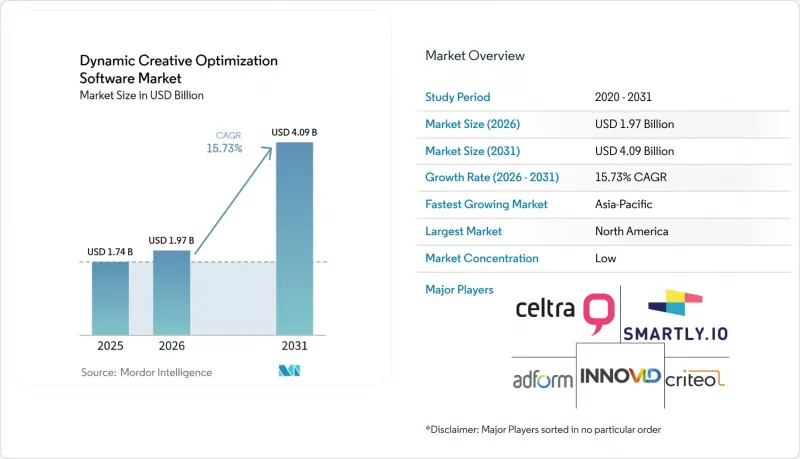
Mordor Intelligence에 의하면, 동적·크리에이티브·오프티마이제이션(DCO) 소프트웨어 시장 규모는 2025년 17억 4,000만 달러, 2026년 19억 7,000만 달러에서 2031년까지 40억 9,000만 달러로 확대된다고 예측되고 있어 2026년부터 2031년까지 연평균 성장률(CAGR)은 15.73%를 나타낼 전망입니다.
본 보고서는 구성 요소(소프트웨어 및 서비스), 도입 형태(클라우드, On-Premise, 하이브리드), 용도(디스플레이 광고, 소셜 미디어 광고 등), 기업 규모(대기업 및 중소기업), 최종 사용자(은행, 금융서비스 및 보험(BFSI), 헬스케어 및 생명과학 등), 그리고 지역별로 분류되어 있습니다. 시장 전망은 금액(달러) 기준으로 제시되어 있습니다.
세계 동적 크리에이티브 최적화(DCO) 소프트웨어 시장 동향 및 인사이트
프로그래매틱 광고 및 개인화 광고의 성장
세계 광고비는 2026년에 1조 달러를 넘어설 것으로 예상되며, 프로그래매틱 채널은 디지털 투자의 80% 이상을 차지할 것으로 전망됩니다. 이러한 규모로 인해, 수작업 제작에 의존하지 않고 수많은 크리에이티브 조합을 전달해야 하는 광고주에게 동적 크리에이티브 최적화(DCO) 소프트웨어 시장은 매우 중요해졌습니다. 하나의 캠페인에서 대상 그룹, 기기, 지역, 게재 위치마다 서로 다른 메시지가 필요할 수 있습니다. 동적 크리에이티브 도구는 승인된 자산과 의사 결정 규칙을 각 노출에 연결함으로써 이러한 조합을 관리할 수 있게 해줍니다. 덴츠는 2027년까지 아시아태평양의 광고비 중 79%가 알고리즘에 의해 주도될 것으로 예측하고 있으며, 이로 인해 기존 프로그래매틱 시장을 넘어 도입 기반이 확대될 것입니다. 프로그래매틱 활동이 증가함에 따라, 광고주는 크리에이티브 팀이나 미디어 팀의 업무 부담을 늘리지 않으면서도 관련성을 유지할 수 있는 플랫폼을 필요로 하고 있습니다.
크리에이티브 의사 결정에서의 생성형 AI와 머신러닝
생성형 AI는 광고주가 동적 캠페인을 위한 크리에이티브 자료를 준비하는 방식을 변화시키고 있습니다. 이를 통해 팀은 기존의 제작 프로세스에서는 불가능했던 대규모의 승인된 자산 세트를 생성, 적용 및 테스트할 수 있게 됩니다. 이 기능은 캠페인에서 제품, 지역 또는 채널별로 맞춤화된 메시지가 필요한 경우에 유용합니다. 제작 속도가 빨라짐에 따라, 검토 팀이 브랜드, 법규, 플랫폼 요건 준수를 여전히 확인해야 하므로 더욱 강력한 관리 체계도 요구됩니다. Mediaocean은 2026년 6월 NIVO AI를 출시하고, 크리에이티브 생성, 예측 스코어링, 캠페인 트래픽 관리, 보고서 작성 각 단계에 Innovid의 에이전트를 도입했습니다. 이 회사는 수동 캠페인 설정과 비교하여 시범 운영에서 워크플로우 개선률이 최대 90%에 달했다고 보고했으며, 이는 구매자들이 AI 기능이 독립적인 기능으로 제공되는 것이 아니라 운영 워크플로우에 통합되기를 점점 더 기대하고 있는 이유를 여실히 보여줍니다.
개인정보 보호 규제와 제3자 신호의 상실
개인정보 보호 요건의 변화에 따라, 플랫폼이 크리에이티브를 실시간으로 선택하는 데 사용할 수 있는 데이터도 변화하고 있습니다. 구글은 2025년 4월 크롬의 쿠키 폐지 방침을 변경했으며, 이후 2025년 10월에는 ‘프라이버시 샌드박스’의 대부분을 폐지했습니다. 전반적인 규정 준수 환경을 살펴보더라도, 광고주는 여전히 책임감 있는 동의 획득 관행을 입증하고 개인 데이터의 사용을 제한해야 할 의무가 있습니다. 프랑스 행정법원(Conseil d’Etat)은 2026년 3월, 동의 입증 및 삭제권과 관련하여 크리테오(Criteo)사에 부과된 4,000만 유로(4,500만 달러)의 GDPR(EU 개인정보보호규정) 벌금을 지지했습니다. 동적 크리에이티브 최적화(DCO) 소프트웨어 시장에서 이러한 압력은 컨텍스트 타겟팅, 퍼스트 파티 데이터 활용 및 개인정보 보호를 고려한 의사 결정을 촉진하고 있습니다. 또한 이에 따라 엔지니어링 및 거버넌스 관련 업무가 증가하고, 광고주의 구매 주기가 장기화되거나 도입 비용이 증가할 것으로 예측됩니다.
부문 분석
2025년 시점에서 구성 요소별로 살펴보면, 동적 크리에이티브 최적화 소프트웨어 시장의 71.24%를 소프트웨어가 차지했습니다. 소프트웨어는 크리에이티브의 변형을 구성하고, 의사 결정 규칙을 적용하며, 필요한 시점에 선택된 버전을 전달하는 핵심 시스템을 제공합니다. 이러한 주도적인 지위는 프로그래매틱 규모의 캠페인 운영에서 소프트웨어가 수행하는 중심적인 역할을 반영합니다. 광고주는 이 계층을 활용하여 템플릿을 타겟층, 상품, 게재 위치의 입력 정보와 연계합니다. 또한, 소프트웨어 계층은 자동화된 광고 전달의 시간 제한 내에서 작동해야 합니다.
서비스 시장은 2026년부터 2031년까지 연평균 성장률(CAGR) 18.82%로 확대될 것으로 예측됩니다. 이러한 급속한 성장은 도입 지원, 크리에이티브 기획, 피드 통합 및 지속적인 캠페인 분석에 대한 수요를 반영합니다. 많은 광고주는 커넥티드 TV, 소셜 미디어, 리테일 미디어 전반에 걸쳐 복잡한 캠페인을 동시에 설정할 수 있는 사내 팀을 보유하고 있지 않습니다. Mediaocean이 2026년에 NIVO AI를 출시한 것은 플랫폼 제공업체가 제품에 워크플로우 지원 기능을 통합하고 있음을 보여주는 사례입니다. 대규모 광고주들이 기술과 캠페인 운영 양쪽을 아우르는 지원을 요구함에 따라, 라이선스형 소프트웨어와 관리형 최적화(Managed Optimization)의 경계가 모호해지고 있습니다.
2025년 도입 방식별 시장 점유율에서 클라우드 도입은 68.41%를 차지했습니다. 클라우드 플랫폼은 캠페인 진행 중 다수의 크리에이티브 조합을 생성하고 테스트하는 데 필요한 처리 능력을 제공할 수 있습니다. 또한 분산형 인프라를 통해 여러 시장에 걸친 광고 게재도 지원합니다. 이러한 기능은 광고주가 캠페인 진행 상황에 따라 컨텐츠를 신속하게 업데이트해야 할 때 유용합니다. 따라서 클라우드 도입은 속도, 유연성 및 광범위한 지리적 도달 범위를 중시하는 광고주에게 적합합니다.
하이브리드 배포는 2026년부터 2031년까지 연평균 성장률(CAGR) 17.69%로 확대될 것으로 예측됩니다. 이는 사내 거버넌스나 데이터 소재지 규제로 인해 퍼블릭 클라우드 시스템 이용이 제한되는 경우, 구매자에게 데이터 처리와 크리에이티브 배포를 분리할 수 있는 수단을 제공합니다. 기밀성이 높은 오디언스 데이터나 고객 데이터는 On-Premise 또는 프라이빗 환경에 보관한 채, 크리에이티브 전달에는 클라우드 인프라를 활용할 수 있습니다. On-Premise 배포는 현지화 요건이 엄격하거나 사내 정책으로 인해 클라우드 기반 처리가 제한되는 경우 여전히 유효한 선택지가 됩니다. 하이브리드 모델의 채택 확대는 캠페인 성과와 데이터 관리 모두를 지원하기 위한 동적 크리에이티브 최적화 소프트웨어의 필요성을 부각시키고 있습니다. 이 옵션을 통해 구매자는 기밀 데이터를 자사의 거버넌스 하에 두면서 확장 가능한 배포 인프라를 활용할 수 있게 됩니다.
지역별 분석
2025년, 북미는 지역 시장의 34.62%를 차지했습니다. 이 지역에는 Amazon, Walmart Connect, Kroger 및 소매업체가 소유한 네트워크 등 대규모 리테일 미디어 생태계가 존재합니다. 또한, 여러 채널에서 프로그래매틱 캠페인을 전개하는 대형 광고주가 집중되어 있습니다. 커넥티드 TV 및 커머스 미디어 생태계가 고도로 발달해 있어, 가구 데이터와 소매 데이터를 활용하여 크리에이티브를 맞춤화할 수 있는 플랫폼에 대한 수요가 뒷받침되고 있습니다. 2026년 5월에는 크리테오(Criteo)와 덴츠 프랑스(Dentsu France)가 완전히 통합된 MCP 동영상 캠페인을 시작했으며, 2026년 6월에는 미디어오션(Mediaocean)이 NIVO AI를 도입했습니다.
아시아태평양은 2026년부터 2031년까지 연평균 성장률(CAGR) 19.18%를 나타낼 것으로 예측되며, 이는 동적 크리에이티브 최적화 소프트웨어 시장에서 지역별 최고 성장률입니다. 2025년, 이 지역 전체에서 프로그래매틱 광고는 24% 성장했으며, 중국에서는 25%, 인도에서는 21%의 성장을 기록했습니다. 덴츠는 알고리즘을 통한 광고 구매가 2024년 59.5%에서 2027년까지 아시아태평양 광고비의 79%를 차지할 것으로 예측했습니다. 일본에서는 프로그래매틱 광고 활동이 활발하지만, 약사법에 따른 광고 심사 과정에서 여러 차례의 수동 승인이 필요한 경우가 있습니다.
2025년, 동적 크리에이티브 최적화(DCO) 소프트웨어 시장에서 유럽은 영국, 독일, 프랑스를 필두로 큰 점유율을 차지했습니다. 이들 국가에서는 성숙한 디지털 광고 활동과 풍부한 예산이 DCO 플랫폼에 대한 지속적인 수요를 뒷받침하고 있습니다. 남미는 도입이 진행 중인 지역으로 발전하고 있으며, 브라질과 아르헨티나에서는 전자상거래의 성장과 프로그래매틱 광고 활동의 확대가 이를 뒷받침하고 있습니다. 중동 및 아프리카는 도입 초기 단계에 있지만, 사우디아라비아와 아랍에미리트(UAE)에서는 디지털 인프라 확충과 온라인 상거래 확대를 통해 디지털 광고에 대한 투자가 증가하고 있습니다.
기타 혜택:
- 엑셀 형식 시장 예측(ME) 시트
- 3개월간의 애널리스트 지원
자주 묻는 질문
목차
제1장 서론
제2장 조사 방법
제3장 개요
제4장 시장 구도
제5장 시장 규모와 성장 예측
제6장 경쟁 구도
제7장 시장 기회와 향후 전망
JHS 26.09.01According to Mordor Intelligence, the dynamic creative optimization software market size is projected to expand from USD 1.74 billion in 2025 and USD 1.97 billion in 2026 to USD 4.09 billion by 2031, registering a CAGR of 15.73% between 2026 and 2031.
This report is Segmented by Component (Software, and Services), Deployment Mode (Cloud, On-Premise, and Hybrid), Application (Display Advertising, Social Media Advertising, and More), Enterprise Size (Large Enterprises, and Small and Medium Enterprises), End User (BFSI, Healthcare and Life Sciences, and More), and Geography. The Market Forecasts are Provided in Terms of Value (USD).
Global Dynamic Creative Optimization Software Market Trends and Insights
Growth in Programmatic and Personalized Advertising
Global advertising expenditure is set to surpass USD 1 trillion in 2026, while programmatic channels are expected to account for more than 80% of digital investment. This scale makes the dynamic creative optimization software market relevant to advertisers who must serve many creative combinations without relying on manual production. A campaign can require different messages for audience groups, devices, locations, and placements. Dynamic creative tools make those combinations manageable by linking approved assets and decision rules to each impression. Dentsu expects 79% of Asia-Pacific advertising spend to be algorithmically driven by 2027, which broadens the adoption base beyond established programmatic markets. As programmatic activity increases, advertisers need platforms that can maintain relevance without increasing the workload for creative and media teams.
Generative AI and Machine Learning in Creative Decisioning
Generative AI is changing how advertisers prepare creative material for dynamic campaigns. It allows teams to produce, adapt, and test larger sets of approved assets than traditional production processes allow. This capability is useful when campaigns require messages tailored by product, location, or channel. Faster production also creates a need for stronger controls, as review teams must still verify compliance with brand, legal, and platform requirements. Mediaocean launched NIVO AI in June 2026, placing Innovid agents across creative generation, predictive scoring, campaign trafficking, and reporting. The company reported pilot workflow improvements of up to 90% compared with manual campaign setup, underscoring why buyers increasingly expect AI functions to be integrated into the operating workflow rather than offered as a separate feature.
Privacy Regulation and Third-Party Signal Loss
Privacy requirements are changing the data that platforms can use to select a creative in real time. Google changed its approach to Chrome cookie deprecation in April 2025 and later dismantled much of the Privacy Sandbox in October 2025. The wider compliance environment still requires advertisers to demonstrate responsible consent practices and limit the use of personal data. France's Conseil d'Etat upheld a EUR 40 million (USD 45 Million) GDPR fine against Criteo in March 2026, relating to consent demonstration and the right to erasure. For the dynamic creative optimization software market, this pressure favors contextual targeting, first-party data activation, and privacy-aware decisioning. It also adds engineering and governance work, which can lengthen buying cycles and increase the expected implementation costs for advertisers.
Other drivers and restraints analyzed in the detailed report include:
- Expansion of Retail Media and Commerce Advertising
- Need for Cross-Channel Creative Automation
- Platform Walled Gardens and Limited Interoperability
For complete list of drivers and restraints, kindly check the Table Of Contents.
Segment Analysis
Software held 71.24% of the dynamic creative optimization software market share by component in 2025. It provides the core system that assembles creative versions, applies decision rules, and delivers the selected version at the required time. Its leading position reflects the central role of software in operating campaigns at programmatic scale. Advertisers use this layer to connect templates with audience, product, and placement inputs. The software layer must also work within the time limits of automated advertising delivery.
Services are projected to expand at a CAGR of 18.82% from 2026 to 2031. The faster growth reflects the need for implementation support, creative planning, feed integration, and ongoing campaign analysis. Many advertisers do not have internal teams that can configure complex deployments across connected television, social media, and retail media at the same time. Mediaocean's 2026 NIVO AI launch illustrates how platform providers are embedding workflow support into their product offerings. The distinction between licensed software and managed optimization is becoming less clear as large buyers seek support that covers both technology and campaign operations.
Cloud deployment accounted for 68.41% of the market share by deployment mode in 2025. Cloud platforms can provide the processing capacity needed to create and test many creative combinations during an active campaign. They also support cross-market delivery through distributed infrastructure. These capabilities are valuable when advertisers need to update content rapidly in response to campaign inputs. Cloud deployment is therefore well-suited to advertisers who prioritize speed, flexibility, and wide geographic reach.
Hybrid deployment is projected to expand at a CAGR of 17.69% from 2026 to 2031. It gives buyers a way to separate data processing from creative delivery when internal governance or data residency rules limit the use of public cloud systems. Sensitive audience or customer data can remain in an on-premise or private environment, while creative delivery can use cloud infrastructure. On-premises deployment remains relevant when localization requirements are strict or when internal policy restricts cloud-based processing. The growing adoption of hybrid models underscores the need for dynamic creative optimization software to address both campaign performance and data control. This option can help a buyer keep sensitive data under its own governance while still using scalable serving infrastructure.
Complete Report Scope:
- By Component
- Software
- Services
- By Deployment Mode
- Cloud
- On-Premise
- Hybrid
- By Application
- Display Advertising
- Social Media Advertising
- Video Advertising
- Connected Television (CTV) Advertising
- Retail Media Advertising
- Digital Out-of-Home (DOOH) Advertising
- Email and Owned Media Advertising
- By Enterprise Size
- Large Enterprises
- Small and Medium Enterprises
- By End User
- IT and Telecommunication
- BFSI
- Healthcare and Life Sciences
- Retail and E-Commerce
- Industrial Manufacturing
- Education and Research Institutions
- Media and Entertainment
- Government and Administration
- Travel and Hospitality
- Other End Users
- By Geography
- North America
- United States
- Canada
- Mexico
- South America
- Brazil
- Argentina
- Rest of South America
- Europe
- Germany
- United Kingdom
- France
- Russia
- Spain
- Rest of Europe
- Asia-Pacific
- China
- Japan
- India
- South Korea
- Southeast Asia
- Rest of Asia-Pacific
- Middle East and Africa
- Middle East
- Saudi Arabia
- United Arab Emirates
- Rest of Middle East
- Africa
- South Africa
- Nigeria
- Rest of Africa
- Middle East
- North America
Geography Analysis
North America held 34.62% of the regional market in 2025. The region has a large retail media ecosystem, including Amazon, Walmart Connect, Kroger, and retailer-owned networks. It also has a concentration of large advertisers operating programmatic campaigns across several channels. The depth of its connected television and commerce media ecosystem supports demand for platforms that can adapt creative using household and retail data. Criteo and Dentsu France launched a fully orchestrated MCP video campaign in May 2026, while Mediaocean introduced NIVO AI in June 2026.
Asia-Pacific is projected to expand at a CAGR of 19.18% from 2026 to 2031, the highest regional rate in the dynamic creative optimization software market. Programmatic advertising grew 24% across the region in 2025, with 25% growth in China and 21% in India. Dentsu expects algorithmic buying to account for 79% of Asia-Pacific advertising spend by 2027, compared with 59.5% in 2024. Japan has robust programmatic activity, but advertising review processes under the Pharmaceutical Affairs Act can involve multiple rounds of human approval.
Europe accounted for a significant share of the dynamic creative optimization software market in 2025, led by the United Kingdom, Germany, and France. Mature digital advertising activity and larger budgets support ongoing demand for DCO platforms in these countries. South America is developing as an adoption region, with Brazil and Argentina supported by e-commerce growth and increasing programmatic activity. The Middle East and Africa are at an earlier stage, while Saudi Arabia and the United Arab Emirates are increasing digital advertising investment through broader digital infrastructure and online commerce.
- Celtra, Inc.
- Smartly.io Inc.
- Innovid Corp.
- Adform A/S
- Criteo S.A.
- Jivox Corporation
- Bannerflow AB
- Clinch US Inc.
- Clinch Labs Ltd.
- Adzymic Pte Ltd
- Zuuvi ApS
- RevJet, Inc.
- Choozle, Inc.
- Aarki, Inc.
- Creatopy Inc.
- Nativo, Inc.
- AdButler Inc.
- Spongecell, Inc.
- Groovinads S.L.
- Gamned SAS
- The COOL Company SAS
- Storyteq B.V.
Additional Benefits:
- The market estimate (ME) sheet in Excel format
- 3 months of analyst support
TABLE OF CONTENTS
1 INTRODUCTION
- 1.1 Study Assumptions and Market Definition
- 1.2 Scope of the Study
2 RESEARCH METHODOLOGY
3 EXECUTIVE SUMMARY
4 MARKET LANDSCAPE
- 4.1 Market Overview
- 4.2 Market Drivers
- 4.2.1 Growth in Programmatic and Personalized Advertising
- 4.2.2 Generative AI and Machine Learning Adoption in Creative Decisioning
- 4.2.3 Expansion of Retail Media and Commerce Advertising
- 4.2.4 Rising Need for Cross-Channel Creative Automation
- 4.2.5 Creative Signal Substitution for Declining Audience Signals
- 4.2.6 Real-Time Product, Price, Inventory, Weather, and Location Feeds
- 4.3 Market Restraints
- 4.3.1 Privacy Regulation and Third-Party Signal Loss
- 4.3.2 Platform Walled Gardens and Limited Interoperability
- 4.3.3 Creative Governance Risk from Generative AI
- 4.3.4 Fragmented Measurement Across Retail Media, CTV, Social, and Open Web
- 4.4 Impact of Macroeconomic Factors on the Market
- 4.5 Industry Value-Chain Analysis
- 4.6 Technology Outlook
- 4.7 Regulatory Landscape
- 4.8 Porter's Five Forces Analysis
- 4.8.1 Threat of New Entrants
- 4.8.2 Bargaining Power of Suppliers
- 4.8.3 Bargaining Power of Buyers
- 4.8.4 Threat of Substitutes
- 4.8.5 Intensity of Competitive Rivalry
5 MARKET SIZE AND GROWTH FORECASTS (VALUE)
- 5.1 By Component
- 5.1.1 Software
- 5.1.2 Services
- 5.2 By Deployment Mode
- 5.2.1 Cloud
- 5.2.2 On-Premise
- 5.2.3 Hybrid
- 5.3 By Application
- 5.3.1 Display Advertising
- 5.3.2 Social Media Advertising
- 5.3.3 Video Advertising
- 5.3.4 Connected Television (CTV) Advertising
- 5.3.5 Retail Media Advertising
- 5.3.6 Digital Out-of-Home (DOOH) Advertising
- 5.3.7 Email and Owned Media Advertising
- 5.4 By Enterprise Size
- 5.4.1 Large Enterprises
- 5.4.2 Small and Medium Enterprises
- 5.5 By End User
- 5.5.1 IT and Telecommunication
- 5.5.2 BFSI
- 5.5.3 Healthcare and Life Sciences
- 5.5.4 Retail and E-Commerce
- 5.5.5 Industrial Manufacturing
- 5.5.6 Education and Research Institutions
- 5.5.7 Media and Entertainment
- 5.5.8 Government and Administration
- 5.5.9 Travel and Hospitality
- 5.5.10 Other End Users
- 5.6 By Geography
- 5.6.1 North America
- 5.6.1.1 United States
- 5.6.1.2 Canada
- 5.6.1.3 Mexico
- 5.6.2 South America
- 5.6.2.1 Brazil
- 5.6.2.2 Argentina
- 5.6.2.3 Rest of South America
- 5.6.3 Europe
- 5.6.3.1 Germany
- 5.6.3.2 United Kingdom
- 5.6.3.3 France
- 5.6.3.4 Russia
- 5.6.3.5 Spain
- 5.6.3.6 Rest of Europe
- 5.6.4 Asia-Pacific
- 5.6.4.1 China
- 5.6.4.2 Japan
- 5.6.4.3 India
- 5.6.4.4 South Korea
- 5.6.4.5 Southeast Asia
- 5.6.4.6 Rest of Asia-Pacific
- 5.6.5 Middle East and Africa
- 5.6.5.1 Middle East
- 5.6.5.1.1 Saudi Arabia
- 5.6.5.1.2 United Arab Emirates
- 5.6.5.1.3 Rest of Middle East
- 5.6.5.2 Africa
- 5.6.5.2.1 South Africa
- 5.6.5.2.2 Nigeria
- 5.6.5.2.3 Rest of Africa
- 5.6.5.1 Middle East
- 5.6.1 North America
6 COMPETITIVE LANDSCAPE
- 6.1 Market Concentration
- 6.2 Strategic Moves
- 6.3 Market Share Analysis
- 6.4 Company Profiles (includes Global Level Overview, Market Level Overview, Core Segments, Financials as available, Strategic Information, Market Rank/Share, Products and Services, Recent Developments)
- 6.4.1 Celtra, Inc.
- 6.4.2 Smartly.io Inc.
- 6.4.3 Innovid Corp.
- 6.4.4 Adform A/S
- 6.4.5 Criteo S.A.
- 6.4.6 Jivox Corporation
- 6.4.7 Bannerflow AB
- 6.4.8 Clinch US Inc.
- 6.4.9 Clinch Labs Ltd.
- 6.4.10 Adzymic Pte Ltd
- 6.4.11 Zuuvi ApS
- 6.4.12 RevJet, Inc.
- 6.4.13 Choozle, Inc.
- 6.4.14 Aarki, Inc.
- 6.4.15 Creatopy Inc.
- 6.4.16 Nativo, Inc.
- 6.4.17 AdButler Inc.
- 6.4.18 Spongecell, Inc.
- 6.4.19 Groovinads S.L.
- 6.4.20 Gamned SAS
- 6.4.21 The COOL Company SAS
- 6.4.22 Storyteq B.V.
7 MARKET OPPORTUNITIES AND FUTURE OUTLOOK
- 7.1 White-Space and Unmet-Need Assessment


