

|
시장보고서
상품코드
2117612
바이러스 항원 시장 : 점유율 분석, 업계 동향과 통계, 성장 예측(2026-2031년)Viral Antigens - Market Share Analysis, Industry Trends & Statistics, Growth Forecasts (2026 - 2031) |
||||||
 Mordor Intelligence
Mordor Intelligence에 의하면, 바이러스 항원 시장 규모는 2025년에 1억 9,160만 달러로 평가되었고 2026년 2억 1,290만 달러에서 2031년까지 3억 6,120만 달러에 이를 것으로 예측되며, 예측 기간(2026-2031년) CAGR은 11.2%를 나타낼 전망입니다.
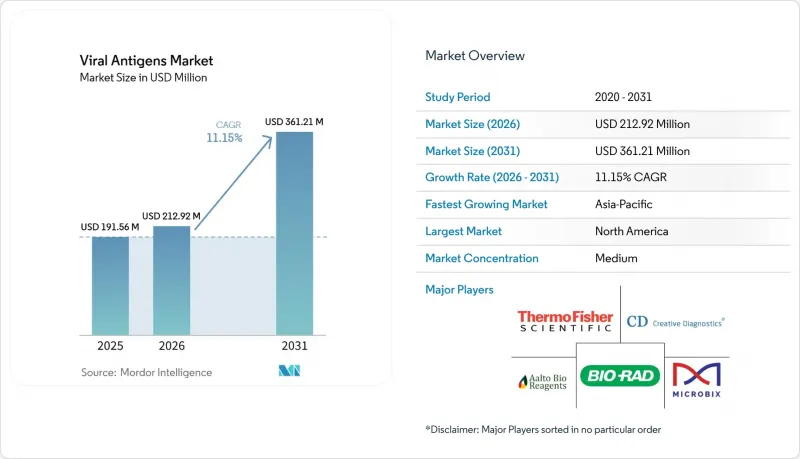
본 보고서는 유형(네이티브, 재조합, 합성, 기타), 바이러스(인플루엔자, HIV, 간염, 뎅기열), 용도(진단, 백신 개발, 연구 개발), 최종 사용자(연구 기관, 제약·바이오기술 기업, 병원, 학술 기관),판매 채널(병원, 소매, 온라인), 측정법(ELISA, 면역측정법, 기타), 지역(북미, 유럽, 아시아태평양, 남미, 중동 및 아프리카)별로 분류되어 있습니다. 금액은 달러(USD)로 표시되어 있습니다.
세계 바이러스 항원 시장 동향 및 인사이트
고속 처리 바이러스 혈청학 검사 및 품질 관리(QC) 검사에 대한 수요 증가
팬데믹 이후 감시 체계가 축소되지 않고 지속됨에 따라, 임상 실험실에서는 2024년 이후 혈청학적 검사 건수가 증가하고 있습니다. 이러한 변화는 분석법 및 품질 관리용 시료에 사용되는 표준화된 항원에 대한 수요를 더욱 안정적으로 만들어 바이러스 항원 시장을 뒷받침하고 있습니다. 또한, 외부 품질 평가 프로그램 역시 검사실이 패널 준비 및 숙련도 평가를 위해 반복적인 공급을 필요로 하기 때문에 정기적인 구매 주기를 창출하고 있습니다. Microbix사는 2026년 1월, 30개국 이상에서 능력 시험 및 외부 품질 평가 용도로 재조합 SARS-CoV-2 뉴클레오캡시드 항원을 상용화했습니다. 재조합 기준 항원이 인증 품질 프로그램에 포함되면, 고객은 대체품으로 전환하는 것을 피하는 경향이 있습니다. 이는 대체품으로 전환할 경우 재검증이나 내부 심사가 필요하기 때문입니다. 이러한 경향으로 인해 바이러스 항원 시장의 초기 진출기업들은 일시적인 감염 확산에 따른 구매에만 의존하는 공급업체보다 더 지속 가능한 수익 기반을 확보하고 있습니다.
진단 및 백신 연구 개발을 위한 재조합 항원 플랫폼의 확대
재조합 항원은 로트 간 일관성을 향상시키고 천연 유래 원료 조달에 수반되는 생물안전성 문제를 완화하기 때문에 많은 분석법 개발자들에게 선호되는 형태가 되었습니다. 이러한 추세로 인해 바이러스 항원 시장의 프리미엄 부문이 확대되고 있으며, 특히 표적 에피토프, 확장 가능한 발현 및 보다 철저한 문서화를 필요로 하는 구매자들 사이에서 두드러지게 나타나고 있습니다. 백신 연구에서도 유사한 동향이 나타나고 있으며, 개발자들은 결합 시험, 중화 시험 및 분석법 대조군 설계를 위해 정밀한 항원 변이체를 필요로 하고 있습니다. Sino Biological사는 2026년 3월, 균주 선정 후 몇 주 만에 2026-2027년 북반구 인플루엔자 백신 균주를 위한 재조합 항원을 출시했습니다. 이는 속도와 준비 태세가 상업적 포지셔닝에 어떻게 영향을 미치는지를 보여줍니다. 당사슬 부착형 및 비당사슬 부착형 발현 옵션을 모두 지원할 수 있는 공급업체는 고감도 진단 용도와 일상적인 품질 관리 용도 모두에 쉽게 대응할 수 있는 입장에 있습니다. 그 결과, 바이러스 항원 시장에서는 단순한 카탈로그 상품 구성의 폭뿐만 아니라 유연한 생산 플랫폼이 점점 더 높이 평가되고 있습니다.
생물학적 원료의 배치 간 변동성 및 콜드체인에 대한 민감성
콜드체인에 대한 의존도는 바이러스 항원 시장, 특히 천연 유래 생물학적 원료나 온도에 민감한 재조합 형태의 제품에 있어 여전히 중요한 운영상의 제약으로 남아 있습니다. 운송 중 사소한 편차조차도 면역 반응성을 저하시키고 로트 불합격을 초래할 가능성이 있으며, 그 결과 하류 진단 키트 생산에 차질을 빚게 됩니다. 2024년 『Vaccine』 저널에 게재된 연구에 따르면, 콜드체인의 불균형은 자원이 부족한 환경에서 생물학적 제품의 성능과 가용성에 계속해서 영향을 미치고 있는 것으로 나타났습니다. 이 문제는 원료의 안정성이 불확실한 경우, 제조업체나 키트 개발자가 더 많은 안전 재고를 확보하게 되므로 운전 자본에 대한 압박도 가중시킵니다. 이러한 부담은 물류 측면에만 그치지 않습니다. 전 세계 생물학적 표준화 체계 하에서 특성 평가 및 기준 물질에 대한 요건이 점점 더 엄격해지고 있기 때문입니다. 그 결과, 바이러스 항원 시장은 냉장 시설, 검증 능력, 공급망 가시성이 부족한 지역에서 여전히 지역별 도입 현황에 편차가 나타나고 있습니다.
부문 분석
2025년에는 재조합 항원이 이 부문을 주도하며 32.8%의 점유율을 차지했습니다. 또한 2031년까지 연평균 성장률(CAGR) 11.8%라는 가장 높은 성장률을 기록하며 확대될 것으로 예측됩니다. 많은 구매자들이 현재 일관성, 순도 및 항원 설계에 대한 더 우수한 관리를 우선시하고 있기 때문에 이러한 실적을 바탕으로 재조합 형태는 바이러스 항원 시장에서 계속해서 중심적인 위치를 차지하고 있습니다. 진단 키트 제조업체들은 특히 분석법의 민감도나 재현성이 규제 당국에 대한 신청과 직결되는 경우, 표적 에피토프를 보다 정확하게 정의할 수 있는 능력을 중요하게 여깁니다. 또한, 바이오의약품 및 백신 개발 프로그램에서도 여러 개발 단계에 걸친 확장 가능한 생산이나 보다 엄격한 공정 관리가 필요한 경우, 재조합형 원료가 선호됩니다. 이러한 요인들이 재조합형 제품의 판매량 증가와 프리미엄 가격 책정을 모두 뒷받침하고 있습니다.
네이티브 항원은 여전히 구조에 의한 제시가 중요한 상황, 예를 들어 간염이나 단순 헤르페스 바이러스 검사에서의 특정 혈청학적 용도에서 여전히 중요한 역할을 하고 있습니다. 그 상업적 위상은 이미 검증되었으며, 당장 재설계 압력을 받을 가능성이 낮은 기존 워크플로우에서 더욱 견고합니다. 합성 항원은 표적 펩타이드의 응용이나 신속 검사 스트립 개발 분야에서 주목받고 있으며, 이러한 분야에서는 완전한 단백질 구조보다 정의된 서열이 더 유용할 수 있습니다. 불활성화 항원 및 약독화 생항원은 여전히 백신 개발 및 연구 개발 환경과 밀접하게 연결되어 있으며, 이러한 환경에서는 익숙한 면역원성 프로파일이 계속해서 중요하게 여겨집니다. 바이러스 항원 시장 전체에서 진정한 분기점은 표준화된 재조합 규모의 제품과, 보다 제한적인 기술적 맥락에서 유용성을 유지하고 있는 특수한 형식 사이에 있다고 할 수 있습니다.
재조합 제품의 두 번째 구분은 생산 숙주의 관점에서 볼 때, 세균계와 보다 복잡한 세포 기반 발현 플랫폼의 차이입니다. 세균 발현은 저비용 공급과 신속한 처리량이 가능하기 때문에 보다 단순한 비당사슬 표적에 대해서는 여전히 매력적인 선택지입니다. 대조적으로, 곤충 세포나 포유류 세포 계통은 특히 성능 요건이 더 까다로운 외피를 가진 바이러스 단백질의 경우, 구매자가 천연형에 가까운 접힘 구조나 당사슬 부착을 필요로 할 때 중요해집니다. 이러한 생산 형태의 다양화로 인해 조달 형태도 변화하고 있습니다. 일부 고객은 단일한 범용 원료가 아닌, 서로 다른 분석 공정마다 조합된 항원 버전을 요구하고 있기 때문입니다. 따라서 바이러스 항원 업계는 더 많은 재조합 물질을 판매할 뿐만 아니라, 각 다운스트림 공정의 용도에 맞추어 형식과 발현 숙주를 최적화함으로써 가치를 창출하고 있습니다.
이러한 추세는 문서화, 분석적 특성 평가 및 로트 릴리스에 대한 엄격한 관리의 중요성을 높이고 있습니다. 농도, 순도, 기능적 성능을 명확한 자료로 설명할 수 있는 공급업체는 규제 대상 고객사에게 더 유리한 입장에 있습니다. 전 세계적으로 생물학적 기준 물질에 대한 기대치가 엄격해짐에 따라, 추적성은 더욱 중요한 구매 요인이 되고 있습니다. 따라서 소규모 기업이 기술적으로 우수한 단백질을 생산할 수 있다 하더라도, 대규모 재조합 단백질 공급업체에게 우위가 생깁니다. 바이러스 항원 시장에서 각 유형의 선도적 지위는 분자 설계와 마찬가지로 제조 과정의 엄격한 관리에 의해 뒷받침되고 있습니다.
2025년에는 인플루엔자 바이러스 항원이 매출의 24.7%를 차지하며, 인플루엔자는 바이러스 항원 시장에서 가장 큰 바이러스 종 부문이 되었습니다. 이러한 주도적 지위는 백신 제조업체, 임상 검사 기관 및 분석법 개발자에서의 수요가 매년 갱신되는 연간 재조제 주기를 반영합니다. 항원 드리프트로 인해 균주 선정부터 조달 필요까지의 기간이 단축되기 때문에 인플루엔자는 여전히 상업적으로 중요한 위치를 차지하고 있습니다. 포트폴리오를 신속하게 갱신하지 못하는 공급업체는 전체 계절 주기를 놓칠 위험에 처합니다. 이러한 시기적 압박으로 인해, 다른 바이러스 카테고리가 더 큰 성장세를 보이며 주목을 받고 있는 상황에서도 인플루엔자는 안정적인 판매량을 자랑하는 부문으로 남아 있습니다.
2026년 3월에 2026-2027년 북반구 백신 균주에 연동된 재조합 인플루엔자 항원이 출시된다는 사실은 공식 권고가 발표된 후 공급업체가 얼마나 신속하게 행동해야 하는지를 보여줍니다. 코로나바이러스 항원의 경우, 과거에 보였던 것과 같은 비상시 수요 급증 패턴이 아니라, 감시, 점막 면역 조사 및 능력 시험을 통해 지속적으로 수요가 창출되고 있습니다. HIV 및 간염 항원은 선별 검사 프로그램, 산업보건 검사 및 혈액은행 관련 워크플로우에 의해 계속해서 뒷받침되고 있습니다. 2025년 10월에 발효될 B형 간염 바이러스 항원 정성 검사의 FDA에 의한 클래스 II 재분류는 신규 진단제 개발자에게 있어 승인 절차상의 부담을 경감시키고, 간염 관련 제품 개발에서 더 광범위한 활동을 촉진할 가능성이 있습니다. 단순 헤르페스 바이러스 및 지카 바이러스는 시장 점유율은 작지만, 공급업체가 타겟을 좁힌 제품 라인업으로 틈새 수요를 지킬 수 있는 전문 검사 분야에서는 여전히 중요한 위치를 차지하고 있습니다.
뎅기열 바이러스는 가장 빠르게 성장하는 바이러스 종 부문이며, 뎅기열 바이러스 항원 시장 규모는 2031년까지 연평균 성장률(CAGR) 11.6%로 확대될 것으로 예측됩니다. 이러한 성장은 단기적인 수요 급증에 기인한 것이 아니라, 감시 체계의 확대, 당일 검사 수요의 확산, 그리고 유행 지역에서의 공중 보건 수요에 의해 뒷받침되고 있으므로 구조적인 것입니다. 인도에서 NS1 신속 진단 검사에 대한 긍정적인 평가는 저비용 검사 방식이 어떻게 대규모 접근성 확대로 이어지는지를 여실히 보여줍니다. 신속 면역 분석법에서의 사용에 성능을 맞출 수 있는 공급업체는 성숙한 호흡기 질환 부문보다 뎅기열 분야에서 더 신속하게 시장에 진입할 가능성이 있습니다. 이것이 바이러스 항원 시장이 전략적 초점을 열대병 분야로 부분적으로 전환하고 있는 이유 중 하나입니다.
또한 바이러스 종 수준에서도 제품 포트폴리오의 폭이 점점 더 중요하게 여겨지고 있습니다. 참조 검사 기관이나 대규모 기관 구매자는 실용적인 문서를 갖추고 여러 병원체 군을 포괄할 수 있는 단일 공급업체를 선호하는 경향이 있습니다. 이러한 경향은 적격성 심사 부담을 줄여주고 평균 주문 규모 확대로 이어집니다. 또한, 주류인 호흡기 및 혈액 매개 감염 표적과 소규모 신흥 바이러스 제품 라인을 결합한 공급업체에게도 유리하게 작용합니다. 따라서 바이러스 항원 업계에서 바이러스 종에 걸친 제품의 폭이 넓으면, 소수의 표적이 수익의 대부분을 차지하고 있는 경우에도 고객 유지를 강화할 수 있습니다.
지역별 분석
2025년, 북미는 바이러스 항원 시장 점유율의 39.6%를 차지하며 계속해서 최대 지역 기여자로서의 지위를 유지했습니다. 이 지역은 참조 검사 기관의 밀집된 네트워크, 강력한 공중보건 감시 활동, 그리고 충분히 특성화된 항원 원료가 필요한 규제 대상 IVD 제조거점의 혜택을 받고 있습니다. 미국의 구매자들은 추적성, 문서화, 재현 가능한 제조를 높이 평가하고 있으며, 이는 대형 기존 공급업체들에게 힘을 실어주고 있습니다. 캐나다는 국립 연구소의 활동을 통해 안정적인 수요를 창출하고 있는 반면, 멕시코는 뎅기열 및 기타 감염병 검사 분야에서 점진적으로 증가하는 수요를 뒷받침하고 있습니다. 이러한 요인들이 결합되어 북미 바이러스 항원 시장은 임상, 공중보건 및 규제 대상 제조 용도에 걸쳐 폭넓은 수요 기반을 갖추고 있습니다.
유럽은 2025년에도 여전히 2위의 규모를 유지하며, 잘 갖춰진 검사실 인프라와 활발한 학술적 바이러스 연구에 힘입어 계속해서 성장하고 있습니다. 독일과 영국은 IVD 개발 및 조달의 주요 지역 거점으로서 역할을 수행하고 있습니다. 유럽의 엄격한 규제 때문에 고객은 보다 충실한 기술 자료와 신뢰할 수 있는 품질 관리 시스템을 갖춘 공급업체를 선택하는 경향이 있으며, 이로 인해 주요 벤더 간 시장 점유율 집중이 가속화될 가능성이 있습니다. 따라서 제품 수요가 견조하더라도, 유럽의 바이러스 항원 시장은 자격을 갖추지 못한 신규 시장 진출기업에게는 진입이 어려운 시장입니다. 따라서 이 지역은 여전히 매력적이지만, 성공 여부는 문서화의 충실도와 상업적 신뢰성에 크게 좌우됩니다.
아시아태평양은 2031년까지 연평균 성장률(CAGR) 11.6%를 기록하며 가장 빠른 성장을 보일 것으로 예측됩니다. 이 지역은 인도, 인도네시아, 태국, 필리핀에서의 뎅기열 감시 확대는 물론, 중국의 활발한 국내 바이오 제조 활동과 일본의 확립된 인플루엔자 감시 체제의 혜택을 받고 있습니다. 특히 인도는 중요한 시장으로, 뎅기열 NS1 신속 진단법의 보다 광범위한 활용을 둘러싼 논의가 저비용 항원 형식에 대한 상당한 수요를 불러일으킬 가능성이 있기 때문입니다. 또한, 이 지역의 많은 구매자들은 기존공급 관계에 얽매이기 어렵기 때문에 경쟁력 있는 가격과 현실적인 납기일을 제시할 수 있는 신규 진출기업들에게 진입의 여지가 생기고 있습니다. 이러한 요인들로 인해 아시아태평양은 예측 기간 동안 바이러스 항원 시장의 주요 성장 동력이 될 것입니다.
남미는 2025년 매출 기준으로는 비교적 작은 비중을 차지하고 있지만, 브라질과 아르헨티나는 공중보건 검사 기관 네트워크와 열대병 검사 수요가 있어 여전히 주요 수요 거점으로 남아 있습니다. 브라질은 뎅기열 관련 조달에서 특히 중요한데, 인프라가 제한적인 고부담 지역에서도 당일 분류 도구를 활용할 수 있기 때문입니다. 중동 및 아프리카는 여전히 초기 단계 시장이며, 수요는 GCC(걸프협력회의) 국가들의 의료 시스템과 남아프리카의 비교적 잘 갖춰진 검사 환경에 집중되어 있습니다. 콜드체인의 제약으로 인해 아프리카의 일부 시장에서는 여전히 보급이 제한되고 있으며, 그로 인해 안정적이고 취급이 용이한 제품 형태가 상업적으로 더 매력적입니다. 두 지역 모두에서 바이러스 항원 시장은 존재하며 성장하고 있지만, 성숙한 시장에 비해 제품의 사용 편의성, 물류, 그리고 합리적인 가격이 여전히 더 결정적인 요소로 작용하고 있습니다.
기타 혜택:
- 엑셀 형식 시장 예측(ME) 시트
- 3개월간의 애널리스트 지원
자주 묻는 질문
목차
제1장 서론
제2장 조사 방법
제3장 개요
제4장 시장 구도
제5장 시장 규모와 성장 예측
제6장 경쟁 구도
제7장 시장 기회와 향후 전망
JHS 26.09.01According to Mordor Intelligence, the viral antigens market size was valued at USD 191.6 million in 2025 and estimated to grow from USD 212.9 million in 2026 to reach USD 361.2 million by 2031, at a CAGR of 11.2% during the forecast period (2026-2031).
This report is Segmented by Type (Native, Recombinant, Synthetic, and More), Virus (Influenza, HIV, Hepatitis, Dengue), Application (Diagnostics, Vaccine Development, R&D), End User (Research Labs, Pharma/Biotech, Hospitals, Academic), Channel (Hospital, Retail, Online), Method (ELISA, Immunoassays, Others), and Geography (North America, Europe, Asia-Pacific, South America, MEA). In Value (USD).
Global Viral Antigens Market Trends and Insights
Rising Need for High-Throughput Viral Serology and QC Testing
Clinical laboratories have expanded serology testing volumes since 2024 because post-pandemic surveillance systems have stayed active instead of winding down. This shift supports the viral antigens market by creating steadier demand for standardized antigens used inside assays and in quality-control materials. External quality assessment programs also add a recurring purchase cycle because labs need repeat supplies for panel preparation and proficiency testing. Microbix commercialized its recombinant SARS-CoV-2 nucleocapsid antigen in January 2026 for proficiency testing and external quality assessment use across more than 30 countries. Once a recombinant reference antigen is built into an accredited quality program, customers tend to avoid switching because a replacement requires revalidation and internal review. That pattern gives early suppliers in the viral antigens market a more durable revenue base than suppliers exposed only to episodic outbreak purchasing.
Expansion of Recombinant Antigen Platforms for Diagnostics and Vaccine R&D
Recombinant antigens have become the preferred format for many assay developers because they improve batch consistency and reduce biosafety complications linked to native sourcing. This preference is widening the premium layer of the viral antigens market, especially where buyers need targeted epitopes, scalable expression, and stronger documentation. The same trend is visible in vaccine research, where developers need precise antigen variants for binding studies, neutralization work, and assay control design. Sino Biological launches recombinant antigens for the 2026-2027 Northern Hemisphere influenza vaccine strains in March 2026, within weeks of strain selection, showing how speed and readiness affect commercial positioning. Suppliers that can support glycosylated and non-glycosylated expression options are better placed to serve both high-sensitivity diagnostic uses and routine quality-control applications. The result is a viral antigens market that increasingly rewards flexible production platforms rather than simple catalog breadth alone.
Batch Variability and Cold-Chain Sensitivity of Biological Inputs
Cold-chain dependence remains a meaningful operational limit for the viral antigens market, especially for native biological inputs and temperature-sensitive recombinant formats. Even minor transport deviations can reduce immunoreactivity and trigger lot failures, which then disrupt downstream diagnostic kit production. A 2024 study in Vaccine showed that cold-chain inequity continues to affect biological product performance and access in lower-resource settings. That problem also raises working-capital pressure because manufacturers and kit developers keep larger safety stocks when input stability is uncertain. The burden is not only logistical, because characterization and reference material expectations continue to tighten under global biological standardization frameworks. As a result, the viral antigens market still faces uneven adoption across geographies where refrigeration, validation capacity, and supply-chain visibility are less reliable.
Other drivers and restraints analyzed in the detailed report include:
- Growing Testing Volume for Seasonal and Emerging Viral Threats
- Shift Toward Multiplex and Syndromic Viral Panels
- Narrow Buyer Base and Long Validation Cycles in Diagnostics
For complete list of drivers and restraints, kindly check the Table Of Contents.
Segment Analysis
Recombinant antigens led this segmentation with 32.8% share in 2025, and they are also projected to grow at the fastest 11.8% CAGR through 2031. This performance keeps recombinant formats at the center of the viral antigens market because many buyers now prioritize consistency, purity, and better control over antigen design. Diagnostic kit manufacturers value the ability to define target epitopes more precisely, especially when assay sensitivity and reproducibility are tied to regulatory submissions. Biopharma and vaccine programs also prefer recombinant inputs when they need scalable production and cleaner process control across multiple development stages. These factors support both volume growth and premium pricing for recombinant formats.
Native antigens still serve an important role where conformational presentation remains critical, including selected serology uses for hepatitis and herpes simplex virus testing. Their commercial position is stronger in legacy workflows that are already validated and less exposed to immediate redesign pressure. Synthetic antigens are gaining interest in targeted peptide applications and rapid test strip development, where a defined sequence can be more useful than a full protein structure. Inactivated and live attenuated antigens remain tied more closely to vaccine development and research settings, where familiar immunogenic profiles continue to matter. Across the viral antigens market, the real divide is increasingly between standardized recombinant scale products and specialized formats that remain useful in narrower technical contexts.
A second layer within recombinant products is the production-host split between bacterial systems and more complex cell-based expression platforms. Bacterial expression remains attractive for simpler non-glycosylated targets because it supports lower-cost supply and faster throughput. In contrast, insect-cell and mammalian systems matter when buyers need native-like folding or glycosylation, particularly for enveloped virus proteins with stricter performance requirements. That production mix is reshaping procurement because some customers now request paired antigen versions for different assay steps rather than a single universal input. The viral antigens industry therefore gains value not only from selling more recombinant material, but from matching format and expression host to each downstream use.
This trend also raises the importance of documentation, analytical characterization, and lot release discipline. Suppliers that can explain concentration, purity, and functional performance with clear files are better placed in regulated accounts. Traceability has become a stronger purchasing factor as global biological reference expectations tighten. That gives larger recombinant suppliers an advantage, even when smaller firms can produce technically sound proteins. In the viral antigens market, type leadership is therefore supported as much by manufacturing discipline as by molecular design.
Influenza virus antigens accounted for 24.7% of revenue in 2025, making influenza the largest virus-type segment in the viral antigens market. This leadership reflects the annual reformulation cycle that renews demand from vaccine manufacturers, clinical laboratories, and assay developers. Influenza remains commercially important because antigenic drift compresses the timeline between strain selection and procurement needs. Suppliers that cannot update portfolios quickly risk losing an entire seasonal cycle. That timing pressure keeps influenza a dependable volume segment even when other virus categories attract more growth attention.
The March 2026 launch of recombinant influenza antigens linked to the 2026-2027 Northern Hemisphere vaccine strains shows how quickly suppliers must move after official recommendations are released. Coronavirus antigens continue to generate demand through surveillance, mucosal immunity research, and proficiency testing rather than through the emergency surge pattern seen earlier. HIV and hepatitis antigens remain supported by screening programs, occupational health testing, and blood-bank related workflows. FDA reclassification of qualitative hepatitis B virus antigen assays to Class II, effective in October 2025, lowers the pathway burden for new diagnostic developers and can support broader activity in hepatitis-linked product development. Herpes simplex virus and Zika virus occupy smaller positions, but they remain relevant in specialty testing settings where suppliers can defend niche demand with targeted catalogs.
Dengue virus is the fastest-growing virus-type segment, with the viral antigens market size for dengue projected to rise at an 11.6% CAGR through 2031. The growth case is structural because it rests on broader surveillance, wider same-day testing needs, and public health demand in endemic regions rather than on a short-term spike. India's active evaluation of NS1 rapid diagnostic test use highlights how lower-cost formats can expand access at scale. Suppliers that can align performance with rapid immunoassay use may gain faster entry in dengue than in mature respiratory categories. This is one reason the viral antigens market is shifting some strategic focus toward tropical disease coverage.
Portfolio breadth is also becoming more valuable at the virus-type level. Reference laboratories and larger institutional buyers often prefer a single supplier that can cover multiple pathogen classes with usable documentation. That preference reduces qualification workload and can increase average order size. It also favors vendors that combine mainstream respiratory and blood-borne targets with smaller emerging-virus catalogs. In the viral antigens industry, breadth across virus types can therefore strengthen retention even when only a few targets drive most revenue.
Complete Report Scope:
- By Type
- Native Antigens
- Recombinant Antigens
- Synthetic Antigens
- Inactivated Antigens
- Live Attenuated Antigens
- Other Types
- By Diagnostic Method
- Antigen-Based Diagnostic Kits
- Immunoassays
- ELISA
- Hemagglutination
- Radioimmunoassay
- Immunofluorescence
- Immunoperoxidase Staining
- Electron Microscopy
- Other Diagnostic Methods
- By Virus Type
- Influenza Virus
- Coronavirus
- Human Immunodeficiency Virus
- Hepatitis Virus
- Herpes Simplex Virus
- Dengue Virus
- Zika Virus
- Other Virus Types
- By Application
- Diagnostics
- Vaccine Development
- Research and Development
- Therapeutic Use
- Other Applications
- By End User
- Research and Diagnostic Laboratories
- Pharmaceutical and Biotechnology Companies
- Hospitals
- Academic and Government Research Institutes
- Veterinary Clinics
- Other End Users
- By Distribution Channel
- Hospital Pharmacies
- Retail Pharmacies
- Online Pharmacies
- Geography
- North America
- United States
- Canada
- Mexico
- Europe
- Germany
- United Kingdom
- France
- Italy
- Spain
- Russia
- Rest of Europe
- Asia-Pacific
- China
- India
- Japan
- South Korea
- Australia
- Rest of Asia-Pacific
- South America
- Brazil
- Argentina
- Rest of South America
- Middle East and Africa
- GCC
- South Africa
- Rest of Middle East & Africa
- North America
Geography Analysis
North America held 39.6% of the viral antigens market share in 2025, which kept it as the largest regional contributor. The region benefits from a dense network of reference laboratories, strong public health surveillance activity, and a regulated IVD manufacturing base that requires well-characterized antigen inputs. Buyers in the United States place high value on traceability, documentation, and reproducible manufacturing, which supports larger established suppliers. Canada adds stable demand through national laboratory activity, while Mexico supports incremental need in dengue and other infectious disease testing categories. This combination gives the viral antigens market in North America a broad demand base across clinical, public health, and regulated manufacturing use.
Europe remained the second-largest region in 2025 and continues to be supported by strong laboratory infrastructure and active academic virus research. Germany and the United Kingdom serve as key regional hubs for IVD development and procurement. Regulatory discipline in Europe pushes customers toward suppliers with stronger technical files and dependable quality systems, which can accelerate share concentration among larger vendors. That makes the viral antigens market in Europe less open to unqualified entrants, even when product demand is healthy. The region therefore remains attractive, but success depends heavily on documentation strength and commercial reliability.
Asia-Pacific is forecast to record the fastest growth at 11.6% CAGR through 2031. The region benefits from expanding dengue surveillance in India, Indonesia, Thailand, and the Philippines, along with stronger domestic biomanufacturing activity in China and established influenza monitoring in Japan. India is especially important because the debate around broader use of dengue NS1 rapid diagnostics could unlock sizable volume demand for low-cost antigen formats. Many buyers in the region are also less tied to legacy supply relationships, which can create room for new entrants with competitive pricing and practical delivery timelines. That makes Asia-Pacific the main growth engine for the viral antigens market over the forecast period.
South America accounted for a smaller 2025 revenue base, but Brazil and Argentina remain the leading demand centers because of their public health laboratory networks and tropical disease testing needs. Brazil is especially important for dengue-linked procurement because same-day triage tools can serve high-burden settings with limited infrastructure depth. The Middle East and Africa are still earlier-stage markets, with demand concentrated in GCC healthcare systems and South Africa's more established laboratory environment. Cold-chain limitations continue to restrain broader penetration in several African markets, which makes stable and easier-to-handle product formats more commercially attractive. Across both regions, the viral antigens market is present and growing, but product usability, logistics, and affordability remain more decisive than in mature markets.
- Aalto Bio Reagents Ltd.
- Abbott Laboratories
- Beckton Dickinson
- bioMerieux
- Bio-Rad Laboratories
- Bio-Techne
- Cepheid
- Creative Diagnostics
- Danaher
- DiaSorin
- Roche
- LGC Group
- Merck
- Microbix Biosystems Inc.
- ProSpec-Tany TechnoGene Ltd.
- QuidelOrtho
- Randox Laboratories
- Sino Biological, Inc.
- The Native Antigen Company Ltd.
- Thermo Fisher Scientific
Additional Benefits:
- The market estimate (ME) sheet in Excel format
- 3 months of analyst support
TABLE OF CONTENTS
1 INTRODUCTION
- 1.1 Study Assumptions and Market Definition
- 1.2 Scope of the Study
2 RESEARCH METHODOLOGY
3 EXECUTIVE SUMMARY
4 MARKET LANDSCAPE
- 4.1 Market Overview
- 4.2 Market Drivers
- 4.2.1 Rising Need for High-Throughput Viral Serology and QC Testing
- 4.2.2 Expansion of Recombinant Antigen Platforms for Diagnostics and Vaccine R and D
- 4.2.3 Growing Testing Volume for Seasonal and Emerging Viral Threats
- 4.2.4 Shift Toward Multiplex and Syndromic Viral Panels
- 4.2.5 Regulatory Push for Traceable and Well Characterized Reference Antigens
- 4.2.6 Growth of Outsourced Antigen Manufacturing and Custom Bioreagent Supply
- 4.3 Market Restraints
- 4.3.1 Batch Variability and Cold-Chain Sensitivity of Biological Inputs
- 4.3.2 Narrow Buyer Base and Long Validation Cycles in Diagnostics
- 4.3.3 Substitution Risk from Nucleic Acid and Protein-Free Assay Designs
- 4.3.4 Price Pressure in Commodity Antigen Catalog Products
- 4.4 Value Chain Analysis
- 4.5 Supply Chain Analysis
- 4.6 Regulatory Landscape
- 4.7 Technological Outlook
- 4.8 Porter's Five Forces Analysis
- 4.8.1 Bargaining Power of Suppliers
- 4.8.2 Bargaining Power of Buyers
- 4.8.3 Threat of New Entrants
- 4.8.4 Threat of Substitutes
- 4.8.5 Intensity of Competitive Rivalry
5 MARKET SIZE AND GROWTH FORECASTS
- 5.1 By Type
- 5.1.1 Native Antigens
- 5.1.2 Recombinant Antigens
- 5.1.3 Synthetic Antigens
- 5.1.4 Inactivated Antigens
- 5.1.5 Live Attenuated Antigens
- 5.1.6 Other Types
- 5.2 By Diagnostic Method
- 5.2.1 Antigen-Based Diagnostic Kits
- 5.2.2 Immunoassays
- 5.2.3 ELISA
- 5.2.4 Hemagglutination
- 5.2.5 Radioimmunoassay
- 5.2.6 Immunofluorescence
- 5.2.7 Immunoperoxidase Staining
- 5.2.8 Electron Microscopy
- 5.2.9 Other Diagnostic Methods
- 5.3 By Virus Type
- 5.3.1 Influenza Virus
- 5.3.2 Coronavirus
- 5.3.3 Human Immunodeficiency Virus
- 5.3.4 Hepatitis Virus
- 5.3.5 Herpes Simplex Virus
- 5.3.6 Dengue Virus
- 5.3.7 Zika Virus
- 5.3.8 Other Virus Types
- 5.4 By Application
- 5.4.1 Diagnostics
- 5.4.2 Vaccine Development
- 5.4.3 Research and Development
- 5.4.4 Therapeutic Use
- 5.4.5 Other Applications
- 5.5 By End User
- 5.5.1 Research and Diagnostic Laboratories
- 5.5.2 Pharmaceutical and Biotechnology Companies
- 5.5.3 Hospitals
- 5.5.4 Academic and Government Research Institutes
- 5.5.5 Veterinary Clinics
- 5.5.6 Other End Users
- 5.6 By Distribution Channel
- 5.6.1 Hospital Pharmacies
- 5.6.2 Retail Pharmacies
- 5.6.3 Online Pharmacies
- 5.7 Geography
- 5.7.1 North America
- 5.7.1.1 United States
- 5.7.1.2 Canada
- 5.7.1.3 Mexico
- 5.7.2 Europe
- 5.7.2.1 Germany
- 5.7.2.2 United Kingdom
- 5.7.2.3 France
- 5.7.2.4 Italy
- 5.7.2.5 Spain
- 5.7.2.6 Russia
- 5.7.2.7 Rest of Europe
- 5.7.3 Asia-Pacific
- 5.7.3.1 China
- 5.7.3.2 India
- 5.7.3.3 Japan
- 5.7.3.4 South Korea
- 5.7.3.5 Australia
- 5.7.3.6 Rest of Asia-Pacific
- 5.7.4 South America
- 5.7.4.1 Brazil
- 5.7.4.2 Argentina
- 5.7.4.3 Rest of South America
- 5.7.5 Middle East and Africa
- 5.7.5.1 GCC
- 5.7.5.2 South Africa
- 5.7.5.3 Rest of Middle East & Africa
- 5.7.1 North America
6 COMPETITIVE LANDSCAPE
- 6.1 Market Concentration
- 6.2 Market Share Analysis
- 6.3 Strategic Moves
- 6.4 Company Profiles (includes Global Level Overview, Market Level Overview, Core Segments, Financials as available, Strategic Information, Market Rank/Share, Products and Services, Recent Developments)
- 6.4.1 Aalto Bio Reagents Ltd.
- 6.4.2 Abbott Laboratories
- 6.4.3 Becton, Dickinson and Company
- 6.4.4 bioMerieux SA
- 6.4.5 Bio-Rad Laboratories, Inc.
- 6.4.6 Bio-Techne Corporation
- 6.4.7 Cepheid
- 6.4.8 Creative Diagnostics
- 6.4.9 Danaher Corporation
- 6.4.10 DiaSorin S.p.A.
- 6.4.11 F. Hoffmann-La Roche Ltd
- 6.4.12 LGC Limited
- 6.4.13 Merck KGaA
- 6.4.14 Microbix Biosystems Inc.
- 6.4.15 ProSpec-Tany TechnoGene Ltd.
- 6.4.16 QuidelOrtho Corporation
- 6.4.17 Randox Laboratories Ltd.
- 6.4.18 Sino Biological, Inc.
- 6.4.19 The Native Antigen Company Ltd.
- 6.4.20 Thermo Fisher Scientific Inc.
7 MARKET OPPORTUNITIES AND FUTURE OUTLOOK
- 7.1 White-Space and Unmet-Need Assessment


