

|
시장보고서
상품코드
2117613
부트리시란 : 시장 점유율 분석, 업계 동향 및 통계, 성장 예측(2026-2031년)Vutrisiran - Market Share Analysis, Industry Trends & Statistics, Growth Forecasts (2026 - 2031) |
||||||
 Mordor Intelligence
Mordor Intelligence에 의하면, 부트리시란 시장 규모는 2025년에 23억 1,000만 달러로 평가되었습니다. 2026년 29억 3,000만 달러에서 2031년까지 96억 4,000만 달러에 이를 것으로 추정되고 2026-2031년까지 CAGR은 26.9%를 나타낼 전망입니다.
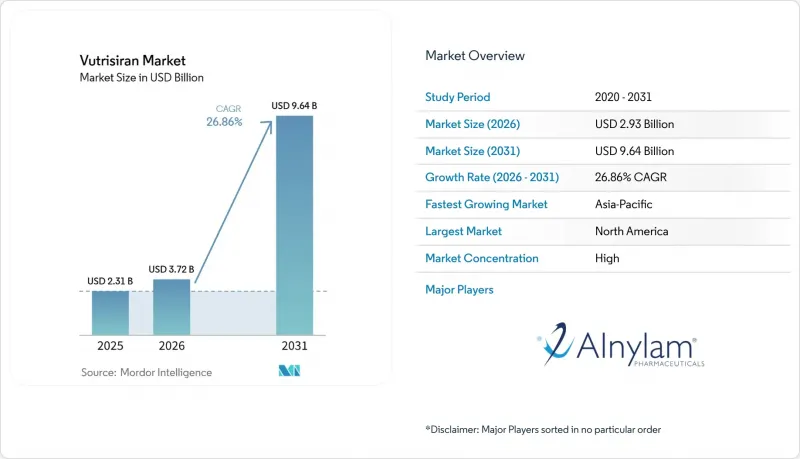
본 보고서는 적응증(hATTR 다발성 신경병증, ATTR 심근증), 유통 채널(병원 약국, 소매 약국, 온라인 약국), 최종 사용자(병원, 전문 클리닉, 재택치료, 학술 연구 기관),지역(북미, 유럽, 아시아태평양, 남미, 중동 및 아프리카)별로 분류되어 있습니다. 시장 예측은 금액(미 달러) 기준으로 제시되어 있습니다.
세계의 부트리시란 시장 동향 및 인사이트
hATTR-PN 및 ATTR-CM에서의 승인 적응증 확대
부트리시란은 다발성 신경병증 전용 제품에서 hATTR-PN과 ATTR-CM 모두에 사용되는 치료제로 전환되었습니다. 이러한 변화가 바로 부트리시란 시장의 단기적 성장을 견인하는 가장 큰 요인입니다. 2025년 3월 FDA의 결정에 따라 알닐람(Alnylam)은 ATTR-CM 분야에서 최초의 RNAi 치료제로 승인을 획득하여, 동등한 사이렌서가 해당 분야에 진입하기 전에 조기 선두를 확보했습니다. HELIOS-B 임상시험에서는 전체 대상 집단에서 모든 원인에 의한 사망률과 심혈관 사건 재발을 합친 복합 평가변수에서 28%의 감소가 나타났으며, 배경 요법으로 TTR 안정화제를 사용하지 않은 환자에서는 그 감소율이 33%에 달했습니다. 또한, 이 임상시험에서 치료를 받은 환자의 22%에서 심혈관 자기공명영상(cMRI)을 통해 아밀로이드 퇴행이 확인된 반면, 위약군에서는 퇴행이 관찰되지 않아 부트리시란 시장을 뒷받침하는 질병 수정 작용프로파일이 더욱 공고해졌습니다. 유럽, 캐나다, 일본에서의 적응증 확대로 인해 2025-2026년에 걸쳐 새로운 치료 대상 집단이 지속적으로 증가하고 있으며, 그 속도는 많은 희귀질환 치료제의 출시 당시보다 빠릅니다. 그 결과, 부트리시란 시장은 더 이상 좁은 범위의 유전성 신경장애 환자층에 국한되지 않고, 보다 광범위한 심혈관 질환 치료 대상층과 연계되고 있습니다.
트랜스사이레틴 아밀로이드증의 진단율 상승
ATTR 아밀로이도증은 일상 진료에서 여전히 진단 누락이 많기 때문에 부토리실란 시장은 여전히 진단 정확도의 향상에 크게 의존하고 있습니다. 2025년 미국의 한 연구에 따르면, ATTRwt-CM을 가진 메디케어 수혜 환자 중 99mTc-PYP 신티그래피와 완전한 단일클론 단백질 검사를 결합한 권장 비침습적 진단 경로를 받은 비율은 고작 44%에서 54%에 그쳤습니다. 이러한 격차는 부트리시란 시장에서 상업적 성장의 한계가 치료법에 대한 인식뿐만 아니라 환자 발견 상황에 더 크게 좌우되고 있음을 보여줍니다. 심장 전문의가 ATTR-CM의 주요 의뢰처이며, 인식이 높아짐에 따라 선별 검사는 심부전 검사 과정에 더욱 깊이 통합되고 있습니다. 알닐람(Alnilam)사가 2026년 3월 Viz.ai와 공동으로 진행하는 프로젝트에서는 FDA 승인을 받은 심초음파 AI 도구를 미국 내 2,000개 병원에서 활용하여, 조기 사례 발견 및 의뢰 조정을 직접적으로 목표로 하고 있습니다. 진단 전환율 향상에 따라 향후 치료 대상 환자층이 확대될 것으로 예상되며, 부트리시란 시장은 적응증 확대뿐만 아니라 진료 경로의 확장과 연동하여 성장해 나갈 것으로 보입니다.
연간 치료비 고액화와 보험 환급을 둘러싼 마찰
부트리시란 시장의 상업적 확장에 있어 가장 큰 장벽은 치료비이며, 연간 치료비는 45만-50만 달러로 추정됩니다. 아일랜드 국립의약경제학센터는 hATTR-PN에 대해 제출된 가격으로의 보상을 지지하지 않았으며, 2024년 5월 비공개 가격 협상을 거쳐 비로소 치료 접근성이 진전되었습니다. 캐나다 의약품청은 2026년 ATTR-CM에 대한 보험 급여를 13대 0의 표결로 지지했으나, 희귀질환 자금 조달에서 일반적으로 나타나는 비용 대비 효과에 대한 압력을 반영한 조건을 부가했습니다. 이러한 지불자 측의 대응은 규제 당국의 승인이 부트리스일란 시장 전체의 신속한 보급으로 자동적으로 이어지지는 않는다는 점을 보여줍니다. 2027년 이후, 특히 단계적 치료(step therapy) 규정이 엄격한 지역에서는 부트리시란에 대한 접근이 허용되기 전에, 저비용의 타파미디스 제네릭 의약품이 일부 의료 시스템에서 1차 선택지가 될 가능성이 있습니다. 이러한 동향으로 인해, 부트리시란 시장 수요 요인이 계속해서 양호하더라도 가격에 민감한 국가들에서의 단기적인 보급이 둔화될 우려가 있습니다.
부문별 분석
2025년, hATTR 다발성 신경병증은 부트리시란 시장의 72.4%를 차지했으며, 이는 해당 질환에 대한 조기 승인 및 2022년 이후 확립된 치료 기반을 반영한 것입니다. 2026년에 발표된 HELIOS-A 임상시험의 장기 연장 데이터에 따르면, 4년 이상의 지속적 치료 후에도 신경학적 효과가 지속되는 것으로 확인되었으며, 이는 부트리스란 시장에서 이 분야의 입지를 뒷받침하고 있습니다. 이러한 지속적인 효과는 수익 구성이 시간이 지남에 따라 변화하더라도 hATTR-PN의 임상적 중요성을 유지하는 요인이 됩니다. 한편, ATTR 심근증은 2031년까지 연평균 성장률(CAGR) 29.5%로 확대될 것으로 예측되며, 부트리시란 시장에서 가장 강력한 성장 동력이 될 전망입니다. 심근증 환자층은 유전성 신경 장애 환자층보다 규모가 크며, 심장 아밀로이드증에 대한 인식 제고 활동은 기존 신경 장애의 진료 패턴보다 빠르게 확산되고 있습니다.
ATTR 심근증은 예측 기간이 끝날 때까지 주도적인 위치를 차지할 것으로 예상되며, 이에 따라 부트리시란 산업의 중심은 신경학에서 순환기학으로 이동하게 될 것입니다. 동아시아 환자를 대상으로 한 HELIOS-B 임상시험의 전용 하위군 분석에서는 일본인과 한국인 환자에서 더 광범위한 시험 대상 집단과 일관된 유효성 및 안전성 결과가 나타났습니다. 이러한 근거는 일본 내 상업적 타당성을 뒷받침할 뿐만 아니라, 다른 아시아태평양 시장에서의 향후 접근성에 대한 논의를 강화합니다. 심장 영상 검사에서 확인된 22%의 아밀로이드 퇴행률은 안정화 요법의 포지셔닝에서 지금까지 중심적인 위치를 차지하지 않았던 ‘구조적 회복’이라는 메시지를 더하고 있습니다. 이것이 바로 부트리시란 시장이 기존 적응증의 역사보다 ATTR-CM 치료의 광범위한 채택에 의해 형성되고 있는 이유입니다.
지역별 분석
2025년, 북미는 부트리시란 시장 점유율의 74.8%를 차지했으며, 미국은 ATTR 치료 분야에서 계속해서 가장 발전된 상업적 환경을 유지할 것입니다. 2025년 3월 ATTR-CM에 대한 FDA 승인으로 인해 처방 의사의 범위가 신경과 전문의를 넘어 확대되었으며, 순환기내과 전문의와 심부전 전문의가 직접 이 약물의 채택 과정에 참여하게 되었습니다. 알닐람(Alnilam)사의 추정에 따르면, 미국에는 7만 5,000명 이상의 잠재적 ATTR-CM 환자가 존재하며, 이는 급속한 매출 성장 이후에도 부트리시란 시장에는 여전히 대규모의 미치료 환자층이 남아 있음을 보여줍니다. 캐나다에서는 2025년 12월 캐나다 보건부가 ATTR-CM에 대한 AMVUTTRA를 승인하고, 2026년에는 캐나다 의약품청이 이에 이어 보험 적용에 관한 긍정적인 권고를 내림으로써 중요한 한 걸음을 내디뎠습니다.
유럽은 2025년 6월 유럽집행위원회의 승인으로 인해 보다 광범위한 상업적 확장을 위한 규제 기반이 마련됨에 따라, 부트리시란 시장에게 있어 성장 중인 지역이 되고 있습니다. 다만, 중앙 승인 후에도 각국이 독자적인 환급 일정을 채택하고 있기 때문에 도입 진척 속도에는 여전히 편차가 나타나고 있습니다. 네덜란드에서는 ATTR-CM을 대상으로 보험 적용 조건을 확대하는 움직임이 나타나고 있으며, 이는 보험사와의 협의가 적응증 확대에 발맞추어 진행되고 있음을 보여줍니다. 2026년 6월에는 GENESIS Pharma와의 제휴가 덴마크, 핀란드, 노르웨이, 스웨덴으로 확대되어, ATTR-CM 유병률이 현저하고 희귀질환 의료 체계가 확립된 지역으로의 진출도 진행되고 있습니다.
아시아태평양에서는 일본의 높은 ATTR-CM 유병률과 규제 측면의 진전에 힘입어, 2031년까지 연평균 성장률(CAGR)이 30.8%에 달하며, 부트리시란 시장 규모가 가장 빠르게 확대될 것으로 예측됩니다. 2025년 체계적 문헌고찰에 따르면, 일본의 ATTR-CM 유병률은 연간 100만 명당 100건으로 추정되며, 이는 출처 자료에 인용된 추적 대상 국가 중 가장 높은 수준이었습니다. 동아시아 HELIOS-B 하위 그룹에서도 일본과 한국의 환자들에 대한 유효성 및 안전성 결과는 전체 시험 대상 집단과 일치하는 것으로 나타났습니다. 아시아태평양의 더 많은 심혈관 프로그램이 부트리시란에 대한 접근성 및 보험 환급 평가를 시작함에 따라, 이러한 증거는 해당 지역의 부트리시란 시장에 대한 근거를 뒷받침합니다. 남미, 중동 및 아프리카는 북미, 유럽, 일본에 비해 진단 체계, 전문의 네트워크, 보험 환급 제도가 아직 충분히 정비되지 않았기 때문에 여전히 초기 단계의 비즈니스 기회로 남아 있습니다.
기타 혜택
- 엑셀 형식 시장 예측(ME) 시트
- 3개월간의 애널리스트 지원
자주 묻는 질문
목차
제1장 서론
제2장 조사 방법
제3장 개요
제4장 시장 구도
제5장 시장 규모 및 성장 예측
제6장 경쟁 구도
제7장 시장 기회 및 향후 전망
KTH 26.09.02According to Mordor Intelligence, the vutrisiran market size was valued at USD 2.31 billion in 2025 and estimated to grow from USD 2.93 billion in 2026 to reach USD 9.64 billion by 2031, at a CAGR of 26.9% during the forecast period 2026-2031.
This report is Segmented by Indication (hATTR Polyneuropathy, ATTR Cardiomyopathy), Distribution Channel (Hospital Pharmacies, Retail Pharmacies, Online Pharmacies), End User (Hospitals, Specialty Clinics, Home Care Settings, Academic and Research Institutes), and Geography (North America, Europe, Asia-Pacific, South America, Middle East and Africa). The Market Forecasts are Provided in Terms of Value (USD).
Global Vutrisiran Market Trends and Insights
Expanding Approved Use Across hATTR-PN and ATTR-CM
Vutrisiran moved from a polyneuropathy-only product to a therapy used in both hATTR-PN and ATTR-CM, and that shift is the strongest near-term growth driver for the vutrisiran market. The March 2025 FDA decision gave Alnylam the first RNAi approval in ATTR-CM, which created an early lead before any comparable silencer reached the same setting. HELIOS-B showed a 28% reduction in the combined endpoint of all-cause mortality and recurrent cardiovascular events in the overall population, and the reduction reached 33% in patients not using background TTR stabilizers. The same program also reported amyloid regression on cardiovascular magnetic resonance imaging in 22% of treated patients, while no regression was seen in placebo groups, which strengthened the disease-modifying profile supporting the vutrisiran market. Regulatory expansion in Europe, Canada, and Japan kept adding new treated populations through 2025 and 2026, and that pace is faster than many rare disease launches achieve. As a result, the vutrisiran market is no longer tied only to a narrow hereditary neuropathy base and is now linked to a broader cardiology treatment pool.
Rising Diagnosis Rates for Transthyretin Amyloidosis
The vutrisiran market still depends heavily on better diagnosis because ATTR amyloidosis remains underdetected in routine practice. A 2025 U.S. study found that only 44% to 54% of Medicare patients with ATTRwt-CM received the recommended non-invasive pathway that combines 99mTc-PYP scintigraphy with complete monoclonal protein testing. That gap shows that the commercial ceiling is still set more by patient finding than by treatment awareness alone in the vutrisiran market. Cardiologists have become the main referral source for ATTR-CM, and screening is moving deeper into heart failure workups as awareness improves. Alnylam's March 2026 work with Viz.ai uses an FDA-cleared echocardiography AI tool across 2,000 U.S. hospitals, which directly targets earlier case finding and referral coordination. Better diagnostic conversion should widen the treated population over time and keep the vutrisiran market tied to care-pathway expansion rather than to label expansion alone.
High Annual Therapy Cost and Reimbursement Friction
The biggest commercial brake on the vutrisiran market is treatment cost, with annual therapy pricing estimated at USD 450,000 to USD 500,000. Ireland's National Centre for Pharmacoeconomics did not support reimbursement at the submitted price for hATTR-PN, and access moved forward only after confidential price negotiations in May 2024. Canada's Drug Agency supported reimbursement for ATTR-CM in 2026 with a 13-0 vote, but it attached conditions that reflect cost-effectiveness pressure common in rare disease funding. Those payer steps show that regulatory approval does not automatically translate into fast penetration across the vutrisiran market. From 2027 onward, lower-cost tafamidis generics could become the first option in some systems before access to vutrisiran is granted, especially where step therapy rules are strict. That dynamic could slow near-term uptake in price-sensitive countries even when demand drivers for the vutrisiran market remain favorable.
Other drivers and restraints analyzed in the detailed report include:
- Preference for Quarterly Subcutaneous Disease-Modifying Therapy
- Broader Cardiologist and Neurologist Adoption After Label Expansion
- Limited Patient Pool and Slow Diagnostic Conversion
For complete list of drivers and restraints, kindly check the Table Of Contents.
Segment Analysis
hATTR Polyneuropathy held 72.4% of the vutrisiran market in 2025, which reflected its earlier approval and its established treatment base since 2022. Long-term HELIOS-A extension data published in 2026 confirmed sustained neurological benefit after more than 4 years of continuous treatment, which supports retention in this part of the vutrisiran industry. That durable benefit keeps hATTR-PN clinically important even as the revenue mix changes over time. At the same time, ATTR Cardiomyopathy is projected to expand at 29.5% CAGR through 2031, which makes it the strongest growth engine within the vutrisiran market. The cardiomyopathy pool is larger than the hereditary neuropathy pool, and awareness programs around cardiac amyloidosis are widening faster than older neuropathy referral patterns.
ATTR Cardiomyopathy is expected to move into the lead by the end of the forecast period, which changes the center of the vutrisiran industry from neurology toward cardiology. A dedicated HELIOS-B subgroup analysis in East Asian patients showed efficacy and safety results in Japanese and Korean patients that were consistent with the broader trial population. That evidence supports the commercial case in Japan and also strengthens future access discussions in other Asia-Pacific markets. The 22% amyloid regression rate seen on cardiac imaging adds a structural recovery message that has not been central to stabilizer therapy positioning. This is why the vutrisiran market is being shaped less by legacy indication history and more by the broader scale of ATTR-CM treatment adoption.
Complete Report Scope:
- By Indication
- hATTR Polyneuropathy
- ATTR Cardiomyopathy
- By Distribution Channel
- Hospital Pharmacies
- Retail Pharmacies
- Online Pharmacies
- By End User
- Hospitals
- Specialty Clinics
- Home Care Settings
- Academic and Research Institutes
- By Geography
- North America
- United States
- Canada
- Mexico
- Europe
- Germany
- United Kingdom
- France
- Italy
- Spain
- Rest of Europe
- Asia-Pacific
- China
- India
- Japan
- South Korea
- Australia
- Rest of Asia-Pacific
- South America
- Brazil
- Argentina
- Rest of South America
- Middle East and Africa
- GCC
- South Africa
- Rest of Middle East & Africa
- North America
Geography Analysis
North America held 74.8% of the vutrisiran market share in 2025, with the United States remaining the most advanced commercial setting for ATTR treatment. The March 2025 FDA approval for ATTR-CM expanded the prescriber base beyond neurologists and brought cardiologists and heart failure specialists directly into the uptake path. Alnylam's estimate of more than 75,000 potential ATTR-CM patients in the United States shows that the vutrisiran market still has a large untreated pool even after rapid revenue growth. Canada added another important step when Health Canada approved AMVUTTRA for ATTR-CM in December 2025 and Canada's Drug Agency followed with a positive reimbursement recommendation in 2026.
Europe is an expanding region for the vutrisiran market because the June 2025 European Commission approval created the regulatory base for wider commercial rollout. Uptake still moves at different speeds because each country follows its own reimbursement timetable after central approval. The Netherlands moved to expand reimbursement conditions to cover ATTR-CM, which shows that payer discussions are following the label expansion. The June 2026 expansion of the GENESIS Pharma partnership into Denmark, Finland, Norway, and Sweden also extends reach into a region with meaningful ATTR-CM prevalence and established rare disease care pathways.
Asia-Pacific is projected to deliver the fastest vutrisiran market size growth at 30.8% CAGR through 2031, supported by Japan's high ATTR-CM prevalence and regulatory progress. A 2025 systematic review estimated Japan's ATTR-CM prevalence at 100 cases per million per year, which was the highest level among the tracked countries cited in the source set. The East Asian HELIOS-B subgroup also showed that Japanese and Korean patients had efficacy and safety outcomes consistent with the full study population. That evidence supports the regional case for the vutrisiran market as more cardiology programs in Asia-Pacific begin to evaluate access and reimbursement. South America and the Middle East and Africa still represent earlier-stage opportunities because diagnostic depth, specialist networks, and reimbursement systems are less developed than in North America, Europe, and Japan.
- Alnylam Pharmaceuticals
Additional Benefits:
- The market estimate (ME) sheet in Excel format
- 3 months of analyst support
TABLE OF CONTENTS
1 INTRODUCTION
- 1.1 Study Assumptions and Market Definition
- 1.2 Scope of the Study
2 RESEARCH METHODOLOGY
3 EXECUTIVE SUMMARY
4 MARKET LANDSCAPE
- 4.1 Market Overview
- 4.2 Market Drivers
- 4.2.1 Expanding Approved Use Across hATTR-PN and ATTR-CM
- 4.2.2 Rising Diagnosis Rates for Transthyretin Amyloidosis
- 4.2.3 Preference for Quarterly Subcutaneous Disease-Modifying Therapy
- 4.2.4 Broader Cardiologist and Neurologist Adoption After Label Expansion
- 4.2.5 Stronger Referral Pathways Through Amyloidosis Centers of Excellence
- 4.2.6 Payer Support for High-Value Rare Disease Therapies
- 4.3 Market Restraints
- 4.3.1 High Annual Therapy Cost and Reimbursement Friction
- 4.3.2 Limited Patient Pool and Slow Diagnostic Conversion
- 4.3.3 Competing TTR Stabilizers and RNAi Therapies
- 4.3.4 Need for Specialized Infusion or Injection Site Coordination
- 4.4 Value Chain Analysis
- 4.5 Supply Chain Analysis
- 4.6 Regulatory Landscape
- 4.7 Technological Outlook
- 4.8 Porter's Five Forces Analysis
- 4.8.1 Bargaining Power of Suppliers
- 4.8.2 Bargaining Power of Buyers
- 4.8.3 Threat of New Entrants
- 4.8.4 Threat of Substitutes
- 4.8.5 Intensity of Competitive Rivalry
5 MARKET SIZE AND GROWTH FORECASTS
- 5.1 By Indication
- 5.1.1 hATTR Polyneuropathy
- 5.1.2 ATTR Cardiomyopathy
- 5.2 By Distribution Channel
- 5.2.1 Hospital Pharmacies
- 5.2.2 Retail Pharmacies
- 5.2.3 Online Pharmacies
- 5.3 By End User
- 5.3.1 Hospitals
- 5.3.2 Specialty Clinics
- 5.3.3 Home Care Settings
- 5.3.4 Academic and Research Institutes
- 5.4 By Geography
- 5.4.1 North America
- 5.4.1.1 United States
- 5.4.1.2 Canada
- 5.4.1.3 Mexico
- 5.4.2 Europe
- 5.4.2.1 Germany
- 5.4.2.2 United Kingdom
- 5.4.2.3 France
- 5.4.2.4 Italy
- 5.4.2.5 Spain
- 5.4.2.6 Rest of Europe
- 5.4.3 Asia-Pacific
- 5.4.3.1 China
- 5.4.3.2 India
- 5.4.3.3 Japan
- 5.4.3.4 South Korea
- 5.4.3.5 Australia
- 5.4.3.6 Rest of Asia-Pacific
- 5.4.4 South America
- 5.4.4.1 Brazil
- 5.4.4.2 Argentina
- 5.4.4.3 Rest of South America
- 5.4.5 Middle East and Africa
- 5.4.5.1 GCC
- 5.4.5.2 South Africa
- 5.4.5.3 Rest of Middle East & Africa
- 5.4.1 North America
6 COMPETITIVE LANDSCAPE
- 6.1 Market Concentration
- 6.2 Market Share Analysis
- 6.3 Strategic Moves
- 6.4 Company Profiles (includes Global Level Overview, Market Level Overview, Core Segments, Financials as available, Strategic Information, Market Rank/Share, Products and Services, Recent Developments)
- 6.4.1 Alnylam Pharmaceuticals, Inc.
7 MARKET OPPORTUNITIES AND FUTURE OUTLOOK
- 7.1 White-Space and Unmet-Need Assessment


