

|
시장보고서
상품코드
2117614
눈꺼풀 성형술 기기 : 시장 점유율 분석, 업계 동향 및 통계, 성장 예측(2026-2031년)Blepharoplasty Devices - Market Share Analysis, Industry Trends & Statistics, Growth Forecasts (2026 - 2031) |
||||||
 Mordor Intelligence
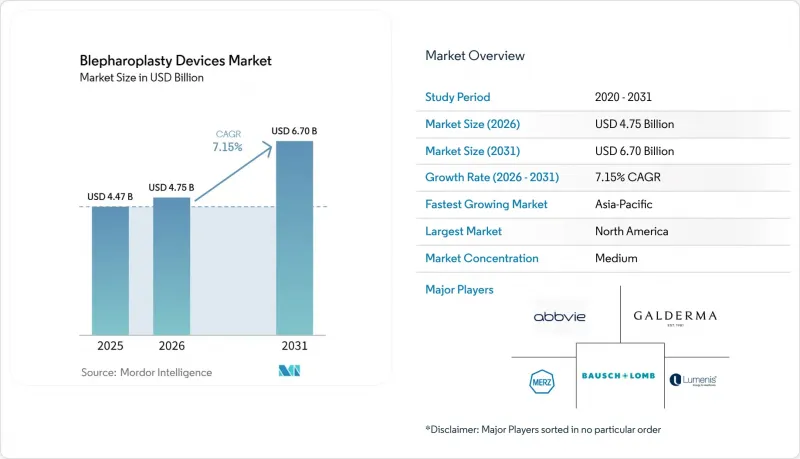
Mordor Intelligence에 의하면, 눈꺼풀 성형술 기기 시장 규모는 2025년 44억 7,000만 달러로 평가되었습니다. 2026년에는 47억 5,000만 달러로 확대되어 2026-2031년에 걸쳐 CAGR 7.15%로 성장을 지속하여, 2031년에는 67억 달러에 이를 것으로 예측됩니다.
본 보고서는 제품 유형(레이저 및 에너지 기반 시스템, 피부 필러, 기타), 시술 유형(상안검 성형술, 하안검 성형술, 복합 안검 수술, 기타),기술(기존 수술, 레이저 보조 수술, 플라즈마 및 에너지 기반 기술, 고주파를 이용한 안검 성형술, 기타), 성별(여성, 남성), 최종 사용자(병원, 안과 및 안성형외과 클리닉, 기타), 지역별로 분류되어 있습니다. 예측치는 금액(달러)으로 표시되어 있습니다.
세계의 눈꺼풀 성형술 기기 시장 동향 및 인사이트
미적 및 기능적 눈꺼풀 교정에 대한 수요 증가
눈꺼풀 성형술 기기 시장은 다른 많은 미용 목적의 안면 수술 카테고리보다 폭넓은 수요 프로파일의 혜택을 받고 있습니다. 이는 동일한 수술을 통해 미용적 목적뿐만 아니라 피부 이완이나 안검 하수증으로 인한 임상적으로 확인된 시력 장애의 개선도 가능하기 때문입니다. 이러한 이중적인 역할 덕분에 눈꺼풀 성형술 기기 시장은 더욱 견고한 수요 기반을 갖추고 있습니다. 기능적인 상안검 수술은 순수하게 미용 목적을 위한 수술에는 존재하지 않는 보험 환급 경로를 통해 수행될 수 있기 때문입니다. 2025년 AAFPRS 회원 조사에 따르면, 눈꺼풀 성형술은 남녀 모두에게 주요 외과 수술 중 하나로 자리 잡고 있으며, 회원들의 클리닉에서 수술 대상자의 대다수는 56세 이상의 환자로 구성되어 있었습니다.
또한, ISAPS의 조사에 따르면 전 세계 미용 성형 수술 중 눈꺼풀 수술은 남성에서 1위, 여성에서 2위를 차지하고 있으며, 이는 특정 계층에 국한된 수요가 아니라 폭넓은 계층에서 널리 수용되고 있음을 보여줍니다. 따라서 눈꺼풀 성형술 기기 시장은 노화에 따른 의료적 필요와 미적 희망을 위한 선택적 수술 모두로부터 수요를 뒷받침받고 있으며, 이를 통해 특정 환자층에 대한 의존도를 낮출 수 있게 되었습니다.
고령화와 피부 이완증 유병률의 상승
눈꺼풀 성형술 기기 시장은 구조적인 고령화 추세에 힘입어 성장하고 있습니다. 이는 환자가 50대 중반을 지나 더 고령이 될수록 눈꺼풀 처짐 및 관련 질환이 더 흔해지기 때문입니다. 2026년 ‘테헤란 노인 안과 연구’에서는 노화에 따라 눈꺼풀 질환이 유의미하게 증가한다는 사실이 보고되었을 뿐만 아니라, 병태 유형이나 중증도가 성별에 따라 다르다는 점도 밝혀졌는데, 이는 수술 계획이나 치료 환경을 결정하는 데 중요한 의미를 지닙니다.
2025년 중국 고령자를 대상으로 실시된 횡단면 조사에서도 눈꺼풀 질환의 높은 유병률이 확인되었으며, 노화에 따른 수요가 성숙한 서유럽 의료 시스템에만 국한된 것이 아님을 뒷받침했습니다. 시야 방해, 눈꺼풀의 무거움, 노화에 따른 눈 주위 변화는 단기적인 미용 트렌드에만 의존하는 것이 아니기 때문에 눈꺼풀 성형술 기기 시장은 이러한 인구 동향의 변화로 인해 꾸준한 수술 건수를 확보할 전망입니다. 장기적으로 볼 때, 선택적 미용 수술에 대한 소비자의 의향이 불안정해지더라도 고령화는 눈꺼풀 성형술 기기 시장에 있어 가장 지속 가능한 성장 동력 중 하나가 될 것으로 보입니다.
미용 성형 수술의 고액 본인 부담금과 보험 적용 범위 제한
눈꺼풀 성형술 기기 시장은 여전히 환자의 경제적 부담에 영향을 받기 쉬운 상황입니다. 그 이유는 미용 목적의 눈꺼풀 수술이 광범위한 보험 환급 제도를 통해 지급되는 것이 아니라, 많은 가구가 본인 부담으로 충당하고 있기 때문입니다. 기능적인 상안검 수술의 경우, 시력 장애를 입증하는 자료가 있으면 일부 또는 전액 보험 적용이 될 수 있지만, 미용 목적의 수술은 선택적 지출 상황에 대해 여전히 훨씬 더 민감한 상태입니다. 이로 인해 임상적으로 필요한 수요는 견조한 반면, 자금 조달 선택지가 제한적이거나 가계 형편이 어려운 경우에는 외모를 중시하는 수요가 정체되는 양극화된 시장이 형성되고 있습니다.
눈꺼풀 성형술 기기 시장에서 이러한 경향이 가장 두드러지게 나타나는 것은 중산층 환자 그룹입니다. 왜냐하면 이들은 진찰에는 큰 관심을 보이지만, 수술, 병용되는 주사제, 수술 후 관리가 본인 부담 패키지로 묶이면 실제 시술로 이어지는 비율이 낮아지는 경향이 있기 때문입니다. 의료 관광은 일부 환자에게는 일정한 도움이 되지만, 여행비, 휴가 기간, 수술 후 관리 준비에는 여전히 경제적 여유가 필요하기 때문에 일반인들에게 있어 비용 측면의 장벽을 제거할 수는 없습니다. 그 결과, 눈꺼풀 성형술 기기 시장은 견실한 수요 기반을 유지하고 있지만, 적격 환자나 관심 있는 환자 모두가 동일한 비율로 시술에 이르게 되는 것은 아닙니다.
부문별 분석
2025년, 레이저 및 에너지 기반 시스템은 안검 성형술 시장 규모의 42.4%를 차지하며 가장 큰 제품 그룹이 되었습니다. 이러한 우위는 멀티모달리티 플랫폼의 프리미엄 가치와 레이저 보조 수술, CO2 레이저를 이용한 피부 재생, RF(고주파)를 통한 눈꺼풀 탄력 강화 등 폭넓은 용도로의 활용을 반영한 것입니다. 도입된 플랫폼 한 대로 한 번의 내원 동안 여러 가지 눈 주위 시술을 수행할 수 있습니다. 또한, 장비 공급업체들은 도입된 장비에 대해 소모품 비용 및 시술별 수익 모델을 추가하고 있습니다. 이를 통해 제조업체와 클리닉은 장비의 초기 판매를 넘어 지속적인 수익을 창출할 수 있습니다.
피부 필러는 2026년부터 2031년까지 연평균 성장률(CAGR) 8.7%를 나타낼 것으로 예측되며, 안검 성형술 시장에서 가장 빠르게 성장하는 제품 유형이 될 것입니다. 이러한 성장은 눈 주위 볼륨 감소로 고민하는 환자들 사이에서 눈물주머니 교정용 히알루론산 필러의 보급에 힘입은 것입니다. 이러한 환자들은 볼륨이 더 줄어들 경우 근본적인 외모상의 문제가 악화될 가능성이 있으므로, 외과적 지방 제거술에는 적합하지 않을 수 있습니다.
2025년, 상안검 성형술은 시술 부문의 43.4%를 차지했으며, 이로 인해 시술 수준에서 눈꺼풀 성형술 기기 시장에서 가장 큰 점유율을 차지하고 있습니다. 이러한 선두 위상은 고령 환자에서 안검하수증에 따른 큰 기능적 부담과, 상안검 피부의 처짐이 임상적으로 현저해질 때 시야 장애를 비교적 쉽게 입증할 수 있다는 점을 반영하고 있습니다. 또한, 이 수술은 수술 시간이 짧고 의뢰 경로도 확립되어 있다는 장점이 있어, 많은 초회 수술 환자에게 여전히 첫 번째 선택지로 남아 있습니다.
복합 눈꺼풀 수술은 2031년까지 연평균 성장률(CAGR) 8.3%를 나타낼 것으로 예측되며, 이에 따라 눈꺼풀 성형술 기기 시장에서 가장 빠르게 성장하는 시술 유형이 될 것입니다. 이러한 변화는 특히 상안검의 무거움과 하안검의 노화가 별개의 문제가 아니라 상호 연관된 우려 사항으로 간주될 때, 환자들이 한 번의 시술로 눈 주위를 보다 종합적으로 교정하기를 선호하는 경향을 반영합니다. 2025년 『PRS Global Open』 저널에 게재된 연구에서는 미국 미용 의료 현장에서 하안검 성형술의 중요성이 강조되었으며, 복합 사례에서 보다 적절한 계획 수립을 가능하게 하는 지방 재배치법 등 수술 기법의 정교화가 진행되고 있음이 지적되었습니다.
지역별 분석
2025년, 북미는 눈꺼풀 성형술 기기 시장 점유율의 42.6%를 차지하며 지역별 확고한 선두 자리를 유지했습니다. 이 지역은 고령 환자층이 다수 존재하고, 의료비 지출이 높으며, 보험 적용 대상인 기능적 증례와 자비 부담 미용 수술을 모두 지원할 수 있는 임상 경로가 잘 갖춰져 있다는 점 등의 혜택을 누리고 있습니다. 2025년 소급 연구에 따르면, 안검 성형술의 56% 이상이 이미 외래 환경에서 시행되고 있으며, 이는 시술의 효율화와 전문의의 진료 건수를 뒷받침하는 성숙한 제공 모델을 시사합니다. 유럽은 고령 인구와 주요 국가에서 확립된 민간 미용 클리닉 네트워크에 힘입어, 눈꺼풀 성형술 기기 시장에서 여전히 2위 지역 블록을 유지했습니다.
아시아태평양은 2031년까지 연평균 성장률(CAGR)이 10.2%로 가장 빠르게 성장하는 지역 부문이며, 이로 인해 눈꺼풀 성형술 기기 시장에서 가장 강력한 성장 추세를 보이고 있습니다. 이러한 성장은 한국의 확고한 성형 수술 명성, 중국의 미용 수요 증가, 일본의 성숙한 시술 문화, 전문적인 안면 관리를 위해 국경을 넘어 계속해서 이동하는 환자들에 의해 뒷받침되고 있습니다. 또한, 아시아태평양의 눈꺼풀 성형술 기기 시장은 고주파나 눈 주위 복합 치료 등 빠르게 성장하는 기술과도 밀접하게 연관되어 있어, 제품과 시술의 폭을 넓히는 요인이 되고 있습니다.
기타 혜택
- 엑셀 형식 시장 예측(ME) 시트
- 3개월간의 애널리스트 지원
자주 묻는 질문
목차
제1장 서론
제2장 조사 방법
제3장 개요
제4장 시장 구도
제5장 시장 규모 및 성장 예측
제6장 경쟁 구도
제7장 시장 기회 및 향후 전망
KTH 26.09.02According to Mordor Intelligence, the blepharoplasty devices market size is expected to grow from USD 4.47 billion in 2025 to USD 4.75 billion in 2026 and is forecast to reach USD 6.70 billion by 2031 at 7.15% CAGR over 2026-2031.
This report is Segmented by Product Type (Laser & Energy-Based Systems, Dermal Fillers, Others), Procedure Type (Upper Blepharoplasty, Lower Blepharoplasty, Combination Eyelid Surgery, and Others), Technology (Traditional, Laser Assisted, Plasma, Radiofrequency, Others), Gender (Female, Male), End-User (Hospitals, Clinics, and More), and Geography. Forecasts in Value (USD).
Global Blepharoplasty Devices Market Trends and Insights
Rising Demand for Aesthetic and Functional Eyelid Correction
The blepharoplasty devices market benefits from a demand profile that is broader than most elective facial categories, because the same procedure can address cosmetic goals and clinically documented vision-related impairment from dermatochalasis or ptosis. This dual role gives the blepharoplasty devices market a firmer demand base, since functional upper-lid cases can move through reimbursement pathways that do not exist for purely appearance-driven surgery. The 2025 AAFPRS member survey showed that blepharoplasty remained among the leading surgical procedures for both men and women, and patients aged 56 and older formed the majority of surgical candidates in member practices.
ISAPS also showed that eyelid surgery ranked 1st among men and 2nd among women across surgical aesthetic procedures worldwide, which points to strong cross-demographic acceptance rather than isolated demand pockets. The blepharoplasty devices market therefore carries volume support from both age-related medical need and elective appearance preferences, which helps reduce reliance on a single patient profile.
Aging Population and Higher Prevalence of Dermatochalasis
The blepharoplasty devices market is supported by a structural aging trend, because eyelid laxity and related disorders become more common as patients move beyond their mid-50s and into later decades of life. The 2026 Tehran Geriatric Eye Study reported a meaningful rise in eyelid disorders with age and also showed that condition type and severity varied by sex, which matters for procedure planning and treatment setting decisions.
A 2025 China-based cross-sectional survey in older adults also found a high prevalence of eyelid disorders, reinforcing that aging-related demand is not limited to mature Western healthcare systems. The blepharoplasty devices market is likely to draw steady functional case volume from these demographic shifts, because visual obstruction, lid heaviness, and age-linked periocular changes do not depend on short-term beauty trends alone. Over time, this makes aging one of the most durable growth supports for the blepharoplasty devices market, even when consumer sentiment in elective aesthetics becomes uneven.
High Out-of-Pocket Cost and Limited Insurance Coverage for Cosmetic Cases
The blepharoplasty devices market remains exposed to patient affordability because cosmetic eyelid procedures are still financed directly by many households rather than paid through broad reimbursement pathways. Functional upper-lid cases can move into partial or full coverage when documentation supports visual impairment, but cosmetic cases remain much more sensitive to discretionary spending conditions. This creates a split market where clinically necessary demand is firmer, while appearance-led demand can pause when financing options are narrow, or household budgets weaken.
The blepharoplasty devices market feels this most clearly in middle-income patient groups, because they may show strong interest in consultation but lower conversion when surgery, adjunctive injectables, and post-procedure care are bundled into a self-pay episode. Medical tourism offers some relief for select patients, but it does not remove the cost barrier for the wider population because travel, time away from work, and aftercare logistics still require financial flexibility. As a result, the blepharoplasty devices market keeps a solid demand base, but not all eligible or interested patients convert into procedures at the same rate.
Other drivers and restraints analyzed in the detailed report include:
- Expansion of Minimally Invasive and Laser-assisted Surgery
- Social Media-Driven Normalization of Periocular Rejuvenation
- Shortage of Fellowship-Trained Oculoplastic Surgeons in Non-Metro Markets
For complete list of drivers and restraints, kindly check the Table Of Contents.
Segment Analysis
Laser & Energy-Based Systems accounted for 42.4% of the blepharoplasty market size in 2025, making them the largest product group. Their lead reflects the premium value of multi-modality platforms and their use across laser-assisted procedures, CO2 resurfacing, and RF eyelid tightening. A single installed platform can support several periocular services during the same patient visit. Device suppliers are also adding consumable fees and per-treatment revenue models to their installed base. This creates recurring revenue for manufacturers and clinics beyond the original equipment sale.
Dermal Fillers are projected to grow at 8.7% CAGR between 2026 and 2031, making them the fastest-growing product type in the blepharoplasty market. Growth is being supported by the wider use of hyaluronic acid fillers for tear-trough correction among patients with periocular volume loss. These patients may not be suitable for surgical fat excision, since further volume removal could worsen the underlying appearance concern.
Upper Blepharoplasty held 43.4% of the procedure segment in 2025, and this gives it the largest share of the blepharoplasty devices market share at the procedure level. Its lead reflects the large functional burden tied to dermatochalasis in older patients and the relative ease of documenting visual field impairment when upper-lid skin redundancy becomes clinically significant. The procedure also benefits from shorter operative time and a more familiar referral pathway, which helps it remain the default starting point for many first-time surgical patients.
Combination Eyelid Surgery is forecast to grow at 8.3% CAGR through 2031, which makes it the fastest-rising procedure type in the blepharoplasty devices market. This shift reflects patient preference for fuller periocular correction in one episode, especially when upper-lid heaviness and lower-lid aging are viewed as linked concerns rather than separate decisions. A 2025 study in PRS Global Open highlighted the prominence of lower blepharoplasty in U.S. aesthetic practice and pointed to technique refinement, including fat repositioning approaches that can support better planning in combination cases.
Complete Report Scope:
- By Product Type
- Laser & Energy-Based Systems
- Dermal Fillers
- Ophthalmic Surgical Equipment
- Others (Surgical Consumables & Accessories, Plasma Skin Resurfacing Systems, RF Accessories)
- By Procedure Type
- Upper Blepharoplasty
- Lower Blepharoplasty
- Combination Eyelid Surgery
- Others (Revision Blepharoplasty, Asian Blepharoplasty)
- By Technology
- Traditional Surgery
- Laser Assisted Surgery
- Plasma And Energy Based Techniques
- Radiofrequency-Based Blepharoplasty
- Others (Non-Surgical Adjunctive Techniques, Electrosurgical Techniques)
- By Gender
- Female
- Male
- By End-User
- Hospitals
- Ophthalmic And Oculoplastic Clinics
- Ambulatory Surgical Centers
- Plastic Surgery Centers
- Others (Cosmetic & Aesthetic Clinics, Dermatology Clinics)
- By Geography
- North America
- United States
- Canada
- Mexico
- Europe
- Germany
- United Kingdom
- France
- Italy
- Spain
- Rest of Europe
- Asia-Pacific
- China
- India
- Japan
- Australia
- South Korea
- Rest of Asia-Pacific
- Middle East and Africa
- GCC
- South Africa
- Rest of Middle East and Africa
- South America
- Brazil
- Argentina
- Rest of South America
- North America
Geography Analysis
North America held 42.6% of the blepharoplasty devices market share in 2025, which kept it firmly in the leading regional position. The region benefits from a large aging patient base, high healthcare spending, and a clinical pathway that can support both reimbursed functional cases and self-pay cosmetic volume. A 2025 retrospective study showed that more than 56% of blepharoplasties were already being performed in ambulatory settings, which points to a mature delivery model that supports procedural efficiency and specialist throughput. Europe remained the second-largest regional block in the blepharoplasty devices market, supported by older populations and a well-established private aesthetics clinic network in major countries.
Asia-Pacific is the fastest-growing regional segment with a 10.2% CAGR through 2031, and this gives it the strongest expansion profile in the blepharoplasty devices market. Growth is supported by South Korea's established surgical reputation, China's widening aesthetics demand, Japan's mature procedure culture, and ongoing patient movement across borders for specialist facial care. The blepharoplasty devices market in Asia-Pacific also aligns closely with faster-growth technologies such as radiofrequency and combination periocular treatment, which supports both product and procedure depth.
- Abbvie
- Alcon
- B. Braun
- Bausch + Lomb Incorporated
- Candela Medical
- Carl Zeiss
- Cutera
- Cynosure, LLC
- Galderma
- InMode Ltd.
- Integra LifeSciences
- Lumenis
- Medtronic
- Merz Pharma
- Sisram Medical Ltd. (Alma Lasers)
- Sklar Surgical Instruments
- Tiger Aesthetics LLC
Additional Benefits:
- The market estimate (ME) sheet in Excel format
- 3 months of analyst support
TABLE OF CONTENTS
1 Introduction
- 1.1 Study Assumptions & Market Definition
- 1.2 Scope of the Study
2 Research Methodology
3 Executive Summary
4 Market Landscape
- 4.1 Market Overview
- 4.2 Market Drivers
- 4.2.1 Rising Demand For Aesthetic And Functional Eyelid Correction
- 4.2.2 Aging Population And Higher Prevalence Of Dermatochalasis
- 4.2.3 Expansion Of Minimally Invasive And Laser-Assisted Techniques
- 4.2.4 Greater Acceptance Of Outpatient And Same-Day Procedures
- 4.2.5 Social Media Driven Normalization Of Periocular Rejuvenation
- 4.2.6 Cross-Border Patient Flow For Specialist And Value-Based Care
- 4.3 Market Restraints
- 4.3.1 High Out-of-Pocket Cost And Limited Insurance Coverage For Cosmetic Cases
- 4.3.2 Procedure Anxiety Over Scarring, Dry Eye, And Revision Risk
- 4.3.3 Shortage Of Fellowship-Trained Oculoplastic Surgeons In Non-Metro Markets
- 4.3.4 Stringent Device And Facility Compliance For Energy-Based Platforms
- 4.4 Supply-Chain Analysis
- 4.5 Regulatory Landscape
- 4.6 Technological Outlook
- 4.7 Porter's Five Forces
- 4.7.1 Threat of New Entrants
- 4.7.2 Bargaining Power of Suppliers
- 4.7.3 Bargaining Power of Buyers
- 4.7.4 Threat of Substitutes
- 4.7.5 Industry Rivalry
5 Market Size & Growth Forecasts (Value, USD)
- 5.1 By Product Type
- 5.1.1 Laser & Energy-Based Systems
- 5.1.2 Dermal Fillers
- 5.1.3 Ophthalmic Surgical Equipment
- 5.1.4 Others (Surgical Consumables & Accessories, Plasma Skin Resurfacing Systems, RF Accessories)
- 5.2 By Procedure Type
- 5.2.1 Upper Blepharoplasty
- 5.2.2 Lower Blepharoplasty
- 5.2.3 Combination Eyelid Surgery
- 5.2.4 Others (Revision Blepharoplasty, Asian Blepharoplasty)
- 5.3 By Technology
- 5.3.1 Traditional Surgery
- 5.3.2 Laser Assisted Surgery
- 5.3.3 Plasma And Energy Based Techniques
- 5.3.4 Radiofrequency-Based Blepharoplasty
- 5.3.5 Others (Non-Surgical Adjunctive Techniques, Electrosurgical Techniques)
- 5.4 By Gender
- 5.4.1 Female
- 5.4.2 Male
- 5.5 By End-User
- 5.5.1 Hospitals
- 5.5.2 Ophthalmic And Oculoplastic Clinics
- 5.5.3 Ambulatory Surgical Centers
- 5.5.4 Plastic Surgery Centers
- 5.5.5 Others (Cosmetic & Aesthetic Clinics, Dermatology Clinics)
- 5.6 By Geography
- 5.6.1 North America
- 5.6.1.1 United States
- 5.6.1.2 Canada
- 5.6.1.3 Mexico
- 5.6.2 Europe
- 5.6.2.1 Germany
- 5.6.2.2 United Kingdom
- 5.6.2.3 France
- 5.6.2.4 Italy
- 5.6.2.5 Spain
- 5.6.2.6 Rest of Europe
- 5.6.3 Asia-Pacific
- 5.6.3.1 China
- 5.6.3.2 India
- 5.6.3.3 Japan
- 5.6.3.4 Australia
- 5.6.3.5 South Korea
- 5.6.3.6 Rest of Asia-Pacific
- 5.6.4 Middle East and Africa
- 5.6.4.1 GCC
- 5.6.4.2 South Africa
- 5.6.4.3 Rest of Middle East and Africa
- 5.6.5 South America
- 5.6.5.1 Brazil
- 5.6.5.2 Argentina
- 5.6.5.3 Rest of South America
- 5.6.1 North America
6 Competitive Landscape
- 6.1 Market Concentration
- 6.2 Market Share Analysis
- 6.3 Company Profiles {(includes Global level Overview, Market level overview, Core Segments, Financials as available, Strategic Information, Market Rank/Share for key companies, Products & Services, and Recent Developments)}
- 6.3.1 AbbVie Inc. (Allergan Aesthetics)
- 6.3.2 Alcon Inc.
- 6.3.3 B. Braun SE
- 6.3.4 Bausch + Lomb Incorporated
- 6.3.5 Candela Medical
- 6.3.6 Carl Zeiss Meditec AG
- 6.3.7 Cutera, Inc.
- 6.3.8 Cynosure, LLC
- 6.3.9 Galderma
- 6.3.10 InMode Ltd.
- 6.3.11 Integra LifeSciences Holdings Corporation
- 6.3.12 Lumenis Ltd.
- 6.3.13 Medtronic plc
- 6.3.14 Merz Pharma (Merz Aesthetics)
- 6.3.15 Sisram Medical Ltd. (Alma Lasers)
- 6.3.16 Sklar Surgical Instruments
- 6.3.17 Tiger Aesthetics LLC
7 Market Opportunities & Future Outlook
- 7.1 White-space & unmet-need assessment


