

|
시장보고서
상품코드
2118019
온디바이스 AI 추론 소프트웨어 시장 : 점유율 분석, 업계 동향과 통계, 성장 예측(2026-2031년)On-Device AI Inference Software - Market Share Analysis, Industry Trends & Statistics, Growth Forecasts (2026 - 2031) |
||||||
 Mordor Intelligence
Mordor Intelligence에 의하면, 온디바이스 AI추론 소프트웨어 시장 규모는 2025년 46억 1,000만 달러에서 2026년에는 56억 2,000만 달러로 확대되어 2031년까지 174억 1,000만 달러에 이를 것으로 예상되고 있어 2026년부터 2031년까지 CAGR 25.38%로 성장할 전망입니다.
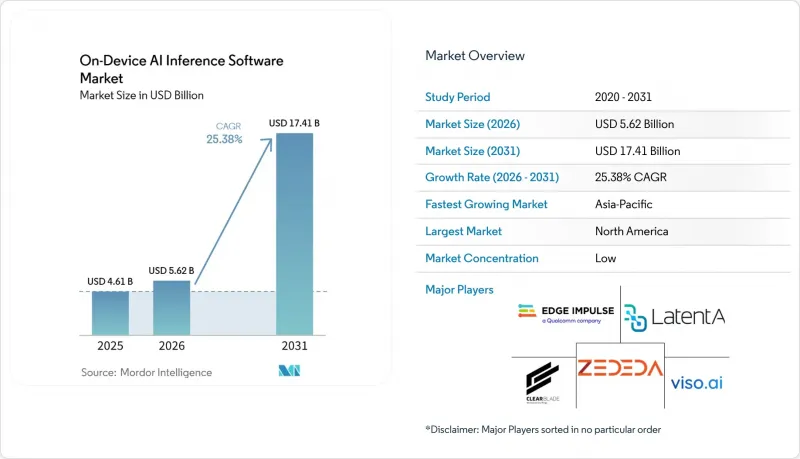
본 보고서는 제공 형태(플랫폼 및 서비스), 기기 유형(스마트폰, PC 및 노트북, 자동차 시스템, IoT 기기, 산업용 엣지 기기, 로봇 및 드론), 최종 사용자(IT 및 통신, 자동차 및 운송, 헬스케어 및 생명과학, 소매 및 전자상거래 등), 그리고 지역별로 분류되어 있습니다. 시장 전망은 금액(달러) 기준으로 제시되어 있습니다.
전 세계 온디바이스 AI 추론 소프트웨어 시장 동향 및 인사이트
IoT 엔드포인트 데이터의 급증으로 인해 로컬 배포 수요가 가속화되고 있습니다.
온디바이스 AI 추론 소프트웨어 시장은 연결된 기기에서 생성되는 데이터 양 증가로 인해 혜택을 보고 있습니다. 조사에 따르면, 2026년 초 전 세계적으로 210억 대의 IoT 기기가 사용될 것이며, 센서, 카메라, 장비에서 끊임없는 데이터 스트림이 생성될 것으로 예측됩니다. 모든 데이터 스트림을 집약형 인프라로 전송하면 대역폭 비용이 증가하고, 용도이 네트워크 지연의 영향을 받을 수 있습니다. 새로운 시스템 온 칩(SoC) 설계에는 로컬 작업을 위한 경량 신경망 처리 장치(NPU), 벡터 확장 기능 및 디지털 신호 처리 코어가 통합되어 있습니다. 이러한 기능을 통해 데이터가 생성되는 바로 그 자리에서 이상 감지, 상태 모니터링 및 소형 비전 모델이 지원됩니다. 소프트웨어 제공업체는 자사의 도구에 추론, 텔레메트리, 모델 드리프트 점검 및 무선(OTA) 업데이트를 결합함으로써 지속적인 고객 관계를 구축할 수 있습니다.
저지연 의사 결정에 대한 수요가 소프트웨어 아키텍처를 재구성하고 있습니다.
온디바이스 AI 추론 소프트웨어 시장은 클라우드의 응답을 기다릴 수 없는 용도를 지원합니다. 드론, 산업용 시스템, 차량, 네트워크 장비는 가동 중에 의사 결정을 내려야 합니다. 제공된 분석에 따르면, 클라우드의 왕복 시간은 50-200밀리초 범위인 반면, 로컬 처리에서는 응답 시간을 한 자릿수 초반의 밀리초 단위로 단축할 수 있는 것으로 나타났습니다. 초당 12미터로 이동하는 드론은 200밀리초의 지연 동안 2.4미터를 이동하게 되며, 이는 심각한 제어상의 문제를 야기할 수 있습니다. 자동차의 지각 시스템도 첨단 운전자 지원 기능을 위해 지각에서 행동까지의 시간을 단축해야 합니다. 이러한 요구에 따라 소프트웨어 벤더들은 특정 신경망 처리 장치(NPU)에서 성능을 향상시키는 하드웨어 전용 커널 라이브러리를 구축하도록 촉진받고 있습니다.
하드웨어 및 런타임 생태계의 분절화가 크로스 플랫폼 이식성을 제한하고 있습니다.
온디바이스 AI 추론 소프트웨어 시장은 여전히 하드웨어 전용 백엔드 및 런타임 환경으로 인해 분열되어 있습니다. HailoRT, Qualcomm AI Engine Direct, MediaTek NeuroPilot, Apple Core ML, Google LiteRT 및 ONNX Runtime은 각각 서로 다른 툴체인 및 최적화 기법을 채택하고 있습니다. 특정 신경망 처리 유닛(NPU)을 위해 제작된 모델을 다른 유닛에서 제대로 실행하려면, 연산자의 처리 방식, 메모리 레이아웃 및 정밀도 설정을 수정해야 하는 경우가 적지 않습니다. 단일 실리콘 제품군과의 긴밀한 통합은 성능을 향상시킬 수 있지만, 벤더가 지원할 수 있는 디바이스의 범위를 좁히게 됩니다. 광범위한 호환성은 지원 범위를 넓힐 수 있지만, 기업 구매자가 기대하는 지연 시간상의 이점을 희생할 가능성이 있습니다. 따라서 본 자료에서는 이식성 도구가 소프트웨어 공급업체 간의 주요 경쟁 영역이라고 지적하고 있습니다.
부문 분석
2025년, 플랫폼은 온디바이스 AI 추론 소프트웨어 시장 점유율의 74.18%를 차지했습니다. 조직은 모델 최적화, 런타임 배포, 디바이스 플릿 관리를 단일 워크플로로 통합한 환경을 선호합니다. 이러한 모델을 통해 압축, 배포, 모니터링을 위해 개별 도구를 조합하는 데 필요한 노력을 줄일 수 있습니다. 또한 플랫폼 공급업체는 양자화 및 프루닝에서 오케스트레이션, 성능 텔레메트리에 이르기까지 모델의 전체 수명 주기에 관여하고 있습니다. 이러한 광범위한 역할로 인해, 조직이 대규모 디바이스 플릿 전체에 플랫폼을 배포한 후에는 해당 플랫폼을 대체하기 어려워질 수 있습니다.
서비스 시장은 2031년까지 연평균 성장률(CAGR) 28.41%로 확대될 것으로 예측됩니다. 구매 기업들은 추론 최적화, 모델 압축, 관리형 엣지 배포와 같은 기능을 모두 사내에서 구축하기보다는 외부 지원을 활용하는 경향이 강해지고 있습니다. 이러한 수요는 모델에 도메인별 튜닝이나 상세한 규정 준수 기록이 종종 필요한 산업 제조 및 의료 분야에서 특히 두드러집니다. 서비스 분야는 전문 제공업체에게 완전한 플랫폼 스택 없이도 엔터프라이즈 고객에게 진입할 수 있는 경로를 제공합니다. 또한 구매자가 선택한 하드웨어 환경에 맞추어 모델을 최적화하는 기업에게도 특화된 비즈니스 기회를 창출합니다.
지역별 분석
2025년, 북미는 온디바이스 AI 추론 소프트웨어 시장의 34.62% 점유율을 차지했습니다. 이 지역에는 제조, 물류, 의료 각 분야에서 소프트웨어 개발자, 엔터프라이즈용 기술 구매자, 그리고 커넥티드 디바이스 도입 사례가 집중되어 있습니다. 미국은 AI 칩 공급망, 대규모 기업 소프트웨어 고객 기반, 그리고 프리미엄 개발 도구 판매를 위한 확립된 채널을 통해 이 수요의 상당 부분을 차지했습니다. 퀄컴의 스냅드래곤 플랫폼과 신경망 처리 장치(NPU) 로드맵은 인텔 및 AMD의 제품과 함께 현지 소프트웨어 도입을 위한 폭넓은 하드웨어 기반을 제공합니다. 또한 캐나다에서는 데이터 현지화 정책에 따라 진료 현장 인근에서의 처리가 권장되는 의료 용도 분야에서 수요를 뒷받침하고 있습니다.
아시아태평양은 2031년까지 연평균 성장률(CAGR) 29.84%를 나타낼 것으로 예측됩니다. 중국은 산업용 IoT 도입을 확대하고 있으며, 인도는 금융 서비스의 디지털화를 추진하고, 일본은 성숙한 로봇 공학 기반을 보유하고, 한국은 신경 처리 장치(NPU) 분야에서 활발한 연구 및 반도체 개발 활동을 펼치고 있습니다. 제공된 자료에 따르면, 중국의 엣지 AI 박스 시장은 2025년에 85억 위안(11억 7,000만 달러)에 달하고, 2026년에는 120억 위안(16억 5,000만 달러)에 이를 것으로 예측됩니다. 한국은 신경망 처리 장치(NPU)와 메모리를 통합한 기술 개발의 혜택을 받고 있는 반면, 인도에서는 규제 대상인 결제 분야에서 현지에서의 부정 행위 감지에 대한 수요가 있습니다. 일본 및 동남아시아에서는 현지 언어 지원, 맞춤형 센서 기능, 분산된 디바이스 전체에서 유지보수가 가능한 소프트웨어를 필요로 하는 로봇 제조 및 스마트 리테일 용도에 대한 수요가 증가하고 있습니다.
유럽은 2025년에 상당한 시장 점유율을 차지하며, 2031년까지 견조한 성장을 유지할 것으로 예측됩니다. 독일의 자동차 제조업체와 인더스트리 4.0 시설에서는 품질 관리, 예측 유지보수, 자재 운반을 위해 로컬 추론이 활용되고 있습니다. EU AI법에 따라 감사 가능성, 인간의 감독, 데이터 최소화가 소프트웨어 조달에 있어 중요한 요소가 되고 있습니다. 남미, 중동 및 아프리카는 규모는 작지만, 브라질의 스마트 시티 및 핀테크 관련 이니셔티브, 사우디아라비아와 아랍에미리트(UAE)의 국가 주도 AI 프로그램, 나이지리아와 남아프리카공화국의 모바일 퍼스트 도입에 힘입어 기회가 확대되고 있습니다.
기타 혜택:
- 엑셀 형식 시장 예측(ME) 시트
- 3개월간의 애널리스트 지원
자주 묻는 질문
목차
제1장 서론
제2장 조사 방법
제3장 개요
제4장 시장 구도
제5장 시장 규모와 성장 예측
제6장 경쟁 구도
제7장 시장 기회와 향후 전망
JHS 26.09.01According to Mordor Intelligence, the on-Device AI inference software market size is expected to increase from USD 4.61 billion in 2025 to USD 5.62 billion in 2026 and reach USD 17.41 billion by 2031, growing at a CAGR of 25.38% over 2026-2031.
This report is Segmented by Offering (Platforms, and Services), Device Type (Smartphones, Pcs and Laptops, Automotive Systems, Iot Devices, Industrial Edge Devices, and Robotics and Drones), End User (IT and Telecommunication, Automotive and Transportation, Healthcare and Life Sciences, Retail and E-Commerce, and More), and Geography. The Market Forecasts are Provided in Terms of Value (USD).
Global On-Device AI Inference Software Market Trends and Insights
Proliferation of IoT Endpoint Data Accelerates Local Deployment Demand
The On-Device AI Inference Software Market is benefiting from the growing volume of data produced by connected devices. The research cited 21 billion IoT devices in use globally in early 2026, generating continuous streams of data from sensors, cameras, and equipment. Sending every stream to centralized infrastructure can raise bandwidth costs and expose applications to network delays. New system-on-chip designs include lightweight neural processing units, vector extensions, and digital signal processing cores for local tasks. These capabilities support anomaly detection, condition monitoring, and compact vision models at the point where data is created. Software providers can build recurring relationships when their tools combine inference, telemetry, model-drift checks, and over-the-air updates.
Demand for Low-Latency Decision-Making Reshapes Software Architecture
The On-Device AI Inference Software Market supports applications that cannot wait for a cloud response. Drones, industrial systems, vehicles, and network equipment need decisions during active operations. The supplied analysis noted that cloud round-trip times can range from 50 to 200 milliseconds, while local processing can reduce response times to low single-digit milliseconds. A drone moving at 12 meters per second would travel 2.4 meters during a 200-millisecond delay, which can create a material control problem. Automotive perception systems also require short perception-to-action times for advanced driver-assistance functions. This need encourages software vendors to build hardware-specific kernel libraries that improve performance on particular neural processing units.
Fragmented Hardware and Runtime Ecosystems Limit Cross-Platform Portability
The On-Device AI Inference Software Market remains divided across hardware-specific backends and runtime environments. HailoRT, Qualcomm AI Engine Direct, MediaTek NeuroPilot, Apple Core ML, Google LiteRT, and ONNX Runtime use different toolchains and optimization approaches. A model prepared for one neural processing unit often needs revised operator handling, memory layouts, and precision settings before it can run well on another. Deep integration with a single silicon family can improve performance but reduce the range of devices a vendor can address. Broad compatibility can widen coverage but may sacrifice the latency benefits that enterprise buyers expect. The supplied material, therefore, identifies portability tools as a major area of competition for software suppliers.
Other drivers and restraints analyzed in the detailed report include:
- Privacy-Preserving Local Inference Requirements Create a Compliance Tailwind
- Generative AI Expansion on Resource-Constrained Devices Opens New Uses
- Memory, Thermal, and Battery Constraints Challenge Sustained Use
For complete list of drivers and restraints, kindly check the Table Of Contents.
Segment Analysis
Platforms held 74.18% of the on-device AI Inference Software Market share in 2025. Organizations favor integrated environments that combine model optimization, runtime deployment, and device-fleet management into a single workflow. This model reduces the effort required to assemble separate tools for compression, deployment, and monitoring. Platform vendors also participate throughout the model lifecycle, from quantization and pruning to orchestration and performance telemetry. That broad role can make a platform difficult to replace after an organization has deployed it across a large device fleet.
Services are projected to expand at a 28.41% CAGR through 2031. Buyers increasingly use external support for inference optimization, model compression, and managed edge deployment rather than building all these capabilities internally. This demand is notable in industrial manufacturing and healthcare, where models often need domain-specific tuning and detailed compliance records. The services category gives specialized providers a route to enterprise customers without requiring a complete platform stack. It also creates a focused opportunity for firms that optimize models for a buyer's selected hardware environment.
Complete Report Scope:
- By Offering
- Platforms
- Services
- By Device Type
- Smartphones
- PCs and Laptops
- Automotive Systems
- IoT Devices
- Industrial Edge Devices
- Robotics and Drones
- By End User
- IT and Telecommunication
- BFSI
- Automotive and Transportation
- Healthcare and Life Sciences
- Retail and E-Commerce
- Industrial Manufacturing
- Education and Research Institutions
- Government and Administration
- Energy and Utilities
- Other End Users
- By Geography
- North America
- United States
- Canada
- Mexico
- South America
- Brazil
- Argentina
- Rest of South America
- Europe
- Germany
- United Kingdom
- France
- Russia
- Spain
- Rest of Europe
- Asia-Pacific
- China
- Japan
- India
- South Korea
- Southeast Asia
- Rest of Asia-Pacific
- Middle East and Africa
- Middle East
- Saudi Arabia
- United Arab Emirates
- Rest of Middle East
- Africa
- South Africa
- Nigeria
- Rest of Africa
- Middle East
- North America
Geography Analysis
North America held 34.62% of the On-Device AI Inference Software Market share in 2025. The region has a high concentration of software developers, enterprise technology buyers, and connected-device deployments across manufacturing, logistics, and healthcare. The United States contributed much of this demand through its AI chip supply chain, a large base of enterprise software customers, and established channels for selling premium development tools. Qualcomm's Snapdragon platform and neural processing unit roadmaps, along with those from Intel and AMD, provide a broad hardware base for local software deployment. Canada also supports demand in healthcare applications where data-localization policies favor processing near the point of care.
Asia-Pacific is projected to grow at a 29.84% CAGR through 2031. China is expanding industrial IoT deployments, India is digitizing financial services, Japan has a mature robotics base, and South Korea has significant research and semiconductor activity in neural processing units. The supplied material reported that China's edge AI box market reached CNY 8.5 billion (USD 1.17 billion) in 2025 and is projected to reach CNY 12 billion (USD 1.65 billion) in 2026. South Korea benefits from work on neural processing unit-integrated memory, while India has a demand for local fraud detection in regulated payments. Japan and Southeast Asia are seeing demand for robotics manufacturing and smart retail applications that require local-language support, tailored sensor capabilities, and software that can be maintained across dispersed device fleets.
Europe held a meaningful share in 2025 and is expected to maintain solid growth through 2031. Germany's automotive manufacturers and Industry 4.0 facilities use local inference for quality control, predictive maintenance, and material handling. The EU AI Act makes auditability, human oversight, and data minimization important factors in software procurement. South America, the Middle East, and Africa are smaller but developing opportunities, supported by Brazil's smart-city and financial technology activity, sovereign AI programs in Saudi Arabia and the United Arab Emirates, and mobile-first deployments in Nigeria and South Africa.
- Edge Impulse, Inc.
- Latent AI, Inc.
- ClearBlade, Inc.
- ZEDEDA, Inc.
- Viso AI AG
- Axelera AI B.V.
- Hailo Technologies Ltd.
- Kneron, Inc.
- Blaize, Inc.
- Neurala, Inc.
- EdgeCortix Inc.
- DEEPX Co., Ltd.
- Quadric.io, Inc.
- ailia Inc.
- Embedl AS
- RunAnywhere AI, Inc.
- Zetic AI, Inc.
- BrainChip Holdings Ltd.
- Synaptics Incorporated
- Gorilla Technology Group Inc.
Additional Benefits:
- The market estimate (ME) sheet in Excel format
- 3 months of analyst support
TABLE OF CONTENTS
1 INTRODUCTION
- 1.1 Study Assumptions and Market Definition
- 1.2 Scope of the Study
2 RESEARCH METHODOLOGY
3 EXECUTIVE SUMMARY
4 MARKET LANDSCAPE
- 4.1 Market Overview
- 4.2 Market Drivers
- 4.2.1 Proliferation of IoT Endpoint Data
- 4.2.2 Demand for Low-Latency Decision-Making
- 4.2.3 Privacy-Preserving Local Inference Requirements
- 4.2.4 Expansion of Generative AI on Resource-Constrained Devices
- 4.2.5 Hardware-Software Co-Optimization Around NPUs
- 4.2.6 Device-Level AI Governance and Offline Resilience
- 4.3 Market Restraints
- 4.3.1 Fragmented Hardware and Runtime Ecosystems
- 4.3.2 Memory, Thermal, and Battery Constraints
- 4.3.3 Model Accuracy Loss from Compression and Quantization
- 4.3.4 Distributed Model Security and Update Exposure
- 4.4 Impact of Macroeconomic Factors on the Market
- 4.5 Industry Value-Chain Analysis
- 4.6 Technology Outlook
- 4.7 Regulatory Landscape
- 4.8 Porter's Five Forces Analysis
- 4.8.1 Threat of New Entrants
- 4.8.2 Bargaining Power of Suppliers
- 4.8.3 Bargaining Power of Buyers
- 4.8.4 Threat of Substitutes
- 4.8.5 Intensity of Competitive Rivalry
5 MARKET SIZE AND GROWTH FORECASTS (VALUE)
- 5.1 By Offering
- 5.1.1 Platforms
- 5.1.2 Services
- 5.2 By Device Type
- 5.2.1 Smartphones
- 5.2.2 PCs and Laptops
- 5.2.3 Automotive Systems
- 5.2.4 IoT Devices
- 5.2.5 Industrial Edge Devices
- 5.2.6 Robotics and Drones
- 5.3 By End User
- 5.3.1 IT and Telecommunication
- 5.3.2 BFSI
- 5.3.3 Automotive and Transportation
- 5.3.4 Healthcare and Life Sciences
- 5.3.5 Retail and E-Commerce
- 5.3.6 Industrial Manufacturing
- 5.3.7 Education and Research Institutions
- 5.3.8 Government and Administration
- 5.3.9 Energy and Utilities
- 5.3.10 Other End Users
- 5.4 By Geography
- 5.4.1 North America
- 5.4.1.1 United States
- 5.4.1.2 Canada
- 5.4.1.3 Mexico
- 5.4.2 South America
- 5.4.2.1 Brazil
- 5.4.2.2 Argentina
- 5.4.2.3 Rest of South America
- 5.4.3 Europe
- 5.4.3.1 Germany
- 5.4.3.2 United Kingdom
- 5.4.3.3 France
- 5.4.3.4 Russia
- 5.4.3.5 Spain
- 5.4.3.6 Rest of Europe
- 5.4.4 Asia-Pacific
- 5.4.4.1 China
- 5.4.4.2 Japan
- 5.4.4.3 India
- 5.4.4.4 South Korea
- 5.4.4.5 Southeast Asia
- 5.4.4.6 Rest of Asia-Pacific
- 5.4.5 Middle East and Africa
- 5.4.5.1 Middle East
- 5.4.5.1.1 Saudi Arabia
- 5.4.5.1.2 United Arab Emirates
- 5.4.5.1.3 Rest of Middle East
- 5.4.5.2 Africa
- 5.4.5.2.1 South Africa
- 5.4.5.2.2 Nigeria
- 5.4.5.2.3 Rest of Africa
- 5.4.5.1 Middle East
- 5.4.1 North America
6 COMPETITIVE LANDSCAPE
- 6.1 Market Concentration
- 6.2 Strategic Moves
- 6.3 Market Share Analysis
- 6.4 Company Profiles (includes Global Level Overview, Market Level Overview, Core Segments, Financials as available, Strategic Information, Market Rank/Share, Products and Services, Recent Developments)
- 6.4.1 Edge Impulse, Inc.
- 6.4.2 Latent AI, Inc.
- 6.4.3 ClearBlade, Inc.
- 6.4.4 ZEDEDA, Inc.
- 6.4.5 Viso AI AG
- 6.4.6 Axelera AI B.V.
- 6.4.7 Hailo Technologies Ltd.
- 6.4.8 Kneron, Inc.
- 6.4.9 Blaize, Inc.
- 6.4.10 Neurala, Inc.
- 6.4.11 EdgeCortix Inc.
- 6.4.12 DEEPX Co., Ltd.
- 6.4.13 Quadric.io, Inc.
- 6.4.14 ailia Inc.
- 6.4.15 Embedl AS
- 6.4.16 RunAnywhere AI, Inc.
- 6.4.17 Zetic AI, Inc.
- 6.4.18 BrainChip Holdings Ltd.
- 6.4.19 Synaptics Incorporated
- 6.4.20 Gorilla Technology Group Inc.
7 MARKET OPPORTUNITIES AND FUTURE OUTLOOK
- 7.1 White-Space and Unmet-Need Assessment


