

|
시장보고서
상품코드
2118030
세포 배양 용품 CDMO 시장 : 점유율 분석, 업계 동향과 통계, 성장 예측(2026-2031년)Cell Culture Supply CDMO - Market Share Analysis, Industry Trends & Statistics, Growth Forecasts (2026 - 2031) |
||||||
 Mordor Intelligence
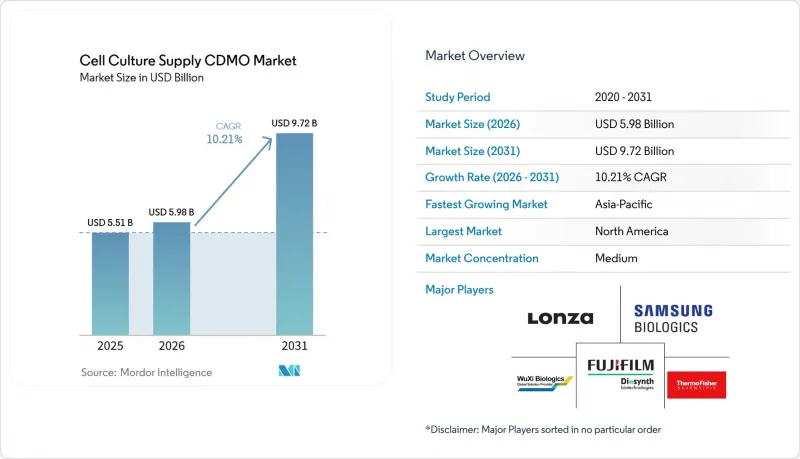
Mordor Intelligence에 의하면, 세포 배양 용품 CDMO 시장은 2025년에 55억 1,000만 달러, 2026년에 59억 8,000만 달러가 되고, 2031년까지 97억 2,000만 달러에 이를 것으로 예측되며, 2026년부터 2031년까지 CAGR 10.21%로 성장할 전망입니다.
본 보고서는 서비스 유형(분석 개발, 세포주 개발 등), 세포주 플랫폼(CHO 세포, HEK293 세포 등),규모(벤치 스케일, 파일럿 스케일, 상업용 스케일), 용도(단일클론 항체 개발 등), 최종 사용자(바이오의약품 기업 등), 지역(북미, 유럽, 아시아태평양 등)별로 분류되어 있습니다. 예측치는 금액(미 달러)으로 표시되어 있습니다.
세계 세포 배양 용품 CDMO 시장 동향 및 인사이트
세포 배양 및 업스트림 공정 개발의 아웃소싱
사내 GMP 바이오리액터 네트워크를 구축하려면 여전히 스폰서의 막대한 자본 투자가 필요하기 때문에 아웃소싱은 세포 배양 용품 CDMO 시장의 성장을 뒷받침하는 가장 명확한 요인 중 하나로 남아 있습니다. 단일 사내 GMP 시설에 대한 설비 투자액이 5억 달러를 초과하는 경우도 있어, 많은 개발 기업들은 자산을 자체적으로 보유하기보다는 외부 제조 파트너에 계속 집중하고 있습니다. WuXi Biologics는 2025년에 209건의 신규 통합 프로젝트를 보고했으며, 이로 인해 해당 기업의 총 포트폴리오 수는 945개 프로그램에 달했습니다. 이러한 규모는 아웃소싱이 현재 초기 개발 단계를 훨씬 넘어 더 장기적인 관계로 확대되고 있음을 보여줍니다. 세포 배양 용품 CDMO 시장도 캐스케이드형 아웃소싱을 통해 확대되고 있습니다. 이는 풀서비스 제공업체가 사내에 모든 역량을 보유하고 있지 않은 경우, 세포주 개발이나 분석 업무를 틈새 전문 업체에 하도급하는 방식입니다. 이러한 패턴으로 인해 세포 배양 용품 CDMO 시장 전체에서 대상 프로젝트 수가 증가하고 있습니다. 이는 아웃소싱이 현재 스폰서의 네트워크나 제공업체 기반 자체를 통해 이루어지고 있기 때문입니다.
일회용 및 모듈형 바이오 제조의 도입
세포 배양 용품 CDMO 시장은 도입 속도를 높이고 오염 위험을 줄여주는 일회용 및 모듈식 제조 시스템을 배경으로 더욱 발전하고 있습니다. WuXi Biologics는 새로 도입된 바이오리액터의 70% 이상이 일회용이라고 밝혔으며, 이는 이 형식이 초기 단계에서의 활용을 훨씬 넘어 더 광범위한 생산 계획에 통합되고 있음을 보여줍니다. 또한 이 회사는 50L 일회용 관류 시스템이 3상 임상시험의 원료의약품 수요를 충족시키면서 프로테인 A 수지의 소요량을 92% 절감할 수 있음을 보여주었으며, 이는 설비 선택이 공정 효율과 직접적으로 연결되어 있음을 시사합니다. 후지필름의 홀리스프링스 거점은 ‘kojoX’ 모듈식 설계 방식을 채택하고 있으며, 회사에 따르면 이를 통해 기존 건설 방식에 비해 시설 설계 기간을 70% 단축할 수 있었습니다고 합니다. 이는 생산 능력 확보 시기가 스폰서의 의사 결정에 영향을 미치는 시장에서 중요한 요소입니다. 따라서 세포 배양 용품 CDMO 시장은 새로운 생산 능력 확충뿐만 아니라, 새로운 생산 능력을 보다 소규모로 신속하게 단계적으로 도입할 수 있다는 사실에서도 혜택을 받고 있습니다. 이를 통해 공급업체의 투자 위험이 감소하고 고객의 대기 시간이 단축됩니다.
대용량 GMP 바이오리액터공급 부족과 기술 이전의 복잡성
세포 배양 용품 CDMO 시장의 주요 제약 요인은 상업 규모의 GMP 생산 능력 공급이 벤치 스케일이나 파일럿 스케일 공급보다 여전히 부족한 점입니다. 초기 지연을 겪은 후 진행 중인 후기 단계 프로그램으로 인해, 특히 CHO 세포 유래 단일클론 항체 개발 및 첨단 의료 프로그램에서 2025년까지의 상업적 제조 슬롯 리드타임이 길어졌습니다. 이러한 불균형이 문제가 되는 이유는 스폰서가 개발 지원을 확보하더라도 신청 및 출시 일정에 부합하는 검증된 대규모 생산 용량이 필요할 때 여전히 지연에 직면하는 경우가 많기 때문입니다. 또한 이 섹션에서는 벤치 스케일부터 상업 생산에 이르기까지 일관성을 갖춘 통합형 공급자가 우위를 점할 것이라고 지적하고 있습니다. 이는 여러 공급업체 간에 공정 소유권이 이관될 경우, 기술 이전 및 검증 과제를 관리하기가 더욱 어려워지기 때문입니다. 그 결과, 세포 배양 용품 CDMO 시장에서는 개별 서비스 공정을 제공하는 것이 아니라, 규모, 일관성 및 사전 상용화 준비 태세를 모두 갖춘 공급업체가 계속해서 높은 평가를 받고 있습니다.
부문 분석
2025년, 분석 개발은 세포 배양 용품 CDMO 시장의 44.86%를 차지하며, 현재 매출 구성에서 가장 큰 서비스 카테고리가 되었습니다. 이러한 위상은 점점 더 복잡해지는 바이오의약품의 공정 특성 평가, 강제 분해 시험, 출하 지원 및 규제용 자료 작성과 관련된 막대한 문서 작성 부담을 반영한 것입니다. 이 업무는 첨단 장비, 확립된 품질 시스템, 그리고 개발 단계 전반에 걸친 신청 요건을 충족할 수 있는 팀에 의존하기 때문에 각 스폰서사는 계속해서 이 업무를 전문 파트너에게 위탁하고 있습니다.
세포주 개발은 2031년까지 연평균 성장률(CAGR)이 11.18%를 나타낼 것으로 예측되어, 가장 빠르게 성장하는 서비스가 될 것으로 전망됩니다. 이러한 성장 속도는 새로운 바이오의약품 형식에서 맞춤형 숙주 공학에 대한 수요가 증가하고 있음을 반영합니다. 구체적으로는 표적 당사슬 프로파일 및 발현 성능을 충족하기 위해 보다 맞춤형 개발 경로가 필요한 이중 특이성 항체나 ADC 등이 있습니다. 실무적인 관점에서 볼 때, 세포 배양 용품 CDMO 시장의 서비스 구성은 분석 정확도, 세포 공학 능력 및 다운스트림 제조의 연속성을 단일 상업적 관계 내에서 결합할 수 있는 공급자로 이동하고 있습니다.
2025년 시점에서 플랫폼별로 살펴보면, CHO 세포는 세포 배양 용품 CDMO 시장의 57.42%를 차지하며, 상업적 중요성 면에서 다른 세포주 시스템을 크게 앞지르고 있습니다. 이러한 우위는 오랜 기간에 걸친 규제 숙련도, 최적화된 배지 및 피딩 전략, 그리고 CHO의 생물학적 특성에 기반하여 구축된 고도로 발달된 클론 스크리닝 워크플로우에 기인합니다. 세포 배양 용품 CDMO 업계에서 확고한 기반은 중요합니다. 스폰서가 후기 단계나 상용화를 위한 노력을 추진할 때, 여전히 제조 실적이 있는 플랫폼을 선호하기 때문입니다. HEK293 세포는 바이러스 백신 및 유전자 치료 벡터 프로그램에서 계속해서 활용되고 있지만, 하이브리도마 플랫폼도 여전히 중요하게 여겨지고 있는 반면, 바이오시밀러 및 단일클론 항체 개발자들에게는 재조합 발현 시스템이 더 뛰어난 확장성을 제공하기 때문에 점차 대체되고 있습니다.
줄기세포는 가장 빠르게 성장하는 플랫폼이 될 것으로 예상되며, 2031년까지 연평균 성장률(CAGR)은 12.74%로 전망됩니다. 이러한 성장은 향후 생산 능력 수요가 어디에서 증가할지를 시사합니다. 이러한 변화는 유도 만능 줄기세포(iPS 세포) 및 중간엽 줄기세포(MSC)의 GMP 준수 증식 시스템이 필요한, 진행 중인 동종 세포 치료 파이프라인으로의 전환에 기인합니다. 그 결과, CHO 세포의 우위가 약화되는 것은 아니며, 플랫폼에 대한 수요가 다양화될 것입니다. 이에 따라 예측 기간 동안 세포 배양 용품 CDMO 시장 전반에 걸쳐 더욱 다양한 시설 설계와 운영 노하우가 요구될 것으로 보입니다.
지역별 분석
2025년, 북미는 세포 배양 용품 CDMO 시장의 41.92%를 차지하며, 현재 매출 기준으로 가장 규모가 큰 지역 점유율을 확보했습니다. 이 지역은 탄탄한 바이오의약품 파이프라인, 성숙한 규제 체계, 그리고 2025년 국내 의약품 제조 확대를 촉진하기 위한 정책 조치의 혜택을 받고 있습니다. 캐나다는 확립된 연구 역량을 통해 이 지역의 기반을 강화하고 있지만, BIOTECanada는 장기적인 국내 생산 능력 확대를 위한 중요한 과제로 노동력 준비 태세를 지적하고 있습니다.
아시아태평양은 세포 배양 용품 CDMO 시장에서 가장 빠르게 성장하는 지역이 될 것으로 예상되며, 2031년까지의 연평균 성장률(CAGR)은 13.26%로 예측됩니다. 이 지역의 성장 추세는 정부 지원에 의한 제조 클러스터, 플랫폼의 심화, 그리고 한국, 중국, 일본, 싱가포르, 인도에서의 생산 능력에 대한 적극적인 투자에 의해 뒷받침되고 있습니다. WuXi Biologics는 2026년 6월, 싱가포르의 제제 시설에서 모듈식 상량식을 마쳤습니다. 이 시설은 연간 약 1억 개의 프리필드 주사기 및 바이알을 생산할 수 있도록 설계되어, 이 지역공급 역량이 원료의약품 생산 능력에만 국한되지 않음을 보여줍니다. 인도 역시 그 역할을 확대하고 있으며, 아로빈드 파마(Aurobind Pharma)는 2026년 6월, 15KL의 바이오리액터 용량을 갖춘 ‘TheraNym’을 가동하고, 국내 및 수출 수요를 위한 MSD와공급 계약을 체결했습니다.
유럽은 성숙한 GMP 인프라와 고급 분석 능력, 그리고 확립된 바이오의약품 고객 기반을 모두 갖추고 있어 세포 배양 용품 CDMO 시장에서 구조적으로 중요한 위치를 계속 차지하고 있습니다. 이 지역의 전망은 정책 조치에 의해서도 뒷받침되고 있으며, 유럽연합 집행위원회의 2025년 생명공학 패키지에는 바이오시밀러 승인 및 지역 제조 역량을 강화하기 위한 조치가 포함되어 있습니다. 이 세 가지 주요 거점 외에도 남미, 중동 및 아프리카는 규모는 작지만 활기찬 지역이며, 민관 협력을 통한 제조 노력과 다각화 전략이 향후 공급업체의 사업 확장을 위한 선택적 기회를 창출하고 있습니다.
기타 혜택:
- 엑셀 형식 시장 예측(ME) 시트
- 3개월간 애널리스트 지원
자주 묻는 질문
목차
제1장 서론
제2장 조사 방법
제3장 개요
제4장 시장 구도
제5장 시장 규모와 성장 예측
제6장 경쟁 구도
제7장 시장 기회와 향후 전망
JHS 26.09.01According to Mordor Intelligence, the cell culture supply CDMO market is projected to be USD 5.51 billion in 2025, USD 5.98 billion in 2026, and reach USD 9.72 billion by 2031, growing at a CAGR of 10.21% from 2026 to 2031.
This report is Segmented by Service Type (Analytical Development, Cell Line Development, and More), Cell Line Platform (CHO Cells, HEK293 Cells, and More), Scale (Bench Scale, Pilot Scale, Commercial Scale), Application (Monoclonal Antibody Development, and More), End-User (Biopharmaceutical Companies, and More), and Geography (North America, Europe, Asia-Pacific, and More). Forecasts are in Value (USD).
Global Cell Culture Supply CDMO Market Trends and Insights
Outsourcing of Cell Culture and Upstream Development
Outsourcing remains one of the clearest growth supports for the cell culture supply CDMO market because building an internal GMP bioreactor network still requires very high capital commitments from sponsors. A single in-house GMP facility can exceed USD 500 million in capital expenditure, which keeps many developers focused on external manufacturing partners instead of asset ownership. WuXi Biologics reported 209 new integrated projects in 2025, which brought its total portfolio to 945 programs, and that scale shows how outsourcing now extends well beyond early development into longer duration relationships. The cell culture supply CDMO market is also widening through cascading outsourcing, where full-service providers subcontract cell line development and analytical work to niche specialists when they do not maintain every capability internally. That pattern increases the number of addressable projects across the cell culture supply CDMO market because outsourcing now flows through sponsor networks and through the provider base itself.
Adoption of Single-Use and Modular Biomanufacturing
The cell culture supply CDMO market is also moving forward on the back of single-use and modular manufacturing systems that improve deployment speed and reduce contamination risk. WuXi Biologics stated that more than 70% of newly installed bioreactors are single-use, which shows that this format has moved well beyond early phase use and into broader production planning. The same company also showed that a 50L single-use perfusion system could support drug substance needs for a Phase III clinical trial while cutting Protein A resin requirements by 92%, which connects equipment choice directly with process efficiency. FUJIFILM's Holly Springs site used the kojoX modular design approach, and the company said this reduced facility design time by 70% versus conventional construction, which matters in a market where capacity timing affects sponsor decisions.The cell culture supply CDMO market therefore benefits not only from new capacity additions, but also from the fact that newer capacity can be deployed in smaller and faster increments that reduce investment risk for providers and shorten waiting time for customers.
Limited High-Capacity GMP Bioreactor Availability and Tech Transfer Complexity
A major constraint on the cell culture supply CDMO market is that commercial scale GMP capacity remains tighter than bench scale and pilot scale availability. The late-phase programs moving forward after earlier delays extended lead times for commercial manufacturing slots through 2025, especially in CHO-based monoclonal antibody work and advanced therapy programs. This imbalance matters because sponsors can often secure development support, but still face delays when they need validated large-scale production slots that align with filing and launch schedules. The same section also points out that integrated providers with bench-to-commercial continuity gain an advantage because tech transfer and validation challenges become harder to manage when process ownership changes across multiple vendors. As a result, the cell culture supply CDMO market continues to reward providers that can combine scale, continuity, and prior commercial readiness instead of offering isolated service steps.
Other drivers and restraints analyzed in the detailed report include:
- Expansion of Complex Biologics, Biosimilars, and GMP-Grade Inputs
- Regional Onshoring, Closed Systems, and Contamination Control
- Skilled Bioprocess Talent Shortage and Single-Source Dependence for Critical Inputs
For complete list of drivers and restraints, kindly check the Table Of Contents.
Segment Analysis
Analytical development held 44.86% of the cell culture supply CDMO market in 2025, making it the largest service category in the current revenue mix. That position reflects the heavy documentation burden around process characterization, forced degradation testing, release support, and regulatory package preparation for increasingly complex biologics. Sponsors continue to delegate this work to specialist partners because the activity depends on sophisticated instrumentation, established quality systems, and teams that can support filing expectations across development stages.
Cell line development is expected to be the fastest-growing service, with a projected CAGR of 11.18% through 2031, and that pace reflects the growing need for tailored host engineering in newer biologic formats. The bispecific antibodies and ADCs, which need more customized development paths to meet target glycosylation profiles and expression performance. In practical terms, the service mix of the cell culture supply CDMO market is shifting toward providers that can combine analytical precision, cell engineering capability, and downstream manufacturing continuity in one commercial relationship.
CHO cells accounted for 57.42% of the cell culture supply CDMO market by platform in 2025, which keeps them far ahead of other cell line systems in commercial relevance. Their lead reflects years of regulatory familiarity, optimized media and feeding strategies, and highly developed clone screening workflows built around CHO biology. In the cell culture supply CDMO industry, an established base matters because sponsors still prefer platforms with proven manufacturing precedent when they move toward late-stage and commercial work. HEK293 cells continue to serve viral vaccine and gene therapy vector programs, while hybridoma platforms remain relevant but face gradual displacement as recombinant expression systems offer better scalability for biosimilar and monoclonal antibody developers.
Stem cells are expected to be the fastest-growing platform, with a projected CAGR of 12.74% through 2031, and that growth signals where future capacity requirements are likely to build. The shift to the advancing pipeline of allogeneic cell therapies that need GMP-compliant expansion systems for induced pluripotent stem cells and mesenchymal stem cells. The result is not a decline in CHO dominance, but a broadening of platform demand that will require more varied facility design and operating expertise across the cell culture supply CDMO market over the forecast period.
Complete Report Scope:
- By Service Type
- Analytical Development
- Cell Line Development
- cGMP Manufacturing
- Process Optimization
- Other Service Types
- By Cell Line Platform
- CHO Cells
- HEK293 Cells
- Hybridoma Cells
- Stem Cells
- Other Cell Line Platforms
- By Scale
- Bench Scale
- Pilot Scale
- Commercial Scale
- By Application
- Monoclonal Antibody Development
- Therapeutic Protein Production
- Gene Therapy Vector Production
- Viral Vaccine Production
- By End-User
- Biopharmaceutical Companies
- Contract Development and Manufacturing Organizations
- Contract Research Organizations
- Academia and Research Institutes
- By Geography
- North America
- United States
- Canada
- Mexico
- Europe
- Germany
- United Kingdom
- France
- Italy
- Spain
- Rest of Europe
- Asia-Pacific
- China
- Japan
- India
- Australia
- South Korea
- Rest of Asia-Pacific
- Middle East and Africa
- GCC
- South Africa
- Rest of Middle East and Africa
- South America
- Brazil
- Argentina
- Rest of South America
- North America
Geography Analysis
North America held 41.92% of the cell culture supply CDMO market in 2025, giving the region the largest geographic position in current revenue terms. The region benefits from a dense biologics pipeline, a mature regulatory structure, and policy actions in 2025 that aimed to make domestic pharmaceutical manufacturing easier to expand. Canada adds to the regional base through established research capability, although BIOTECanada has flagged workforce readiness as an important issue for long-term domestic capacity expansion.
Asia-Pacific is expected to be the fastest-growing region in the cell culture supply CDMO market, with a projected CAGR of 13.26% through 2031. The region's growth profile is supported by state-backed manufacturing clusters, rising platform depth, and a strong pace of capacity investment across South Korea, China, Japan, Singapore, and India. WuXi Biologics completed the modular topping-out of its Singapore drug product facility in June 2026, and the site is designed for around 100 million units of pre-filled syringes and vials per year, showing how the regional offer is moving beyond drug substance capacity alone. India is also deepening its role, and Aurobindo Pharma launched TheraNym in June 2026 with 15KL bioreactor capacity and an MSD supply agreement for domestic and export demand.
Europe remains structurally important to the cell culture supply CDMO market because it combines mature GMP infrastructure with deep analytical capability and an established biologics customer base. The regional outlook is also supported by policy action, and the European Commission's 2025 biotechnology package includes measures intended to strengthen biosimilar authorization and regional manufacturing capacity. Outside the three major hubs, South America, the Middle East, and Africa remain smaller but active areas where public-private manufacturing efforts and diversification strategies are creating selective opportunities for future provider expansion.
- AGC Biologics
- BioVectra Inc.
- Boehringer Ingelheim
- Catalent
- Curia Global, Inc.
- Esco Aster Pte. Ltd.
- FUJIFILM
- Genscript
- KBI Biopharma, Inc.
- Lonza Group
- Minaris Regenerative Medicine GmbH
- Oxford Biomedica plc
- Rentschler Biopharma SE
- Samsung Biologics Co., Ltd.
- Siegfried Holding AG
- Syngene International
- Thermo Fisher Scientific
- WACKER Biotech GmbH
- WuXi Biologics Cayman Inc.
- Yposkesi
Additional Benefits:
- The market estimate (ME) sheet in Excel format
- 3 months of analyst support
TABLE OF CONTENTS
1 Introduction
- 1.1 Study Assumptions and Market Definition
- 1.2 Scope of the Study
2 Research Methodology
3 Executive Summary
4 Market Landscape
- 4.1 Market Overview
- 4.2 Market Drivers
- 4.2.1 Outsourcing of Cell Culture and Upstream Development
- 4.2.2 Adoption of Single-Use and Modular Biomanufacturing
- 4.2.3 Expansion of Complex Biologics and Biosimilars Pipelines
- 4.2.4 Regional Onshoring of Critical Bioprocess Capacity
- 4.2.5 Tightened Closed-System and Contamination-Control Expectations
- 4.2.6 Increasing Demand for GMP-Grade Cell Culture Media and Reagent Manufacturing
- 4.3 Market Restraints
- 4.3.1 Limited High-Capacity GMP Bioreactor Availability
- 4.3.2 Skilled Bioprocess Talent Shortage
- 4.3.3 Single-Source Dependence for Critical Inputs
- 4.3.4 Tech Transfer and Validation Complexity
- 4.4 Supply/Value Chain Analysis
- 4.5 Regulatory Landscape
- 4.6 Technological Outlook
- 4.7 Porter's Five Forces Analysis
- 4.7.1 Threat of New Entrants
- 4.7.2 Bargaining Power of Suppliers
- 4.7.3 Bargaining Power of Buyers
- 4.7.4 Threat of Substitutes
- 4.7.5 Competitive Rivalry
5 Market Size & Growth Forecasts (Value, USD)
- 5.1 By Service Type
- 5.1.1 Analytical Development
- 5.1.2 Cell Line Development
- 5.1.3 cGMP Manufacturing
- 5.1.4 Process Optimization
- 5.1.5 Other Service Types
- 5.2 By Cell Line Platform
- 5.2.1 CHO Cells
- 5.2.2 HEK293 Cells
- 5.2.3 Hybridoma Cells
- 5.2.4 Stem Cells
- 5.2.5 Other Cell Line Platforms
- 5.3 By Scale
- 5.3.1 Bench Scale
- 5.3.2 Pilot Scale
- 5.3.3 Commercial Scale
- 5.4 By Application
- 5.4.1 Monoclonal Antibody Development
- 5.4.2 Therapeutic Protein Production
- 5.4.3 Gene Therapy Vector Production
- 5.4.4 Viral Vaccine Production
- 5.5 By End-User
- 5.5.1 Biopharmaceutical Companies
- 5.5.2 Contract Development and Manufacturing Organizations
- 5.5.3 Contract Research Organizations
- 5.5.4 Academia and Research Institutes
- 5.6 By Geography
- 5.6.1 North America
- 5.6.1.1 United States
- 5.6.1.2 Canada
- 5.6.1.3 Mexico
- 5.6.2 Europe
- 5.6.2.1 Germany
- 5.6.2.2 United Kingdom
- 5.6.2.3 France
- 5.6.2.4 Italy
- 5.6.2.5 Spain
- 5.6.2.6 Rest of Europe
- 5.6.3 Asia-Pacific
- 5.6.3.1 China
- 5.6.3.2 Japan
- 5.6.3.3 India
- 5.6.3.4 Australia
- 5.6.3.5 South Korea
- 5.6.3.6 Rest of Asia-Pacific
- 5.6.4 Middle East and Africa
- 5.6.4.1 GCC
- 5.6.4.2 South Africa
- 5.6.4.3 Rest of Middle East and Africa
- 5.6.5 South America
- 5.6.5.1 Brazil
- 5.6.5.2 Argentina
- 5.6.5.3 Rest of South America
- 5.6.1 North America
6 Competitive Landscape
- 6.1 Market Concentration
- 6.2 Market Share Analysis
- 6.3 Company Profiles (includes Global level Overview, Market level overview, Core Segments, Financials as available, Strategic Information, Market Rank/Share for key companies, Products & Services, Recent Developments)
- 6.3.1 AGC Biologics
- 6.3.2 BioVectra Inc.
- 6.3.3 Boehringer Ingelheim International GmbH
- 6.3.4 Catalent, Inc.
- 6.3.5 Curia Global, Inc.
- 6.3.6 Esco Aster Pte. Ltd.
- 6.3.7 FUJIFILM Diosynth Biotechnologies
- 6.3.8 GenScript ProBio
- 6.3.9 KBI Biopharma, Inc.
- 6.3.10 Lonza Group AG
- 6.3.11 Minaris Regenerative Medicine GmbH
- 6.3.12 Oxford Biomedica plc
- 6.3.13 Rentschler Biopharma SE
- 6.3.14 Samsung Biologics Co., Ltd.
- 6.3.15 Siegfried Holding AG
- 6.3.16 Syngene International Limited
- 6.3.17 Thermo Fisher Scientific Inc.
- 6.3.18 WACKER Biotech GmbH
- 6.3.19 WuXi Biologics Cayman Inc.
- 6.3.20 Yposkesi
7 Market Opportunities & Future Outlook
- 7.1 White-space & Unmet-need Assessment


