

|
시장보고서
상품코드
2118044
심장 영상 진단 소프트웨어 시장 : 시장 점유율 분석, 업계 동향 및 통계, 성장 예측(2026-2031년)Cardiac Imaging Software - Market Share Analysis, Industry Trends & Statistics, Growth Forecasts (2026 - 2031) |
||||||
 Mordor Intelligence
Mordor Intelligence에 의하면, 심장 영상 진단 소프트웨어 시장 규모는 2025년 6억 3,000만 달러로 평가되었고, 2026년에는 6억 9,000만 달러로 추정되고, 2026-2031년 CAGR 8.97%로 성장을 지속할 전망이며, 2031년에는 10억 6,000만 달러에 이를 것으로 예측됩니다.
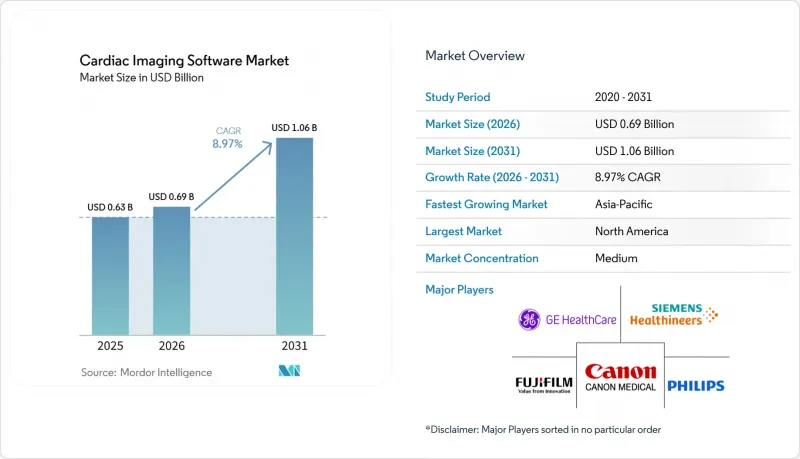
본 보고서는 모달리티별(CT, CMR, 초음파, 기타), 용도별(CAD, 구조적 심장 질환, 기타), 최종 사용자별(병원, ASC, 기타), 배포 방식별(온프레미스, 클라우드/SaaS, 기타), 시스템 유형별(CVIS, PACS, AI 플랫폼), 구성 요소별(소프트웨어, 서비스, 하드웨어/소프트웨어), 지역별(북미, 유럽, 아시아태평양, 중동 및 아프리카, 남미)로 분류되어 있습니다. 예측치는 금액(달러)으로 표시되어 있습니다.
세계의 심장 영상 진단 소프트웨어 시장 동향 및 인사이트
증가하는 심혈관 질환 영상 진단 업무
심혈관 질환은 모든 의료 현장에서 시기적절한 영상 진단 및 임상적 해석에 대한 지속적인 수요를 창출하고 있습니다. 이러한 수요로 인해 의료 서비스 제공업체들은 전문 팀을 같은 속도로 확대하지 못한 채 일상적인 분석 및 보고를 완료해야 하는 더 큰 압박에 직면하고 있습니다. 의료 기관이 측정, 워크플로우 우선순위 지정, 보고서 작성을 자동화함에 따라 심장 영상 진단 소프트웨어 시장은 혜택을 보고 있습니다. CT 및 MR 검사에는 방대한 양의 영상 검토와 후처리가 필요하며, 이는 첨단 시각화 및 정량화 소프트웨어에 대한 수요를 뒷받침하고 있습니다. 또한, 의료 기관이 분산된 도구를 여러 영상 진단 프로세스를 지원하는 플랫폼으로 대체하는 것도 심장 영상 진단 소프트웨어 시장에 긍정적인 영향을 미칩니다. 소프트웨어 업그레이드를 미루어 왔던 병원들도 판독 업무 부담과 시술용 영상 진단 수요가 증가함에 따라 도입을 우선시할 가능성이 있습니다.
AI를 활용한 판독 지원 및 측정 자동화
AI를 활용한 도구는 심장 영상 진단 팀이 반복적인 분석 작업을 수행하고 임상 업무를 체계화하는 방식을 변화시키고 있습니다. FDA는 2025년에 AI 및 머신러닝과 관련된 92건의 심장학 분야 신청을 승인했으며, 2024년의 승인 건수는 62건이었습니다. 2025년 승인 대상 그룹에서 플라크 분석, 칼슘 스코어, 그리고 CT 기반 분획 혈류 예비 용량(FFR)이 주요 제품 범주로 꼽혔습니다. 2026년 CPT(진료 행위 분류) 개정에서는 CT 기반 분획 혈류 예비 능력 및 CT 관류에 관한 카테고리 I 코드가 추가되어, 보험 적용 대상 측정 범주가 확대되었습니다. Philips는 2026년에 ‘SmartHeart’의 FDA 승인을 획득했으며, 이 소프트웨어는 30초 이내에 심장 MR 스캔 계획을 자동화합니다. 이러한 발전에 따라, 고정된 소프트웨어 버전에 의존하지 않고 승인된 업데이트를 수시로 받을 수 있는 구독 모델이 유리해지고 있습니다.
높은 통합 및 도입 비용
CVIS의 전면 교체 프로그램의 경우, 본격적인 가동에 이르기까지 설정, 인터페이스, 임상 검증에 18-36개월이 소요될 수 있습니다. 이 기간은 연간 재무 계획 주기를 초과할 수도 있어, 심장 영상 진단 소프트웨어 시장의 조달 결정을 지연시킬 가능성이 있습니다. 지역 병원의 경우, 검사 건수가 적은 상황에서는 엔터프라이즈 플랫폼 도입을 정당화하기 어렵다고 느낄 수 있습니다. 또한, 레거시 시스템에서 마이그레이션할 때는 에코 루프, 카테터 검사, 구조화된 보고서를 신중하게 처리해야 합니다. 데이터 마이그레이션에 수반되는 위험으로 인해, 도입 범위나 비용이 초기 소프트웨어 구매 비용을 초과할 가능성이 있습니다. 인터페이스 개발 및 데이터 변환 작업을 간소화하는 벤더라면 이러한 장벽을 보다 효과적으로 해소할 수 있을 것입니다.
부문 분석
2025년, 심초음파 검사는 매출의 32.18%를 차지했으며, 모달리티별 분석에서 가장 큰 점유율을 기록했습니다. 병원, 외래수술센터(ASC), 외래 진료소 등 다양한 시설에서의 활용이 심장 영상 진단 소프트웨어에 대한 안정적인 수요를 뒷받침하고 있습니다. 주요 심초음파 플랫폼에는 AI 안내에 의한 영상 획득, 좌심실 박출률 자동 측정, 변형 정량화 기능이 점점 더 많이 통합되고 있습니다. 이러한 기능들은 일상적인 워크플로우와 구조화된 보고서의 일관성을 향상시킬 수 있습니다. 심장 CT 및 심장 MR의 경우, 후처리 및 정량 분석에 대한 수요가 높아지고 있는 반면, 핵의학 워크플로우 도구는 일부 적응증에서 그 역할이 점차 제한되고 있습니다. EchoNext사는 2025년, 표준 12도심전도 정보를 바탕으로 구조적 심장 질환 진단을 위해 심초음파 검사가 필요할 가능성이 있는 환자를 식별하는 기술에 대해 FDA 승인을 획득했습니다.
통합형 및 다중 모달리티 영상 진단 플랫폼은 2031년까지 연평균 성장률(CAGR) 15.27%를 나타낼 것으로 예측됩니다. 구조적 심장 질환, 심근증, 선천성 질환의 진단에는 CT, MR 및 심초음파 검사 소견을 종합적으로 검토해야 할 경우가 있습니다. 통합된 판독 환경을 통해 검토 중에 별도의 용도 간을 오갈 필요성을 줄일 수 있습니다. 또한, 해부학적 데이터, 조직 데이터, 기능적 데이터를 공통 워크플로에 통합함으로써 다학제적 검토를 지원할 수도 있습니다. 플랫폼의 커버리지 범위가 넓다면, 단일 모달리티 구매보다 엔터프라이즈 계약이 더 높은 가치를 제공할 가능성이 있습니다. 의료 제공업체들이 일관된 데이터 교환과 보고서 작성을 요구하는 가운데, AI를 활용한 후처리와의 통합은 계속해서 중요해질 것입니다.
2025년에는 관상동맥 질환용 용도이 매출의 33.35%를 차지했습니다. 이 용도에는 CCTA 후처리, CT 기반 분획 혈류 예비량(FFR), 플라크 정량 및 칼슘 스코어링이 포함됩니다. CMS는 2025년에 CCTA에 대한 병원 환급액을 357달러로 인상했으며, AI 기반 플라크 분석에 대해서는 950달러의 환급액을 책정했습니다. 이러한 변경으로 인해 측정 가능한 임상 결과를 제공하는 심장 소프트웨어의 경제적 타당성이 향상되었습니다. HeartFlow사는 2025년 9월 차세대 플라크 분석 알고리즘에 대해 FDA 승인을 획득했으며, Cigna사는 2025년 10월부터 해당 서비스에 대한 보험 적용을 시작했습니다. 이러한 진전은 심장 영상 진단 소프트웨어 시장에서 일회성 보고서 작성에서 지속적인 위험 평가로의 전환을 촉진할 것입니다.
구조적 심장 질환 시장은 2031년까지 연평균 성장률(CAGR) 17.12%로 확대될 것으로 예측됩니다. 경카테터 대동맥판막 치환술, 승모판막 수복술, 좌심방 귀 폐쇄술에는 상세한 해부학적 계획과 시술 중 영상 진단 지원이 필요합니다. Philips는 2026년, 승모판막 수복술에서 AI를 활용한 안내 기능 ‘DeviceGuide’를 탑재한 ‘EchoNavigator R5.0’에 대해 FDA 승인을 획득했습니다. 이 승인으로 인해 해당 소프트웨어는 시술 지원 도구로서 카테터실에서 사용될 수 있게 되었습니다. 심부전, 부정맥, 판막증, 선천성 질환, 폐고혈압, 심근증에서도 전문적인 워크플로가 요구되고 있습니다. 또한, 다른 임상적 이유로 시행된 CT 검사에서 소프트웨어가 심혈관계 소견을 식별할 수 있게 됨에 따라 예방적 선별 검사의 범위도 확대되고 있습니다.
지역별 분석
2025년, 북미는 전 세계 매출의 42.17%를 차지했으며, 심장 영상 진단 소프트웨어 시장에서 최대 점유율을 확보했습니다. 소프트웨어를 통한 측정값에 대한 CMS(미국 의료보험센터)의 환급 경로와 통합 의료 네트워크에서 CVIS(심혈관 영상 진단 시스템)의 광범위한 활용이 수요를 뒷받침하고 있습니다. 2025년, CMS는 CCTA에 대한 병원 환급액을 357달러, CT 기반 분획 혈류 예비량(FFR)에 대한 환급액을 1,017달러, AI를 이용한 관상동맥 플라크 분석에 대한 환급액을 950달러로 설정했습니다. 미국은 지역별 지출에서 1위를 차지하고 있으며, 캐나다에서는 각 주의 의료 시스템에 CVIS 통합이 진행되고 있습니다. 멕시코의 민간 병원 부문은 공공 환급 프로그램 이외의 또 다른 도입 경로를 제공합니다.
유럽에서는 수요가 상당히 많지만, 도입 상황은 국가마다 다르며, 공급업체가 GDPR(EU 개인정보보호규정) 및 MDR 요건을 충족할 수 있는지 여부에 따라 달라집니다. 독일, 영국, 프랑스, 이탈리아, 스페인은 대학 병원 및 디지털 영상 진단 프로그램을 통해 이 지역 수요를 뒷받침하고 있습니다. 프랑크푸르트의 괴테 대학교는 심장 MR 워크플로우를 촬영부터 구조화된 보고서 작성까지 자동화하는 ‘LIDIA-Hessen’ 프로젝트를 개발 중입니다. 스페인과 이탈리아에서는 디지털 헬스 프로그램을 통해 PACS 및 CVIS 업그레이드가 진행되고 있습니다. 스칸디나비아 국가들의 의료 시스템에서는 통합된 거버넌스를 통해 도입에 관한 의사 결정이 간소화되므로, 클라우드 기반 CVIS 도입이 가능해졌습니다. 남미는 여전히 초기 단계에 있으며, 브라질과 아르헨티나에서는 민간 병원 및 진단 네트워크에서 디지털 영상 진단 기능 구축이 진행되고 있습니다.
아시아태평양은 2031년까지 연평균 성장률(CAGR) 13.34%를 나타낼 것으로 예측되며, 이는 심장 영상 진단 소프트웨어 시장에서 가장 높은 지역 성장률입니다. 고령화, 심혈관 질환 유병률, 그리고 의료 AI에 대한 공공 투자가 이러한 성장을 뒷받침하고 있습니다. 일본, 중국, 한국, 인도가 주요 성장 지역이 될 것입니다. ElPixel사는 2025년 6월, Clairvo Technologies사와 제휴하여 일본 내 심장 CT 분석 플랫폼 ‘CoronaryDoc’의 상용화에 착수했습니다. 중동 및 아프리카는 소규모 기반에서 발전하고 있으며, GCC 국가들의 의료 인프라 투자와 남아프리카공화국의 민간 병원 수요가 PACS 및 CVIS 도입을 촉진하고 있습니다.
기타 혜택 :
- 엑셀 형식 시장 예측(ME) 시트
- 3개월간의 애널리스트 지원
자주 묻는 질문
목차
제1장 서론
제2장 조사 방법
제3장 주요 요약
제4장 시장 구도
제5장 시장 규모 및 성장 예측
제6장 경쟁 구도
제7장 시장 기회 및 향후 전망
AJY 26.09.03According to Mordor Intelligence, the cardiac imaging software market size is expected to grow from USD 0.63 billion in 2025 to USD 0.69 billion in 2026 and is forecast to reach USD 1.06 billion by 2031 at 8.97% CAGR over 2026-2031.
This report is Segmented by Modality (CT, CMR, Echo, Others), Application (CAD, Structural Heart, Others), End User (Hospitals, Ascs, Others), Deployment (On-Premises, Cloud/SaaS, Others), System Type (CVIS, PACS, AI Platforms), Component (Software, Services, HW Software), and Geography (North America, Europe, Asia-Pacific, MEA, South America). Forecasts in Value (USD).
Global Cardiac Imaging Software Market Trends and Insights
Rising Cardiovascular Disease Imaging Workloads
Cardiovascular disease continues to create sustained demand for timely imaging and clinical interpretation across care settings. This demand places greater pressure on providers to complete routine analysis and reporting without expanding specialist teams at the same pace. The cardiac imaging software market benefits when organizations use automation to handle measurements, workflow prioritization, and report preparation. CT and MR studies require substantial image review and post-processing, which supports demand for advanced visualization and quantification software. The cardiac imaging software market also benefits when providers replace fragmented tools with platforms that support several imaging pathways. Hospitals that delayed software upgrades may prioritize implementation as reading workloads and procedural imaging needs rise.
AI-Assisted Interpretation and Measurement Automation
AI-assisted tools are changing how cardiac imaging teams complete repetitive analysis tasks and organize clinical work. The FDA cleared 92 AI and machine learning-related cardiology submissions in 2025, compared with 62 in 2024. Plaque analysis, calcium scoring, and CT-derived fractional flow reserve were among the leading product categories in the 2025 clearance group. The 2026 CPT updates added Category I codes for CT-derived fractional flow reserve and CT perfusion, which widened the reimbursable measurement categories. Philips received FDA clearance for SmartHeart in 2026, and the software automates cardiac MR scan planning in under 30 seconds. These developments favor subscription models that allow customers to receive cleared updates over time rather than rely on fixed software versions.
High Integration And Implementation Costs
Full CVIS replacement programs can require 18 to 36 months for configuration, interfaces, and clinical validation before go-live. This duration can extend beyond an annual finance planning cycle and delay procurement decisions in the cardiac imaging software market. Community hospitals may find that enterprise platforms are difficult to justify against smaller study volumes. Migration from legacy systems also requires careful handling of echo loops, catheterization studies, and structured reports. Data migration risks can raise the scope and cost of implementation beyond the initial software purchase. Vendors that simplify interface development and conversion work can better address this barrier.
Other drivers and restraints analyzed in the detailed report include:
- Cloud-Based Multi-Site Cardiology Operations
- Expansion of Ambulatory And Distributed Cardiac Care
- Cybersecurity, Privacy, And Data-Sovereignty Requirements
For complete list of drivers and restraints, kindly check the Table Of Contents.
Segment Analysis
Echocardiography held 32.18% of revenue in 2025, giving it the largest position in the modality analysis. Its wide use across hospitals, ambulatory surgical centers, and outpatient clinics supports steady demand for cardiac imaging software. Leading echo platforms increasingly include AI-guided acquisition, automated left ventricular ejection fraction measurement, and strain quantification. These functions can improve the consistency of routine workflows and structured reports. Cardiac CT and cardiac MR are expanding the need for post-processing and quantitative analysis, while nuclear workflow tools face a more limited role in some indications. EchoNext received FDA clearance in 2025 to identify patients who may need echocardiography for structural heart disease from standard 12-lead ECG information.
Combined and multimodality imaging platforms are forecast to grow at a 15.27% CAGR through 2031. Structural heart disease, cardiomyopathy, and congenital conditions can require CT, MR, and echocardiography findings to be considered together. A unified reading environment can reduce the need to move between separate applications during review. It can also support multidisciplinary discussion by bringing anatomical, tissue, and functional data into a common workflow. Broader platform coverage can make enterprise contracts more valuable than a single-modality purchase.. Integration with AI post-processing will remain important as providers seek consistent data exchange and reporting.
Coronary artery disease applications accounted for 33.35% of revenue in 2025. This application includes CCTA post-processing, CT-derived fractional flow reserve, plaque quantification, and calcium scoring. CMS increased hospital reimbursement for CCTA to USD 357 in 2025 and established USD 950 reimbursement for AI plaque analysis. These changes improved the economic case for cardiac software that provides measurable clinical outputs. HeartFlow received FDA clearance for its next-generation Plaque Analysis algorithm in September 2025, and Cigna began coverage for the service in October 2025. This development supports a shift from one-time reporting toward ongoing risk assessment in the cardiac imaging software market.
Structural heart disease is forecast to grow at a 17.12% CAGR through 2031. Transcatheter aortic valve implantation, mitral valve repair, and left atrial appendage closure require detailed anatomical planning and intra-procedural imaging support. Philips received FDA clearance for EchoNavigator R5.0 with DeviceGuide in 2026 for AI-powered guidance during mitral valve repair. The approval extends software use into the catheterization laboratory as a procedural support tool. Heart failure, arrhythmia, valvular disease, congenital disease, pulmonary hypertension, and cardiomyopathy also require specialized workflows. Preventive screening is widening as software identifies cardiovascular findings in CT studies completed for other clinical reasons
Complete Report Scope:
- By Modality
- Cardiac Computed Tomography
- Coronary CT Angiography
- Coronary Artery Calcium Scoring
- CT-Derived Fractional Flow Reserve
- Plaque Quantification and Characterization
- Others
- Cardiac Magnetic Resonance Imaging
- Ventricular Function Analysis
- T1 and T2 Mapping
- Tissue Characterization
- Flow and Perfusion Analysis
- Others
- Echocardiography
- Transthoracic Echocardiography
- Transesophageal Echocardiography
- Three-Dimensional Echocardiography
- Strain and Deformation Imaging
- AI-Guided Image Acquisition
- Others
- Nuclear Cardiology
- SPECT
- PET
- Myocardial Perfusion Analysis
- Others
- X-Ray and Fluoroscopy
- Cath Lab Imaging
- Angiography and Fluoroscopy
- Others
- Combined and Multimodality Imaging
- Cardiac Computed Tomography
- By Application
- Coronary Artery Disease
- Structural Heart Disease
- Heart Failure
- Arrhythmia and Electrophysiology
- Valvular Heart Disease
- Congenital Heart Disease
- Pulmonary Hypertension
- Cardiomyopathy
- Preventive and Opportunistic Cardiac Screening
- Image-Guided Treatment Planning
- Procedure Monitoring and Post-Treatment Assessment
- Others
- By End User
- Hospitals
- Academic Medical Centers
- Community Hospitals
- Integrated Delivery Networks
- Diagnostic Imaging Centers
- Cardiovascular Clinics
- Ambulatory Surgical Centers
- Research and Pharmaceutical Organizations
- Others
- Hospitals
- By Deployment
- On-Premises
- Cloud-Based and Software as a Service
- Web-Based
- Hybrid and Edge Deployment
- Others
- By System Type
- Cardiovascular Information Systems
- Cardiology Picture Archiving and Communication Systems
- Integrated Cardiovascular Information System and Cardiology PACS Platforms
- Advanced Visualization and Post-Processing Platforms
- Artificial Intelligence Analysis Platforms
- Structured Reporting and Workflow Platforms
- Others
- By Component
- Software
- Services
- Implementation and Integration Services
- Training and Support Services
- Managed and Professional Services
- Hardware-Enabled Software Solutions
- By Geography
- North America
- United States
- Canada
- Mexico
- Europe
- Germany
- United Kingdom
- France
- Italy
- Spain
- Rest of Europe
- Asia-Pacific
- China
- Japan
- India
- Australia
- South Korea
- Rest of Asia-Pacific
- Middle East and Africa
- GCC
- South Africa
- Rest of Middle East and Africa
- South America
- Brazil
- Argentina
- Rest of South America
- North America
Geography Analysis
North America held 42.17% of global revenue in 2025, which gave the region the largest position in the cardiac imaging software market. CMS reimbursement pathways for software-derived measurements and broad CVIS use at integrated delivery networks support demand. In 2025, CMS set CCTA hospital reimbursement at USD 357, CT-derived fractional flow reserve reimbursement at USD 1,017, and AI coronary plaque analysis reimbursement at USD 950. The United States leads regional spending, while Canada is progressing through CVIS consolidation at provincial health systems. Mexico's private hospital sector provides another adoption route outside public reimbursement programs.
Europe has substantial demand, but adoption varies by country and by the ability of vendors to meet GDPR and MDR requirements. Germany, the United Kingdom, France, Italy, and Spain anchor regional demand through university hospitals and digital imaging programs. Goethe University Frankfurt is developing the LIDIA-Hessen project to automate cardiac MR workflows from acquisition to structured reporting. Spain and Italy are pursuing PACS and CVIS upgrades through digital health programs. Scandinavian systems can support cloud CVIS adoption because centralized governance can simplify implementation decisions. South America remains at an earlier stage, with Brazil and Argentina building digital imaging capability in private hospital and diagnostic networks.
Asia-Pacific is forecast to grow at a 13.34% CAGR through 2031, the fastest regional rate in the cardiac imaging software market. Aging populations, cardiovascular disease prevalence, and public investment in health AI support this expansion. Japan, China, South Korea, and India are the central growth areas. ElPixel partnered with Clairvo Technologies in June 2025 to commercialize the CoronaryDoc cardiac CT analysis platform in Japan. The Middle East and Africa are developing from a smaller base, with GCC health infrastructure investment and private hospital demand in South Africa supporting PACS and CVIS deployment.
- Agfa-Gevaert
- Artrya Limited
- Canon
- Circle Cardiovascular Imaging Inc.
- Cleerly, Inc.
- DESKi
- DiA Imaging Analysis Ltd.
- Digisonics, Inc.
- Esaote S.p.A.
- FUJIFILM
- GE HealthCare Technologies Inc.
- HeartFlow, Inc.
- HeartLung Corporation
- INFINITT Healthcare Co., Ltd.
- Intelerad Medical Systems
- Koninklijke Philips
- Medis Medical Imaging Systems
- Merative
- NeoSoft LLC
- Pie Medical Imaging
- Ram Soft
- ScImage, Inc.
- Sectra
- Shimadzu
- Siemens Healthineers
- Tempus AI, Inc.
- TomTec Imaging Systems GmbH
- Ventripoint Diagnostics Ltd.
- Viz.ai
Additional Benefits:
- The market estimate (ME) sheet in Excel format
- 3 months of analyst support
TABLE OF CONTENTS
1 Introduction
- 1.1 Study Assumptions & Market Definition
- 1.2 Scope of the Study
2 Research Methodology
3 Executive Summary
4 Market Landscape
- 4.1 Market Overview
- 4.2 Market Drivers
- 4.2.1 Rising Cardiovascular Disease Imaging Workloads
- 4.2.2 AI-Assisted Interpretation and Measurement Automation
- 4.2.3 Cloud-Based Multi-Site Cardiology Operations
- 4.2.4 Expansion of Ambulatory and Distributed Cardiac Care
- 4.2.5 Opportunistic Cardiac Findings From Existing CT Scans
- 4.2.6 Reimbursement Expansion for Software-Derived Cardiac Measurements
- 4.3 Market Restraints
- 4.3.1 High Integration and Implementation Costs
- 4.3.2 Cybersecurity, Privacy and Data-Sovereignty Requirements
- 4.3.3 Shortage of Cardiology Informatics Specialists
- 4.3.4 Evidence, Validation and Reimbursement Uncertainty for AI Software
- 4.4 Supply Chain Analysis
- 4.5 Regulatory Landscape
- 4.6 Technological Outlook
- 4.7 Porter's Five Forces Analysis
- 4.7.1 Threat of New Entrants
- 4.7.2 Bargaining Power of Suppliers
- 4.7.3 Bargaining Power of Buyers
- 4.7.4 Threat of Substitutes
- 4.7.5 Intensity of Competitive Rivalry
5 Market Size & Growth Forecasts (Value, USD)
- 5.1 By Modality
- 5.1.1 Cardiac Computed Tomography
- 5.1.1.1 Coronary CT Angiography
- 5.1.1.2 Coronary Artery Calcium Scoring
- 5.1.1.3 CT-Derived Fractional Flow Reserve
- 5.1.1.4 Plaque Quantification and Characterization
- 5.1.1.5 Others
- 5.1.2 Cardiac Magnetic Resonance Imaging
- 5.1.2.1 Ventricular Function Analysis
- 5.1.2.2 T1 and T2 Mapping
- 5.1.2.3 Tissue Characterization
- 5.1.2.4 Flow and Perfusion Analysis
- 5.1.2.5 Others
- 5.1.3 Echocardiography
- 5.1.3.1 Transthoracic Echocardiography
- 5.1.3.2 Transesophageal Echocardiography
- 5.1.3.3 Three-Dimensional Echocardiography
- 5.1.3.4 Strain and Deformation Imaging
- 5.1.3.5 AI-Guided Image Acquisition
- 5.1.3.6 Others
- 5.1.4 Nuclear Cardiology
- 5.1.4.1 SPECT
- 5.1.4.2 PET
- 5.1.4.3 Myocardial Perfusion Analysis
- 5.1.4.4 Others
- 5.1.5 X-Ray and Fluoroscopy
- 5.1.5.1 Cath Lab Imaging
- 5.1.5.2 Angiography and Fluoroscopy
- 5.1.5.3 Others
- 5.1.6 Combined and Multimodality Imaging
- 5.1.1 Cardiac Computed Tomography
- 5.2 By Application
- 5.2.1 Coronary Artery Disease
- 5.2.2 Structural Heart Disease
- 5.2.3 Heart Failure
- 5.2.4 Arrhythmia and Electrophysiology
- 5.2.5 Valvular Heart Disease
- 5.2.6 Congenital Heart Disease
- 5.2.7 Pulmonary Hypertension
- 5.2.8 Cardiomyopathy
- 5.2.9 Preventive and Opportunistic Cardiac Screening
- 5.2.10 Image-Guided Treatment Planning
- 5.2.11 Procedure Monitoring and Post-Treatment Assessment
- 5.2.12 Others
- 5.3 By End User
- 5.3.1 Hospitals
- 5.3.1.1 Academic Medical Centers
- 5.3.1.2 Community Hospitals
- 5.3.1.3 Integrated Delivery Networks
- 5.3.2 Diagnostic Imaging Centers
- 5.3.3 Cardiovascular Clinics
- 5.3.4 Ambulatory Surgical Centers
- 5.3.5 Research and Pharmaceutical Organizations
- 5.3.6 Others
- 5.3.1 Hospitals
- 5.4 By Deployment
- 5.4.1 On-Premises
- 5.4.2 Cloud-Based and Software as a Service
- 5.4.3 Web-Based
- 5.4.4 Hybrid and Edge Deployment
- 5.4.5 Others
- 5.5 By System Type
- 5.5.1 Cardiovascular Information Systems
- 5.5.2 Cardiology Picture Archiving and Communication Systems
- 5.5.3 Integrated Cardiovascular Information System and Cardiology PACS Platforms
- 5.5.4 Advanced Visualization and Post-Processing Platforms
- 5.5.5 Artificial Intelligence Analysis Platforms
- 5.5.6 Structured Reporting and Workflow Platforms
- 5.5.7 Others
- 5.6 By Component
- 5.6.1 Software
- 5.6.2 Services
- 5.6.2.1 Implementation and Integration Services
- 5.6.2.2 Training and Support Services
- 5.6.2.3 Managed and Professional Services
- 5.6.3 Hardware-Enabled Software Solutions
- 5.7 By Geography
- 5.7.1 North America
- 5.7.1.1 United States
- 5.7.1.2 Canada
- 5.7.1.3 Mexico
- 5.7.2 Europe
- 5.7.2.1 Germany
- 5.7.2.2 United Kingdom
- 5.7.2.3 France
- 5.7.2.4 Italy
- 5.7.2.5 Spain
- 5.7.2.6 Rest of Europe
- 5.7.3 Asia-Pacific
- 5.7.3.1 China
- 5.7.3.2 Japan
- 5.7.3.3 India
- 5.7.3.4 Australia
- 5.7.3.5 South Korea
- 5.7.3.6 Rest of Asia-Pacific
- 5.7.4 Middle East and Africa
- 5.7.4.1 GCC
- 5.7.4.2 South Africa
- 5.7.4.3 Rest of Middle East and Africa
- 5.7.5 South America
- 5.7.5.1 Brazil
- 5.7.5.2 Argentina
- 5.7.5.3 Rest of South America
- 5.7.1 North America
6 Competitive Landscape
- 6.1 Market Concentration
- 6.2 Market Share Analysis
- 6.3 Company Profiles (includes Global Level Overview, Market Level Overview, Core Segments, Financials as available, Strategic Information, Market Rank/Share, Products and Services, Recent Developments)
- 6.3.1 Agfa-Gevaert NV
- 6.3.2 Artrya Limited
- 6.3.3 Canon Medical Systems Corporation
- 6.3.4 Circle Cardiovascular Imaging Inc.
- 6.3.5 Cleerly, Inc.
- 6.3.6 DESKi
- 6.3.7 DiA Imaging Analysis Ltd.
- 6.3.8 Digisonics, Inc.
- 6.3.9 Esaote S.p.A.
- 6.3.10 FUJIFILM Holdings Corporation
- 6.3.11 GE HealthCare Technologies Inc.
- 6.3.12 HeartFlow, Inc.
- 6.3.13 HeartLung Corporation
- 6.3.14 INFINITT Healthcare Co., Ltd.
- 6.3.15 Intelerad Medical Systems Incorporated
- 6.3.16 Koninklijke Philips N.V.
- 6.3.17 Medis Medical Imaging Systems B.V.
- 6.3.18 Merative
- 6.3.19 NeoSoft LLC
- 6.3.20 Pie Medical Imaging B.V.
- 6.3.21 RamSoft, Inc.
- 6.3.22 ScImage, Inc.
- 6.3.23 Sectra AB
- 6.3.24 Shimadzu Corporation
- 6.3.25 Siemens Healthineers AG
- 6.3.26 Tempus AI, Inc.
- 6.3.27 TomTec Imaging Systems GmbH
- 6.3.28 Ventripoint Diagnostics Ltd.
- 6.3.29 Viz.ai
7 Market Opportunities & Future Outlook
- 7.1 White-Space and Unmet-Need Assessment


