

|
시장보고서
상품코드
2118045
도메인 특화 언어 모델 시장 : 시장 점유율 분석, 업계 동향 및 통계, 성장 예측(2026-2031년)Domain-Specific Language Models - Market Share Analysis, Industry Trends & Statistics, Growth Forecasts (2026 - 2031) |
||||||
 Mordor Intelligence
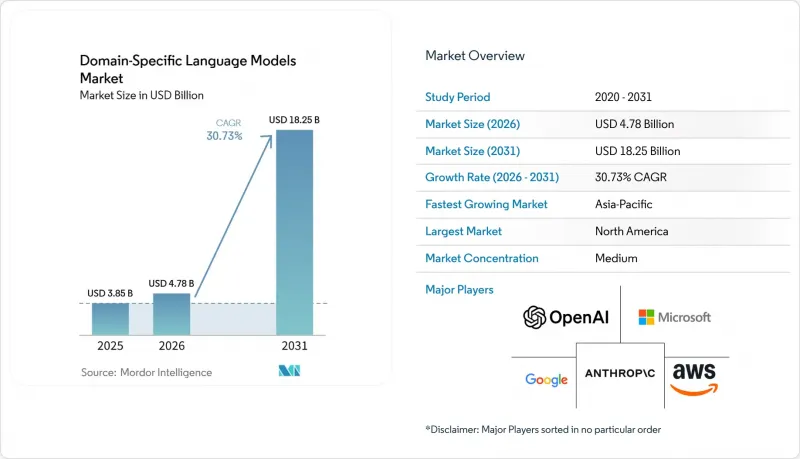
Mordor Intelligence에 의하면, 도메인 특화 언어 모델 시장 규모는 2025년에 38억 5,000만 달러로 평가되었고, 2026년 47억 8,000만 달러에서 2031년까지 182억 5,000만 달러에 이를 것으로 추정되며, 예측 기간(2026-2031년) CAGR은 30.73%를 나타낼 전망입니다.
본 보고서는 제공 방식별(프레임워크 및 서비스), 배포 방식별(클라우드 및 온프레미스), 용도별(챗봇 및 가상 비서, 코드 생성 및 검토, 컨텐츠 및 미디어 생성, 고객 서비스 자동화, 언어 번역 및 현지화 등), 그리고 지역별로 분류되어 있습니다. 시장 예측은 금액(달러) 기준으로 제시되어 있습니다.
세계의 도메인 특화 언어 모델 시장 동향 및 인사이트
도메인 특화 정확도에 대한 기업 수요로 인해 시범 운영에서 본격 운영으로 전환
2025년, 금융 서비스, 의료, 법무 각 분야에서 도입이 시범 단계에서 본격 운영으로 전환됨에 따라, 도메인 특화 언어 모델 시장에서 기업의 채택이 가속화되었습니다. 규제 당국의 심사 하에서 정확도가 유지되어야 하고, 도메인 고유의 용어를 대략적으로 다룰 수 없는 엄격하게 정의된 워크플로우에서는 성능 차이가 더욱 뚜렷하게 나타납니다. 2026년에 더 많은 기업이 프레임워크, 데이터셋, 평가 루틴을 표준화함에 따라 초기 본격적인 도입은 전환 비용을 발생시키며, 이는 도메인 특화 언어 모델 시장에서 고객의 장기적인 정착을 뒷받침하고 있습니다.
모델의 추적 가능성에 대한 규제 압력으로 인해 AI 조달 기준이 재구성되고 있습니다.
규제적 압력으로 인해, 특히 금융 서비스, 헬스케어 및 기타 감독 대상 환경에서 추적 가능성은 도메인 특화 언어 모델 시장의 필수 구매 조건으로 자리 잡고 있습니다. 구매자들은 현재 관리된 데이터셋, 감사 가능한 출력, 그리고 훈련 관련 문서를 더욱 중요하게 여기고 있습니다. 이러한 기능 덕분에 내부 검토나 외부 규정 준수 점검에 필요한 노력이 줄어들기 때문입니다. IEEE IJCNN 2025에서 발표된 연구에 따르면, 도메인 특화 모델은 문서 규정 준수 점검에서 GPT-4나 Mistral-7B를 능가하는 성능을 보여주며, 규제 대상 작업을 위한 전용 아키텍처의 필요성을 뒷받침하고 있습니다. Aveni사의 FinLLM 제품군은 각 벤더가 FCA, PRA, EU AI법과 관련된 규제를 포함하여 금융 규제 요건에 제품을 부합시키고 있는 실제 사례이기도 합니다. 이로 인해 도메인 특화 언어 모델 시장의 조달 동향에 변화가 생기고 있습니다. 선정 기준이 모델의 광범위한 인기에 의존하는 비중이 줄어들고, 출력 결과의 관리·문서화·검토가 가능하다는 증거가 더욱 중요하게 여겨지게 되었기 때문입니다. 이러한 기능을 사전에 제시할 수 있는 벤더는 도메인 특화 언어 모델 시장에서 새로운 기업용 프로젝트를 수주하는 데 유리한 입장에 있습니다.
고품질 도메인 데이터 확보 비용이 개발 일정을 압박
개인정보 보호, 기밀성 및 법적 이용 제한으로 인해 수집 및 재사용 가능한 데이터가 제한되기 때문에 고품질 도메인 데이터에 대한 접근은 여전히 도메인 특화 언어 모델 시장의 주요 제약 요인으로 남아 있습니다. 의료 기관은 환자 기록을 자유롭게 공유할 수 없고, 금융 기관은 엄격한 비밀 유지 의무에 직면해 있으며, 법률 사무소는 모델 학습에 활용하기 어려운 기밀 정보 파일을 보유하고 있습니다. 노무라 종합연구소는 개인정보 보호 제약으로 인해 실제 대화 데이터를 수집하기 어려웠기 때문에 보험 규정 준수 업무에서 합성 데이터를 활용하여 이 과제를 해결했습니다. 하지만 합성 데이터라 하더라도 실제 운영 환경 수준의 튜닝에 활용하려면 전문 지식, 엄격한 검증 규칙, 그리고 세심한 검토가 여전히 필요합니다. 이로 인해 성숙한 데이터 엔지니어링 팀이나 규정 준수를 준수하는 데이터 파이프라인에 대한 접근 권한이 없는 도메인 특화 언어 모델 시장의 소규모 조직에게는 비용과 리드 타임이 증가하게 됩니다. 그 결과, 유사한 요구 사항을 가지고 있지만 사내 자원이 부족한 기업에 비해 대기업이나 인프라 관련 제공업체가 시장에서 더 신속하게 움직일 수 있게 되었습니다.
부문 분석
2025년, 프레임워크는 도메인 특화 언어 모델 시장에서 57.74%의 점유율을 차지했습니다. 이는 대부분의 기업 프로그램이 여전히 모델 구축, 튜닝, 평가, 거버넌스에 필요한 핵심 기반에서 시작되고 있다는 사실을 반영합니다. 이러한 기반 속에서 범용 언어 모델 프레임워크는 많은 경우 출발점 역할을 하는 반면, 도메인 특화형 프레임워크는 독자적인 코퍼스, 작업별 구조 및 전문적인 평가 로직을 통합함으로써 더 높은 부가가치를 창출하는 역할을 담당하고 있습니다. 이러한 구분이 도메인 특화 언어 모델 시장에서 중요한 이유는 기업이 단순한 실험이 아닌 규제 대상인 비즈니스 고유 작업에서 재현 가능한 성과를 필요로 하게 되면 가치가 상위 단계로 이동하기 때문입니다. 관리된 훈련 자산, 주석 기법 및 내부 벤치마크를 축적하는 프레임워크 공급업체는 시간이 지남에 따라 도메인 특화 언어 모델 시장에서 더욱 견고한 전환 장벽을 구축하는 경향을 보입니다.
도메인 특화 언어 모델 시장에서 서비스 규모는 2031년까지 연평균 성장률(CAGR) 29.12%로 확대될 것으로 예측됩니다. 이는 구매자들이 단순히 개별 모델에 대한 접근 권한이 아닌, 실질적인 도입 지원을 요구하기 때문입니다. 컨설팅 및 시스템 통합은 여전히 중요한데, 그 이유는 대부분의 기업이 여전히 도메인 모델을 내부 프로세스,데이터 자산, 검토 단계 및 정책 관리와 연계하기 위한 지원이 필요하기 때문입니다. 조직은 업무 진행 방식을 이미 정의해 둔 내부 용어, 규제 용어, 출력 형식에 맞추어 모델의 동작을 조정하기를 원하기 때문에 미세 조정과 맞춤화가 가장 높은 부가가치를 지닌 서비스 계층을 형성하고 있습니다. 또한 가중치, 프롬프트, 로그를 승인된 환경 내에 보관할 수 있는 인프라 옵션을 찾는 기업이 늘어나면서, 관리형 추론 및 호스팅의 중요성도 높아지고 있습니다. 이로 인해 도메인 특화 언어 모델 업계의 서비스 부문은 사내에서 모델 운영 스택을 완전히 구축하지 않고도 프로덕션 환경에 배포하고자 하는 기업들에게 특히 중요한 존재가 되고 있습니다.
지역별 분석
2025년, 북미는 41.55%의 점유율을 차지하며 도메인 특화 언어 모델 시장에서 가장 규모가 큰 지역 시장이 되었습니다. 이 지역은 금융 서비스, 헬스케어, 법률 기술, 기업 소프트웨어 분야의 성숙한 고객 기반은 물론, 하이퍼스케일러가 제공하는 탄탄한 인프라와 수많은 AI 스타트업의 존재라는 이점을 누리고 있습니다. 이러한 조건 덕분에 북미는 프로덕션 환경으로의 배포에 있어 가장 확고한 기반을 갖춘 지역이 되었습니다. 이는 기업이 도구, 컴퓨팅 리소스, 규정 준수 서비스, 통합 파트너를 한 곳에서 이용할 수 있기 때문입니다. 또한, 많은 대형 구매 기업이 이미 클라우드 계약, 보안 거버넌스 팀, 그리고 도입 기간을 단축하는 사내 데이터 프로그램을 보유하고 있기 때문에 이 지역은 도메인 특화 언어 모델 시장에서 계속해서 중요한 위치를 차지하고 있습니다. 이러한 조합 덕분에 일부 워크로드가 관리가 철저한 프라이빗 환경이나 온프레미스 환경으로 이전되고 있는 상황에서도 꾸준한 확장이 뒷받침되고 있습니다.
아시아태평양은 2031년까지 연평균 성장률(CAGR) 30.98%로 확대될 것으로 예측되며, 도메인 특화 언어 모델 시장에서 가장 빠르게 성장하는 지역이 될 전망입니다. 이러한 성장은 각국이 주도하는 AI 이니셔티브, 현지 언어에 대한 강력한 수요, 그리고 많은 기성 서유럽 모델이 제공할 수 있는 범위를 뛰어넘는 적응성을 필요로 하는 기업의 이용 사례와 밀접한 관련이 있습니다. NTT는 2026년 5월, ‘tsuzumi 2’를 업데이트하며 일본어 비즈니스 문서 처리 및 기밀성이 높은 기업 환경에 적합한 도입 모드에 대한 지속적인 제품 투자를 보여주었습니다. 또한 Stockmark도 2026년 4월 ‘AI foundation’이라는 제목의 문서를 공개하여, 실용적인 도입에 최적화하는 동시에 기업의 문서 워크플로우를 둘러싼 활발한 현지 개발을 반영하고 있습니다. 중국에서는 CNPC의 ‘Kunlun’ 도메인 모델이 2026년 5월까지 152개의 용도 시나리오로 확장되었으며, 석유 및 가스 탐사, 정유시설 운영, 자본 금융에 걸쳐 7개 언어를 지원합니다. 이러한 동향은 아시아태평양의 도메인 특화 언어 모델 시장이 단순히 수입된 범용 도구뿐만 아니라, 업계 고유의 이용 사례와 언어 요구 사항에 의해 형성되고 있음을 보여줍니다.
유럽, 남미, 중동 및 아프리카는 도메인 특화 언어 모델 시장의 다음 수요층을 형성하고 있지만, 각각 서로 다른 도입 경로를 따르고 있습니다. 유럽에서는 AI 규정 준수 의무와 데이터 레지던시 요건이 시장을 형성하고 있으며, 이러한 요인들이 주권형 인프라에 대한 투자와 보다 통제된 기업 도입 방안을 뒷받침하고 있습니다. 도이치 텔레콤은 2026년 3월, 자사의 ‘T-Systems Industrial AI Cloud’가 주권형 LLM ‘SOOFI’의 훈련을 위해 1만 대의 GPU를 가동하고 있다고 발표하며, 해당 지역 내 인프라 구축 노력의 규모를 부각시켰습니다. 또한, 코히어(Cohere)와 알레프 알파(Aleph Alpha)도 2026년 4월, 엄격한 데이터 관리 요건을 가진 기업 및 정부를 위한 주권형 AI 플랫폼을 구축하기 위해 합병을 발표했습니다. 중동 및 아프리카에서는 주권 AI와 아랍어 지원 도입이 기관 차원에서 조기에 진행되고 있는 반면, 남미는 도입 주기의 초기 단계에 있지만 브라질이 금융 서비스 및 애그리테크 분야에서 선도적인 노력을 주도하고 있습니다. 이러한 지역들이 결합되어 도메인 특화 언어 모델 시장을 초기 핵심 영역을 넘어 확장시키는 동시에, 규제, 언어 및 컴퓨팅 리소스에 대한 접근성이 지역별로 각기 다른 방식으로 발전 궤적을 형성하고 있음을 보여줍니다.
기타 혜택 :
- 엑셀 형식 시장 예측(ME) 시트
- 3개월간의 애널리스트 지원
자주 묻는 질문
목차
제1장 서론
제2장 조사 방법
제3장 주요 요약
제4장 시장 구도
제5장 시장 규모 및 성장 예측
제6장 경쟁 구도
제7장 시장 기회 및 향후 전망
AJY 26.09.03According to Mordor Intelligence, the domain-Specific language models market size was valued at USD 3.85 billion in 2025 and is estimated to grow from USD 4.78 billion in 2026 to reach USD 18.25 billion by 2031, at a CAGR of 30.73% during the forecast period (2026-2031).
This report is Segmented by Offering (Frameworks and Services), Deployment (Cloud and On-Premise), Application (Chatbots and Virtual Assistants, Code Generation and Review, Content and Media Generation, Customer Service Automation, Language Translation and Localization, and More), and Geography. The Market Forecasts are in Terms of Value (USD).
Global Domain-Specific Language Models Market Trends and Insights
Enterprise Demand For Domain-Tuned Accuracy Converts Pilots to Production
Enterprise adoption in the domain-specific language models market accelerated in 2025 as deployments moved out of pilot mode and into production across financial services, healthcare, and legal work. The performance gap is clearer in tightly defined workflows where accuracy must hold under regulatory review, and domain-specific terminology cannot be handled loosely. As more enterprises standardize their frameworks, datasets, and evaluation routines in 2026, early production deployments are creating switching costs that support longer customer retention in the domain-specific language models market.
Regulatory Pressure For Model Traceability Reshapes AI Procurement Criteria
Regulatory pressure is driving traceability to become a required purchase condition in the domain-specific language models market, especially in financial services, healthcare, and other supervised environments. Buyers now place more value on controlled datasets, auditable outputs, and training documentation because these features reduce the effort needed for internal review and external compliance checks. Research presented at IEEE IJCNN 2025 found that domain-tuned models outperformed GPT-4 and Mistral-7B in documentation compliance checks, supporting the case for specialized architectures for regulated tasks. Aveni's FinLLM suite also illustrates how vendors are aligning products with financial regulatory expectations, including those tied to the FCA, PRA, and the EU AI Act. This is changing procurement in the domain-specific language models market because qualification now depends less on broad model popularity and more on evidence that outputs can be controlled, documented, and reviewed. Vendors that can show those features up front are better positioned to win new enterprise programs in the domain-specific language models market.
High-Quality Domain Data Acquisition Cost Pressures Development Timelines
Access to high-quality domain data remains a major restraint in the domain-specific language models market, as privacy, confidentiality, and legal-use restrictions limit what can be collected and reused. Healthcare providers cannot freely pool patient records, financial institutions face strict confidentiality duties, and legal firms hold privileged matter files that are difficult to repurpose for model training. Nomura Research Institute addressed this challenge in insurance compliance work by using synthetic data, as real conversational material was difficult to collect within privacy constraints. Even so, synthetic data still requires subject-matter expertise, strong validation rules, and careful review before it can support production-grade tuning. This raises costs and lead times for smaller organizations in the domain-specific language models market that lack mature data engineering teams or access to compliant data pipelines. The result is a market where larger enterprises and infrastructure-adjacent providers can move faster than firms with similar needs but weaker internal resources.
Other drivers and restraints analyzed in the detailed report include:
- Rising Retrieval-Augmented Fine-Tuning Extends Domain Precision In Regulated Workflows
- Cost Compression Through Smaller, Specialized Models Changes The Build-Versus-Buy Calculus
- Evaluation Difficulty and Hallucination Risk Limit Adoption in Mission-Critical Applications
For complete list of drivers and restraints, kindly check the Table Of Contents.
Segment Analysis
Frameworks held a 57.74% share of the domain-specific language models market in 2025, reflecting the fact that most enterprise programs still start with the core scaffolding needed to build, tune, evaluate, and govern models. Within that base, general-purpose language model frameworks often serve as the starting layer, while domain-specific frameworks play a higher-value role by integrating proprietary corpora, task-specific structures, and specialized evaluation logic. That distinction matters in the domain-specific language models market because value shifts upward once enterprises need repeatable performance in regulated, business-specific tasks rather than simple experimentation. Framework vendors that accumulate controlled training assets, annotation methods, and internal benchmarks tend to build stronger switching barriers over time in the domain-specific language models market.
Services are projected to expand at 29.12% CAGR through 2031 in the domain-specific language models market as buyers seek practical deployment support rather than isolated model access. Consulting and systems integration remain important because most enterprises still need help connecting domain models to internal processes, data estates, review layers, and policy controls. Fine-tuning and customization form the highest-value service layer because organizations want model behavior aligned with internal vocabulary, regulatory language, and output formats that already define how work gets done. Managed inference and hosting are also gaining importance as more enterprises require infrastructure choices that keep weights, prompts, and logs inside approved environments. This makes the services side of the domain-specific language models industry especially relevant for firms that want to deploy to production without building a full in-house model operations stack.
Complete Report Scope:
- By offering
- Frameworks (Including General-Purpose and Domain-Specific Language Model Frameworks)
- Services (Including Consulting and Systems Integration, Fine-Tuning and Customization, Managed Inference and Hosting)
- By Deployment
- Cloud
- On-Premise
- By Application
- Chatbots and Virtual Assistants
- Code Generation and Review
- Content and Media Generation
- Customer Service Automation
- Language Translation and Localization
- Other Applications
- By Geography
- North America
- United States
- Canada
- South America
- Brazil
- Rest of South America
- Europe
- Germany
- United Kingdom
- France
- Italy
- Spain
- Rest of Europe
- Asia-Pacific
- China
- India
- Japan
- South Korea
- Australia
- Rest of Asia-Pacific
- Middle East and Africa
- Middle East
- United Arab Emirates
- Saudi Arabia
- Turkey
- Rest of Middle East
- Africa
- South Africa
- Rest of Africa
- Middle East
- North America
Geography Analysis
North America held a 41.55% share in 2025, making it the largest regional market for domain-specific language models. The region benefits from a mature buyer base in financial services, healthcare, legal technology, and enterprise software, along with deep hyperscaler infrastructure and a broad pool of AI startups. These conditions make North America the most established environment for production deployment because enterprises can access tooling, compute, compliance services, and integration partners in one place. The region also remains important in the domain-specific language models market because many large buyers already have cloud contracts, security governance teams, and internal data programs that shorten deployment time. That combination supports steady scaling even as some workloads shift toward more controlled private and on-premises setups.
Asia-Pacific is projected to expand at 30.98% CAGR through 2031, making it the fastest-growing region in the domain-specific language models market. Growth is tied to sovereign AI efforts, strong local-language demand, and enterprise use cases that require better adaptation than many off-the-shelf Western models can provide. NTT's May 2026 update to tsuzumi 2 showed continued product investment in Japanese business document handling and in deployment modes suited to sensitive enterprise environments. Stockmark also released a document titled "AI foundation" in April 2026, optimized for practical deployment and reflecting active local development around enterprise document workflows. In China, CNPC's Kunlun domain model had been deployed across 152 application scenarios by May 2026, spanning oil and gas exploration, refinery operations, and capital finance, with multilingual support across 7 languages. These developments show that the domain-specific language models market in Asia-Pacific is being shaped by sector-specific use cases and language requirements rather than by imported generic tooling alone.
Europe, South America, the Middle East, and Africa form the next layer of demand in the domain-specific language models market, though each follows a different adoption path. Europe is being shaped by AI compliance obligations and data residency needs, which are encouraging investment in sovereign infrastructure and more controlled enterprise deployment choices. Deutsche Telekom stated in March 2026 that its T-Systems Industrial AI Cloud was operating 10,000 GPUs to train the SOOFI sovereign LLM, underscoring the scale of regional infrastructure commitments. Cohere and Aleph Alpha also announced a merger in April 2026 to build a sovereign AI platform for enterprises and governments with strict data control requirements. The Middle East and Africa are seeing early institutional adoption of sovereign AI and Arabic-language deployments, while South America is earlier in its cycle, with Brazil leading initial activity in financial services and agri-tech. Together, these regions broaden the domain-specific language models market beyond the early core and show that regulation, language, and compute access are shaping regional trajectories in different ways.
- OpenAI, LLC
- Microsoft Corporation
- Google LLC
- Amazon Web Services, Inc.
- Anthropic PBC
- Meta Platforms, Inc.
- IBM Corporation
- NVIDIA Corporation
- Alibaba Cloud (Alibaba Group Holding Limited)
- Baidu, Inc.
- Tencent Holdings Limited
- Huawei Technologies Co., Ltd.
- Cohere Inc.
- AI21 Labs Ltd.
- Mistral AI SAS
- Databricks, Inc.
- Writer, Inc.
- Abridge AI, Inc.
- Harvey AI, Inc.
- Salesforce, Inc.
Additional Benefits:
- The market estimate (ME) sheet in Excel format
- 3 months of analyst support
TABLE OF CONTENTS
1 INTRODUCTION
- 1.1 Study Assumptions and Market Definition
- 1.2 Scope of the Study
2 RESEARCH METHODOLOGY
3 EXECUTIVE SUMMARY
4 MARKET LANDSCAPE
- 4.1 Market Overview
- 4.2 Market Drivers
- 4.2.1 Enterprise Demand for Domain-Tuned Accuracy
- 4.2.2 Regulatory Pressure for Model Traceability and Controlled Outputs
- 4.2.3 Rising Retrieval-Augmented Fine-Tuning in Regulated Workflows
- 4.2.4 Cost Compression Through Smaller, Specialized Models
- 4.2.5 Sovereign AI Procurement and Local Data Residency Mandates
- 4.2.6 Vertical SaaS Embedding of Domain-Specific Models
- 4.3 Market Restraints
- 4.3.1 High-Quality Domain Data Acquisition Cost
- 4.3.2 Evaluation Difficulty and Hallucination Risk in Mission-Critical Use
- 4.3.3 Restricted Talent Pool for Domain Fine-Tuning and Model Ops
- 4.3.4 Fragmented Compliance Across Borders
- 4.4 Industry Value Chain Analysis
- 4.5 Technological Outlook
- 4.6 Regulatory Landscape
- 4.7 Porter's Five Forces Analysis
- 4.7.1 Bargaining Power of Suppliers
- 4.7.2 Bargaining Power of Buyers
- 4.7.3 Threat of New Entrants
- 4.7.4 Threat of Substitutes
- 4.7.5 Competitive Rivalry
- 4.8 Impact of Macroeconomic Factors on the Market
5 MARKET SIZE AND GROWTH FORECASTS (VALUE)
- 5.1 By offering
- 5.1.1 Frameworks (Including General-Purpose and Domain-Specific Language Model Frameworks)
- 5.1.2 Services (Including Consulting and Systems Integration, Fine-Tuning and Customization, Managed Inference and Hosting)
- 5.2 By Deployment
- 5.2.1 Cloud
- 5.2.2 On-Premise
- 5.3 By Application
- 5.3.1 Chatbots and Virtual Assistants
- 5.3.2 Code Generation and Review
- 5.3.3 Content and Media Generation
- 5.3.4 Customer Service Automation
- 5.3.5 Language Translation and Localization
- 5.3.6 Other Applications
- 5.4 By Geography
- 5.4.1 North America
- 5.4.1.1 United States
- 5.4.1.2 Canada
- 5.4.2 South America
- 5.4.2.1 Brazil
- 5.4.2.2 Rest of South America
- 5.4.3 Europe
- 5.4.3.1 Germany
- 5.4.3.2 United Kingdom
- 5.4.3.3 France
- 5.4.3.4 Italy
- 5.4.3.5 Spain
- 5.4.3.6 Rest of Europe
- 5.4.4 Asia-Pacific
- 5.4.4.1 China
- 5.4.4.2 India
- 5.4.4.3 Japan
- 5.4.4.4 South Korea
- 5.4.4.5 Australia
- 5.4.4.6 Rest of Asia-Pacific
- 5.4.5 Middle East and Africa
- 5.4.5.1 Middle East
- 5.4.5.1.1 United Arab Emirates
- 5.4.5.1.2 Saudi Arabia
- 5.4.5.1.3 Turkey
- 5.4.5.1.4 Rest of Middle East
- 5.4.5.2 Africa
- 5.4.5.2.1 South Africa
- 5.4.5.2.2 Rest of Africa
- 5.4.5.1 Middle East
- 5.4.1 North America
6 COMPETITIVE LANDSCAPE
- 6.1 Market Concentration
- 6.2 Strategic Moves
- 6.3 Market Share Analysis
- 6.4 Company Profiles (includes Global Level Overview, Market Level Overview, Core Segments, Financials as available, Strategic Information, Market Rank/Share, Products and Services, Recent Developments)
- 6.4.1 OpenAI, LLC
- 6.4.2 Microsoft Corporation
- 6.4.3 Google LLC
- 6.4.4 Amazon Web Services, Inc.
- 6.4.5 Anthropic PBC
- 6.4.6 Meta Platforms, Inc.
- 6.4.7 IBM Corporation
- 6.4.8 NVIDIA Corporation
- 6.4.9 Alibaba Cloud (Alibaba Group Holding Limited)
- 6.4.10 Baidu, Inc.
- 6.4.11 Tencent Holdings Limited
- 6.4.12 Huawei Technologies Co., Ltd.
- 6.4.13 Cohere Inc.
- 6.4.14 AI21 Labs Ltd.
- 6.4.15 Mistral AI SAS
- 6.4.16 Databricks, Inc.
- 6.4.17 Writer, Inc.
- 6.4.18 Abridge AI, Inc.
- 6.4.19 Harvey AI, Inc.
- 6.4.20 Salesforce, Inc.
7 MARKET OPPORTUNITIES AND FUTURE OUTLOOK
- 7.1 White-Space and Unmet-Need Assessment


