

|
시장보고서
상품코드
2118046
마케팅 클라우드 시장 : 점유율 분석, 업계 동향과 통계, 성장 예측(2026-2031년)Marketing Cloud - Market Share Analysis, Industry Trends & Statistics, Growth Forecasts (2026 - 2031) |
||||||
 Mordor Intelligence
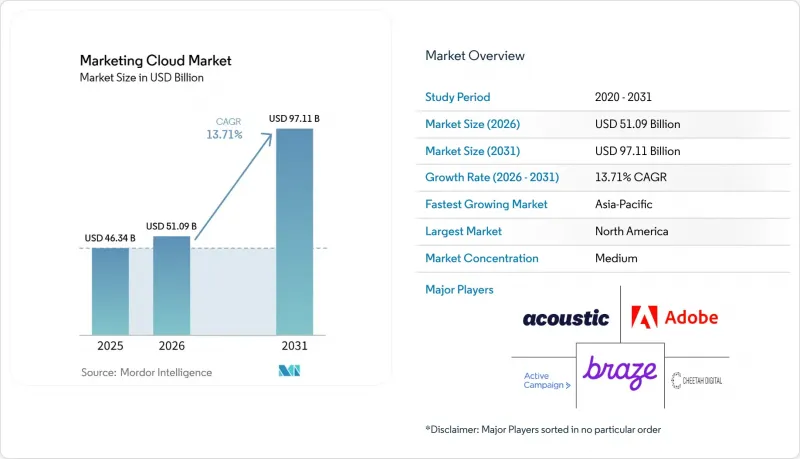
Mordor Intelligence에 의하면, 마케팅 클라우드 시장 규모는 2025년에 463억 4,000만 달러, 2026년에 510억 9,000만 달러가 되고, 2026년부터 2031년까지 CAGR 13.71%로 성장을 지속하여, 2031년까지 971억 1,000만 달러에 이를 것으로 예측됩니다.
본 보고서는 구성 요소(플랫폼 및 서비스), 도입 형태(퍼블릭 클라우드, 하이브리드 클라우드, 프라이빗 클라우드), 조직 규모(대기업 및 중소기업), 마케팅 기능(광고·브랜딩 등), 최종 사용자 산업(은행, 금융서비스 및 보험(BFSI), IT 및 통신 등), 그리고 지역별로 분류되어 있습니다. 시장 예측은 금액(달러) 기준으로 제시되어 있습니다.
세계 마케팅 클라우드 시장 동향 및 인사이트
AI를 활용한 캠페인 오케스트레이션 및 컨텐츠 생성
생성형 AI는 시범 운영 단계에서 기업의 전체 마케팅 스택 전반에 걸친 일상적인 활용 단계로 전환되고 있습니다. 세일즈포스는 2026년 6월에 ‘Agentforce Marketing’을 출시했습니다. 이 플랫폼을 통해 AI 에이전트가 잠재 고객을 식별하고, 옴니채널 컨텐츠를 생성하며, 매출 목표에 맞추어 캠페인을 최적화할 수 있습니다. 세일즈포스에 따르면, 초기 도입 기업인 롤링스(Rollings)는 도입 후 캠페인 제작 시간이 75% 단축되었다고 보고했으며, 이는 자동화가 실행 속도에 측정 가능한 영향을 미치기 시작했음을 보여줍니다. 이러한 변화로 인해 오케스트레이션 및 반복적인 제작 업무가 수작업 워크플로우에서 해방됨에 따라, 팀의 업무 배분 방식도 변화하게 됩니다. 마케팅 클라우드 시장 전체에서 이러한 기능을 조기에 도입한 벤더는 대응이 느린 경쟁사에 비해 데이터 및 워크플로우 측면에서 더욱 견고한 우위를 확보할 가능성이 높습니다. 또한, EU AI법에 따라 플랫폼 제공업체는 유럽 내 고객을 대상으로 한 자동화된 의사 결정에 대해 투명성을 확보하기 위한 관리 기능을 추가해야 합니다.
전체 고객 여정에서 실시간 개인화에 대한 수요 증가
실시간 개인화는 더 이상 차별화 요소라기보다는 고객의 기본적인 기대치로 자리 잡아가고 있습니다. 세일즈포스에 따르면, AI를 활용한 개인화된 추천 및 대화형 에이전트가 2025년 연말 연시 시즌 전 세계 소매 주문의 20%를 주도하며 2,620억 달러의 매출을 창출했다고 합니다. 또한 세일즈포스의 보고서에 따르면, 마케터의 86%가 “AI가 고객 참여를 변화시켰습니다”고 응답했으며, 78%는 “필요한 개인화된 컨텐츠의 양이 인간 팀만으로는 생산할 수 있는 범위를 넘어섰다”고 밝혔습니다. 클라비요(Claviyo)에 따르면, 이 회사의 플랫폼은 2026년 초 80억 건 이상의 고객 프로파일에 걸쳐 하루 34억 건의 고객 상호작용을 처리하고 있으며, 이는 대규모 개인화에 현재 필요한 인프라의 깊이를 보여줍니다. 실제로 지출은 행동 데이터, 거래 데이터, 동의 데이터를 단일 운영 계층으로 통합하는 통합된 고객 프로파일로 이동하고 있습니다. 마케팅 클라우드 시장은 이러한 변화의 혜택을 누리고 있습니다. 왜냐하면 이러한 데이터 흐름을 원활하게 연계하는 플랫폼은 채널 전반에 걸쳐 더 신속하고 관련성 높은 고객 의사 결정을 지원할 수 있기 때문입니다.
CRM, CDP, 커머스, 데이터 레이크에 걸친 통합의 복잡성
통합의 복잡성은 마케팅 클라우드 시장 전반에 걸친 광범위한 도입에 있어 여전히 가장 중요한 제약 요인으로 남아 있습니다. 현재 기업의 시스템 스택에서는 서로 다른 벤더의 CRM 시스템, CDP, 커머스 플랫폼, 데이터 레이크를 조합하는 것이 일반화되어 있으며, 계층이 추가될 때마다 ID 매칭, 워크플로우 설계, 데이터 마이그레이션에 필요한 노력이 증가합니다. 기업이 AI 도구를 도입하면 이 문제는 더욱 두드러집니다. 왜냐하면 이러한 시스템에는 기존 레거시 스택이 제공할 수 있는 것보다 더 깔끔하고 빠른 데이터 연결이 필요하기 때문입니다. 그 결과, 팀은 커넥터 유지보수에 많은 시간을 할애하게 되어 캠페인, 분석, 고객 프로그램 개선에 할애할 시간이 줄어들게 됩니다. 각 벤더는 네이티브 통합이나 인수 활동을 통해 이러한 부담을 줄이려고 노력하고 있으며, 그 일례로 세일즈포스가 2026년 6월에 Contentful과 합의에 도달한 것을 들 수 있습니다. 하지만 이기종 환경에서는 새로운 기능이 추가될 때마다 호환성 문제가 발생할 가능성이 있기 때문에 이러한 제약은 여전히 큰 과제로 남아 있습니다.
부문 분석
2025년 시점에서 플랫폼은 마케팅 클라우드 시장의 81.46% 점유율을 차지했으나, 서비스 부문은 2031년까지 연평균 성장률(CAGR) 15.68%를 나타낼 것으로 예측됩니다. 이러한 차이는 이 부문이 여전히 가치 창출 및 계정 관리 측면에서 핵심 소프트웨어 플랫폼에 얼마나 크게 의존하고 있는지를 보여줍니다. 또한, 이미 플랫폼 라이선스를 취득한 구매자들이 도입, 최적화 및 관리형 지원에 더 많은 비용을 지출하고 있다는 점은 도입 기반이 성숙해지고 있음을 시사합니다. 마케팅 클라우드 업계에서 기업들이 사내 팀의 부담을 지나치게 늘리지 않으면서 AI 에이전트, 라이프사이클 자동화 및 연동된 데이터 파이프라인을 운영화하려고 시도함에 따라 서비스에 대한 수요가 증가하고 있습니다.
관리형 서비스는 대규모 사내 운영 체제를 구축하지 않고도 고급 기능을 원하는 중견 기업의 구매자에게 특히 중요합니다. 또한, 엔터프라이즈급 도입의 경우 기대되는 효과가 나타나기 전에 워크플로우 재설계, 데이터 준비, 거버넌스 설정이 필요한 경우가 많기 때문에 전문 서비스도 여전히 중요한 역할을 하고 있습니다. 어도비는 2025 회계연도 매출을 237억 7,000만 달러로 보고했으며, 크리에이티브 및 마케팅 전문가를 위한 구독 매출은 전년 대비 11% 증가했습니다. 이는 대규모 소프트웨어 생태계가 관련 서비스 수요를 어느 정도 규모로 뒷받침할 수 있는지를 반영하고 있습니다. 마케팅 클라우드 업계에서 이로 인해 플랫폼이 경제적 기반으로서의 역할을 수행하는 한편, 도입이 복잡해짐에 따라 실행 부담의 일부를 서비스가 점점 더 떠안게 되고 있습니다.
2025년에는 퍼블릭 클라우드를 통한 도입이 매출의 68.92%를 차지하며, 2031년까지 연평균 성장률(CAGR) 14.91%를 나타낼 것으로 전망됩니다. 이러한 이중적인 주도적 역할은 클라우드가 더 이상 신규 도입 시 단순한 권장 모델에 그치지 않고, 마케팅 클라우드 시장의 운영 표준이 되었음을 보여줍니다. 구매자가 클라우드를 선호하는 이유는 업데이트가 신속하고, API에 대한 접근이 용이하며, 대량의 데이터를 다루는 개인화 이용 사례에서 뛰어난 확장성을 갖추고 있기 때문입니다. 이러한 추세로 인해 AI 릴리스 주기나 실시간 처리 요구를 충분히 충족하지 못하는 기존 On-Premise 아키텍처의 매력도 떨어지고 있습니다.
프라이빗 클라우드는 데이터 처리 관리나 내부 거버넌스가 여전히 구매 기준을 좌우하는 규제 환경에서 그 역할을 유지하고 있습니다. 또한, 전환 기간 동안 기밀성이 높은 기록을 레거시 환경에 남겨두면서 캠페인과 분석 계층을 현대화하고자 하는 기업에게는 하이브리드 모델도 여전히 유효합니다. 세일즈포스의 Contentful 인수 계획은 컨텐츠와 오케스트레이션을 더욱 긴밀하게 연결하는 ‘클라우드 퍼스트’이자 ‘컴포저블’한 운영 모델로의 광범위한 전환을 뒷받침하는 것입니다. 마케팅 클라우드 시장 전체에서 주요 분기점은 더 이상 조직이 클라우드를 도입할지 여부가 아니라, 보안, 규정 준수 또는 기존 운영에 지장을 주지 않으면서 중요한 워크플로우를 얼마나 신속하게 클라우드로 전환할 수 있는지에 있습니다.
지역별 분석
2025년, 북미는 매출의 40.27%를 차지하며 마케팅 클라우드 시장 전체에서 1위를 유지했습니다. 세일즈포스는 2025 회계연도 마케팅 및 커머스 클라우드 매출을 52억 8,100만 달러로 보고했으며, 이는 해당 지역의 엔터프라이즈 플랫폼 관련 지출 규모를 반영한 것입니다. 이 지역은 벤더의 집중, 성숙한 디지털 인프라, 그리고 통합을 많이 활용하는 도입을 뒷받침할 수 있는 기업의 예산과 같은 이점을 누리고 있습니다. 유럽은 여전히 주요 수요 거점이며, 독일, 영국, 프랑스가 이 지역 활동의 대부분을 뒷받침하고 있습니다. EU AI법에 따라 고객을 위한 자동화 시스템에 대한 거버넌스와 투명성이 더욱 요구되고 있어, AI 기능과 보다 명확한 규정 준수 관리를 결합할 수 있는 플랫폼이 선호되고 있습니다.
아시아태평양은 2031년까지 연평균 성장률(CAGR) 18.92%를 나타낼 것으로 예측되며, 마케팅 클라우드 시장에서 가장 빠르게 성장하는 지역 부문이 될 것입니다. 이 성장률은 몇몇 주요 시장의 현재 보급률이 상대적으로 낮다는 점과 중소기업의 클라우드 도입 전환이 가속화되고 있음을 반영합니다. Klaviyo사의 보고서에 따르면, 2026년 1분기 북미 및 남미 이외 지역의 매출은 39% 증가했으며, 영국을 제외한 EMEA 지역에서는 전년 동기 대비 51% 증가를 기록했습니다. 이는 최신 고객 참여 플랫폼을 둘러싼 국제적인 수요 증가가 광범위하게 진행되고 있음을 시사합니다. 중국은 여전히 규모 면에서 가장 규모가 큰 지역 시장이지만, 인도와 동남아시아에서는 특히 중소기업을 중심으로 도입세가 더욱 강해지고 있습니다. 또한 호주에서는 실시간 개인화 및 거버넌스 기능이 더 높은 전략적 가치를 지닌 은행·보험 업계에 막대한 예산이 투입되고 있습니다.
남미는 마케팅 클라우드 시장에서 여전히 비교적 작은 비중을 차지하고 있지만, 해당 지역의 디지털 마케팅 역량 확대에 따라 그 중요성은 계속해서 높아지고 있습니다. 브라질은 가장 큰 기업 기반과 가장 활발한 기술 지출을 모두 갖추고 있어, 계속해서 이 지역의 주요 수요 중심지로 자리 잡고 있습니다. 중동 및 아프리카에서는 걸프 국가들이 디지털 다각화에 적극적으로 투자하고 있는 반면, 사하라 이남 시장에서는 도입이 아직 초기 단계에 머물러 있는 등 양극화된 경향이 나타나고 있습니다. 이러한 지역들은 북미나 유럽과 같은 성숙한 시장을 넘어 성장을 목표로 하는 벤더들에게 확장의 여지를 제공합니다.
기타 혜택:
- 엑셀 형식 시장 전망(ME) 시트
- 3개월간의 애널리스트 지원
자주 묻는 질문
목차
제1장 서론
제2장 조사 방법
제3장 개요
제4장 시장 구도
제5장 시장 규모와 성장 예측
제6장 경쟁 구도
제7장 시장 기회와 향후 전망
JHS 26.09.01According to Mordor Intelligence, the marketing cloud market size stood at USD 46.34 billion in 2025 and USD 51.09 billion in 2026 and is forecast to reach USD 97.11 billion by 2031, at a CAGR of 13.71% from 2026 to 2031.
This report is Segmented by Component (Platforms, and Services), Deployment Mode (Public Cloud, Hybrid Cloud, and Private Cloud) Organization Size (Large Enterprises, and Small and Medium-Sized Enterprises), Marketing Function (Advertising and Branding, and More), End User Industry (BFSI, IT and Telecom, and More), and Geography. The Market Forecasts are Provided in Terms of Value (USD).
Global Marketing Cloud Market Trends and Insights
Ai-Driven Campaign Orchestration and Content Generation
Generative AI has moved from pilot activity into daily use across enterprise marketing stacks. Salesforce launched Agentforce Marketing in June 2026, and the platform allows AI agents to identify prospects, create omnichannel content, and optimize campaigns against revenue goals. Salesforce said early adopter Rawlings reported 75% faster campaign creation after implementation, which shows that automation is now affecting execution speed in measurable ways. This shift also changes how teams allocate work, because orchestration and repetitive production tasks can move away from manual workflows. Across the Marketing Cloud Market, vendors that deploy these capabilities earlier are likely to build stronger data and workflow advantages over slower rivals. The EU AI Act is also pushing platform providers to add transparency controls to automated customer-facing decisions in Europe.
Rising Need for Real-Time Personalization Across Customer Journeys
Real-time personalization now functions less as a differentiator and more as a basic customer expectation. Salesforce said AI-powered personalized recommendations and conversational agents drove 20% of all global retail orders during the 2025 holiday season, generating USD 262 billion in revenue. Salesforce also reported that 86% of marketers said AI has changed customer engagement, while 78% said the required volume of personalized content is beyond what human teams can produce alone. Klaviyo said its platform processed 3.4 billion daily customer interactions across more than 8 billion customer profiles in early 2026, which shows the infrastructure depth now needed for personalization at scale. The practical effect is that spending is moving toward unified customer profiles that bring together behavioral, transactional, and consent data into a single operating layer. The Marketing Cloud Market benefits from this shift because platforms that connect those data flows cleanly can support faster and more relevant customer decisions across channels.
Integration Complexity Across Crm, Cdp, Commerce, and Data Lakes
Integration complexity remains the most material restraint on wider deployment across the Marketing Cloud Market. Enterprise stacks now commonly combine CRM systems, CDPs, commerce platforms, and data lakes from different vendors, and each added layer increases the effort needed for identity matching, workflow design, and data movement. The problem becomes more visible when companies adopt AI tools, because those systems need cleaner and faster data connections than many legacy stacks can provide. Teams then spend more time maintaining connectors and less time improving campaigns, analysis, and customer programs. Vendors are trying to reduce this burden through native integration and acquisition activity, including Salesforce's June 2026 agreement for Contentful. Even so, the restraint remains significant because each new capability can create a new compatibility gap in heterogeneous environments.
Other drivers and restraints analyzed in the detailed report include:
- First-Party Data Activation as Third-Party Cookies Fade
- Composable Marketing Stacks Replacing Monolithic Suites
- Enterprise Data Privacy, Residency, and Consent Compliance Burden
For complete list of drivers and restraints, kindly check the Table Of Contents.
Segment Analysis
Platforms held 81.46% of the Marketing Cloud Market share in 2025, while services are projected to grow at a 15.68% CAGR through 2031. That gap shows how strongly the category still depends on core software platforms for value capture and account control. It also shows that the installed base is maturing, because buyers who already licensed platforms are now spending more on implementation, optimization, and managed support. Within the marketing cloud industry, service demand is rising as enterprises try to operationalize AI agents, lifecycle automation, and connected data pipelines without overextending internal teams.
Managed services are particularly relevant for mid-market buyers who want sophisticated capability without building a large internal operating layer. Professional services also remain important because enterprise deployments often require workflow redesign, data preparation, and governance setup before expected gains appear. Adobe reported FY2025 revenue of USD 23.77 billion, with Creative and Marketing Professional subscriptions growing 11% year over year, which reflects the scale at which large software ecosystems can support attached services demand. In the marketing cloud industry, this leaves platforms as the economic anchor while services carry a growing share of the execution burden as deployments become more complex.
Public cloud deployment accounted for 68.92% of revenue in 2025 and is projected to record a 14.91% CAGR through 2031. That dual lead shows that cloud is no longer just the preferred model for new deployments, but the operating standard for the Marketing Cloud Market. Buyers favor it because it supports faster updates, easier API access, and better elasticity for data-heavy personalization use cases. The same pattern also reduces the appeal of older on-premise architectures that struggle to keep pace with AI release cycles and real-time processing needs.
Private cloud retains a role in regulated environments where control over data handling and internal governance still shapes buying criteria. Hybrid models also remain relevant for enterprises that want to modernize campaign and analytics layers while keeping sensitive records in legacy environments during transition. Salesforce's planned acquisition of Contentful reinforces the broader move toward cloud-first and composable operating models that connect content and orchestration more tightly. Across the Marketing Cloud Market, the main divide is no longer whether organizations will use cloud, but how fast they can move critical workflows there without disrupting security, compliance, or existing operations.
Complete Report Scope:
- By Component
- Platforms
- Services
- Managed Services
- Professional Services
- By Deployment Mode
- Public Cloud
- Hybrid Cloud
- Private Cloud
- By Organization Size
- Large Enterprises
- Small and Medium-Sized Enterprises
- By Marketing Function
- Advertising and Branding
- Customer Data Management
- Campaign Management
- Content Management
- Email Marketing
- Social Media Marketing
- Analytics and Reporting
- By End User Industry
- BFSI
- IT and Telecom
- Healthcare and Life Sciences
- Retail and E-Commerce
- Media and Entertainment
- Travel and Hospitality
- Manufacturing
- Education
- Rest of End User Industries
- By Geography
- North America
- United States
- Canada
- Mexico
- South America
- Brazil
- Argentina
- Rest of South America
- Europe
- Germany
- United Kingdom
- France
- Italy
- Spain
- Russia
- Rest of Europe
- Asia-Pacific
- China
- India
- Japan
- South Korea
- Australia
- Rest of Asia-Pacific
- Middle East and Africa
- Middle East
- Turkey
- Saudi Arabia
- United Arab Emirates
- Rest of Middle East
- Africa
- South Africa
- Rest of Africa
- Middle East
- North America
Geography Analysis
North America held 40.27% of revenue in 2025, which kept it in the leading position across the Marketing Cloud Market. Salesforce reported FY2025 Marketing and Commerce cloud revenue of USD 5.281 billion, which reflects the depth of enterprise platform spending tied to this region. The region benefits from a dense vendor base, mature digital infrastructure, and enterprise budgets that can support integration-heavy deployments. Europe remains a major demand center, with Germany, the United Kingdom, and France anchoring a large share of regional activity. The EU AI Act is pushing more governance and transparency into customer-facing automated systems, which supports platforms that can combine AI capability with clearer compliance controls.
Asia-Pacific is projected to record an 18.92% CAGR through 2031, making it the fastest-growing regional segment in the Marketing Cloud Market. The growth rate reflects lower current penetration in several large markets and a faster shift toward cloud adoption among SMEs. Klaviyo reported that revenue outside the Americas grew 39% in Q1 2026, with EMEA excluding the United Kingdom up 51% year over year, which points to broader international demand expansion around modern customer engagement platforms. China remains the largest regional market by volume, while India and Southeast Asia present stronger velocity in adoption, especially among smaller businesses. Australia also supports premium budgets in banking and insurance where real-time personalization and governance capabilities carry higher strategic value.
South America remains a smaller part of the Marketing Cloud Market, but it is still gaining importance as digital marketing capability broadens in the region. Brazil remains the main regional demand center because it combines the largest business base with the strongest technology spending profile. The Middle East and Africa shows a split pattern, with Gulf countries investing more actively in digital diversification while sub-Saharan markets remain earlier in adoption. Together, these regions provide expansion room for vendors seeking growth beyond the more established North American and European base.
- Adobe Inc.
- ActiveCampaign, LLC
- Acoustic, L.P.
- Braze, Inc.
- Cheetah Digital, LLC
- CleverTap Private Limited
- Emarsys eMarketing Systems AG
- HubSpot, Inc.
- Iterable, Inc.
- Klaviyo, Inc.
- Leanplum, Inc.
- MoEngage, Inc.
- Oracle Corporation
- Pega Systems Inc.
- Redpoint Global Inc.
- Salesforce, Inc.
- SAP SE
- SAS Institute Inc.
- Segment.io, Inc.
- Sprinklr, Inc.
- Tealium, Inc.
- Teradata Corporation
- Treasure Data, Inc.
- WebEngage Technologies Pvt. Ltd.
- Zeta Global Holdings Corp.
Additional Benefits:
- The market estimate (ME) sheet in Excel format
- 3 months of analyst support
TABLE OF CONTENTS
1 INTRODUCTION
- 1.1 Study Assumptions and Market Definition
- 1.2 Scope of the Study
2 RESEARCH METHODOLOGY
3 EXECUTIVE SUMMARY
4 MARKET LANDSCAPE
- 4.1 Market Overview
- 4.2 Market Drivers
- 4.2.1 Rising Need for Real-Time Personalization Across Customer Journeys
- 4.2.2 AI-Driven Campaign Orchestration and Content Generation
- 4.2.3 First-Party Data Activation as Third-Party Cookies Fade
- 4.2.4 Composable Marketing Stacks Replacing Monolithic Suites
- 4.2.5 Growth of Revenue-Tied Lifecycle Automation in B2B and B2C
- 4.2.6 Expansion of Privacy-Safe Identity Resolution and Consent Management
- 4.3 Market Restraints
- 4.3.1 Integration Complexity Across CRM, CDP, Commerce, and Data Lakes
- 4.3.2 Enterprise Data Privacy, Residency, and Consent Compliance Burden
- 4.3.3 Vendor Lock-In Risks From Closed Marketing Suites
- 4.3.4 Skills Gap in Marketing Analytics, Automation, and AI Operations
- 4.4 Industry Value-Chain Analysis
- 4.5 Regulatory Landscape
- 4.6 Technological Outlook
- 4.7 Porter's Five Forces Analysis
- 4.7.1 Bargaining Power of Buyers
- 4.7.2 Bargaining Power of Suppliers
- 4.7.3 Threat of New Entrants
- 4.7.4 Threat of Substitutes
- 4.7.5 Intensity of Competitive Rivalry
- 4.8 Pricing Analysis
- 4.9 Impact of Macroeconomic Factors on the Market
5 MARKET SIZE AND GROWTH FORECASTS (VALUE)
- 5.1 By Component
- 5.1.1 Platforms
- 5.1.2 Services
- 5.1.2.1 Managed Services
- 5.1.2.2 Professional Services
- 5.2 By Deployment Mode
- 5.2.1 Public Cloud
- 5.2.2 Hybrid Cloud
- 5.2.3 Private Cloud
- 5.3 By Organization Size
- 5.3.1 Large Enterprises
- 5.3.2 Small and Medium-Sized Enterprises
- 5.4 By Marketing Function
- 5.4.1 Advertising and Branding
- 5.4.2 Customer Data Management
- 5.4.3 Campaign Management
- 5.4.4 Content Management
- 5.4.5 Email Marketing
- 5.4.6 Social Media Marketing
- 5.4.7 Analytics and Reporting
- 5.5 By End User Industry
- 5.5.1 BFSI
- 5.5.2 IT and Telecom
- 5.5.3 Healthcare and Life Sciences
- 5.5.4 Retail and E-Commerce
- 5.5.5 Media and Entertainment
- 5.5.6 Travel and Hospitality
- 5.5.7 Manufacturing
- 5.5.8 Education
- 5.5.9 Rest of End User Industries
- 5.6 By Geography
- 5.6.1 North America
- 5.6.1.1 United States
- 5.6.1.2 Canada
- 5.6.1.3 Mexico
- 5.6.2 South America
- 5.6.2.1 Brazil
- 5.6.2.2 Argentina
- 5.6.2.3 Rest of South America
- 5.6.3 Europe
- 5.6.3.1 Germany
- 5.6.3.2 United Kingdom
- 5.6.3.3 France
- 5.6.3.4 Italy
- 5.6.3.5 Spain
- 5.6.3.6 Russia
- 5.6.3.7 Rest of Europe
- 5.6.4 Asia-Pacific
- 5.6.4.1 China
- 5.6.4.2 India
- 5.6.4.3 Japan
- 5.6.4.4 South Korea
- 5.6.4.5 Australia
- 5.6.4.6 Rest of Asia-Pacific
- 5.6.5 Middle East and Africa
- 5.6.5.1 Middle East
- 5.6.5.1.1 Turkey
- 5.6.5.1.2 Saudi Arabia
- 5.6.5.1.3 United Arab Emirates
- 5.6.5.1.4 Rest of Middle East
- 5.6.5.2 Africa
- 5.6.5.2.1 South Africa
- 5.6.5.2.2 Rest of Africa
- 5.6.5.1 Middle East
- 5.6.1 North America
6 COMPETITIVE LANDSCAPE
- 6.1 Market Concentration
- 6.2 Strategic Moves
- 6.3 Market Share Analysis
- 6.4 Company Profiles (includes Global Level Overview, Market Level Overview, Core Segments, Financials as available, Strategic Information, Market Rank/Share, Products and Services, Recent Developments)
- 6.4.1 Adobe Inc.
- 6.4.2 ActiveCampaign, LLC
- 6.4.3 Acoustic, L.P.
- 6.4.4 Braze, Inc.
- 6.4.5 Cheetah Digital, LLC
- 6.4.6 CleverTap Private Limited
- 6.4.7 Emarsys eMarketing Systems AG
- 6.4.8 HubSpot, Inc.
- 6.4.9 Iterable, Inc.
- 6.4.10 Klaviyo, Inc.
- 6.4.11 Leanplum, Inc.
- 6.4.12 MoEngage, Inc.
- 6.4.13 Oracle Corporation
- 6.4.14 Pega Systems Inc.
- 6.4.15 Redpoint Global Inc.
- 6.4.16 Salesforce, Inc.
- 6.4.17 SAP SE
- 6.4.18 SAS Institute Inc.
- 6.4.19 Segment.io, Inc.
- 6.4.20 Sprinklr, Inc.
- 6.4.21 Tealium, Inc.
- 6.4.22 Teradata Corporation
- 6.4.23 Treasure Data, Inc.
- 6.4.24 WebEngage Technologies Pvt. Ltd.
- 6.4.25 Zeta Global Holdings Corp.
7 MARKET OPPORTUNITIES AND FUTURE OUTLOOK
- 7.1 White-Space and Unmet-Need Assessment


