|
시장보고서
상품코드
2118051
인도의 고정 무선 액세스 시장 : 시장 점유율 분석, 업계 동향 및 통계, 성장 예측(2026-2031년)India Fixed Wireless Access - Market Share Analysis, Industry Trends & Statistics, Growth Forecasts (2026 - 2031) |
||||||
 Mordor Intelligence
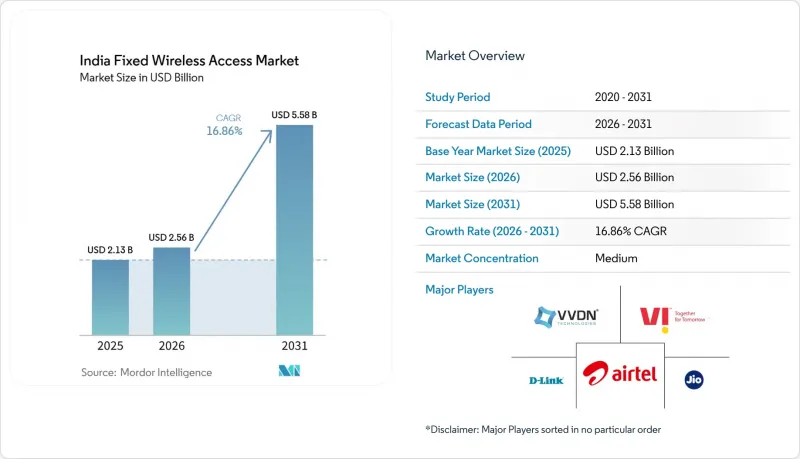
Mordor Intelligence에 의하면, 인도의 고정 무선 액세스 시장 규모는 2025년에 21억 3,000만 달러로 평가되었고, 2026년 25억 6,000만 달러에서 2031년까지 55억 8,000만 달러에 이를 것으로 예측되며, 예측 기간(2026-2031년) CAGR은 16.86%를 나타낼 전망입니다.
본 보고서는 유형별(하드웨어 및 서비스), 용도별(주거, 상업, 산업, 정부 및 공공 안전), 주파수 대역별(6GHz 미만, 밀리파(24GHz 이상), 면허 불필요/공유 CBRS), 구축 방식별(실내용 CPE, 실외용 CPE, 자가 설치형 창문 장착 CPE)로 분류되어 있습니다. 시장 전망은 금액(달러) 단위로 제시되어 있습니다.
인도의 고정 무선 액세스 시장 동향 및 인사이트
5G 독립형(SA) 도입으로 광섬유 수준의 무선 용량 확대
인도에서 비독립형(NSA)에서 독립형(SA) 5G 아키텍처로의 전환은 고정 무선 액세스 서비스의 품질과 규모에 가장 뚜렷한 영향을 미치고 있습니다. 주요 통신사 2곳은 2025년까지 고정 무선 접속 플랫폼을 5G 독립형 코어로 전환하여 서비스 제어 기능을 개선하는 한편, 인구 밀집 지역에서 광섬유 광대역에 대한 대응 능력을 강화했습니다. 에릭슨의 보고서에 따르면, 2025년 9월 기준 Jio와 Airtel의 고정 무선 액세스 연결 건수는 총 1,200만 건에 달했으며, 가입자들의 이용 현황이 이미 이러한 네트워크 전환에 부응하고 있음을 보여주었습니다. 또한, 인도의 고정 무선 액세스 시장은 공동 주택이나 트래픽이 많은 지역에서 5G 독립형(SA)이 실현하는 저지연 및 트래픽 처리 능력 향상이라는 이점도 누리고 있습니다. 2025년 2월 에어텔이 노키아 및 퀄컴과 체결한 단말기 계약은 통신 사업자들이 고정 무선 접속을 단순한 부가 서비스로 취급하지 않고 있음을 보여줍니다. 이는 사업자들이 이미 전국 확대 계획에 맞추어 고객용 단말기 및 Wi-Fi 성능을 조정해 왔기 때문입니다. 뛰어난 코어 아키텍처, 광범위한 무선 커버리지, 그리고 단말기 준비가 완료되었습니다는 요소가 맞물려, 인도의 고정 무선 액세스 시장은 다른 대부분의 고정 광대역 분야보다 빠른 속도로 보급되고 있습니다.
BharatNet과 연계된 농촌 지역 광대역 구축이 FWA의 급속한 보급을 뒷받침하고 있습니다.
BharatNet은 가정용 광섬유 수익화가 여전히 어려운 지역에서 라스트 마일 무선 링크의 경제성을 향상시키기 위해, 단순한 광섬유 사업 이상의 존재가 되고 있습니다. 개정된 BharatNet 프로그램의 3단계에는 1조 3,900억 루피(180억 달러)의 예산이 편성되어 있으며, 3년 동안 4만 개의 그람 판차야트와 60만 개의 마을을 추가로 대상으로 하고 있습니다. 광섬유가 그람 판차야트 수준까지 도달하면, 사업자는 각 가정에 고가의 광섬유를 설치하는 대신 고정 무선 접속을 최종 접속 계층으로 활용할 수 있게 됩니다. TRAI의 데이터에 따르면, 2026년 3월 기준 농촌 지역의 5G 고정 무선 접속 계약 건수는 615만 건에 달하고, 도시 지역의 617만 건과 거의 비슷한 수준을 보였으며, 인도의 고정 무선 접속 시장이 이미 주요 도시를 넘어 확장되고 있음을 확인할 수 있었습니다. BharatNet의 링 토폴로지 설계와 원격 광섬유 모니터링 체계도 중요한 요소입니다. 이는 고정 무선 접속의 집약 노드가 단순히 전파 도달 범위뿐만 아니라 신뢰성 높은 백홀에 의존하고 있기 때문입니다. 이를 통해 인도의 고정 무선 접속 시장은 기존 무선 광대역 모델로는 유지할 수 없었던 수준까지 농촌 지역에서 더 광범위한 확장이 가능해졌습니다.
주파수 대역별 가용성과 정책의 명확성은 여전히 제각각입니다.
26GHz 대역에 관한 정책의 명확성은 여전히 불충분하며, 고처리량 고정 무선 액세스 도입에 관한 결정이 지연되고 있습니다. Wi-Fi 기반 광대역용으로 26GHz 대역 주파수를 전용하자는 릴라이언스 지오(Reliance Geo)사의 제안은 2026년 6월 시점에서도 기술적 검토 중이었으며, 일부 비-IMT 이용 사례에 대한 운영 체계가 아직 확정되지 않았음을 보여주었습니다. 2025년 5월 TRAI가 발표한, 여러 대역에 걸친 마이크로파 주파수 할당에 관한 협의 문서에서도 유사한 문제가 지적되었습니다. 이는 무선 백홀 및 관련 이용 사례를 위한 광범위한 주파수 구조가 여전히 검토 중이었기 때문입니다. 이는 인도의 고정 무선 접속 시장에 있어 중요한 문제입니다. mm파(mmWave) 장비 선정, 기업의 도입 일정, 공급업체로부터의 조달 계획은 모두 규제상의 확실성에 달려 있기 때문입니다. 이러한 불확실성은 중소규모 공급업체나 전문 기업 사용자에게 더 큰 부담이 됩니다. 그들은 조달 및 도입 계획을 장기간 미정 상태로 둘 수 없기 때문입니다. 정책 결정이 확정될 때까지 인도의 고정 무선 접속 시장은 당초 6GHz 미만 주파수 대역을 중심으로 확장을 이어가는 한편, 고주파 대역의 이용 사례는 보다 선별적으로 발전해 나갈 것으로 보입니다.
부문 분석
2025년 인도 고정 무선 액세스 시장에서 하드웨어는 시장 점유율의 61.22%를 차지했습니다. 이는 통신 사업자가 신규 연결을 위해 고객 단말 장비(CPE)를 배포한 속도를 반영한 것입니다. Wi-Fi 6을 통합한 실내용 5G 게이트웨이는 통신 사업자가 광대역과 하드웨어를 단일 서비스 제안으로 패키지화할 수 있게 해주기 때문에 대중 시장을 겨냥한 전개에서 표준적인 고객 단말기가 되었습니다. 또한, 인도의 고정 무선 액세스 시장에서는 실내 무선 커버리지 강화가 필요한 기업 건물 및 공동 주택에서 펨토셀이나 피코셀과 같은 액세스 유닛의 중요성이 커졌습니다. GSA 보고서에 따르면, 2025년 전 세계 5G 고정 무선 액세스용 CPE 출하량은 26% 증가했으며, 인도는 5G 지원 고정 무선 액세스용 CPE 출하량의 50% 이상을 차지했습니다. 이는 인도가 최신 세대의 하드웨어로 빠르게 전환하고 있음을 보여줍니다. 이러한 하드웨어 중심의 구조는 가입자 수 증가가 여전히 엣지 측에서의 단말기 설치 및 활성화 속도에 의존하던 시장에 적합했습니다.
서비스 시장은 2031년까지 연평균 성장률(CAGR) 16.92%를 나타낼 것으로 예측되며, 이는 인도의 고정 무선 액세스 산업이 일회성 장비 판매에서 지속적인 연결 서비스 및 플랫폼 수익으로 전환되고 있음을 보여줍니다. Airtel이 2025년 2월 노키아와 체결한 계약에는 인도 국내에서 제조된 5G 실외용 고정 무선 액세스 게이트웨이 수신기 및 Wi-Fi 6 액세스 포인트가 포함되어 있어, 대규모 구축과 국내 공급 체계 지원을 연계하는 것이었습니다. HFCL의 5G 실내 고정 무선 액세스 CPE는 미디어텍(MediaTek)의 T750 칩셋을 기반으로 하며, 제로 터치 관리 및 AI 지원 용도를 탑재하고 있어 현지 벤더들도 디바이스 계층의 서비스성을 향상시키고 있음을 보여주었습니다. 도입 대수가 증가함에 따라 인도의 고정 무선 액세스 시장은 하드웨어 자체뿐만 아니라 관리형 연결, 클라우드 지원, 보안 기능 및 번들 컨텐츠를 통해 더 많은 가치를 창출할 것으로 전망됩니다.
2025년 인도의 고정 무선 액세스 시장에서 주거용 연결이 66.76%를 차지했으며, 가정용 광대역이 여전히 주요 이용 사례임이 확인되었습니다. 이러한 우위는 특히 준도시 지역이나 인구 밀도가 낮은 지역에서 여전히 완전한 FTTH(광섬유 홈 연결) 서비스 범위를 벗어나 있는 주택이 다수 존재하기 때문입니다. 또한, 에어텔(Airtel)의 ‘AirFiber’가 2,000개 이상의 도시에서 전개되고 있다는 사실은 허가 절차나 토목 공사로 인해 광섬유 설치가 지연되기 쉬운 도시 지역의 공동주택에 대해 통신 사업자들이 계속해서 주력하고 있음을 보여줍니다. 따라서 인도의 고정 무선 액세스 시장은 비즈니스 및 공공 분야에서의 이용이 확대되기 시작했음에도 불구하고, 우선 주거 부문에서의 보급을 통해 성장했습니다. 이러한 균형 덕분에 통신 사업자들은 현재 대규모 가입자 기반을 확보하는 동시에, 다른 용도에서의 고부가가치 계약을 위한 여지도 남겨두고 있습니다.
정부 및 공공 안전 분야는 2031년까지 연평균 성장률(CAGR) 17.11%로 확대될 것으로 예측되며, 인도의 고정 무선 접속 시장에서 가장 빠르게 성장하는 용도로 자리매김하고 있습니다. 인도 철도가 2026년 1월, 중요한 통신 수단으로 5G 및 4G SD-WAN을 도입한 것은 공공 인프라 기관이 중요한 운영 환경에서 ‘무선 우선(Wireless First)’ 아키텍처를 채택할 의지가 있음을 보여줍니다. 또한, BSNL이 하이데라바드에서 ‘Quantum 5G FWA’를 출시한 것은 보급형 가격보다 네트워크의 내결함성을 중시하는 기업, 중소기업 및 소규모 기업(MSME), 스마트 제조 클러스터에서의 이용이 확대되고 있음을 시사합니다. 따라서 인도 고정 무선 액세스 업계의 상업 및 산업 분야 수요는 단순한 선택적 연결에서 생산성, 사업 연속성, 거점 유연성과 관련된 보다 전략적인 엔터프라이즈 액세스 계층으로 전환되고 있습니다.
기타 혜택 :
- 엑셀 형식 시장 예측(ME) 시트
- 3개월간의 애널리스트 지원
목차
제1장 서론
제2장 조사 방법
제3장 주요 요약
제4장 시장 구도
제5장 시장 규모 및 성장 예측
제6장 경쟁 구도
제7장 시장 기회 및 향후 전망
AJYAccording to Mordor Intelligence, the India fixed wireless access market size was valued at USD 2.13 billion in 2025 and is estimated to grow from USD 2.56 billion in 2026 to reach USD 5.58 billion by 2031, at a CAGR of 16.86% during the forecast period (2026-2031).
This report is Segmented by Type (Hardware and Services), Application (Residential, Commercial, Industrial, and Government and Public Safety), Frequency Band (Sub-6 GHz, Mmwave (Above 24 GHz), and Unlicensed/Shared CBRS), and Deployment Mode (Indoor CPE, Outdoor CPE, and Self-Install Window-Mount CPE). The Market Forecasts are Provided in Value (USD).
India Fixed Wireless Access Market Trends and Insights
5G Standalone Rollout Expands Fiber-Like Wireless Capacity
India's move from non-standalone to standalone 5G architecture has had the clearest impact on the quality and scale of fixed wireless access services. Both major operators pushed their fixed wireless access platforms toward 5G standalone cores by 2025, improving service control and enabling stronger responses to fiber broadband in dense areas. Ericsson reported that combined Jio and Airtel fixed wireless access connections reached 12 million by September 2025, which showed that subscriber uptake was already responding to this network transition. The Indian fixed wireless access market also benefits from the lower latency and improved traffic handling that 5G standalone enables in apartment clusters and high-traffic neighborhoods. Airtel's February 2025 device contract with Nokia and Qualcomm showed that operators were not treating fixed wireless access as an add-on service, because they were already aligning customer equipment and Wi-Fi performance with national rollout plans. That combination of better core architecture, broader radio coverage, and device readiness has kept the Indian fixed wireless access market on a faster adoption path than most fixed broadband categories.
BharatNet-Linked Rural Broadband Build-Out Supports Fast FWA Take-Up
BharatNet has become more than a fiber program because it improves the economics of the last-mile wireless link in places where household fiber remains difficult to monetize. Phase 3 of the amended BharatNet program carries an outlay of INR 1.39 trillion (USD 18 billion) and targets an additional 40,000 gram panchayats and 600,000 villages over 3 years. Once fiber reaches the gram panchayat level, operators can use fixed wireless access as the final connection layer instead of extending expensive fiber all the way to each home. TRAI data showed that rural 5G fixed wireless access subscriptions stood at 6.15 million in March 2026, almost equal to the urban base of 6.17 million, and confirmed that the Indian fixed wireless access market was already scaling beyond major cities. BharatNet's ring-topology design and remote fiber monitoring structure also matter, because fixed wireless access aggregation nodes depend on dependable backhaul rather than only on radio reach. This has given India's fixed wireless access market a broader rural runway than earlier wireless broadband models could sustain.
Spectrum Availability And Policy Clarity Remain Uneven Across Bands
Policy clarity around the 26 GHz band has remained incomplete, slowing decisions on high-throughput fixed wireless access deployments. Reliance Jio's proposal to repurpose 26 GHz spectrum for Wi-Fi-based broadband was still under technical review in June 2026, which showed that the operating framework for some non-IMT use cases was not yet settled. TRAI's May 2025 consultation paper on microwave spectrum assignment across several bands highlighted the same issue, as the broader spectrum structure for wireless backhaul and related use cases was still being worked through. This matters for the India fixed wireless access market because mmWave equipment decisions, enterprise deployment schedules, and vendor sourcing plans all depend on regulatory certainty. The uncertainty weighs more heavily on smaller device vendors and specialized enterprise users, as they cannot keep procurement and deployment plans open for long. Until policy decisions are finalized, the Indian fixed wireless access market is likely to continue expanding, initially in sub-6 GHz bands, while high-frequency use cases advance more selectively.
Other drivers and restraints analyzed in the detailed report include:
- FWA Becomes the Preferred Last-Mile Option Where Fiber Monetization is Slow
- Enterprise Backup Connectivity Demand Rises With SD-WAN And Cloud Deployment
- Fiber Price Compression Caps Premium FWA ARPU Expansion
For complete list of drivers and restraints, kindly check the Table Of Contents.
Segment Analysis
Hardware accounted for 61.22% of the India fixed wireless access market share in 2025, reflecting the pace at which operators deployed customer premises equipment for new connections. Indoor 5G gateways with integrated Wi-Fi 6 became the standard customer device in mass-market rollouts, because they allowed operators to package broadband and hardware as a single service proposition. The Indian fixed wireless access market also saw access units such as femtocells and picocells gain relevance in enterprise buildings and multi-dwelling settings where indoor radio coverage needed reinforcement. GSA reported that global 5G fixed wireless access CPE shipments grew 26% in 2025, and India accounted for more than 50% of its fixed wireless access CPE shipments that were 5G-enabled, underscoring the country's rapid move toward current-generation hardware. This hardware-heavy structure suited a market where subscriber growth still depended on how quickly devices could be placed and activated at the edge.
Services are projected to grow at a 16.92% CAGR through 2031, indicating that the Indian fixed wireless access industry is moving from one-time equipment value to recurring connectivity and platform revenue. Airtel's February 2025 contract with Nokia covered 5G outdoor fixed wireless access gateway receivers and Wi-Fi 6 access points manufactured in India, which linked scale deployment with domestic supply support. HFCL's 5G indoor fixed wireless access CPE, built on MediaTek's T750 chipset with zero-touch management and an AI-enabled application, showed that local vendors were also improving the serviceability of the device layer. As the installed base grows, the Indian fixed wireless access market is likely to capture more value from managed connectivity, cloud support, security features, and bundled content rather than from hardware alone.
Residential connections accounted for 66.76% of the Indian fixed wireless access market in 2025, confirming that household broadband remained the anchor use case. That dominance stemmed from the large number of homes that still lack full fiber-to-the-home coverage, especially in semi-urban and lower-density districts. Airtel's AirFiber presence in more than 2,000 cities also showed that operators continued to focus on urban multi-dwelling units, where permissions and civil works can delay fiber builds. The India fixed wireless access market, therefore, expanded first through residential adoption, even as business and public use began to grow. That balance gives operators a large subscriber base today while still leaving room for higher-value contracts in other applications.
Government and public safety are projected to expand at a 17.11% CAGR through 2031, which made it the fastest-growing application in the Indian fixed wireless access market. Indian Railways' January 2026 adoption of 5G and 4G SD-WAN for critical communications demonstrated that public infrastructure agencies were willing to adopt wireless-first architectures in critical operating environments. BSNL's Quantum 5G FWA launch in Hyderabad also pointed to broader use in enterprises, MSMEs, and smart manufacturing clusters, where network resilience matters more than entry-level pricing. Commercial and industrial demand in the Indian fixed wireless access industry is therefore moving from optional connectivity toward a more deliberate enterprise access layer tied to productivity, continuity, and site flexibility.
Complete Report Scope:
- By Type
- Hardware
- Consumer Premise Equipment (CPE)
- Access Units (Femto and Picocells)
- Services
- Hardware
- By Application
- Residential
- Commercial
- Industrial
- Government and Public Safety
- By Frequency Band
- Sub-6 GHz
- mmWave (Above 24 GHz)
- Unlicensed/Shared CBRS
- By Deployment Mode
- Indoor CPE
- Outdoor CPE
- Self-Install Window-Mount CPE
List of Companies Covered in this Report:
- Reliance Jio Infocomm Limited
- Bharti Airtel Limited
- Vodafone Idea Limited
- Nokia Corporation
- Telefonaktiebolaget LM Ericsson
- Samsung Electronics Co., Ltd.
- Qualcomm Technologies, Inc.
- VVDN Technologies Pvt. Ltd.
- D-Link (India) Limited
- Arcadyan Technology Corporation
- Sercomm Corporation
- Askey Computer Corp.
- Wistron NeWeb Corporation (WNC)
- Cambium Networks Corporation
- HFCL Limited
- Tejas Networks Limited
- CommScope Holding Company, Inc.
- PLANET Technology Corporation
- ZTE Corporation
Additional Benefits:
- The market estimate (ME) sheet in Excel format
- 3 months of analyst support
TABLE OF CONTENTS
1 INTRODUCTION
- 1.1 Study Assumptions and Market Definition
- 1.2 Scope of the Study
2 RESEARCH METHODOLOGY
3 EXECUTIVE SUMMARY
4 MARKET LANDSCAPE
- 4.1 Market Overview
- 4.2 Market Drivers
- 4.2.1 5G Standalone Rollout Expands Fiber-Like Wireless Capacity
- 4.2.2 BharatNet-Linked Rural Broadband Build-Out Supports Fast FWA Take-Up
- 4.2.3 FWA Becomes the Preferred Last-Mile Option Where Fiber Monetization Is Slow
- 4.2.4 Enterprise Backup Connectivity Demand Rises With SD-WAN and Cloud Dependency
- 4.2.5 Self-Install CPE and Lower Truck-Roll Intensity Improve Unit Economics
- 4.2.6 Bundled Digital Services Improve FWA Stickiness and Reduce Churn
- 4.3 Market Restraints
- 4.3.1 Spectrum Availability and Policy Clarity Remain Uneven Across Bands
- 4.3.2 Fiber Price Compression Caps Premium FWA ARPU Expansion
- 4.3.3 Outdoor CPE and mmWave Reliability Issues Slow Mass Adoption in Dense Urban Areas
- 4.3.4 CPE Affordability Remains a Barrier in Price-Sensitive Households
- 4.4 Industry Value-Chain Analysis
- 4.5 Regulatory Landscape
- 4.6 Technological Outlook
- 4.6.1 Key Enablers for FWA Adoption
- 4.6.2 Vendor Initiatives and Partnerships
- 4.6.3 Business Considerations and Prerequisites
- 4.6.4 FWA vs FTTH / FTTdp Comparison
- 4.6.5 Rural, Semi-Urban and Urban Use-Case Models
- 4.7 Impact of Macroeconomic Factors on the Market
- 4.8 Porter's Five Forces Analysis
- 4.8.1 Bargaining Power of Suppliers
- 4.8.2 Bargaining Power of Buyers
- 4.8.3 Threat of New Entrants
- 4.8.4 Threat of Substitutes
- 4.8.5 Competitive Rivalry
5 MARKET SIZE AND GROWTH FORECASTS (VALUE)
- 5.1 By Type
- 5.1.1 Hardware
- 5.1.1.1 Consumer Premise Equipment (CPE)
- 5.1.1.2 Access Units (Femto and Picocells)
- 5.1.2 Services
- 5.1.1 Hardware
- 5.2 By Application
- 5.2.1 Residential
- 5.2.2 Commercial
- 5.2.3 Industrial
- 5.2.4 Government and Public Safety
- 5.3 By Frequency Band
- 5.3.1 Sub-6 GHz
- 5.3.2 mmWave (Above 24 GHz)
- 5.3.3 Unlicensed/Shared CBRS
- 5.4 By Deployment Mode
- 5.4.1 Indoor CPE
- 5.4.2 Outdoor CPE
- 5.4.3 Self-Install Window-Mount CPE
6 COMPETITIVE LANDSCAPE
- 6.1 Market Concentration
- 6.2 Strategic Moves
- 6.3 Market Share Analysis
- 6.4 Company Profiles (includes Global Level Overview, Market Level Overview, Core Segments, Financials as Available, Strategic Information, Market Rank/Share for Key Companies, Products and Services, and Recent Developments)
- 6.4.1 Reliance Jio Infocomm Limited
- 6.4.2 Bharti Airtel Limited
- 6.4.3 Vodafone Idea Limited
- 6.4.4 Nokia Corporation
- 6.4.5 Telefonaktiebolaget LM Ericsson
- 6.4.6 Samsung Electronics Co., Ltd.
- 6.4.7 Qualcomm Technologies, Inc.
- 6.4.8 VVDN Technologies Pvt. Ltd.
- 6.4.9 D-Link (India) Limited
- 6.4.10 Arcadyan Technology Corporation
- 6.4.11 Sercomm Corporation
- 6.4.12 Askey Computer Corp.
- 6.4.13 Wistron NeWeb Corporation (WNC)
- 6.4.14 Cambium Networks Corporation
- 6.4.15 HFCL Limited
- 6.4.16 Tejas Networks Limited
- 6.4.17 CommScope Holding Company, Inc.
- 6.4.18 PLANET Technology Corporation
- 6.4.19 ZTE Corporation
7 MARKET OPPORTUNITIES AND FUTURE OUTLOOK
- 7.1 White-Space and Unmet-Need Assessment