

|
시장보고서
상품코드
2118060
의료기기용 공작기계 시장 : 점유율 분석, 업계 동향과 통계, 성장 예측(2026-2031년)Medical Devices Machine Tools - Market Share Analysis, Industry Trends & Statistics, Growth Forecasts (2026 - 2031) |
||||||
 Mordor Intelligence
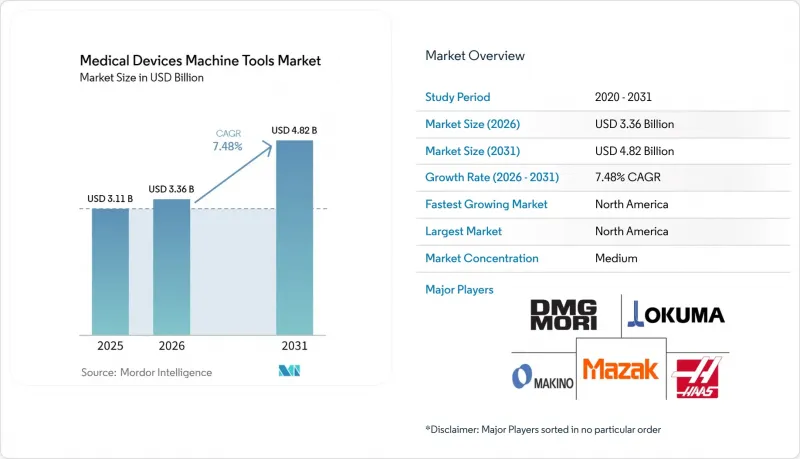
Mordor Intelligence에 의하면, 의료기기용 공작기계 시장 규모는 2025년에 31억 1,000만 달러, 2026년에 33억 6,000만 달러가 되고, 2031년까지 48억 2,000만 달러에 이를 것으로 예측되며, 2026년부터 2031년까지 CAGR 7.48%로 성장할 전망입니다.
본 보고서는 기계 유형(CNC 선반, CNC 머시닝 센터 등), 용도(외과용 및 로봇용 기구, 정형외과·외상용 기기 등), 최종 사용자(의료기기 OEM 등), 지역(북미, 아시아태평양, 유럽 등)별로 분류되어 있습니다. 본 보고서에서는 상기 모든 부문에 대해 시장 규모 및 예측치(달러)를 제시하고 있습니다.
세계 의료기기용 공작기계 시장 동향 및 인사이트
임플란트 및 외과용 부품 제조에서 초정밀 5축 가공에 대한 수요 증가
환자별로 맞춤 제작된 고관절 스템, 경골 트레이, 척추 고정 케이지의 제조에는 복잡한 가공과 엄격하게 관리된 표면 마감이 요구됩니다. 5축 밀링 가공을 통해 제조 공정 중 공작물의 재배치 필요성이 줄어듭니다. 세팅 횟수를 줄임으로써 제조업체는 ISO 13485 요건에 따라 검증해야 하는 기록의 수를 줄일 수 있습니다. 이로 인해 의료기기용 공작기계 시장에서 공정 내 측정, 공구 마모 보정 및 공정 추적 기능을 갖춘 CNC 플랫폼에 대한 수요가 증가하고 있습니다. 마키노(Makino)사의 N2-5XA는 임플란트 제조 시 오염 관리를 목적으로 하는 드라이·칩리스 설계를 채택하고 있습니다. 따라서 기계의 사양은 기하학적 성능뿐만 아니라 청정도 및 문서화 요건에 의해서도 점점 더 좌우되고 있습니다.
FDA의 QMSR과 ISO 13485의 조화로 인해, 검증 대응 공작기계에 대한 수요가 증가하고 있습니다.
QMSR 최종 규정은 2026년 2월 2일에 발효되어, 21 CFR Part 820을 ISO 13485:2016과 조화시켰습니다. 의료기기 제조업체는 현재 생산 공정 전반에 걸쳐 더욱 엄격한 문서화, 위험 관리 및 추적성을 요구받고 있습니다. 신규 설비 구매자는 이러한 요건을 충족하는 설치, 운영 및 가공 적합성 확인 문서를 필요로 합니다. 기존 품질 시스템 규제 절차를 사용해 온 시설의 경우, 공작기계의 재검증이나 교체가 필요할 수 있습니다. 의료 규정 준수를 전문으로 지원하는 공급업체는 구매자의 도입 부담을 덜어줄 수 있습니다. 이로 인해 의료기기용 공작기계 시장에서 검증 대응 장비의 가치가 높아지고 있습니다.
고도의 적격성 확인, 검증 및 재검증 부담이 기계 도입을 지연시키고 있습니다.
새로운 CNC 셀은 규제 대상 의료용 부품을 제조하기 전에 적합성 평가를 받아야 합니다. 공장 인수 시험, 절삭유 밸리데이션, 클린룸 설치 및 제조 실행 시스템(MES)과의 통합은 도입 과정을 장기화시킬 수 있습니다. 또한, 소프트웨어 업데이트, 대대적인 개조 및 공정 변경 역시 부분적 또는 전면적인 재적격성 평가를 필요로 할 수 있습니다. 클래스 III 임플란트 및 환자 접촉 부품 제조업체는 중요한 특성에 대해 적절한 공정을 유지해야 하며, 이로 인해 일부 프로그램에 적합한 장비 선택의 폭이 제한됩니다. 이러한 요건으로 인해 의료기기용 공작기계 시장의 하이엔드 분야에 수요가 집중될 가능성이 있습니다. 또한, 제조업체가 생산 능력 확충이 필요한 경우에도 새로운 생산 라인의 가동 시기가 지연되는 원인이 될 수 있습니다.
부문 분석
2025년 의료기기용 공작기계 시장에서 CNC 머시닝 센터는 28.5%의 점유율을 차지했습니다. 이러한 위상은 복잡한 형상과 문서화된 공정이 모두 요구되는 임플란트 및 의료 기구의 대량 생산에 해당 장비가 활용되고 있음을 반영합니다. 5축 머시닝 센터는 정형외과용 및 척추용 부품의 곡면 가공 및 동시 가공을 지원합니다. 레이저 절단 및 마이크로 머시닝 장비는 2026년부터 2031년까지 연평균 성장률(CAGR) 8.8%를 나타낼 것으로 예측됩니다. 이러한 시스템은 기존 절단 방법으로는 손상될 가능성이 있는 부품에 대한 스텐트 절단, 기기 마킹 및 절제 가공에 활용되고 있습니다. TRUMPF사는 2025년 6월, 광범위한 표면을 높은 생산성으로 초단펄스 가공하기 위한 ‘TruMicro 9010’을 발표했습니다.
CNC 선반은 뼈 나사, 캐뉼레이트 패스너, 샤프트 제조에 중요한 역할을 하고 있습니다. 스위스형 및 선삭·밀링 복합기는 높은 동심도를 유지하면서 티타늄이나 스테인리스 스틸 부품의 대량 생산이 가능합니다. CNC 연삭·마감 가공기는 임플란트의 표면 처리 및 미세한 표면 마감이 요구되는 기타 용도를 지원합니다. EDM은 경화된 금형이나 밀링 가공으로는 버를 남기지 않고 제조하기 어려운 미세 구조의 가공에 있어 여전히 필수적입니다. 초음파 가공기, 브로치, 드릴링 머신 등의 기타 시스템은 PEEK 임플란트나 카테터용 금형의 특수 가공을 지원합니다. 이러한 기술들은 각각 의료기기용 공작기계 시장에서 서로 다른 생산 요구를 충족시킵니다. QMSR 체계 하에서 공정 설정을 문서화하고 관리해야 하므로, 레이저 파라미터의 적합성 평가는 특히 중요합니다.
지역별 분석
북미는 2025년에 의료기기용 공작기계 시장 규모의 31.6%를 차지하며, 2031년까지 연평균 성장률(CAGR) 8.9%로 성장할 것으로 전망됩니다. 이 지역은 OEM 및 수탁 제조 시설에서 QMSR에 기반한 적합성 평가 업무의 혜택을 받고 있습니다. 니어쇼어링 또한 미국, 캐나다, 코스타리카로의 투자를 촉진하고 있습니다. 고령화가 진행됨에 따라 정형외과용 및 심혈관용 기기의 생산량은 계속해서 견조한 추세를 보이고 있습니다. 이러한 요인들이 결합되어 규정 준수 관련 지출과 추가 인증 생산 능력에 대한 수요가 연계되고 있습니다. 프로이덴베르크 메디컬(Freudenberg Medical)은 2025년, 전기생리학용 및 구조적 심장용 카테터를 생산하기 위해 코스타리카에서의 사업을 확장했습니다.
유럽은 독일의 공작기계 생태계 및 의료 기술 생산에 힘입어 여전히 주요 수요 기반으로 자리 잡고 있습니다. 독일의 의료 기술 부문은 2024년에 414억 유로(466억 3,000만 달러)의 매출을 기록했으며, 이는 450억 달러(507억 9,000만 달러)에 해당하고 수출 비율은 68%였습니다. VDW 보고서에 따르면, 2025년 독일의 공작기계 생산은 8% 감소했으나, 의료 기술 분야는 방위, 항공우주, 전자 분야와 함께 수요를 지탱했습니다. 스위스, 아일랜드, 영국도 이 지역의 생산 거점으로 합류했습니다. 유럽의 구매자들은 EU 기계 규정에 기반한 네트워크 연결 기계의 사이버 보안 요건도 고려해야 합니다. 이러한 요인들이 의료기기용 공작기계 시장의 갱신 투자 및 기능 강화 투자를 촉진하고 있습니다.
아시아태평양은 북미 이외의 주요 성장 지역이며, 일본, 한국, 중국, 말레이시아, 태국, 인도가 제조 역량을 제공합니다. 일본의 공작기계 수주액은 2025년에 1조 6,000억 엔(106억 달러)에 달하며, 일본공작기계공업회는 2026년 수주액을 1조 7,000억 엔(113억 6,000만 달러)으로 전망하고 있습니다. 일본의 자동화 기반은 의료, 반도체, 방위 분야 수요를 뒷받침하고 있습니다. 파낙은 2025년도 매출액으로 8,578억 엔(57억 3,000만 달러)을 보고했으며, 2026년 4월에는 북미의 로봇 생산 능력에 9,000만 달러를 투자하겠다고 발표했습니다. 남미, 중동 및 아프리카는 여전히 규모가 작은 의료용 기계 가공 시장입니다. 코스타리카는 북미 OEM 제조업체와의 근접성과 유능한 수탁 제조업체의 수가 증가하고 있어 정밀 제조의 중요한 거점이 되고 있습니다.
기타 혜택:
- 엑셀 형식 시장 예측(ME) 시트
- 3개월간의 애널리스트 지원
자주 묻는 질문
목차
제1장 서론
제2장 조사 방법
제3장 개요
제4장 시장 구도
제5장 시장 규모와 성장 예측
제6장 경쟁 구도
제7장 시장 기회와 향후 전망
JHS 26.09.01According to Mordor Intelligence, the medical devices machine tools market size is projected to be USD 3.11 billion in 2025, USD 3.36 billion in 2026, and reach USD 4.82 billion by 2031, growing at a CAGR of 7.48% from 2026 to 2031.
This report is Segmented by Machine Type (CNC Turning Machines, CNC Machining Centers, and More), by Application (Surgical and Robotic Instruments, Orthopedic and Trauma Devices, and More), by End-User (Medical Device OEMs, and More), and by Geography (North America, Asia-Pacific, Europe, and More). The Report Offers Market Size and Forecasts in Value (USD) for all the Above Segments.
Global Medical Devices Machine Tools Market Trends and Insights
Rising Demand for Ultra-Precision 5-Axis Machining in Implant and Surgical Component Production
Patient-specific hip stems, tibial trays, and spinal fusion cages require complex machining and tightly controlled surfaces. Five-axis milling reduces the need to reposition workpieces during production. Fewer setups can reduce the number of records that manufacturers must validate under ISO 13485 requirements. This supports demand for CNC platforms with in-process metrology, tool wear compensation, and process traceability in the medical devices machine tools market. Makino's N2-5XA uses a dry-chip-less design intended to address contamination control in implant production. Machine specifications are therefore increasingly shaped by cleanliness and documentation needs as well as geometric capability.
FDA QMSR and ISO 13485 Alignment Increasing Demand for Validation-Ready Machine Tools
The QMSR Final Rule became effective on February 2, 2026, and aligned 21 CFR Part 820 with ISO 13485:2016. Medical device manufacturers now need stronger documentation, risk management, and traceability across production steps.Buyers of new equipment need installation, operational, and processing qualification documents that fit these requirements. Existing facilities that used legacy Quality System Regulation procedures may need to revalidate machines or replace them. Suppliers with dedicated medical compliance support can reduce the implementation burden on buyers. This increases the value of validation-ready equipment in the medical devices machine tools market.
High Qualification, Validation, and Revalidation Burden Slowing Machine Deployment
New CNC cells must undergo qualification before they can produce regulated medical components. Factory acceptance testing, coolant validation, cleanroom installation, and manufacturing execution system integration can lengthen the deployment process. Software updates, major modifications, and process changes can also trigger partial or full requalification. Class III implant and patient-contact component manufacturers must maintain capable processes on critical features, which limits the range of equipment suitable for some programs. These requirements can concentrate demand at the premium end of the medical device machine tool market. They can also delay the ramp-up of new production lines even when manufacturers have demand for additional capacity.
Other drivers and restraints analyzed in the detailed report include:
- Expansion of Contract Medical Device Manufacturing Capacity
- Rapid Adoption of Hybrid Additive-Subtractive Workflows for Near-Net Medical Parts
- Elevated Tooling, Coolant, and Maintenance Costs for Titanium and Cobalt-Chromium Machining
For complete list of drivers and restraints, kindly check the Table Of Contents.
Segment Analysis
CNC machining centers held 28.5% of the 2025 medical device machine tool market. Their position reflects their use in high-volume implant and instrument production, where complex geometry and documented processes are both required. Five-axis centers support contoured surfaces and simultaneous machining on orthopedic and spinal parts. Laser cutting and micromachining machines are forecast to grow at an 8.8% CAGR from 2026 to 2031. These systems serve stent cutting, device marking, and ablation work on components that can be damaged by conventional cutting. TRUMPF introduced the TruMicro 9010 in June 2025 for high-productivity ultra-short pulse processing of larger surfaces.
CNC turning machines play a substantial role in the production of bone screws, cannulated fasteners, and shafts. Swiss-type and turn-mill configurations can produce high volumes of titanium and stainless-steel parts with close concentricity. CNC grinding and finishing machines support implant surface preparation and other applications that need fine surface finishes. EDM remains necessary for hardened tooling and microfeatures that are difficult to produce by milling without burrs. Other systems, including ultrasonic, broaching, and drilling machines, handle specialized work for PEEK implants and catheter tooling. Each of these technologies serves a different production need in the medical device machine tools market. Laser parameter qualification is especially important because process settings must be documented and controlled under the QMSR framework.
Complete Report Scope:
- By Machine Type
- CNC Turning Machines (Including Swiss-Type, Sliding-Headstock and Turn-Mill Machines)
- CNC Machining Centers (Including 3-Axis, 4-Axis and 5-Axis Machines)
- CNC Grinding & Finishing Machines (Including Grinding, Honing, Lapping and Polishing Machines)
- Electrical Discharge Machining (EDM) Machines
- Laser Cutting and Micromachining Systems
- Other Machine Types (Drilling, Broaching, Ultrasonic, Sawing, etc.)
- By Application
- Surgical and Robotic Instruments
- Orthopedic and Trauma Devices
- Dental Devices
- Implantable Medical Devices (Cardiovascular, Neurovascular and Minimally Invasive Devices)
- Diagnostic, Medical Imaging and Endoscopy Equipment
- Ophthalmic and Hearing Devices
- Drug-Delivery and Other Medical Devices
- By End User
- Medical Device OEMs
- Contract Development and Manufacturing Organizations (CDMO)
- Contract Manufacturing Organizations (CMO) & Precision Job Shops
- Others (Research Institutes, Prototyping/ Medical Technology Centers)
- By Geography
- North America
- United States
- Canada
- Mexico
- South America
- Brazil
- Costa Rica
- Rest of South America
- Europe
- United Kingdom
- Ireland
- Germany
- France
- Italy
- Spain
- Switzerland
- BENELUX (Belgium, Netherlands, and Luxembourg)
- NORDICS (Denmark, Finland, Iceland, Norway, and Sweden)
- Rest of Europe
- Asia-Pacific
- China
- India
- Japan
- South Korea
- Malaysia
- Taiwan
- Australia
- Rest of Asia-Pacific
- Middle East and Africa
- Saudi Arabia
- Israel
- Turkey
- Egypt
- South Africa
- Rest of Middle East and Africa
- North America
Geography Analysis
North America held 31.6% of the medical devices machine tools market size in 2025 and is forecast to grow at an 8.9% CAGR through 2031. The region benefits from QMSR-driven qualification work at OEM and contract manufacturing facilities. Near-shoring also supports investment in the United States, Canadian, and Costa Rica. Aging populations continue to support orthopedic and cardiovascular device volumes. This combination links compliance spending with demand for additional qualified capacity. Freudenberg Medical expanded its Costa Rica operations in 2025 to produce electrophysiology and structural heart catheters.
Europe remains a major demand base, supported by Germany's machine tool ecosystem and medical technology production. Germany's medical technology sector generated EUR 41.4 billion (USD 46.63 billion) in 2024, equivalent to USD 45 billion (USD 50.79 billion), and had an export ratio of 68%. VDW reported that German machine tool production fell 8% in 2025, while medical technology provided demand support alongside defense, aerospace, and electronics. Switzerland, Ireland, and the United Kingdom add to the regional production base. European buyers must also consider cybersecurity requirements for networked machinery under the EU Machinery Regulation. These factors support replacement and capability investments in the medical devices machine tools market.
Asia-Pacific is the main growth area outside North America, with Japan, South Korea, China, Malaysia, Thailand, and India providing manufacturing capacity. Japan's machine tool orders reached JPY 1.6 trillion (USD 10.6 billion) in 2025, and the Japan Machine Tool Builders' Association expected JPY 1.7 trillion (USD 11.36 billion) in orders for 2026. Japan's automation base supports demand across medical, semiconductor, and defense applications. FANUC reported JPY 857.8 billion (USD 5.73 billion) in fiscal 2025 revenue and announced a USD 90 million investment in North American robot production capacity in April 2026.South America, the Middle East, and Africa remain smaller medical machining markets. Costa Rica has become an important location for precision manufacturing due to its proximity to North American OEMs and its growing pool of qualified contract manufacturers.
- DMG MORI Co., Ltd.
- Yamazaki Mazak Corporation
- Okuma Corporation
- Makino Milling Machine Co., Ltd.
- Haas Automation, Inc.
- FANUC Corporation
- GF Machining Solutions Management SA
- TRUMPF SE + Co. KG
- Doosan Machine Tools Co., Ltd.
- Hyundai WIA Corporation
- CHIRON Group SE
- EMAG GmbH & Co. KG
- Hermle AG
- HARDINGE INC.
- JTEKT Corporation
- Fives Group
- Siemens AG
- Mitsubishi Electric Corporation
- Hurco Companies, Inc.
- Rollomatic SA
Additional Benefits:
- The market estimate (ME) sheet in Excel format
- 3 months of analyst support
TABLE OF CONTENTS
1 INTRODUCTION
- 1.1 Study Assumptions and Market Definition
- 1.2 Scope of the Study
2 RESEARCH METHODOLOGY
3 EXECUTIVE SUMMARY
4 MARKET LANDSCAPE
- 4.1 Market Overview
- 4.2 Market Drivers
- 4.2.1 Rising Demand for Ultra-Precision 5-Axis Machining in Implant and Surgical Component Production
- 4.2.2 FDA QMSR and ISO 13485 Alignment Increasing Demand for Validation-Ready Machine Tools
- 4.2.3 Expansion of Contract Medical Device Manufacturing Capacity
- 4.2.4 Rapid Adoption of Hybrid Additive-Subtractive Workflows for Near-Net Medical Parts
- 4.2.5 Acceleration of Lights-Out Production to Offset Skilled Machinist Shortages
- 4.2.6 Rising Need for In-Process Metrology, Tool Wear Compensation, and Digital Traceability
- 4.3 Market Restraints
- 4.3.1 High Qualification, Validation, and Revalidation Burden Slowing Machine Deployment
- 4.3.2 Elevated Tooling, Coolant, and Maintenance Costs for Titanium and Cobalt-Chromium Machining
- 4.3.3 Long Lead Times for Cleanroom-Compatible Installation and MES Integration
- 4.3.4 Cybersecurity and Data-Integrity Risks in connected CNC Cells
- 4.4 Value and Supply-Chain Analysis
- 4.5 Regulatory Landscape
- 4.6 Technology Trends and Innovation Outlook
- 4.7 Purchasing Criteria and Vendor Selection Factors
- 4.8 Insights on Aftermarket/ Retrofit Market Segment
- 4.9 Medical Devices Market Overview & Insights
- 4.10 Impact of Macroeconomic, Trade and Geopolitical Factors on the Market (Tariffs, export controls, Critical-material supply risks, tariffs, etc.)
5 MARKET SIZE AND GROWTH FORECASTS (Values, In USD Billion)
- 5.1 By Machine Type
- 5.1.1 CNC Turning Machines (Including Swiss-Type, Sliding-Headstock and Turn-Mill Machines)
- 5.1.2 CNC Machining Centers (Including 3-Axis, 4-Axis and 5-Axis Machines)
- 5.1.3 CNC Grinding & Finishing Machines (Including Grinding, Honing, Lapping and Polishing Machines)
- 5.1.4 Electrical Discharge Machining (EDM) Machines
- 5.1.5 Laser Cutting and Micromachining Systems
- 5.1.6 Other Machine Types (Drilling, Broaching, Ultrasonic, Sawing, etc.)
- 5.2 By Application
- 5.2.1 Surgical and Robotic Instruments
- 5.2.2 Orthopedic and Trauma Devices
- 5.2.3 Dental Devices
- 5.2.4 Implantable Medical Devices (Cardiovascular, Neurovascular and Minimally Invasive Devices)
- 5.2.5 Diagnostic, Medical Imaging and Endoscopy Equipment
- 5.2.6 Ophthalmic and Hearing Devices
- 5.2.7 Drug-Delivery and Other Medical Devices
- 5.3 By End User
- 5.3.1 Medical Device OEMs
- 5.3.2 Contract Development and Manufacturing Organizations (CDMO)
- 5.3.3 Contract Manufacturing Organizations (CMO) & Precision Job Shops
- 5.3.4 Others (Research Institutes, Prototyping/ Medical Technology Centers)
- 5.4 By Geography
- 5.4.1 North America
- 5.4.1.1 United States
- 5.4.1.2 Canada
- 5.4.1.3 Mexico
- 5.4.2 South America
- 5.4.2.1 Brazil
- 5.4.2.2 Costa Rica
- 5.4.2.3 Rest of South America
- 5.4.3 Europe
- 5.4.3.1 United Kingdom
- 5.4.3.2 Ireland
- 5.4.3.3 Germany
- 5.4.3.4 France
- 5.4.3.5 Italy
- 5.4.3.6 Spain
- 5.4.3.7 Switzerland
- 5.4.3.8 BENELUX (Belgium, Netherlands, and Luxembourg)
- 5.4.3.9 NORDICS (Denmark, Finland, Iceland, Norway, and Sweden)
- 5.4.3.10 Rest of Europe
- 5.4.4 Asia-Pacific
- 5.4.4.1 China
- 5.4.4.2 India
- 5.4.4.3 Japan
- 5.4.4.4 South Korea
- 5.4.4.5 Malaysia
- 5.4.4.6 Taiwan
- 5.4.4.7 Australia
- 5.4.4.8 Rest of Asia-Pacific
- 5.4.5 Middle East and Africa
- 5.4.5.1 Saudi Arabia
- 5.4.5.2 Israel
- 5.4.5.3 Turkey
- 5.4.5.4 Egypt
- 5.4.5.5 South Africa
- 5.4.5.6 Rest of Middle East and Africa
- 5.4.1 North America
6 COMPETITIVE LANDSCAPE
- 6.1 Market Concentration
- 6.2 Strategic Moves
- 6.3 Market Share Analysis
- 6.4 Company Profiles (includes Global Level Overview, Market Level Overview, Core Segments, Financials as available, Strategic Information, Products and Services, Recent Developments)
- 6.4.1 DMG MORI Co., Ltd.
- 6.4.2 Yamazaki Mazak Corporation
- 6.4.3 Okuma Corporation
- 6.4.4 Makino Milling Machine Co., Ltd.
- 6.4.5 Haas Automation, Inc.
- 6.4.6 FANUC Corporation
- 6.4.7 GF Machining Solutions Management SA
- 6.4.8 TRUMPF SE + Co. KG
- 6.4.9 Doosan Machine Tools Co., Ltd.
- 6.4.10 Hyundai WIA Corporation
- 6.4.11 CHIRON Group SE
- 6.4.12 EMAG GmbH & Co. KG
- 6.4.13 Hermle AG
- 6.4.14 HARDINGE INC.
- 6.4.15 JTEKT Corporation
- 6.4.16 Fives Group
- 6.4.17 Siemens AG
- 6.4.18 Mitsubishi Electric Corporation
- 6.4.19 Hurco Companies, Inc.
- 6.4.20 Rollomatic SA
7 MARKET OPPORTUNITIES AND FUTURE OUTLOOK
- 7.1 White-Space and Unmet-Need Assessment


