

|
시장보고서
상품코드
2118071
디지털 현미경 시장 : 시장 점유율 분석, 업계 동향 및 통계, 성장 예측(2026-2031년)Digital Microscopes - Market Share Analysis, Industry Trends & Statistics, Growth Forecasts (2026 - 2031) |
||||||
 Mordor Intelligence
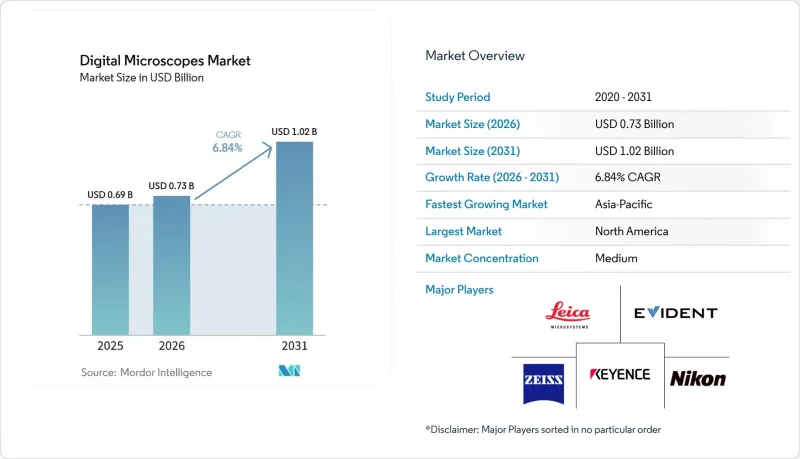
Mordor Intelligence에 의하면, 디지털 현미경 시장 규모는 2025년에 6억 9,000만 달러로 평가되었고, 2026년 7억 3,000만 달러에서 2031년까지 10억 2,000만 달러에 이를 것으로 예측되며, 예측 기간(2026-2031년) CAGR은 6.84%를 나타낼 전망입니다.
본 보고서는 제품 유형별(디지털 생물 현미경, 형광 현미경, 수술용 현미경, 공초점 현미경, 역상 현미경, 기타), 이미징 기술별(명시야, 형광, 공초점 이미징, 3D, 정량 위상), 용도별(진단, 생명과학, 신약 개발, 외과 수술, 암 연구), 최종 사용자별(병원, 병리 검사실, 제약, 생명공학, 학술 기관) 및 지역별로 분류되어 있습니다. 예측치는 금액(달러)으로 표시되어 있습니다.
세계의 디지털 현미경 시장 동향 및 인사이트
AI를 활용한 이미지 분석 및 워크플로우 자동화
AI를 활용한 분석을 통해 검사실은 수동 확인 작업을 늘리지 않고도 더 많은 이미지를 처리할 수 있게 됩니다. 장비 수준의 모델은 이미지 획득 시 형태 분류, 세포 분할, 이상 부위 표시를 지원합니다. 이를 통해 조작자 간의 편차가 줄어들고 품질 관리 절차의 일관성이 높아집니다. 니콘은 2026년 5월, 검사 워크플로우를 위한 AI 탑재 이미지 분석 기능을 갖춘 원클릭 자동 산업용 현미경 ‘ECLIPSE LV100AMS’를 발표했습니다. 기존 광학 장비를 완전히 교체하지 않고도 분석 기능을 업그레이드할 수 있게 된다면, 디지털 현미경 시장에 이점이 될 것입니다. 호환 가능한 소프트웨어 계층을 제공하는 공급업체는 처리 능력 향상이 필요하지만 새로운 장비 구매를 정당화할 수 없는 검사실을 지원할 수 있습니다.
디지털 병리학 및 원격 진단 연계
전체 슬라이드 이미징 및 원격 검토 시스템을 통해 병리학 전문 지식을 더 광범위한 거점 네트워크에서 활용할 수 있게 됩니다. 이러한 변화는 암이나 복잡한 질환 사례에 대해 보다 신속한 상담이 필요한 검사실에 중요한 의미를 지닙니다. 디지털 병리학의 도입으로 스캐너, 이미지 아카이브 및 검토 용도를 연동하는 도구에 대한 수요도 증가하고 있습니다. 유럽에서는 IVDR(체외진단 의료기기 규정)의 틀에 따라 일상적인 진단 용도에서의 인증이 중요시되며, 검증된 임상용 제품과 연구 전용 시스템이 구분되고 있습니다. 따라서 디지털 현미경 시장은 DICOM 호환 시스템 및 개방형 인터페이스의 가용성에 영향을 받습니다. 다중 공급업체 워크플로우 관리를 용이하게 하는 공급업체는 대규모 병원의 조달 과정에서 유리한 입장에 있습니다.
높은 초기 투자 비용 및 총 소유 비용
고급 공초점 시스템이나 AI 통합형 수술용 현미경은 유지보수, 소프트웨어 라이선스, 업그레이드 계약을 제외하더라도 10만 달러에서 50만 달러의 비용이 들 수 있습니다. 이러한 비용 차이로 인해 자금력이 풍부한 병원이나 제약 회사와 소규모 진단실험실, 학술 기관, 계약 연구 기관(CRO) 사이에 격차가 발생하고 있습니다. 정밀 광학 시스템이나 독자적으로 개발된 센서 어레이의 경우, 다른 기술 분야에서 볼 수 있는 것과 같은 비용 절감이 이루어지지 않고 있습니다. 그 결과, 자금력이 있는 구매자를 둘러싼 치열한 경쟁이 발생하고 있으며, 비용에 민감한 환경에서는 가격 압박이 가중되고 있습니다. 리스, 구독, 시약 대여와 같은 모델은 이러한 장벽을 낮출 가능성이 있지만, 북미 및 일부 유럽 국가를 제외하면 그 이용은 여전히 제한적입니다. 디지털 현미경 시장에서는 성능 향상과 첨단 장비를 더 쉽게 확보할 수 있게 해주는 조달 모델 간의 균형을 맞추어야 합니다.
부문 분석
2025년, 디지털 생물학용 현미경은 제품 유형별 매출의 31.46%를 차지했습니다. 이 가장 큰 점유율은 임상 진단, 병리 검사, 교육 및 일상적인 생명과학 업무에서의 활용을 반영합니다. 그 폭넓은 유용성으로 인해 병원 네트워크나 대학의 각 학과에서 일반적인 구매 대상이 되고 있습니다. 교체 수요는 장비의 수명뿐만 아니라 영상화 요구 사항의 변화에도 영향을 받습니다.
공초점 디지털 현미경은 2031년까지 연평균 성장률(CAGR) 9.51%로 확대될 것으로 예측됩니다. 이 현미경들은 정밀 종양학 및 공간 생물학 분야에서 사용되는 광학 단층 촬영, 3D 형광 매핑, 생세포 분석에 대응합니다. ZEISS는 2025년 3월, LSM 910 및 LSM 990 플랫폼을 위한 ‘Lightfield 4D’를 도입했습니다. 이 시스템은 초당 최대 80개의 체적 Z 스택을 지원하며, 라이브 이미징 중 광독성을 줄이는 것을 목표로 합니다.
2025년, 명시야 이미징은 매출의 29.68%를 차지하며 이미징 기술 중 가장 큰 점유율을 기록했습니다. 이러한 위상은 병리학, 혈액학 및 교육 분야에서 오랫동안 축적된 활용 실적을 반영한 것입니다. 기존의 워크플로우 프로토콜과 직원 교육이 이미 마련되어 있기 때문에 각 기관은 다른 영상 기법으로의 전환에 신중한 태도를 보이고 있습니다. 경쟁 기술이 명시야 기법을 대체하기 위해서는 정확도와 처리량 측면에서 명확한 이점이 필요합니다.
정량 위상 이미징은 2031년까지 연평균 성장률(CAGR) 10.32%를 나타낼 것으로 예측됩니다. 이 기술은 형광 표지자를 사용하지 않고 세포의 질량, 형태 및 동태를 측정합니다. 이를 통해 염색 과정을 생략할 수 있어 장시간의 생세포 실험이 가능해집니다. 따라서 이미징 기술 분야의 디지털 현미경 시장 규모는 비침습적 세포 분석에 대한 수요의 영향을 점점 더 많이 받고 있습니다.
지역별 분석
2025년, 북미는 매출의 41.32%를 차지하며 지역별 최대 점유율을 기록했습니다. 이 지역에는 학술 의료 센터, 생명공학 클러스터, 제약 연구 거점이 밀집해 있습니다. 이로 인해 첨단 디지털 현미경에 대한 견고한 수요 기반이 형성되고 있습니다. 미국 국립보건원(NIH)의 장비 공유 프로그램은 2025 회계연도에 고부가가치 연구 장비에 대한 접근을 지원했습니다.
유럽은 견고한 수요 기반과 주요 정밀 광학 기기 제조 클러스터를 모두 갖추고 있습니다. 독일에는 라이카 마이크로시스템즈, 자이스, 제노옵틱의 주요 연구개발 및 제조 거점이 있습니다. 이를 통해 제품 시장 출시 기간 단축과 애플리케이션 개발 파트너와의 협력 강화가 가능해집니다. EU의 IVDR(체외진단용 의료기기 규정) 프레임워크에 따라, 진단 용도를 위한 인증된 플랫폼과 연구 용도로만 제한된 제품 간의 구분이 마련되어 있습니다.
아시아태평양은 2031년까지 연평균 성장률(CAGR) 9.17%를 나타낼 것으로 예측되며, 이는 지역별 가장 높은 성장률입니다. 이러한 성장은 의료 수요와 산업용 검사 요건에 의해 뒷받침되고 있습니다. 중국, 한국, 일본은 반도체 제조 및 정밀의료용 영상 진단을 통해 수요를 지탱하고 있습니다. 또한 일본에서는 생명과학 연구 및 반도체 검사 분야에서 sCMOS 카메라와 냉각식 카메라에 대한 수요가 지속되고 있습니다.
기타 혜택 :
- 엑셀 형식 시장 예측(ME) 시트
- 3개월간의 애널리스트 지원
자주 묻는 질문
목차
제1장 서론
제2장 조사 방법
제3장 주요 요약
제4장 시장 구도
제5장 시장 규모 및 성장 예측
제6장 경쟁 구도
제7장 시장 기회 및 향후 전망
AJY 26.09.03According to Mordor Intelligence, the digital microscopes market size was valued at USD 0.69 billion in 2025 and is estimated to grow from USD 0.73 billion in 2026 to reach USD 1.02 billion by 2031, at a CAGR of 6.84% during the forecast period (2026-2031).
This report is Segmented by Product Type (Digital Biological, Fluorescence, Surgical, Confocal, Inverted, Others), Imaging Technology (Brightfield, Fluorescence, Confocal Imaging, 3D, Quantitative Phase), Application (Diagnostics, Life Science, Drug Discovery, Surgical, Cancer Research), End User (Hospitals, Pathology Labs, Pharma, Biotech, Academic), and Geography. Forecasts are Provided in Value (USD).
Global Digital Microscopes Market Trends and Insights
AI-Enabled Image Analysis and Workflow Automation
AI-enabled analysis helps laboratories process more images without increasing manual review requirements. Instrument-level models can support morphological classification, cell segmentation, and anomaly flagging during image acquisition. This reduces variation between operators and makes quality-control procedures more consistent. Nikon introduced the ECLIPSE LV100AMS in May 2026 as a one-click automated industrial microscope with AI-powered image analysis for inspection workflows. The digital microscopes market benefits when existing optical assets can receive analytical upgrades without complete replacement. Suppliers that offer compatible software layers can serve laboratories that need better throughput but cannot justify a new instrument purchase.
Digital Pathology and Remote Diagnostic Collaboration
Whole-slide imaging and remote review systems allow pathology expertise to be used across a wider network of sites. The shift is relevant for laboratories that need faster consultation on cancer and complex disease cases. Digital pathology adoption also increases demand for tools that connect scanners, image archives, and review applications. In Europe, the IVDR framework makes certification important for routine diagnostic use and separates validated clinical products from research-only systems. The digital microscopes market is therefore affected by the availability of DICOM-compatible systems and open interfaces. Suppliers that make multi-vendor workflows easier to manage are better placed in large hospital procurement processes.
High Capital Cost and Total Cost of Ownership
Premium confocal systems and AI-integrated surgical microscopes can cost USD 100,000 to USD 500,000 before maintenance, software licenses, and upgrade contracts. This cost separates well-funded hospitals and pharmaceutical companies from smaller diagnostic laboratories, academic institutions, and contract research organizations. Precision optics and proprietary sensor arrays have not experienced the same cost reductions seen in some other technology categories. The result is intense competition for funded buyers and greater price pressure in cost-sensitive settings. Leasing, subscriptions, and reagent-rental models can reduce this barrier, although their use remains limited outside North America and selected European countries. The digital microscopes market must balance performance gains with procurement models that make advanced equipment more attainable.
Other drivers and restraints analyzed in the detailed report include:
- Life-Science Research and Drug-Discovery Investment
- Semiconductor Miniaturization and Automated Defect Inspection
- Data Interoperability and Cybersecurity Qualification Burden
For complete list of drivers and restraints, kindly check the Table Of Contents.
Segment Analysis
Digital Biological Microscopes accounted for 31.46% of product-type revenue in 2025. This largest position reflects their use in clinical diagnostics, pathology review, teaching, and routine life-science work. Their broad utility makes them a common purchase for hospital networks and university departments. Replacement demand is tied to instrument lifespan as well as changes in imaging requirements.
Confocal Digital Microscopes are forecast to expand at a 9.51% CAGR through 2031. They support optical sectioning, 3D fluorescence mapping, and live-cell analysis used in precision oncology and spatial biology. ZEISS introduced Lightfield 4D for its LSM 910 and LSM 990 platforms in March 2025. The system supports up to 80 volume Z-stacks per second and is intended to reduce phototoxicity during live imaging.
Brightfield Imaging held 29.68% of revenue in 2025, the largest share within imaging technology. Its position reflects long-established use in pathology, hematology, and education. Existing workflow protocols and staff training make institutions cautious about changing to another modality. A competing technology needs a clear accuracy or throughput benefit before it can displace brightfield procedures.
Quantitative Phase Imaging is forecast to grow at a 10.32% CAGR through 2031. It measures cell mass, morphology, and dynamics without fluorescent labels. This can remove staining steps and support long-duration live-cell experiments. The digital microscopes market size for imaging technology is therefore increasingly influenced by demand for lower-intervention cell analysis.
Complete Report Scope:
- By Product Type
- Digital Biological Microscopes
- Digital Fluorescence Microscopes
- Digital Surgical Microscopes
- Confocal Digital Microscopes
- Inverted Digital Microscopes
- Others
- By Imaging Technology
- Brightfield Imaging
- Fluorescence Imaging
- Confocal Imaging
- 3D & Extended-Depth Imaging
- Quantitative Phase Imaging
- Others (Darkfield, Phase Contrast, DIC, Multispectral, AI-enabled Imaging)
- By Application
- Clinical Diagnostics & Pathology
- Life Science Research
- Drug Discovery & Development
- Surgical & Intraoperative Visualization
- Cancer Research
- Others (Education and Training, Academic Research)
- By End User
- Hospitals & Clinics
- Diagnostic & Pathology Laboratories
- Pharmaceutical Companies
- Biotechnology Companies
- Academic & Research Institutes
- Others (Contract Research and Contract Quality-Control Organizations)
- By Geography
- North America
- United States
- Canada
- Mexico
- Europe
- Germany
- United Kingdom
- France
- Italy
- Spain
- Rest of Europe
- Asia-Pacific
- China
- India
- Japan
- Australia
- South Korea
- Rest of Asia-Pacific
- Middle East and Africa
- GCC
- South Africa
- Rest of Middle East and Africa
- South America
- Brazil
- Argentina
- Rest of South America
- North America
Geography Analysis
North America held 41.32% of revenue in 2025, the largest regional position. The region has a dense concentration of academic medical centers, biotechnology clusters, and pharmaceutical research campuses. This creates a substantial demand base for advanced digital microscopy. The National Institutes of Health shared instrumentation program supported access to high-value research equipment in fiscal year 2025.
Europe combines a substantial demand base with a major precision-optics manufacturing cluster. Germany hosts primary research, development, and manufacturing operations for Leica Microsystems, ZEISS, and Jenoptik. This can improve product launch timing and collaboration with application-development partners. The EU IVDR framework creates a division between certified platforms for diagnostic use and products limited to research.
Asia-Pacific is forecast to grow at a 9.17% CAGR through 2031, the fastest regional rate. Its growth draws on healthcare demand and industrial inspection requirements. China, South Korea, and Japan support demand through semiconductor manufacturing and precision medical imaging. Japan also has ongoing demand for sCMOS and cooled cameras in life-science research and semiconductor inspection.
- ACCU-SCOPE Inc.
- AmScope
- Bruker
- Carl Zeiss
- Euromex Microscopen B.V.
- Evident Corporation
- Hirox Co., Ltd.
- Hitachi
- Jenoptik AG
- Keyence Corporation
- Labomed Inc.
- Danaher
- Meiji Techno Co., Ltd.
- Motic Instruments Inc.
- Nikon
- Thermo Fisher Scientific
- Vision Engineering Ltd.
Additional Benefits:
- The market estimate (ME) sheet in Excel format
- 3 months of analyst support
TABLE OF CONTENTS
1 Introduction
- 1.1 Study Assumptions & Market Definition
- 1.2 Scope of the Study
2 Research Methodology
3 Executive Summary
4 Market Landscape
- 4.1 Market Overview
- 4.2 Market Drivers
- 4.2.1 AI-Enabled Image Analysis and Workflow Automation
- 4.2.2 Semiconductor Miniaturization and Automated Defect Inspection
- 4.2.3 Digital Pathology and Remote Diagnostic Collaboration
- 4.2.4 Life-Science Research and Drug-Discovery Investment
- 4.2.5 On-Site Inspection Through Portable and Wireless Systems
- 4.2.6 Software-Led Retrofit of Installed Microscope Bases
- 4.3 Market Restraints
- 4.3.1 High Capital Cost and Total Cost of Ownership
- 4.3.2 Shortage of Imaging and Image-Analysis Skills
- 4.3.3 Data Interoperability and Cybersecurity Qualification Burden
- 4.3.4 Short Product Cycles and Component-Availability Risk
- 4.4 Supply-Chain Analysis
- 4.5 Regulatory Landscape
- 4.6 Technological Outlook
- 4.7 Porter's Five Forces Analysis
- 4.7.1 Threat of New Entrants
- 4.7.2 Bargaining Power of Suppliers
- 4.7.3 Bargaining Power of Buyers
- 4.7.4 Threat of Substitutes
- 4.7.5 Industry Rivalry
5 Market Size & Growth Forecasts (Value, USD)
- 5.1 By Product Type
- 5.1.1 Digital Biological Microscopes
- 5.1.2 Digital Fluorescence Microscopes
- 5.1.3 Digital Surgical Microscopes
- 5.1.4 Confocal Digital Microscopes
- 5.1.5 Inverted Digital Microscopes
- 5.1.6 Others
- 5.2 By Imaging Technology
- 5.2.1 Brightfield Imaging
- 5.2.2 Fluorescence Imaging
- 5.2.3 Confocal Imaging
- 5.2.4 3D & Extended-Depth Imaging
- 5.2.5 Quantitative Phase Imaging
- 5.2.6 Others (Darkfield, Phase Contrast, DIC, Multispectral, AI-enabled Imaging)
- 5.3 By Application
- 5.3.1 Clinical Diagnostics & Pathology
- 5.3.2 Life Science Research
- 5.3.3 Drug Discovery & Development
- 5.3.4 Surgical & Intraoperative Visualization
- 5.3.5 Cancer Research
- 5.3.6 Others (Education and Training, Academic Research)
- 5.4 By End User
- 5.4.1 Hospitals & Clinics
- 5.4.2 Diagnostic & Pathology Laboratories
- 5.4.3 Pharmaceutical Companies
- 5.4.4 Biotechnology Companies
- 5.4.5 Academic & Research Institutes
- 5.4.6 Others (Contract Research and Contract Quality-Control Organizations)
- 5.5 By Geography
- 5.5.1 North America
- 5.5.1.1 United States
- 5.5.1.2 Canada
- 5.5.1.3 Mexico
- 5.5.2 Europe
- 5.5.2.1 Germany
- 5.5.2.2 United Kingdom
- 5.5.2.3 France
- 5.5.2.4 Italy
- 5.5.2.5 Spain
- 5.5.2.6 Rest of Europe
- 5.5.3 Asia-Pacific
- 5.5.3.1 China
- 5.5.3.2 India
- 5.5.3.3 Japan
- 5.5.3.4 Australia
- 5.5.3.5 South Korea
- 5.5.3.6 Rest of Asia-Pacific
- 5.5.4 Middle East and Africa
- 5.5.4.1 GCC
- 5.5.4.2 South Africa
- 5.5.4.3 Rest of Middle East and Africa
- 5.5.5 South America
- 5.5.5.1 Brazil
- 5.5.5.2 Argentina
- 5.5.5.3 Rest of South America
- 5.5.1 North America
6 Competitive Landscape
- 6.1 Market Concentration
- 6.2 Market Share Analysis
- 6.3 Company Profiles {(includes Global level Overview, Market level overview, Core Segments, Financials as available, Strategic Information, Market Rank/Share for key companies, Products & Services, and Recent Developments)}
- 6.3.1 ACCU-SCOPE Inc.
- 6.3.2 AmScope
- 6.3.3 Bruker Corporation
- 6.3.4 Carl Zeiss AG
- 6.3.5 Euromex Microscopen B.V.
- 6.3.6 Evident Corporation
- 6.3.7 Hirox Co., Ltd.
- 6.3.8 Hitachi High-Tech Corporation
- 6.3.9 Jenoptik AG
- 6.3.10 Keyence Corporation
- 6.3.11 Labomed Inc.
- 6.3.12 Leica Microsystems GmbH
- 6.3.13 Meiji Techno Co., Ltd.
- 6.3.14 Motic Instruments Inc.
- 6.3.15 Nikon Corporation
- 6.3.16 Thermo Fisher Scientific Inc.
- 6.3.17 Vision Engineering Ltd.
7 Market Opportunities & Future Outlook
- 7.1 White-space & unmet-need assessment


