

|
시장보고서
상품코드
2118102
자동 앱 테스트 플랫폼 시장 : 점유율 분석, 업계 동향과 통계, 성장 예측(2026-2031년)Automated App Testing Platform - Market Share Analysis, Industry Trends & Statistics, Growth Forecasts (2026 - 2031) |
||||||
 Mordor Intelligence
Mordor Intelligence에 의하면, 자동 앱 테스트 플랫폼 시장 규모는 2025년에 54억 6,000만 달러로 평가되었고 2026년 59억 2,000만 달러에서 성장하여 2031년까지 103억 7,000만 달러에 이를 것으로 추정되고 있습니다.
2026년부터 2031년까지의 예측 기간 동안 연평균 성장률(CAGR)은 11.9%에 달할 전망입니다.
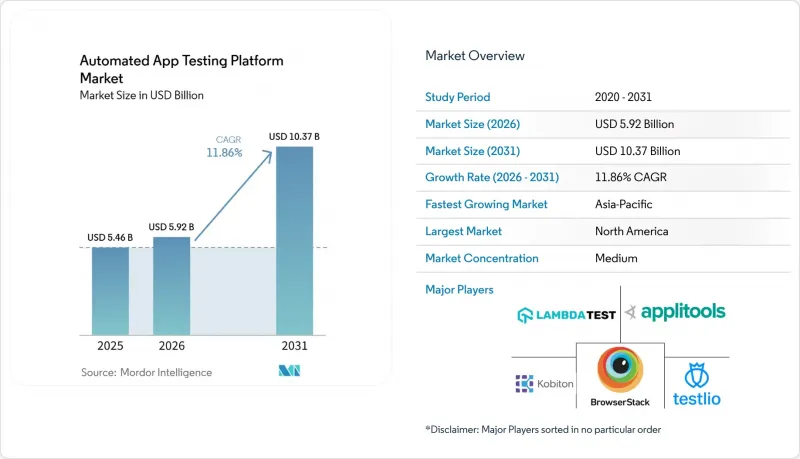
본 보고서는 구성 요소(소프트웨어 및 서비스), 테스트 대상 용도(웹 용도 등), 도입 모델(클라우드, 하이브리드, On-Premise), 기업 규모(대기업 및 중소기업), 최종 사용자(IT 및 통신, 자동차 및 운송 등), 그리고 지역별로 분류되어 있습니다. 시장 예측은 금액(달러) 기준으로 제시되어 있습니다.
세계 자동 앱 테스트 플랫폼 시장 동향 및 인사이트
AI를 활용한 테스트 생성 및 자가 복구형 자동화가 플랫폼의 가치를 재정의
AI 기반 테스트 도구는 용도 인터페이스의 변경 사항을 식별하고, 수동 개입을 최소화하면서 영향을 받는 테스트 단계를 업데이트할 수 있습니다. 이는 유지보수 작업이 본래 커버리지 향상, 결함 조사, 그리고 장애가 실제 제품 문제를 반영하는지 확인하는 데 사용되어야 할 팀의 자원을 소모할 가능성이 있기 때문에 중요한 점입니다. 자가 복구 기능은 테스트를 인터페이스 변경 사항에 지속적으로 적응시키는 것을 목표로 하며, 이를 통해 소프트웨어를 빈번하게 출시하는 팀의 자동 테스트 신뢰성이 향상됩니다. 2026년, 설문조사에 참여한 QA 팀에게 AI는 가장 큰 투자 우선순위였으며, 응답자의 61%가 AI 생성 코드에 대한 테스트 수요가 ‘중간 정도에서 대폭’ 증가했다고 보고했습니다. 따라서 자동 앱 테스트 플랫폼 시장은 코드 생성량 증가와 출시 전 검증 수요 증가라는 두 가지 이점을 모두 누리고 있습니다. Tricentis는 2025 회계연도에 사상 최대의 연간 반복 수익(ARR) 5억 달러를 기록했으며, 이러한 실적을 에이전트 기반 품질 엔지니어링 기능에 대한 기업 수요에 기인한 것이라고 설명했습니다.
애자일 및 DevOps 릴리스 주기의 가속화가 기본 수요를 뒷받침하고 있습니다.
릴리스 주기가 단축됨에 따라 소프트웨어가 사용자에게 전달되기 전에 수동 테스트를 완료하기는 어려워지고 있습니다. 지속적 통합(CI) 및 지속적 배포(CD)를 채택한 팀은 별도의 테스트 단계를 거친 후가 아니라, 코드 변경 사항이 커밋된 시점에서 테스트를 실행해야 합니다. 자동화된 검사를 통해 개발자는 변경 사항이 기존 기능에 영향을 미쳤는지, 혹은 관련 서비스에 오류를 유발했는지에 대한 정보를 더 이른 단계에서 파악할 수 있습니다. 2026년 기준으로, 조사 대상 QA 팀 중 DevOps 파이프라인과 완전히 또는 거의 완전히 통합된 팀은 고작 26%에 불과하여, 파이프라인과 연동된 테스트 도구의 도입 여지가 남아 있습니다. 이러한 격차는 배포 도구를 도입한 조직과 여전히 고립된 테스트 프로세스에 의존하는 조직 모두에게 자동 앱 테스트 플랫폼 시장에서 분명한 기회로 작용하고 있습니다. Mabl사의 보고서에 따르면, AI 지원 테스트를 도입한 팀은 2024년 기준에 비해 코드 배포 속도를 46% 향상시켰습니다고 합니다.
고급 자동화 프레임워크의 유지보수 부담이 투자 대비 효과를 저해한다.
취약한 인터페이스 선택기를 중심으로 구축된 대규모 테스트 스위트는 기반이 되는 비즈니스 기능이 여전히 정상적으로 작동하고 있더라도 화면이 변경된 것만으로 실패할 가능성이 있습니다. 그 결과, 팀은 용도 변경 사항을 평가하기 전에 테스트 수정 작업에 시간을 할애해야 하며, 이는 개발자에 대한 피드백이 지연될 뿐만 아니라 테스트 프로세스에 대한 신뢰도 저하로 이어질 우려가 있습니다. 동일한 인터페이스 변경이 관련 사용자 여정을 포괄하는 여러 테스트에 영향을 미치는 경우, 이 문제는 더욱 복잡해집니다. 2026년에는 QA 테스트의 57%가 자동화되었지만, 유지 관리에는 QA 팀의 역량의 약 5분의 1이 소요되었습니다. 이로 인해 자동 앱 테스트 플랫폼 시장에는 인재 유출의 위험이 발생하고 있습니다. 불만을 품은 사용자들은 자동화를 업무 부담을 줄이는 수단이 아니라 새로운 업무의 원천으로 간주할 가능성이 있기 때문입니다. 2025년 Tricentis Japan이 401명의 기업 IT 관리자를 대상으로 실시한 조사에 따르면, 일본 대기업의 64%에서 테스트 자동화 커버리지가 60% 미만이며, 특히 통합 테스트와 인수 테스트의 지연이 두드러지는 것으로 나타났습니다.
부문 분석
2025년에는 소프트웨어가 매출의 72.41%를 차지하며 자동 앱 테스트 플랫폼 시장에서 가장 큰 구성 요소가 되었습니다. 기업들은 테스트 스크립트 작성, 개발 파이프라인과의 통합, 보고서 작성을 위해 계속해서 소프트웨어 플랫폼을 활용하고 있습니다. 서비스 부문은 2031년까지 연평균 성장률(CAGR) 14.82%를 나타낼 것으로 예측되며, 이는 구성 요소 유형 중 가장 높은 성장률입니다. 이러한 추세는 플랫폼 접근권과 테스트 전문 지식을 포함하는 관리형 서비스를 선호하는 구매자가 일부 존재함을 반영합니다. Testlio와 Qualitest는 플랫폼 접근 권한과 관리형 QA 지원을 결합한 제공업체의 예입니다. 이러한 계약 형태에서는 고객이 사내에 완전한 체계를 구축할 필요가 없으며, 테스트 범위 확보 및 결함 대응에 대한 책임을 제공업체에 맡길 수 있습니다.
또한, 이 서비스 모델은 자체 관리형 도구 도입을 제한하는 기술 인력 부족 문제에도 대응하고 있습니다. 충분한 수의 테스트 자동화 엔지니어를 채용할 수 없는 조직은 자동화를 미루는 대신 테스트 지원을 구매할 가능성이 있습니다. 따라서 이 서비스는 성장의 원천인 동시에, 보다 단순한 도구에 대한 충족되지 않은 수요의 증거이기도 합니다. AI를 통해 테스트 작성 및 유지보수 작업의 자동화가 진행됨에 따라, 소프트웨어 및 서비스의 경계는 점점 더 모호해질 가능성이 있습니다. 플랫폼 제공업체는 더 폭넓은 고객의 QA 요구를 충족시키기 위해 파트너십 구축이나 인수를 추진할 수 있습니다. ‘자동 앱 테스트 플랫폼 시장’에서 이러한 접근 방식은 테스트 요구 사항이 변화하는 상황에서도 벤더가 고객과의 관계를 유지하는 데 도움이 될 수 있습니다.
웹 용도는 2025년 매출의 28.19%를 차지하며, 용도 유형 중 가장 큰 비중을 차지하고 있습니다. 브라우저 기반 용도는 기업이 서비스를 제공하는 일반적인 수단으로 자리 잡고 있으며, 브라우저 테스트 도구도 충분히 정착되어 있습니다. IoT 및 임베디드 용도는 2031년까지 연평균 성장률(CAGR) 15.43%를 나타낼 것으로 예측되며, 이 부문에서 가장 높은 성장률을 보이고 있습니다. 연결 기기는 제조, 의료, 물류 분야에서 확대되고 있습니다. 이러한 도입에는 기기 소프트웨어, 펌웨어, 용도 및 이에 연결된 서비스의 테스트가 필요합니다. 또한 팀이 다양한 기기 및 OS 버전에 걸친 테스트 범위를 필요로 하기 때문에 모바일 애플리케이션도 여전히 중요한 수요 원천으로 남아 있습니다.
데스크톱 앱은 여전히 브라우저에 의존하지 않는 환경이 요구되는 은행업 및 행정 분야에서 중요한 역할을 계속하고 있습니다. 소프트웨어 기능이 연결된 서비스를 통해 제공되는 사례가 증가함에 따라 API 및 마이크로서비스의 중요성이 높아지고 있습니다. Postman의 보고서에 따르면, 2026년에는 조직의 82%가 ‘API 우선’ 접근 방식을 채택했습니다. 웹, 모바일, API, 임베디드 각 계층에 걸친 테스트를 통합적으로 관리할 수 있는 단일 플랫폼이 있다면, 개별 도구를 관리해야 하는 부담을 줄일 수 있습니다. 이 기능은 자동 앱 테스트 플랫폼 시장에 있어 중요한 의미를 지닙니다. 왜냐하면 기업의 구매 담당자들은 서로 다른 용도 환경 전반에 걸쳐 일관된 보고서를 요구하고 있기 때문입니다. 이러한 계층 전반에 걸쳐 비즈니스 동작을 확인할 수 있는 벤더는 특정 테스트 범주에 초점을 맞춘 제공업체에 비해 우위를 점하고 있습니다.
지역별 분석
북미는 2025년 매출의 34.62%를 차지하며 지역별 최대 점유율을 기록했습니다. 이 지역에는 클라우드 제공업체, SaaS(Software-as-a-Service) 기업, 그리고 빈번한 릴리스 일정을 가진 기업 소프트웨어 개발 기업이 고밀도로 집적되어 있습니다. Tricentis는 2025 회계연도 연간 경상 수익이 5억 달러에 달했다고 보고했으며, 포춘 500대 기업의 60% 이상이 자사의 고객 기반에 포함되어 있다고 밝혔습니다. 이는 해당 지역에서 품질 엔지니어링에 대한 기업 수요가 높음을 반영합니다. 접근성 및 데이터 개인정보 보호에 관한 요구 사항 또한 기업이 디지털 서비스를 출시 전에 테스트해야 하는 또 다른 이유가 되고 있습니다.
유럽에서는 데이터 보호, 접근성, 그리고 금융 서비스 및 헬스케어 분야의 산업별 의무가 주요 동력이 되고 있습니다. 이러한 요건들로 인해 규정 준수 관련 테스트 기능을 제공하는 플랫폼이 우위를 점하고 있습니다. 독일과 영국은 여전히 유럽에서 중요한 국가이며, 독일에서는 산업 제조를 통해 임베디드 및 IoT 테스트에 대한 수요도 발생하고 있습니다. 남미는 도입 초기 단계에 있으며, 제공된 조사에서는 브라질과 아르헨티나가 주요 도입국으로 꼽혔습니다. OECD의 분석에 따르면, 비용 장벽과 클라우드 인프라 부족이 해당 지역 중소기업의 AI 도입을 제약하는 요인이 될 수 있는 것으로 밝혀졌습니다. 클라우드를 통해 제공되는 서비스와 사용량 기반 과금 모델은 자동 앱 테스트 플랫폼 시장이 이들 국가의 더 많은 조직으로 확산되는 데 기여할 것입니다.
아시아태평양은 2031년까지 연평균 성장률(CAGR) 15.18%를 나타낼 것으로 예측되며, 지역별로는 가장 높은 성장률을 기록할 전망입니다. 스마트폰의 보급, ‘디지털 퍼스트’ 비즈니스 활동, 그리고 소프트웨어 품질에 대한 관심 증대가 이 지역의 성장을 뒷받침하고 있습니다. 일본에서는 2025년 후반 조사 대상이었던 401명의 기업 IT 관리자 중 97.5%가 소프트웨어 품질 리스크를 인식하고 있는 반면, 64%는 테스트 자동화 적용률이 60% 미만이라고 보고했습니다. 인도는 세계 역량 센터 및 테스트 제공 서비스를 통해 조기 도입 지역으로 부상하고 있습니다. 중동에서는 특히 사우디아라비아와 아랍에미리트에서 정부 관련 디지털 프로그램에 따른 수요가 나타나고 있습니다. 아프리카는 여전히 인프라 제약에 직면해 있지만, 클라우드를 통한 플랫폼을 활용하여 시장에 진입할 기회를 얻을 수 있습니다.
기타 혜택:
- 엑셀 형식 시장 예측(ME) 시트
- 3개월간의 애널리스트 지원
자주 묻는 질문
목차
제1장 서론
제2장 조사 방법
제3장 개요
제4장 시장 구도
제5장 시장 규모와 성장 예측
제6장 경쟁 구도
제7장 시장 기회와 향후 전망
JHS 26.09.01According to Mordor Intelligence, the automated app testing platform market size was valued at USD 5.46 billion in 2025 and is estimated to grow from USD 5.92 billion in 2026 to reach USD 10.37 billion by 2031, at a CAGR of 11.9% during the forecast period from 2026 to 2031.
This report is Segmented by Component (Software, and Services), Application Under Test (Web Applications, and More), Deployment Model (Cloud, Hybrid, and On-Premises), Enterprise Size (Large Enterprises, and Small and Medium-Sized Enterprises), End User (IT and Telecommunication, Automotive and Transportation, and More), and Geography. The Market Forecasts are Provided in Terms of Value (USD).
Global Automated App Testing Platform Market Trends and Insights
AI Driven Test Creation and Self Healing Automation Redefine Platform Value
AI-based testing tools can identify changes to an application interface and update affected test steps with less manual intervention. This matters because maintenance work can consume capacity that teams would otherwise use to improve coverage, investigate defects, and review whether a failure reflects a genuine product issue. Self-healing functions are intended to keep tests aligned with interface changes, thereby making automated testing more reliable for teams that frequently release software. In 2026, AI was the leading investment priority for surveyed QA teams, and 61% of respondents reported a moderate to significant increase in testing demand for AI-generated code. The Automated App Testing Platform Market is therefore benefiting from both increased code production and a greater need to validate it before release. Tricentis reported record annual recurring revenue of USD 500 million for fiscal 2025 and linked its performance to enterprise demand for agentic quality engineering capabilities.
Accelerating Agile and DevOps Release Cadence Sustains Baseline Demand
Shorter release cycles make manual testing difficult to complete before the software reaches users. Teams using continuous integration and continuous delivery need test execution to begin when code changes are submitted rather than after a separate testing phase. Automated checks can provide developers with earlier information on whether a change affected an existing function or introduced a failure in a connected service. Only 26% of surveyed QA teams were fully or mostly integrated with their DevOps pipelines in 2026, leaving room for more pipeline-connected testing tools. This gap presents the Automated App Testing Platform Market with a clear opportunity for organizations that have adopted delivery tools but still rely on disconnected testing processes. Mabl reported that teams using AI assisted testing increased code deployment speed by 46% compared with 2024 baselines.
High Automation Framework Maintenance Burden Erodes Return on Investment
Large test suites built around fragile interface selectors can fail when a screen changes, even if the underlying business function still works. Teams must then spend time fixing tests before they can assess the application change, which can delay feedback for developers and reduce confidence in the testing process. The problem becomes more difficult when the same interface change affects several tests that cover related user journeys. In 2026, 57% of QA tests were automated, while maintenance accounted for around 1/5 of the QA team's capacity. This creates a retention risk for the Automated App Testing Platform Market because dissatisfied users may see automation as another source of work rather than a way to reduce it. A 2025 Tricentis Japan survey of 401 enterprise IT managers found that 64% of major Japanese companies had test automation coverage below 60%, with integration and acceptance testing lagging the most.
Other drivers and restraints analyzed in the detailed report include:
- API and Microservices Expansion Widening Regression Scope
- Cloud Device Labs Democratizing Real Device Coverage
- Automation Skills Gaps and Legacy System Integration Slow Enterprise Adoption
For complete list of drivers and restraints, kindly check the Table Of Contents.
Segment Analysis
Software accounted for 72.41% of revenue in 2025, making it the largest component of the Automated App Testing Platform Market. Enterprises continue to use software platforms for test scripting, development pipeline integration, and reporting. Services are projected to grow at a 14.82% CAGR through 2031, the highest rate among component types. This pattern reflects a preference among some buyers for managed engagements that include platform access and testing expertise. Testlio and Qualitest are examples of providers that combine platform access with managed QA support. Such arrangements can place responsibility for coverage and defect handling with the provider, rather than requiring the customer to build the full capability internally.
The service model also addresses the skills shortage that limits the adoption of self-managed tools. Organizations that cannot hire enough test automation engineers may purchase testing support rather than postpone automation. That makes services both a source of growth and evidence of unmet demand for simpler tools. The boundary between software and services may become less distinct as AI automates more test creation and maintenance work. Platform providers can pursue partnerships or acquisitions to serve a broader set of customers' QA needs. In the Automated App Testing Platform Market, this approach may help vendors retain customer relationships as testing needs change.
Web applications accounted for 28.19% of 2025 revenue, the largest share across application types. Browser-based applications remain a common way for enterprises to deliver services, and browser testing tools are well established. IoT and embedded applications are forecast to grow at a 15.43% CAGR through 2031, the fastest rate in this segmentation. Connected devices are expanding across manufacturing, healthcare, and logistics. These deployments require testing of device software, firmware, applications, and their connected services. Mobile applications also remain an important source of demand because teams need coverage across devices and operating system versions.
Desktop applications remain relevant in banking and public administration, where browser independence can still be required. APIs and microservices have become more important because software functions are increasingly delivered through connected services. Postman reported that 82% of organizations used an API-first approach in 2026. A single platform that coordinates testing across web, mobile, APIs, and embedded layers can reduce the need to manage separate tools. This capability is relevant to the Automated App Testing Platform Market because enterprise buyers are seeking consistent reporting across different application environments. Vendors that can check business behavior across these layers have an advantage over providers focused on one test category.
Complete Report Scope:
- By Component
- Software
- Services
- By Application Under Test
- Web Applications
- Mobile Applications
- Desktop Applications
- APIs and Microservices
- IoT and Embedded Applications
- By Deployment Model
- Cloud
- Hybrid
- On-Premises
- By Enterprise Size
- Large Enterprises
- Small and Medium-Sized Enterprises
- By End User
- IT and Telecommunication
- BFSI
- Automotive and Transportation
- Healthcare and Life Sciences
- Retail and E-Commerce
- Industrial Manufacturing
- Education and Research Institutions
- Government and Administration
- Energy and Utilities
- Other End Users
- By Geography
- North America
- United States
- Canada
- Mexico
- South America
- Brazil
- Argentina
- Rest of South America
- Europe
- Germany
- United Kingdom
- France
- Russia
- Spain
- Rest of Europe
- Asia-Pacific
- China
- Japan
- India
- South Korea
- Southeast Asia
- Rest of Asia-Pacific
- Middle East and Africa
- Middle East
- Saudi Arabia
- United Arab Emirates
- Rest of Middle East
- Africa
- South Africa
- Nigeria
- Rest of Africa
- Middle East
- North America
Geography Analysis
North America held 34.62% of 2025 revenue, the largest regional share. The region has a high concentration of cloud providers, software-as-a-service companies, and enterprise software developers with frequent release schedules. Tricentis reported USD 500 million in annual recurring revenue for fiscal 2025 and stated that more than 60% of Fortune 500 companies were in its customer base. This reflects the depth of enterprise demand for quality engineering in the region. Accessibility and data privacy requirements add another reason for companies to test digital services before release.
Europe is driven by data protection, accessibility, and sector-specific obligations in financial services and healthcare. These requirements favor platforms that provide compliance-related testing capabilities. Germany and the United Kingdom remain important European countries, with Germany also generating demand for embedded and IoT testing through industrial manufacturing. South America is at an earlier stage of adoption, with Brazil and Argentina identified as leading adopters in the supplied research. OECD analysis found that cost barriers and limited cloud infrastructure can constrain SME AI adoption in the region. Cloud-delivered and use-based offerings can help the Automated App Testing Platform Market reach more organizations in these countries.
Asia-Pacific is forecast to grow at a 15.18% CAGR through 2031, the fastest regional rate. Smartphone use, digital-first business activity, and a growing focus on software quality support the region's expansion. In Japan, 97.5% of 401 enterprise IT managers surveyed in late 2025 recognized software quality risk, while 64% reported test automation coverage below 60%. India is becoming an early adopter location through its global capability centers and testing delivery work. The Middle East is seeing demand from government-linked digital programs, particularly in Saudi Arabia and the United Arab Emirates. Africa remains constrained by infrastructure, but can gain access through cloud-delivered platforms.
- Applause App Quality, Inc.
- Applitools Ltd.
- BrowserStack Limited
- Cigniti Technologies Limited
- Global App Testing Ltd.
- HeadSpin, Inc.
- International Business Machines Corporation
- Katalon, Inc.
- Kobiton, Inc.
- LambdaTest, Inc.
- Leapwork A/S
- mabl Inc.
- OpenText Corporation
- Parasoft Corporation
- Perfecto Mobile Ltd. (Perforce Software)
- Qualitest Group Ltd.
- QA Wolf, LLC
- Rainforest QA, Inc.
- Ranorex GmbH
- Sauce Labs Inc.
- SmartBear Software, Inc.
- Testlio Inc.
- TestMu AI, Inc. (formerly LambdaTest)
- Tricentis GmbH
- Worksoft, Inc.
Additional Benefits:
- The market estimate (ME) sheet in Excel format
- 3 months of analyst support
TABLE OF CONTENTS
1 INTRODUCTION
- 1.1 Study Assumptions and Market Definition
- 1.2 Scope of the Study
2 RESEARCH METHODOLOGY
3 EXECUTIVE SUMMARY
4 MARKET LANDSCAPE
- 4.1 Market Overview
- 4.2 Market Drivers
- 4.2.1 Accelerating Agile and DevOps Release Cadence
- 4.2.2 Rising Mobile Application and Device-OS Fragmentation
- 4.2.3 AI-Driven Test Creation and Self-Healing Automation
- 4.2.4 Cloud Device Labs Lowering the Cost of Real-Device Coverage
- 4.2.5 Accessibility and Privacy Validation Becoming Release Gates
- 4.2.6 API and Microservices Expansion Increasing Regression Scope
- 4.3 Market Restraints
- 4.3.1 High Automation Framework Maintenance Burden
- 4.3.2 Fragmented Device and Operating-System Ecosystems
- 4.3.3 Data Privacy Constraints in Cloud and AI Testing
- 4.3.4 Automation Skills Gaps and Legacy-System Integration
- 4.4 Impact of Macroeconomic Factors on the Market
- 4.5 Industry Value-Chain Analysis
- 4.6 Technology Outlook
- 4.7 Regulatory Landscape
- 4.8 Porter's Five Forces Analysis
- 4.8.1 Threat of New Entrants
- 4.8.2 Bargaining Power of Suppliers
- 4.8.3 Bargaining Power of Buyers
- 4.8.4 Threat of Substitutes
- 4.8.5 Intensity of Competitive Rivalry
5 MARKET SIZE AND GROWTH FORECASTS (VALUE)
- 5.1 By Component
- 5.1.1 Software
- 5.1.2 Services
- 5.2 By Application Under Test
- 5.2.1 Web Applications
- 5.2.2 Mobile Applications
- 5.2.3 Desktop Applications
- 5.2.4 APIs and Microservices
- 5.2.5 IoT and Embedded Applications
- 5.3 By Deployment Model
- 5.3.1 Cloud
- 5.3.2 Hybrid
- 5.3.3 On-Premises
- 5.4 By Enterprise Size
- 5.4.1 Large Enterprises
- 5.4.2 Small and Medium-Sized Enterprises
- 5.5 By End User
- 5.5.1 IT and Telecommunication
- 5.5.2 BFSI
- 5.5.3 Automotive and Transportation
- 5.5.4 Healthcare and Life Sciences
- 5.5.5 Retail and E-Commerce
- 5.5.6 Industrial Manufacturing
- 5.5.7 Education and Research Institutions
- 5.5.8 Government and Administration
- 5.5.9 Energy and Utilities
- 5.5.10 Other End Users
- 5.6 By Geography
- 5.6.1 North America
- 5.6.1.1 United States
- 5.6.1.2 Canada
- 5.6.1.3 Mexico
- 5.6.2 South America
- 5.6.2.1 Brazil
- 5.6.2.2 Argentina
- 5.6.2.3 Rest of South America
- 5.6.3 Europe
- 5.6.3.1 Germany
- 5.6.3.2 United Kingdom
- 5.6.3.3 France
- 5.6.3.4 Russia
- 5.6.3.5 Spain
- 5.6.3.6 Rest of Europe
- 5.6.4 Asia-Pacific
- 5.6.4.1 China
- 5.6.4.2 Japan
- 5.6.4.3 India
- 5.6.4.4 South Korea
- 5.6.4.5 Southeast Asia
- 5.6.4.6 Rest of Asia-Pacific
- 5.6.5 Middle East and Africa
- 5.6.5.1 Middle East
- 5.6.5.1.1 Saudi Arabia
- 5.6.5.1.2 United Arab Emirates
- 5.6.5.1.3 Rest of Middle East
- 5.6.5.2 Africa
- 5.6.5.2.1 South Africa
- 5.6.5.2.2 Nigeria
- 5.6.5.2.3 Rest of Africa
- 5.6.5.1 Middle East
- 5.6.1 North America
6 COMPETITIVE LANDSCAPE
- 6.1 Market Concentration
- 6.2 Strategic Moves
- 6.3 Market Share Analysis
- 6.4 Company Profiles (includes Global Level Overview, Market Level Overview, Core Segments, Financials as available, Strategic Information, Market Rank/Share, Products and Services, Recent Developments)
- 6.4.1 Applause App Quality, Inc.
- 6.4.2 Applitools Ltd.
- 6.4.3 BrowserStack Limited
- 6.4.4 Cigniti Technologies Limited
- 6.4.5 Global App Testing Ltd.
- 6.4.6 HeadSpin, Inc.
- 6.4.7 International Business Machines Corporation
- 6.4.8 Katalon, Inc.
- 6.4.9 Kobiton, Inc.
- 6.4.10 LambdaTest, Inc.
- 6.4.11 Leapwork A/S
- 6.4.12 mabl Inc.
- 6.4.13 OpenText Corporation
- 6.4.14 Parasoft Corporation
- 6.4.15 Perfecto Mobile Ltd. (Perforce Software)
- 6.4.16 Qualitest Group Ltd.
- 6.4.17 QA Wolf, LLC
- 6.4.18 Rainforest QA, Inc.
- 6.4.19 Ranorex GmbH
- 6.4.20 Sauce Labs Inc.
- 6.4.21 SmartBear Software, Inc.
- 6.4.22 Testlio Inc.
- 6.4.23 TestMu AI, Inc. (formerly LambdaTest)
- 6.4.24 Tricentis GmbH
- 6.4.25 Worksoft, Inc.
7 MARKET OPPORTUNITIES AND FUTURE OUTLOOK
- 7.1 White-Space and Unmet-Need Assessment


