

|
시장보고서
상품코드
2118105
기업 지식 관리 및 검색 분야 생성형 AI 시장 : 시장 점유율 분석, 업계 동향 및 통계, 성장 예측(2026-2031년)Generative AI In Enterprise Knowledge Management and Search - Market Share Analysis, Industry Trends & Statistics, Growth Forecasts (2026 - 2031) |
||||||
 Mordor Intelligence
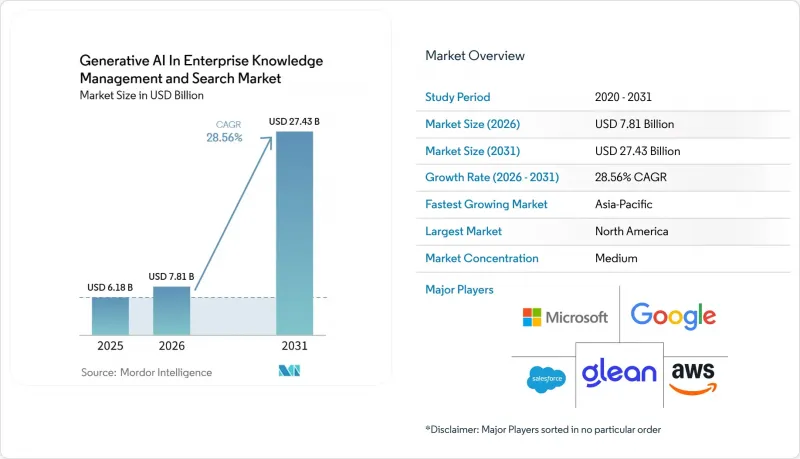
Mordor Intelligence에 의하면, 기업 지식 관리 및 검색 분야 생성형 AI시장 규모는 2025년 61억 8,000만 달러로 평가되었고, 2026년에는 78억 1,000만 달러로 추정되고, 2031년까지 274억 3,000만 달러에 이를 것으로 예상되며, 2026-2031년 CAGR 28.56%로 성장할 전망입니다.
본 보고서는 제공 제품별(소프트웨어 플랫폼 및 서비스), 배포 방식별(클라우드, 온프레미스, 하이브리드), 기업 규모별(대기업 및 중소기업), 최종 사용자별(IT 및 통신, 은행, 금융서비스 및 보험(BFSI), 헬스케어 및 생명과학, 제조업, 소매 및 전자상거래, 정부·공공 부문, 기타), 지역별로 분류되어 있습니다. 시장 예측은 금액(달러) 기준으로 제시되어 있습니다.
기업 지식 관리 및 검색 분야 생성형 AI 시장 동향 및 인사이트
SaaS 스택 전반에 걸친 기업 지식의 파편화 심화
기업에서는 대개 개별 데이터 모델, 접근 제어, 인덱스를 가진 125개 이상의 SaaS 용도를 운영하고 있습니다. 이러한 구조에서는 공유된 인텔리전스 계층이 없으면 시스템 전반에 걸친 정보 검색이 어려워집니다. Salesforce, Confluence, Slack, ServiceNow 등에서 분리된 데이터는 AI 프로그램의 확장에 따라 답변의 질을 저하시킬 가능성이 있습니다. 지식 근로자는 정보를 찾거나 도움을 줄 수 있는 동료를 파악하는 데 막대한 시간을 소비하게 됩니다. 거버넌스가 적용된 지식 그래프를 도입하면, 각 AI 에이전트를 고립된 저장소에 개별적으로 연결하는 대신 공통된 기반을 제공할 수 있습니다. 따라서 기업이 지식 통합을 아키텍처상의 우선순위로 삼음으로써, 기업의 지식 관리 및 검색 분야의 생성형 AI 시장은 혜택을 받게 될 것입니다.
권한을 고려한 시맨틱 검색과 근거 있는 답변에 대한 수요
기밀 정보에 대한 무단 접근이 법적 위험이나 평판 저하를 초래하기 때문에 시맨틱 검색이 주목받고 있습니다. 기존 키워드 검색 시스템은 직원의 현재 역할을 반영하지 않는 정적인 권한 캐시에 의존하는 경우가 있습니다. 이러한 취약점은 감사를 통해 무단 접근이 밝혀질 때까지 간과될 가능성이 있습니다. 아마존 웹 서비스(Amazon Web Services)는 2026년 6월, 관리형 검색 확장 생성 서비스에서 실시간 접근 제어 목록(ACL) 적용 기능을 갖춘 ‘Amazon Bedrock Managed Knowledge Base’의 일반 제공을 시작했습니다. 권한 적용은 용도 설정이라기보다는 인프라의 기능으로 자리 잡고 있습니다. 금융 서비스, 의료, 정부 기관의 구매 담당자들은 기업의 지식 관리 및 검색 분야의 생성형 AI 시장에서 검색 시 권한의 정확성을 벤더 선정 요건으로 삼고 있습니다.
AI가 생성한 부정확하거나 검증 불가능한 답변에 수반되는 ‘환각’ 위험과 기업 내 신뢰의 한계
환각적인 답변은 법적 조사, 규정 준수 보고, 임상 의사 결정 지원 분야에서 여전히 중대한 우려 사항으로 남아 있습니다. 기반 모델은 확률론적이며, 오류가 발생할 경우 해당 추론을 검증하기 어려운 경우가 있습니다. MIT CISR은 이러한 불투명성을 조직이 배제해야할 것이 아니라 관리해야 할 구조적 문제로 규정했습니다. 규제 대상 분야의 조달 팀은 답변을 검증할 수 없는 경우 도입을 연기할 수 있습니다. 인용 정보를 기반으로 한 출력을 통해 직원은 기술된 내용을 검색 가능한 문서까지 거슬러 올라갈 수 있습니다. 출처를 명확히 밝히는 벤더는 기업의 지식 관리 및 검색 분야에서 생성형 AI 시장의 핵심적인 신뢰 장벽을 해결하는 데 있어 더 유리한 입장에 있습니다.
부문 분석
2025년, 소프트웨어 플랫폼은 기업 지식 관리 및 검색 분야 생성형 AI 시장 점유율의 73.64%를 차지했습니다. 인덱싱 엔진, 오케스트레이션 계층, 권한 그래프는 지식 검색 시스템의 기반을 형성합니다. 구매자는 일반적으로 더 광범위한 이용 사례를 전개하기 전에 이 인프라를 필요로 합니다. 마이크로소프트, 구글, 아마존 웹 서비스(AWS)는 기존 기업 계약에 플랫폼 기능을 통합할 수 있습니다. 이를 통해 플랫폼 조달은 더 광범위한 인프라 구축 노력의 연장선상에 위치하게 됩니다. 또한, 플랫폼에 대한 수요는 공통된 제어 체계 하에서 다수의 저장소를 연동해야 할 필요성을 반영하고 있습니다.
서비스 시장은 2026-2031년 연평균 성장률(CAGR) 29.47%를 나타낼 것으로 예측됩니다. 조직은 초기 도입 후 도메인별 튜닝, 검색 파이프라인 최적화, 거버넌스 설계에 대한 지원을 필요로 합니다. 이러한 요구 사항은 대개 단일 도입 프로젝트의 범위를 넘어섭니다. 또한 시스템이 단일 쿼리 처리를 넘어 발전함에 따라 에이전트형 워크플로우에도 지속적인 변경이 필요해집니다. 따라서 서비스 수익은 일회성 설정에서 지속적인 작업으로 전환될 가능성이 있습니다. Salesforce는 2026년 봄 릴리스에서 ‘Agentic Enterprise Search’를 도입했습니다. 이는 200개 이상의 외부 소스에서 얻은 컨텍스트를 활용하고, 여러 AI 에이전트를 연동하는 기능입니다. 이 제품의 방향성은 기업의 지식 관리 및 검색 분야 생성형 AI 시장에서 서비스 요구 사항이 플랫폼 아키텍처의 일부로 자리 잡고 있음을 보여줍니다.
2025년 기준으로, 기업의 지식 관리 및 검색 분야 생성형 AI 시장의 78.21%를 클라우드 도입이 차지했습니다. 관리형 수집 파이프라인, 유연한 인덱싱, SaaS 커넥터가 이러한 도입 추세를 뒷받침하고 있습니다. 클라우드 서비스를 이용하면 일반적인 엔터프라이즈 용도과의 연동이 용이해집니다. 또한 조직이 핵심 검색 인프라를 사내에서 관리해야 할 필요성도 줄어듭니다. 이러한 이점은 데이터 소스가 빈번하게 변경되는 경우에 특히 중요합니다. 보다 신속한 도입을 원하는 조직에게 클라우드 모델은 여전히 주요 선택지로 남아 있습니다.
하이브리드 배포는 2031년까지 연평균 성장률(CAGR) 29.92%를 나타낼 것으로 예측됩니다. 규제 대상 문서, 레거시 스토어, 고도의 보안이 요구되는 리포지토리의 경우, 클라우드를 통한 오케스트레이션 외에도 로컬에서의 색인 생성이 필요할 수 있습니다. 엄격한 데이터 상주 요건으로 인해 국방, 금융 서비스, 의료 분야에서는 온프레미스 시스템이 여전히 중요하게 여겨지고 있습니다. IBM의 watsonx.data Context 기능은 프로세스에 거버넌스를 적용하면서 하이브리드 환경 전반에 걸친 검색을 지원합니다. 하이브리드 배포를 통해 기밀 데이터에 대한 접근성을 유지하면서 최신 오케스트레이션 도구도 지원할 수 있습니다. 따라서 기업의 지식 관리 및 검색 분야의 생성형 AI 시장에서 다양한 기술 환경을 갖춘 조직에게 하이브리드 배포는 중요한 선택지가 됩니다.
지역별 분석
2025년, 북미는 기업 지식 관리 및 검색 분야 생성형 AI 시장 점유율의 40.86%를 차지했습니다. 이 지역은 SaaS 기반 기업과 클라우드 인프라가 고도로 집중되어 있다는 이점을 누리고 있습니다. 미국은 전체 제품 스택에 걸쳐 수요를 주도하고 있습니다. 포춘 500대 기업의 구매자, 기술 기업, 확고한 벤더 기반이 이러한 위상을 뒷받침하고 있습니다. 조직이 AI 관련 지출을 통합함에 따라 전용 지식 플랫폼이 점차 보급되고 있습니다. 캐나다에서는 수요가 확대되고 있으며, 멕시코에서는 AI를 활용한 지식 운영을 구축하고 있는 공유 서비스 센터가 성장 동력이 되고 있습니다.
아시아태평양은 2031년까지 연평균 성장률(CAGR) 30.74%를 나타낼 것으로 예측됩니다. 중국, 인도, 한국, 호주에서는 기업의 디지털화 활동이 활발해지고 있습니다. 인도의 기술 서비스 부문은 국내 기업 및 다국적 기업 수요를 뒷받침하고 있습니다. 다국어 검색은 지역별로 다양한 인재 구성을 가진 노동력에게 중요합니다. 한국의 제조 그룹과 통신사는 기술 문서에 대해 도메인 특화형 검색을 활용하고 있습니다. 일본과 호주는 개인정보 보호 및 규정 준수에 대한 고려를 바탕으로 다소 완만한 속도로 진전하고 있습니다. OECD 보고서에 따르면, 2025년에도 아시아태평양 경제권 전체에서 대기업과 중소기업 간의 AI 도입 격차는 여전히 두드러졌습니다.
유럽은 기업의 지식 관리 및 검색 분야의 생성형 AI 시장에서 두 번째로 큰 지역입니다. 독일, 영국, 프랑스가 이 지역 기업 지출의 대부분을 차지하고 있습니다. EU의 AI법은 관련 AI 용도에 대해 투명성과 감독 요건을 규정하고 있습니다. 이로 인해 출처 정보나 접속 로그를 제공하는 플랫폼이 유리해집니다. 남미에서는 브라질과 아르헨티나의 금융 서비스 및 소매 산업에서 조기 도입이 진행되며 시장이 부상하고 있습니다. 사우디아라비아와 아랍에미리트(UAE)는 정부의 디지털화 프로그램을 통해 수요를 촉진하고 있습니다. 아프리카는 여전히 초기 단계에 있지만, 남아프리카공화국과 이집트는 금융 서비스 및 통신 부문에서 도입이 진전되고 있는 초기 상업 거점이 되고 있습니다.
기타 혜택
- 엑셀 형식 시장 예측(ME) 시트
- 3개월간의 애널리스트 지원
자주 묻는 질문
목차
제1장 서론
제2장 조사 방법
제3장 주요 요약
제4장 시장 구도
제5장 시장 규모 및 성장 예측
제6장 경쟁 구도
제7장 시장 기회 및 향후 전망
AJY 26.09.03According to Mordor Intelligence, the generative AI in enterprise knowledge management and search market size is expected to increase from USD 6.18 billion in 2025 to USD 7.81 billion in 2026 and reach USD 27.43 billion by 2031, growing at a CAGR of 28.56% over 2026-2031.
This report is Segmented by Offering (Software Platforms and Services), Deployment Mode (Cloud, On-Premises, and Hybrid), Enterprise Size (Large Enterprises and SMEs), End User (IT and Telecom, BFSI, Healthcare and Life Sciences, Manufacturing, Retail, Government, and Other End Users), and Geography. The Market Forecasts are Provided in Terms of Value (USD).
Global Generative AI In Enterprise Knowledge Management and Search Market Trends and Insights
Rising Enterprise Knowledge Fragmentation Across SaaS Stacks
Enterprises often operate more than 125 SaaS applications with separate data models, access controls, and indexes. This structure makes cross-system retrieval difficult without a shared intelligence layer. Disconnected data from Salesforce, Confluence, Slack, and ServiceNow can degrade answer quality as AI programs expand. Knowledge workers can spend substantial time locating information or identifying colleagues who can help. A governed knowledge graph can provide a common foundation instead of linking each AI agent to isolated repositories. The generative AI in enterprise knowledge management and search market therefore benefits when organizations treat knowledge unification as an architectural priority.
Demand for Permission-Aware Semantic Search and Grounded Answers
Semantic search is gaining attention because incorrect access to privileged information creates legal and reputational exposure. Older keyword systems can rely on static permission caches that do not reflect current employee roles. This weakness may remain hidden until an audit identifies unauthorized access. Amazon Web Services made Amazon Bedrock Managed Knowledge Base generally available in June 2026 with real-time access-control-list enforcement in a managed retrieval-augmented generation service. Permission enforcement is becoming an infrastructure capability rather than an application setting. Financial services, healthcare, and government buyers are making retrieval-time permission accuracy a vendor selection requirement in the generative AI in enterprise knowledge management and search market.
Hallucination Risk and Limited Enterprise Trust in Incorrect or Unverifiable AI-Generated Answers
Hallucinated answers remain a significant concern for legal research, compliance reporting, and clinical decision support. Foundation models are probabilistic, and their reasoning can be difficult to inspect when errors occur. MIT CISR identified this opacity as a structural issue that organizations must manage rather than eliminate. Procurement teams in regulated fields can delay deployment when answers cannot be verified. Citation-backed outputs allow employees to trace statements to a retrievable document. Vendors that provide source attribution are better placed to address a core trust barrier in the generative AI in enterprise knowledge management and search market.
Other drivers and restraints analyzed in the detailed report include:
- Shift From Static Search to Copilot-Led Knowledge Workflows
- Faster Retrieval of Tribal Knowledge for Hybrid and Distributed Teams
- Complex Integration With Legacy Repositories, Enterprise Applications, and Identity Systems
For complete list of drivers and restraints, kindly check the Table Of Contents.
Segment Analysis
Software platforms held 73.64% of the generative AI in enterprise knowledge management and search market share in 2025. Indexing engines, orchestration layers, and permission graphs form the foundation of knowledge retrieval systems. Buyers generally need this infrastructure before they can deploy a broader use case. Microsoft, Google, and Amazon Web Services can embed platform functions in existing enterprise agreements. This can make platform procurement an extension of wider infrastructure commitments. Platform demand also reflects the need to connect many repositories under a common set of controls.
Services are projected to grow at a CAGR of 29.47% from 2026 to 2031. Organizations need support for domain-specific tuning, retrieval-pipeline optimization, and governance design after initial implementation. These requirements often extend beyond a single deployment project. Agentic workflows also require continuing changes as systems move beyond single-turn queries. Service revenue can therefore shift toward recurring work rather than one-time configuration. Salesforce introduced Agentic Enterprise Search in its Spring 2026 release, using context from more than 200 external sources and coordinating multiple AI agents. This product direction shows how service requirements are becoming part of platform architecture in the generative AI in enterprise knowledge management and search market.
Cloud deployment held 78.21% of the generative AI in enterprise knowledge management and search market in 2025. Managed ingestion pipelines, elastic indexing, and SaaS connectors support this deployment preference. Cloud services can make it easier to connect common enterprise applications. They also reduce the need for organizations to manage core retrieval infrastructure internally. These benefits are especially relevant when data sources change frequently. The cloud model remains the main route for organizations seeking faster deployment.
Hybrid deployment is projected to grow at a CAGR of 29.92% through 2031. Regulated documents, legacy stores, and high-security repositories can require local indexing alongside cloud orchestration. On-premises systems remain relevant in defense, financial services, and healthcare due to strict data-residency requirements. IBM's watsonx.data Context capabilities support retrieval across hybrid environments with governance applied to the process. Hybrid deployments can preserve access to sensitive data while still supporting modern orchestration tools. This makes them relevant to organizations with mixed technology estates in the generative AI in enterprise knowledge management and search market.
Complete Report Scope:
- By Offering
- Software Platforms
- Services
- By Deployment Mode
- Cloud
- On-Premises
- Hybrid
- By Enterprise Size
- Large Enterprises
- Small and Medium Enterprises
- By End User
- IT and Telecom
- BFSI
- Healthcare and Life Sciences
- Manufacturing
- Retail and E-Commerce
- Government and Public Sector
- Other End Users
- By Geography
- North America
- United States
- Canada
- Mexico
- South America
- Brazil
- Argentina
- Rest of South America
- Europe
- Germany
- United Kingdom
- France
- Italy
- Spain
- Russia
- Rest of Europe
- Asia-Pacific
- China
- Japan
- India
- South Korea
- Australia
- Rest of Asia-Pacific
- Middle East
- Saudi Arabia
- United Arab Emirates
- Turkey
- Rest of Middle East
- Africa
- South Africa
- Egypt
- Rest of Africa
- North America
Geography Analysis
North America held 40.86% of the generative AI in enterprise knowledge management and search market share in 2025. The region benefits from a high concentration of SaaS-native enterprises and cloud infrastructure. The United States leads demand across the product stack. Fortune 500 buyers, technology companies, and a developed vendor base support this position. Dedicated knowledge platforms have gained traction as organizations consolidate AI spending. Canada contributes growing demand, while Mexico benefits from shared-service centers that are building AI-enabled knowledge operations.
Asia-Pacific is projected to grow at a CAGR of 30.74% through 2031. China, India, South Korea, and Australia are increasing enterprise digitalization activity. India's technology services sector supports demand from domestic enterprises and multinational clients. Multilingual retrieval is relevant for its varied regional workforce. South Korean manufacturing groups and telecom companies use domain-specific retrieval for engineering documentation. Japan and Australia are advancing more gradually, taking privacy and compliance considerations into account. The OECD reported that the gap in AI adoption between larger firms and SMEs remained pronounced across Asia-Pacific economies in 2025.
Europe is the second-largest regional area for the generative AI in enterprise knowledge management and search market. Germany, the United Kingdom, and France generate much of the region's enterprise spending. The EU AI Act creates transparency and oversight requirements for relevant AI applications. This favors platforms that provide citation provenance and access logs. South America is emerging, with early adoption in Brazilian and Argentine financial services and retail. Saudi Arabia and the United Arab Emirates are supporting demand through government digitalization programs. Africa remains at an earlier stage, with South Africa and Egypt among the initial commercial locations for financial services and telecommunications deployments.
- Microsoft Corporation
- Google LLC
- Amazon Web Services, Inc.
- Salesforce, Inc.
- Glean Technologies, Inc.
- ServiceNow, Inc.
- International Business Machines Corporation
- Elastic N.V.
- Coveo Solutions Inc.
- Lucidworks, Inc.
- Sinequa SAS
- Algolia SAS
- Open Text Corporation
- Guru Technologies, Inc.
- Atlassian Corporation Plc
- Notion Labs, Inc.
- Moveworks, Inc.
- Kore.ai, Inc.
- Vectara, Inc.
- SAP SE
Additional Benefits:
- The market estimate (ME) sheet in Excel format
- 3 months of analyst support
TABLE OF CONTENTS
1 INTRODUCTION
- 1.1 Study Assumptions and Market Definition
- 1.2 Scope of the Study
2 RESEARCH METHODOLOGY
3 EXECUTIVE SUMMARY
4 MARKET LANDSCAPE
- 4.1 Market Overview
- 4.2 Market Drivers
- 4.2.1 Rising Enterprise Knowledge Fragmentation Across SaaS Stacks
- 4.2.2 Demand for Permission-Aware Semantic Search and Grounded Answers
- 4.2.3 Shift From Static Search to Copilot-Led Knowledge Workflows
- 4.2.4 Faster Retrieval of Tribal Knowledge for Hybrid and Distributed Teams
- 4.2.5 Model Governance Pressure, Auditability, and Citation-Backed Answers
- 4.2.6 Domain-Specific Context Graphs and Agentic Retrieval Improving Accuracy
- 4.3 Market Restraints
- 4.3.1 Hallucination Risk and Limited Enterprise Trust in Incorrect or Unverifiable AI-Generated Answers
- 4.3.2 Complex Integration With Legacy Repositories, Enterprise Applications, and Identity Systems
- 4.3.3 Data Privacy, Access Control, Data Residency, and Regulatory Compliance Challenges
- 4.3.4 Poor Content Quality, Outdated Knowledge, and Inconsistent Enterprise Taxonomies
- 4.4 Value Chain Analysis
- 4.5 Regulatory Landscape
- 4.6 Technology Architecture and Outlook
- 4.7 Porter's Five Forces Analysis
- 4.7.1 Threat of New Entrants
- 4.7.2 Bargaining Power of Suppliers
- 4.7.3 Bargaining Power of Buyers
- 4.7.4 Threat of Substitutes
- 4.7.5 Industry Rivalry
5 MARKET SIZE AND GROWTH FORECASTS (VALUE)
- 5.1 By Offering
- 5.1.1 Software Platforms
- 5.1.2 Services
- 5.2 By Deployment Mode
- 5.2.1 Cloud
- 5.2.2 On-Premises
- 5.2.3 Hybrid
- 5.3 By Enterprise Size
- 5.3.1 Large Enterprises
- 5.3.2 Small and Medium Enterprises
- 5.4 By End User
- 5.4.1 IT and Telecom
- 5.4.2 BFSI
- 5.4.3 Healthcare and Life Sciences
- 5.4.4 Manufacturing
- 5.4.5 Retail and E-Commerce
- 5.4.6 Government and Public Sector
- 5.4.7 Other End Users
- 5.5 By Geography
- 5.5.1 North America
- 5.5.1.1 United States
- 5.5.1.2 Canada
- 5.5.1.3 Mexico
- 5.5.2 South America
- 5.5.2.1 Brazil
- 5.5.2.2 Argentina
- 5.5.2.3 Rest of South America
- 5.5.3 Europe
- 5.5.3.1 Germany
- 5.5.3.2 United Kingdom
- 5.5.3.3 France
- 5.5.3.4 Italy
- 5.5.3.5 Spain
- 5.5.3.6 Russia
- 5.5.3.7 Rest of Europe
- 5.5.4 Asia-Pacific
- 5.5.4.1 China
- 5.5.4.2 Japan
- 5.5.4.3 India
- 5.5.4.4 South Korea
- 5.5.4.5 Australia
- 5.5.4.6 Rest of Asia-Pacific
- 5.5.5 Middle East
- 5.5.5.1 Saudi Arabia
- 5.5.5.2 United Arab Emirates
- 5.5.5.3 Turkey
- 5.5.5.4 Rest of Middle East
- 5.5.6 Africa
- 5.5.6.1 South Africa
- 5.5.6.2 Egypt
- 5.5.6.3 Rest of Africa
- 5.5.1 North America
6 COMPETITIVE LANDSCAPE
- 6.1 Market Concentration
- 6.2 Competitive Positioning Analysis
- 6.3 Strategic Moves
- 6.4 Market Share Analysis
- 6.5 Company Profiles (includes Global Level Overview, Market Level Overview, Core Segments, Financials as available, Strategic Information, Market Rank/Share, Products and Services, Recent Developments)
- 6.5.1 Microsoft Corporation
- 6.5.2 Google LLC
- 6.5.3 Amazon Web Services, Inc.
- 6.5.4 Salesforce, Inc.
- 6.5.5 Glean Technologies, Inc.
- 6.5.6 ServiceNow, Inc.
- 6.5.7 International Business Machines Corporation
- 6.5.8 Elastic N.V.
- 6.5.9 Coveo Solutions Inc.
- 6.5.10 Lucidworks, Inc.
- 6.5.11 Sinequa SAS
- 6.5.12 Algolia SAS
- 6.5.13 Open Text Corporation
- 6.5.14 Guru Technologies, Inc.
- 6.5.15 Atlassian Corporation Plc
- 6.5.16 Notion Labs, Inc.
- 6.5.17 Moveworks, Inc.
- 6.5.18 Kore.ai, Inc.
- 6.5.19 Vectara, Inc.
- 6.5.20 SAP SE
7 MARKET OPPORTUNITIES AND FUTURE OUTLOOK
- 7.1 White-Space and Unmet-Need Assessment


