|
시장보고서
상품코드
2118122
삼인산나트륨 시장 : 시장 점유율 분석, 업계 동향 및 통계, 성장 예측(2026-2031년)Sodium Tripolyphosphate - Market Share Analysis, Industry Trends & Statistics, Growth Forecasts (2026 - 2031) |
||||||
 Mordor Intelligence
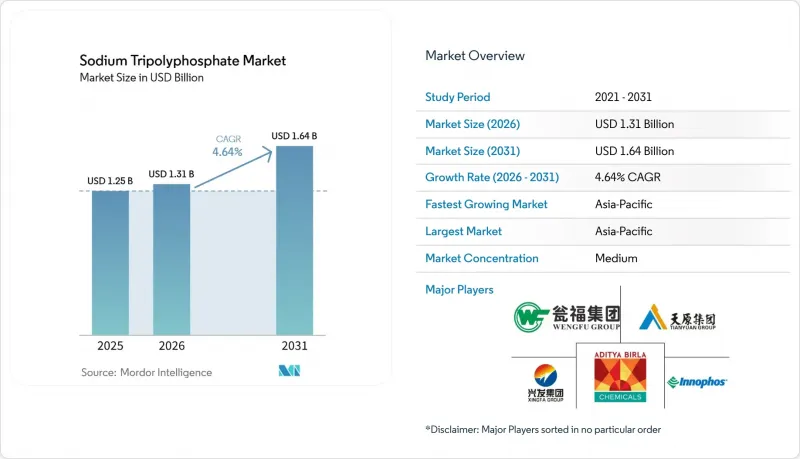
Mordor Intelligence에 의하면, 삼인산나트륨 시장 규모는 2025년 12억 5,000만 달러로 평가되었고, 2026년에는 13억 1,000만 달러로 추정되고, 2026-2031년 CAGR 4.64%로 성장을 지속할 전망이며, 2031년까지 16억 4,000만 달러에 이를 것으로 예측됩니다.
본 보고서는 등급별(식품 등급, 산업용 등급), 용도별(세제·세척제, 식품 첨가물, 기타), 형태별(분말, 과립), 최종 이용 산업별(가정용 및 산업용 세척, 식음료, 기타), 지역별(아시아태평양, 북미, 유럽, 남미, 중동 및 아프리카)로 분류되어 있습니다. 시장 예측은 금액(달러) 기준으로 제시되어 있습니다.
세계의 삼인산나트륨 시장 동향 및 인사이트
가정용 및 산업용 세제 배합에서 삼인산나트륨 수요 증가
세제 및 세척제 제조업체는 2025년에도 삼인산나트륨 시장에서 가장 큰 최종 용도 부문으로 남아 있을 것으로 예상되며, 총 소비량의 47.39%를 차지하고 분말 세척 시스템에서 핵심 빌더로서의 STPP의 역할을 유지할 것으로 보입니다. 이러한 의존도는 남아시아, 동남아시아, 아프리카 일부와 같은 경수 시장에서 특히 두드러지며, 이 지역들에서 STPP는 세정 효율, 배합 안정성, 비용 관리 측면에서 실용적인 균형을 지속적으로 제공하고 있는데, 많은 인산염 무첨가 시스템은 대규모 사용 시 이를 완전히 충족시키지 못합니다. 또한, 상업용 및 산업용 세척 부문도 수요를 뒷받침하고 있습니다. 이는 푸드서비스 산업의 위생 관리, 식기세척기용 세제, 자동차용 세척 제품에서 가정용 세제보다 높은 STPP 배합 비율이 채택되는 경우가 많으며, 소매용 소비자 브랜드와는 다른 속도로 규제 당국의 감시를 받고 있기 때문입니다. 또한, 중국의 제품 기준에서는 세정제 배합에 대한 순도 요건이 강화되어, 원료 공급을 관리하고 대량 주문을 하는 세제 제조업체에 일관된 품질을 제공할 수 있는 통합형 제조업체가 유리한 입지를 차지하고 있습니다. 그 결과, 삼인산나트륨 시장은 단순히 가장 저렴한 상품 가격으로의 전환이라기보다는 세정 용도에서의 수량 증가와 선택적인 프리미엄화의 혜택을 지속적으로 누리고 있습니다.
수처리 분야에서 스케일 억제 및 금속 이온 봉쇄를 목적으로 한 STPP의 이용 확대
수처리는 삼인산나트륨 시장에서 가장 빠르게 성장하는 최종 용도 부문이며, 2031년까지 연평균 성장률(CAGR) 5.44%를 나타낼 것으로 예측됩니다. STPP는 초기 결정 형성을 억제하고 스케일을 형성하는 이온을 분산된 상태로 유지함으로써 열교환 표면에 침전되는 것을 방지하기 때문에 이 용도에서 여전히 유용합니다. 킬레이트화 및 스케일 방지 실무에 관한 기술 문헌에서는 이러한 메커니즘에 대해 다루고 있습니다. 동남아시아, 걸프 지역, 남아시아 전역에 걸친 산업용 생산 능력 확대가 수요를 견인하고 있으며, 발전소, 공정 산업, 상업시설, 데이터센터에서는 냉각탑 및 보일러 회로용 신뢰성 높은 수처리 프로그램이 요구되고 있습니다. 또한 구매자들은 킬레이트 성능이 더 예측 가능한 고순도 등급에 대한 관심을 높이고 있으며, 공급업체의 평가 기준이 가격뿐만 아니라 배치 간 일관성, 문서화, 용도 지원으로 전환되고 있습니다. 인도와 아세안(ASEAN) 지역의 도시 상수도 시스템에 대한 공공 투자도 수요의 새로운 원천이 되고 있습니다. 이는 기존에는 민간 산업 구매자가 시장을 독점해 왔으나, 기관의 조달이 이를 보완하기 시작했기 때문입니다. 이러한 추세로 인해 삼인산나트륨 시장은 가정용 세제 수요 주기에 대한 의존도가 낮은 보다 견고한 중기적 성장 기반을 확보하고 있습니다.
세제 및 세척 제품의 인산염 함량에 대한 엄격한 규제
세제에 대한 인산염 사용 규제 환경은 2025년과 2026년에 더욱 엄격해질 것으로 예상되며, 이는 삼인산나트륨 시장에 있어 가장 명확한 제약 요인 중 하나로 남아 있을 것으로 보입니다. 2025년 6월에는 유럽연합 이사회와 유럽의회가 잠정 합의에 도달하여, 유럽집행위원회에 대부분의 세제 카테고리에서 추가적인 인산염 감축의 실현 가능성과 환경에 미치는 영향을 2년 이내에 평가할 것을 요구할 전망입니다. 이 동향이 중요한 이유는 당장 전 세계 수요에 급격한 변화를 일으키지는 않겠지만, 유럽 시장에 제품을 공급하는 공급업체의 계획 수립 부담을 가중시키기 때문입니다. 이러한 공급업체들은 향후 더욱 엄격해질 가능성이 있는 인 규제에 맞추어 배합 전략, 제품 문서, 제품 포트폴리오 설계를 조정해야 할 필요가 생깁니다. 미국에서는 EPA(미국 환경보호청)의 허가 체계에 따른 영양염류에 초점을 맞춘 배출 규제로 인해, 폐수 내 다운스트림 공정에서의 인 부하에 대한 모니터링이 강화되면서 산업용 및 시설용 세정 부문에서 배합 변경에 대한 압박이 계속해서 높아지고 있습니다. 그 결과, 규제 환경은 점점 더 불균일해지고 있으며, 유럽과 북미에서는 인산염 규제가 강화되는 방향으로 나아가고 있는 반면, 높은 성장세를 이어가고 있는 아시아태평양 시장에서는 STPP의 지속적인 사용에 대해 보다 관대한 태도가 유지되고 있습니다. 이러한 격차로 인해, 삼인산나트륨 시장의 다국적 공급업체들은 병행되는 제품 라인과 규정 준수 체계를 관리할 수밖에 없게 되었으며, 최종 용도 수요가 안정적인 경우에도 사업 운영의 복잡성이 증가하고 있습니다.
부문 분석
산업용 등급은 세제, 세라믹 타일, 산업용 수처리 용도가 계속해서 톤수 기준 최대 비중을 차지함에 따라, 2025년에는 57.84%의 점유율을 유지하며 삼인산나트륨 시장에서 가장 큰 등급으로 남았습니다. 그러나 아시아태평양 및 북미 전역에서 가공육, 수산물, 편의 식품의 생산이 확대됨에 따라, 식품 등급은 2031년까지 연평균 성장률(CAGR) 5.32%를 기록하며 삼인산나트륨 시장에서 가장 빠르게 성장하는 부문이 될 것으로 예측됩니다. 이 분류는 대량 소비형 산업용도가 현재 수요를 계속 주도하고 있는 반면, 향후 가치 창출은 보다 엄격하고 사양에 기반한 식품 용도로 이동하고 있음을 나타냅니다. 식품 등급의 조달에는 표준 산업용 판매에서 일반적으로 요구되는 것보다 일관된 문서화, 낮은 오염 위험, 보다 견고한 감사 추적이 고객에게 요구되므로 진입 장벽이 높습니다.
이러한 등급 구조는 삼인산나트륨 시장 전체경쟁 구도에도 영향을 미치고 있습니다. 산업용 등급은 규모를 중시하는 사업으로 기능하며, 브랜드 포지셔닝보다 저비용 생산, 원료 통합, 폭넓은 용도로의 확대가 더 중요하게 여겨집니다. 이 부문에 제품을 공급하는 제조업체는 여러 최종 용도 채널에 진출할 수 있다는 이점이 있어, 특정 용도 수요가 둔화되더라도 생산량을 유지하기 쉽습니다. 반면, 구매자는 특히 세정력이나 분산 성능 측면에서 표준 범용 제품으로는 제공할 수 없는 수준의 높은 일관성이 요구되는 경우, 단계별 제어 및 용도에 따른 조정이 가능한 산업용 등급을 더욱 중시하는 추세입니다. 식품 등급은 여전히 선택 기준이 까다로운 부문으로, 가격이 결정 요인이 되기 전에 인증 범위, 추적성, 기술 지원이 공급업체 선정에 큰 영향을 미치는 경우가 많습니다. 그 결과, 삼인산나트륨 시장은 대입자 및 소입자라는 구분뿐만 아니라, 상품(commodity) 계열과 규정 준수 중심의 프리미엄 계열로도 나뉘어 있으며, 각각에 따라 다른 진입 장벽과 이익 구조가 존재합니다.
또한, 식품 가공업체는 검증 절차가 완료되면 승인된 공급업체를 장기간 지속적으로 이용하는 경향이 있어, 이로 인해 식품 등급의 수익은 현물 시세에 좌우되는 산업용 판매보다 안정적이기 쉽습니다. 이러한 추세로 인해 산업용 등급이 총 물량의 대부분을 계속 차지하고 있음에도 불구하고, 기존 생산자들은 생산 능력과 상업적 초점을 더 높은 사양의 제품으로 전환하도록 유도받고 있습니다.
세제 및 세척 제품은 2025년에 49.62%의 용도 점유율을 차지한 것으로 평가되었으며, 삼인산나트륨 시장에서 가장 큰 용도 기반으로서의 지위를 유지할 것으로 보입니다. 이러한 우위는 분말 제제에서 물 연화, 분산 및 세척 성능에 있어 STPP가 확립한 역할에 의해 뒷받침되고 있습니다. 식품 첨가물은 가장 빠르게 성장하는 용도로, 2031년까지 연평균 성장률(CAGR) 5.38%로 확대될 것으로 예측됩니다. 이는 삼인산나트륨 시장이 기존 세정 용도에만 의존하는 것이 아니라, 규제 대상인 식품 가공 용도에서의 지지를 강화하고 있음을 보여줍니다. 이러한 조합을 통해 성숙한 핵심 부문과 성장 속도가 빠르며 사양에 민감한 부문 사이에서 용도 구성의 균형이 유지되고 있습니다. 또한, 세제에 관한 단일 규제 변경이 시장 전체 수요 동향을 완전히 좌우할 위험도 완화됩니다.
세정 용도에서는 여전히 상업용 부문이 중요한 위치를 차지하고 있습니다. 이는 식기세척기, 푸드서비스 산업의 위생 관리, 산업용 표면 세정 분야에서 일반 소매용 세탁 제품과는 다른 고객 우선순위가 존재하며, 더 강력한 배합이 요구되는 경우가 많기 때문입니다. 이러한 구매자들은 일반적으로 성능의 안정성, 세정 효율, 운영 시스템과의 호환성을 우선시합니다. 이로 인해 소비자용 세제 브랜드의 성장 속도가 둔화되거나 성분 변경의 압박에 직면하더라도 STPP 수요를 유지하는 데 도움이 되고 있습니다. 식품 첨가물 부문은 가공업체들이 육류, 수산물, 유제품, 제빵 제품 라인 전반에 걸쳐 수분 유지력, 단백질 안정화, 수율 향상을 필요로 함에 따라 계속해서 확대되고 있습니다. 이러한 기능들은 상업적 생산의 경제성과 직접적으로 부합합니다. 세라믹 및 타일 제조는 STPP가 석고 몰드를 손상시키지 않으면서 슬러리의 응집 해체를 촉진하기 때문에 삼인산나트륨 시장에서 꾸준한 기술적 용도로 자리 잡고 있습니다. 이로 인해 공정 안정성이 극히 중요한 고급 도자기 및 위생 도기 생산에서 STPP는 계속해서 중요한 역할을 수행하고 있습니다. 도료, 안료, 분산제, 금속 표면 처리는 여전히 성숙한 용도로, 그 성장은 획기적인 제품 혁신이라기보다는 산업 생산량의 추이와 연동되어 있습니다. 그 결과, 식품 등급이나 용도 특화형 제품을 제공할 수 있는 제조업체는 단순히 대량 생산용 세제 수요에만 초점을 맞추고 있는 공급업체보다 더 많은 가치를 창출할 가능성이 높다고 볼 수 있습니다.
따라서 용도 구성 측면에서 수익의 질이 점차 개선되고 있는 것으로 나타나며, 보다 엄격한 문서화 및 치밀한 기술적 개입이 필요한 용도에서 더 빠른 성장이 예상됩니다. 이러한 추세는 삼인산나트륨 시장에서 세정 제품의 역할을 약화시키지는 않겠지만, 향후 경쟁의 일부를 전문적인 배합 지원 분야로 전환시키는 결과를 가져올 것입니다.
지역별 분석
아시아태평양은 2025년에 세계 시장 점유율의 52.82%를 차지한 것으로 평가되었으며, 2031년까지 연평균 성장률(CAGR) 5.12%로 이 지역에서 가장 높은 성장률을 나타낼 것으로 전망됩니다. 이러한 입지 덕분에 해당 지역은 수급 양면에서 삼인산나트륨 시장의 중심적 존재로 남을 것입니다. 중국은 여전히 생산의 주축이며, 국내 인광석 공급량과 통합 정제 능력을 바탕으로 생산자들은 많은 유럽 및 미국 기업보다 낮은 구조적 비용을 실현하고 있습니다. 이러한 비용 우위는 수출 가격과 지역 간 경쟁을 좌우하는 요인이 되고 있습니다. 또한, 규모의 경제와 원료 관리가 특수 브랜드 확립보다 더 중요시되는 표준 등급 소재 부문에서 중국의 영향력을 강화하고 있습니다. 인도는 도시화, 가공식품 수요, 일용소비재의 정상화, 산업용수 인프라에 대한 투자에 힘입어 중국을 제외한 지역에서는 여전히 가장 중요한 성장 동력으로 자리 잡고 있습니다. 이러한 요인들이 다양한 용도에서의 STPP 소비 확대를 뒷받침하고 있습니다. 베트남과 인도네시아는 세제 및 세라믹 부문을 통해 소비량을 더욱 늘리고 있는 반면, 일본과 한국은 고순도 식품 등급 및 특수 산업용도에 중점을 두고 있습니다.
북미와 유럽에서는 규제가 수요 및 제품 전략 수립에 더 큰 역할을 하고 있기 때문에 삼인산나트륨 시장을 둘러싼 사업 환경은 다릅니다. 유럽에서는 수처리, 세라믹, 특수 세정 용도에서 산업용 등급의 소비가 견조한 추세를 보이고 있습니다. 그러나 2025년에 예정된 세제 규제에 관한 합의로 인해, 향후 인(phosphorus) 관련 정책은 공급업체와 구매업체 모두에게 보다 적극적으로 계획해야 할 과제가 될 가능성이 높습니다. 미국에서는 현재 예측 기간에 접어들기 전부터 많은 가정용 세탁 제품이 이미 인산염 무첨가 제형으로 전환되었기 때문에 식품 가공, 시설용 세정, 산업용 수처리에 대한 의존도가 높은 상태가 지속되고 있습니다. 그 결과, 식품 가공 부문은 규제 대상 사용 채널과 육류, 가금류, 수산물 제조 분야의 대규모 도입 실적을 바탕으로 이 지역에서 비교적 안정적인 수요 하한선을 형성하고 있습니다. 러시아는 산업 기반 덕분에 여전히 주목할 만한 소비국이지만, 공급 안정성에 대한 우려와 무역 흐름의 변화로 인해 유럽 전체에서 러시아의 입지는 복잡해지고 있습니다.
남미, 중동 및 아프리카는 절대적 규모 면에서는 여전히 작지만, 삼인산나트륨 시장에 의미 있는 성장 기회를 계속 제공합니다. 브라질과 아르헨티나에서는 식품 가공, 가금류·수산물 수출, 광범위한 소비재의 성장에 연동된 국내 세제 제조를 통해 수요가 뒷받침되고 있습니다. 중동 및 아프리카에서는 사우디아라비아와 남아프리카공화국이 계속해서 주요 시장으로 자리 잡고 있습니다. 이 시장들에서는 건조한 환경 하에서 산업용수 관리, 해수 담수화, 냉각 인프라가 여전히 운영상의 우선순위이므로, 수처리가 더 큰 역할을 하고 있습니다. 또한 사하라 이남 아프리카에서도 도시화가 진행됨에 따라 세제 사용이 확대되고 있으며, 국내 생산이 여전히 제한적인 지역에서는 아시아로부터의 수입이 현지 공급 부족을 계속해서 보완하고 있어, 물량은 점차 증가할 것으로 전망됩니다.
기타 혜택
- 엑셀 형식 시장 예측(ME) 시트
- 3개월간의 애널리스트 지원
목차
제1장 서론
제2장 조사 방법
제3장 주요 요약
제4장 시장 구도
제5장 시장 규모 및 성장 예측
제6장 경쟁 구도
제7장 시장 기회 및 향후 전망
AJYAccording to Mordor Intelligence, the sodium tripolyphosphate market size is expected to grow from USD 1.25 billion in 2025 to USD 1.31 billion in 2026 and is forecast to reach USD 1.64 billion by 2031 at 4.64% CAGR over 2026-2031.
This report is Segmented by Grade (Food Grade, Industrial Grade), Application (Detergents & Cleaning Products, Food Additives, and More), Form (Powder, Granular), End-Use (Household & Industrial Cleaning, Food & Beverage, and More), and Geography (Asia-Pacific, North America, Europe, South America, Middle-East and Africa). The Market Forecasts are Provided in Terms of Value (USD).
Global Sodium Tripolyphosphate Market Trends and Insights
Rising Demand for STPP in Household and Industrial Detergent Formulations
Detergent and cleaning product manufacturers are expected to remain the largest end-use base in the sodium tripolyphosphate market in 2025, accounting for 47.39% of total consumption and maintaining STPP's role as a core builder in powdered cleaning systems. This dependence remains particularly strong in hard-water markets across South Asia, Southeast Asia, and parts of Africa, where STPP continues to offer a practical balance of cleaning efficiency, formulation stability, and cost control that many phosphate-free systems do not fully match at scale. The institutional and industrial cleaning channel further strengthens demand, as food-service sanitation, automatic dishwashing, and automotive cleaning products often use higher STPP loading rates than household detergents and face a different pace of regulatory scrutiny compared with retail consumer brands. Product standards in China are also increasing purity requirements in cleaning formulations, supporting integrated producers that control raw material supply and can deliver consistent quality to large-volume detergent accounts. As a result, the sodium tripolyphosphate market continues to benefit from volume support and selective premiumization within cleaning applications, rather than a simple shift toward the lowest commodity price.
Growing Use of STPP in Water Treatment for Scale Inhibition and Metal Ion Sequestration
Water treatment is the fastest-growing end-use channel in the sodium tripolyphosphate market and is forecast to grow at a CAGR of 5.44% through 2031. STPP remains useful in this application because it interferes with early crystal formation and keeps scale-forming ions dispersed, preventing them from settling on heat-transfer surfaces. Technical review literature on sequestration and anti-scaling practices discusses this mechanism. Industrial capacity additions across Southeast Asia, the Gulf region, and South Asia are reinforcing demand, as power plants, process industries, commercial facilities, and data centers require dependable treatment programs for cooling towers and boiler circuits. Buyers are also showing greater interest in higher-purity grades with more predictable chelating performance, shifting supplier evaluation away from price alone and toward batch consistency, documentation, and application support. Public investment in municipal water systems across India and ASEAN economies adds another source of demand, as institutional procurement is beginning to complement the historic dominance of private industrial buyers. This pattern gives the sodium tripolyphosphate market a firmer medium-term growth layer that is less dependent on household detergent cycles.
Stringent Regulations on Phosphate Content in Detergents and Cleaning Products
The regulatory climate for phosphate use in detergents is expected to tighten further in 2025 and 2026, remaining one of the clearest restraints on the sodium tripolyphosphate market. In June 2025, the Council of the European Union and the European Parliament are expected to reach a provisional agreement requiring the European Commission to assess, within two years, the feasibility and environmental effects of further phosphorus reductions across most detergent categories. This development matters because it may not create an immediate global demand shock, but it will increase the planning burden for suppliers serving Europe. These suppliers will need to align formulation strategies, product documentation, and portfolio design with potentially tighter future phosphorus limits. In the United States, nutrient-focused discharge controls under the EPA permit framework continue to reinforce reformulation pressure in industrial and institutional cleaning channels by increasing scrutiny of downstream phosphorus loads in wastewater. As a result, the regulatory landscape is becoming more uneven, with Europe and North America moving toward tighter phosphate accountability while high-growth Asia-Pacific markets remain more open to continued STPP use. This gap forces multinational suppliers in the sodium tripolyphosphate market to manage parallel product lines and compliance systems, raising operating complexity even where end-use demand remains stable.
Other drivers and restraints analyzed in the detailed report include:
- Increasing Demand for Processed Foods Driving the Use of Food-Grade Phosphate Additives
- Rising Industrialization and Urbanization Supporting Demand for Cleaning and Water Treatment Chemicals
- Environmental Concerns Related to Eutrophication from Phosphate Discharge
For complete list of drivers and restraints, kindly check the Table Of Contents.
Segment Analysis
Industrial grade is expected to hold a 57.84% share in 2025 and remain the largest grade in the sodium tripolyphosphate market, as detergent, ceramic tile, and industrial water treatment applications continue to account for the largest tonnage base. However, food grade is forecast to register a CAGR of 5.32% through 2031, making it the faster-growing segment of the sodium tripolyphosphate market as processed meat, seafood, and convenience food production expands across Asia-Pacific and North America. This split indicates that high-volume industrial applications continue to lead current demand, while future value creation is shifting toward stricter, specification-driven food applications. Food-grade procurement has higher entry barriers, as customers require consistent documentation, lower contaminant risk, and a stronger audit trail than standard industrial sales typically demand.
The grade structure also influences competition across the sodium tripolyphosphate industry. Industrial grade functions more as a scale-driven business, where low-cost production, raw material integration, and broad application reach matter more than brand positioning alone. Producers serving this segment benefit from exposure to multiple end-use channels, which helps protect volumes when demand slows in one application. At the same time, buyers are placing greater emphasis on phase-controlled and application-tuned industrial grades, especially where detergency or deflocculant performance requires greater consistency than a standard commodity product can provide. Food grade remains a more selective segment, as certification breadth, traceability, and technical support often determine supplier approval before price becomes the deciding factor. As a result, the sodium tripolyphosphate market is not only split between large and small grades but also between a commodity lane and a premium, compliance-led lane, each with distinct barriers and margin structures.
Food processors also tend to retain approved vendors for longer periods once validation is complete, which can make food-grade revenue more stable than spot-driven industrial sales. This dynamic encourages established producers to shift capacity and commercial focus toward higher-specification output, even though industrial grade continues to dominate total volume.
Detergents and cleaning products are projected to hold a 49.62% application share in 2025, maintaining their position as the largest application base in the sodium tripolyphosphate market. This dominance is supported by STPP's established role in water softening, dispersing, and cleaning performance across powdered formulations. Food additives represent the fastest-growing application and are projected to expand at a CAGR of 5.38% through 2031, indicating that the sodium tripolyphosphate market is gaining stronger support from regulated food processing applications rather than relying solely on legacy cleaning uses. This combination keeps the application mix balanced between a mature anchor segment and a faster-growing, specification-sensitive segment. It also reduces the risk that a single regulatory change in detergents will fully determine the direction of total market demand.
Within cleaning applications, the institutional segment remains important because automatic dishwashing, food-service sanitation, and industrial surface cleaning often require stronger formulations and involve different customer priorities than mass retail laundry products. These buyers typically prioritize performance consistency, cleaning efficiency, and compatibility with operating systems, which helps preserve STPP demand even as consumer detergent brands move more slowly or face reformulation pressure. Food additives are advancing because processors require moisture retention, protein stabilization, and yield support across meat, seafood, dairy, and bakery lines. These functions align directly with commercial production economics. Ceramic and tile manufacturing remains a steady technical application in the sodium tripolyphosphate market because STPP supports slurry deflocculation without damaging plaster molds. This keeps it relevant in high-end porcelain and sanitaryware production, where process stability is critical. Paints, pigments, dispersants, and metal surface treatment remain more mature applications, with growth tracking industrial output rather than significant product innovation. As a result, producers that can offer food-grade or application-engineered products are likely to capture more value than suppliers focused only on bulk detergent-oriented demand.
The application mix, therefore, indicates a gradual improvement in revenue quality, with faster growth coming from applications that require stronger documentation and closer technical engagement. This trend does not weaken the role of cleaning products in the sodium tripolyphosphate market, but it shifts part of future competition toward specialized formulation support.
Complete Report Scope:
- By Grade
- Food Grade
- Industrial Grade
- By Application
- Detergents & Cleaning Products
- Food Additives
- Ceramic & Tile Manufacturing
- Paints, Pigments & Dispersants
- Metal Surface Treatment
- Other Applications
- By Form
- Powder
- Granular
- By End Use Industry
- Household & Industrial Cleaning
- Food & Beverage
- Water Treatment
- Ceramics
- Paints & Coatings
- Metal Processing
- Other End-Use Industries
- By Geography
- Asia-Pacific
- China
- India
- Japan
- South Korea
- Rest of Asia-Pacific
- North America
- United States
- Canada
- Mexico
- Europe
- Germany
- United Kingdom
- France
- Italy
- Russia
- Rest of Europe
- South America
- Brazil
- Argentina
- Rest of South America
- Middle-East and Africa
- Saudi Arabia
- South Africa
- Rest of Middle-East and Africa
- Asia-Pacific
Geography Analysis
Asia-Pacific is expected to hold 52.82% of the global share in 2025 and record the fastest regional CAGR, at 5.12%, through 2031. This position keeps the region at the center of the sodium tripolyphosphate market in terms of both supply and demand. China remains the production backbone, as its domestic phosphate rock availability and integrated refining capacity give producers lower structural costs than many Western counterparts can achieve. This cost advantage shapes export pricing and regional competition. It also strengthens China's influence in standard-grade materials, where scale and raw material control carry more weight than specialty branding. India remains the most important growth engine outside China, supported by urbanization, packaged food demand, the formalization of fast-moving consumer goods, and investment in industrial water infrastructure. These factors support broader STPP consumption across multiple applications. Vietnam and Indonesia add further volume through detergents and ceramics, while Japan and South Korea focus more on higher-purity food-grade and specialty industrial uses.
North America and Europe present a different operating environment for the sodium tripolyphosphate market, as regulation plays a larger role in shaping demand and product strategy. In Europe, industrial-grade consumption remains steady in water treatment, ceramics, and specialty cleaning applications. However, the expected 2025 agreement on detergent regulation is likely to make future phosphorus policy a more active planning issue for suppliers and buyers. The United States remains more dependent on food processing, institutional cleaning, and industrial water treatment, as many household laundry products had already shifted toward phosphate-free formulations before the current forecast period. As a result, food processing provides a relatively stable demand floor in the region, supported by regulated usage pathways and a large installed base in meat, poultry, and seafood manufacturing. Russia remains a notable consumer due to its industrial base, although supply security concerns and shifts in trade flows complicate its position within the broader European geography.
South America, the Middle East, and Africa remain smaller in absolute size, but they continue to offer meaningful expansion opportunities for the sodium tripolyphosphate market. Brazil and Argentina support demand through food processing, poultry and seafood exports, and domestic detergent manufacturing linked to broader consumer goods growth. In the Middle East and Africa, Saudi Arabia and South Africa remain key markets. Water treatment plays a larger role in these markets, as industrial water management, desalination, and cooling infrastructure remain operational priorities in arid environments. Sub-Saharan Africa also offers gradual volume upside as detergent adoption rises with urban growth and imports from Asia continue to address local supply gaps where domestic production remains limited.
- Aditya Birla Chemicals (Thailand) Pvt. Ltd.
- Advansix
- Chengxing Group
- Fosfa a.s.
- Guizhou Zhongshen Phosphates Chemical
- Hubei Lomon Phosphorus Chemical
- Hubei Xingfa Chemicals Group Co. Ltd.
- ICL Group Ltd.
- Innophos
- Kazphosphate LLC
- Prayon S.A.
- SDIC
- Sichuan Shengda Group
- Yibin Tianyuan Group
- Wengfu (Group) Co., Ltd.
- Yuntianhua Group
Additional Benefits:
- The market estimate (ME) sheet in Excel format
- 3 months of analyst support
TABLE OF CONTENTS
1 Introduction
- 1.1 Study Assumptions and Market Definition
- 1.2 Scope of the Study
2 Research Methodology
3 Executive Summary
4 Market Landscape
- 4.1 Market Overview
- 4.2 Market Drivers
- 4.2.1 Rising Demand for Sodium Tripolyphosphate in Household and Industrial Detergent Formulations
- 4.2.2 Growing Use of STPP in Water Treatment for Scale Inhibition and Metal Ion Sequestration
- 4.2.3 Increasing Demand for Processed Foods Driving the Use of Food-Grade Phosphate Additives
- 4.2.4 Growing Demand for High-Purity Sodium Tripolyphosphate in Specialty Industrial Applications
- 4.2.5 Rising Industrialization and Urbanization Supporting Demand for Cleaning and Water Treatment Chemicals
- 4.3 Market Restraints
- 4.3.1 Stringent Regulations on Phosphate Content in Detergents and Cleaning Products
- 4.3.2 Environmental Concerns Related to Eutrophication from Phosphate Discharge
- 4.3.3 Increasing Adoption of Phosphate-Free Builders and Alternative Chelating Agents
- 4.4 Value Chain Analysis
- 4.5 Porter's Five Forces Analysis
- 4.5.1 Threat of New Entrants
- 4.5.2 Bargaining Power of Suppliers
- 4.5.3 Bargaining Power of Buyers
- 4.5.4 Threat of Substitutes
- 4.5.5 Competitive Rivalry
5 Market Size and Growth Forecasts (Value)
- 5.1 By Grade
- 5.1.1 Food Grade
- 5.1.2 Industrial Grade
- 5.2 By Application
- 5.2.1 Detergents & Cleaning Products
- 5.2.2 Food Additives
- 5.2.3 Ceramic & Tile Manufacturing
- 5.2.4 Paints, Pigments & Dispersants
- 5.2.5 Metal Surface Treatment
- 5.2.6 Other Applications
- 5.3 By Form
- 5.3.1 Powder
- 5.3.2 Granular
- 5.4 By End Use Industry
- 5.4.1 Household & Industrial Cleaning
- 5.4.2 Food & Beverage
- 5.4.3 Water Treatment
- 5.4.4 Ceramics
- 5.4.5 Paints & Coatings
- 5.4.6 Metal Processing
- 5.4.7 Other End-Use Industries
- 5.5 By Geography
- 5.5.1 Asia-Pacific
- 5.5.1.1 China
- 5.5.1.2 India
- 5.5.1.3 Japan
- 5.5.1.4 South Korea
- 5.5.1.5 Rest of Asia-Pacific
- 5.5.2 North America
- 5.5.2.1 United States
- 5.5.2.2 Canada
- 5.5.2.3 Mexico
- 5.5.3 Europe
- 5.5.3.1 Germany
- 5.5.3.2 United Kingdom
- 5.5.3.3 France
- 5.5.3.4 Italy
- 5.5.3.5 Russia
- 5.5.3.6 Rest of Europe
- 5.5.4 South America
- 5.5.4.1 Brazil
- 5.5.4.2 Argentina
- 5.5.4.3 Rest of South America
- 5.5.5 Middle-East and Africa
- 5.5.5.1 Saudi Arabia
- 5.5.5.2 South Africa
- 5.5.5.3 Rest of Middle-East and Africa
- 5.5.1 Asia-Pacific
6 Competitive Landscape
- 6.1 Market Concentration
- 6.2 Strategic Moves
- 6.3 Market Share (%)/Ranking Analysis
- 6.4 Company Profiles (includes Global Overview, Market Overview, Core Segments, Financials as available, Strategic Information, Products and Services, and Recent Developments)
- 6.4.1 Aditya Birla Chemicals (Thailand) Pvt. Ltd.
- 6.4.2 Advansix
- 6.4.3 Chengxing Group
- 6.4.4 Fosfa a.s.
- 6.4.5 Guizhou Zhongshen Phosphates Chemical
- 6.4.6 Hubei Lomon Phosphorus Chemical
- 6.4.7 Hubei Xingfa Chemicals Group Co. Ltd.
- 6.4.8 ICL Group Ltd.
- 6.4.9 Innophos
- 6.4.10 Kazphosphate LLC
- 6.4.11 Prayon S.A.
- 6.4.12 SDIC
- 6.4.13 Sichuan Shengda Group
- 6.4.14 Yibin Tianyuan Group
- 6.4.15 Wengfu (Group) Co., Ltd.
- 6.4.16 Yuntianhua Group
7 Market Opportunities and Future Outlook
- 7.1 White-Space and Unmet-Need Assessment