|
시장보고서
상품코드
2118128
IRAC 30 살충제 시장 : 시장 점유율 분석, 업계 동향 및 통계, 성장 예측(2026-2031년)IRAC 30 Insecticides - Market Share Analysis, Industry Trends & Statistics, Growth Forecasts (2026 - 2031) |
||||||
 Mordor Intelligence
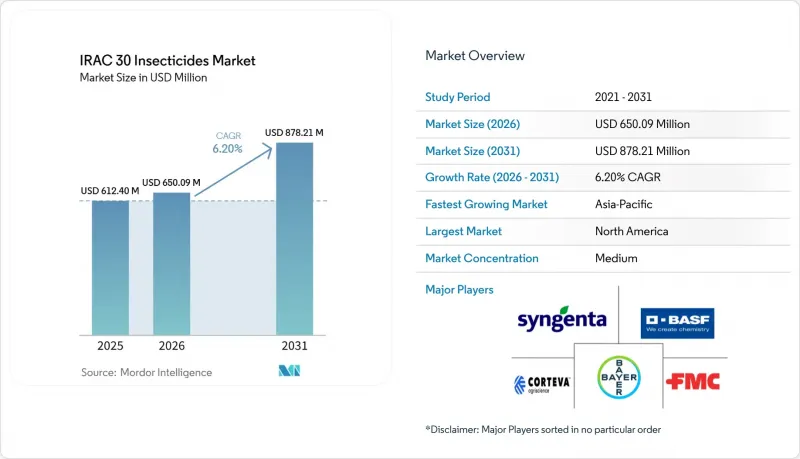
Mordor Intelligence에 의하면, IRAC 30 살충제 시장 규모는 2025년 6억 1,240만 달러로 평가되었고, 2026년에는 6억 5,009만 달러로 추정되고, 2026-2031년 CAGR 6.20%로 성장을 지속할 전망이며, 2031년까지 8억 7,821만 달러에 이를 것으로 예측됩니다.
본 보고서는 시용 방법별(케미게이션, 엽면 살포, 훈증, 기타), 작물 유형별(상업 작물, 과일 및 채소, 곡물 및 곡류, 기타), 지역별(북미, 유럽, 기타)로 분류되어 있습니다. 시장 예측은 금액(달러)과 수량(톤)으로 제시되어 있습니다.
세계의 IRAC 30 살충제 시장 동향 및 인사이트
내성 관리용 화학물질에 대한 수요 증가
주요 해충에서 피레스로이드계, 유기인계, 디아미드계 살충제에 대한 내성이 보고됨에 따라, 생산자와 농업 전문가들은 서로 다른 작용기전을 가진 대안을 모색해야 하는 상황에 놓여 있으며, 이것이 IRAC 30 살충제 시장을 직접적으로 견인하고 있습니다. 그룹 30 화합물은 메타디아미드와 이소옥사졸린이 기존 살충제군이 이용하는 결합 부위가 아닌 GABA 수용체의 새로운 알로스테릭 부위에 작용하기 때문에 이러한 수요에 부합합니다. 2025년에 발표된 조사에 따르면, 클로란트라닐리프로?ル 내성을 가진 Chilo suppressalis 개체군에서 시프로플라닐리드에 대한 교차 내성은 확인되지 않았습니다. 또한, 같은 조사에서는 측정된 유전율이 낮은 것으로 보고되었으며, 이는 본질적인 내성 위험이 낮음을 시사합니다. 이러한 증거에 따라, 해충 피해로 인해 기존 제품의 유용성이 이미 저하된 작물에서 IRAC 30 살충제 시장은 단순한 순환 재배의 예비 수단이라는 역할에서 재배 시즌 동안 계획적인 역할을 수행하는 방향으로 전환되고 있습니다. 또한, IRAC 30 살충제 시장은 인용된 지침에서 그룹 30의 야외 내성 사례가 보고되지 않은 점에서도 혜택을 받고 있습니다. 이를 통해 이 계열이 아직 상용화의 초기 단계에 있는 동안 내성 관리상의 가치를 높게 유지할 수 있게 되었습니다.
유효 성분의 재등록 일정 강화
IRAC 30 살충제 시장은 현재 유럽과 북미에서 많은 기존 살충제 유효 성분에 영향을 미치고 있는 더 느리고 더 엄격한 심사 주기로부터도 힘을 얻고 있습니다. 유럽의 AIR 6 갱신 프로그램은 2025년 3월부터 2028년 12월 사이에 승인 기한이 만료되는 물질을 대상으로 하고 있으며, 이는 일부 확립된 화학 물질이 다시 완전한 심사 단계를 거치고 있음을 의미합니다. 크롭라이프 인터내셔널(CropLife International) 또한 2025년 4월 현재 농약 갱신 신청이 지연되고 있다고 보고했는데, 이는 승인 시기가 비교적 최근인 화학물질 군에 실질적인 우위를 가져다주고 있습니다. 미국에서는 브로플라닐리드와 이소시클로세람의 최근 승인으로 인해, 이러한 제품들은 많은 기존 경쟁 제품들에 비해 현재의 재등록 압박에서 한 발 더 물러설 수 있게 되었습니다. 이는 IRAC 30 살충제 시장에 더 긴 상업적 유예 기간을 확보하는 데 도움이 되고 있습니다. 이 유예 기간이 중요한 이유는 제품의 규제상 유효 기간이 아직 초기 단계에 있을 때 기업이 더 광범위한 등록 작업, 스튜어드십에 대한 투자, 판로 개발을 정당화할 수 있기 때문입니다.
수출용 작물에서의 잔류 기준 준수 압력
잔류 기준 준수는 IRAC 30 살충제 시장에 여전히 큰 제약 요인으로 작용하고 있습니다. 이는 새로 출시된 유효 성분이 무역 상대국 간에 수입 허용치 및 잔류 기준의 조화 과정을 거치는 데 시간이 걸리는 경우가 많기 때문입니다. 미네소타주 농업국은 2026년 1월 이소시클로세람을 심사한 결과, 해당 유효 성분이 미네소타주 법에 따라 퍼플루오로알킬 및 폴리플루오로알킬 물질(PFAS)로 분류됨에 따라 수질 모니터링 프로그램에 추가했습니다. 이 결정으로 인해 사용이 금지된 것은 아니지만, 규제가 선행되는 지역에서 라벨 표기 범위의 확대가 어느 정도의 속도로 진행될지를 좌우할 수 있는 더욱 주의를 기울여야 할 요소가 추가되었습니다. IRAC 30 살충제 시장은 수출용 작물에서 더 큰 영향을 받기 쉬운 경향이 있습니다. 이는 생산자나 수출업체가 새로운 화학 물질을 중심으로 한 대규모 프로그램을 구축하기 전에, 원산지 시장과 수출지 시장 모두에서 잔류 기준이 일치한다는 확신이 필요하기 때문입니다. 이 때문에 밭에서 성능이 뛰어나더라도 무역의 영향을 받기 쉬운 작물 시스템에서는 도입이 늦어지는 경향이 있습니다. 이는 상업적 위험이 개별 밭이 아닌 전체 출하량에 미치기 때문입니다.
부문 분석
엽면 살포는 가장 큰 시용 형태이며, 2025년에는 IRAC 30 살충제 시장 점유율의 55.2%를 차지했습니다. 이는 신속한 살충 효과와 잔효성이 모두 중요한 채소, 면화, 과수, 콩류에서 엽면 살포가 널리 이용되고 있음을 반영합니다. 메릴랜드 대학교 익스텐션은 새로운 이소시클로세람 계열 엽면 살포 제품이 다이아몬드백 나방, 타니시파리,콜로라도 딱정벌레 등의 해충을 대상으로 개발되었다고 지적하고 있으며, 이는 IRAC 30 살충제 시장에서 엽면 살포 프로그램의 상업적 중요성을 뒷받침합니다. 또한, 엽면 살포는 고부가가치 작물 시스템에 그룹 30 화학 물질을 도입하는 데 있어 여전히 가장 주목받는 경로로 남아 있습니다. 이는 생산자가 같은 시즌 내에 그 성능을 기존 화학 물질군과 직접 비교할 수 있기 때문입니다. BASF SE는 브로플라닐리드가 여러 발생 단계에 걸쳐 유효함을 제시하고 있으며, 이것이 엽면 살포 프로그램이 여전히 IRAC 30 살충제 시장에서 가장 큰 점유율을 차지하고 있는 이유 중 하나입니다. 토양 처리, 케미게이션, 훈증은 현재 이러한 형태로 확립된 그룹 30 제제가 적기 때문에 여전히 규모가 작은 상태입니다.
종자 처리는 가장 빠르게 보급되고 있는 살포 방법이며, IRAC 30 살충제 시장에서 종자 처리 시장 규모는 2031년까지 연평균 성장률(CAGR) 3.6%로 확대될 것으로 예측됩니다. 이러한 성장 추세가 가장 두드러지는 분야는 곡물과 줄기 작물이며, 이러한 작물의 경우 파종 초기 와이어웜 피해로 인해 작물의 정착이 저해될 우려가 있어, 생산자가 생육 기간 동안 적절한 대책을 마련할 기회를 얻지 못할 수 있습니다. 신젠타 그룹은 봄밀 검사에서 ‘에콴토(Equento)’가 최대 97%의 와이어웜 구제율을 달성했다고 보고했으며, 이를 통해 IRAC 30 살충제 시장은 생육 초기 방제 분야에서 강력한 도입 근거를 확보하게 되었습니다. 또한 정밀 살포를 통해 프리미엄 종자 처리 프로그램의 경제성도 향상되고 있습니다. 더 나아가, ‘아텍스조(Atexzo)’를 통해 이소시클로세람이 잔디 부문으로 확대된 것은 IRAC 30 살충제 시장이 당초 핵심이었던 밭작물 용도를 넘어 확장되기 시작했음을 보여줍니다.
지역별 분석
북미는 가장 규모가 큰 지역 부문으로, 2025년 IRAC 30 살충제 시장 점유율의 37.6%를 차지했습니다. 이러한 위상은 미국의 곡물 및 특수 작물 생산 기반, 캐나다에서 종자 처리의 중요한 역할, 2025년 11월 미국 환경보호청(EPA)이 10종의 이소시클로세람 제품을 최종 등록함으로써 발생한 상업적 호재를 반영한 것입니다. 캐나다에서는 카놀라와 봄밀의 윤작에서 생산자들이 생육 초기 와이어웜 방제가 필요하며, 네오니코티노이드계 약제를 다량 사용하는 방제 프로그램과는 다른 화학적 대안을 찾고 있기 때문에 상당한 수요가 발생하고 있습니다. 미국에서는 옥수수 벨트가 종자 처리 수요를 뒷받침하는 한편, 남동부 및 남서부의 면화·채소 생산 지대에서는 엽면 살포를 통한 흡수가 수요를 지탱하고 있습니다. 멕시코는 수출 지향적인 채소 부문이 그룹 30의 엽면 살포 제품이 이미 대상으로 하고 있는 해충 프로파일과 일치하기 때문에 IRAC 30 살충제 시장에 있어 계속해서 인접한 기회가 되고 있습니다.
아시아태평양은 가장 빠르게 성장하는 지역이며, 이 지역의 IRAC 30 살충제 시장 규모는 2031년까지 연평균 성장률(CAGR) 3.8%로 확대될 것으로 예측됩니다. 이 지역에서는 벼, 채소, 면화 등이 대규모로 생산되고 있으며, 해충 피해가 심각하고 윤작 선택지가 중요한 부문에서 새로운 화학 성분에 대한 안정적인 수요가 발생하고 있습니다. 크롭라이프 재팬에 따르면, 2025 농업 연도 일본의 살충제 출하액은 5.3% 증가했으며, 미쓰이 화학 크롭 앤 라이프 솔루션즈 주식회사는 이미 ‘BROFREYA’ 브랜드로 브로플라닐리드 제제를 판매하고 있습니다. PI 인더스트리즈 리미티드도 인도에서 ‘BROFREYA’를 판매하고 있으며, 이는 IRAC 30 살충제 시장이 남아시아의 확립된 국내 유통 채널을 통해 이미 침투하고 있음을 보여줍니다.
유럽은 여전히 중요한 시장입니다. 강력한 내성 관리 대책과 기존 유효 성분에 대한 지속적인 재검토가 채소 및 곡물 부문에서 새로운 화학 계열의 농약이 진입할 여지를 만들어내고 있기 때문입니다. 남미에서는 대두 및 면화 생산자들이 수출용 농업에서 추가적인 윤작 방안을 모색하고 있어 그 중요성이 높아지고 있습니다. 다만, 해당 지역에서 IRAC 30 살충제 시장이 더욱 빠르게 확대되기 위해서는 잔류 기준의 일관성이 계속해서 중요할 것으로 보입니다. 중동 및 아프리카에서는 아직 개발 초기 단계에 있지만, 2025년에 세계보건기구(WHO)가 벡터 방제용 브로플라닐리드 수화제를 사전 승인함에 따라 공중보건 부문에서 이 화합물에 대한 인지도가 높아지고 있습니다. 이러한 인지도 향상은 유효 성분에 대한 인식이 아직 정착되고 있는 사하라 이남 아프리카의 일부 지역에서 향후 농업용 등록을 위한 길을 열어줄 가능성이 있습니다.
기타 혜택
- 엑셀 형식 시장 예측(ME) 시트
- 3개월간의 애널리스트 지원
자주 묻는 질문
목차
제1장 서론
제2장 개 보고서의 내용
제3장 주요 요약 및 주요 조사 결과
제4장 주요 산업 동향
제5장 시장 규모 및 성장 예측
제6장 경쟁 구도
제7장 작물 보호용 화학제품 기업 CEO를 향한 중요 전략적 과제
AJY 26.09.03According to Mordor Intelligence, the IRAC 30 insecticides market size is projected to grow from USD 612.40 million in 2025 to USD 650.09 million in 2026 and is forecast to reach USD 878.21 million by 2031 at 6.20% CAGR over 2026-2031.
This report is Segmented by Application Mode (Chemigation, Foliar, Fumigation, and More), by Crop Type (Commercial Crops, Fruits and Vegetables, Grains and Cereals, and More), and Geography (North America, Europe, and More). The Market Forecasts are Provided in Terms of Value (USD) and Volume (Metric Tons).
Global IRAC 30 Insecticides Market Trends and Insights
Rising Need for Resistance-Management Chemistry
Documented resistance to pyrethroid, organophosphate, and diamide insecticides in major pests is pushing growers and agronomists to seek options with a different mode of action, which directly supports the IRAC 30 insecticides market. Group 30 compounds fit that need because meta-diamides and isoxazolines act on a novel allosteric site on the GABA receptor rather than the binding sites used by older insecticide groups. Research published in 2025 showed no cross-resistance in chlorantraniliprole-resistant Chilo suppressalis populations to cyproflanilide, and the study also reported low realized heritability, suggesting a lower intrinsic resistance risk. That evidence helps the IRAC 30 insecticides market move from a backup rotation role into a planned field-season role in crops where pest pressure is already reducing the usefulness of older products. The IRAC 30 insecticides market also benefits because there were no documented field resistance cases for Group 30 in the cited guidance, which keeps its resistance-management value high while the class is still early in its commercial life.
Tightening Active-Ingredient Re-registration Timelines
The IRAC 30 insecticides market is gaining support from the slower, stricter review cycle now affecting many older insecticide actives in Europe and North America. The AIR 6 renewal program in Europe covers substances with approvals expiring between March 2025 and December 2028, which means several established chemistries are moving through another full review stage. CropLife International also reported a backlog of pesticide renewals in April 2025, and that creates a practical advantage for newer chemistry classes with more recent approval timelines. In the United States, the recent approvals of broflanilide and isocycloseram leave these products further from the present re-registration pressure than many older competitors, which supports a longer commercial runway for the IRAC 30 insecticides market. That longer runway matters because companies can justify broader registration work, stewardship spending, and channel development when the product's regulatory life is still in an earlier phase.
Residue Compliance Pressure in Export Crops
Residue compliance remains a significant restraint for the IRAC 30 insecticides market, as newly launched actives often need time to move through import tolerance and residue alignment processes across trading partners. The Minnesota Department of Agriculture reviewed isocycloseram in January 2026 and added it to its water quality monitoring program because the active ingredient is classified as a per- and polyfluoroalkyl substance (PFAS) under Minnesota law. That decision did not block use, but it added another layer of attention that can shape how quickly label expansion moves in regulatory-forward areas. The IRAC 30 insecticides market is more exposed in export crops because growers and exporters need confidence that residue standards are aligned in both origin and destination markets before large programs are built around a newer chemistry. This makes adoption slower in trade-sensitive crop systems, even when field performance is strong, because commercial risk falls on the entire shipment rather than the individual field.
Other drivers and restraints analyzed in the detailed report include:
- Expansion of High-Value Seed Treatment Programs
- Precision Application Enabling Lower Dose Economics
- Resistance Cross-Over Risk from Overused Modes of Action
For complete list of drivers and restraints, kindly check the Table Of Contents.
Segment Analysis
Foliar was the largest application mode, accounting for 55.2% of the IRAC 30 insecticides market share in 2025, reflecting its broad use in vegetables, cotton, tree fruit, and pulses, where quick knockdown and residual activity both matter. University of Maryland Extension noted that new isocycloseram foliar products are being positioned for pests such as diamondback moth, tarnished plant bug, and Colorado potato beetle, which supports the commercial weight of foliar programs in the IRAC 30 insecticides market. Foliar use also remains the most visible route for introducing Group 30 chemistry into high-value crop systems because growers can compare its performance directly with older chemistry classes in the same season. BASF SE presents broflanilide as active across multiple life stages, which helps explain why foliar programs still hold the largest position in the IRAC 30 insecticides market. Soil treatment, chemigation, and fumigation remain smaller because fewer Group 30 formulations are currently established in those formats.
Seed treatment is the fastest application mode, and the IRAC 30 insecticides market size for seed treatment is projected to expand at a 3.6% CAGR through 2031. The growth case is strongest in cereals and row crops, where wireworm pressure can damage crop establishment before growers have a chance to respond in-season. Syngenta Group Co., Ltd. reported up to 97% wireworm kill for Equento in spring wheat trials, which gives the IRAC 30 insecticides market a strong adoption argument in early-season protection. Precision placement also improves the economics of premium seed treatment programs, while the extension of isocycloseram into turf through Atexzo shows that the IRAC 30 insecticides market is beginning to build beyond its first core field-crop uses.
Complete Report Scope:
- Application Mode
- Chemigation
- Foliar
- Fumigation
- Seed Treatment
- Soil Treatment
- Crop Type
- Commercial Crops
- Fruits and Vegetables
- Grains and Cereals
- Pulses and Oilseeds
- Turf and Ornamental
- Geography
- North America
- United States
- Canada
- Mexico
- Rest of North America
- South America
- Brazil
- Argentina
- Rest of South America
- Europe
- Germany
- United Kingdom
- France
- Italy
- Spain
- Russia
- Rest of Europe
- Asia-Pacific
- China
- India
- Japan
- South Korea
- Australia and New Zealand
- Rest of Asia-Pacific
- Middle East
- Saudi Arabia
- United Arab Emirates
- Rest of Middle East
- Africa
- South Africa
- Egypt
- Rest of Africa
- North America
Geography Analysis
North America was the largest regional segment, accounting for 37.6% of the IRAC 30 insecticides market share in 2025. This position reflects the cereal and specialty crop base of the United States, the strong role of seed treatment in Canada, and the commercial push created by the Environmental Protection Agency (EPA) final registration of 10 isocycloseram products in November 2025. Canada adds meaningful demand through canola and spring wheat rotations where growers need early-season wireworm control and a chemistry option that differs from neonicotinoid-heavy programs. Within the United States, the Corn Belt supports seed treatment demand, while cotton and vegetable corridors in the Southeast and Southwest support foliar uptake. Mexico remains an adjacent opportunity for the IRAC 30 insecticides market because its export-oriented vegetable sector aligns with the pest profile already targeted by Group 30 foliar products.
Asia-Pacific is the fastest region, and the IRAC 30 insecticides market size in Asia-Pacific is projected to expand at a 3.8% CAGR through 2031. The region offers scale in rice, vegetables, and cotton, which creates steady demand for new chemistry where pest pressure is high, and rotation options matter. CropLife Japan reported that Japan's insecticide shipment value rose 5.3% in the 2025 agricultural year, and broflanilide products are already being marketed there by Mitsui Chemicals Crop and Life Solutions, Inc. under the BROFREYA brand. PI Industries Limited also markets BROFREYA in India, which shows that the IRAC 30 insecticides market is already moving through established domestic distribution channels in South Asia.
Europe remains important because strong resistance-management practices and the continuing review of older active ingredients are creating room for newer chemistry classes in vegetables and cereals. South America is gaining relevance as soybean and cotton growers look for additional rotation tools in export agriculture, although residue alignment will remain important before the IRAC 30 insecticides market scales faster there. Middle East and Africa is still earlier in development, but the 2025 World Health Organization prequalification of broflanilide wettable powder for vector control raises the visibility of the chemistry across public health channels. That broader visibility may help future agricultural registration pathways in parts of sub-Saharan Africa where awareness of the active ingredient is still developing.
- FMC Corporation
- Syngenta Group Co., Ltd.
- BASF SE
- Bayer AG
- Corteva, Inc.
- Helm Agro US, Inc.
- UPL Limited
- Sumitomo Chemical Co., Ltd.
- Nufarm Limited
- Rotam Global AgroSciences Ltd.
- Mitsui Chemicals, Inc.
- ISAGRO S.p.A.
- PI Industries Limited
- Gharda Chemicals Limited
- Arysta LifeScience
Additional Benefits:
- The market estimate (ME) sheet in Excel format
- 3 months of analyst support
TABLE OF CONTENTS
1 INTRODUCTION
- 1.1 Study Assumptions And Market Definition
- 1.2 Scope of the Study
- 1.3 Research Methodology
2 REPORT OFFERS
3 EXECUTIVE SUMMARY AND KEY FINDINGS
4 KEY INDUSTRY TRENDS
- 4.1 Consumption Of Pesticide Per Hectare
- 4.2 Pricing Analysis For Active Ingredients
- 4.3 Regulatory Framework
- 4.4 Value Chain And Distribution Channel Analysis
- 4.5 Market Drivers
- 4.5.1 Rising need for resistance-management chemistry
- 4.5.2 Tightening active-ingredient re-registration timelines
- 4.5.3 Expansion of high-value seed treatment programs
- 4.5.4 Precision application enabling lower dose economics
- 4.5.5 Residual efficacy premium for novel modes of action
- 4.5.6 Digital pest forecasting improving spray timing
- 4.6 Market Restraints
- 4.6.1 Residue compliance pressure in export crops
- 4.6.2 Resistance cross-over risk from overused modes of action
- 4.6.3 Biocontrol substitution in protected cultivation
- 4.6.4 Stewardship burden for new chemistry launches
5 MARKET SIZE AND GROWTH FORECAST (VALUE AND VOLUME)
- 5.1 Application Mode
- 5.1.1 Chemigation
- 5.1.2 Foliar
- 5.1.3 Fumigation
- 5.1.4 Seed Treatment
- 5.1.5 Soil Treatment
- 5.2 Crop Type
- 5.2.1 Commercial Crops
- 5.2.2 Fruits and Vegetables
- 5.2.3 Grains and Cereals
- 5.2.4 Pulses and Oilseeds
- 5.2.5 Turf and Ornamental
- 5.3 Geography
- 5.3.1 North America
- 5.3.1.1 United States
- 5.3.1.2 Canada
- 5.3.1.3 Mexico
- 5.3.1.4 Rest of North America
- 5.3.2 South America
- 5.3.2.1 Brazil
- 5.3.2.2 Argentina
- 5.3.2.3 Rest of South America
- 5.3.3 Europe
- 5.3.3.1 Germany
- 5.3.3.2 United Kingdom
- 5.3.3.3 France
- 5.3.3.4 Italy
- 5.3.3.5 Spain
- 5.3.3.6 Russia
- 5.3.3.7 Rest of Europe
- 5.3.4 Asia-Pacific
- 5.3.4.1 China
- 5.3.4.2 India
- 5.3.4.3 Japan
- 5.3.4.4 South Korea
- 5.3.4.5 Australia and New Zealand
- 5.3.4.6 Rest of Asia-Pacific
- 5.3.5 Middle East
- 5.3.5.1 Saudi Arabia
- 5.3.5.2 United Arab Emirates
- 5.3.5.3 Rest of Middle East
- 5.3.6 Africa
- 5.3.6.1 South Africa
- 5.3.6.2 Egypt
- 5.3.6.3 Rest of Africa
- 5.3.1 North America
6 COMPETITIVE LANDSCAPE
- 6.1 Key Strategic Moves
- 6.2 Market Share Analysis
- 6.3 Company Landscape
- 6.4 Company Profiles (Includes Global Level Overview, Market Level Overview, Core Business Segments, Financials, Key Information, Market Rank, Market Share, Products and Services, and Analysis of Recent Developments)
- 6.4.1 FMC Corporation
- 6.4.2 Syngenta Group Co., Ltd.
- 6.4.3 BASF SE
- 6.4.4 Bayer AG
- 6.4.5 Corteva, Inc.
- 6.4.6 Helm Agro US, Inc.
- 6.4.7 UPL Limited
- 6.4.8 Sumitomo Chemical Co., Ltd.
- 6.4.9 Nufarm Limited
- 6.4.10 Rotam Global AgroSciences Ltd.
- 6.4.11 Mitsui Chemicals, Inc.
- 6.4.12 ISAGRO S.p.A.
- 6.4.13 PI Industries Limited
- 6.4.14 Gharda Chemicals Limited
- 6.4.15 Arysta LifeScience