

|
시장보고서
상품코드
2118138
OTT용 AI 컨텐츠 모더레이션 시장 : 시장 점유율 분석, 업계 동향 및 통계, 성장 예측(2026-2031년)AI Content Moderation For OTT - Market Share Analysis, Industry Trends & Statistics, Growth Forecasts (2026 - 2031) |
||||||
 Mordor Intelligence
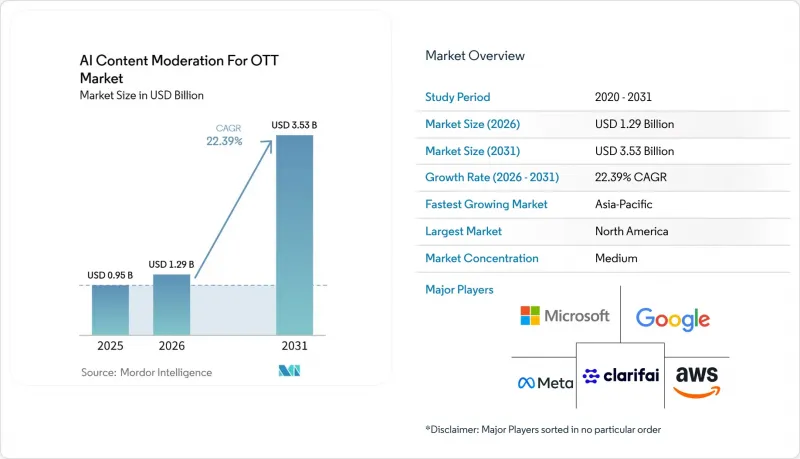
Mordor Intelligence에 의하면, OTT 시장에서 AI를 활용한 컨텐츠 모더레이션 시장 규모는 2025년 9억 5,000만 달러로 평가되었고, 2026년 12억 9,000만 달러에서 2031년까지 35억 3,000만 달러로 확대될 것으로 예측되며, 2026-2031년 연평균 성장률(CAGR)은 22.39%를 나타낼 전망입니다.
본 보고서는 모더레이션 유형별(텍스트 모더레이션, 이미지 모더레이션, 동영상 모더레이션, 음성 모더레이션), 컨텐츠 유형별(영화, TV 프로그램 및 에피소드 형식 컨텐츠, 다큐멘터리), 그리고 지역별(북미, 남미, 유럽, 아시아태평양, 중동 및 아프리카)로 분류되어 있습니다. 시장 전망은 금액(달러) 기준으로 제시되어 있습니다.
세계의 OTT용 AI 컨텐츠 모더레이션 시장 동향 및 인사이트
사용자 생성 동영상 및 라이브 스트림 양 증가
사용자 제작 동영상 및 라이브 스트림의 양이 증가하여 인력 검토만으로는 운영 능력을 초과함에 따라, 자동 검토는 OTT용 AI 컨텐츠 모더레이션 시장에서 핵심적인 운영 요건이 되었습니다. Streamlabs 및 Stream Hatchet의 보고서에 따르면, Kick의 방송 시간은 전년 대비 큰 폭 증가를 보인 반면, 한국의 CHZZK에서는 시청 시간이 크게 증가했습니다. 소규모 플랫폼이나 신생 플랫폼의 경우, 신뢰 및 안전 대책 팀의 인력이 제한적인 경우가 많아 외부 모더레이션 도구에 대한 의존도가 높아지고 있습니다. 라이브 컨텐츠의 경우, 대응 판단에 할애되는 시간이 몇 분에서 몇 초로 단축됩니다. 이러한 요건으로 인해, 위험성이 있는 컨텐츠를 식별하고 판단이 어려운 사례를 방송 중에 검토 담당자에게 배정할 수 있는 시스템이 요구되고 있습니다.
플랫폼의 책임과 디지털 안전 규제 강화
디지털 안전에 관한 규제로 인해 컨텐츠 모더레이션은 단순한 비용 센터가 아니라 규정 준수상의 의무로 자리 잡고 있습니다. 유럽 데이터 보호 위원회는 개인 데이터를 다루는 모더레이션 시스템이 ‘디지털 서비스법(Digital Services Act)’의 통지 및 조치 요건과 ‘일반 데이터 보호 규정(GDPR(EU 개인정보보호규정))’의 적법성 조건을 모두 충족해야 한다고 밝혔습니다. 이러한 이중 요건으로 인해 유럽 내 도입에 있어 ‘프라이버시 바이 디자인(Privacy by Design)’ 아키텍처의 중요성이 높아지고 있습니다. 또한, 결정 내용을 기록하고, 이의 제기에 대응하며, 관할 구역별로 다른 규칙을 사용자에게 적용할 수 있는 시스템에 대한 수요도 증가하고 있습니다. 따라서 OTT 시장을 위한 AI 컨텐츠 검토는 플랫폼의 전체 심사 프로세스를 재구축하지 않고도 조정 가능한 정책 엔진으로의 전환을 통해 이점을 얻고 있습니다. 투명한 에스컬레이션 경로를 제공하는 기업은 대량 처리를 위한 자동화를 유지하면서도 규제 당국의 기대에 부응할 수 있습니다.
오감지 및 문맥 의존성의 격차
오감지는 OTT 시장의 AI 컨텐츠 검토에 있어 여전히 상업적 및 평판상의 큰 제약 요인으로 남아 있습니다. Davidson 씨의 연구에 따르면, 다중 모달 대규모 언어 모델은 혐오 발언에 대한 인간의 판단과 더 밀접하게 일치시킬 수 있지만, 정치적 발언에 대해서는 여전히 불균형적으로 많은 오감지 플래그가 부여되는 것으로 나타났습니다. 또한 이 연구에서는 전반적인 오류율은 낮음에도 불구하고, 일부 고급 모델에서 주제별 유해성에 대한 편향이 더 두드러진다는 사실도 밝혀졌습니다. 상용 애플리케이션 프로그래밍 인터페이스(API)에 관한 ACM CHI 연구에 따르면, 특정 집단을 표적으로 한 노골적인 컨텐츠에 대한 검토는 과도한 반면, 암묵적인 혐오 발언에 대한 검토는 불충분한 것으로 밝혀졌습니다. 잘못된 삭제는 알고리즘의 설명 책임 규칙에 따라 운영되는 플랫폼에 이의 제기, 설명, 결정 철회와 같은 업무를 발생시킵니다. 실용적인 대응책으로는 인간의 판단을 완전히 대체하는 것이 아니라, 신뢰도가 낮거나 법적으로 민감한 결정을 훈련을 받은 검토 담당자에게 맡기는 하이브리드 설계가 있습니다.
부문 분석
2025년, 동영상 모더레이션은 매출의 40.66%를 차지했습니다. 이 부문은 신속한 정책 적용이 필요한 대량의 업로드 동영상 및 라이브 미디어에 의해 뒷받침되었습니다. 또한, 동영상은 소셜 미디어, 스트리밍, 라이브 커머스 서비스에서 높은 처리 능력을 필요로 하며, 브랜드 안전성 측면의 위험도 상당히 높습니다. 이러한 특성으로 인해 AI를 활용한 동영상 검토는 신뢰 및 안전 팀에게 최우선 과제가 되었습니다. OTT 시장에서 동영상용 AI 컨텐츠 검토 시장 규모는 컨텐츠 자산의 수와 시간적 제약이 있는 시각 자료의 검토 가치가 높은 점, 이 두 가지 요소에 모두 좌우됩니다. 플랫폼에는 위반 사항을 신속하게 감지하고, 판단이 어려운 사례를 사람에게 배정할 수 있는 도구가 필요합니다. 이 요건은 컨텐츠가 라이브로 방송되거나, 짧은 시간 내에 많은 시청자에게 전달되는 경우에 가장 중요해집니다. 그 결과, 동영상 제공업체들은 실시간 감지, 심사 대기열, 증거 기록 등의 기능을 서비스에 추가하고 있습니다.
음성 모더레이션은 2026-2031년 연평균 성장률(CAGR) 22.96%로 가장 높은 성장률을 나타낼 것으로 예측됩니다. 이는 팟캐스트의 혐오 발언, 딥페이크의 합성 음성, 라이브 방송의 댓글 등에 대응하기 위한 것입니다. 음성 신호는 텍스트나 이미지에 중점을 두었던 기존의 자동화 파이프라인에서 종종 제외되곤 했습니다. 멀티모달 시스템을 통해 플랫폼 운영자에게 있어 음성과 영상의 통합적인 평가가 점점 더 실용화되고 있습니다. 텍스트 모더레이션은 여전히 가장 성숙한 분야로, 기업의 프롬프트 및 응답 심사 요구를 충족시키고 있습니다. 이미지 모더레이션이나 행동 메타데이터, 이모티콘 시퀀싱 분석 등의 기타 모더레이션 기법은 게임, 데이팅, 커뮤니티 서비스 분야에서 활용이 확대되고 있습니다. 이러한 환경에서는 텍스트 분류기만으로는 감지할 수 없는 위반 행위가 포함될 가능성이 있습니다. 벤더와의 개별 거래 관계를 줄이고자 하는 구매자에게 있어, 크로스 모달 지원은 중요한 구매 기준이 되어가고 있습니다.
지역별 분석
2025년, 북미는 매출의 38.76%를 차지했습니다. 이 지역은 미국에 주요 소셜 미디어 플랫폼, 스트리밍 서비스, 디지털 광고 네트워크가 집중되어 있다는 이점을 누리고 있습니다. 플랫폼 운영자들은 비즈니스 프로세스 아웃소싱(BPO)에 의존하던 심사 모델에서 AI를 활용한 집행 시스템으로 전환하고 있습니다. 이러한 전환으로 인해 대량의 컨텐츠를 선별하면서도 이의 제기나 고위험 판단에 대해서는 인간 심사를 유지할 수 있는 도구에 대한 수요가 증가하고 있습니다. 캐나다에서는 청소년 이용과 관련된 AI 안전 대책에 초점을 맞춘 조사도 진행되고 있습니다. Mila와 Robust Open Online Safety Tools 컨소시엄은 2026년 7월, AI 챗봇용 오픈소스 자살 예방 도구를 공개했습니다.
아시아태평양은 2026-2031년 연평균 성장률(CAGR) 23.14%를 나타낼 것으로 예측되며, 이는 각 지역 중 가장 높은 성장률입니다. 이 지역의 라이브 커머스 활성화와 다양한 언어 요구 사항으로 인해 지속적인 컨텐츠 검토 수요가 발생하고 있습니다. CHZZK가 2025년에 기록한 10억 시간 이상의 시청 시간은 지역 플랫폼이 검토해야 하는 라이브 컨텐츠의 규모를 여실히 보여줍니다. 인도의 ‘정보기술 규정’에서는 일정 규모 이상의 소셜 미디어 중개업체에 대해 금지 컨텐츠를 식별하기 위한 자동화 도구 사용을 의무화하고 있습니다. 이 지역의 OTT 시장에서 AI 컨텐츠 모더레이션은 현지 언어 모델과 현지화된 정책의 도입을 통해 점점 더 뒷받침되고 있습니다. 이 지역은 서비스 수출 거점에서 모더레이션 기술에 대한 주요 수요원으로 전환되고 있습니다.
유럽 OTT 시장의 AI 컨텐츠 모더레이션은 플랫폼의 설명 책임에 관한 성숙한 프레임워크에 의해 뒷받침되고 있습니다. 2025년 9월에 발표된 유럽 데이터 보호 위원회(EDPB)의 지침은 ‘디지털 서비스법’과 ‘일반 데이터 보호 규정(GDPR(EU 개인정보보호규정))’의 통합된 의무를 명확히 했습니다. 이로 인해 유럽 내 도입 과정에서 개인정보 보호, 통지 처리 및 집행 기록에 관한 기술적 요건이 강화되고 있습니다. 남미, 중동 및 아프리카는 여전히 신흥 지역이며, 많은 서비스가 비즈니스 프로세스 아웃소싱(BPO) 모델을 통해 제공되고 있습니다. 2026년 CHI 컨퍼런스에서 발표된 조사에 따르면, 사하라 이남 아프리카의 모더레이터에 대한 심리적 지원 및 계약상 보호에 미비한 점이 있는 것으로 밝혀졌습니다. 노동 보호를 강화하면 사람이 직접 처리하는 에스컬레이션 비용이 상승하여, 해당 지역에서 자동화를 촉진하는 결과로 이어질 가능성이 있습니다.
기타 혜택 :
- 엑셀 형식 시장 예측(ME) 시트
- 3개월간의 애널리스트 지원
자주 묻는 질문
목차
제1장 서론
제2장 조사 방법
제3장 개요
제4장 시장 구도
제5장 시장 규모 및 성장 예측
제6장 경쟁 구도
제7장 시장 기회 및 향후 전망
AJY 26.09.01According to Mordor Intelligence, the AI content moderation for OTT Market size is projected to expand from USD 0.95 billion in 2025 and USD 1.29 billion in 2026 to USD 3.53 billion by 2031, registering a CAGR of 22.39% between 2026 to 2031.
This report is Segmented by Moderation Type (Text Moderation, Image Moderation, Video Moderation, and Audio Moderation), Content Type (Movies and Films, TV Shows and Episodic Content, and Documentaries), and Geography (North America, South America, Europe, Asia-Pacific, Middle East, and Africa). The Market Forecasts are Provided in Terms of Value (USD).
Global AI Content Moderation For OTT Market Trends and Insights
Rising User-Generated Video and Live-Stream Volume
The rising volume of user-generated video and live streams is exceeding the capacity of human-only review operations, making automated review a core operating requirement for the AI content moderation for OTT market. Streamlabs and Stream Hatchet reported strong year-over-year growth in Kick's hours streamed, while South Korea's CHZZK recorded a significant increase in hours watched. Smaller and newer platforms often operate with limited trust and safety teams, increasing their reliance on external moderation tools. Live content reduces the time available for enforcement decisions from minutes to seconds. This requirement favors systems that can identify risky material and route uncertain cases to reviewers during broadcasts.
Stricter Platform Liability and Digital Safety Regulation
Digital safety rules are making content moderation a compliance obligation rather than a cost center. The European Data Protection Board stated that moderation systems handling personal data must meet both Digital Services Act notice-and-action requirements and General Data Protection Regulation lawfulness conditions. This dual requirement raises the importance of privacy-by-design architecture in European deployments. It also supports demand for systems that can record decisions, support appeals, and apply different rules to users in different jurisdictions. The AI content moderation for OTT market, therefore, benefits from a move toward policy engines that can be adjusted without rebuilding a platform's full review process. Companies that provide transparent escalation paths can address regulatory expectations while retaining automation for large volumes.
False Positives and Context-Sensitivity Gaps
False positives remain a significant commercial and reputational constraint for the AI content moderation for OTT market. Davidson found that multimodal large language models can align more closely with human hate-speech judgments, but political speech can still receive disproportionate false-positive flags. The study also found sharper topic-toxicity bias in some more advanced models despite lower overall error rates. An ACM CHI study of commercial application programming interfaces found over-moderation of explicit group-targeted content and under-moderation of implicit hate speech. Incorrect removals create appeal, explanation, and reversal work for platforms operating under algorithmic accountability rules. The practical response is a hybrid design that sends low-confidence or legally sensitive decisions to trained reviewers instead of fully replacing human judgment.
Other drivers and restraints analyzed in the detailed report include:
- Multimodal AI Lowers Per-Asset Moderation Cost
- Advertiser Brand-Safety and Suitability Spending
- Moderator Well-Being and Human-Escalation Costs
For complete list of drivers and restraints, kindly check the Table Of Contents.
Segment Analysis
Video moderation held 40.66% of revenue in 2025. The segment was supported by the large volume of uploaded videos and live media requiring fast policy enforcement. Video also carries high processing needs and considerable brand-safety exposure for social media, streaming, and live commerce services. Those characteristics made AI-assisted video review a priority for trust and safety teams. The AI content moderation for OTT market size for video depends on both the number of assets and the higher review value of time-sensitive visual material. Platforms need tools that can detect violations rapidly and direct difficult cases to humans. This requirement is strongest when content is broadcast live or reaches a large audience quickly. Video suppliers are consequently adding real-time detection, review queues, and evidence records to their offerings.
Audio moderation is projected to record the highest growth at a 22.96% CAGR from 2026 to 2031. It addresses hate speech in podcasts, synthetic voice in deepfakes, and commentary in live streams. Audio signals were often excluded from older automated pipelines that focused on text and images. Multimodal systems are making joint audio and visual assessment more practical for platform operators. Text moderation remains the most mature area and serves enterprise prompt and response screening needs. Image moderation and other moderation types, including behavioral metadata and emoji-sequence analysis, are gaining use in gaming, dating, and community services. These environments can contain violations that text classifiers do not identify. Cross-modal coverage is becoming a central purchase criterion for buyers that want fewer separate vendor relationships.
Complete Report Scope:
- By Moderation Type
- Text Moderation
- Image Moderation
- Video Moderation
- Audio Moderation
- Other Moderation Types
- By Content Type
- Movies and Films
- TV Shows and Episodic Content
- Documentaries
- Other Content Types
- By Geography
- North America
- United States
- Canada
- Mexico
- South America
- Brazil
- Argentina
- Rest of South America
- Europe
- Germany
- United Kingdom
- France
- Italy
- Spain
- Russia
- Rest of Europe
- Asia-Pacific
- China
- India
- Japan
- South Korea
- Australia
- Rest of Asia-Pacific
- Middle East
- Turkey
- Saudi Arabia
- United Arab Emirates
- Rest of Middle East
- Africa
- South Africa
- Egypt
- Rest of Africa
- North America
Geography Analysis
North America held 38.76% of revenue in 2025. The region benefits from the concentration of major social media platforms, streaming services, and digital advertising networks in the United States. Platform operators are shifting from business-process-outsourcing-heavy review models toward AI-supported enforcement systems. This shift increases demand for tools that can screen high volumes while preserving human review for appeals and high-risk decisions. Canada also has research activity focused on AI safety guardrails for youth interactions. Mila and the Robust Open Online Safety Tools consortium released an open-source suicide prevention guardrail for AI chatbots in July 2026.
Asia-Pacific is projected to grow at a 23.14% CAGR from 2026 to 2031, the fastest rate among regions. Its live commerce activity and diverse language requirements create continuous moderation needs. CHZZK's more than 1 billion hours watched in 2025 shows the scale of live content that regional platforms must review. India's Information Technology Rules require significant social media intermediaries to use automated tools to identify prohibited material. The AI content moderation for OTT market in the region is increasingly supported by local language models and localized policy deployment. The region is shifting from a services-export location toward a major source of demand for moderation technology.
Europe's AI content moderation for OTT market is supported by a mature framework for platform accountability. The EDPB guidelines issued in September 2025 clarified the combined obligations of the Digital Services Act and the General Data Protection Regulation. This raises technical requirements for privacy, notice handling, and enforcement records in European deployments. South America, the Middle East, and Africa remain emerging areas where many services are delivered through business-process-outsourcing models. Research presented at the 2026 CHI Conference documented gaps in psychological support and contractual protections for moderators in sub-Saharan Africa. Stronger labor protections could raise the cost of human escalation and encourage more automation in these regions.
- Microsoft Corporation
- Google LLC
- Amazon Web Services, Inc.
- Meta Platforms, Inc.
- OpenAI, Inc.
- Clarifai, Inc.
- Accenture plc
- Cognizant Technology Solutions Corporation
- Genpact Limited
- Wipro Limited
- TELUS International (Cda) Inc.
- TaskUs, Inc.
- Appen Limited
- Concentrix Corporation
- LiveWorld, Inc.
- WebPurify, Inc.
- Besedo Global AB
- Hivemoderation, Inc.
- ActiveFence Ltd.
- Spectrum Labs
Additional Benefits:
- The market estimate (ME) sheet in Excel format
- 3 months of analyst support
TABLE OF CONTENTS
1 INTRODUCTION
- 1.1 Study Assumptions and Market Definition
- 1.2 Scope of the Study
2 RESEARCH METHODOLOGY
3 EXECUTIVE SUMMARY
4 MARKET LANDSCAPE
- 4.1 Market Overview
- 4.2 Market Drivers
- 4.2.1 Rising User-Generated Video and Live-Stream Volume
- 4.2.2 Stricter Platform Liability and Digital Safety Regulation
- 4.2.3 Advertiser Brand-Safety and Suitability Spending
- 4.2.4 Multimodal AI Lowers Per-Asset Moderation Cost
- 4.2.5 Regulation-Aware Moderation for Synthetic and Deepfake Content
- 4.2.6 Edge-Ready Moderation for Live and Interactive Media
- 4.3 Market Restraints
- 4.3.1 False Positives and Context-Sensitivity Gaps
- 4.3.2 Moderator Well-Being and Human-Escalation Costs
- 4.3.3 Data Residency Limits on Cross-Border Review Operations
- 4.3.4 Adversarial Prompting and Model Poisoning Risks
- 4.4 Industry Value Chain Analysis
- 4.5 Impact of Macroeconomic Factors on the Market
- 4.6 Regulatory Landscape
- 4.7 Technological Outlook
- 4.8 Porter's Five Forces Analysis
- 4.8.1 Bargaining Power of Suppliers
- 4.8.2 Bargaining Power of Buyers
- 4.8.3 Threat of New Entrants
- 4.8.4 Threat of Substitutes
- 4.8.5 Competitive Rivalry
5 MARKET SIZE AND GROWTH FORECASTS (VALUE)
- 5.1 By Moderation Type
- 5.1.1 Text Moderation
- 5.1.2 Image Moderation
- 5.1.3 Video Moderation
- 5.1.4 Audio Moderation
- 5.1.5 Other Moderation Types
- 5.2 By Content Type
- 5.2.1 Movies and Films
- 5.2.2 TV Shows and Episodic Content
- 5.2.3 Documentaries
- 5.2.4 Other Content Types
- 5.3 By Geography
- 5.3.1 North America
- 5.3.1.1 United States
- 5.3.1.2 Canada
- 5.3.1.3 Mexico
- 5.3.2 South America
- 5.3.2.1 Brazil
- 5.3.2.2 Argentina
- 5.3.2.3 Rest of South America
- 5.3.3 Europe
- 5.3.3.1 Germany
- 5.3.3.2 United Kingdom
- 5.3.3.3 France
- 5.3.3.4 Italy
- 5.3.3.5 Spain
- 5.3.3.6 Russia
- 5.3.3.7 Rest of Europe
- 5.3.4 Asia-Pacific
- 5.3.4.1 China
- 5.3.4.2 India
- 5.3.4.3 Japan
- 5.3.4.4 South Korea
- 5.3.4.5 Australia
- 5.3.4.6 Rest of Asia-Pacific
- 5.3.5 Middle East
- 5.3.5.1 Turkey
- 5.3.5.2 Saudi Arabia
- 5.3.5.3 United Arab Emirates
- 5.3.5.4 Rest of Middle East
- 5.3.6 Africa
- 5.3.6.1 South Africa
- 5.3.6.2 Egypt
- 5.3.6.3 Rest of Africa
- 5.3.1 North America
6 COMPETITIVE LANDSCAPE
- 6.1 Market Concentration
- 6.2 Strategic Moves
- 6.3 Vendor Positioning Analysis
- 6.4 Company Profiles (includes Global Level Overview, Market Level Overview, Core Segments, Financials as available, Strategic Information, Products and Services, Recent Developments)
- 6.4.1 Microsoft Corporation
- 6.4.2 Google LLC
- 6.4.3 Amazon Web Services, Inc.
- 6.4.4 Meta Platforms, Inc.
- 6.4.5 OpenAI, Inc.
- 6.4.6 Clarifai, Inc.
- 6.4.7 Accenture plc
- 6.4.8 Cognizant Technology Solutions Corporation
- 6.4.9 Genpact Limited
- 6.4.10 Wipro Limited
- 6.4.11 TELUS International (Cda) Inc.
- 6.4.12 TaskUs, Inc.
- 6.4.13 Appen Limited
- 6.4.14 Concentrix Corporation
- 6.4.15 LiveWorld, Inc.
- 6.4.16 WebPurify, Inc.
- 6.4.17 Besedo Global AB
- 6.4.18 Hivemoderation, Inc.
- 6.4.19 ActiveFence Ltd.
- 6.4.20 Spectrum Labs
7 Market Opportunities and Future Outlook
- 7.1 White-Space and Unmet-Need Assessment


