

|
시장보고서
상품코드
2118143
B2B 자율형 커머스 소프트웨어 시장 : 시장 점유율 분석, 업계 동향 및 통계, 성장 예측(2026-2031년)B2B Autonomous Commerce Software - Market Share Analysis, Industry Trends & Statistics, Growth Forecasts (2026 - 2031) |
||||||
 Mordor Intelligence
Mordor Intelligence에 의하면, B2B 자율형 커머스 소프트웨어 시장 규모는 2025년 87억 4,000만 달러로 평가되었고, 2026년에는 102억 1,000만 달러로 추정되고, 2026-2031년 CAGR 23.18%로 성장을 지속할 전망이며, 2031년까지 289억 6,000만 달러에 이를 것으로 예측됩니다.
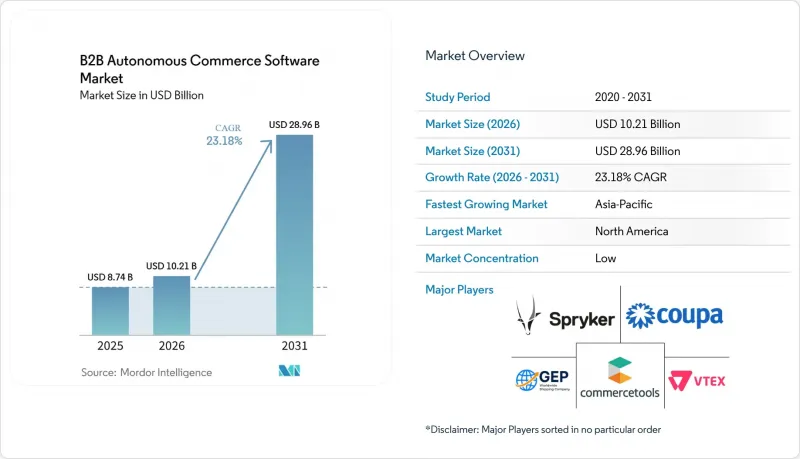
본 보고서는 구성 요소별(소프트웨어 및 서비스), 도입 모델별(클라우드, 하이브리드, 온프레미스), 기업 규모별(대기업 및 중소기업), 커머스 기능별(자율형 조달·소싱 등), 최종 사용자별(IT 및 통신, BFSI 등) 및 지역별로 분류되어 있습니다. 시장 예측은 금액(달러) 기준으로 제시되어 있습니다.
세계의 B2B 자율형 커머스 소프트웨어 시장 동향 및 인사이트
하이퍼 오토메이션 및 비용 효율성에 대한 기업 수요
조달 및 수주 관리에 대한 인건비 압박으로 인해 재무 및 운영 책임자들에게 자동화의 필요성은 더욱 분명해지고 있습니다. 수작업에 의존하는 B2B 구매 프로세스는 고객 경험 저하 및 판매 기회 손실로 이어질 수 있으며, 그 결과 더 신속하고 신뢰할 수 있는 거래의 가치가 높아지고 있습니다. 한 세계 제조업체는 Lio Technologies사의 AI 네이티브 조달 워크포스를 도입한 지 6개월 이내에, 기존에 외부에 위탁하던 조달 업무의 75%를 자동화했습니다. 주목할 점은 인건비 절감에만 그치지 않습니다. 청구서 처리를 신속화함으로써 매출채권 회수 및 공급업체와의 협력이 개선될 뿐만 아니라, 수작업에 의한 예외 처리가 줄어들어 팀은 판단이 필요한 특수한 주문이나 공급업체의 문제에 대처할 시간을 더 많이 확보할 수 있게 됩니다. 따라서 B2B 자율형 커머스 소프트웨어 시장은 현금 순환 주기와 조달 생산성의 측정 가능한 개선을 필요로 하는 재무 부서 리더의 주목을 받고 있습니다. 이 두 가지 가치를 모두 제공할 수 있는 공급업체는 단순히 기능의 수만으로 경쟁하는 공급업체보다 유리한 입장에 있습니다.
대규모 언어 모델과 도구 오케스트레이션의 급속한 발전
현재는 전문 에이전트가 조정 계층 아래에서 공급업체 발굴, 입찰 분석, 계약 검토 및 예외 처리 라우팅을 처리할 수 있게 되었습니다. 이러한 접근 방식을 통해 데이터 필드가 통일되어 있고 각 결정이 사전 정의된 조건을 통해 표현될 수 있는 경우에만 가장 효과적이었던 기존의 규칙 기반 조달 도구의 한계가 해소됩니다. 비정형 문서, 제품 카탈로그, 가격 정보를 다룰 수 있는 에이전트는 고정된 로직으로는 대응하기 어려웠던 변동성이 큰 영역까지 자동화를 확대합니다. SAP는 2026년 5월, ‘Autonomous Enterprise’ 비전과 ‘SAP Autonomous Suite’를 발표했습니다. 여기에는 자사의 기업 소프트웨어 환경 내에서 조달 및 소싱을 수행하기 위한 ‘Joule’ 어시스턴트가 포함되어 있습니다. 주요 플랫폼 제공업체들이 핵심 상업 업무에 이미 사용되고 있는 시스템에 에이전트 기능을 추가함에 따라, B2B 자율형 커머스 소프트웨어 시장은 그 혜택을 누리고 있습니다. 또한 모델 기능의 급속한 향상으로 인해 제품 출시 주기가 단축되고, 벤더가 기술적 우위를 유지할 수 있는 기간도 짧아지고 있습니다.
높은 도입 비용과 레거시 시스템과의 통합 문제
자율 에이전트를 ERP 시스템, 공급업체 포털, 계약 저장소, 결제 시스템에 연결하는 것은 여전히 도입에 있어 큰 장벽으로 남아 있습니다. 이러한 시스템 중 상당수는 기계가 읽을 수 있는 API 액세스를 전제로 구축되지 않았습니다. 구형 시스템의 경우, 맞춤형 어댑터, 수동 전자 데이터 교환(EDI) 매핑, 제품 분류 체계 정비가 필요할 수 있으며, 이로 인해 도입 기간이 몇 주에서 몇 분기까지 걸릴 수 있습니다. 중소기업의 경우 이러한 부담이 더욱 커지는 경향이 있습니다. 통합에 드는 비용이 첫해 소프트웨어 비용에서 차지하는 비중이 커질 뿐만 아니라, 구매 프로세스와 기존 기업 소프트웨어 환경을 모두 이해하고 있는 인력이 부족한 경우가 많기 때문입니다. B2B 자율형 커머스 소프트웨어 시장에서는 미리 구축된 커넥터, 표준화된 온보딩, 성과 기반 가격 책정과 같은 대응 방안이 추진되고 있습니다. 그럼에도 불구하고, 도입 작업은 첫 도입을 고려하는 많은 조직에게 여전히 큰 제약 요인으로 남아 있습니다.
부문 분석
2025년, B2B 자율형 커머스 소프트웨어 시장에서 소프트웨어가 72.41%의 점유율을 차지했습니다. 기업들은 일반적으로 조달, 주문 관리 또는 결제를 위한 라이선스가 포함된 모듈부터 도입을 시작하고, 그 후 설정 및 통합을 위한 서비스를 추가합니다. 이러한 ‘플랫폼 우선’ 접근 방식은 완전한 맞춤형 구축보다 재사용 가능한 기능을 우선시하는 경향을 반영합니다. 조직은 미리 정의된 워크플로우에서 시작하여 초기 운영 성과가 확립된 후에 도입 범위를 확대할 수 있기 때문입니다. 또한, 미리 정의된 워크플로는 특정 조달 카테고리, 정기적인 수주 프로세스 또는 제한된 공급업체 그룹에 초점을 맞춘 후, 동일한 운영 모델을 더 광범위하게 적용할 수 있습니다. 이 서비스 시장은 2031년까지 연평균 성장률(CAGR) 26.83%로 확대될 것으로 예측됩니다. 서비스의 성장 속도가 더 빠른 것은本番 환경 도입에 있어 기존에는 개별적으로 개발되는 경우가 많았던 기업 자원 계획(ERP) 시스템, 공급업체 네트워크, 결제 경로, 계약 저장소 및 내부 승인 프로세스에 여전히 막대한 작업이 필요함을 보여줍니다.
구축, 컨설팅 및 관리형 서비스는 통합 단계에서 정체될 가능성이 있는 파일럿 프로젝트를 조직이 극복하는 데 도움이 됩니다. GEP Worldwide와 JAGGAER는 자사의 소프트웨어 제품을 통해 이러한 노력을 지원하는 제공업체의 예입니다. Labviva는 2026년 6월, 생명과학 분야의 연구개발 조달을 위해 전문적인 소형 언어 모델과 조정 모델을 결합한 ‘The Agentic Crew’를 출시했습니다. 이 모델의 설계에는 초기 단계부터 규정 준수 및 감사 가능성 요건이 반영되어 있습니다. 기업 프로그램이 확대됨에 따라, B2B 자율 상거래 소프트웨어 시장에서는 지속적인 모델 거버넌스 및 기업 자원 계획(ERP) 동기화를 지원하는 서비스가 등장할 전망입니다.
2025년, B2B 자율형 커머스 소프트웨어 시장 점유율 중 클라우드가 74.18%를 차지했습니다. 이러한 우위는 SaaS(Software-as-a-Service)의 도입 속도와 초기 인프라 비용을 대폭 절감하는 구독형 가격 정책을 반영한 결과입니다. 또한 클라우드 시스템에서는 거래량 증가에 따라 에이전트 활용 규모를 유연하게 확대할 수 있습니다. 한편, 하이브리드 환경은 2031년까지 연평균 성장률(CAGR) 25.42%로 확대될 것으로 예측됩니다. 이는 온프레미스 ERP(기업 자원 계획) 시스템에 대한 막대한 투자를 유지하고 있으며, 당분간 기록 시스템을 퍼블릭 클라우드로 완전히 이전할 수 없는 기업의 요구를 반영한 것입니다. 또한, 이러한 기업들은 자동화를 시작하기 전에 프로세스를 재구축할 것을 요구하지 않으며, 기존 기록, 승인 경로 및 보안 관리와 연동되어 새로운 서비스가 작동하기를 원합니다.
하이브리드 시스템에서는 클라우드 기반 에이전트와 로컬 환경에서 관리되는 거래 데이터에 대한 액세스를 결합할 수 있습니다. 이러한 구성을 통해 레거시 시스템과의 연결성을 유지하면서, 핵심 기록 관리 시스템을 변경하거나 확립된 거래 관리를 중단하지 않고도 새로운 자동화 서비스를 도입할 수 있습니다. 또한, 유럽의 데이터 주권 관련 요건으로 인해 유럽연합(EU) 내에서 호스팅되는 옵션이나 온프레미스형 옵션에 대한 관심이 높아지고 있습니다. mysupply, Procuras, Valora와 같은 독일공급업체들은 데이터가 유럽연합 내에 머무르는 것을 핵심으로 자사 제품을 포지셔닝하고 있습니다. 온프레미스 배포는 여전히 가장 작은 규모의 모델이지만, 국방, 규제 대상 금융 서비스, 공공 조달 분야에서는 중요한 역할을 수행하고 있습니다. 따라서 B2B 자율형 상거래 소프트웨어 시장에서는 현대화 계획과 현지 데이터 규제를 모두 충족하는 도입 옵션이 요구되고 있습니다.
지역별 분석
2025년, 북미는 B2B 자율형 커머스 소프트웨어 시장 점유율의 36.73%를 차지했습니다. 이 지역에는 기업 소프트웨어 구매자, 에이전트에 초점을 맞춘 스타트업, 그리고 확립된 조달 기술 시스템을 갖춘 기업이 고밀도로 집중되어 있으며, 미국은 소스-투-페이(Source-to-Pay), 주문 관리, 에이전트 지원형 결제 분야에서 가장 많은 도입 실적을 자랑합니다. Coupa Software와 GEP Worldwide는 북미의 대규모 기업 고객 기반을 바탕으로 구매자 및 공급업체 네트워크를 구축해 왔습니다. 캐나다와 멕시코에서는 제조업 및 자동차 산업공급망에서 발생하는 수요가 더해지고 있으며, 국경을 넘는 조달로 인해 청구서 대조 및 다중 통화 결제 관리의 필요성이 높아지고 있습니다.
유럽은 B2B 자율형 커머스 소프트웨어 시장에 있어 규모는 크지만, 독자적인 지역적 환경을 보이고 있습니다. 유럽연합(EU)의 규정 준수 요건에 따라 감사 가능성, 추적성 및 사람이 직접 수동으로 수정할 수 있는 기능을 중심으로 한 제품 설계가 진행되고 있습니다. EU의 AI법 및 NIS2로 인해 거버넌스와 공급망 보안 기능의 중요성이 높아지고 있는 한편, 데이터 주권 문제로 인해 독일 및 인근 국가의 구매자들은 조달 플랫폼이 데이터를 EU 지역 내에 보관하고 있는지 면밀히 검토하고 있습니다. 독일은 유럽 최대 시장이지만, 중소규모 산업 제조업체에 대한 시장 침투율은 아직 낮은 상황입니다. 영국과 프랑스는 도입 시장으로서 성장하고 있으며, 브라질은 다국어·다통화 대응이 가능한 공급업체와 연계한 제조 및 농업 관련 비즈니스의 수출을 통해 남미 수요를 뒷받침하고 있습니다.
아시아태평양은 2031년까지 연평균 성장률(CAGR) 27.84%로 확대될 것으로 예측됩니다. 이러한 성장은 인도와 동남아시아의 ERP(전사적 자원 관리) 클라우드 전환, 공공 디지털 조달 프로그램, 그리고 다중 통화 거래를 관리하는 수출 지향 기업들에 의해 뒷받침되고 있습니다. 인도는 Procol Technologies를 비롯한 에이전트 주도형 조달 소프트웨어에 있어 최종 사용자 시장이자 동시에 개발 거점입니다. 한편, 중국은 거대한 제조 거점과 지속적으로 성장하는 B2B 디지털 상거래 인프라를 보유하고 있지만, 데이터 현지화 규제가 국경을 넘는 플랫폼 설계에 영향을 미치고 있습니다. 사우디아라비아와 아랍에미리트(UAE)는 정부 주도로 기업의 디지털화와 조달 현대화를 추진하고 있습니다. 남아프리카공화국과 나이지리아는 신흥 상업 허브이며, 모바일 우선 기업 플랫폼이 도입 장벽을 낮추고 있습니다.
기타 혜택 :
- 엑셀 형식 시장 예측(ME) 시트
- 3개월간의 애널리스트 지원
자주 묻는 질문
목차
제1장 서론
제2장 조사 방법
제3장 개요
제4장 시장 구도
제5장 시장 규모 및 성장 예측
제6장 경쟁 구도
제7장 시장 기회 및 향후 전망
AJY 26.09.01According to Mordor Intelligence, the B2B autonomous commerce software market size is expected to grow from USD 8.74 billion in 2025 to USD 10.21 billion in 2026 and is forecast to reach USD 28.96 billion by 2031 at 23.18% CAGR over 2026-2031.
This report is Segmented by Component (Software, and Services), Deployment Model (Cloud, Hybrid, and On-Premises), Enterprise Size (Large Enterprises, and Small and Medium-Sized Enterprises), Commerce Function (Autonomous Procurement and Sourcing, and More), End User (IT and Telecommunication, BFSI, and More), and Geography. The Market Forecasts are Provided in Terms of Value (USD).
Global B2B Autonomous Commerce Software Market Trends and Insights
Enterprise Demand for Hyper-Automation and Cost Efficiency
Labor cost pressure in procurement and order management has made the case for automation clearer for finance and operations leaders. Manual B2B buying processes can create poor customer experiences and lost sales opportunities, which increases the value of faster, more reliable transactions. A global manufacturer automated 75% of procurement work that it had previously outsourced within 6 months after deploying Lio Technologies' AI-native procurement workforce. The focus is not limited to lower labor costs, as faster invoice processing can improve cash collection and supplier coordination, while fewer manual exceptions can give teams more time to address unusual orders and supplier issues that require judgment. The B2B Autonomous Commerce Software Market is therefore attracting attention from finance leaders who need measurable improvements in cash cycles and procurement productivity. Providers that show both types of value are better placed than those competing only on the number of features.
Rapid Advances in Large Language Models and Tool Orchestration
Specialized agents can now handle supplier discovery, bid analysis, contract review, and exception routing under a coordinating layer. This approach reduces the limits of earlier rules-based procurement tools, which were most effective only when data fields were consistent and each decision could be expressed through predefined conditions. Agents that can work with unstructured documents, product catalogs, and pricing information extend automation into areas that were too variable for fixed logic. SAP introduced its Autonomous Enterprise vision and SAP Autonomous Suite in May 2026, including Joule assistants for procurement and sourcing within its enterprise software environment. The B2B Autonomous Commerce Software Market is benefiting as larger platform providers add agent capabilities to systems already used for core commercial operations. Faster improvements in model capabilities are also shortening product release cycles and reducing the time vendors have to sustain a technical lead.
High Implementation Costs and Legacy Integration Challenges
Connecting autonomous agents to enterprise resource planning systems, supplier portals, contract repositories, and payment systems remains a major barrier to adoption. Many of these systems were not built for machine-readable application programming interface access. Older systems can require custom adapters, manual electronic data interchange mapping, and product taxonomy work, which can lengthen deployment from weeks to quarters. The burden is often heavier for small and medium-sized enterprises because integration spending represents a larger share of their first-year software cost, and these organizations may have fewer staff who understand both purchasing processes and older enterprise software environments. The B2B Autonomous Commerce Software Market is responding with prebuilt connectors, standardized onboarding, and outcome-based pricing. Even so, implementation work remains a material constraint for many organizations considering their first deployment.
Other drivers and restraints analyzed in the detailed report include:
- Cloud Infrastructure Expansion and Lower Inference Costs
- ERP Modernization and API-Ready B2B Transaction Channels
- Data Privacy, Cybersecurity, and Regulatory Uncertainty
For complete list of drivers and restraints, kindly check the Table Of Contents.
Segment Analysis
Software held 72.41% of the B2B Autonomous Commerce Software Market share in 2025. Enterprises commonly begin with licensed modules for procurement, order management, or payments before adding services for configuration and integration. This platform-first approach reflects a preference for reusable capabilities rather than fully custom builds, because organizations can begin with a defined workflow and extend the deployment after early operating results are established, and the defined workflow may focus on a specific purchasing category, a recurring order process, or a limited group of suppliers before the same operating model is applied more widely. Services are projected to expand at a 26.83% CAGR through 2031. The faster growth of services shows that production deployments still require substantial work across enterprise resource planning systems, supplier networks, payment rails, contract repositories, and internal approval processes that were often developed independently.
Implementation, consulting, and managed services help organizations move beyond pilots that might otherwise stall at the integration stage. GEP Worldwide and JAGGAER are among the providers supporting this work through their software offerings. Labviva launched The Agentic Crew in June 2026, combining specialized small language models and a coordinating model for life sciences research and development procurement. Its design includes compliance and auditability requirements from the start. As enterprise programs expand, the B2B Autonomous Commerce Software Market is likely to see services support ongoing model governance and enterprise resource planning synchronization.
Cloud accounted for 74.18% of the B2B Autonomous Commerce Software Market share in 2025. Its lead reflects the speed of software-as-a-service deployment and subscription pricing that avoids large initial infrastructure costs. Cloud systems also allow organizations to scale agent use as transaction volumes increase, while hybrid is projected to expand at a 25.42% CAGR through 2031. This reflects the needs of enterprises that retain significant on-premises enterprise resource planning investments and cannot move their systems of record fully to the public cloud in the near term, and their new services need to work with established records, approval paths, and security controls rather than requiring those processes to be rebuilt before automation begins.
Hybrid systems can pair cloud-based agents with access to transaction data maintained in local environments. This arrangement preserves connectivity to older systems while allowing new automation services to be introduced without requiring changes to the core recordkeeping system or disrupting established transaction controls. European data sovereignty requirements are also encouraging interest in European Union-hosted and on-premises options. German providers such as mysupply, Procuras, and Valora have positioned their offerings around data remaining in the European Union. On-premises deployment remains the smallest model, but it is important in defense, regulated financial services, and public procurement. The B2B Autonomous Commerce Software Market, therefore, needs deployment options that align with both modernization plans and local data regulations.
Complete Report Scope:
- By Component
- Software
- Services
- By Deployment Model
- Cloud
- Hybrid
- On-Premises
- By Enterprise Size
- Large Enterprises
- Small and Medium-Sized Enterprises
- By Commerce Function
- Autonomous Procurement and Sourcing
- Autonomous Sales and Quoting
- Order Capture and Order Execution
- Pricing, Promotion, and Contract Compliance
- Inventory Replenishment and Fulfillment
- Autonomous Payments and Reconciliation
- By End User
- IT and Telecommunication
- BFSI
- Automotive and Transportation
- Healthcare and Life Sciences
- Retail and E-Commerce
- Industrial Manufacturing
- Education and Research Institutions
- Government and Administration
- Energy and Utilities
- Other End Users
- By Geography
- North America
- United States
- Canada
- Mexico
- South America
- Brazil
- Argentina
- Rest of South America
- Europe
- Germany
- United Kingdom
- France
- Russia
- Spain
- Rest of Europe
- Asia-Pacific
- China
- Japan
- India
- South Korea
- Southeast Asia
- Rest of Asia-Pacific
- Middle East and Africa
- Middle East
- Saudi Arabia
- United Arab Emirates
- Rest of Middle East
- Africa
- South Africa
- Nigeria
- Rest of Africa
- Middle East
- North America
Geography Analysis
North America held 36.73% of the B2B Autonomous Commerce Software Market share in 2025. The region has a high concentration of enterprise software buyers, agent-focused startups, and companies with established procurement technology systems, and the United States has the largest number of deployments across source-to-pay, order management, and agent-supported payments. Coupa Software and GEP Worldwide have built buyer and supplier networks from substantial North American enterprise customer bases. Canada and Mexico add demand from manufacturing and automotive supply chains, where cross-border procurement creates a need for invoice reconciliation and multi-currency payment management.
Europe is a sizable but distinct regional environment for the B2B Autonomous Commerce Software Market. European Union compliance requirements are shaping product design around auditability, traceability, and human override functions. The European Union AI Act and NIS2 are increasing the importance of governance and supply-chain security features, while data sovereignty has led German and nearby buyers to examine whether procurement platforms keep data within the European Union. Germany is the largest European market and has an underpenetrated base of small- and medium-sized industrial manufacturers. The United Kingdom and France are growing deployment markets, while Brazil supports South American demand through manufacturing and agribusiness exports that work with multilingual, multi-currency suppliers.
Asia-Pacific is projected to expand at a 27.84% CAGR through 2031. Growth is supported by enterprise resource planning cloud migration in India and Southeast Asia, public digital procurement programs, and export-oriented companies managing multi-currency trade. India is both an end-user market and a development base for agent-led procurement software, including Procol Technologies, while China has a large manufacturing base and growing B2B digital commerce infrastructure, although data localization rules affect cross-border platform designs. Saudi Arabia and the United Arab Emirates are pursuing government-led enterprise digitization and procurement modernization. South Africa and Nigeria are emerging commercial hubs where mobile-first enterprise platforms are reducing implementation barriers.
- commercetools GmbH
- Spryker Systems GmbH
- Oro Inc.
- Sana Commerce B.V.
- VTEX, Inc.
- Go Autonomous ApS
- Lio Technologies GmbH
- Procure Technologies, Inc.
- Mercanis GmbH
- Didero, Inc.
- Zinit GmbH
- Procol Technologies Private Limited
- Keelvar, Inc.
- GEP Worldwide LLC
- Coupa Software Incorporated
- JAGGAER, LLC
- Zycus Inc.
- Punchout2Go
- KIBO Commerce, Inc.
- Tacton Systems AB
- CommerceFlow, Inc.
- Endless Commerce, Inc.
Additional Benefits:
- The market estimate (ME) sheet in Excel format
- 3 months of analyst support
TABLE OF CONTENTS
1 INTRODUCTION
- 1.1 Study Assumptions and Market Definition
- 1.2 Scope of the Study
2 RESEARCH METHODOLOGY
3 EXECUTIVE SUMMARY
4 MARKET LANDSCAPE
- 4.1 Market Overview
- 4.2 Market Drivers
- 4.2.1 Enterprise Demand for Hyper-Automation and Cost Efficiency
- 4.2.2 Rapid Advances in Large Language Models and Tool Orchestration
- 4.2.3 Cloud Infrastructure Expansion and Lower Inference Costs
- 4.2.4 ERP Modernization and API-Ready B2B Transaction Channels
- 4.2.5 Machine-Readable Commercial Data Becoming a Competitive Requirement
- 4.2.6 Autonomous Exception Resolution for High-Volume, Long-Tail Orders
- 4.3 Market Restraints
- 4.3.1 High Implementation Costs and Legacy Integration Challenges
- 4.3.2 Data Privacy, Cybersecurity, and Regulatory Uncertainty
- 4.3.3 Sparse Training Data for Negotiated B2B Pricing and Contract Terms
- 4.3.4 Low-Trust Failure Modes in Multi-Party Autonomous Transactions
- 4.4 Impact of Macroeconomic Factors on the Market
- 4.5 Industry Value-Chain Analysis
- 4.6 Technology Outlook
- 4.7 Regulatory Landscape
- 4.8 Porter's Five Forces Analysis
- 4.8.1 Threat of New Entrants
- 4.8.2 Bargaining Power of Suppliers
- 4.8.3 Bargaining Power of Buyers
- 4.8.4 Threat of Substitutes
- 4.8.5 Intensity of Competitive Rivalry
5 MARKET SIZE AND GROWTH FORECASTS (VALUE)
- 5.1 By Component
- 5.1.1 Software
- 5.1.2 Services
- 5.2 By Deployment Model
- 5.2.1 Cloud
- 5.2.2 Hybrid
- 5.2.3 On-Premises
- 5.3 By Enterprise Size
- 5.3.1 Large Enterprises
- 5.3.2 Small and Medium-Sized Enterprises
- 5.4 By Commerce Function
- 5.4.1 Autonomous Procurement and Sourcing
- 5.4.2 Autonomous Sales and Quoting
- 5.4.3 Order Capture and Order Execution
- 5.4.4 Pricing, Promotion, and Contract Compliance
- 5.4.5 Inventory Replenishment and Fulfillment
- 5.4.6 Autonomous Payments and Reconciliation
- 5.5 By End User
- 5.5.1 IT and Telecommunication
- 5.5.2 BFSI
- 5.5.3 Automotive and Transportation
- 5.5.4 Healthcare and Life Sciences
- 5.5.5 Retail and E-Commerce
- 5.5.6 Industrial Manufacturing
- 5.5.7 Education and Research Institutions
- 5.5.8 Government and Administration
- 5.5.9 Energy and Utilities
- 5.5.10 Other End Users
- 5.6 By Geography
- 5.6.1 North America
- 5.6.1.1 United States
- 5.6.1.2 Canada
- 5.6.1.3 Mexico
- 5.6.2 South America
- 5.6.2.1 Brazil
- 5.6.2.2 Argentina
- 5.6.2.3 Rest of South America
- 5.6.3 Europe
- 5.6.3.1 Germany
- 5.6.3.2 United Kingdom
- 5.6.3.3 France
- 5.6.3.4 Russia
- 5.6.3.5 Spain
- 5.6.3.6 Rest of Europe
- 5.6.4 Asia-Pacific
- 5.6.4.1 China
- 5.6.4.2 Japan
- 5.6.4.3 India
- 5.6.4.4 South Korea
- 5.6.4.5 Southeast Asia
- 5.6.4.6 Rest of Asia-Pacific
- 5.6.5 Middle East and Africa
- 5.6.5.1 Middle East
- 5.6.5.1.1 Saudi Arabia
- 5.6.5.1.2 United Arab Emirates
- 5.6.5.1.3 Rest of Middle East
- 5.6.5.2 Africa
- 5.6.5.2.1 South Africa
- 5.6.5.2.2 Nigeria
- 5.6.5.2.3 Rest of Africa
- 5.6.5.1 Middle East
- 5.6.1 North America
6 COMPETITIVE LANDSCAPE
- 6.1 Market Concentration
- 6.2 Strategic Moves
- 6.3 Market Share Analysis
- 6.4 Company Profiles (includes Global Level Overview, Market Level Overview, Core Segments, Financials as available, Strategic Information, Market Rank/Share, Products and Services, Recent Developments)
- 6.4.1 commercetools GmbH
- 6.4.2 Spryker Systems GmbH
- 6.4.3 Oro Inc.
- 6.4.4 Sana Commerce B.V.
- 6.4.5 VTEX, Inc.
- 6.4.6 Go Autonomous ApS
- 6.4.7 Lio Technologies GmbH
- 6.4.8 Procure Technologies, Inc.
- 6.4.9 Mercanis GmbH
- 6.4.10 Didero, Inc.
- 6.4.11 Zinit GmbH
- 6.4.12 Procol Technologies Private Limited
- 6.4.13 Keelvar, Inc.
- 6.4.14 GEP Worldwide LLC
- 6.4.15 Coupa Software Incorporated
- 6.4.16 JAGGAER, LLC
- 6.4.17 Zycus Inc.
- 6.4.18 Punchout2Go
- 6.4.19 KIBO Commerce, Inc.
- 6.4.20 Tacton Systems AB
- 6.4.21 CommerceFlow, Inc.
- 6.4.22 Endless Commerce, Inc.
7 MARKET OPPORTUNITIES AND FUTURE OUTLOOK
- 7.1 White-Space and Unmet-Need Assessment


