

|
시장보고서
상품코드
2118153
AI 기반 배아 선별 시장 : 시장 점유율 분석, 업계 동향 및 통계, 성장 예측(2026-2031년)AI-Powered Embryo Selection - Market Share Analysis, Industry Trends & Statistics, Growth Forecasts (2026 - 2031) |
||||||
 Mordor Intelligence
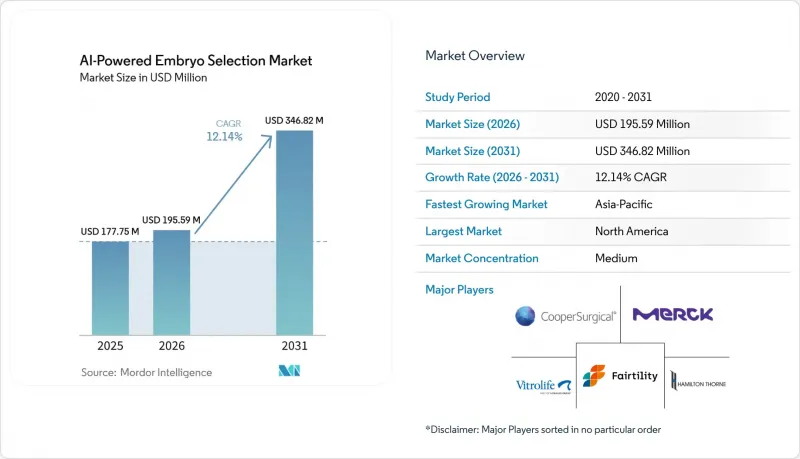
Mordor Intelligence에 의하면, AI 기반 배아 선별 시장은 2025년 1억 7,775만 달러로 평가되었고, 2026년에는 1억 9,559만 달러로 추정되고, 2026-2031년 CAGR 12.14%로 성장을 지속할 전망이며, 2031년까지 3억 4,682만 달러에 이를 것으로 예측됩니다.
본 보고서는 구성 요소별(소프트웨어, 서비스), 배포 방식별(클라우드 기반, 온프레미스), 기술별(딥러닝, 머신러닝, 기타), 용도별(체외수정, 기타), 최종 사용자별(불임 치료 클리닉 및 체외수정 센터, 기타), 지역별(북미, 유럽, 아시아태평양, 중동 및 아프리카, 남미)로 분류되어 있습니다. 시장 예측은 금액(달러) 기준으로 제시되어 있습니다.
세계의 AI 기반 배아 선별 시장 동향 및 인사이트
불임증 증가와 출산 연령의 고령화
AI 기반 배아 선별 시장의 주요 수요 원인은 성인 인구에서 널리 나타나는 불임에 있습니다. 이 문제는 전 세계 성인의 17.5%에 영향을 미치고 있으며, 고소득 지역과 저소득 지역 간에는 유의미한 차이가 거의 보이지 않습니다. 2025년 조사에 따르면, 1990-2021년 전 세계 남성 불임 사례 수가 74.7% 증가한 것으로 나타났으며, 이로 인해 클리닉들은 단순한 단일 요인에 의한 평가 방식이 아닌 보다 상세한 평가 프로토콜을 채택할 수밖에 없게 되어, 수요 기반이 점점 더 복잡해지고 있습니다. AI 기반 배아 선별 시장은 출산 시기가 늦어지는 현상이 점점 더 중요하게 여겨지고 있는 점도 호재로 작용하고 있습니다. 치료 시작이 늦어질수록 1주기당 경제적 부담이 커지는 경향이 있으며, 피할 수 있는 배아 선별 오류를 방지해야 한다는 압박감도 커지기 때문입니다. 이에 따라 AI 기반 배아 선별 시장에는 대규모의 지속적인 임상 수요가 발생하고 있습니다. 특히, 환자가 체외수정 시도마다 막대한 비용을 지불하고 있으며, 보다 엄격한 순위 지정을 위한 지원을 요구하고 있는 경우에는 이러한 경향이 두드러집니다. 또한, 이는 클리닉이 고령 환자나 반복적인 배아 이식 주기를 받는 환자를 대응할 때, 일관성을 높이는 도구에 투자해야 할 강력한 이유가 됨을 의미합니다.
배아 평가에서 주관성 저감이 필요
AI 기반 배아 선별 시장이 탄력을 받고 있는 이유는 일상적인 검사실 업무에서 수동 배아 평가에는 여전히 명백한 재현성의 한계가 나타나기 때문입니다. Alife Health의 조사에 따르면, 전문가 그룹이 코호트에서 최상위 배아를 선정할 때의 불일치율은 34.6%였으며, 평가 대상 배아가 3개 이상인 경우 그 불일치율은 44%까지 상승했습니다. 이는 상업적으로도 중요한 의미를 지닙니다. 왜냐하면, 특히 동일한 이미지 세트에 대해 직원마다 서로 다른 결론을 내릴 가능성이 있는 경우, 클리닉은 더 이상 배아 순위를 매기는 작업을 순전히 개인의 판단에 맡기는 것으로 간주하지 않기 때문입니다. 미국생식의학회(ASRM)는 2024년, AI 시스템이 체외수정(IVF) 실험실 내에서 보다 객관적이고 일관된 평가를 지원할 수 있다고 밝혔으며, 이를 통해 AI 기반 배아 선별 시장은 더욱 견고한 임상적 타당성의 기반을 확보하고 있습니다. 그 결과, AI 기반 배아 선별 시장은 치료 성과에 대한 기대뿐만 아니라, 감사 가능성, 재현성, 그리고 여러 기관으로 구성된 불임 치료 네트워크 전반에 걸친 보다 명확한 프로세스 관리와도 점점 더 밀접하게 연결되고 있습니다.
임상 도입에 따른 높은 검증 부담
AI 기반 배아 선별 시장은 임상 검증에 소요되는 비용과 기간으로 인해 현저한 둔화를 겪고 있습니다. 유럽에서는 EU AI법에 따라 배아 선별 소프트웨어가 고위험 AI로 분류되어 있으며, 공급업체는 의료기기로서의 의무 외에도 설명 가능성, 위험 관리, 시판 후 모니터링을 지원해야 합니다. 이러한 요건으로 인해 개발 일정이 장기화되고, 자금은 제품의 신속한 개선이 아닌 문서화, 검증, 모니터링으로 배분되게 됩니다. 이러한 상황은 확립된 임상시험 네트워크, 기존 규정 준수 팀, 상업 활동을 중단하지 않고 여러 국가에 대한 승인을 관리할 수 있는 충분한 자금을 보유한 기업에게 유리하게 작용합니다. 그 결과, AI 기반 배아 선별 시장에서는 초기 연구에서 기술 모델이 우수한 성능을 보였더라도 소규모 벤더가 신속하게 경쟁을 펼칠 여지는 제한적입니다.
부문 분석
2025년에는 소프트웨어가 매출의 52.83%를 차지했으며, 연평균 성장률(CAGR) 12.62%로 가장 빠르게 성장하는 부문이 될 것으로 예측됩니다. 이러한 선두 위상은 AI 기반 배아 선별 시장에서 상업적 가치가 어디에서 형성되고 있는지를 보여줍니다. 각 시설별로 새로운 영상 장비를 구매하는 경우에 비해 초기 도입 장벽이 낮아지기 때문에 클리닉에서는 1주기 단위나 구독형 가격 책정이 점점 더 선호되고 있습니다. 이러한 구조에서는 도입이 일회성 조달보다는 검사실의 처리 능력이나 임상 워크플로우에서의 활용 상황과 더 밀접하게 연결되어 있습니다.
서비스 계층은 여전히 중요합니다. 통합, 교육, 검증 지원, 워크플로우 설정은 구매 후 도구가 지속적으로 사용될지 여부에 여전히 영향을 미치기 때문입니다. 장기적으로 보면, AI 기반 배아 선별 시장에서 성공하는 구성 요소 전략은 지속적인 소프트웨어 수익과 도입 후에도 클리닉의 활용을 유지하기에 충분한 서비스 깊이를 결합한 것이 계속해서 주류를 이룰 것으로 보입니다.
클라우드 기반 도입은 2025년에 53.27%의 점유율을 차지한 것으로 평가되었으며, 2031년까지 연평균 성장률(CAGR) 13.18%로 확대될 것으로 전망되어, AI 기반 배아 선별 시장에서 주요 도입 형태가 될 것으로 보입니다. 이러한 우위는 타임랩스 이미지 저장, 원격 액세스, 모델 업데이트, 거점 간 워크플로우 관리와 같은 실무상의 요구를 반영한 것입니다. 처리 능력이 높은 체외수정(IVF) 센터에서는 방대한 양의 이미지 아카이브가 생성되지만, 클라우드 아키텍처를 채택함으로써 각 시설은 로컬 하드웨어의 반복적인 확장을 피하면서도 검사실 팀 전체가 접근성을 유지할 수 있게 됩니다. 또한, 클라우드 도입은 중앙 집중식 업데이트와 다수의 진료 거점에 걸친 보다 일관된 모델 버전 관리를 지원하므로, 공급업체의 경제성 측면에서도 부합합니다.
환자 데이터에 관한 규정, 현지 거버넌스 방침, 또는 내부 IT 정책으로 인해 외부 호스팅 승인을 얻기 어려운 환경에서는 온프레미스 도입이 여전히 유효합니다. 대규모 네트워크에서는 조정, 분석, 업데이트를 위해 클라우드를 이용하는 경우가 많지만, 일부 클리닉에서는 관리 및 거버넌스상의 이유로 온프레미스 도입을 유지하게 됩니다. 장기적인 결과로, AI 기반 배아 선별 시장에서는 단일하고 획일적인 모델을 강요하기보다는 중앙 집중형 확장성과 현지 규정 준수 요건을 모두 지원하는 혼합형 도입 구조가 형성될 것입니다.
지역별 분석
2025년, 북미는 AI 기반 배아 선별 시장의 45.74% 점유율을 차지했으며, 이러한 주도적 위상은 해당 지역의 규제 대상 제품 집중, 고도로 발달된 체외수정(IVF) 네트워크, 불임 치료 기술에 대한 벤처 캐피털의 투자 활동을 반영한 것입니다. 북미의 AI 기반 배아 선별 시장이 더욱 성숙한 이유는 미국의 조달 위원회가 해당 도구가 일상적인 임상 사용에 적합한지 평가할 때 FDA 승인 여부에 명확한 가치를 두고 있기 때문입니다. 또한, 자비로 진행되는 불임 치료의 경제적 구조도 도입을 촉진하고 있습니다. 미국에서는 본인 부담 체외수정(IVF) 1주기 비용이 1만 2,000달러에서 2만 5,000달러에 달하기 때문에 환자가 치료비를 부담하는 모델에서 프리미엄 추가 소프트웨어를 도입할 여지가 남아 있기 때문입니다. 따라서 보험 환급이 기술 투자의 대부분을 결정하는 시스템에 비해, 북미의 AI 기반 배아 선별 시장은 상업적 요구에 더 유연하게 대응할 수 있는 구조를 갖추고 있습니다.
아시아태평양은 AI 기반 배아 선별 시장에서 가장 빠르게 성장하는 지역이 될 것으로 예측되며, 2031년의 연평균 성장률(CAGR)은 15.31%를 나타낼 것으로 전망됩니다. 이 지역의 성장 궤적은 높은 불임 부담, 보조생식기술(ART)에 대한 접근성 개선, 장기적으로 소프트웨어 라이선스 계약을 뒷받침할 수 있는 대규모 잠재 환자층 등의 요인이 복합적으로 작용하여 형성되고 있습니다. AI 기반 배아 선별 시장은 치료 접근성이 확대되고 있으며, 각 사례에 침습적인 절차를 추가하지 않고도 더 나은 치료 주기의 경제성을 추구하는 클리닉이 늘어나고 있는 아시아태평양에서 특히 유리한 입지를 점하고 있습니다. 인도는 개정된 분석에서 UNFPA(유엔 인구 기금)가 뒷받침하는 인구 통계학적 증거만 채택되었지만, 불임으로 고통받는 부부의 수가 많고 체외수정(IVF) 생태계가 성장하고 있다는 점에서 두드러집니다.
유럽은 AI 기반 배아 선별 시장에서 구조적으로 중요한 위치를 계속 차지하고 있습니다. 이는 높은 체외수정(IVF) 시행률과 지역 자체의 범위를 넘어 제품 설계에 영향을 미치는 엄격한 규정 준수 기준이 결합되어 있기 때문입니다. EU의 AI 법에 따라 고위험 생식 AI 분야에서 설명 가능성, 편향 제어, 시판 후 모니터링이 더욱 중요시되면서 시장 진입 장벽은 높아지는 한편, 공급업체들은 모델 작동의 정당성을 더욱 강화해야 하는 압박을 받고 있습니다. 독일의 더 엄격한 생식 의학 관련 규제는 AI를 활용한 선별이 임상 실무 패턴에 쉽게 통합되어 있는 프랑스, 벨기에, 스페인 등 시장에 비해 도입을 제한하고 있습니다. 중동 및 아프리카와 남미는 AI 기반 배아 선별 시장에서 여전히 초기 단계의 기회를 보이고 있으며, 자본 예산 및 보상 제도가 도입 속도를 좌우하는 가운데, 공공 규제가 있는 시스템보다는 자비 진료를 실시하는 의료기관이 선도할 가능성이 높다고 여겨집니다.
기타 특전
- 엑셀 형식 시장 예측(ME) 시트
- 3개월간의 애널리스트 지원
자주 묻는 질문
목차
제1장 서론
제2장 조사 방법
제3장 주요 요약
제4장 시장 구도
제5장 시장 규모 및 성장 예측
제6장 경쟁 구도
제7장 시장 기회 및 향후 전망
AJY 26.09.03According to Mordor Intelligence, the AI-powered embryo selection market is expected to grow from USD 177.75 million in 2025 to USD 195.59 million in 2026 and is forecasted to reach USD 346.82 million by 2031 at 12.14% CAGR over 2026-2031.
This report is Segmented by Component (Software, Services), Deployment Mode (Cloud-Based, On-Premises), Technology (Deep Learning, Machine Learning, and More), Application (In Vitro Fertilization, and More), End-User (Fertility Clinics and IVF Centers, and More), and Geography (North America, Europe, Asia-Pacific, Middle East and Africa, South America). Market Forecasts Provided in Terms of Value (USD).
Global AI-Powered Embryo Selection Market Trends and Insights
Rising Infertility and Delayed Parenthood
The AI-powered embryo selection market draws its core demand from the wide reach of infertility across adult populations, because the issue affects 17.5% of adults globally and shows little meaningful variation between higher-income and lower-income regions. That demand base is becoming more complex, because a 2025 study showed that global male infertility cases rose by 74.7% between 1990 and 2021, which pushes clinics toward more detailed assessment protocols instead of simpler, single-factor evaluation paths. The AI-powered embryo selection market also benefits from the growing weight of delayed parenthood, since later treatment entry often comes with tighter cycle economics and stronger pressure to avoid avoidable embryo selection errors. This creates a large and recurring clinical pool for the AI-powered embryo selection market, especially where patients are already paying heavily for each IVF attempt and want more disciplined ranking support. It also means clinics have stronger reasons to pay for tools that improve consistency when they serve older patients or patients coming into repeated transfer cycles.
Need To Reduce Subjectivity in Embryo Grading
The AI-powered embryo selection market is gaining traction because manual embryo grading still shows clear reproducibility limits in daily laboratory practice. Alife Health cited a 34.6% disagreement rate among specialists choosing the top embryo from a cohort, and the disagreement rose to 44% when 3 or more embryos were available for review. This matters commercially because clinics are no longer viewing embryo ranking as a purely individual judgment task, especially when different staff members may reach different conclusions on the same image set. The American Society for Reproductive Medicine stated in 2024 that AI systems can support more objective and more consistent evaluation inside the IVF laboratory, which gives the AI-powered embryo selection market a stronger clinical legitimacy base. As a result, the AI-powered embryo selection market is increasingly tied not only to outcome expectations, but also to auditability, repeatability, and clearer process control across multi-site fertility networks.
High Validation Burden for Clinical Deployment
The AI-powered embryo selection market faces a meaningful slowdown due to the cost and duration of clinical validation. In Europe, the EU AI Act classifies embryo selection software as high-risk AI, which means vendors must support explainability, risk controls, and post-market oversight alongside medical device obligations. These requirements extend development timelines and redirect spending toward documentation, validation, and monitoring instead of faster product iteration. This favors companies with established trial networks, existing compliance teams, and enough funding to manage multi-country submissions without pausing commercial execution. As a result, the AI-powered embryo selection market gives smaller vendors less room to compete quickly, even when their technical models perform well in early studies.
Other drivers and restraints analyzed in the detailed report include:
- Growing Adoption of Time-Lapse Imaging Workflows
- Expansion of Data-Rich Digital Fertility Ecosystems
- Uneven Reimbursement and Capital Budget Priorities in Fertility Care
For complete list of drivers and restraints, kindly check the Table Of Contents.
Segment Analysis
Software held 52.83% of revenue in 2025 and is also expected to be the fastest-growing segment with 12.62% CAGR, that lead showed where commercial value is forming inside the AI-powered embryo selection market. Clinics have increasingly favored per-cycle or subscription pricing because it lowers the initial hurdle compared with buying new imaging hardware for every site. In this structure, adoption is tied more closely to laboratory throughput and clinical workflow use than to one-time procurement events.
The services layer remains important because integration, training, validation support, and workflow setup still affect whether a tool is used consistently after purchase. Over time, the winning component strategies in the AI-powered embryo selection market will likely remain those that combine recurring software revenue with enough service depth to keep clinics active after deployment.
Cloud-based deployment held 53.27% share in 2025 and is projected to expand at 13.18% CAGR through 2031, making it the leading deployment path in the AI-powered embryo selection market. That lead reflects the practical demands of time-lapse image storage, remote access, model updates, and cross-site workflow management. High-throughput IVF centers generate large image archives, and cloud architecture lets those sites avoid repeated local hardware expansion while keeping access available across laboratory teams. It also fits vendor economics, because cloud deployment supports centralized updates and more consistent model version control across many clinic locations.
On-premises deployment still remains relevant in settings where patient data rules, local governance preferences, or internal IT policies make external hosting harder to approve. Large networks are more likely to use cloud for coordination, analytics, and updates, while some clinics will preserve local deployment for control and governance reasons. The long-term result is a mixed deployment structure where the AI-powered embryo selection market supports both centralized scale and local compliance needs instead of forcing one uniform model.
Complete Report Scope:
- By Component
- Software
- Services
- By Deployment Mode
- Cloud-Based
- On-Premises
- By Technology
- Deep Learning
- Machine Learning
- Computer Vision and Image Analytics
- Predictive Analytics and Data Integration
- Other Technologies
- By Application
- In Vitro Fertilization
- Embryo Viability Assessment
- Embryo Monitoring and Morphokinetic Analysis
- Cryopreservation and Embryo Storage
- Research and Clinical Trials
- By End-User
- Fertility Clinics and IVF Centers
- Hospitals and Specialty Reproductive Centers
- Research Institutes and Universities
- By Geography
- North America
- United States
- Canada
- Mexico
- Europe
- Germany
- United Kingdom
- France
- Italy
- Spain
- Rest of Europe
- Asia-Pacific
- China
- Japan
- India
- Australia
- South Korea
- Rest of Asia-Pacific
- Middle East and Africa
- GCC
- South Africa
- Rest of Middle East and Africa
- South America
- Brazil
- Argentina
- Rest of South America
- North America
Geography Analysis
North America held 45.74% of the AI-powered embryo selection market share in 2025, and that leadership reflected the region's concentration of regulated products, advanced IVF networks, and venture-backed fertility technology activity. The AI-powered embryo selection market is more mature in North America because U.S. procurement committees place clear value on FDA status when they assess whether a tool is ready for routine clinical use. Private-pay fertility economics also support adoption, since out-of-pocket IVF cycles in the United States can range from USD 12,000 to USD 25,000 and leave room for premium add-on software within a patient-funded treatment model. This makes the AI-powered embryo selection market more commercially responsive in North America than in systems where reimbursement decides most technology spending.
Asia-Pacific is projected to be the fastest-growing regional slice of the AI-powered embryo selection market, with 15.31% CAGR projected through 2031. The region's growth path is tied to a mix of high infertility burden, improving access to ART, and large addressable patient pools that can support software licensing over time. The AI-powered embryo selection market is especially well-positioned in Asia-Pacific, where treatment access is expanding, and clinics are seeking better cycle economics without adding invasive steps to every case. India stands out because a large number of infertile couple base to a growing IVF ecosystem, even though the rewritten analysis retains only the population-side evidence supported by UNFPA.
Europe remains structurally important to the AI-powered embryo selection market because it combines high IVF activity with demanding compliance standards that influence product design well beyond the region itself. The EU AI Act has made explainability, bias controls, and post-market monitoring more central for high-risk reproductive AI, which raises the bar for commercial entry while also pushing vendors toward more defensible model behavior. Germany's stricter reproductive framework limits adoption more than in markets such as France, Belgium, or Spain, where broader use of AI-assisted selection fits more easily into clinical practice patterns. Middle East and Africa, along with South America, remain earlier-stage opportunities in the AI-powered embryo selection market, where private-pay centers will likely move ahead of publicly constrained systems as capital budgeting and reimbursement continue to shape adoption speed.
- AIVF Ltd.
- Boston IVF
- Cook Group
- The Cooper Companies
- DeepLife AI
- Esco Lifesciences
- Fairtility Ltd.
- Fujifilm Irvine Scientific, Inc.
- Genea Biomedx
- Hamilton Thorne Ltd.
- iGenomix
- IVI-RMA Global
- Merck
- Monash IVF Group
- Nikon
- Overture Life, Inc.
- Presagen
- TMRW Life Sciences
- Virtus Health
- Vitrolife
- Carl Zeiss
Additional Benefits:
- The market estimate (ME) sheet in Excel format
- 3 months of analyst support
TABLE OF CONTENTS
1 Introduction
- 1.1 Study Assumptions and Market Definition
- 1.2 Scope of the Study
2 Research Methodology
3 Executive Summary
4 Market Landscape
- 4.1 Market Overview
- 4.2 Market Drivers
- 4.2.1 Rising Infertility and Delayed Parenthood
- 4.2.2 Need to Reduce Subjectivity in Embryo Grading
- 4.2.3 Higher IVF Success Expectations from Clinics and Patients
- 4.2.4 Growing Adoption of Time-Lapse Imaging Workflows
- 4.2.5 Expansion of Data-Rich Digital Fertility Ecosystems
- 4.2.6 Increasing Integration of AI into IVF Laboratory Decision-Making
- 4.3 Market Restraints
- 4.3.1 High Validation Burden for Clinical Deployment
- 4.3.2 Limited Multicenter Training Data and Interoperability Gaps
- 4.3.3 Ethical Concerns Around Algorithmic Transparency and Bias
- 4.3.4 Uneven Reimbursement and Capital Budget Priorities in Fertility Care
- 4.4 Supply/Value Chain Analysis
- 4.5 Regulatory Landscape
- 4.6 Technological Outlook
- 4.7 Porter's Five Forces Analysis
- 4.7.1 Threat of New Entrants
- 4.7.2 Bargaining Power of Suppliers
- 4.7.3 Bargaining Power of Buyers
- 4.7.4 Threat of Substitutes
- 4.7.5 Competitive Rivalry
5 Market Size & Growth Forecasts (Value, USD)
- 5.1 By Component
- 5.1.1 Software
- 5.1.2 Services
- 5.2 By Deployment Mode
- 5.2.1 Cloud-Based
- 5.2.2 On-Premises
- 5.3 By Technology
- 5.3.1 Deep Learning
- 5.3.2 Machine Learning
- 5.3.3 Computer Vision and Image Analytics
- 5.3.4 Predictive Analytics and Data Integration
- 5.3.5 Other Technologies
- 5.4 By Application
- 5.4.1 In Vitro Fertilization
- 5.4.2 Embryo Viability Assessment
- 5.4.3 Embryo Monitoring and Morphokinetic Analysis
- 5.4.4 Cryopreservation and Embryo Storage
- 5.4.5 Research and Clinical Trials
- 5.5 By End-User
- 5.5.1 Fertility Clinics and IVF Centers
- 5.5.2 Hospitals and Specialty Reproductive Centers
- 5.5.3 Research Institutes and Universities
- 5.6 By Geography
- 5.6.1 North America
- 5.6.1.1 United States
- 5.6.1.2 Canada
- 5.6.1.3 Mexico
- 5.6.2 Europe
- 5.6.2.1 Germany
- 5.6.2.2 United Kingdom
- 5.6.2.3 France
- 5.6.2.4 Italy
- 5.6.2.5 Spain
- 5.6.2.6 Rest of Europe
- 5.6.3 Asia-Pacific
- 5.6.3.1 China
- 5.6.3.2 Japan
- 5.6.3.3 India
- 5.6.3.4 Australia
- 5.6.3.5 South Korea
- 5.6.3.6 Rest of Asia-Pacific
- 5.6.4 Middle East and Africa
- 5.6.4.1 GCC
- 5.6.4.2 South Africa
- 5.6.4.3 Rest of Middle East and Africa
- 5.6.5 South America
- 5.6.5.1 Brazil
- 5.6.5.2 Argentina
- 5.6.5.3 Rest of South America
- 5.6.1 North America
6 Competitive Landscape
- 6.1 Market Concentration
- 6.2 Market Share Analysis
- 6.3 Company Profiles (includes Global level Overview, Market level overview, Core Segments, Financials as available, Strategic Information, Market Rank/Share for key companies, Products & Services, Recent Developments)
- 6.3.1 AIVF Ltd.
- 6.3.2 Boston IVF
- 6.3.3 Cook Medical
- 6.3.4 CooperSurgical, Inc.
- 6.3.5 DeepLife AI
- 6.3.6 Esco Medical
- 6.3.7 Fairtility Ltd.
- 6.3.8 Fujifilm Irvine Scientific, Inc.
- 6.3.9 Genea Biomedx
- 6.3.10 Hamilton Thorne Ltd.
- 6.3.11 iGenomix
- 6.3.12 IVI-RMA Global
- 6.3.13 Merck KGaA
- 6.3.14 Monash IVF Group
- 6.3.15 Nikon Corporation
- 6.3.16 Overture Life, Inc.
- 6.3.17 Presagen
- 6.3.18 TMRW Life Sciences
- 6.3.19 Virtus Health
- 6.3.20 Vitrolife AB
- 6.3.21 ZEISS Group
7 Market Opportunities & Future Outlook
- 7.1 White-space & Unmet-need Assessment


